One Health in Action: Tackling Antimicrobial Resistance with RENOFARM
Watch on YouTubeVideo summary
Antimicrobial resistance (AMR) is presented as a critical global threat to food security, animal health, and public well-being that necessitates a comprehensive "One Health" approach rather than being viewed merely as a disease. Dr. Alessandro Patriarchi, FAO's Regional Coordinator for AMR in Asia and the Pacific, explained that while AMR is a natural phenomenon, its acceleration stems from the misuse and overuse of antimicrobials in agriculture, leading to harder-to-treat infections and increased mortality risks. The economic stakes are equally high, with potential losses in livestock production GDP and soaring healthcare costs if effective action is not taken immediately. To combat this, FAO has structured its strategy around five key pillars: governance through multisectoral national plans, awareness campaigns that drive behavioral change beyond simple information dissemination, robust surveillance and research using tools like the Assessment Tool for Laboratories, promotion of responsible antimicrobial use, and the encouragement of good practices across the sector.
Central to this effort is the flagship initiative RENOFARM (Reduce the Need for Antimicrobials on Farms), launched in April 2024, which aims to transform agri-food systems by reducing dependence on antimicrobials while maintaining productivity. This initiative operates under a "5G" framework comprising Good production practices, Good health services, Good alternatives, Good incentives, and Good connections, supported by five action accelerators. Regional implementation has seen significant progress, including support for Cambodia and Mongolia in developing costed national action plans with monitoring frameworks, piloting RENOFARM within Indonesia's poultry sector to enhance biosecurity through Farmer Field Schools, and strengthening laboratory networks and data management in Malaysia. However, a key challenge identified is the consistent implementation of standardized surveillance protocols by national entities in Low- and Middle-Income Countries, where building local capacity remains essential for adopting these standardized approaches effectively.
Despite the existence of successful laboratory-developed alternatives like probiotics, their adoption among small-scale aquaculture farmers in Asia remains limited due to a gap between evidence and practical implementation. Farmers often perceive antimicrobials as cheaper and more reliable options for maintaining animal health and livelihoods, which inadvertently fuels AMR risks. Bridging this divide requires targeted awareness campaigns that present a compelling economic investment case, demonstrating how reducing antimicrobial use and adopting alternatives can increase production and save money over time, potentially within five years. Furthermore, integrating RENOFARM into national biosecurity frameworks relies heavily on the "5G" principles, requiring governments to compile existing evidence and translate it into understandable language for farmers to highlight the benefits of agricultural transformation, human health protection, and sustained productivity.
Looking forward, FAO is coordinating massive efforts among quadripartite organizations to align data systems and generate clear, actionable evidence, particularly through the GISA (Global Integrated Surveillance System). This system aims to analyze antimicrobial usage patterns across borders and regions, acknowledging that AMR does not respect national boundaries and requires a unified response. While RENOFARM currently functions as a retrospective repository, there are plans to transition it into an active early warning system to better predict and mitigate risks. The session concluded with gratitude to the participants and organizers, noting that further technical lectures will be organized by FAO officers to continue building capacity and advancing the global fight against antimicrobial resistance through collaborative, evidence-based action.
Read the full video transcript
A very good morning uh to everyone uh
distinguished representative from FAO
Dr. Justin Chisena Miss Marilyn. Our
speaker today Dr. Allesandro
Asani network Malaysia estimate students
and participant. A very good day to all
of you. Well, it is my great pleasure to
welcome everyone to this webinar on the
FAO technical lecture series which is
one of the activities under the FAO
AUNFS youth research proposal
competition 2026 which is a strategic
initiative aimed at empowering the next
generation of agri leaders in the Asian
plus region. Today's webinar is more
than informative session is actually a
platform to inspire young researchers to
think critically propose innovative
solution and contribute meaningful to
the transformation of agri food systems
across Asia. Agri food systems are
facing complex and interconnected
challenges including food security,
climate change, environmental
sustainability, nutrition, public health
and inclusive rural development. Well,
addressing these challenges requires
strong scientific evidence, practical
innovation and meaningful links between
research and policy. And this
competition reflects a strong
partnership between FAO and AU and AFS.
For those who who not known what is afs
is actually a a new teatic established
under network. EFS stand for a food
security which combining FAO's technical
expertise and policy relevance with the
academic strength and regional network
of AUFS.
Well through this collaboration we aim
to bridge the gap between academic
research and real world policy
application.
Ladies and gentlemen, the program
provides an important opportunity for
young graduate students to develop
research proposal aligned with the FAO
strategic framework, particularly the
areas of better production, better
nutrition, better environment, better
life and crosscutting innovation through
data and digital transformation.
And these priority areas are highly
relevant to the future of sustainable,
resilient and inclusive agri food
systems. And through the journey from
proposal development, selection,
mentorship, grant award, implementation
and policy dialogue, participant will
gain not only research experience but
also exposure to regional collaboration
and policy oriented thinking. And this
is especially important because young
researchers are not only future leaders,
you are also current contributors to the
solution that our region urgently needs.
And I would like to express my sincere
appreciation to FAO, AUFS,
ASEAN network, the University Malaysia
and all partners involved in making this
initiative possible.
And I also warmly encourage all eligible
students to take this opportunity
seriously to be bold in your ideas and
to ensure that your research contributes
to practical and impactful solution for
society. With that, I wish everyone u a
productive and inspiring webinar. May
today's section provide clarity,
motivation and direction for all
potential applicants. And ladies and
gentlemen, now allow me to briefly
introduce with our speaker today. Dr.
Alexandro Patriarchi is a AMR regional
coordinator FAO regional office for Asia
and the Pacific that is based in
Bangkok, Thailand.
Dr. Alandro Pachaki holds a PhD in
microbiology from University College
Dublin where he specialized in the
ecology and molecular characterization
of campilobacttor species in portry. He
has over 15 years of international
experience with the United Nations
system including FAO and WHO and he
joined FAO's animal health service in
2015 where he established the
organization first interdep departmental
working group on antimicrobial
resistance and coordinated the
development of FAO's first M action
plan. He also serve as FAO's striper
type focal point facilitating
collaboration with F uh with WHO and WH
and after contributing to AMR capacity
building initiative at WHO he returned
to FAO's regional office for AIA in the
Pacific in 2025
where he leads regional efforts on MR
governance and food system food safety
system and ladies and gentlemen after
his presentation uh we're going to take
one or two question or two to three
question if available from the
participant and now Dr. Alandro the
platform is yours.
>> Thank you. Thank you very much. Um
Sara and to all uh very good morning or
evening or or afternoon here in Bangkok.
It's a morning. So good morning to all
and thanks uh so much for the
introduction. I'm very very pleased to
be here with you and hopefully my
presentation will provide you with some
inspiration.
uh as you move on with your careers. So
I'm going to share screen now to present
my few slides.
Can you please confirm you can see my
screen?
>> Yes. Yes.
>> Okay. Excellent. So thanks again again.
My name is Alexandro Patriarchi. I'm a
microbiologist by background and I'm
currently uh serving at the FO regional
office for Asia and the Pacific as
regional AMR coordinator. I'm very very
pleased to uh present to you a few
slides covering the issues of
antimicrobial resistance and how it
pertains of course the one approach and
as well the renovation
just very briefly the FAO mandate is to
achieve food security for all improve
nutrition raise living standards birds
increase agricultural productivity,
improve the condition of rural
population and contribute to a grow
growing world economy while ensuring
freedom from hunger.
uh the regional office based here in
Bakol. It's one of the five regional
offices um is committed to u transmit
and and uh and you know making the the
mandate reality here in this region. Um
and it does organize its work around the
strategic framework 2022 2031
and the FO betters better production
better nutrition better environment
better life and these are guiding our
work for a more efficient inclusive
resilient and sustainable agri food
systems
amongst the priority u that this office
is addressing antimicrobial resistance
ance is one of them. It's one important
priority. Uh it is relevant to the FA's
mandate as it directly threatens food
security, sustainable agri food systems,
animal and plant health, rural
livelihoods,
and safe food production, which are all
core areas of the FAO's responsibilities
and mandates.
So by the end of this presentation you
will hopefully have a better
understanding of what antimicrobial
resistance is and why it matters to agri
food system and its transformation.
you would hopefully become a bit more
familiar on with what are some of the
tools that we are as SFAO currently
using as well as framework and
initiatives
and um I hope you will formulate in your
mind and identify opportunities and
challenges for research and innovation
um as as as a direct results of of this
of hearing this presentation.
So just very briefly, AMR is can be
described not as a disease but rather a
a natural phenomenon that occurs when
bacteria but also viruses, fungi and
parasites
evolve in such a way that they are no
longer responding to antimicrobial
agents such as antibiotics, antivirals,
antifungal and antiparasitics.
These are drugs who are meant to kill um
the organism that uh uh cause disease in
humans but also in animal and plants. So
the AMR is making infections harder or
impossible to treat and increasing the
risk of disease spread sever illness
disability and ultimately death.
The AMR gives the ability of micro to
microchines organism to resist
antimicrobial treatments. It occurs
naturally
u but it is accelerated very much by
misuse and overuse of these uh compounds
and it affect of course humans, animals,
plants and environment all together.
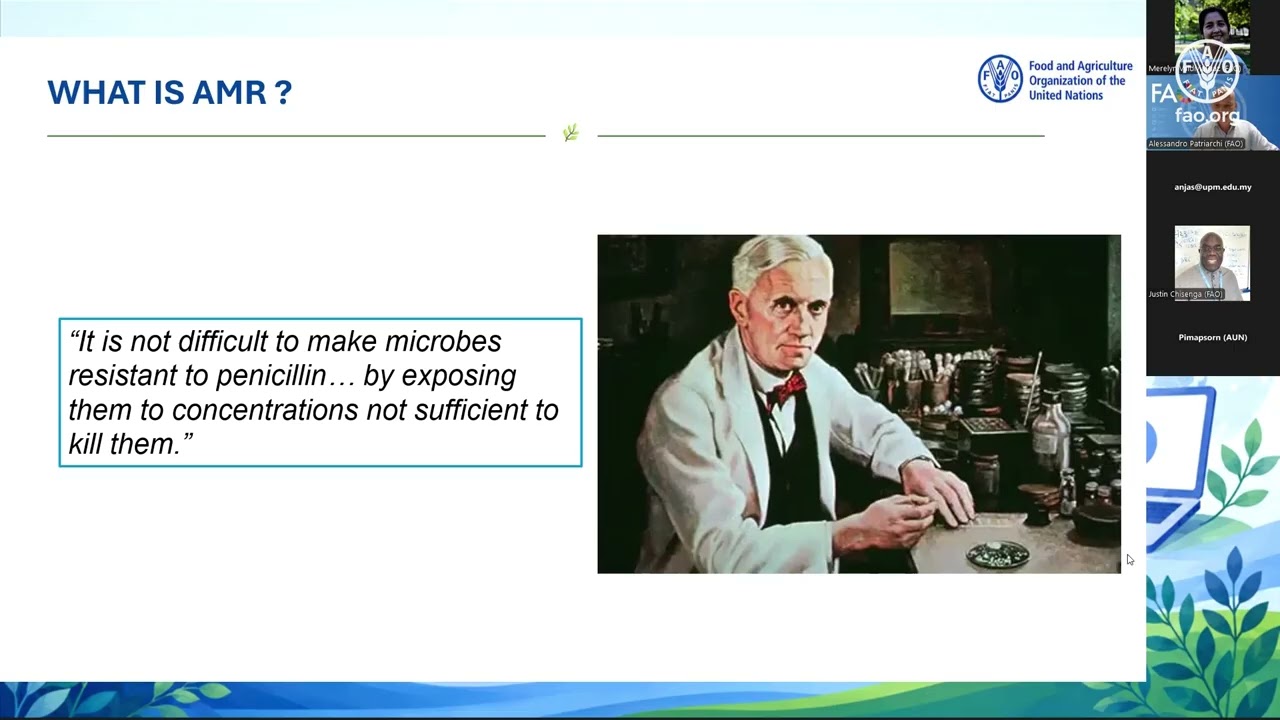
If we go back to the discovery of the
first antibiotic penis by Alexander
Fleming, we realize that and I'm quoting
one of his uh saying is that he realized
that it is not difficult to make
microbes resistant to penicellin by
exposing them to concentration not
sufficient to kill them. So in a way as
we as Alexander Fleming discovered the
very first antibiotic he also outlined
the basis of antimicrobial resistance by
informing the world that there is it's
very likely that these microbes will
develop resistance to the same
antimicrobials.
Why is antimicrobial resistance
important? And this slide is providing
you some numbers, but it does make
infection harder or impossible to treat.
Imagine a simple cat you might have in
your arm that get infected by a bacteria
and you are no longer able to treat that
infected wound. So your um the treatment
that you will have to go through will
become longer and more difficult if not
impossible to trade.
AMR causes millions of that each year
globally and there is constant
estimation of numbers that that's coming
up at global level. uh just in 2021
bacterial AMR alone directly caused an
estimated 1.14 million humans death and
was associated with 4.7 million death
globally
without any action AMR could reduce the
global life expectancy by 1.8 eight
years within a decade and cause up to 39
million deaths by 2050.
And the region Asia and the Pacific,
South Asia and the Pacific is the region
that is most affected by antimicrobial
resistance.
It threatens modern medicine.
uh you you you have to think that
antibiotics are used also uh when anyone
needs to go through surgery or for
cancer treatments. These these
treatments or surgery or other um uh
medical attention rely on the use of
antibiotics
uh very much. So if those antibiotics or
antimicrobials become ineffective then
we are going to affect also the way we
try we we treat cancer and and other
condition. It increases healthcare cost
and the economic losses. We would see in
a in a few slides I show you some
numbers around the economic losses but
it obviously increases the health care
cost as patients will have to stay
longer in the hospital as the treatment
to treat their uh infection or disease
are becoming less and less effective. It
spreads across human animals and the
environment including plants. Again I
will show you uh in a couple of slides
how the AMR is one of the area that uh
pertain the uh one heads or that
requires a one approach.
It is getting worse over time with
that's projected to rise and AMR is not
something we can uh defeat.
uh it is something however that we can
control and mitigate by applying the uh
good practices and we will provide some
example as as I go through the slide the
the slides and finally trade food safety
and food security um as well
so how is AMR related to the agri food
systems that's simply because AMR
threatens animal health, both
terrestrial and aquatic. It threatens
plant health, food security and food
safety, the farmer livelihoods and the
environmental sustainability as a whole.
The emergent and spread of resistance
microorganism.
It's driven in part by the misuse and uh
overuse of these antimicrobials in food
production, livestock, aquaculture and
prop production including crop
production.
Addressing AMR requires therefore a
so-called one health approach which I am
sure you are all familiar with that
promotes good production practices bio
security disease prevention surveillance
and the responsible use of
antimicrobials amongst other u
amongst others.
So these slides is hope hopefully
providing you with a clear understanding
on why antimicrobial resistance has to
be addressed using using a one health
approach. On the left hand side of these
slides you can see a picture with many
red dots. Uh these red dots represent
antimicrobial resistance microorganism
but also residues of antibiotics or uh
plasmids which are capable of
transferring the resistance uh between
bacterias. You can also see a lot of
sectors are represented in here starting
from the human sectors but also pet
animals uh pharmaceutical
uh factories
intensive animal husbandry waste water
crop production rivers. You can see
waters. You can see the the soil uh
being contaminated by either bacteria
that are resistance or residues or
plasmids.
So that's to describe that and to you
know make it clear that antimicrobial
resistance has no boundaries. It
recognize no sectors. Therefore, we need
to work uh in a coordinated manners
under the one health approach to
seriously address this issue. Again, a
few more uh numbers in terms of human
deaths that are attributed to bacterial
are this time focused in South Asia.
estimated in 2021 to be 335,000
deaths or 270,000
in South Asia is Asia and Oceanania.
Approximately
22%
of countries in this region still report
using antimicrobials for road promotion.
And this is a practice that sees the use
of antimicrobials or antibiotics in very
low dosage that is administrated to
animals.
So that their nutrient intake is higher.
So in other words, low dosage of
antibiotics
affect the microbiota of animals so that
they can grow faster with less uh
nutrients. This is a a very bad practice
and we as FAO are trying to support
countries in phasing out completely this
practice and as it um extensively
contributes to the phenomenon of
antimicrobial resistance.
Many countries again still lack
comprehensive framework to address
antimicrobials pollution in the
environment.
Think of the withdrawal periods. Uh when
we treat animals at farm level, we if we
do not respect the withdrawal period,
then
some of these compounds of antibiotics
are excreted in uh uh non- metabolized
into directly into the environment in
river or our waters. And that's
happening to up to 80% of these
antibiotics being excreted and in the
environment
non- metabolized.
So you you can see how really AMR needs
really a coordinated approach among
sectors under the one umbrella at the
global level but also regional and
country level. FAO collaborates very
closely with what we call the partners
organization, the world health
organization, WH, WHA, the world's uh
health organization for health um and
the UN the UN uh environment program
to support countries in addressing MR in
under the one else approach.
Now if we change our lens and we look at
the issue from an economical perspect
um I think there have been a few reports
one very recent report from that
highlights in a few words highlights how
uh vast the economic impacts in
agriculture
u
issue because of the issue of
antimicrobial resistance without robust
action
Global treatment costs and
productivities losses could reach up to
four 412 billion and 443 billion
respectively for a treatment and from
productivity losses. the GDP
uh loss in livestock production could
reach up to 575
billion by 2050 with nearly 1 trillion
in global welfare loss. So these are
really really high numbers and it's
really showing how the economy of
especially low and middle inome
countries will be affected eventually if
nothing is done to address antimicrobial
resistance in agriculture.
When it comes to the FBO, the Food and
Agriculture Organization started
addressing uh antimicrobial resistance
in 2015 when the very first FBO action
plan was drafted by the inter interdep
departmental working group on
antimicrobial resistance that brings
together different expertise and sectors
that we have within our organization
and it you you can cluster the area of
work that FO is implementing uh from
global, regional and country level into
five main areas. The first is pertaining
the center in governance and allocating
resources to accelerate and sustain
progress at country level. And when you
say governance, you think uh primarily
on the mechanism that are in place at
country level that should guide
activities and action to address
antimicrobial resistance. Any multis
sectoral mechanism uh that guides their
efforts would pertain to this area. So
any support that we as FO give the
government to set up multis sectoral
truly one health mechanism uh would
pertain this this area. Another area is
increasing stakeholders engagement and
awareness. This is a very very important
as the issue of AMR is not really easy
to understand nor easy to explain. As I
said earlier AMR is not a disease. uh
it's rather a phenomenon and the general
public might get confused on what it
exactly implies uh
the antimicrobial resistance and how
they are affected primarily by uh by a
another important aspect under the
awareness and engagement is that
awareness alone will not work. We have
now some data showing us that if we try
to raise awareness alone that will not
drive any change. And therefore the
engagement like such as this serious
engaging with youth and researchers
trying to communicate uh clearly what
the risk of antimicro systems are. It's
very very important and that hopefully
will drive behavioral change and
ultimately a better use of these
resources that we have that are life
saving.
Another important area is the
surveillance and research. It goes I
think alone that uh countries and then
you know generation of quality data it's
of utmost importance if you want to
drive uh policy change.
uh you need to generate a data and to
generate around the patterns of
antimicrobial resistance but also not
the way we use in a given context
uh how much we use and how we use these
compounds.
So that's why it's very very important
that countries are equipped with
laboratories that are
generating quality data that can be
ultimately used to drive policy change
enabling good practices to prevent
infection and control. That's also a a
quite practical area of work. We will
see uh how what some example for each of
these area in the next few slides. But
this area pertain primarily on the way
uh farmers for conservative food and
agriculture uses this this somehow this
antimicrobials
um in the their farming settings. The
promotion of responsible use to keep
antimicrobials working is also an
important area. they cause sometimes
hands in hands with good practices and
and so this area and all the effort the
FO and partners conduct to address AMR
would ultimately ensure the efficacy
efficacy of these life saving
antimicrobials.
we want to preserve them uh while
sustaining food and agricultural
production. And on the other hand, we
when we want to reduce the prevalence of
antimicrobial resistance and the spreads
um and slow down the spread and
emergence across the whole food chain.
So on the left hand side you see a few
picture of a couple of documents. The
blue and the orange that's are those are
the FAO action plans and the one above
the white one is the very first global
action plan on antimicrobial resistance
which was adopted by the World Health
Organization back in 2016
um to provide the blueprints or the you
know the global guides uh um to address
antimicrobial resistance. The first
edition of the global action plan uh is
now outdated and the second edition has
just came up. Last May World
assembly has adopted and governing body
from the uh Gua also endorsed it and FAO
and UNP will follow with the endorsement
official endorsement of this document
which was co developed uh by the word
and by the quadripartid so-called
quadripartite organization therefore WH
wa and UNP
and this document encompasses
uh what I've just uh discussed. It's
completely in line with the areas that I
was just mentioning and it of course
describe the importance and I highlight
and underscore the importance of the one
head approach uh as the only way to
address antimicrobial resistance. So in
it I've just extracted what I thought
what I think are important points
and the first one is the one at
implementation and recognizing the
interconnected roles of human animal
plants food and environmental sectors.
The second refers to the importance of
the prevention first approaches that
includes uh the importance of biocurity
of vaccination practices, infection,
infection prevention and control
measures, water and sanitation and
improved farm management practices. A
sustainable agri food system that reduce
the need for antimicrobials rather than
relying solely on the sewership
measures. This this is a quite an
important point as we are shifting a
little bit our narrative from we need to
use less antimicrobials
to we need to need less antimicrobials.
So it's it's it's just a one word
difference but it changes a lot in terms
of how we see things uh ultimately
taking place
country level and what concern for
example the farming practices
stronger surveillance and monitoring
system systems for AMR and AMU.
uh we will see what FAO and the quality
organization came up with in terms of
system to compile quality data to drive
uh change in in policies sustainable
financing and accountability. This is
something that is becoming increasingly
important in the past few years. Um as
we see that many national action plans
lacks the uh costing and the finance
component leading to uh plans that are
not receiving any funds for them to be
implemented. So it's a it's something
that uh it comes with the cost benefits
analysis and it links nicely into with
the engagement and awareness tracing. Um
so that we can use a a a different type
of communication.
Um this time will involve the economy of
farms for example. Um um
and the final one is the international
cooperation innovation and knowledge
sharing to accelerate implementation.
Again this refers to the one element to
the need to coordinate and cooperate
with existing partners to address the
AMR uh as one.
What I've just described in the global
action plans nicely linked to what we
call the renop farm. This is the reduce
the need for antimicrobials on farms for
sustainable agri food system
transformation initiatives. This is a
flagship FAO global initiatives on
antimicrobial resistance that was
officially launched in April 2024.
And as a 10-year initiative, it helps
countries reduce the need for
antimicrobials in in a food systems
while maintaining or even improving the
productivity. Um the reason it is linked
to the global action plan is and because
the new global action plans makes many
reference to renovit
as it reduce the dependence of
antimicrobials
through increased biocurity vaccination
and improved husbandry practices by
strengthening the surveillance system
and the laboratory capacity. by
developing an implementation of costed
plans and by promoting a one governance
and multis sectoral coordination.
Um the red of farm initiatives will
inform very much uh two areas of good
practice and responsible use of
antimicrobials that I was showing uh you
earlier.
Again, the Renaoparm um it's a two years
young initiatives launched in 2024.
Uh just last April this year uh the
second symphonium symposium uh took
place in Ronchang, China um where 300 to
400 participants from government,
research institution, producers
organization, private sectors and
international partners gathered together
to assess the achievement and progress
against rhino farms in uh globally
and also to show renewed commit
commitments to uh the principle of the
renovative
and this commitment has been sort of
signed in what we call now the renovar
drone chan consensus document that
highlight commitments from all
participants to accelerate the
development and financing of national
renovs
to integrate the 5G's approach into
routine livestock extension practices I
will tell you what the 5G approaches in
a second to privatize the prevention
first policies and to strengthen
evidence-based decision making
as as
fararm is a global initiatives but it
has very very concrete targets and these
are three. The first one is to ensure
that at least 100 countries with their
national action plans are fully
implemented in the in their agri food
sectors. The second is that at least 50%
of animal plant workers um strengthen
their capacity to reduce the need for
antimicrobials in agri food systems. So
this is about a lot about trainings and
racing capacity of all those individuals
who can make the change at farm level
and at least 80% of countries that
participates in the infarm initiative
contribute to the international FOMR
monitoring system the so-called infarm
and I will spend a couple of slides on
what infarm is in a minute but the 5Gs
refers to good production practices
good health services, good alternatives,
good incentives and good connection.
This is the way uh the red of arm
initiatives intend to go uh to achieve
the the three targets by using these
five G's and it uses also five action
accelerator including education and
awareness, youth engagement, public and
private partnership, behavioral and
social intervention, research innovation
and new technologies.
So all together the 5Gs with their
action accelerators are going to drive
change and transform agri food systems
in a way that it will not rely so much
on antimicrobials no longer but it will
improve what are the good production
good health and service good
alternatives good incentives and good
connections.
This slide is just showing you
just a screenshot of u each of the 5Gs
uh and the related domains and then this
just to show you that uh you know
there's some some certain level of
complexity behind the the the the 5Gs
um and you know without me reading
through all of this I think one of the
interesting one is the good incentives
um as it pertains the what we call the
certification or arms acronization
process
um that sits mainly under the good
incentive pillar of the 5Gs and this is
designed as a progressive risk based
system to encourage sustainable
reduction of antimicrobial use while
improving farm management standards.
This recognition or accreditation
process will ultimately drive uh change
the way in the way uh farms are managed
for the better. Of course, by following
uh u a scoring system through which
farms will be able to hopefully receive
some gradication uh or certification by
the governments of the countries where
they are in. uh and that will hopefully
lead to a better access to um markets
and therefore better livelihood for
farmers and and companies that runs the
farms. So this is just to provide you an
example on how the uh ren of army
initiives touches the ground u from
being at a global level initiative to a
very very practical action at country
level and at foreign level.
Zooming in now at the regional level. Um
here at the FAO RAP uh office,
we follow the same approach of course as
outlined in the global action plan and
the FAO action plan which includes and
embed the renovitis.
But we need to apply uh a few points or
rather lens to ensure the action and
implementation take place in in this so
diverse region as the Asia and the
Pacific. So we need to understand up
fronts what are the organizational
technical political and social cultural
contexts that that we have in this
region and at country level. We need to
develop and apply or apply existing tool
and frameworks to address the identified
gap. The provision of training and
support to build needed capacity in food
and agriculture. Facilitation of
coordination and partnership that can
reinforce effective mitigation of AMR in
food and agriculture and then enable
sustained uh implementation. These are
in a nutshell uh it can give you an idea
on how this regional office is actually
trying to make a difference in this
region
when it comes to addressing
antimicrobial resistance. From now on uh
I would like to just provide you a few
example uh of the what are the tool or
framework or the initiatives that we as
FAO regional office are using at country
level primarily to address Omar under
each of the areas that I was mentioning
you uh before which are governance
awareness and engagement surveillance
and then good practice and responsible
use. The government's area as I said it
pertains primarily supports provided to
countries in implementing but also the
reviewing and and developing of national
action plan on antimicrobial resistance.
The awareness component it's more around
the stakeholder engagement
and making sure that the behavioral
change take place and the surveillance
it's all around generating quality data
that can be ultimately used to drive
policy change and finally good practice
and responsible use uh uh to enable that
change at farm level by using the for
example the 5Gs that I was just
mentioning under the reform initiatives.
So for each of these area I put I pulled
out couple of one or two example the
starting for with the strengthening
sustainable governance and resource
allocation to minimize and contain a mar
sustainability in food and agriculture.
Um these slides represent how national
action plans uh supports might take
place. Um first uh the national action
plan it's a it's a guiding document
national document which compile all the
activities or implementation steps that
the government will then implement to
address an issue in this case
antimicrobial resistance. And since
antimicrobial resistance we have seen
it's a multi- sectoral uh phenomenon it
deserve what we call the one approach
and therefore the governance the and the
bodies at national level who will
develop uh and implement national action
plan must be uh multis sectoral in its
nature. In other words, h governments
should uh have in place mechanisms that
are including expertise around animal
health, terrestrial and aquatic and food
sectors, the environment, the plant
sectors etc. the mechanism. The national
body will then develop uh or update uh
activities within the national action
plan. And then this national action plan
will have to be costed by using an uh
and we can support the government by
using a dedicated costing and budgeting
tool to then provide a monitoring and
evaluation framework and then implement
and ensuring that the implementation is
monitored to assess what's working and
what's not working.
uh a concrete example u Mongolia is not
a part of Basian but I think we can also
mention Cambodia is one of the latest
where these countries were developing or
have developed national action plan on
antimicrobial resistance but they were
lacking a costed plan or in some cases
even a monitoring and evaluation
framework so our support as FBO regional
office was to u uh help them developing
a result based and fully costed one uh
national action plan uh by strengthening
capacity in how to develop a monitoring
and evaluation phase framework costing
and budgeting by teaching them how to
use a dedicated tool and then multis
sectoral coordination by increasing
awareness and engagement of the um
all the sector sectors which are
relevant including human health, animal
health, agricultural and plant
protection, food safety, water sector
and environment sectors for the case of
Mongolia. Very similar case study was
support was provided to Cambodia as well
and other countries in the in this
region. Moving on to the awareness and
engagement area.
Um we primarily ensure that um the issue
of antimicrobial resistance is explained
and the awareness levels around the
globe uh and a country level but even at
community level it's always up
try to make sure that farmers individual
from the general public the private
sector civil society are constantly kept
updated on on what AMR uh is and what it
means for their own lives. as I
mentioned and as a gap or a challenge
here when it comes to awareness is that
again awareness alone will not drive
change
and you know even to make things more
difficult it's quite complex to describe
and so it is likely that um by using a
technical language you will not get
attention from the general public so the
opportunity here would be to uh come up
with different language or different
narratives according to the target
audience we want to uh uh
engage with in so if we are focusing on
farmers and we want to drive change in
the way the farmers conduct their
business at farm level then we might uh
want to use for example the economic
lens and and and change the narrative
around the economic lens with the
understanding that farmers that in the
major income is from their farms from
their animals. So their interest is to
keep animal healthy and productive and
so port for other for other categories
for what concern the good practice and
uh responsible use.
This is mainly driven by the renovar
initiative. Again this is a 10 years
orient actionoriented it's country
focused country led initiative
responding to the global agri food
system transformation agenda it is
basically saying that we cannot continue
business as usual when it comes to agri
food system and the way we conduct
farming
uh because the production and the
economic loss will be so much higher in
the upcoming years according to numerous
estimation that we must uh transform the
way we are conducting the agri food
system. Uh so reno farms once again
engage the entire production chain from
farm to fork trying to strengthen
partnership including public and private
sector with a simple objective to
support countries in reducing the need
for antimicrobials
um through the 5G.
that I mentioned earlier.
Indonesia was the amongst the first
countries who piloted the initiatives
and back in 2024. It focused on the
poultry sector in the Luna province and
supported the implementation of national
action plan by promoting farm level
practices that reduce the need of
antimicrobials while maintaining the
productivities of animal health.
One of the activities concrete
activities that we have implemented in
Indonesia to achieve the goal of reno
farm is through the so-called farmer
field schools uh which is a model that
is focused on the awareness so
increasing the awareness of farmers
increasing the capacity for farmers to
apply biocurity measures increase the
good husband practices increase the
responsible antimicrobial use and the
peer-to-peer farmer learning. This has
been proven to be quite effective and
it's something that we are actively
engaging with different countries in the
region to conduct and to drive change at
farm level. So 20 facilitators were
trained farmer field school was
established that means that the activity
has is sustainable as it continued led
by the government themselves after we
provided the initial support. It is
improved the biocurity and the disease
prevention and it has reduced the
reliance of antimicrobials to better
farm management. So it was an important
case study in Indonesia as it showed
that this approach works um at country
level.
Moving on in strengthening surveillance
research and evidence through multis
sectoral surveillance and research on
AMRU
and residues. Um this is one of the tool
that we are currently using as FAO
globally. Um it's called the assessment
tool for laboratories and AMR
surveillance systems. Erh this is a a a
tool that serves to um um allows
countries to measure the status or stage
of their national surveillance system in
food and agriculture and also their
capacity
uh in terms of laboratory capacity to
generate uh quality data using a
standardized approach. Um it is it is
quite an important tool if you want to
ensure that countries raise their level
and their ability to generate uh quality
data uh that will then eventually uh
drive policy change. Um
one of the latest um mission we've
conducted in Malaysia in September 2025
evaluated the strength and the gap uh in
the governance systems in the laboratory
work networks and data management
surveillance coordination to support
evidence-based improvements in
Malaysia's AMR monitoring system.
uh the mission has shown and provided
the country with a very well structured
road map for strengthening the
surveillance and the laboratory capacity
and ultimately helping national
authority to prioritize investment.
So therefore saving funds and improve
cross sectors coordination to enhance
and generate reliable data for policy
and decision making. Think of uh the
usual
situation in a given country is in terms
of surveillance is that different
laboratories may be in different
sectors. They independently and work in
clusters may be looking at the pro
prevalence of antimicrobial resistance.
This is not very effective way of
working. it would rather be more
meaningful and less
expensive to coordinate into a network
of laboratories uh to improve the way we
utilize resources in a given country. So
that's what the atlas mission and the
address tool allows countries to um
identify implement.
Another example is the international FA
antimicrobial resistance monitoring
so-called infarm.
This is a global information system that
has been developed by FA by FO to
support national regional and global
surveillance and monitoring.
uh the system is will help countries to
collect collect and analyze a mara data
to visualize and interpret data to
inform policy making decision and to
share his information at national and
international level. The um infarm
systems comes as a clear request from
the uh from a from a gap that was
identified by the quartite and other
partners constitution with other
partners a few years ago now uh whereby
we've realized at the global regional
and national level we were not having
data around how we use antimicrobials at
farm level um and and and what are the
partners p part partners patterns of
antimicrobial resistance amongst this
food and agriculture sectors. So
therefore infarm was generated together
with the uh WH's global antimicrobial
resistance and new surveillance system
called glass which focuses on the human
health and the one animals antimicrobial
use global database called anime news
together these global systems will
contribute to what's called the giza
it's the quadriide global integrated
systems for surveillance and
antimicrobial resistance and
antimicrobial usage.
This Giza
uh system will ultimately give the world
uh
a a much detailed picture on how the
world is using these antimicrobials and
how we uh can uh prevent and and and you
know retrieve and maintain the
effectiveness of these antimicrobials
over time. So it's quite an important um
uh area of work that it's of course
coming with large host as well for
countries.
This is an example on how this office
has actually uh organized a regional
training to train some focal point at
country level uh in Cambodia, Indonesia,
Lao, VDR, Malaysia, Philippines,
Singapore, Thailand and Vietnam uh to
strengthen the readiness for AMR data
reporting which is uh taking place on a
regular basis. I think the third call
for data will soon be announced uh and
will will ask countries uh relevant
bodies to uh share quality uh data
around surveillance and uh resistance
and use.
Finally, this is my last slide. It's in
includes a few takeaways that I hope
will stimulate some discussion and
questions. First one is that
antimicrobial resistance is a growing
threat to food system, livelihood and
public health. We are not uh
um
saying um resolving the AMR phenomena
but we can indeed control it and
mitigate it to and ensure that agri food
systems are more productive. The one
health is not an option. It is the way
we have to address antimicrobial
resistance at all level at global,
regional and country level. Better data
leads to better decision. We have seen
how the infarm and other systems allows
countries to raise their capacity in
terms of generating data for us to
better use and and and drive decisions.
FO and the quadratized partners provides
a quite a few number of tools, knowledge
and policy supports that can be used by
countries to implement the prioritize
activities.
Countries need to move from planning to
implementation. How to do it? This is
one question that we are still
addressing and it's not an easy one as
we have seen in the past 10 years that
countries do develop national plans
including all relevant areas uh under
the one approach but the implementation
of these activities still remains quite
slow. So what it is that is preventing
countries to implement? Is it the lack
of funds? Is it the lacks of resources?
Is the lack of political commitments? Is
it all of them? And what can we do to
address this? And finally, prevention
uh reduce the need of antimicrobial.
This is widely been addressed by the the
flagship initiative renov. We need to
move from the idea that we can cure and
and
treat any disease whether it's human,
animal or plants. Uh because this will
no longer be the case. We have to start
understanding that these antimicrobials
they are not um they start they start to
not working anymore. So we need to move
from the treatment to the prevention of
this of of diseases. Okay. With that, I
hope I went I wasn't too uh over time,
but I'm very happy to take a few
questions over.
>> Thank you very much Dr. Aleandro for
your valuable inputs and sharing on the
topics of one health uh to all of us
this morning and um yeah now I would
like to invite participant if you want
if any of you would like to ask a
question but before that in in the chat
room I have one question from Abdullah
from Pakistan his question is regarding
the infarm rainarm initiative how is FAO
addressing the standardization of farm
labor surveillance data from LMIC is
where veterary reporting is highly
fragmented.
Yeah, you can you can check in at the
chat room.
>> Yeah, you do you want me to address
this?
>> Yes. Yes, if you can if you can answer
uh yeah respond to that question.
>> Yeah.
>> Thank you. That's quite it's quite
relevant question and you know I'm
pleased to address it. the the the
existence of protocols to to generate
data is is there. The infarm for
example, the infarm systems provides um
countries with that information with
those protocol which ensure that data is
generated in a using standardized
protocols which are accepted by uh and
defined by extensive consultation
process by experts around the around the
globe. we um by doing so countries are
able to um again use the standardized
data uh to generate
again quality data that can be compared
over countries and over time. However,
the challenge remains here as I was
saying the use of standardized protocol
which are available currently available
in the infarm and I think I believe I
have a link in my presentation on the
infarm
uh where you can look at those
protocols. The real challenge is the
implementation.
It's how can we make sure that
government or national entities do apply
those standardized protocol which might
be different from what the countries
have been used up until then. uh to to
to finish my answer. It's it's um while
protocol exists, you always need to
contextualize
uh the physibility of those protocols uh
and compare it against the current u
capacity that that given country has.
Not all the countries have capacity to
conduct LMIC. Not all countries have the
capacity to grow pyrobacttor. Not all
the countries have the same capacity. So
where there is no capacity, primary
action is to raise that capacity so that
then countries can adopt and use the
same standardized uh approach. I hope
that answered the question.
>> Okay. Thank you very much Dr. Alesandro.
Uh now um if any of the uh youth
official proposal competition
participant if you like to uh ask any
question to our panel panelist today you
can unmute yourself and then uh straight
away uh asking the question you like to
to ask
any question from the participant H
she
probably there's there's another another
subsequent question from from Mr.
Abdullah I think just a short one.
What are the uh immediate plans by FAO
to leverage special mapping and data
modeling to transition in farm from a
retrospective repository into an active
early warning system that can predict
emerging resistant fox?
>> Yeah, again a very very very nice
relevant question. Thank you. Thank you
for that. So I think um my answer would
have to include the the Giza uh system.
So as you might remember the Giza system
is the global integrated surveillance
system that would enable anyone to
really analyze data in such a way that
it would become clear on what are the
patterns what what's the where are we
going in terms of um use of
antimicrobials and antimicrobial uh
patterns. Um so that will uh enable us
to identify what are uh the risks and
put in place active early warning
systems uh that can visualize hopefully
in a very simple and detailed way
because the assumption is that quality
data is generated using standardized
protocol that would enable a
visualization of of patterns across
countries and across Ross regions and
you know I I recall at the beginning of
the presentation I mentioned that AMR
does not recognize any B borders or no
sectors it doesn't recognize countries
so we cannot longer focused on one
country or one region maybe a region
will be uh okay but um we cannot longer
think of uh generating data uh in one
country and then the next country if we
have a gap of or limited data that would
uh impede us to generate a clear message
that we ultimately want. H finally to
answer the the efforts that we are
putting as quadripartite in terms of
generating this kind of evidence it's
huge and massive. You have to think that
these four organization that compose the
quadripartile are quite big organization
and and what they what we are doing is
huge in terms of coming up with systems
which are making some sense between each
other that align with each other even
though they are different sectors. So
there's a huge work in terms of
coordination between the organization
and between centers in general to to
address that. Thank you our
thank you very much u we we now we are
receiving lots of question but but
anyway I I I I might allow another two
question because uh we run out of time
but probably if any of you have any
additional question uh you can email to
us. So probably we we will can we we we
will provide the answer for you in
future and there's one question from
Cambodia Dr. Sandro from Panagium. His
question is many promising probiotic
technologies have shown success in
laboratory studies but their adoption by
fish farmers remains limited from FO
perspective. One of the major barriers
to translating probiotic based
innovation into practical disease
prevention strategies for smallcale
aquaculture farmers in Asia. Yeah, I
think because even in Malaysia many
farmers they they innovate their own you
know probiotic or postbotic whatsoever
but but since that is actually uh you
know the fit editing whatsoever sometime
they have to go through a lengthy
process in order for for the products to
be you know accepted worldwide. So your
comment on that?
>> Yeah and thanks thanks Fan for the
excellent question. I think what I'm
seeing as I'm reading through the
question I see a common line and that's
you know uh highlighting once again the
gap and that is the implementation. So
we we might have gen you know we might
be able as as as
globally to generate enough evidence to
demonstrate that for example uh use of
probiotic technology are successful in a
laboratory setting but even that I would
argue that we have evidence that the use
of probiotics and other alternatives
that are not antimicrobials are
successful at farm level. We have
demonstrated that
what we are missing is that it's farmer
doing it then somehow farmers might
still think that the use of
antimicrobials definitely is cheaper
option. Hence they might believe that by
using antimicrobials they might save
money therefore the livelihood will be
improved the the health of animals will
be maintained but doing so they are
contributing vastly to these major
threats which will ultimately affect us
as humans but also animals
productivities and the environment. So
here I would uh put my uh the emphasis
of my answer will be to the awareness
and engagement
uh
area
and to the fact that I was mentioning
before we need to identify who are the
target audience for our awareness
raising messaging. If it's a farmer,
then we might use an economic investment
case that demonstrate to them that by
using less antimicrobials and raising
biocurity or using probiotics, it's
actually effectively increasing their
production, maintaining their production
or increasing it and saving uh funds and
money and financials for them in say
five years as opposed to maintain the
same the same business u as it usual uh
to to complete my answer I think in all
the areas governance surveillance good
production responsible use uh that I was
showing we have uh quite a lot of
evidence on what are the what is the
good thing to do let's say um we have
that I think in over 10 10 years we have
we generated enough evidence. The issue
is now on why countries or or
stakeholders are not implementing those.
Why are they still for example some
countries is still using antimicrobials
as growth promoters.
Uh we we need to understand that and we
need to provide those countries who have
tools and and guidance for them to move
away from these bad practices.
uh uh using all all we have already
developed. Thank you all.
>> Thank you. Thank you uh for the answer.
Probably just just I think this this is
the last question from the participant
Ciful from Indonesia. He's asking um how
to integrate the reno farm into
biocurity frameworks in national level.
>> Yeah. So the the bio security heavily
rely on the 5Gs that I was mentioning in
my presentation. Those 5Gs are including
different domains. Each of the 5Gs
includes different domains. Those are
you you can see them as opportunities
for farmers or health workers to uh to
utilize for the better.
Um
so how to integrate the rate of arm into
biocurity framework at national level
it's completely down to the government
and and again I'm making a lot of links
back to the awareness you've increase
awareness on how grano farm initiatives
and the five trees are going to be
beneficial for the farmer for the agri
food system transformation but
ultimately for the uh you know human
beings the productivity etc.
We we do have evidence. It's just
compiling evidence and transforming that
into uh understandable language uh for
farmers uh that needs to then apply the
bio security framework in in their farms
over.
>> Thank you very much uh Dr. Allesandro
and thank you also to all participant
that actively participate by asking
question. Um with that uh I believe all
of us has already received uh you know
available inputs again from uh Dr.
Alessandro and and has been uh presented
in the chat box. If there is any
additional question you can send through
email to us at a n_agree.
Security upm.edu.mmy.
With that uh on behalf of AU and EFS and
also the FAO we are we would like to
thank to all of you uh for participating
to this uh webinar. Uh please uh uh get
close to us because there's there's a
series of technical lectures by FAO
officers that that that going to be uh
you know uh organized within this few
days. So keep updated, keep check your
email and before we end our session uh
if you can take a group photo that would
be great Miss Pim.
Okay, thank you very much everybody.
Thanks Dr. Asandro and to all of us to
all of you. Uh have a good day. Bye-bye.