One Country One Product in Asia
Watch on YouTubeVideo summary
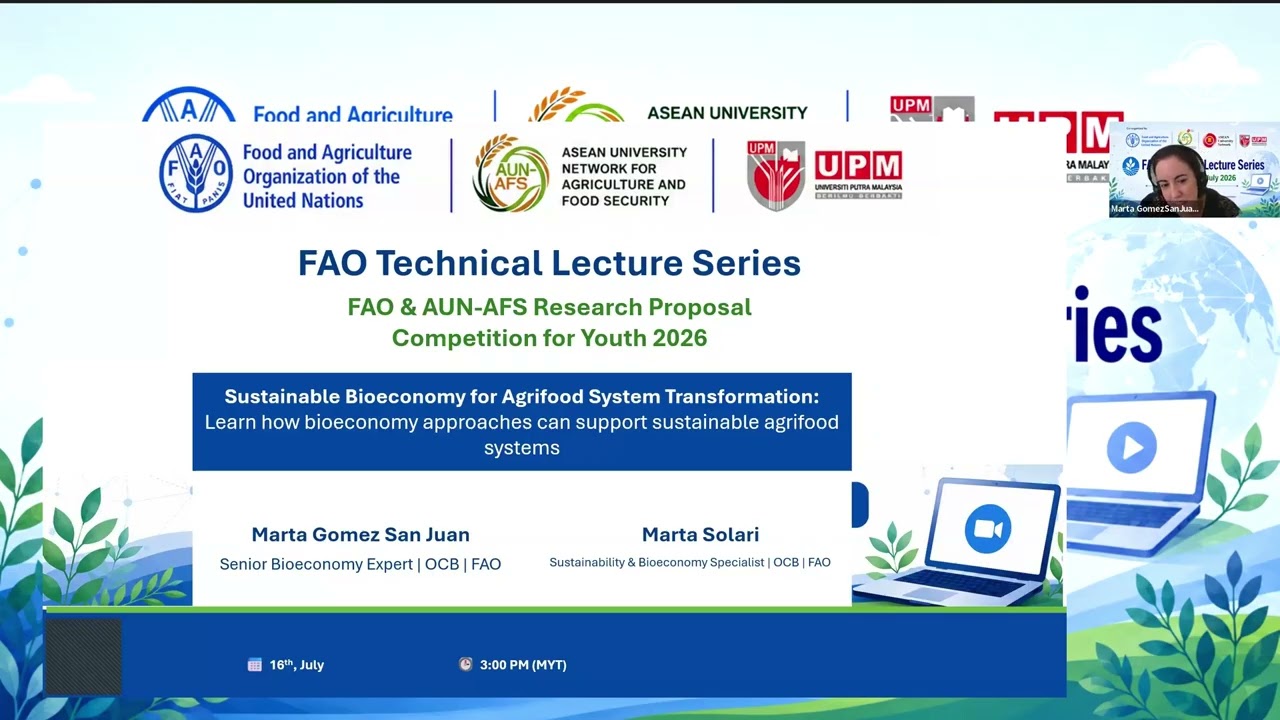
The FAO Technical Lecture Series 2026 on "One Country One Product in Asia" introduced a strategic approach to transforming agro-food systems through the bioeconomy, defined as a balanced system that integrates economic value, social welfare, food security, and environmental sustainability. Presented by experts Marta Solari and Marta Gomez, the session outlined four key pillars driving this initiative: policy coherence, global partnerships, ground-level innovations, and data management. Under policy coherence, FAO supports nations like Namibia, Uruguay, Kenya, and Paraguay in developing tailored strategies using tools such as the Bioeconomy Dashboard. Simultaneously, the organization fosters inclusive growth by engaging diverse stakeholders through initiatives like the Global Bioeconomy Summit and proposed partnerships aimed at sustainable transformation.
Innovations on the ground are demonstrated through projects that valorize agricultural waste and promote bio-inputs, ranging from using black soldier fly larvae for feed in Kodaiwa and coconut coir in Ghana to utilizing banana leaves in Pakistan and biopolymers in Thailand. Specific case studies highlighted the potential of quinoa value chains in Bolivia and agro-tourism in Vanuatu, illustrating how local resources can be leveraged for economic benefit. To support these efforts, FAO is addressing critical data gaps via the COP30 Bioeconomy Challenge, which focuses on establishing common metrics to measure global progress. This cross-sectoral approach welcomes professionals from law, engineering, and economics, ensuring that projects prioritize local communities, indigenous peoples, women, and youth through less hierarchical business models similar to Malaysia's "B40" strategy.
However, the long-term sustainability of the bioeconomy sector relies heavily on policy coherence and legal clarity to effectively engage private sector investors and financial institutions. While political frameworks are emerging, challenges remain regarding farmer adoption of alternatives like black soldier fly fertilizer due to uncertainties surrounding chemical fertilizers, necessitating specific incentives to drive change. To overcome these hurdles, FAO is actively collaborating with UN agencies such as UNEP, UNIDO, and ESCAP to build robust partnerships and develop unified metrics for the Sustainable Development Goals. The speakers urged researchers and students to maintain curiosity, engage with simple yet impactful innovations, and participate in regional networks to advance bioeconomy initiatives across Asia.
The session concluded by emphasizing that despite existing momentum, the future of this field depends on continued collaboration and clear regulatory environments to unlock its full potential. By combining strategic policy support with practical, waste-valorizing projects and robust data collection, the bioeconomy can drive equitable growth and environmental stewardship in the region. The lecture series ended with gratitude to the participants and an announcement for the next session on July 17, 2026, which will focus on the "One Country One Priority Product" initiative, further expanding the dialogue on transforming agricultural systems through sustainable innovation.
Read the full video transcript
Hey, good morning uh good afternoon
everyone. Distinguished speakers,
esteemed colleague, ladies and
gentlemen, on behalf of the Food and
Agriculture Organization of the United
Nations, the Assean University Network
for Agriculture and Food Security, the
Asian University Network and University
Putra Malaysia. It is my great pleasure
to welcome all of you to today's session
of the FAO technical lecture series
2026.
We are delighted to have participants
joining us from universities, research
institutions,
government agencies, industry and
international organizations
across Asia and beyond. Thank you for
taking the time to be with us today. And
then before we begin, I would like to
share a few housekeeping announcements.
Uh number one, the this webinar is being
recorded. The recording will be made
available after the session and the
access link has been shared in the zoom
chat box and we encourage you to save
the link for future reference. And
throughout the lecture, kindly keep your
microphone muted to ensure the best
audio quality to everyone. And we
encourage you to submit your questions
at any time using the Zoom Q&A function.
Following the presentation, I will
facilitate the question and answer
session and post as many questions as
time permits. Right. And should you
experience any technical difficulties
during this uh webinar, please contact
us uh as the organizing committee uh via
the zoom chat. Once again, thank you for
joining us and we hope you enjoy today's
session. Right.
Okay. So, good afternoon and distinguish
uh the speaker distinguished speakers,
colleagues and friends. Uh it is a
pleasure to welcome you to the seven of
the FAO technical lecture series 2026
on behalf of the organizer food uh and
agriculture organization of the United
Nations the university uh network for
agriculture and food security these
university network and university.
Thank you for joining us today. As we
continue this lecture series, we hope
that each session uh provides new
perspectives and practical knowledge to
support your research and professional
development.
And uh just a bit introduction for
today's lecture. Um let me uh give you
some preamble of the session.
Transforming agri food system requires
innovative approaches that balance
economic development, environmental
sustainability as well as social
well-being. Right? And the concept of
the bioeconomy has emerged as an
important strategy for creating value
from biological resources while reducing
waste, promoting circularity as well as
supporting climate resilience. And
today's lecture explores how sustainable
bioeconomic initiatives are helping
transform agro food systems particularly
through the FAO's work across the
Asia-Pacific region. Right. So uh our
first speaker today is Miss Marti,
bioeconomic and sustainability
specialist at FAO. And Miss Solari has
worked extensively on international
environmental law and sustainable
development.
And she currently supports FAO's global
work on bioeconomy
uh bringing uh together policy
sustainability
as well as innovation to advance a
growth food system transformation.
And joining her we also have Miss Martha
Gomez, senior bioeconomy expert at at
FAO with a background in agricultural
engineering and biosystems. Miss Gomez
has spent many years supporting FO's
global bio economy program helping
countries integrate by economy
principles into sustainable food and
agriculture policies and together they
bring uh I would say extensive
international experience in promoting
sustainable circular and climate
resilient agri food system. Ladies and
gentlemen, uh please join me in
welcoming Miss Ma Solari and Miss Marta
Gomez. Right. So the session is yours
now.
>> Thank you very much. Thank you very
much. Uh it's it's really a pleasure to
be here. Thank you very much for the
invitation. Uh let me share my screen
with the presentation. Sorry, just one
second. Uh,
sorry.
Okay.
Okay. Let me start from the
[clears throat] beginning.
Oh, why is it? Sorry.
I'm really with it. Sorry. Okay.
Is it?
So,
okay. [music] Uh, my name is Marta. I'm
I'm from Italy. Uh, I have um I'm
graduating in law here in Italy. Then I
um did a master in international
environmental law in Scotland. And then
um now I'm doing a PhD in in bio economy
both from a legal perspective and at the
same time I started working uh with with
FAO actually I started in FAO as a
fellow because FAO has um as a program
that is a it's a fellowship program so
for um students PhD students and uh
researchers uh to you know uh in to for
them to be involved in started be
involved in FAO and that's how I
started. I also spent um six months in
the regional office for Asia in the
Pacific uh in Bangkok, Thailand. uh
during this uh during this program and
uh when this the program finished I came
back to Italy to FAU headquarters in
Rome and I started as a as a
sustainability and by economy specialist
uh in headquarter. Um I so I I leave the
floor to my colleague Marta to introduce
herself as well.
>> Thank you. Hello everyone. I'm Marta
Gomez. I'm um a major in agriculture and
in engineering. So I guess the mix of
both was was bioeconomy and that's how I
started. Um I started as an intern in
FAO. Um we are both for the from the
division of environment climate change
diversity and environment environment
team. So so that's where I started and
and and I stayed as bioconomy started
growing and growing as we will explain
later uh in our presentation.
Thank you Marta.
>> Thank you Marta. So I will start with
our presentation again. Thank you very
much. It's an honor to be here and we
really hope uh we'll be able to explain
you know to better explain what uh by
economy is give some examples and of
course we we really look forward um to
the the Q&A session. Um so first of all
why by economy matters uh why this topic
is so hot right now this is a really um
like it's a global um globally speaking
it's a it's the momentum of bio economy
right now and these are the reasons. So
first of all um bio economy can help to
uh reduce our impact on the natural
resources. So in we can use uh thanks to
bio economy we can use biological
resources more efficiently and more
sustainably. But uh also bio economy can
help us take pollution because um bio
economy can turn help us to turn waste
or what we consider waste into
byproducts. Uh that means into valuable
products you know new new generation
let's say of products. Uh this way bio
economy uh can also support us to make
our food system more more resilient. Um
but um bio economy also means more green
jobs in many different sectors and in
particular more opportunities for youth
in in um you know in green jobs. And
last and more I would say also most
important is that by economy can help us
facing the um what are the main and uh
biggest challenges of our of our time.
Uh it means uh climate change um food
insecurity uh pollution clim
biodiversity sorry bio economy can
really help us to tackle this um these
challenges. uh I put here some examples
of what bio economy is because bio
economy uh you know it's a it's a really
abstract uh concept but uh it's in our
day lives because uh thanks to bio
economy we can uh produce for example
sustainable textile uh building
materials we can uh it's also in our
cosmetics for example um it can help us
uh in order again to take pollution
Thanks to biop pesticide, bio fertilizer
and bio inputs in general. This is a
really hot topic right now. Um but with
thanks to bioeconomy we can produce
bioplastics or uh in energy and the
energy um um well in matter we can
produce biogas and bofuels. So there are
many uh bio economy is in our daily
life. Basically
what we uh do on bio economy as FAO. So
FAO was the first UN entity to elevate
by economy to a strategic corporate
priority almost uh more than 10 years
ago actually. And there is not uh a
common uh commonly wide accepted uh
concept like what bio economy is the
definition of bio economy. But FAO uh
used the bio we use the bio economy um
definition that the global bio economy
summit adopted back in 2020.
uh that is um a sustainable bio economy
that balances economic value, social
welfare, food security and nutrition
with environmental sustain
sustainability uh promoted through
formulation and implementation of
coherent evidence-based policies and
practices in micro and macro
environments using technological
organizational and social innovations.
So this is our working definition of bio
economy and um FAO um basically um
included by economy in in its 20 program
priority areas in 2022
uh especially under the better
environment pillar and uh in 2026 so
this year released the medium-term plan
for 2026 2029 and we sharpened by
economy uh a bit um including four
pillars or priorities there are policy
coherence partnerships by innovations on
the ground and data information and
knowledge this in order to help us shape
you know the our work on bio economy so
the first uh sorry but first I would
like to leave the floor to my colleague
Marta because Marta when when everything
started Marta was here so I would like
to ask her to guide us through this
timeline of of bio economy in FAU.
>> Okay. So
in 2012 more or less is where the most
countries started doing a bioconomy
strategy a comprehensive document or
policy on on the bioeconomy starting
shaping their own definitions um and
sectors included etc. So in the global
forum for food and agriculture um in
2015 so a couple of years after this
first movement I guess of policies
um in Berlin uh every year there is this
conference um it was dedicated to the
bioeconomy. So these uh pioneer
countries I guess came and and started
showing uh what they were doing and this
is a conference that where ministers of
agriculture is ministerial level um
attend at the end and then they make a
communicate taken from the technical uh
I guess discussions the days the days
before and then they make a a
communicate. So this um 2015 communicate
was all about bioeconomy and and
positioning the the concept and what
needed to be done etc. And one of the
main points because they were ministers
of agriculture h was the the competition
with food security the the issues with
with um land use and and biomass use
etc. Um because with the bio economy
biomass is more used better used as well
but can also be increase some
competition between uses food non-f food
bio energy and others. So they to to
come into this arena I guess and
especially on this point of food
security and sustainability on the bio
economy. So yeah, we we started and uh
we received kind fun finding from the
government of Germany and and developed
a small project where um we put together
a group of experts from these pioneer
countries and others especially from
governments and developed 10 principles
and 24 criteria on sustainable
bioeconomy. So how to develop bioeconomy
yes but in a sustainable way that
doesn't compete compete with food
security and that was in 2016 more or
less when it was finalized and since
then is it has been our main structure
or framework for all the work we do the
analysis or the working countries that I
will explain later etc. So these 10
principles and 24 criteria we can share
the link later is I guess our basis. And
then in 2017 we continued with with
another German project that supported by
economy strategies development because
yeah in 2012 there were many again
another wave in 2015 and others.
Yeah, bio economy is something for the
global south for for the countries that
have biomass or biological resources or
also the knowledge to to use their local
plants maybe or or yeah resources. So
well bio economy is for everyone but but
especially those that maybe have the
knowledge uh they don't know how to
maybe tap into it or valorize it. So um
we we developed this program to support
by economic strategies in in the global
south and and that's it and then in 2021
is is what Marta mentioned the the new
framework was developed in FAO by our
members and and senior management and
there are four pillars I believe you are
learning about all of them and today is
about better environment and and they
created some priorities and one was
bioeconomy so out of out of the blue
somehow not out out of the blue because
many countries were working on it. But
um for for FAO was a was a surprise or
all our work on the principles and
criteria and the strategies was uh
valorized itself I guess by countries
and they made um by economy as a
priority. So I guess the the
organization as a whole was
going towards that goal and and and
developing projects to to support the
bio economy in in many other angles. So
our team passed from developing these
technical materials to also doing it but
mostly coordinating other other
divisions work. Uh FAO has 130 offices
more or less so regional offices,
country offices all our colleagues there
are experts um coordinating between them
etc. And that's called a PPA prime
priority area and it goes until 2031. So
we still have some years to to finish
this I guess portfolio of projects. And
after that also within Rome, our
embassies I guess and the the the
policy makers and the discussions in
Rome uh took place also for the
bioeconomy and and there are now many
resolutions, mandates in different
angles that um at higher policy level
within embass embassies here in Rome
were were developed and 2025 and right
Now our main um work on the technical
side not the coordination side was on
supporting the G20 initiative on
bioeconomy that took um off in 2024 but
um was further developed in 2025. H this
initiative from the G20 developed 10
principles for the bio economy. So our
20 10 principles and 24 criteria for
sustainable bioeconomy were used and and
supported this other framework and now
uh we use both frameworks. Um ours is a
bit more granular. So it's perfect
because we can h cover more ground and
in 2025 at the COP 13 um the the climate
conference of the parties um in in
Brazil um bioeconomy challenge was
launched and that's what we also do a
lot now on on metrics indicators and
more concrete measurement of of the
bioeconomy.
Over to Marta.
>> Thank you Mart. So what are FEO
priorities on the bio economy? So the
the BE2 um pillar the B2 sorry um
program area uh for the uh for this
bianium 2026 2027 under each pillar. So
on policy coherence um as Marta
mentioned we uh in 2024 we launched the
bioeconomy uh dashboard uh so we are
maintaining the the dashboard but and we
are updating updating it at as uh there
are many uh new strategies and uh both
uh already in place and under
development. uh we keep supporting uh
countries uh upon request in developing
their own uh strategies and um and and
by economy related policies. And of
course we are trying to um make bio
economy uh more you know widespread
under our FAO uh work um and in in
governing body. So across our our
members um in terms of the partnership
pillar we continue our engage engagement
in global forum. So as as ma mentioned
in the bio economy challenge but also
with the GBS uh so GBS is a global
bioconomy summit for example there will
be um a new one uh a new session let's
say a new um event in October in in
Dublin. Um but we are also uh developing
a bio economy partnership named bio
economy for sustainable transformation
or or best partnership that is currently
under consultation uh among our members.
uh in terms of bio innovations on the
ground that basically means you know
projects on the ground we keep uh
leveraging fund and um uh for uh
implementing more and more projects uh
in in countries uh so on the field and
uh for the last pillar we are advancing
uh toward a core set of of indicators we
lead the WG metrics so the working group
on metrics and and indicators of the bio
economy challenge but Mara will explain
this later to you definitely better
because she leads this this piece of
work. Um and uh so these are uh our
priorities but more in detail uh what we
do under each pillar. So um for policy
Koreans what does this mean in in you
know in practical terms this means that
countries can reach out to us uh asking
for support uh in designing updating and
implementing their bio economy
strategies but policies in general. So
not only strategies like for example so
action plans and other type of of
policies related to bioconomy. Um we
published uh some pieces of work for
example the bio economy toolbox uh which
Mara uh published uh is um a sort of a
step-by-step guide for uh policy makers
to uh help them you know designing
structuring their bio economy
strategies. Uh again there is the
dashboard um that uh is going to be uh
like an updated version of the dashboard
is going to be update uh launched soon
uh probably next week and um can be
helpful especially for um policy makers
in order to understand what other
countries uh do in terms of bio economy
uh policies.
and we helped concretely
uh for example Namibia and Uruguay to
develop their own strategies but we
received other requests. So we are going
also to help Kenya and Paraguay in in
designing uh new bio economy uh
strategies.
Um in terms of the second pillar so
partnership we want to of course you
know um um it's pointless if we do our
work uh alone uh we have to coordinate
with with others and that's why uh we
want to strengthen our partner let's say
the partnership side with of FAO with
other UN agencies but also with um with
other organizations
and uh in order to do this. We uh as
mentioned before we are working on uh in
developing a bio economy uh partnership
the best partnership uh that it tends to
be a global coordination platform uh
where many various stakeholders from the
academic side but also so the government
of course other UN entities but also the
civil society youth and uh um and the
the private sector of course try like we
want them to be uh to work on all
together in shaping and enabling
environment for the bio economy uh in
order to make bio economy more tangible
more concrete and um more actionable we
so in 2025 so last year we um uh had
some round of consultations also with
with youth in order to understand what
they what are the needs um you know for
for these partnerships and uh the
partnership is now under consultation
with with our members um in terms of um
the bioconomy challenge that uh we
mentioned before I leave the floor to
Martha because again she is leading this
this piece of work.
Yes, I I guess we have a different work
of partnerships but responding to the
momentum that Marta mentioned. So the
best partnership helps a lot the
strategies development that uh the
dashboard she does and she's updates um
reflects the this this global movement
and and all the what is happening also
the projects that we will explain later
but the the COP 30 bio economy challenge
is more focused on the metrics and
indicators. Well, the challenge has four
pillars and FAO is only responsible or
leading one of them which is the first
one on metrics and indicators. It's only
three years a program. So that's the
difference also with the with the best
partnership and um the aim is to have um
common understanding of what is um most
easy and helpful maybe to to measure
within the bioeconomy. there are very
few data specific to the bioeconomy.
There is a lot of data um related that
is difficult to package in a way that
means bio economy or supports the bio
economy. So that's that's the main
challenge to to see what everyone is
doing get some common um yeah pathways
and and indicators and ways to measure
from everyone and then understand if
there is a FAO available data in FAO
stat for example FAT or any other UN
stat uh platforms that is open available
is transparent so everyone can have a
minimum common shared understanding and
measurement of some elements and then
every country depending on their
strategy can support
and improve can can further expand and
and support their own development
process of the strategy and and um
understanding if the strategy is going
well or not but at least have some
minimum common understanding.
Yeah. Next one. Marta is still me I
guess. Yes, that's the projects and
please compliment Marta because you
follow this a lot as well. Um that's the
third pillar which is innovations on the
ground but it's related to to
everything. If a country is interested
on the bio economy, they not only have
an action plan and strategy but also
policies, practices, innovations,
investment in in some in some bio
products or sustainable practices and
this is the main point. Um we
yeah have supported Namibia and Uruai in
policy as as Marta mentioned also
Malaysia and I answered in the chat
about this it was a smaller project so
it's within another publication but I I
pointed you to the right um one and and
now this is the mapping of countries for
um projects or non not only policy and
there is uh the majority of them are
projects that valorize waste. So there
is a problem with the waste, maybe it's
being burnt, it's not being used um or
is causing problems in the cities or or
any other pollution problem. And then uh
when waste is impossible to be valorized
or is unavailable unavoidable to to
generate then bioeconomic comes and and
and supports making something uh good
with it and valorize it hopefully and in
a way that makes sense has a business
model behind and and brings additional
incomes to to farmers or small holders
or local communities. And those waste
based projects are in Kodiwa with black
soldier fly that valorizes um cities and
market waste. Um also in Ghana using
coconut koer for some bioplastic
um alternatives. in this case for making
some seedling coating uh for for when
planting the the the starting a
plantation in Barbados after the the
fish is um harvested or catched and and
processed then uh the the waste behind
the after that it's used sometimes as a
fertilizer uh but it can be a bit better
processed the way so that becomes as
fish and has some other properties. Um
in Pakistan they are currently burning
the the banana leaves after the the
harvest. So to reduce emissions also um
we understand these leaves are not used
and therefore can be valorized into
fiber. Actually, this was a project in
um in the Philippines, but uh the Jeff
the Global Environmental Facility fund
um a project in Pakistan using the the
knowledge from from another country. Um
and in Vietnaming the the husk of the
rice um also for some construction
material alternatives and some u better
soil management as well. So this is
using the waste but then also um
countries can implement bioeconomy just
by reducing the chemicals used in their
production or in their activities and
that's where um the bioinputs come in.
So in Uruai we are operationalizing the
bioinputs plan. Um in Thailand there is
a new project on biop-olymer spray for
mango plantations and in Vietnam also on
the soil microbiome for rice. So uh
trying to improve the soil conditions
and and also using less um synthetic
fertilizer and using bio input somehow
for for that. And the last uh type of
projects um is to come into a country
and understanding what is their most
promising value chain and technology and
and trying to upscale it and and just
mapping it to several sectors. So in
Bolivia, we supported Asai um and not in
um in the Amazon region as well as Kinoa
value chains and they are a bit just
underdeveloped. They export it raw no
valorization. So just to try to valorize
it, use also the waste and making since
you are making new business models
anyways make it in a bioeconomy way. So
with maybe more than one product and and
more than one market. So they you
diversify and you have again more
income. And in Vanuatu a very small
island in the Pacific um there is a huge
uh tourism sector. So we are trying to
bring bioeconomy to um the activities.
So some um agro tourism, biiobased
facilities, biobased construction,
biiobased plastics within the
facilities, local um food valorization
as well into um yeah
food for for for the tourism sector and
and again valorizing what is uh most
interesting or important for the local
communities in each country. That's the
main the main point here.
Next one, Martha, please. I think that's
the fourth the fourth pillar and the
last one on data. I mentioned this is
our work now on the on the I guess
technical side within within the COP 30
challenge and um we have recently
published uh an an inventory a dashboard
of indicators as you can see on the on
the right uh with 3,000 indicators for
the bio economy and several steps and
and ways to to filter for the best uh
indicators and the most interesting
ones. there is a case study on South
Africa that you can see there as well if
interested and we are now going to
implement it in in other countries um
this approach and and in a way it's it's
a way to pilot um the work on the
challenge and understand which are these
most interesting uh easy to measure and
globally agreeable indicators also
through pilots that I forgot to mention
before and again this is all within the
framework of the principles and criteria
and the high level principles of the G20
where by the way Malas Malaysia was
super um active in creating those.
Someone in the chat asked about
Malaysia. So not only we supported the
bioconomy strategy but also within the
within the G20 and the indicators work
last year. Um we were much in touch with
them. Over to Marta. I think I spoke too
much. Yes. [laughter]
>> Thank you Martha. So this is um just
just one slide with a sort of a snapshot
of what the regional uh office for Asia
and the Pacific uh so FRO Europe uh
based in Bangkok is is doing right now.
So in terms of of bio innovations the
ground so like concrete projects uh we
we mentioned them Martha mentioned them
um before. So there are many different
projects in Thailand, Vietnam, Pakistan,
Bonu. So they are um spread across
across the whole region. Uh but one of
the biggest um biggest projects they
they are right now it's in terms of data
information and knowledge sharing
because um assessing biomass
availability is really um you know an
issue for you know for FAO but for for
everyone because if you don't know
what's the what is the you know the
availability of biomass you cannot uh
properly inform your uh value chain
development. So they are working on
developing a geospatial analysis model
to uh to assess this uh this
availability. Um in terms of partnership
uh they uh had last year a really huge
event uh called by economy innovations
and investments forum in in Bangkok. um
and they convened uh countries, NGO,
startups, investors. So also the private
sector in order to showcase innovations
uh on by economy and inform you know
partnerships so with uh with countries
but also with the private sectors and uh
with the civil society. Um and in terms
of policy coherence, FAO RAP uh work
closely uh with the Economic and Social
Commission for Asia and the Pacific or
UN escaped in Bangkok as well and they
support them uh uh in and and escap
members in order to develop uh and adopt
a resolution that ESCAP um developed
last year. Yes. um on by economy. Um
and this is the final final slide. Um so
this is a publication
um that it's it wasn't on it wasn't us
it wasn't the FAO by economy team it was
another unit but I think it's a it's a
great publication so I just wanted to
mention this because um it uh like
concentrate all together what are the
opportunities for for youth in the bio
economy and uh in this publication they
also analyzes the strategies you know by
economy strategies in order to
understand um which strategy um which
country in their in in strategy um focus
more on on youth and has more you know
actions that are oriented to involve the
youth in the bio economy. So um I I'll
uh we will u share every publication,
every tool, every link uh that we
mentioned today in the chat. Now um and
uh if you want to know more of course we
will uh address your question in the in
the Q&A session. Um really brief this is
our team. So love narratin is the
environment this is the environment
team. uh and Lev Neritin is uh is the
leader and then we have Allesia Gordes
that is natural resources officers and
we are uh like the bio economy
specialist we have different backgrounds
um and yeah this is our our big team. So
let me
Okay, perfect.
Thank you very much.
>> All right. Uh thank you very much uh
both uh Matas for your excellent
presentations
and uh based on your presentation I
believe uh today's session has
illustrated how the bioeconomy uh can
serve as a powerful driver of innovation
sustainability and resilient across agro
food system and uh I believe uh our uh
audience have a a few uh question to be
asked here. Uh let me begin uh by uh
reading the question for us. Uh this is
I'm not sure whether it is addressed to
uh M Gomez or Misa. I think both of you
can uh answer this question. The first
one is uh what kind of expertise needed
by the FO to push this bioeconomy?
I think the question is more for
Martasari but very quickly for me it
depends a lot on the division we have
our division is environment but there is
also the forestry the economics division
so they all work on bioeconomy so it
depends a lot on on that and also the
projects depending on the country maybe
if you are expert on yeah cash in in
Cambodia for example or that will be
very helpful but over to Marta since
she's more into
>> No it's It's it's true. Uh it really
depends. I mean by economy is a cross
you know cross- sectoral um area. Uh
so I'm I'm not an economy expert. For
example, you know someone uh think that
if you work on by economy you need to be
an economist. Uh well that's not true.
Marta [laughter]
Marta can confirm it. I'm a lawyer. Uh
Marta is an engineer. So we have
different backgrounds but um I think th
this is the you know added value of of
the bio economy as it's a cross-
sectoral area you can have different
backgrounds and you can still be you
know be really helpful and you can uh
you can really shape uh uh the work on
on bio economy whatever your your
background experience is.
All right. Uh thank you uh Mata for the
answers and um yeah another question
coming from our audience. Uh he said
that he is quite concerned with who
ultimately benefits from the bioeconomy
innovations
are social and community protections or
not just integrated but part of the uh
DNA for bioeconomic activities and
innovation. for example, a member nation
with weak governance structure
susceptible to patronage politics. Uh
could you um I mean lighten us uh on
that issue? I mean in terms of the uh
benefit of the bioeconomic innovation
so so who benefit the most?
Um okay I mean I can start and then of
course Martha can can uh
uh so I what FO is doing on by economy
uh really wants to benefit people first
you know the food system the agri food
system and and people uh the local
communities. So when we um we develop a
project on the ground, we think as Manta
said what are the main challenges but
also what are the main um like the the
what's the characteristic of the place
what they have and what we can do in
order to u make what they already have
more uh you know um make it beneficial
for everybody. Um and um yes so
basically um we we also we want of
course to the bio economy to be
environmental sustainable because this
is for everybody. Of course if it's
sustainable it it's help us as you know
the world but we also wanted to like for
example indigenous people local
communities women youth to be engaged to
be involved in this project. uh ma do
you do you want to expand this
>> that's a very good point that's why FAO
works on on bioeconomy because yeah is
the the the
agri food systems the farmers that need
to benefit from it but what what we can
see from also from countries um apart
from FAO's work is that normally is a
more um a less hierarchical or or or
more accessible economy because biomass
is not everywhere but is more yeah I
guess um
accessible for for global communities
they know the knowledge they know how to
use it is not like the fossil fuel
sector that maybe some few have access
to the resource and is much more
vertical u yeah structured so that's uh
what countries want to do in their
strategies when we analyze them are uh
Yeah. How how to make business models
that are a bit more um smaller but
everywhere more accessible to everyone.
And um yeah, I guess the making an
economy that is is is for the local
communities as well. And um Malaysia
again is a very good example. The the
whole strategy and the and yeah and and
the activities they do is to benefit the
B40 group. They always mention it
everywhere. So is is the bottom um 40%
of yeah um they have less than than 40%
of their income. So yes and there is a
very nice model in Malaysia where the
again this the the government makes the
link between the private sector the
businesses the the industry and the
small holder farmers. So the small
holder farmers know what to plant, what
is necessary, which biomass, how to
valorize it and also the the industries
they
develop some tools or some trainings for
them. H ensure they buy this biomass
from them. They have these contracts. So
so the government is there to to try to
facilitate this. So FAO doesn't work
with the private sector. What we can see
from the from the the count's work and
the strategies is that there is a a
strong link to the private sector that
is not so hierarchical and vertical and
and there is some nice examples like
Malaysia where the government and the
private sector work together to support
the the bottom 40 the B 40 over.
>> All right. Uh thank you M. Uh another
question is uh in the bioeconomy
initiatives presented today
how have women participated in decision
making processes and is there evident
that these initiatives have contributed
to women's empowerment at the household
or community level.
Yeah. Please either one of you
>> maybe I go for the strategy development
process is hard to to involve civil
society. We we tried um in in our
toolbox you see all the steps and how to
do it in the perfect way. It's never
perfect. Um so so having someone on the
table doesn't mean ownership or of
course they are involved in the design
but not much maybe the decision making
later on or so. So so one idea that we
have and and could some countries do but
not many are doing is in the action
plan. So every strategy has an action
plan where the bioconomy gets
operationalized in every country and
there you have always the list of um
erh organizations, uh, ministries,
whoever, any stakeholder that is in h in
charge of every action of the strategy
and they will be um yeah, there are
indicators also to measure their
performance and if they are supporting
or not these actions. If you have there
a woman's group or a or a woman's
cooperative or or someone um they are
already part of of the of the decision
making because they will design they
need to agree to be there but also they
will implement and they will be part of
of it not only one day in a round table
and that's it issue funding and and time
so I guess if you put some stakeholders
there to develop your bioeconomy action
plan you need to support them if they
don't have the means to to do it maybe
with their own funding because they are
not a ministry or they are not a an
organization but that's only one idea
and in in some projects yes in in
Barbados and and and others we have a
only woman working on it sorry in
cowover not Barbados but over to Marta
maybe that she was following a bit some
of these projects
>> you know I just wanted to mention that
um so we recently mapped some projects
on bioinputs because bioinputs is again
a really hot topic right now and um FAO
is part of some conversations also with
the European Union for example in it and
we mapped some uh some projects and
there is in particular one project in
Egypt that um aims to involve um women
in particular and basically is um there
are some already some outcomes of this
project. I will share um I will share
the like um a sort of a brief on on this
in the chat but basically um the the
project aims to um achieve enhancement
in incomes, employment and also
nutritional status for uh rural
households and uh it targeted some rural
communities of eight selected villages
in in the minion governator. ate in
Egypt and um it's a it's this is a
gender based uh um you know sort of a
project because we really want to uh
involve women in uh and and in by
economy related activities and basically
uh we are we try to um make them more
involved uh but also more aware of what
uh bio economy uh can can do for them.
you know what how they can be uh part of
of the change and uh what bio economy
can can do for uh for them in order to
let's say upgrade their um their
livelihoods.
>> All right. Thank you. I believe uh the
uh project initiative that you mentioned
just now uh it is safe to say that uh it
is uh I would say uh comprehensive as
well as uh inclusive
uh taking into consideration the
involvement of women right and um I
believe another question came in um this
is quite a challenging how to really
make the idea of the bioeconomic to
become real and useful in all the farmer
levels and community level
you want to respond to that
>> could you please sorry could you please
repeat I had some issues there. Sorry.
>> How to really make the idea of the
bioeconomic to become real and useful uh
for the farmers regarding uh who are
they and community levels. So in short I
believe uh to ensure the uh
effectiveness of the program.
>> Okay. Yeah. I I'll I'll start but then
Ma please compliment because Ma is is
really on project. Um I so you know it's
I think that the biggest challenge in
this case is making people understand
what bio economy is because again there
is not uh you know a commonly uh
established definition of bio economy
but actually we use we have bio economy
in our daily lives but we don't know
that so it's the first step I think is
um a s a sort of a knowledge shift
sharing you know of what bio economy is
and make them visible what bio economy
can do uh for you know for local
communities and uh of course there is
also a matter of implement by economy
because sometimes by economy it's not
that easy to implement uh bio
innovations but there are for example uh
in koduir we have this black soldier fly
uh project you know black soldier fly
really doesn't need uh basically
anything in order to be implemented
because it's larvae that um it's organic
waste h and they produce like you can
produce fertilizers and also feed stock
for um sorry feed for for the animals so
it's really uh it doesn't need a lot to
be implemented just the knowledge so I
think that the biggest challenge is the
knowledge and we can help uh local
communities you know in order uh with uh
with of course the the challenges and um
and of course we we we uh help them we
assist them in all the process.
>> M if you
>> Yes. And actually that's what you said
before that's the the aim of this best
partnership we are trying to to set up
which is to make a movement of it and
and really going everywhere because
we've seen first time maybe everyone
asked many questions second time
everyone is doing bioeconomy already of
course uh and want to do it better for
example um we were supporting very h the
farmers in Asai in Bolivia this is a
very montaneous area they really are
really poor they only have sorry Norasai
um um kinoa the kinoa they only have
kinoa and yeah and and still they were
so excited on what they could do with
the ways with with how to improve the
soil and use bio inputs
yeah so even those farmers that are in
really really difficult conditions in
the mountains for example um coming to
into the the the bio economy so um then
is the issue of really making projects
that uh can help them. Uh and that's
what we try to do. But um
yeah, we need we need that in every
country at least there is one
conference, one project, one strategy,
one anything that starts and then it's
like yeah a reaction almost like an
ensematic reaction it starts really
really um growing very fast. uh and and
then is where FAO comes to support
hopefully. Yeah.
>> Great. Thank you, Ma. Uh this is another
question. And uh I believe uh yeah as
you mentioned just now bioeconomic is an
emerging field in many countries right
so what advice would you offer to uh
especially postgraduate students or even
early career researchers who have an
interest in pursuing research or careers
in this area.
Um so
I I'm I'm personally a PhD in in biocon.
So um I think that bio economy again is
a really cross- sectoral area and for
example my PhD is focused on law because
I'm I'm a lawyer but and there are many
aspects that are correlated to to the
bioeconomy from a legal perspective of
course because if you want to implement
bio economy any activity you need to be
you know under the boundaries of the law
you have to to uh you you uh you need to
comp complain with with this um but you
can so it's it's a really huge momentum
for bioeconomy
um for example bio inputs are really a
topic uh but there are many others for
example bioplastics is bio economy
bioplastics is is a really another hot
topic right now um you can focus on
whatever you want uh but to
[clears throat] in in order to you know
um
research on this topic and um
FAO has many um many publications that
can be really useful have uh also
databases for example FOX is a database
with all the policies uh related to
bioconomy the dashboard again is makes
an analysis of of all the strategies and
and policies related to bio economy Um
also the European Commission works a lot
on bio economy but uh I I I
was part of the you know FAO rap uh
office and I know that Thailand for
example has works a lot on by economy um
and the Asian university uh network in
in general um has many really good piece
of uh of research on on the bio economy.
So I think that if you want to explore
this topic, this is the right the right
moment.
>> M any comments from there?
>> Yeah, it's always hard to to start a
research project and then understand
what will happen in in two or three
years time. But what m Marta mentioned
maybe now for sure there is a political
framework and momentum. So maybe some
more concrete bio inputs or or
innovations that fall under that for
sure I think will have um a space
because countries have these strategies
and that they need to implement in maybe
10 years time or five years. So the the
frame the the timing is there for for
research I think. Yeah.
>> Okay. Uh I believe uh the uh bioeconomy
uh I would say industry in the future uh
it is safe to say that if we have a
proper uh policy as a guidance then uh I
believe the industry will be uh more or
less sustained right in the future but
uh how how do you foresee the uh
so-called demand for the bioeconomy
product in the future?
Oh, that's that's a really nice
question. Uh, so um I think that as we
analyze strategies, bio economy
strategies, we we see that governments
know that bioindustries are, you know, a
really huge piece of of work on bio
economy. Of course, because uh there are
many byproducts that can um derive from
from bioeconomy activities and um but
there are some issues in order to uh
implement and to make bio like the
private sector more involved in in bio
economy because um first of all there is
a lack of policy coherence and it's
where FAO uh tried to you know help
assist countries is uh because of course
if you don't know what the law wants
from you, you don't know what to do.
[laughter] So it's it's it's a problem,
you know, it's there's no coherence.
It's there's no clarity on what uh you
can do and you cannot do from a legal
perspective. And uh of course this also
um
like um doesn't help the financial
sector because uh no private want to
finance some you know projects if they
don't know what are the you know what in
the future could be uh like expecties.
So this is another uh policy coy is is a
is a think that uh really
it's really important and can help
strengthen the uh the private sector and
in general you know the development of
of the of the bioindustry sector. uh
there will be for I mean in my
perspective I think that from now on uh
we are understanding that bio economy
can really help us take pollution uh
biodiversity um
biodiversity uh degradation and uh
climate change. So uh I think that the
bio industry sector can really grow in
the future like a lot. Uh but again we
need to be we need clarity on what the
the the sector can do or cannot do.
>> Okay. Finger cross on that. Uh hopefully
the the industry can be sustained in the
long run. Right. Okay. Uh another
question I think uh regarding the black
soldiers fly right uh as both of you
mentioned just now uh BSF the black
soldier fly is a very good thing they
just need a knowledge to improve the
idea of bioeconomic right but uh in
front of yield and profit how will the
farmer choose between chemical
fertilizer as well as uh BSF uh with
regards to the usage of this uh product
as a fertilizer. I believe
yeah it is either to choose chemical
fertilizer or pet soldier fly
as a fertilizer. I I thought uh BSF is
used for as a feed, right?
>> Yeah. But also as a fertilizer because
it's it's an organic uh bio like the bio
inputs is an organic fertilizer. Um
well um I think it's really it doesn't
cost basically a lot you know the the
fertilizer from BSF because it's as as I
as I said is really cost efficient you
know the the this techn this by
innovation
um so I think that of course um we can
think about for example incentives so in
my PSA thesis I'm talking about this.
I'm I'm thinking about incentives for
farmers in order to use organic
fertilizers organic bio inputs instead
of the chemical ones. Um
but uh now that there is also a lot of
uncertainty on chemical fertilizer again
this can be a nice momentum to uh you
know to widespread uh what by economy
can can can
do for us because uh BSF is a really
really costefficient technology and uh
anybody can imp you know, a black
soldier flies uh cage in her garden in
in their garden, giving them or organic
waste and uh using fertilizer, using the
the the larvae for the feed. So, it's
really costefficient.
I don't know if Marta knows knows also a
lot on this. So please m integrate my
>> so it's all about the uh I would say uh
dollar and cent right is this cost
efficient then uh it can be done
all right uh another question is uh I
guess uh ma you want to respond to this
question uh does the fao interface with
other UN or international organization
to advance multiple goals that head in a
unified direction for example example UN
Woman or UNF CCC or UN DP etc. or is
there currently any movement to offer a
unified package to help realize the SG
goals?
>> Yes. So we that's what we are trying to
do with the best partnership. Um last
year we had um um two sessions Marta
correct me if I'm wrong two sessions
with the UN environment
management group so is the environment
people in every UN agency uh and also
with those bioconomy experts in other
agencies that there are not so many but
there are in UNIDO there is a a small
team and and others so so that's our
work within the best partnership that
hopefully it will be approved by the end
of the year and then we can have maybe a
package or or some more concrete
deliverables. Now we are only consulting
towards the formation of the
partnership. And second is the the
challenge on the metrics um work we are
doing. We have UNEP and Yunido very
closely working with us on indicators.
And last is the work with ESCAP that
Marta has done in the region that she
mentioned. There is a resolution by um
put it forward by Bangladesh but uh
paired up by other countries I think um
and also other economic commissions
Latin American economic commission um
also is working with us on indicators.
So they are also part of the UN. Over to
Marta.
No.
>> Okay. Uh I believe at the moment we we
have uh that is all for for Q&A session.
I believe uh probably a [clears throat]
few words from you uh both uh Ma Ma
Solari or Ma Gomez. Uh any final words
before we uh I would say conclude this
session?
Um I just want to say that
okay maybe this this sounds like a
really you know not not not really
special but uh I really want to tell you
that you
you should be curious. Uh so be curious
and read a lot on whatever topic in this
case by economy but there is a lot on by
economy. So be curious and think uh you
know um
um try to engage with other people
because bio economy is actually again in
our daily lives you know there's bio
economy everywhere but we don't know so
and also you can have a small idea like
black soldier flight that is a really um
not I mean stupid idea but it's like so
simple you know uh you can fit a flight
with organic waste and you can have so
many different benefits from this. And
um so if you have any idea try like try
to explore it and maybe you can find out
that this is a great bio economy idea
and you can implement with basically at
no cost and um and and yes please also
uh engage with us. Uh I put my email now
on in the chat. So if you want to reach
out to me or also to to our team uh
please do that. And um yeah that's it.
>> Great. Any words from you Ma?
[clears throat]
>> Yes. So apart from what Marta said also
be part of networks. I think is
sometimes a bit of extra work. you is
not only your own research or project or
or or just work but um is so important.
We we need a youth bioeconomy group in
Asia. Uh there is a one in Latin America
but still coming and going. H in Europe
there is but but still we are we are
missing from from many regions sub
regions even countries and and I think
that really helps to connect to to
others being curious but also with other
regions with other places. So so I think
this network sometimes is a bit of time
but not much and it really gives a a lot
a lot of perspective and yeah
>> all right uh thank you very much uh ma.
All right. Uh ladies and gentlemen, uh I
think uh uh that's about it. Uh as we
conclude uh today's session, uh I would
like to extend our sincere appreciation
to our distinguished speakers for
sharing their valuable expertise and
experiences. We also thank all
participants uh for your active
engagement throughout today's webinar.
Uh and just uh for uh uh reminder,
today's recording will be made available
uh through the Google link uh Google
Drive link uh shared in the Zoom chat.
And uh bear in mind that our next
lecture will be held on Thursday uh 17th
July uh 2026 uh around 11 a.m. Malaysia
time. Uh the title of the uh next
lecture will be one country one priority
product initiative
uh which will be presented by Dr. Jean
Lee a senior policy officer at FAO
regional office for Asia and the
Pacific. Right. So over to you Marilyn.
>> Thank you so much. Uh we have two
sessions tomorrow. one on one one
country, one priority that is important
because it's it's an Asian it's a nation
initi initiative at 11:00 a.m. Malaysia
time and then another one on integrated
agriculture and aquaculture system and
governance mechanisms for sustainable
aquacultural development at 15 Malaysia
time.