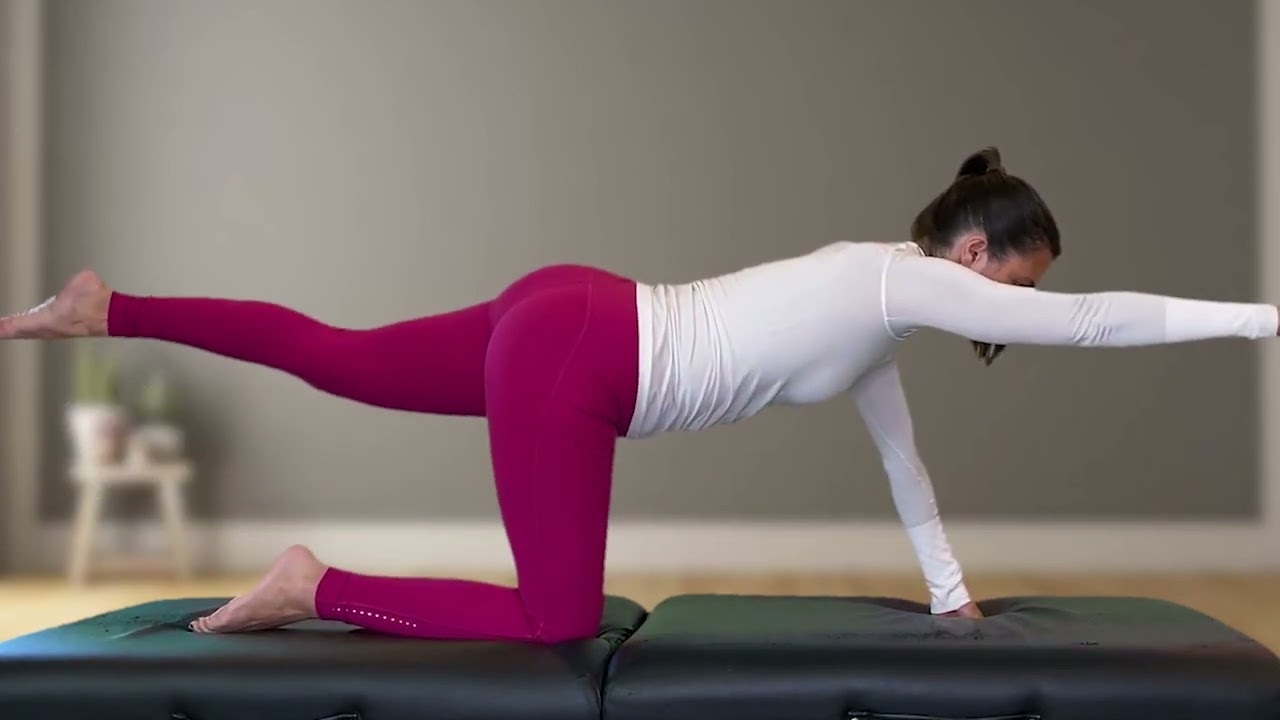
One Core Project: Phase 4 (Short) | Core Strength After C-Section or Hysterectomy
Watch on YouTubeVideo summary
This video introduces Phase 4 of the One Core Project, specifically designed for individuals recovering from a C-section or hysterectomy who need to rebuild core strength after initial healing phases. The session begins with a targeted warm-up routine focused on activating and assessing the posterior pelvic tilt muscles. Participants are instructed to use a block between their knees while performing gentle tilts on both sides of the body, paying close attention to any imbalances in muscle engagement or pain levels. This assessment phase ensures that the right side is not compensating for weakness on the left before moving into strengthening exercises, allowing users to adjust pressure based on which side feels weaker until balance is achieved.
Following the warm-up and activation drills, the workout transitions into a series of dynamic strength-building movements performed in one to three rounds per session. The first exercise is the bird dog, where participants extend opposite arms and legs while maintaining a stable spine and drawing their belly button inward; modifications are offered for those needing less intensity or additional challenge through elbow-to-knee touches. This is followed by full planks held for thirty seconds with options to drop to knees if necessary, leg lifts performed on the back using an anchor point for stability, and sprinter sit-ups that involve reaching one foot toward the opposite hand while keeping the lower core engaged throughout the motion.
The routine concludes with a dedicated cool-down sequence combining breathing exercises with posterior pelvic tilts to promote relaxation and self-grounding of the body. Instructors emphasize taking deep breaths through the nose to expand the rib cage before exhaling fully while flattening the back, ensuring that the core remains active yet relaxed at the end of each cycle. The program suggests performing these three cycles two to four times a week over a period of two to four weeks, after which users can transition into a maintenance phase or return to previous phases as needed for continued recovery and long-term strength building in daily life.
Read the full video transcript
All right, let's get right to it. So,
we're going to start with our posterior
pelvic tilt. We're going to warm up
those core, warm up those abs so we can
get ready to go. So, grab your block,
put it between your knees,
light squeeze, go ahead and do your
posterior pelvic tilt, gently pressing
down your right hand.
You're going to focus and feel that
right quadrant kick in. We're still
going to assess it every time we do this
before we warm up or before we get
started with the program, we want to
warm it up. 3 2 1, go ahead and relax.
We're going to do three of these on the
right, three on the left, see where
we're at from a balancing perspective.
Go ahead and do a posterior pelvic tilt,
flatten that back out, good, and gently
press down on that right side.
Right hand, feel that right side engage.
I want you to assess because we're going
to do the left after this so you can
feel the difference or if they're the
same, we'll we'll go with that. And 3 2
1, and then rest. Just relax, just
relax. We got one more.
Good, posterior pelvic tilt.
Press down with that right hand, gently,
focus on that lower right right quadrant
quadrant of the core, feeling that
activity, feeling that that wake up
happening before we start the
strengthening. And 3 2 1, go ahead and
relax. Now, we're going to switch over
to the left side.
So, go ahead and do your posterior
pelvic tilt, tilt that pelvis, push down
that left side, left hand down, focusing
on that lower left quadrant, comparing
the left to the right, which one's
different, are they the same, just
taking notes. And 3 2 1, relax.
Got two more.
Go ahead and do your posterior pelvic
tilt, flatten that back out, gently
press down that left hand, focus on that
lower left side.
Feeling is there a difference? Is it the
same? And 3 2 1 Go ahead relax. You got
one more.
And go ahead and do your tilt.
Press down left side focusing on that
lower left quadrant. And now I want you
to think of yourself, is there a
difference? If there is, we're going to
be doing something next to help balance
it out. If not, we're going to be doing
both hands at the same time. And 3 2 1
Go ahead and relax. Now if the left side
seemed limited, let's go and put more
pressure on the left side for 3. If the
right side, put it on the right side.
And of course, if if it's equal, we're
going to push both hands down. So let's
go ahead and do your posterior pelvic
tilt.
Pressing your hand down, the appropriate
ones, down. Hold for that full eight
count.
And
3
2 1 Go ahead and relax.
Make sure you take that full rest. Relax
your shoulders, relax your head. We're
just focusing on warming up and
activating that core before we get into
the strengthening program. Go ahead and
do your posterior pelvic tilt.
Gently press down that weakened side or
both hands if it's if it's equal,
holding for that full eight count.
And 3 2 1 Go ahead and relax.
Good, we got one more. And go ahead and
do your tilt.
Press down. Now keep in mind, if you
need to take a little bit more time to
balance it out, you can pause the video
and do a few more reps. That's That's
okay.
And 3 2 1 Go ahead and relax. We have
one more warm-up exercise before we get
to the strength program.
All right, so we're going to go right to
the half plank and finish our warm-up.
So come up to your elbows, on your
knees, get in the half plank position,
tuck that tail underneath, and then
you're going to slightly draw back or
pull back those elbows. Holding that for
the full eight count, really focusing on
driving a lot of energy and activation
to that lower core as warming it up to
get ready for our strength. Three, two,
one, down and rest.
Really important to rest each time,
relax those shoulders. We just want to
activate and kick in that core so we can
get the strengthening
at the best way we can and protect you
as we do it. So, come back up.
On your knees, tuck your tail. Nice,
pull those elbows back. Holding,
remember don't be aggressive on pulling
those elbows back, just a light shift.
And three, two, one, and down and rest.
Now, the goal is is to warm everything
up so that we start doing more dynamic
moving and strengthening that you're
always protected and the right muscles
are doing the work. So, let's go and
come back up.
Tuck your tail,
slide those elbows back, pulling them
back towards your knees.
Good, and then hold.
For three, two, one. Now, our warm-up's
done, we're going to kick it into this
the the strength workout that we're
going to do one to three rounds of a of
the strength exercise. So, let's get
started.
All right, so your first strengthening
exercise here in in phase four is our
bird dog. So, come up onto hands and
knees, knees will be underneath your
hips.
Hands underneath your shoulders, getting
a nice good strong posture. Your body
should be nice aligned, you shouldn't be
rounding your back or your shoulders at
all.
And uh what we're going to do is you're
going to start with your left leg, right
arm. So, it's going to reach your left
leg straight out. Right arm straight
out. We're going to hold this for a
count of 10.
So, nice and strong, you're reaching to
the wall, reaching back, trying not to
lift up.
Good, and go ahead and switch sides.
Nice. Right leg, left arm. Remember the
modification, you can keep your hands
down and just lift your leg. For people
that are maybe more challenged, you can
hold that for that full 10 seconds.
And we're going to do three each side
here.
All right, go ahead and bring that leg
back down.
And let's go ahead and switch sides.
Reaching out.
Good. Remember the the more challenging,
if you want to challenge yourself, you
can bring that elbow to your knee
and back out. And you can do that for
the full 10 seconds or you can do 10 of
those. Go ahead and switch sides.
Reach out.
Good. Once again, if you want to
challenge yourself, go ahead and bring
that elbow to your knee.
Good. And back out and do a couple of
those.
Perfect. And reach out and hold that
position right there. Now, keep the hips
nice and flat. Try not to over rotate.
Nice, good, firm position. This is
great. Go ahead and rest.
We got one more time. Switch sides.
Good. For that full 10 seconds. Now,
keep in mind, you got to keep that belly
button drawn in. You want to keep your
body nice and stable, nice and straight.
Your line and your head is all aligned.
You're not lifting up. You're reaching
out. This is always better to do on a
firm surface.
It's going to be a little easier. You're
going to feel more solid.
And go and come back and rest. Awesome.
Let's get the next exercise.
All right. So, our next exercise is
going to be the full plank. So, let's
get up into full plank on your elbows,
up on your toes. You can hold this
position straight up, nice and straight.
Good. We're going to hold this for 30
seconds, maintaining integrity, staying
strong. And now, a couple modifications,
you could go to your knees and hold that
for a minute. Now, the goal is to really
get to that that full plank. So, let's
come back up to that full plank. If you
want to advance this a little bit and
challenge yourself, you can do a a toe
point and just alternate, maintaining
really proper proper integrity of your
core and your strength.
Good and hold.
We should be feeling this in our
shoulders, a little bit in our legs, a
little bit in our in our core, helping
you maintain that.
And three, two, one. Go ahead and relax.
All right, let's get to the next
exercise. It's going to be our leg
lifts. So, what you're going to do is
you're going to lay flat up flat down on
your back. You're going to anchor
yourself overhead so you're grabbing a
hold of like the couch or a table or
something that's firm. And then I want
you to go ahead and bend your knees up
like you're in a chair.
Good. Grab a block if you have one. This
is really good to have a block put
between your knees. Anchor your upper
body down. Great. We're going to do this
for 30 seconds constant motion
maintaining that back. You want to keep
that back pressed against the floor. So,
let's go and keep those knees bent.
Let's go and bring yourself down nice
and slow.
And then back up. Remember, you're only
bringing yourself down as as far as you
can to keep that back nice and flat. If
you come up and you need to reset
yourself, feel free to reset yourself.
Don't force it. Just nice and slow. Now,
a couple modifications is you can do
this for 10 or 15 seconds if you're not
able to maintain that integrity until
you build enough strength up there. And
of course, if you're stronger and you
want to challenge yourself a little bit
more, you can actually roll up further.
So, go ahead and bring your knees up and
what you're going to do is you roll your
hips up. Keep coming and then back down.
You got to be under controlled motion
the whole time. Let's try that one more
time. Come on up and roll up and back
down. Just be careful just not to let
your knees fall to your chest. It's a
it's all coming from the lower core and
drop
and come back up.
And down and rest. Nice job.
For the last strengthening exercise,
we're going to come up and do our
sprinter sit-up. So, go ahead and sit
up.
All right, you're going to slowly keep
your hands out in front of you, sit sink
back down till you feel your abs fully
kick in, hold that position, then you're
going to reach your right foot to your
left hand. There you go, good, and
alternate.
Awesome, keep it up, maintain that. Now,
if you want to advance this a little
bit, you can go all the way down and
then come up and touch that foot.
Perfect. Let's do one more like that. If
you're ready for that challenge, go
ahead and challenge yourself.
And then you hold. Now, if this is too
hard to do, you can modify by just doing
it less time. Start at 10 or 15 seconds.
And
rest. Go ahead and roll yourself down
nice and slow.
And
awesome. So, remember, this is one
cycle. So, I want you to go back through
the core the four core, and I want you
to do them again. So, you go back and do
your bird dogs, go back and do your
planks, your leg lifts, and your sprint
squats you can or your sprinter sit-ups.
You can do those three cycles three to
five times a week.
All right, once we finish our one to
three cycles of our strengthening, we're
going to finish with our finishing
exercise, our posterior pelvic tilt and
breathing. So, grab your block, put it
between your knees.
All right, let's go ahead and take a
nice deep breath in through your nose,
feel that rib cage expand. As you
exhale, I want you to do a posterior
pelvic tilt, flatten that back out,
focus on that core being strong, holding
that, and go ahead and take a nice deep
breath in through your nose,
holding that position. As you exhale, I
want you to relax, relax your core,
relax your body.
And go ahead and take a nice deep breath
in through your nose,
feel that rib cage expand. As you
exhale, you're going to do your
posterior pelvic tilt.
Good, holding that position. I want you
to take a nice deep breath through your
nose, feel that rib cage expanding out
and up and down into the table or into
the floor. And as you exhale, I want you
to go ahead and just relax.
Go ahead and take a nice deep breath in
through your nose, feeling that rib cage
expand.
As you exhale, I want you to do your
posterior pelvic tilt,
activating that core, getting your body
self-grounded.
Holding, and nice deep breath in through
your nose, get that rib cage expanding.
Good. As you exhale, go ahead and just
relax.
Go ahead and do a few more.
Go ahead and take a nice deep breath in.
Expand that ribs.
As you exhale, press down.
Holding that, focus on that rib cage
expanding, nice deep breath in.
Hold, and then as you exhale nice and
slowly, go and relax everything, relax
your core, relax your shoulders, relax
everything.
Good. Nice deep breath in.
Hold. As you exhale, I want you to go
ahead and breathe or go ahead and do
your posterior pelvic tilt, press your
back down.
Hold.
And then as you inhale through your
nose, feel that rib cage expand.
Hold.
And then as you exhale, I want you to go
ahead and let your body relax, let your
core relax. We got one more.
And as you take a nice deep breath in,
as you exhale, posterior pelvic tilt.
Holding.
Last one, nice deep breath in, get that
rib cage up, out, down.
And then as you exhale, relax. So, if
you do that 2 to 4 weeks of this
program, we're going to I'm going to
move you over to a maintenance program
that you can do. And then you can always
come back to any one of these phases,
and you'll find the ones that you like
the most. I would encourage you to keep
doing them and as you get done I want
you to go back and then finish the do
the maintenance programs and follow that
in your day-to-day lives and of course
keep this breathing as part of that.
Thank you.