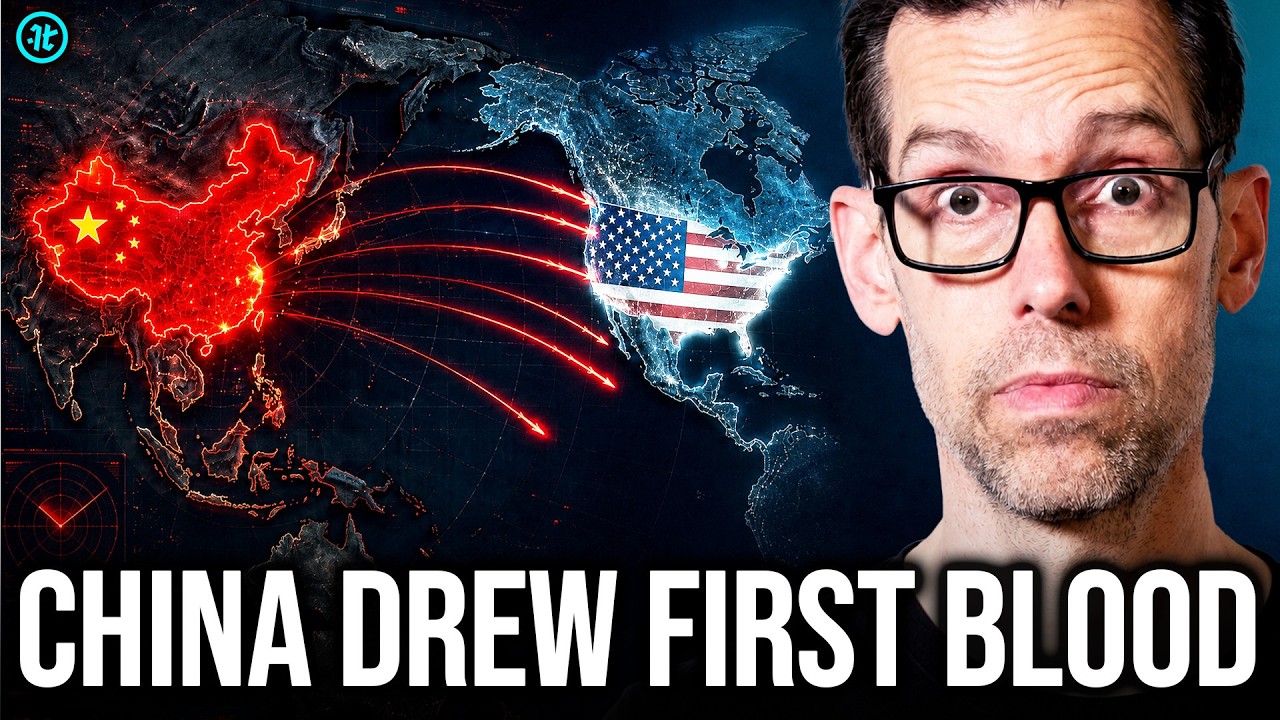
One Chinese AI Model Wiped Out $1 Trillion In A Single Day — And They're Just Getting Started
Watch on YouTubeVideo summary
The United States stock market has become heavily concentrated on artificial intelligence, with eighty percent of the index's value growth over the last three years driven by this sector alone. However, a significant shift is occurring that makes this investment bet increasingly risky: Chinese open-source models are undercutting US pricing and threatening the financial viability of American AI companies. By utilizing a technique called distillation to train smaller, cheaper models on outputs from expensive frontier models like ChatGPT or Claude, China has created highly competent alternatives at roughly one-fifth the cost. Major US tech firms are already reacting by cutting their spending significantly; for instance, Coinbase reduced its AI bill nearly in half and Uber capped engineer budgets after discovering how inflated costs had become compared to these efficient Chinese rivals.
This competitive advantage is not merely a result of market forces but stems from a geopolitical strategy where China leverages advanced US technology against the very industry that restricts chip exports to them. The transcript details allegations by companies like Anthropic and reports from the White House accusing Chinese labs of running millions of queries through fake accounts to clone American intelligence, effectively bypassing hardware embargoes. While distillation is a standard legal technique used internally by major labs, its application against foreign competitors undermines the revenue growth that US AI infrastructure depends on for survival. Consequently, companies like Meta and Amazon are warning of exponential spending increases or scrapping internal metrics because they cannot match these low-cost alternatives without incurring unsustainable debt burdens to maintain their current market position.
Beyond international competition, the US AI industry faces a severe domestic crisis driven by excessive leverage and unrealistic revenue projections that history suggests will lead to widespread investor wipeouts. The sector is currently playing "chicken" between massive infrastructure debts—financed largely through circular accounting tricks where money flows back into chip manufacturers—and revenues that are failing to materialize fast enough, with studies showing ninety-five percent of corporate AI projects producing no measurable profit impact. This fragility is compounded by rising interest rates and a lack of liquidity as global central banks tighten monetary policy, leaving highly leveraged companies like OpenAI and Anthropic vulnerable to collapse. The situation mirrors historical technological bubbles where early investors were destroyed because revenue did not catch up with infrastructure costs in time, creating a contagion risk that could drag the entire US economy down if these foundational players fail.
In response to these mounting pressures, AI industry leaders are attempting to position themselves as victims of dangerous competition while simultaneously lobbying for government bailouts and regulatory protections against open-source models they claim pose safety risks. This strategy seeks to create artificial barriers to entry through regulation that would crush cheaper competitors but ultimately protect established incumbents from the consequences of their own financial mismanagement. For investors, the lesson is clear: AI risk is not isolated to specific stocks but is hidden within pension funds, insurance policies, and broad index funds due to systemic debt distribution by banks following a playbook similar to 2008. The prudent approach involves recognizing that while AI technology will transform the world, betting everything on it ignores the brutal reality of timing mismatches between debt obligations and revenue generation; therefore, diversification beyond this high-risk sector is essential for long-term survival in an economy increasingly tied to its health.
Read the full video transcript
The stock market has become one big bet
on AI, and something just happened that
makes that bet look a lot riskier.
>> They've got $50 billion a year. They're
spending $1.4 trillion a year. What do
they think they're going to do? How are
they going to make up the money?
>> 80% of every dollar the US stock market
has gained in value over the last 3
years has come from artificial
intelligence. The 10 biggest companies
in the S&P 500, nearly all of them
riding on the AI trade, now make up over
40% of the entire index. If you own an
index fund, you don't really own the
broader market anymore. You own the AI
bet. And what is it that happened that
made all of this that much riskier?
Coinbase just cut its AI bill nearly in
half by moving its engineers off of
America's top AI models and on to
cheaper open-source ones that are
proving to be almost as good. That
should be a good thing though, right?
Well, you have to consider this. The
arrival of open-source models to the US
market is not simply the result of
competition. These new models are
actually the result of a geopolitical
battle that's putting the stability of
the US AI industry as a whole at risk.
The question is, how could something
that's good for consumers actually be
bad for the industry? That's a critical
question that we have to answer because
it's going to have a major impact on you
as both an investor and as someone
that's just impacted by the health of
the US economy as a whole. So, let's
walk through what's really going on
because there's something at play here
that most people are missing. I've
broken it into four parts so it's easy
to see how the mechanism works, where
the increased risk is coming from, and
ultimately what you need to do to
protect yourself. Okay, the first thing
to note is that AI is better understood
as an arms [music] race than as a
traditional industry, and the US AI
industry is right now under assault from
China. Now, global competition is
nothing new, obviously, and neither is
competition from China, but what is new
is that both China and the US understand
the potential winner-take-all dynamic of
AI. That's why the US has leveraged
export controls on the chips that are
necessary for AI training, and why China
is now attempting to steal US AI
technology and undermine the financial
viability of our AI market as a whole.
[music] China fully understands just how
vulnerable the US AI industry is to
investor confidence and the absolutely
staggering, crushing debt obligations
that are threatening to take down the
entire current wave of AI investors,
even without China. Here's the strategy
that China's using. For years, America
denied China access to the most advanced
chips, because without advanced chips,
there's just no way for them to build
competitive frontier models. This meant
that China could not go against the US
in a head-to-head competition, but given
the importance of AI, they couldn't just
sit out of the race. That's not an
option. So, certainly not if they want
to be a global hegemon. Instead, they
focused on winning the race via
computational efficiency. To do that,
they began leveraging our own models
against us, potentially illegally, and
working to undercut the one thing the
entire US AI industry absolutely depends
on,
revenue growth. The way that they have
built deeply efficient models from a
cost perspective is something called
distillation. The way that it works is
that you build a simple AI model and
train it on the outputs of a massive,
well-trained frontier model like ChatGPT
or Claude. You create tens of thousands
of fake accounts,
>> [music]
>> send millions of queries to the frontier
model, you capture its answers, and you
use the distilled set of patterns to
teach a smaller, cheaper model to behave
the same way as the large, expensive
model. Because you don't have to build a
physical data center that's big enough
and robust enough to read all of human
knowledge and then distill the patterns
from that gigantic corpus of data, but
you still get the distilled patterns,
you can build a highly competent model
for a tiny fraction of the cost through
distillation. Now, technically,
distillation is a standard. It's a legal
technique. Every major lab does it to
its own models. The problem starts when
a rival nation is doing it to a
competitor's model that they're not
supposed to have access to in the first
place. Now, this is not me making this
up. In February, Anthropic accused three
Chinese labs, DeepSeek, Moonshot, and
MiniMax, of doing exactly this, alleging
more than 16 million queries were run
through roughly 24,000
fake accounts, and in April, the White
House directly accused China of running,
and this is a quote, "deliberate [music]
industrial-scale campaigns to steal
American AI models." Then, on June 10th
of this year, Anthropic sent a letter to
the Senate Banking Committee accusing
Alibaba of the largest such effort to
date. According to Anthropic, China used
these queries as a way to effectively
clone Claude's intelligence. Alibaba
denies it, of course, and so far, these
are just allegations, but China's track
record of stealing foreign IP is
well-documented. [music] Now, in
fairness, it really is a brilliant way
to get around advanced chip export
controls,
>> [music]
>> and it seems to be working because the
cheaper models produced by China are
proving to be good enough to attract
some of America's largest companies
>> [music]
>> as customers are discovering how
insanely expensive frontier models
>> [music]
>> really are at this stage in their
development. Uber spent its entire 2026
budget for AI coding tools by April and
ended up having to cap each engineer at
about $1,500 a month. Meta sent around
an internal memo warning of an
exponential increase in AI spending.
Amazon scrapped an internal leaderboard
ranking employees by AI usage because
people were gaming it and running the
bill sky-high without commensurate
improvements in the product. And a KPMG
survey found only 26% of companies have
a clear view of what they're actually
spending on AI full stop. When something
delivers real value but comes at this
kind of extraordinary cost, you can
expect people are going to start
shopping around for cheaper alternatives
just as China knew they would. Coinbase
cut its AI bill nearly in half by
routing its engineers to Chinese
open-source models, one of them made by
Moonshot, the very lab Anthropic named
in their February complaint. A company
called Lindy also moved off of
Anthropic's Claude and onto another
Chinese open-source model when its AI
cost grew larger than its payroll. So,
the reason is simple. The Chinese
open-source models run about five times
cheaper than the top US model while
scoring within a few points on standard
AI performance benchmarks. In a
price-to-value ratio, the Chinese models
are the clear winner. This presents an
extreme danger for the US AI market,
which is currently playing a game of
chicken with the massive amount of debt
it's had to accrue to build out the
infrastructure required to create and
scale frontier models. Given the size of
the debt, the Chinese open-source models
don't have to siphon much revenue away
from the US industry to do [music]
extreme damage. Not just to our AI
industry, but to our economy as a whole
because it's so tied to AI. The US is
aware of the problem. China's obviously
aware of the dynamic, and the House has
already opened an investigation into the
Chinese model makers, but the cost
pressure is so real that we may not have
the time for a diplomatic or legal
solution to play out. There are signs
that the market may have already noticed
that revenues are not keeping up with
costs in AI. SpaceX has already given
back most of its post-IPO gains, falling
about 32%
from its peak within just 2 weeks of
going public. On June 23rd, a broad tech
sell-off erased close to $700 billion in
a single morning. Oracle had its worst
week since the dot-com crash of 2001 on
concerns over how the AI build-out is
being financed, more on that later, and
the big AI stocks have started moving
apart, likely due to investors beginning
to separate the companies with strong
enough technology and hopefully
sufficient revenue growth from the ones
that are just funding everything on debt
and not showing the indication that
they're going to grow rapidly enough.
The thing everyone has to factor into
how invested they get into the AI sector
is that the pressure on AI revenue isn't
likely to be a passing price war.
[music]
A huge part of it is a deliberate
strategy in the US versus China Cold War
and the hyper-consequential battle for
AI supremacy. So, the question becomes
how long can China continue to force
prices down? They don't have the same
pressures on them that we do. Given the
top-down authoritarian control that G
has, he can just point the Chinese
economy wherever he wants to and he can
redirect funds however he needs them to
be redirected to allow Chinese companies
to build open-source models with or
without revenue and drive the revenue
potential of US models down. And given
that the distillation strategy is so
much cheaper, he doesn't have to worry
about the mega infrastructure build-out
that the US currently has to manage. All
right, the second thing you need to
understand about the dangers facing the
USA AI industry is that even without
China, the revenue just isn't coming in
fast enough.
MIT recently studied how generative AI
is actually performing inside of
companies. They found that 95%
of corporate AI projects that they
looked into produced no measurable
impact on profits, not even small
returns. Now, it's not a big deal for a
young industry with low startup costs,
but it's a major problem for a
technology with the most expensive
infrastructure buildout possibly in
human history, and it's all financed on
debt.
Debt already puts you on a ticking
clock, but when you add hype to the mix,
the clock speeds up. Whenever something
creates euphoria in the market in the
psychotic way that AI has, retail
investors become completely irrational.
They ape in without looking at the
fundamentals, and they expect big
returns fast, and they often buy in on
leverage creating a second debt-based
danger zone. One for the company who is
building using debt, and one for the
investor who's investing on companies
using debt by using debt. In both cases,
the debt just makes it harder for the
participant to withstand the volatility
that inherently exists in the markets,
especially markets that are completely
detached from fundamentals like AI. A
normal technology company reinvests
somewhere between 5 and 20% of its
revenue back into building things, but
with AI, that number has gotten
completely insane. Oracle is now
spending the equivalent of 57%
of its revenue on the AI buildout.
Microsoft is around 45%, and across the
biggest players, AI infrastructure is
eating up close to 94%
of the cash that their core businesses
are throwing off. There's no cushion
left. Sequoia, one of the most
successful venture firms in history,
tried to estimate the size of this hole.
Their belief is that the AI industry now
needs to generate about $600 billion
in brand new annual revenue just to
justify what's already been spent. And
the industry is nowhere near generating
that kind of revenue. And that number
isn't shrinking as the technology
matures. The number is growing. The
problem is that history tells us that
kind of revenue is not going to come in
fast enough. Not to save the current
crop of investors from getting hammered.
And given how systemically important AI
has become to the US market, there could
be a contagion effect as this initial
round of investors gets hammered and
everyone else gets hammered by proxy. I
went into a ton of detail on this exact
problem in this video here if you want
more info.
We'll get back to the show in a moment,
but first, let's talk about the thing
your business just can't survive
without. I go live 3 days a week at 7:00
a.m. And every morning you guys, you
incredible people out there show up.
You're there, you're ready. And if my
connection drops in the middle of that
live stream, that moment is gone
forever. You do not get a second take
when it comes to live content. And I
know a lot of you are in the same
position. Whether you're running live
events, processing transactions, or
managing a remote team, your business
depends on staying connected. Not
sometimes, every [music] time. That's
why I trust AT&T Business. They're built
for business owners who can't afford
downtime. AT&T Business is a reliable
provider for small business owners. For
small business month, we celebrate small
businesses by helping them run better.
>> [music]
>> This means reliable uptime, easy
switching, smart communications.
Impact Theory is powered by AT&T
Business, built to work. Get AT&T
Business at business.att.com.
We will be right back to the show, but
first, let's talk about your standards.
[music]
Most people have two sets of standards,
the ones they talk about and then the
ones they actually live by when nobody's
watching. When you're busy, moving fast,
and hungry, those standards [music] get
negotiated down. You grab whatever is
closest and you tell yourself it doesn't
count, [music]
but it does. Your body is keeping score,
trust me. That's why I keep PaleoValley
beef sticks on hand whenever [music]
I'm at risk not being able to get whole
food because I refuse to let hunger be
the thing that breaks my standard.
[music] These are 100% grass-fed and
grass-finished beef, zero sugar, no
artificial preservatives, no soy,
gluten, or corn, just beef and organic
spices with 6 g of protein per stick.
When you're running between meetings,
traveling, or just don't have time to
think about food, reach [music] for a
PaleoValley beef stick. Right now, you
can get 30 beef sticks for just $36.
That's real nutrition for barely over a
dollar per stick. Click the link below
to get your 30 beef sticks for just $36.
[music] And now, let's get back to the
show.
For now, suffice it to say that
revolutionary new technologies with big
infrastructure build-outs typically
bankrupt the first wave of investors. It
happened with the canals in the UK, the
railways in the UK, and again the
railways in the US, and with the
internet. They all followed the same
pattern. The technology went on to be as
amazing as everyone thought it would be,
but the revenue didn't come in fast
enough to save those early investors.
They all got wiped out. Hype just makes
people get way too far out over their
skis. They do it on leverage, and that's
where the problem arises. And the extra
bad news for AI is that at least in
those previous cases that I just
mentioned, the gap between the money
spent in the infrastructure build out
and the money earned by the new
technology over time narrowed as the
customer demand caught up. With AI,
analysts at Man Group and elsewhere are
going to great lengths to point out that
it's doing the opposite. With AI,
spending is accelerating while the price
companies can charge for its usage is
falling, partly because of the
open-source models that China is pushing
onto the market, just like we covered.
So, even as more people use AI, it's
entirely possible that the revenue won't
climb fast enough for the industry to
remain viable in its current
composition. And the market history
shows that the composition of an
industry can change very suddenly. Just
look at what happened during the dot-com
bubble burst. Companies that seemed like
can't-miss investments went bankrupt
almost overnight and got replaced by the
companies that would eventually win the
internet race, but it took time. To
complicate things even more, the revenue
and costs of AI may actually be worse
than the industry is trying to let on. A
meaningful amount of revenue is actually
circular payments, and according to
Michael Burry, the true cost of the
chips are being hidden behind an
accounting trick. Let me explain. Nvidia
agreed to invest up to a hundred billion
dollars in OpenAI, but that money is
largely just flowing right back into
Nvidia whenever OpenAI buys the chips
that it needs. Nvidia also owns a piece
of a cloud company called CoreWeave.
Nvidia has committed billions of dollars
to buy CoreWeave's unused capacity, So,
their own spending makes their own
investment worth more, sort of. The
investment firm GMO compared this whole
arrangement to the circular financing of
the dot-com bubble era companies that
made them so fragile. And AI's fragility
goes way beyond just circular payments.
The four biggest US cloud companies are
sitting on about $2.1 trillion
in future revenue commitments. But by
one analysis, roughly half of that is
owed by Open AI and Anthropic alone, two
companies that are deeply in the red.
The whole industry starts looking very
precarious when you put that all
together with Michael Burry's warning
that clocking the life cycle of a data
center chip at 5 to 6 years instead of
the more realistic 2 to 3 years, that
could be hiding more than $175
billion
in losses already sustained. Even the
insiders are starting to get cautious.
Microsoft has stepped back from its
commitment to supply all of Open AI's
computing power, letting other companies
absorb some of that exposure instead.
And honestly, it's a smart move because
we're already seeing how a single
Chinese open-source model can crack
investor confidence. In January of 2025,
China's Deep Seek model hit the US
market like a meteorite. Overnight,
investors started questioning the whole
US is going to lead the world in AI
narrative. And the result was a trillion
dollars of US AI market value gone in a
single day. It smacked Nvidia so hard,
they set the record for the largest
single-day loss by one company ever.
That's what one low-cost Chinese model
did. What's going to happen over time as
they put more and more on the market,
especially when the cost of carrying the
debt is just rising? The Fed was
expected to cut rates this year, but
instead, due to rising inflation from
Iran and AI itself, the Fed is now
signaling future hikes. Plus, timing
couldn't be worse. Japan Central Bank
just raised its rate to the highest
level in 31 years, which pulls back hard
on global liquidity. The liquidity that
high-risk markets like AI have been able
to count on for years and are most
likely going to need if things don't
change. Higher rates make every dollar
of infrastructure debt more expensive to
carry, and they punish pay-off later
companies like OpenAI and Anthropic the
hardest. So, the runway for increased
customer adoption to drive sufficient
enough revenue to save the AI companies
from their own debt is getting shorter
by the day. Now, none of that is to say
that AI demand isn't real or that AI
won't change the entire world. It is
real, and it almost certainly will
change the entire world. But, that
doesn't mean that the current investors
won't get wiped out before that plays
out. Okay. We've got the cheap Chinese
models being trained, potentially
illegally, by the US frontier models,
and then deployed as a way to weaken the
much-needed revenue stream required for
the US AI companies to overcome the
crushing debt that they've had to take
on, combined with AI taking longer to
deliver on its promises than anyone
wants to admit, plus debt getting even
more expensive, plus liquidity being
pulled out of the market, plus investor
confidence starting to look less and
less steady, and we have a historical
record of revenues taking way too long
to save the hype-driven early investors.
On top of all that, AI has become so
systemically important that as you wipe
out that first layer of investors, you
might take the economy down with it and
find yourself in a recession or a
depression. Now, the third thing that we
must metabolize on top of all of that to
understand this moment in AI investing
is how the AI companies themselves are
responding to these pressures and what
their responses are likely to mean for
you. To state it plainly, the AI
companies are acting like predictable
and seeking the shelter of the
US government and by proxy, you, the US
taxpayer. Last November, AI floated the
idea that the federal government should
backstop its financing, that taxpayers
should help guarantee the debt behind
its buildout. Thankfully, the backlash
was instantaneous and the company's CFO
walked the comment back within hours
saying she had, quote, muddied the
point. But, from where I'm sitting, this
was not a slip. This is a tried and true
strategy that should really piss people
off and it happens [music] all the time.
This is like a preemptive bank bailout
and it's a pattern of behavior that we
see over and over. Back in March of
2025, Open AI had already sent a letter
to the White House asking for tax
credits, loans, and other vehicles the
US government can direct towards
companies building AI infrastructure.
Now, I actually don't have a beef with
the government deciding that an industry
is so strategically important it's worth
defending or helping to build, but it is
a very slippery slope from generic
incentives to protect an industry to
creating regulatory moats and protecting
individual companies. Competition is
necessary if an industry is going to
innovate and thrive in the long run and
we're already running the risk, that
given AI's systemic importance, that it
will get protected to the point of
codifying the winners and artificially
lowering competition. So, we have to be
paranoid. Now, to be fair, Open AI's
leadership has publicly denied wanting a
bailout. CEO Sam Altman said directly
that OpenAI, and this is a quote, does
not have or want government guarantees,
and the taxpayers shouldn't have to
rescue companies that make bad bets. And
the White House's AI czar, David Sacks,
has also said that there will be no
federal bailout for AI. However, that
same AI czar also pointed out what I've
been saying here, that AI investment now
accounts for half of America's economic
growth, and that a reversal of that
growth in AI would risk a full-on
recession. And Altman has mused that
when something gets big enough, quote,
the government is the insurer of last
resort. So, you will be forgiven if you
remain extraordinarily paranoid about
bailouts and regulatory capture. It is
all too clear that these are not the
statements of an industry that's
confident that it can pay its own way.
They're the early seeds being planted by
industry insiders who are building the
case that AI is just too important to be
allowed to fail. And to be honest, I
agree with them. But, the question
becomes, how do you protect the industry
while aggressively avoiding what one
policy expert called a request for
regulatory capture in its worst form,
especially knowing that when you can't
win on price, the next best thing is to
make it harder for competitors to exist
at all. And the easiest way to do that
is create a narrative that the
competition is dangerous. The government
is going to have to find a way to thread
that needle, because Anthropic is
already going hard in the paint to
convince the world that open-source
models are dangerous.
>> In terms of the scaling of open-source
models, I think it's going down a very
dangerous path, and if the path
continues, I think we could get to a
very dangerous place.
>> Anthropic CEO Dario Amodei beats the we
need regulation to protect against
dangerous AI drum constantly. Not long
ago, he published an essay just calling
for binding government regulation of AI.
Mandatory safety testing by outside
parties, the way we test cars and
airplanes, and to grant the government
the power to block or reverse the
release of an AI model it considers
dangerous. Now, there's no doubt.
There's a real argument here. AI is very
powerful. But, there's also extreme
danger that this is a one-way ticket to
the kind of regulatory capture that ends
up working against the working class
because it makes everything worse and
more expensive. AI is powerful.
And its rollout needs to be thoughtful.
But, the last people who should be
making that decision are ignorant
government officials who make millions
of dollars from insider trading on their
own decisions and the company executives
that stand to benefit financially from
icing out the competition by getting in
bed with said politicians. A smart
startup or an open-source project can't
compete when the government makes it
impossible to get started. Major
analysts and even some of Anthropic's
own allies have pointed out that the
same rules that make AI safer also
conveniently raise the barrier to entry.
And the hardest thing to regulate is
exactly the kind of cheap open-source
competition that is flowing out of China
and eating into US revenue. Tough
regulation sold as safety will only
serve to crush the kind of company that
will actually comply with sensible
light-touch regulation and serve to
innovate and drive costs down while
taking quality up. So, the thing that
companies like Anthropic are pushing for
aren't likely to help you with China and
will stop US companies from competing
with them. But, none of that's going to
matter to a large and growing segment of
the public who just hate AI with an
increasing ferocity. They just want it
shut down. Surveys show that only about
a quarter of Americans hold a positive
view of AI and nearly half who actively
view it negatively. 71% of Americans say
they don't want an AI data center built
near them. That's higher than the
percentage of people who oppose a
nuclear plant going in next to them.
People are watching their power bills
climb and blaming the data centers. And
the AI build-out is sending the price of
everyday electronics to the moon.
Tim Cook called the rapid cost increase
a 100-year flood and Elon Musk said it
was the biggest price jump he's ever
seen in anything. So, as a society,
we're in this super weird place
where we have a technology that a huge
number of people hate, that has already
become so systemically important both
from a national security standpoint and
an economic standpoint, that everyone
should fear what happens if it fails.
And the makers of that technology are
under so much financial strain from the
infrastructure build-out costs that they
have to position themselves as being in
need of regulation for safety reasons,
while also doing everything they can to
ensure they get bailed out if there's
economic trouble. So, the lingering
question is, what do you actually do in
the face of all of this? Well, you start
by understanding the game that's
actually being played. All markets and
all strategies are a game of risk and
reward. The importance of risk in the AI
calculus is a huge part of what makes
this moment in AI investing so
interesting and investing in general, to
be honest, given how tied everything has
become to the AI bet. Now, what do I
mean by that? This is the fourth part
that we have to get. If you're going to
develop a coherent strategy moving
forward, you have to identify where the
risk lives and watch how banks and the
companies themselves are spreading that
risk around. Let's start with the banks.
The banks making those AI loans are not
naive. They know exactly how shaky the
industry is given the amount of debt
that has already been required and how
much more is likely to be required in
the future. They know how much of the
companies' revenue are being swallowed
up by the infrastructure buildout and
they understand perfectly well the
circular revenues and shipped
appreciation schedules that are being
put forward. Understanding risk is their
job. And now it's your job, too. So,
let's zoom in on the risk and look at
what history tells us they're likely to
do. This is what I call the 2008
playbook. They're likely to take the
risky debt, slice it up, dress it up to
look safe, and then sell it off. In
fact, they're already doing it. And once
packaged, it's going to get sold into
private credit funds, insurance
companies, and pension funds. In fact,
they're already doing it. I walked
through the mechanics of how this will
play out in this video here. So, if you
want all the sorted details, be sure to
check it out. For now, I'll just note
this. Hyperscalers took on well over a
hundred billion dollars in new AI data
center debt in 2025 alone. That's many
times more than what they borrowed just
the year before. A law firm tracking
this found that lenders are now pooling
those loans and selling pieces of them
to pension funds and asset managers the
way I just outlined. They're doing this
so they can spread the risk around. And
the Federal Reserve reported that major
life insurers already have close
to a trillion dollars tied up in private
debt and pension funds have also started
tying up money in the debt funds fueling
companies like Meta and Oracle that have
huge exposure to AI. Now, why are the
banks working to distribute the risk in
this particular fashion? Because
spreading the risk across vulnerable
parts of the economy where regular
retail investors live does two things at
once. It moves the risk off of the banks
and onto you, and it spreads that risk
so deeply through the financial system
that if AI stumbles, the government will
feel forced to step in and use money
printing to backstop the AI industry,
which is exactly the kind of bailout
insurance the industry needs to move
forward with these huge debts against
comparatively small revenues and do it
with confidence. So, as you assess your
path forward, the most important thing
you can do is know what you actually
own. AI risk is not going to show up
with a warning label. It's going to hide
in your pension, in your insurance, in
the quote-unquote safe bond fund, and
and as I said at the start, in the index
fund you thought helped you own the
broad market, but now is really just
getting the majority of its returns from
AI. Go look. Ask where your yield is
actually coming from, and then
diversify. [music]
It was a failure to do that that left so
many people vulnerable to the housing
collapse in 2008. It's critical to
remember that you can believe
passionately and with total conviction
that AI is going to drive the bulk of
returns of the next decade or more
because it's just that transformational.
But when a game of chicken is being
played between debt and revenue timing,
history has a brutal warning for
investors. Having the right thesis, but
getting the timing wrong is the same as
just being outright [music] wrong. You
can bet on the right technology and
still get hammered by the timing and the
hidden debt ownership, especially when
China is trying to attack the industry
by being pro-consumer. That's the wild
part. China is going to drive the cost
down. So customers are definitely going
to bite. They're even going to be
advantaged. But that increases the
likelihood that the US industry, the one
part of the US economy that is still
working, will slow down. And if it does,
it's going to crash headlong into the
tsunami of debt obligations that have
already built up in the system, creating
the kind of fragility that we last saw
in 2008. As an investor, you guys have
to play the long game. No one can tell
you what the precise timing of all of
this is going to be. The people who have
gotten wiped out historically are the
ones who needed their money back in a
year or two, or the ones who placed
concentrated bets and then got the
timing wrong, or just did it all on debt
and couldn't survive the volatility. So
be humble. Diversify way beyond AI, even
if you have huge conviction about AI.
Don't underestimate China. And really
don't underestimate people's desire to
get cheap products. All of that creates
fragility for the market. The system
really is rigged, but it's still
winnable.
>> [music]
>> So play defensively. All right, if you
guys want to see me explore ideas like
this in real time, be sure to hit that
subscribe button and join me Monday,
Wednesday, and Friday as I go live and
talk about topics just like this. Hope
to see you there. Till next time, my
friends. Be legendary. Take care. Peace.
If you like this conversation, check out
this episode to learn more.
The US government owes 39 trillion
dollars. There's no plan to pay it back.
Instead, they plan to steal it all from
you. I mean that literally.