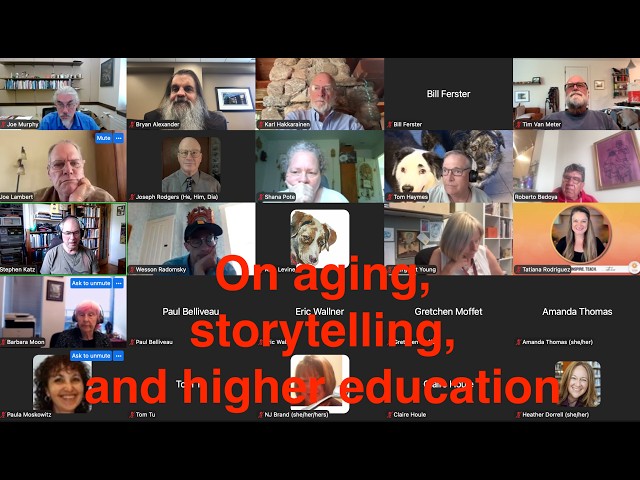
Video summary
The podcast "Future Transform" brings together hosts Brian and Joe Lambert with Professor Steven Katz to explore the complex intersections of storytelling, aging, and higher education. The conversation challenges dominant cultural narratives that often portray later life as a period of decline, loneliness, or danger, arguing instead for a reframing of these experiences. Guests distinguish between the "Third Age," characterized by active and socially rewarding retirement, and the "Fourth Age," which is frequently associated with physical or cognitive frailty. Rather than viewing the Fourth Age as a neglected black hole, the discussion advocates for storytelling that validates identity and citizenship even in moments of vulnerability, urging society to move beyond the fear-based obsession with remaining young and productive at all costs.
A central theme of the dialogue is the urgent need for higher education institutions to evolve alongside demographic shifts by integrating older populations into campus life. The hosts critique mandatory retirement policies as a tragedy that discards valuable wisdom, proposing instead the creation of intergenerational classrooms and utilizing retirement homes as cultural sites for learning. This approach aims to foster natural interactions between young and old students, thereby dismantling ageist barriers. Furthermore, the conversation highlights the necessity of critical gerontology that embraces diversity, specifically calling for Indigenous scholarship, Afro-Canadian perspectives, and other marginalized voices to counteract Western-centric colonial discourses in the field of aging studies.
Beyond theoretical frameworks, the session offers practical suggestions for transforming educational curricula and assessment methods. The guests recommend moving away from standard testing in favor of diverse approaches such as storytelling, art, and site visits that valorize student experience. Specific ideas include developing age-friendly curricula and creating environmental advocacy classes that engage older students. The discussion also touches on the concept of "ancestor intelligence," which reframes artificial intelligence to honor elder stories, particularly within communities that have historically been excluded from technological narratives. These strategies aim to fill the narrative void where many younger people cannot imagine life beyond their sixties or seventies, despite living into their hundreds.
The session concludes with a reflection on how cultural metaphors and vocabularies regarding aging often originate from societal fears rather than internal lived experiences, inadvertently creating new boundaries around the Fourth Age in reaction to past ageism. To support further exploration of these topics, the speakers recommend Atul Gawande's *Being Mortal* and Joe Lambert's book on aging and story. Logistically, the recording will be posted on YouTube with chat extracts added as a blog post, and the hosts invite continued dialogue via email or future sessions. As classes begin in September, the conversation closes with well-wishes for the audience, while also promoting upcoming forum sessions scheduled for January that will cover topics such as enrollment and artificial intelligence.
Read the full video transcript
Greetings and welcome to the future
transform, a weekly conversation about
the future of higher education. In this
session, we explored an unusual and
vibrant combination of topics,
storytelling, aging, and higher
education. Our guests were Joe Lambert,
a world-renowned leader in digital
storytelling, co-founder of what
eventually became Story Center, and most
recently the author of Story, aging, and
the art of making meaning. Plus, Steven
Katz, professor Emiritis of sociology
and distinguished research award
recipient at Trent University. We
explored our trio of topics by
developing many connections between
them. For example, we discuss the
stories we tell of aging, the different
stages of old age, intergenerational
teaching on campus, mandatory
retirement, the invisibility of minority
populations in stories of aging,
different types of assessment by age,
and critical gerontology.
I hope you gained as much from this
session as I did. There will be links in
the show notes. And as always, the
comment box stands ready for your
thoughts and questions.
>> Uh, welcome everybody to the future
trends forum. I'm really glad to see you
here today. We we've got a couple of
terrific guests talking about a deep
vital subject. I'm really looking
forward to our conversation. This week's
topic is a is a hybrid. Uh this is a
very uh interesting one. We're putting
together three things at once and these
three overlap in a ven diagram kind of
way. And we haven't done this before.
This isn't the threesome that we've
tackled before. The three parts are
storytelling,
aging, and higher education.
So the subject here is to figure out how
to blend these. How do these connect?
And I hope over the next hour we will
have many many fruitful and positive
ways to bring these all together. U so
let me introduce our two guests. Um
Stephen Katz, uh professor Amiradus of
sociology and distinguished research
award recipient at Trent University.
Professor Katz, greetings, sir. Thank
you. Hello.
>> Hello. Uh, and thank you for having an
awesome background of which I'm very
envious right now. [laughter] I I I'm in
a conference room, so all you get is the
wall, right? But but I I miss the books.
Professor Katz, uh, first of all, uh,
where are you today? Where have we found
you? Um, I'm at home in Toronto
and uh we just had a gigantic storm here
and fortunately my Wi-Fi just came on
after um about 20 hours of it being off.
Some people still don't have power and
you might hear some chainsaws out there
cutting up branches that have fallen on
the road
>> and uh things that have blown away. So,
apologies for that. But yes, I'm here in
Toronto. Uh, two cats are sleeping
beside me just like Joe's dog and so we
have uh, you know, human nonhuman
energies happening for both of us.
>> No, that's the best. Um, I'm glad to
hear it. In in the chat, Steven Peasley
says, "But storm has done incredible
damage. Um, hang in there, please." And,
uh, if if you go offline, we'll
completely understand.
>> Thank you. But I'm I'm glad you're safe.
Um, would you prefer that I call you
Professor Cats or Dr. Catz or Steven?
What would you prefer?
>> Stephen is usually gets my reaction
best. [laughter]
>> We do want we do want your your
reaction, sir. I'll I'll defer to you on
that. Stephen, the the way we ask people
to introduce themselves in the forum is
a little unusual.
uh we we don't ask for the academic
obituary style where we ask you know
what what did you do in the past and
where'd you go to school we ask about
the future and the near future uh what
are you going to be working on for the
next year what's uh what's top of mind
for you what projects and what ideas are
are uh leading the way
>> um thank you and thank you to you Brian
and Joe for including me I feel very
much like Joe's roadie by the way on
this [laughter]
on this hour. He's [snorts] He's the
rock star. I'm just carrying his gear,
you know. Um
>> that's a bit of horseshit. Uh Stephen,
[laughter]
I stand in the shadow of your actual
expertise versus my own.
>> We'll see about that. But um future.
Okay. Well, I'm retired now from
teaching. I'm still carrying on with
some uh research and writing. I guess my
immediate projects for the future. Uh
some diverse ones. I'm working on a new
project on loneliness and aging and the
so-called loneliness epidemic and what
that really means in terms of larger
cultural narratives about productivity
and resilience and belonging. Um I'm
also in a cover rock and roll band as a
drummer. So
>> I have various projects coming out of
that besides performing some writing on
Boomer rock and roll, boomer memory and
why rock and roll has been so important
obsessively so sometimes
narcissistically so to my generation. Um
and lastly I'm part of some major grants
on aging and marginality and technology.
the role the role of new technologies in
care uh in defining aging in organizing
the experience of the life course in
technical ways um that includes planning
that also includes the use of of kind of
digital economies
u and their value. So those are yeah
some of the main
um things that are taking energy right
now. Well, they sound like wonderful
things in which to invest energy. Um,
[clears throat]
I mean, of course, you know, the the
rock angle is going to set everybody off
on a tangent. Carl, yeah, our friend
Carl Hackaran has already given us a a
guide to a history of rock and 500
songs.
Uh but but these these these books sound
u these this research project sound
wonderful especially grappling with the
um the loneliness question um and uh and
thinking about continue your work on on
on aging. Uh you have a series of books
on this which is uh all look really
really powerful. Um well thank you for
joining us. We're glad to have you. Let
me let me bring up your your u your your
rockstar compadre um Joe Lambert. Um I
mean I it's it's hard for me to
introduce Joe because um uh he's a
friend and also I'm a huge fan of his
work which has changed my life. He's uh
responsible for my first book um and uh
for changing my practice in all kinds of
ways. And Joe is just a great figure on
the world stage uh who has led the way
for digital storytelling and is just
constantly reinventing stories and the
way people get to be present present to
each other. Um I I could say a lot more
but I just want to say Joe welcome and
and what are you working on now?
That's the sound of my ego deflating
after that [laughter] deduction. [gasps]
You know what am I working on? I mean I
I am I am still working on my book on
aging even though I've quasi published
it. I've told everybody it's it's sort
of a a group collaboration
and I'm continuing the elderware project
which is how I met Stephen you know
through our friend Peter White House at
Case Western or you know retired from
Case Western. I met a a group of people
who were doing work in aging that I
wouldn't have known before that. Um, you
know, I'm I'm continuing work now as
story host and and teaching with story
center, my former organization.
And the the new project for the year is
called the water table which is about
the relationship between water and
democracy which I think being here in
Santa Fe
>> and thinking about the history of of
water resource management that goes back
about a thousand years here in New
Mexico
>> and and that water and democracy is is
in inexraably tied. So, I'm going to be
doing some workshops around that in the
new year. Um, just [clears throat] as a
pro bono project and see who else I can
get involved. That's why I'm saying that
out loud. If any of you are interested
in the topic of water and democracy and
storytelling,
I would love to connect on that. And I
love these bands that have been coming
up. Thank you guys for bringing your
bands.
>> Yeah.
>> Oh, that's a first of all, that's a
great name. Uh, Water Table. I I really
like that. Um that's a a very evocative
name for the subject.
>> Yeah, I I'll just say that I met the guy
at for the LA Times named Ian James
who's their water guy and he was the
water guy with the Phoenix paper for
years and Ian and I got talking and I
just suddenly went, "Oh my god, this is
such a I'd read books about you know the
Cadillac Desert and all these books
about water politics, the Colorado River
and
>> but suddenly I'm like oh this is a
global thing. It's even thinking about
Nepal and the management of water
resource. I mean,
>> oh my god, there's so much going on. So,
it's a big big idea.
>> I'm waiting for you to ask the question,
Brian.
>> Uh, sorry, my laptop just paused for a
second. Um, you you were saying you
mentioned uh Can you all hear me?
>> Yeah, we heard you. You didn't freeze to
us. So now I think my uh I think my uh
Siri decided that it was time to uh talk
to me. Um you you were mentioning Nepal
and and the difficulties of water
management.
>> Yeah. I just I and you know this we're
here to talk about really the space that
Stephen and I found ourselves in. So,
let me switch gears a little to say, you
know, why in my year of retirement, the
first year after 41 years of being the
executive director of a nonprofit, the
same nonprofit, I I said, you know, what
do I want to do? And the fact of the
matter is that for about a decade, I'd
been working with people over 60,
purposely doing workshops following my
own age. I turned 60 about 10 years ago.
So I wanted to suddenly be doing more
work with my colleagues, my cohort, uh
people my age, you know, about the role
that story played and I knew that I had
a perspective growing out of one
workshop model that I did with a woman
named Janet Ferguson who's a Bermuda
based international
uh Ferrarian educator uh where we
[clears throat] were looking at life
stage and and you know in some ways
developmental psychological
places that older people go toward. And
those that know the book I wrote called
Seven Stages, Story in the Human
Experience, I was borrowing from Robert
Keegan, who is a, you know, Ivy League
professor that looked kind of was
mating, if you will, Ericson and PG in a
way that I thought was useful for the
way story center taught taught story.
And I've used that framing for a lot of
workshops and inevitably I had some
people that knew what they were talking
about in the gerontological environment
who could talk about the way we should
understand that and and the reason I
invited Stephen to this conver I I did
23 podcast interviews really as research
for the book in I wasn't really trying
to be a podcaster but as research for
the book and of all the people I spoke
to Stephen was the most inspiring ing to
me in the way he talked about the
stories that we tell ourselves about the
process of aging and where I think that
links to our role in higher education. I
went to the university retirement I
think it's called global aging
conference at at u Arizona state in
March. Lindsey Beigley is an amazing
person running this Mirabella,
you know, environment and it's part of a
network. And I suddenly realized that
the intergenerational
component of higher ed is something that
will only grow, right? I mean already
higher ed's in a having problems with
the demographics
of the the kind of drop off on the
number of students that are doing the
normal post high school cohort in their
early late teens early 20s and they're
trying to figure out what to do and one
of the things they can do is integrate
older people not only through the Oer
lifelong learning or other kinds of uh
extension programs but through actually
integrating campus
And and to me, this idea that that
intergenerational
awareness
becomes less of what we used to call the
generational divide and more the
multiple wisdoms that people of
different generations have. And Stephen
had spent some time thinking about these
things a great deal more than I had and
really knew what he was talking about.
So I sort of invite Steve I'm I'm taking
this over from you Ryan. I'd invite
Stephen to talk about how how is it that
higher education has a role in changing
our story about the culture of aging. So
that's the way I'm going to frame the
story to you Stephen.
>> It's a great question.
>> Yeah. So very good question. Um well at
the very basic level as Joe mentioned um
we have a younger population shrinking
and we have an older population growing.
Um, in university, we often have
middle-aged people teaching young people
about older people. [laughter] Um, but
we don't have older people very much at
the university. Um, because of, you
know, previous uh mandated retirement
programs. Um,
so what do we do? Do do we want to
change that? Uh, there's a couple of
trends happening now. One is some
experimental education in
intergenerational classrooms for example
that's happening at my own university um
at and at the University of Toronto and
also holding some of those classes
offampus
uh for example at the University of
Toronto has an intergenerational course
that's uh takes place at Christy Gardens
which is a retirement residence and
long-term care home which opens the
question of why not why don't we have
care homes, long-term care homes, uh
retirement residences as cultural sites
of interest for education, for classes,
for movies, for um festivals, for music,
they have been put so off-rid.
I had an exercise where I actually asked
my students to find long-term care homes
in the town the university was in
because you couldn't find them. There's
no signs. You drive I said drive down a
street and see if you see anything that
relates to older people either. Shops,
signs, I don't mean drugstores and
hearing aid places either. I mean
cultural centers of learning and
vibrancy and um uh entertainment for
example. So in terms of higher
education, intergenerational classrooms
and intergenerational spaces that become
I think important and revitalized as
educational spaces in themselves.
An old age home doesn't have to be just
for care. There's no reason why it can't
be the site of a movie festival for
example or have a dance room or an
intergenerational concert. This is
something we need to move towards to
make education intergenerational
education. So they older people come to
our space but we also go to their spaces
and we kind of integrate the two much
much better forming a network of of uh
vitality and joy and expression and
artistic creativity between us. Now of
course older students don't necessarily
come to university to get a job or to
pass tests or exams to go on to a
career. So that's another thing we have
to look at is shaping the curriculum
that's an agefriendly one that's a
diverse and age friendly curriculum the
kinds of testing the kinds of
expectations
um that we have then there's faculty uh
my un Canada has kind of gotten rid of
mandatory retirement but other places
have not
>> to have a professor who's worked and
thought and taught all her life and then
at 65 to say you're out
I think is a bit of a tragedy. Think
about those resources that are lost. Um
some of you in your states I don't know
if you have mandatory retirement or not
at universities
but that's a discussion that's so that's
a second point a strong discussion about
professorial and educational mandatory
retirement.
Why are we retiring people and asking
them to step off the stage just at a
point in their life where they have so
much to offer, especially wisdom and
experience. And then the third area that
of course Joe works at much more than I
is re-evaluating the potential of wisdom
and experience
in our education, our educational
systems. What role does it play? What
role does an aging life at full of its
understandings
play in educating younger people? Joe
sees it through stories. I think that's
a vital lifeline is stories narratives
and not and also the kinds of narratives
that contest dominant cultural
narratives about aging itself
that contest the ages stereotypes. Do we
want our younger people to grow up being
afraid of aging?
Not only of older people, but aging in
themselves, seeing the aging process as
dangerous, risky, undesirable, ugly,
alienating, and lonely. How can we
educate our younger citizens not to grow
up that way? And that's where I think
Joe's work on narrative and story
becomes so important. What are the
stories about aging that we teach our
younger people? And often there's no
blueprint. We just let the ages overflow
happen and layer on top of everything
for younger people. I ask my students in
my own aging course, how old can you
imagine being and still be yourself,
still be who you are?
>> Most of them said to about 60 or 65. Hm.
>> I said, 'Well, statistics show that
anyone born in 2000 is likely to live to
a 100.
Um, so you have 35 possible years with
no imagination.
>> You can't imagine your last third of
life. What does that say about our
culture to you? What does that say about
your own ability to understand the
longevity that you will likely
experience? And there was kind of
silence just as there's silence on that
last third of life, there's no stories
about it for them. There's no narrative
>> to continue with. That's I think part of
our job in education also to fill in
that void that last third with narrative
with stories and with an integration
between old and young.
Those are three powerful powerful goals.
Stephen, I I I I hope the I hope the
forum can be a space for addressing at
least that last one uh and maybe some of
the others in in in the chat. There have
been some comments u that respond to
this. Um our friend Claire Koul says,
"Classes at community and technical
schools have great possibility here. Our
classes often have a vast age range from
dual enrolled high school students to
adult retraining to retirees seeking
enrichment. Taught the right way, these
intergenerational spaces are a
strength."
And then uh our our our good friend Al
Lavine um had a a story related to this
when he started an educational
technology at the Maricopa Community
Colleges in the early 1990s. There was a
project called Kade to Gray which
connected kids with residents in
retirement homes in a massively online
uh environment.
>> So we we've got some initial signs of
this. Joe Joe Lamry, did you want to
jump in?
Yeah, I mean my my my thinking is is
mainly about the way uh Stephen when
when when I interviewed him talked about
our our
going to the fourth age which is this he
described it as the other side of the
fence which is when we get the diagnosis
that says you you can't you know you're
losing your memory or you get the
diagnosis that says you can't use your
limbs you know in some way anymore. or
whatever. It's the thing we fear the
most. And if you think about one
structure of our societies is we work to
have enough money to not suffer in our
old age. And those of us in the United
States where we're fearing the end of
social security, we're you know we're
already impacted by the way our health
care systems Stephen if you want to
bring your health care system south. We
are
>> ready at any time. all of us, you know,
Bernie Bros are are just trying our best
to get Medicare for all in the United
States. You know, I think what the main
thing I learned about storytelling
that I hadn't considered in this project
is how rich the stories of even that age
of that other side of the fence age. And
I, you know, being able to work with
people like Pia Ktos, another amazing
Canadian, the work of uh Anne Basting,
our American in in story work with
people with Alzheimer's, story work and
other kinds of processes with the frail
elderly because identity does not stop
even if we can't remember the stories of
our youth or the stories of last week.
identity is still there and it's active
and interesting and and fascinating. So
Stephen, I I think this is a kind this
is not exactly higher education. It's
about thinking about all of our lives.
Many people here have elders who are
heading out the door. We're many of us
are more of that age. My partner's mom
has been in memory care for five years.
What do you think about how we should as
educators in general help people think
about
uh being on the other side of the fourth
wall of the other side of that fence?
>> I'll just be brief in that and that's
something I should have mentioned um as
well. Um
Paul Higs and Chris Gillard have a
theory that the third age which is sort
of what many of us talk about when we
talk about seniors culture active busy
uh intellectually engaging socially
rewarding
um lives that is sort of between 55 and
let's say 85 uh with Peter Lazlet first
identified as the third age. So rather
than three boxes of life, youth,
adulthood, and old age, he theorized
that there's actually an age in between
old age and adulthood, which he
identified as the third age. And that
led [clears throat] to third age
universities in Britain and um uh travel
clubs and a whole series of industries
that responded to this piece of the life
course which was not old old was not
disabled but was active and lively but
maybe retired.
That left the last age pushed back if
you wish. um that again my colleagues
Higs and Gillard call the fourth age
imaginary
by which they mean the imagination of
that other side that Joe talked about
and its boundaries. Is it cognitive
decline? Is it physical decline? Is it
survival of a serious medical incident?
Is it uh loss of your family and spouses
and partners? Is it being all alone and
um maybe impoverished? What is it? Where
is the boundary line between that active
senior citizenrich third age and hitting
the wall and entering a dark what they
call black hole
>> of the fourth age. And Joe is right.
Researchers are starting to look at the
fourth age in terms of its vitality, its
citizenship, its forms of expression.
Um, people with dementia are still
people. They still have their lives even
if they have dementia. How do we
understand that? Um so fourth age
education is something that is often
pushed off the map when we talk about
aging as being active, positive,
healthy, um lively.
Sometimes that kind of narrative forgets
that people face a boundary line to that
and enter the black hole of the fourth
age where they often neglected and often
seen as anti-examples to act active and
productive aging. You know, disabled,
declined,
um disenfranchised.
Um what about that part of old old age?
We are kind of neglecting that in our
celebration
sometimes
of the new third age of productive
aging. Right?
>> So story storytelling has to go there
too.
You know appreciation of life identity
social belonging also has to go there.
Um and that's more difficult
>> for us too. It's more difficult to
imagine ourselves as belonging and
participating
um in our own fourth ages.
It's a great scheme, a great system um
thinking those third and fourth ages and
then thinking of the the black hole
model and how we need to have stories
instead of that. The the there have been
a few a few comments in the chat which u
which built on this and also some
resources. So Joe and I both put in
links to his book on this. Uh Al Naveine
shared a blog post of his and you guys
should read his blog just automatically.
Uh he also has the advice and this
kicked off a thread about the importance
of getting uh audio of elderly uh family
members and recording them. And a few
folks have have spoken of how they miss
hearing the voice of of some of theirs.
Um which is very very powerful. Um,
>> but we also have a question from our our
dear friend Carl Heckarin. Carl, you've
been very patient. Please, please go
ahead.
>> All right. Thanks, Brian, and thanks
thanks Joe and Stephen. Uh, so my name
is Carl Hecker and I'm a I've retired
from the computer industry and I'm a
longtime member and instructor at
Worcester Institute for Senior Education
at Assumption University.
We have so we've been in operation for
30 years more than 30 years now and have
um been collaborating wherever possible
with the students on the assumption
campus. So, for example, I've um when
I've taught courses in American history,
I've had a a couple of uh one professor
who would bring his students in to do
their presentations
as a part of you know their their
education and also to
to engage with uh the members in my in
my class. uh similarly partnering with
other uh faculty members to
see what we can do um up to now
including uh conversations about AI.
So it's been a wonderful opportunity.
Uh there's a an email I got just this
this morning about a life legacy project
which is uh conducted by a member of the
assumption faculty
uh having their students
uh talk with members of wise about their
their life experiences. So it'll be just
that kind of of recorded interview as a
part of their of educational
endeavors. One last thing, I've been um
you know teaching about technology for
for quite a while and about 15 years ago
a woman came into one of these sessions
and it was um we gather in the coffee
shop. They bring their laptops, phones,
and tablets uh to see what was going on.
Uh one woman came in uh very nicely
dressed. Um she was 92. She was bringing
in her iPad because she wanted to uh
watch better YouTube videos to learn how
to cook better and to be able to listen
to classical music. Ever since that
point, I've said no one gets to play the
I'm too old card with me. You're always
going to uh be able to learn something.
So, thanks a lot, Brian, and thanks a
lot uh Joe and Stephen.
>> Oh, thank you for that work.
>> Um
the uh Joe or um or Stephen, would you
like to speak to that?
>> Uh just thank you Carl for sharing your
experience. Um, and obviously you're
thinking about these things yourself as
you're retired
um, as well. I see you have a lovely
stone
uh, it looks like an altar behind you of
some kind. Do you sacrifice things in
the fireplace there or
>> um, it's a a stone fireplace that my
father built um, from stones from the
lake where we live.
>> Beautiful.
>> Very beautiful. really nice.
>> I know, you know, Carl, I I just
appreciate what you're saying and I know
more questions are coming up in the
chats. So, my my problem is I'm trying
to keep up with the chat, which I should
just let Brian and and uh gang do, but I
noticed my friend Roberto has this hand
up and I want to
>> next one.
>> Roberto, please go ahead.
>> Uh, thank you. Can you hear me? Uh Joe,
it's wonderful to see you. Uh I'm
calling in from Oakland, California, and
I work in the area of policy, cultural
policy, and an arts manager. I know Joe
from back in the day, Life in the Water
Theater Company. He was uh a founder of
and I think there's a reunion coming up.
I'll be there. But anyway, um,
>> yes,
>> the the thing is
I worked here in Oakland with a group
called Kingmakers in Oakland. It's a
cultural mentorship program for brown
and black boys and they're great group.
I don't I funded them. I was a funer and
um
they have a curriculum called AI
ancestor intelligence.
So talk about that narrative shift about
AI and we're all supposed to get all
swoon around AI and I wait a sec I want
to know the stories of my elders
and given the whiteness of the academy
those stories are never there. So how do
we understand the sociologies that are
evolving around this discourse about
aging and race in that as somehow the
narrative of old folk is just white old
folks and it's not like or so often is
the case not like I was taught that you
got to go kiss your your theas and all
the elders that are in the circle before
you can even say go play that's just
like that was a great you know that was
elementary. So I guess I'm really my
question is do you think this discourse
is evolving
uh thoughtfulness around aging also
maybe some insights how they're dealing
with age uh with race in these this
these narratives maybe I know you know
Joe but Stephen please um
>> yeah actually Stephen is pretty good in
this space so Stephen take it away. Oh.
Uh, sorry, Joe. Yeah. Uh, great
question, Roberto. Love the art on your
wall, by the way. Um,
>> it looks like somebody is punching
somebody or else giving them a strange
haircut
>> for many years. So, it's it's a sarro
cactus that the little buds are being
He's at a barber shop.
>> Oh, he's at a barber shop. Okay, that's
better than a barber shop in the head.
Um these are excellent questions and
they lead to a lot of critical thought
now going on in aging studies about the
um you know dominance of let's say white
narratives of the life course and how
gerontology itself is a kind of
colonizing discourse not only in uh uh
prosperous western countries but in the
rest of the world especially now in
India and China where geranttological
discourse from the west is becoming
modeled into care systems and layered
over traditional care systems in uh
third world countries and in China and
India especially and in Africa um
there's a kind of globalization of white
gerontocratic expertise
that's very troubling
>> but in our teaching absolutely right we
have do and we already there are some
incredibly important indigenous scholars
uh afroamerican afroanadian scholars
feminist work um disability work trans
uh work in aging studies and what is
largely now called critical gerontology
a kind of [clears throat]
>> vague label
>> is absorbing these alternative critical
and radical uh perspectives on aging and
reflecting and teaching them back to our
graduate students and our students. That
stuff is makes its way as usual and
drips and drabs into policy.
Um especially unfortunately in the US
where you have a war on so-called woke
and critical race theory, um ridiculous
kinds of stereotyping. I know. But it
gives power to um anti-education
um you know policies and university
funding and all the stuff all of you
have suffered in the last couple of
years especially about um Sandy
Grandandy a colleague of mine in Ohio uh
has written marvelous stuff about
indigenous stories and narratives of
Alzheimer's disease that's helped us
rethink um how dementia should be
thought about. Um, we have great work on
all of this, great investigations. The
pre the problem is how to get people to
read it, think it, put it into policy,
understand it. um uh Trent University
where I work has one of the largest
indigenous studies uh programs in
Canada, one of the first and so we draw
a lot from the from their uh program on
elderhood. Uh we have elders teaching in
our classroom for example. Um
>> it's still not enough because the power
of gerantocratic what I'm calling
discourse has western science behind it
and western funding behind it and it's
very difficult to break into that. Um
India for example is on a fast track for
building westernstyle long-term care
homes.
>> Very expensive, very urban, very elite.
Um and that is starting to become in the
hierarchy of care options uh floating to
the top. China also on a race to build
western style uh nursing homes
and the reason and it's seen as status
to get into a nursing home a western
style nursing home in China it's seen as
high status how does that come about
when you have traditional forms of care
you have other dialogues stories
practices why does our model become the
top of the option list um both in our
cultures and in other cultures. This is
a task of critical thinking, of critical
advocacy
um to start to dismantle that kind of
hierarchy. Um and Roberto, your question
opens up that critique. It gets to the
heart of it.
>> Uh thank you, Stephen. uh it I know it's
a complicated issues and I think where I
begin uh often in kind of where I have
public speaking as a policy maker uh
that I get the opportunity to do. I just
like the reframing of AI to ancestor
intelligence. Let's
>> let's lean into that and forget that
other you know forget me. It's intruding
into my life. But I I need that those
stories.
>> Yeah. I think it's interesting, you
know, Roberto, you know, the alternate
roots folks and I've been doing a work
this year with, you know, a sort of
anti- athoritarian project called
Horizons Project. and a lot of I found
it really interesting the way cultural
communities now are doing these
multigenerational
collaborations you know and and finding
ways to honor that in a way that you
know a community like alternate roots
has kind of built into it you know a
structure of the elders and the
youngsters and the and getting out of
people's ways I you know there were two
questions here that I'm going to jump
toward Brian one is
we live in a culture in which old people
won't go away either, [laughter] which
we mainly see in our politics, right?
The idea of gerontocracy and and who
gets to make what choices and when do
people make space for other people.
>> I think these things are the things that
get worked out in dialogue and and I I
do think I I live in a co-housing
community. You know, the idea of
multigenerational
emphasis is something we put a lot of
time into. who you know that there are
youngsters, there are children here,
there are teenagers here, there very few
20 and 30 year olds but some
in creating environments where that
happens. It's not just
uh you know senior centers that might be
neighborhood based or or even programs
inside
housing environments, educational
programs inside public housing or inside
other kinds of housing environments that
might be intergenerational.
It's we don't we're not set up to think
like that. We're not set up that it's
natural for a 20year-old to walk into
the same room to have fun as an
80-year-old. And and to [clears throat]
me, if we created I mean, I think what
educational institutions can do is
create mechanisms where that's more
natural and it's and it's not just
sitting in the same room. It's
encouraging things like story exchanges
or or engagement exchanges that may be
connected to curriculum, but they may
just be part of the idea of what a
society looks like inside uh, you know,
a more healthy world than we generally
have. I'm saying that from Santa Fe
where when I moved here at 65 I felt 15
years younger from the Bay Area because
everybody was older than me and I was
like
>> this is kind of cool. I suddenly am a
chipper young 65year-old instead of
being you know whatever. the oldest guy
in the room in Berkeley. You know,
>> I remember moving uh we moved from
Vermont to Virginia and I had the
reverse experience, you know, where I
was, [clears throat]
you know, in my 50s being used to being
like the kid on the block in Vermont.
Um, I I I just want to add in in the
chat, I want to make sure people don't
miss this, uh, Carmen and Wesson and
Tatiana and Simone have posted links and
and, uh, and Joe Murphy links to, uh,
really good resources on audio and
memory. U, so I I want to make sure
that, uh, miss those.
>> Um,
>> cool. That's great.
uh to Joe Lambert. Um building on your
question here and returning Stephen uh
to your um to your question about how
what higher ed can do. We have a nice
formulation of this from Claire Hool who
says this. I've seen plenty of trainings
about generational differences, but they
rarely offer solutions for teaching and
learning just management. What would an
intergenerationally informal curriculum
look like? How would I in my work with
faculty encourage teaching practices
that acknowledge and valorize student
age and experience? Carolyn Crawford
followed this up saying that um she
tends to integrate teamwork on different
projects that emphasize the sharing of
their own subject matter within the
framework and the assignments. So it's a
form of collegial recognition as well as
networking opportunity. So Carolyn
offers one answer in terms of that
teamwork across differences. Joe offers
another answer or two more in terms of
dialogue and in terms of sharing
stories. And I'm curious uh Joe and
Stephen, what else have you seen uh that
higher education has done or could be
doing uh to try to make
intergenerational differences productive
and relational?
Um, I don't know if some of you know
about the intergenerational school that
Peter White House has helped found it in
uh Cleveland, Ohio. And uh some very uh
creative curriculum have come out of
that. But one of them to to respond to
Brian is uh experiential classrooms
where they actually go out um into areas
of Cleveland and the older students uh
who are familiar with it explain their
history of different buildings of
different sites of different ways the
city has developed and it becomes part
of an environmental advocacy
um class for them. and environment is a
great area where all generations have a
stake. Um I mean the typical stereotype
is that boomers and older people have
screwed up the earth for younger people
because of their greed and their
incessant need for owning everything uh
and destroying the earth in the process.
Um so having uh critical environmental
classes um between generations actually
going to places together I uh is
something the intergenerational school
has discovered works as a kind of
curricular um activity. Another one is
to not necessarily use testing tools
aimed for younger people, for older
people
>> and to come up with more creative ways
of evaluation besides the famous ones,
the essay, the exam, the you know
seminar presentation that we all use in
in higher education. Think of other ways
to evaluate
uh like storytelling or like uh breakout
groups or like journals or artistic
forms of expression or site visits. Uh
going to a museum together and talking
about art. Um that's something an
Basting does with people with dementia.
She has a class that goes to a museum in
um and looks at art together and then um
what do you call it? It gathers the
perceptions from all the all the
participants as part of the class
discussion.
So all of this is possible. Um and we
should be you know exploring these kinds
of curriculum. They're also fun.
>> Fun was a great thing to mention. goes
back to Joey's idea of the 20-year-old
and the 80-year-old in the same room and
having fun.
>> Yeah. I mean, there resources that I
found along the way of my research and
and you know, some of them I just threw
in there um as examples and also just
references that that um Stephen just
brought up. Yeah, I I think there's a
lot more going on that's that's not as
visible. I I would like I said when I
went to the um conference at at U
Mirabella you know the the retirement
home in at ASU which is very Tony very
you know speaking rich people's homes it
was like a million dollars to get in or
something crazy it was
>> things but but I you know met the people
that are working across the country and
I learned that there are 115
universities in the United States that
have retirement homes attacked attached
to their universities in some ways
either on the the land or near enough
that there's integrations.
I think part of it is the built
landscapes that we know about and the
the the kind of culture of of uh
segregation that we do with age and you
know it it requires effort on both parts
and I and I'm convinced that um a lot of
younger people are looking for these
relationships and you know we we didn't
really talk about mentorship roles but I
think there's a lot of us that are
playing more of that role the older we
get where we're I I I seem to always be
working with a a 20-year-old or somebody
who's just trying to negotiate, you
know, how to get through. And uh I think
that's another role that we could play
that's not just it's not like big
brother, big grand father, big whatever
we would be. Uh but it's an idea of like
we there should be more organizing of
that. And yeah, my friend Mark Ruth
Freriedman has encore.org.
There's a lot of thinking about the way
that could work more efficiently. I put
Generations United
>> into um this process, which is more like
you build a school near a senior home,
you know, or or a daycare center near a
senior home and so you can at least have
people hanging out. But I think there's
a lot more thought about the roles that
we could play when we don't have the
same kind of day job and maybe we have
just enough money to get by. Those of us
that are fortunate enough to have just
enough money to get by once we've
retired. So all of that's interesting.
We should probably look at other
questions, but I just wanted to say that
>> this is great. Well said. We have we
have two questions that have come up
that are on the same wavelength and I
want to put them both out there for you.
Um because this might go in a different
direction. Uh one of our friends in
Scotland Demeck says that uh the fourth
age has almost no stories. There's
medical description. There's family
testimony from outside but very little
firsterson narrative partly because the
conditions that define it also erode the
capacity to tell it. To what extent can
technology or higher education help
people remain outside the fourth age
black hole? So that's that's the one
question. Next to that, uh our friend in
Armenia, Brent Anders, says, "How does
AI play into this?" Both with AI
literacy and the power of AI to help us
tell stories in different ways such as
audio creations, video, liveaction,
animation. So two two technology and
education questions. What do you think?
How can that help?
>> There's some great resources. Um,
Stephen, take the first question and
I'll take the second one.
>> Okay. Well, uh, that's absolutely right.
The story, the stories, even the
existence of the fourth age is
increasingly well hidden. Um, and I
think that kind of also begins with us.
we have an asymmetry between how we feel
and the dominant narratives that are
around us about aging and how we contest
those. Um, and how those dominant
narratives become our stories is
something that takes a lot of critical
reflective work. Uh, we borrow the
language of medicine in the fourth age.
If you ask somebody who's 95, how are
you? You probably will get a kind of
medical narrative or an inventory of
aches and pains, disease,
>> organic recital.
>> Yes. Organ recital. Exact. Exactly. How
did that become their narrative of who
they are at 95? Um, and that becomes
their dominant story. Um, I guess it
takes, you know, [snorts] what I've seen
in the comments, people spending time
with their elders, uh, making tapes,
sharing experiences, classrooms talking
about the fourth age, not as a disaster
zone, um, but as part of part of life.
Again, my students, the final third, the
last third of their life has no
imagination. Is strictly a dark page or
a blank page. Um,
all of this has really become a problem.
But part of the last thing I'll say is
we have to watch how much we celebrate
what comes before it. How much we
celebrate the positivity of the third
age. Um, and how much that cuts us off
ourselves from fourth age experiences
and understandings. I think we have in a
way reacted to the negativity of
historical agism by overceelebrating
the third age to a point that creates
new boundaries and fears
>> within us about the fourth age. We study
our blood work as if it's a um you know
a lottery
>> and that hopefully we'll win
>> you know on the the cholesterol or blood
pressure or you know
>> right
>> we've become very very a little bit
obsessed I think with keeping ourselves
super healthy, super young, super
active, super productive and engaged
because of the fear of that boundary
coming up and uh falling over the cliff
or over the edge whatever the metaphor
um and I think we need to uh understand
that as a dominant narrative a dominant
cultural narrative itself that we've
adopted
um ask ourselves how do we talk about
ourselves as retired where does our
language come from where did these
stories come from why are we using those
metaphors to talk about ourselves
I'm as young as I feel
>> or um you know these are good thoughts.
I'm not criticizing them but they don't
come from nowhere and they don't come
from just inside ourselves.
>> We have a open space between the stories
of our culture and the stories of oursel
and that space is something we have to
look at I think with a critical eye. How
did we get our vocabularies about
ourselves as we age? And what do they
say about old old age and the boundaries
um that that are between us as it were
and and them
but I'll turn over the AI question which
I
>> Yeah. I mean we're running out of time.
I realize we're out of time, Brian. So
I'm not going to jump into it. I want to
make sure that both Stephen and I thank
you, Brian, for giving us this form. And
I want to thank everybody that came. I
hope we did. We get access to the chat
after the fact.
>> Yes.
>> Because the chat is amazing. And I want
to give you a chance to say goodbye to
everybody and do whatever your ending
business is.
>> Well, if you uh if you'd like, um uh
there's two options. Uh the easy one is
I can send you the chat by email uh Joe
and Stephen right off the bat. But what
I was hoping to do was uh post this
recording to YouTube and then uh add
that as a blog post to which I add
extracts from the chat. Um if if we can
you know set up the time for that. Um
would that work for everybody?
>> Absolutely.
uh in the in the chat Gretchen Moffett
among other books that are mentioned
there uh reference Atul Gwand's being
mortal which I cannot recommend highly
enough Gande is a superb writer a real a
real treasure everything by Gande is
excellent um Joe I got to say Joe
Lambert and and Stephen um can we bring
you back in a few months and uh and
continue this conversation I I get the
feeling that we're we're just scratching
the surface and that there's so much
more. I mean Joe, you mentioned
mentorship for example. In the chat
there were a lot of discussions about
death. Um we we're barely looking at a
question of institutional structures.
Can can I ask you all to come back in a
few months?
>> You could
>> I can ask you I hear that.
>> Now whether we'll do it or not is a
completely different question.
>> I know. I know.
>> No, of course you can.
>> See the abuse the abuse has to has to
come in. It has to continue. up.
[clears throat]
>> Uh Stephen, one thing uh one thing we
might do is uh we might pick one of your
uh recent books um and use that uh as an
anchor. Uh Joe's recent book um on aging
and story is linked in the chat
repeatedly and uh everyone should be
taking a look at that. Joe and Stephen,
thank you so much. You are terrific,
terrific people. Uh
>> Joe, it's always good to see you.
Stephen, it's great to meet you.
>> Thank you. Thank you, Brian, for
including me. Thank all of you for your
patience.
>> Um, I think Brian has my email. Uh,
there's no reason why we can't continue
>> talking uh through email. Uh, my last
point is, as I mentioned, I'm working on
a new project on loneliness and aging.
If any of you have anything to help me
with that, books, experiences,
um, readings, poetry,
anything. Um, I'd really appreciate you
getting in touch with me.
>> Can do. Can do. Um, and last quick
question, Joe and Stephen, what's the
best way to keep up with you guys?
What's the best way to uh follow your
work?
>> Yeah, mine is storyhost.net.
storyhost.net net is my new, you know,
kind of consulting identity where
activities and classes and things that
I'm doing um can be found.
>> I have a um a website that my niece has
started for me of which I'm totally
inadequate in upkeeping.
So, she keeps bugging me about it and
she's right. I would just say my email
is my best connecting point and just a
sharing of stuff. Send me stuff, I'll
send you stuff um through email until my
my website gets I have my CV online
which is not only a boring ridiculous
inventory
of that reads like a phone book of
accomplishments. Uh, I don't recommend
that just because it's uh, but I'm
willing to send that out to anybody if
they want to scan it and find something
interesting for themsel.
>> Um, I always said when I worked before I
retired, I'd like to get to a 50page CV,
which I was joking about at the time,
but now everybody is expecting that.
Somehow they took me seriously and I
think I So I've been trying to get to 50
so they'd stop bugging me. Anyway, I'm
at p I'm at page 47. So,
>> you know, I'm I'm getting close, but
it's it's a silly, you know, CV building
is is kind of a silly inventory. I
people measure by the uh yard rather
than, you know, I have a tape measure,
>> right?
>> But email is best. I'm going to put my
email in the chat uh in case you don't
know it. And I'd really appreciate
hearing from anybody uh about any of
this. And certainly Joe uh Brian and
Joe, yeah, you're a great group. I'd be
happy to come back and learn learn more
about all of you.
>> Well, that's awesome. Thank you. Thank
you both. And uh thank you to everyone
on this uh on this conversation. As
always, the forum community is splendid,
warm, brilliant, thoughtful. This is a
wonderful group. Um, and speaking of
wonderful groups, we have to wrap up. We
have uh sessions now scheduled into
January of next year. So, just go to the
forum website forum the future of
education. us and you can see a whole
bunch of sessions covering everything
from enrollment to AI and quite a bit
more. Um, I'm going to try and post this
as soon as I can uh when I get off the
road. But in the meantime, everybody,
uh, it's September, so um, I hope you
were either in the middle of classes or
classes are about to start. I hope
you're all doing well. Especially hope
you're all safe and sound. In the
meantime, take care. We'll see you next
time online.
Bye-bye. Bye-bye.