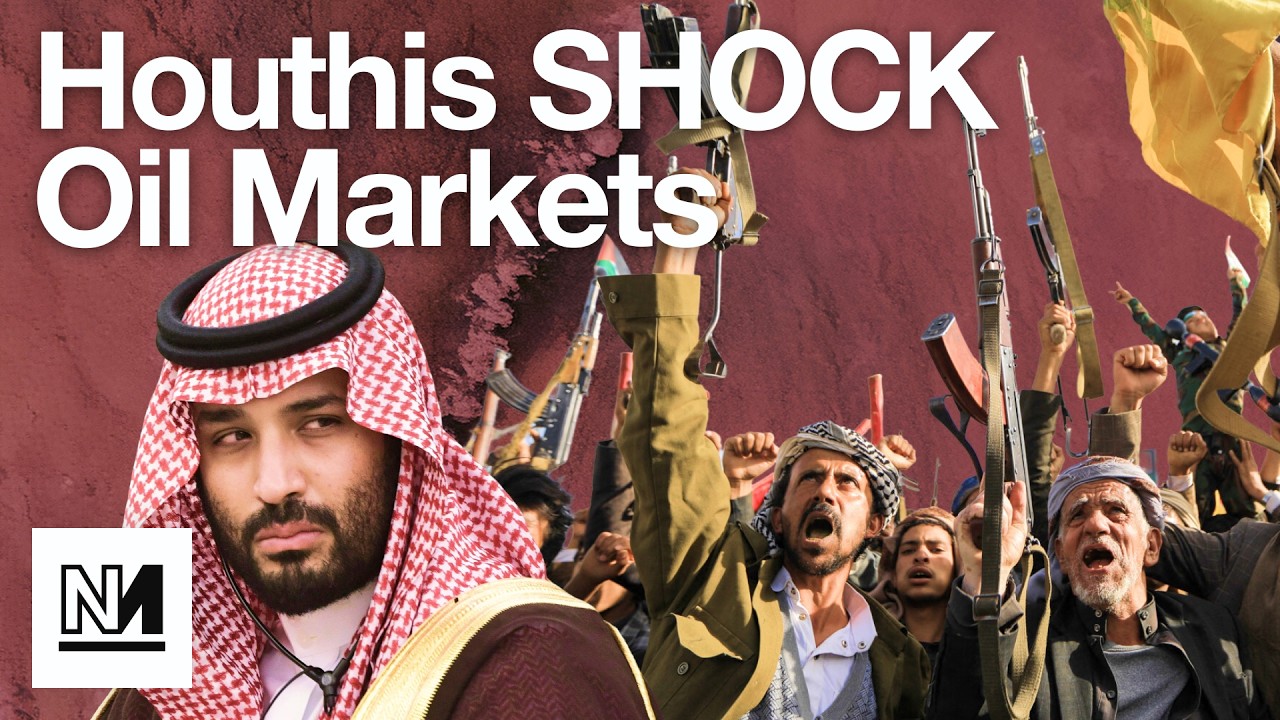
Video summary
Saudi Arabia faces an imminent threat of running out of exportable oil within days following severe drone attacks on its critical infrastructure by Houthi fighters based in Yemen. These strikes have damaged the East-West pipeline, which transports approximately 4% of the world's oil supply, forcing Saudi authorities to shut it down and depleting their export stocks rapidly. Consequently, global oil prices have surged above $108 per barrel for the first time since May, marking a significant spike in energy costs. The situation is compounded by the fact that the pipeline was designed specifically to bypass the Strait of Hormuz by moving oil from the Persian Gulf to the Red Sea; with both the Red Sea route currently blocked by Houthi control and the Strait of Hormuz restricted due to tensions with Iran, Saudi Arabia has very few viable options for exporting its crude.
The strategic advantage held by the Houthis stems from their recent military advances in Yemen, which have allowed them to seize key ports like Mokha and effectively control access through the Bab el-Mandab Strait. Analysts suggest that this shift represents a calculated move in asymmetric warfare, where threatening the East-West pipeline serves as a powerful leverage tool against Saudi Arabia and its allies, including the United States. By demonstrating their ability to disrupt such a vital supply line, the Houthis have forced regional powers into a defensive posture, preventing them from easily retaking territory without risking further attacks on their own energy lifelines. This dynamic has turned the conflict into a geopolitical chess game where ordinary Yemenis suffer displacement and chaos while international powers grapple with the implications of these disruptions for global markets.
Despite initial fears that this convergence of blocked routes would cause an unprecedented catastrophe, the global oil market has shown surprising resilience, with prices rising to around $109 rather than the predicted $200 or higher. Experts attribute this relative stability to China releasing strategic reserves and other nations adjusting production levels to compensate for the supply crunch in one region. However, the long-term outlook remains uncertain as repairs to the damaged pipeline will take considerable time due to a lack of spare parts, and the Houthis appear determined to keep the Red Sea route closed indefinitely. This ongoing instability not only impacts the cost of living globally but also adds significant pressure on political leaders ahead of upcoming elections in the United States, potentially reshaping Middle Eastern politics for years to come.
Read the full video transcript
Saudi Arabia could run out of oil to
export within days, sending energy
prices skyrocketing. That's after major
drone attacks hit key infrastructure in
the country. And this satellite image
shows damage to a pumping station on
Saudi Arabia's East West pipeline
following drone strikes by Hufi fighters
stationed in Iraq. Um the pipeline,
which transports around 4% of the
world's oil, was shut off by Saudi
Arabia on Saturday. Traders told Reuters
that the Gulf State will run out of oil
stocks for export within days unless the
pipeline is reopened. Um this sent oil
prices rising above $108 a barrel for
the first time since May. Um the damage
to the pipeline follows months of
military advances by the Iranianbacked
Houthies. Um, as Joe Inwood reported for
BBC News,
we are now getting a clearer picture of
the fighting that led to the Houthi's
lightning advances
as they swept down Yemen's Red Sea
coast, routing the Saudi back forces of
the internationally recognized
authorities.
This footage was released by the group's
media department. It's not clear exactly
where or when it was filmed.
Much of the footage is too graphic to
broadcast. They say this is what remains
of a convoy that tried to flee. Dozens
of bodies in military uniform are
clearly visible. There is no dressing up
what has happened as anything other than
a disaster for the Saudis and their
allies. So Saudi Arabia began supporting
the Yemeni government in a bloody civil
war against the Houthies in 2015. Um
Saudi fighters supported by American,
British, and Israeli forces have bombed
the country relentlessly ever since. Um
but now the hoopies have made
significant advances. So their capture
of Pim Island from the Saudib backed
government um over the weekend has given
them full control over ships moving into
and out of the Red Sea. Um that's really
significant via the Bab al-Mandab
Strait. Um that means they can prevent
Saudi oil tankers leaving the area into
the Indian Ocean and towards the Asian
market. And with the straight of Hormuz
closed following US air strikes on Iran,
that leaves Saudi Arabia with few
options to export its oil. Um, now that
means that even if the East West
pipeline gets repaired, it may not
matter that much, right? Because this
the whole point of the pipeline is to
move it from the straight of Hormuz to
the Red Sea so they can export via the
Red Sea. If they can't export via the
Red Sea nor the straight of moose and
it's very difficult to get that oil out
of Saudi Arabia. Um, let's listen to
Yemen or Yemen analyst Muhammad Al-
Bashar explaining to CNN um how or to
what extent the Houthies and their
sponsors Iran are in a very strong
position here.
>> The Houthies now have a tool to target
those countries and to pressure the
international community to play
according to their game. So this is
their trump card and they've realized
that
>> ordinary Yemenes meanwhile are caught in
the chaos. So thousands of people have
fled across the Gulf of Aiden to
Djibouti in search of safety in recent
days. The UN estimates that 85,000
people have been displaced by the
conflict since the start of September.
Since the Houthies took over the Red Sea
port city of Mocka last Thursday, there
are reports that entire villages have
been displaced. The influx of refugees
into Djibouti comes with the country
already sheltering over 36,000 refugees
with the majority from Somalia,
Ethiopia, and Yemen. Um, right now it's
unclear how Saudi forces will respond to
the Hoovi advance, but already the blame
game has started. Um, one Middle East
source told CNN this. It was a complete
failure of political leadership. There
was not one air strike throughout the
day yesterday by Saudi support forces,
although there were minute-by-minute
updates. It's a Saudi American [ __ ] of
epic proportions. Um, for Iran, the
Houthi success means it has succeeded in
its bid to push global oil prices
higher, increasing pressure on the Trump
administration to change strategy in the
Middle East. And what happens next in
this conflict could have a major impact
on November's midterm elections in the
United States, as well as reshaping the
politics of the Middle East once again.
Um, this is a really remarkable story
cuz I remember when the straight of Hmuz
first got shut and everyone was saying,
well, this is sort of 20% of the world's
oil supply. This is a disaster. loads of
the world's oil comes through the
straight of of Hormuz. Um, but there's
also from Saudi Arabia, they can get
their oil through the Red Sea so long as
they pipe it from the the east of their
country, which is where most of the oil
is. Um, and sort of they were investing
actually in sort of more pipelines to
get stuff from um the the Persian Gulf
to the Red Sea. And lots of people were
saying at the beginning of the war,
well, what if the Houthies shut down the
Red Sea? Um, that would obviously create
complete chaos, right? And that was sort
of always put forward as that would be
the apocalyptic scenario. There would be
nothing worse than that. And now that's
happened. I mean, it's not really it's
not even the top story today. Seems
fairly significant news to me. Not the
top story on anyone else's website
either. Um, and actually to be honest,
given how bad everyone was saying this
was, oil at only $109 isn't like the
worst it's been.
>> Only been a weekend.
>> Only been a weekend. Yeah. So I I
suppose they think that the hoofies, you
know, they're they're a bunch of
amateurs that they're going to be able
to reopen the Red Sea sometime soon. Um,
and
>> I mean, they kept it shut for a really
long time in 2023 and
>> and also the pipeline apparently is not
going to be fixed for ages because they
need spare parts. So, I mean, it seems
like this seems like this is a bit of a
disaster for the global oil market. Um,
and obviously that's going to be, you
know, it's not good good news for Andy
Burnham because that will sort of have
an effect on the cost of living. Not
good news for Donald Trump if that sort
of the oil price going up before
midterms isn't very helpful for him. But
yeah, I mean it's interesting the
analysts sort of saying this is just a
[ __ ] up from the Saudis and the
Americans because you know you'd have
thought they they should be able to keep
control of these key ports from the
Yemeni militias. Well, look, I I think
actually this might be an object lesson
in how asymmetric warfare can work
really effectively when effectively when
you're at the lower end of it because if
what you can what so so I think maybe
what the Yemeni calculy calculation here
was that look the straight of Hmus close
closes there is then something very
close to us that becomes very valuable
for our enemy Saudi Arabia which is the
output of that of that pipe on the on
the west side of the country. So if
we've threatened that pipe, Saudi Arabia
is probably not going to mess with us
while we try to like take control over
the parts of the country that we haven't
yet taken control of because the risk
for them is that we actually really mess
them up by bombing that pipeline and
then there's no way of getting any of
the oil out.
>> Um and it kind of looks like that what's
that's what what's happened because the
Houthies now now have control over
basically all of the parts of of Yemen
in which people actually live. Um, so
there's a sense in which I mean I'm sure
there's going to be some push back at
some point where they've actually just
sort of won won this war now if they can
hold things off.
>> Um,
and you know the pipeline has been
damaged. Um, you know, it can it will be
it will be repaired. I'm sure perhaps
that damage was just a way of saying
like we're here. We can do this anytime
we want. don't don't try it with the
gains that we've made in in in the
country because of course Saudi Arabia
has been the massive enemy of the of
with the US because they were work work
in tandem with us as well of the Houthis
where whereas um um you know the
Houthies are you know to some extent
unclear what's exaggerated what isn't
linked to linked to Iran um but I do
think this is this has been you know the
the the increase in value of this this
pipeline in Saudi Arabia near to Yemen
has has created the strategic advantage
for the Houthis and I think they
probably exploited it. So that's another
issue where or another sense in which
Trump's botched invasion of Iran or war
against Iran has backfired for America
and their allies because by by Iran
proving that they can control the
straight of horm that's massively
increased their leverage and by
increasing the significance of the east
west pipeline and then also um that
entry to the Red Sea it's given the
Houthies more leverage in their war
against the official Yemen government.
>> And I'll give you another sign as well.
I was reading earlier, I I wish I could
remember exactly where, I think maybe it
was in the Guardian, that um the Saudis
had asked the US two or three times to
do strikes on Yemen and the US had said
no. And that's because that pipeline is
also valuable for them.
>> So interesting. We'll come back to this.
We'll see. I mean, when it comes to oil
prices, I'm now a bit more,
>> I suppose,
>> you know, I'm a bit more wait and see
because when the straightfor was first
closed, you know, I was listening to all
of these podcasts that were saying this
is so much of the global oil supply. I
think it was 20, they were saying it's
20% of the global oil supply and to um
sort of decrease demand by 20%, because
demand for oil is is relatively
inelastic, you're going to need prices
to go up to like $200. that's the only
way to get demand down to sort of have
it back at equilibrium let's say to the
market um and that happened right it
went up to what did it go up to 120 or
something um that was partly because
China released lots of oil from their
strategic reserve so lots of people say
China saved the world um from an oil
crunch at that period of time also
because you know markets are fairly
responsive to supply crunches in one
part of the world and then they up
production elsewhere so yeah in in the
short term this this is the kind of
scenario IO where people would have said
if the straight of Hormuz is closed if
that pipeline's blocked and then if the
Red Sea looks kind of blocked like this
is unprecedented catastrophe but you
know the world seems in some way more
resilient than many people had predicted
which I suppose is positive in a way
[snorts] I mean it's strange to look at
the Middle East now and and the oil
market and say well this is positive
we're more resilient than before this is
my contrarianism coming Yeah.