Video summary
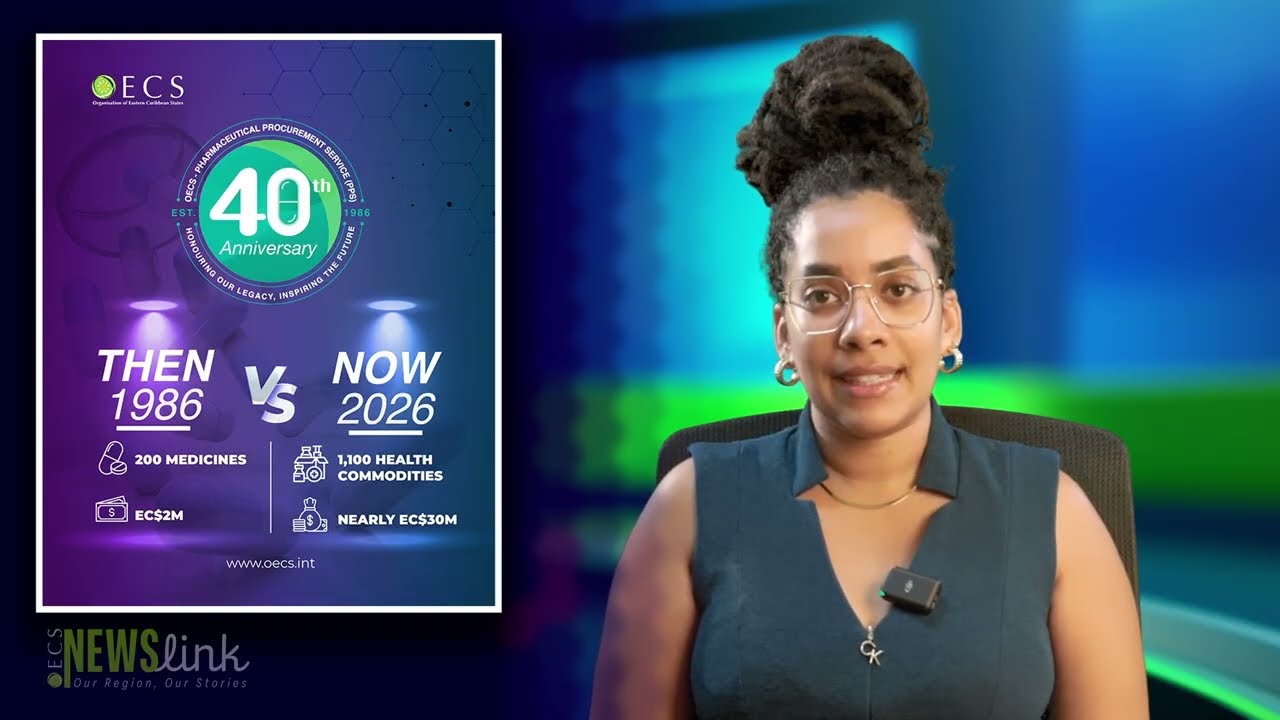
The OECS News Link highlights four significant developments across the region, beginning with a milestone celebration for the OECS Pharmaceutical Procurement Service. Established in 1986, this service has successfully expanded its portfolio from approximately 200 medicines to over 1,100 essential health commodities over the last forty years. The impact of this collective procurement is substantial, generating an estimated five million Eastern Caribbean dollars in annual savings for member states. Camille Glasgow, the chief pharmacist of St. Vincent and the Grenadines, emphasized that these cost reductions allow governments to make healthcare extremely affordable for patients, enabling them to access physicians and prescribed medications at a minimal revenue stamp fee rather than full market prices.
Beyond economic savings, the procurement service is evolving into a critical component of regional health security and disaster preparedness. The OECS Commission has also completed a major infrastructure project aimed at fortifying schools against climate threats in Dominica and St. Vincent and the Grenadines. Atkinson Primary School received improved drainage systems and hurricane-resistant doors, while Sandy Bay Government School was equipped with new water storage tanks, emergency equipment, backup power, solar lighting, and communication systems. Furthermore, thirty-six educators and community stakeholders underwent training in disaster preparedness, creating a model that will now guide similar resilience efforts in St. Lucia and Grenada to better protect vulnerable populations from future climate events.
In the realm of international diplomacy and gender leadership, two OECS women have made history by joining the African Academy for Women in Political Leadership. Lanielle Blanchard, Speaker of the National Assembly in St. Kitts and Nevis, and Lisa Jawahir, a Cabinet Minister in St. Lucia, participated in the academy's official launch in Kigali, Rwanda. Their acceptance into this prestigious program strengthens political ties between Africa and the Caribbean while fostering an exchange of expertise in legislative governance and leadership. This collaboration is expected to create new opportunities for women in political leadership across both regions, promoting a stronger voice for female leaders on the global stage.
The final story focuses on technological advancement through the World Bank-funded OECS Skills and Innovation Project, which has advanced plans for a region-wide digital education system following a development session in Grenada. Software developers and technical specialists from various member states collaborated to build three interconnected platforms covering online learning, student data management, and technology innovation. This initiative, developed by regional professionals, aims to strengthen post-secondary education, improve data-driven decision-making processes, and expand digital opportunities for learners throughout the OECS, ensuring that the region remains competitive in the modern digital economy.
Read the full video transcript
[music]
>> This is the OECS News Link, a roundup of
major news happening across [music] the
OECS today.
In the headlines,
>> 40 years strong, securing medicine for
the region. [music]
OECS fortifies schools against climate
threats. Caribbean women take their
place on the African leadership stage.
[music]
OECS engineers build a smarter education
system.
Good day, viewers, and a welcome to this
edition of the OECS News Link. I am
Claudia McDowell. Thank you for joining
us.
Starting off, the OECS Pharmaceutical
Procurement Service is marking 40 years
of helping OECS countries secure
affordable medicines and essential
health supplies.
Since its establishment in 1986, the
service has expanded from about 200
medicines to roughly 1,100
health commodities, and now generates an
estimated 5 million Eastern Caribbean
dollars in annual savings for
participating member states.
>> Hello, I'm Camille Glasgow, [music] and
I have the privilege to serve as the
chief pharmacist of St. Vincent and the
Grenadines. [music]
The pool procurement has made a
tremendous difference for the patients
and of St. [music] Vincent and the
Grenadines.
Right? So, we are able to have
medication at prices that allows the
government to make health [music] care
extremely affordable.
So, a patient coming through our public
health care system, [music] they're able
to see a physician and get their
prescribed medication at a $5 revenue
stamp. And when we think about what
medication actually costs, [music] that
is really significant.
So, it's not just about the saving on
the medication cost itself, but it was
that saving allows us to give back
[music] to our people.
>> The OECS PPPS has also become a key part
of regional health and disaster
preparedness with plans to continue
strengthening access to medicines and
responding collectively to future health
emergencies.
In our next story, the OECS Commission
has completed a project aimed at
strengthening disaster resilience at two
indigenous schools in Dominica and St.
Vincent and the Grenadines. Atkinson
Primary School received improved
drainage and hurricane resistant doors,
while Sandy Bay Government School
received new water storage tanks,
emergency equipment, backup power, solar
lighting, and communication systems.
36 educators and community stakeholders
were also trained in disaster
preparedness, and the model will now
help guide similar resilience efforts in
St. Lucia and Grenada.
Next, two OECS women leaders have made
history after being accepted into the
African Academy for women in political
leadership, strengthening political ties
between Africa and the Caribbean. St.
Kitts and Nevis National Assembly
Speaker, Lanielle Blanchard, and St.
Lucia Cabinet Minister, Lisa Jawahir,
took part in the Academy's official
launch in Kigali, Rwanda from August 2nd
to 7th.
Their participation will support the
exchange of leadership, legislative
governance, expertise, while creating
new opportunities for women in political
leadership across both regions.
And in our final story, the World Bank
funded OECS Skills and Innovation
Project has advanced plans for a
region-wide digital education system
following a four-day development session
in Grenada.
Software developers and technical
specialists from across OECS member
states worked on three interconnected
platforms covering online learning,
student and education data, and
technology and innovation.
The initiative developed by regional
professionals will strengthen
post-secondary education, improve
data-driven decision-making, and expand
digital opportunities for learners
across the OECS. With this, we come to
the end of this edition of the OECS
Newslink. I am Claudia McDowell, and you
can find out more about these stories in
the OECS online pressroom. Find us on
all major social media platforms as
well.
Thank you for joining us, and see you at
the next edition of the OECS Newslink.
>> [music]
[music]