Novel combinational therapies:Is the increased toxicity worth the possibility of increased benefit?
Watch on YouTubeVideo summary
The speaker begins by highlighting the significant evolution in treating metastatic kidney cancer, noting a shift from sequential single-agent therapies before 2015 to more complex combination strategies. Historically, treatments were administered one after another as patients progressed on a drug until it stopped working, rather than combining them simultaneously due to fears of excessive toxicity that prevented reaching effective doses for both medications at once. The landscape changed with the introduction of immunotherapies and targeted agents like tyrosine kinase inhibitors (TKIs) which target blood vessels or cancer metabolism; however, early attempts to combine these often resulted in unacceptable side effects, limiting their clinical utility until newer approaches were developed that could better manage toxicity while maintaining efficacy.
A pivotal moment discussed is the FDA approval of a combination therapy involving lenvatinib and everolimus, based on data from a randomized phase 2 trial rather than an initial registration study. This specific pairing demonstrated statistically significant tumor shrinkage in about 43% of patients compared to lower rates for single agents alone, with improved progression-free survival durations. While the overall survival benefits were less pronounced due to the nature of the trial design using sequential arms as proxies, this success paved the way for exploring combinations between immunotherapies and TKIs. The rationale behind these new pairings is that while targeted therapies can be toxic when combined with each other, they may have synergistic effects or manageable side effect profiles when paired with checkpoint inhibitors like nivolumab or pembrolizumab, potentially enhancing immune response without compounding severe adverse events.
Recent large-scale studies and ongoing phase 3 trials are now investigating whether combining multiple TKIs with immunotherapy yields better outcomes than standard single-agent treatments, particularly in patients with intermediate or poor-risk disease who showed superior results on dual immunotherapy compared to sunitinib alone. Conversely, favorable-risk patients sometimes fared better on older standards like sunitinib, underscoring the necessity of stratifying patient groups before implementing aggressive combination regimens. Although early-phase trials show impressive objective response rates and durable responses in some cohorts, there remains uncertainty regarding whether these high shrinkage percentages translate into long-term cures or simply prolonged disease control, emphasizing that toxicity management and understanding drug interactions remain critical hurdles to overcome for widespread adoption of these novel therapies.
Read the full video transcript
so I'd like to thank the organizers of
this conference for allowing me the
opportunity to talk to you guys about
kind of novel combination therapies for
the management of kidney cancer
here are my disclosures so you kind of
seen this list multiple times now ever
since about 2005 we really have had 11
fda-approved drugs for the treatment of
metastatic kidney cancer and this is
really phenomenal growth and advancement
within the field you know up until about
2005 or 2015 most of which have has
really been single Asian therapy so back
before 2015 this was kind of the
treatment paradigm and if you had asked
me like do we do combination therapy the
answer would have been no what we really
did was we took treatments and we used
them kind of one after another in a very
sequential sort of fashion so you you
know progressed on one and then you move
to the next and then if you work us on
that you would move to the next so this
is kind of looking at the different
categories of medications in which the
eleven can be classified into the first
of which you know is has always been the
largest group and this has really been
based off of the mechanism by which the
kidney cancer derives its growth and
it's really targeting the blood vessels
that feed the kidney cancer the second
category is are the Amthor targeted
agents and they are medications that
work by changing the metabolism the
kidney cancer that regulates growth and
proliferation and more the new kids on
the block now are the development of the
immunotherapy is which you've heard
multiple times work by boosting your own
immune system to have your immune system
better fight and recognize the kidney
cancer
now back before 2015 there have been
multiple pro
with multiple clinical trials looking at
that as a possibility but up until that
point we really the store was very
simple like you combined the medications
and we never really saw any increased
benefit by using this combination I mean
it seems like a very straightforward
question like you know you take one from
one category and you combine with one
from another category you're attacking
the cancer from two different directions
and you would think that this is
something that would work better but
what we actually saw was when we
combined some of these medications the
amount of toxicity that we ended up
seeing was significantly higher high
enough that we actually weren't able to
get to kind of high enough doses of the
medications such that we could try to
harness this sort of efficacy
information so that's one of the
greatest pitfalls is using combination
therapy is whether or not we actually
can get to both of the drugs which were
initially designed to be used
individually it's a high enough doses
that we can actually use them in
combination other times we've tried to
combine two drugs that target the blood
vessels and we've also seen by we saw
great responses but unfortunately we saw
a lot of toxicity that came along with
it in which they weren't able to move
forward just because of the amount of
people develop toxicity from it so the
first medication or first combination
unit they're a combination that was
fda-approved was the combination of
Labatt and applause everolimus and this
is a combination that takes one drug
that targets the blood vessels that beat
the kidney cancer and one drug that
targets the metabolism so this was done
in a randomized phase 2 clinical trial
so at the time it wasn't designed as a
registration trial that company wasn't
thinking about using this to get FDA
approval so it was a relatively small
trial that took in about a hundred and
fifty patients patients were randomized
to either the combination of Lin bat nip
at 18 everolimus at 5 or Lin bat Nevada
higher dose at 1
four and everolimus at ten which is the
fda-approved dose and they wanted to see
whether or not there were the patients
were able to be treated how long the
disease progression free survival was
and you know also to see whether or not
they were stopped at unacceptable
toxicity the fraud was designed to kind
of look to see whether or not the length
of response for each combination or each
drug was better than ever lime is that's
kind of the comparison arm so this is
what they ended up seeing so they end up
having about 50 patients in each group
and then the patients who got
combination when baton of everolimus had
43 percent of them had shrinkage of
their tumor compared to 27 percent with
own bangable own and 6% with everolimus
by itself and this was thought to be
statistically significant now most of
these are what we call partial responses
what a partial response really means is
that you know you have greater than 30
percent shrinkage but you also have not
it doesn't completely go away the other
number to look at is how long was the
duration response so as you can see the
duration of response for the people who
responded they had a median duration of
response of 13 months and you know for
the single agent arms limb fat and it
was you know 7.5 months and then ever
limas by itself was 8.5 months so even
though there was a small percentage of
people who had shrinkage of their
disease if you did have shrinkage of
their disease it did you know convey
some good clinical benefit here another
kaplan-meier plot that you've probably
seen multiple times and what you do see
is clear separation so the cyan color is
the combination of Lombok no+ everolimus
and you know on a whole the median
progression-free survival is 14 point
six months and then you know ever limas
doing the worst with a 5.5 months and
then magnify itself kind of in the
middle but this in of itself doesn't
really answer the question and we may
not necessarily get the true answer the
question
of what if we used us to use them one
after another like you know that's that
type of trial often is we aren't capable
of doing and so as a result you know we
use these as kind of proxies like you go
ahead and you get the drugs with kind of
the highest possible response and you
know you kind of you know assume that
doing it this way is a little better
this is looking at the overall survival
numbers and you know because this trial
was empowered to look at overall
survival and overall survival gives us a
better metric of what would happen if we
use them sequentially but if you just
don't have the numbers you may not
necessarily see that you know from a
numerical standpoint the combination of
long diagonals everolimus was improved
in comparison to people who got you know
either everolimus by itself or limb
Batna by itself so moving forward the
new interest right now has really been
looking at how can we combine the
immunotherapies with other drugs because
with the immunotherapy drugs that a lot
of excitement has been centered around
this and it does seem like using the
immunotherapy is are a little bit easier
to combine whereas the drugs that we've
used for kidney cancer in the past we've
run into a lot of toxicity issues with
that so as you all have known on
checkmate 205 this is a randomized
clinical trial looking at Nivola map or
opt Evo randomize against everolimus
with a primary endpoint looking at
overall survival with the key secondary
endpoint of looking at the objective
response rate so if you look from a
progression-free survival standpoint by
itself with single agent immunotherapy
you know progression-free survival may
not necessarily give you the tower
answer because from the this you can see
that progression for survival on Evo was
you know four point six months
everolimus was four point four what
really does interest us about the
immunotherapy is is the duration of the
response for those that respond they
sent teen tend to do much better and the
idea behind combination there
for this population is really to see
whether or not we can either improve
upon you know the response rates or to
kind of see whether or not that long
tail can be maintained and this is what
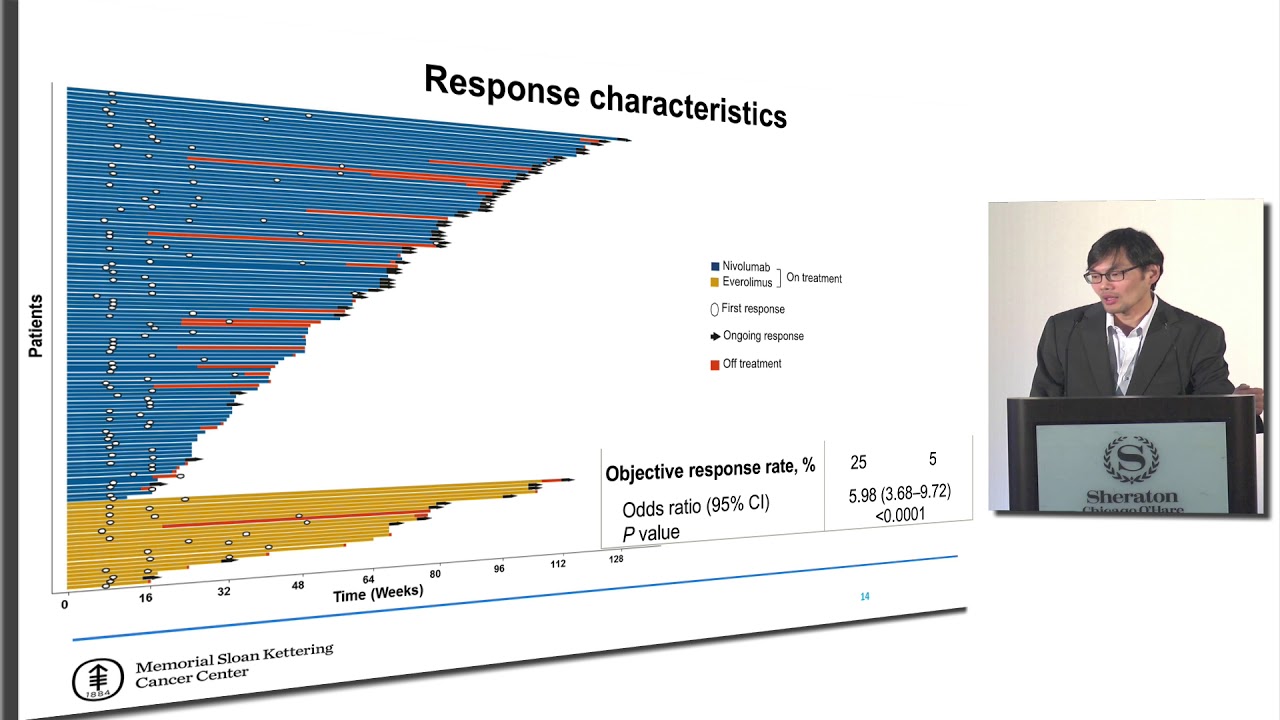
we can see with this swimmer spot so a
swimmers plot is basically every patient
they get started on treatment and you
kind of you know see how long it lasts
for and you can see that quite a few
people who were treated with new bola
map you know we're still an ongoing
treatment and kind of maintaining those
results and this kind of bears out in
the overall survival data which was the
Oh at the end point in which if you got
single agent you know therapy you
definitely did better than not having
gotten a single they become true name
you know therapy so check me two one
four was the first was one of the
combination immunotherapies studies
looking at if it will imatinib ola map
which you've heard about and this was
done in the first line setting but at
the same time so this was a one-to-one
randomization of getting combination
immunotherapy versus the standard of
care at the time which was Sutent
patients were stratified based off of
their risk stratification whether or not
they had favorable risk intermediate
risk or poor risk you know they were
kind of put into separate buckets making
sure that you know kind of the arms are
balanced and patients who again treated
until either progression or they
developed kind of unacceptable toxicity
related to the medications and this is
where we see something very interesting
so in people who had intermediate or
poor risk disease and this is a very
clinical sort of measurement of how
patients are stratified you know the
this has you know we're taking numbers
that or that just come from a strong it
in the blood that don't directly relate
to you know the biology of the cancer
and taking metrics as also in terms of
how you feel as a patient and again like
that gives us some clue about you know
the cancer and being able to you know
see differences in the treatment
approaches well and what we ended up
seeing is for
at intermediate pour rust disease they
did better on the combination of two
immunotherapy drugs than they did on the
standard vegetative therapy at the time
you know with a forty two percent
objective response rate versus twenty
seven which was statistically
significant however for people at
favorable risk disease we actually saw a
reverse trend so for people with
favorable risk disease you actually did
better just going with run-of-the-mill
synonym this is the drug that would just
approve like at this point you know
around ten years ago and giving you more
drug doesn't necessarily mean that we're
getting better effects and in terms of
you know the percentage of people that
are responding so this is one of the
things that we always have to look a
look at before we start you know jumping
into just like you know combining things
that random and implementing them is
really to be able to make that
comparison and looking at you know what
are the groups that are going to benefit
from kind of getting additional
treatment and you know because the
general treatment always comes with a
little bit of additional risk so within
the intermediate or risk group this is
the overall survival data and then you
can see that the curves separate pretty
nicely in which you know people who had
intermediate porous disease you know at
the time in which they evaluated you
know the median overall survival hadn't
yet been reached while as the people who
are created with Sinitta biood sunitinib
in the first line setting had a median
overall survival of twenty six months so
then the question becomes another
possible combination is what if we take
one of the drugs that you know targets
the blood vessels because we know the
response rates and the people who
clinically benefit from that medication
seems to be rather high and we paired it
with one of the immunotherapy drugs and
see whether what the response rates and
clinical outcomes would end up being and
then there is some rationale for making
this combination so one immunotherapy
drug is the drug at tehsil as a mouth
and one drug is Bevis as a map and the
rationale for combining
really is the drugs that target the
blood vessels probably have some effects
on the immune system also you know it's
very tough for us to know in advance
what the exact mechanism by which we see
this cooperation but you know whether or
not it's you know increasing immune
cells ability to present the cells or
opening up the tumor so that more immune
cells can come in or just decreasing be
a number of mune cells that inactivate
the immune system that really still
remains kind of an open-ended question I
don't think we necessarily have the
definitive answer but without having
that definitive answer it doesn't really
change the fact that we do have clinical
studies that can give us some insights
about information about efficacy so in
the phase 3 clinical trial comparing
this combination to sunitinib
in people who expressed PDL 1 so this
was looking at as a primary endpoint you
know expression of the marker that the
immunotherapy targets you know we saw
you know good separation of the curves
and you know an improvement in
progression-free survival in comparison
to sin it at the eleven point two months
versus a seven point seven and from a
toxicity standpoint because a test the
immunotherapies in general haven't had
that many side effects in Bevis ism have
you know for medication that targets the
blood vessel and you know makes it
relatively easy to tolerate and you know
has been you know combined with multiple
agents including give different chemo
therapies you know and uh and has also
been combined
you know successfully with the m4
targeted agents overall showed less side
effects that people find to be
bothersome in comparison to send Aetna
granted you know there are some other
targeted agents that you know may be a
little bit easier to tolerate than this
in a net but you know the comparison
wasn't done against that group and in
this you know we do see you know some
evidence that you know doing this type
of combination from a patient standpoint
in terms of
you know tolerability we see benefit
however there is certainly the
inconvenience standpoint of when we were
talking about doing IV infusions on an
average week basis so right now there
are multiple phase 3 clinical trials
really looking at the use of
immunotherapy plus checkpoint inhibitor
you know with you know pretty much
almost all of the different tyrosine
kinase inhibitors or anti-angiogenesis
drugs that you know are available so
there's the clinical trial with lung bat
nip which is a large phase 3 it's
looking at Lin Batna plus member
Elizabeth temporal is about being the
immunotherapy against Lin Batna plus
everolimus ever being the fda-approved
combination in the second line setting
random guys again soon it nib for exited
there's been two clinical trials that
are completed accrual so and we're kind
of still waiting for the release of
those results one is with exhibit plus
PEM bro
the other one is a voluma a balloon map
is just a tear for an immunotherapy that
can be combined with the exhibit and
then the Bevis ISM a Plaza tezo as I had
mentioned before and then also up and
running right now is the combination of
Kappa Zeta plus an Ebola map randomized
against in it them so right now we don't
have phase 3 data for this sort of t ki
io sort of combination but we can gather
some quick glimpses at what we may
expect however you know a lot of caution
has to go into looking at you know data
from phase one and Phase two trials
because historically speaking you know
our results have all sometimes been a
little bit better
perhaps it's patient selection perhaps
it's just the small numbers of patients
so we don't get as clean up a look so
this is a fifty-two patient study in
which about 56% had an objector response
so this is a very
like you know as you can see from the
waterfall palat like almost all the
patients did end up getting shrinkage
their tumor even beyond you know the 58
percent because the 58 percent looks at
that dotted line and that that cut off
right there and what we still don't yet
know is whether or not this objective
response truly predicts for how long the
progression-free survival is and from
your standpoint as a patient like and
I've told all my patients this when
they've gotten TK eyes is you know it's
all we know shrinkage is always better
than growth but what you are interested
in is not necessarily shrinkage but how
long the drug is effective for like you
know what you the last like just because
you get shrinkage and then the next skin
afterwards the disease grows right back
like you know you didn't care you got
shrinkage like you know I think that
what you want is the medication to work
on a kind of a more ongoing sort of
basis so this is another one of these
clinical trials looking at this type of
combination and this is with an badenov
plus member ellisa mob and this is a
trial that looked at patients that were
both treatment naive so having not
gotten any previous treatment in
patients who got previous therapy so
they got a tki beforehand what they end
up showing was you know it's a small
trial of you know 30 patients if they
looked across the entire 30 patients 63%
had an objective response if you looked
only at the treatment naive patients so
that so the patients who hadn't got any
previous therapy 83% of them had to rank
each of their tumor and then if you
looked at the patients who got previous
treatment then about 50 percent of them
had shrinkage of their tumor and as you
can see from the waterfall plot you know
there's not good prediction on whether
or not you got previous treatment
whether or not you know you had more
frança tor less shrinkage and then the
other thing that we again often look at
is PDL one status and then you know as
you can see from the random smattering
of colors like you know PDL one status
didn't actually well predict whether or
not you're
going to get shrinkage of her tumor you
know with this sort of combination the
question is you know what is the
toxicity like you know so when we look
at toxicity and when we look at
combinations you know it's probably to
be expected that you're going to get
talks is the the odds of you're going to
get the toxicity of the two treatments
what the issue really becomes is also
like do you get additional toxicities
when you have combinations to the two
drugs interact in some sort of way that
you know in the same way that we you
would like them to enhance their
efficacy there's also the possibility
that the drugs may end up enhancing
their toxicity related to each other and
at least that underly follow-up they
didn't see any safety signals to suggest
that there were unexpected talks at his
toxicities related to the medications
and this is their update in which they
looked at progression-free survival
especially when we look at small small
trials like this the medium
progression-free survival on here was 18
months however the actual you know
that's a very wide curve and you know it
only takes a couple people to change how
long that number is measured so we
really do have to wait for the phase
three clinical trial to make you know
firm assessments on you know what the
true progression-free survival will end
up being for this combination another
one the combinations with kappa Plus
nuvola map and this was done either
without or in combination with a
pollutant map so this was only 13
patients again you see kind of within
the same ballpark you know around 50
some percent of people have frankish at
their tumor most of which being partial
responses and the question really
becomes you know how long is this and
the duration of response going to be
looking at so this is really going to be
a really important look that we're going
to get in October of this year for one
of the first trial first phase three
clinical trials with the TK eyes and
immunotherapies with a voluma plus exit
nib you know we know from the press
release that this is a positive trial
but what a positive trial means we don't
yet know so we're kind of anxiously
awaiting to see what those results will
end up being and like you know whether
or not you know this type of combination
will end up being better than and you
know kind of supplant you know the
current clinical approach so in summary
you know I think that combination
therapy and RCC is really a promising
future approach you know we don't yet
know whether or not the using these in
combination is going to be better than
using them sequentially but we do have
some hints to say suggest that that
might be the case and then right now
kind of the big question in the room is
for the multiple TK oh you mean no
therapy combinations you know we've seen
these impressive you know response rates
like in whether or not those response
rates are gonna translate into either
cures which would be great but you know
whether or not they would otherwise
translate just to you know longer
responses you know anyways that's thank
you so much for your attention and I
open the question
[Applause]