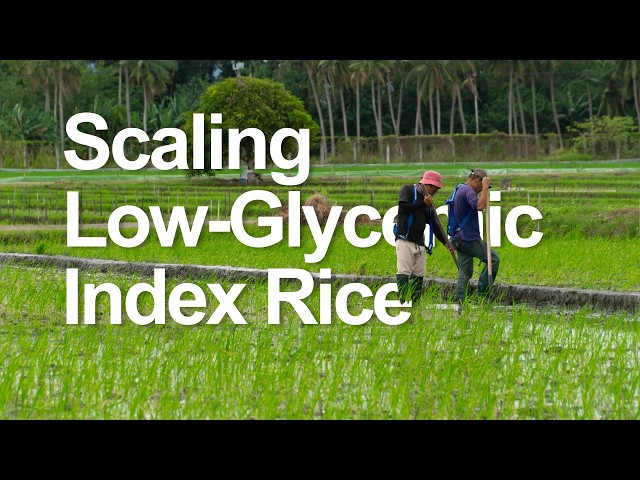
Nourishing Futures: Scaling Low GI Rice in the Philippines
Watch on YouTubeVideo summary
The Low GI Rise project represents a significant collaborative initiative aimed at scaling the production of low glycemic index rice in the Philippines. This effort brings together key stakeholders including the Department of Agriculture, the Field Rise Agriculture Training Institute, regional field offices, and the International Rice Research Institute. A central component of this partnership involves IRRI's role in breeding the specific rice variety while ensuring the production of breeder seeds necessary for subsequent seed classes. These seeds are then distributed through a structured chain involving field rice partners and regional offices to reach farmer seed producers, ultimately supporting the commercial establishment of low GI rice technologies.
To demonstrate the viability of this approach, the project has partnered with 27 farmer cooperators covering an area of 23 hectares across two initial pilot sites in Gamu Sabella and Solana Kagayan. The core of the implementation focuses on farmer field schools that emphasize good agricultural practices, strict adherence to implementation protocols, and standards for rice production. By engaging beneficiaries directly in these practices, the project aims to ensure that farmers are equipped with the knowledge and resources needed to successfully cultivate this new variety, setting a strong foundation for broader adoption.
The ultimate goal of these demonstrations extends beyond simple food security to also address critical issues of affordability and accessibility for the local population. The success achieved in these first pilot sites serves as a model for other regions within the country. If the initial implementations prove successful, there is a clear expectation that other regions will observe these results and replicate the program within their own areas. This scaling strategy relies on proving the concept in controlled environments before expanding to a national level, ensuring sustainable growth for the low GI rice industry.
Read the full video transcript
[music]
The low GI rise project is a
collaborative [music] init um initiative
between the department of agriculture
through uh field rise [music]
um agriculture training institute uh the
department of agriculture [music] uh
regional field office too and um the
international rice research [music]
institute. The role of Erie here is um
not only around breeding uh this variety
but [music] also ensuring that um we
produce the basic seeds, the breeder
seeds that would then be used [music]
for the production of the other seed
classes that uh would be distributed to
other [music] partners. the field rice
and then the regional field offices
[music]
and then uh eventually to the farmer
seed producers and the commercial
production [music] of the low GI rice
establishment technology demonstration
glycemic index. [music]
And as you can see
within this week [music] no we partnered
with 27 farmer cooperators covering 23
hectares.
So the farmer field school focuses
[music] on the different approach like
the good agricultural practices
beneficiaries [music] farmers involved
implementation
protocols and standards [music]
good agricultural production in rice
[music]
after this two initial pilot sites in
[music] Gamu Sabella and Solana Kagayan.
So whatever success we will have in this
first pilot implementation I [music]
think uh that the other regions can see
the success and then we can see if
[music] they will replicate in their
regions
[music] demonstration
low glycemic index ratal
MPI [music] not only addressing food
security but affordability and
accessibility.
[music]
Of course,
demonstration
[music]