Nonprofit Event Marketing Strategies for Mobilizing Supporters and Maximizing Impact
Watch on YouTubeVideo summary
Successful nonprofit event marketing relies fundamentally on building relationships that drive both list growth and donations, as evidenced by the fact that a majority of US donors attend fundraising events specifically to witness an organization's work in action. To achieve this, planners must define clear objectives that extend beyond simple fundraising, such as education or community building, while maintaining strict budgets to prevent overspending. The scope of events can vary widely from traditional galas and 5K walks to creative experiential activities like glass art classes or educational workshops, each offering unique opportunities for monetization through ticket sales, sponsorships, merchandise, and auctions. Crucially, these strategies must include donation options for those unable to attend in person, ensuring inclusivity while maximizing revenue potential across multiple channels.
Effective promotion requires a sustained timeline of four to six months, utilizing a multi-channel approach that combines email campaigns, social media, SMS messages for opted-in VIPs, and offline methods like QR codes on flyers to create urgency and keep the event top-of-mind. Landing pages play a pivotal role in this process by featuring real imagery, social proof, and clear details about who, what, when, and why, all supported by strong calls to action. Once registrations are secured, organizers can leverage tools to manage tickets, view registrant lists, cancel registrations if necessary, and export data for targeted follow-ups. Additionally, website widgets allow users to browse and register for multiple events seamlessly, while connecting with diverse businesses and civic organizations through neutral events fosters partnerships based on shared mission alignment rather than specific targeting alone.
Gathering meaningful feedback is essential for continuous improvement, prioritizing the quality of responses over quantity by offering incentives like raffles or placing QR codes at event tables for immediate surveys. Organizers should also encourage real-time engagement by prompting social media posts with specific hashtags and ensuring all comments are responded to promptly. The communication strategy extends well beyond the event date, recommending a sequence of emails within the first month that includes welcome messages, informational updates, and personal touches like calls or notes to maintain momentum. This post-event follow-up is critical for nurturing attendees into lifelong supporters through automation sequences that share photo galleries, impact stories, and results, ultimately transforming a single interaction into a lasting relationship.
The session concludes by highlighting special offers available to TechUp members, such as new Constant Contact customers receiving a discount on admin fees and the potential for a free year of TechUp Plus with exclusive deep-dive sessions for early signups. A live demonstration further illustrates how to create an event within the platform, showcasing features like custom fields, payment processing options, and RSVP tools that streamline the entire process. For those interested in SMS marketing, it is important to note that explicit permission must be obtained first, messages should remain concise under 160 characters, and registration requires approved 10DLC phone numbers along with tax documentation. Ultimately, while rejection may occur when reaching out to new partners, the necessity of asking remains paramount for establishing connections, and these comprehensive strategies empower nonprofits to mobilize their supporters effectively and maximize their overall impact.
Read the full video transcript
Hi everybody. How are you today? Let me
know if the chat is working. I see your
names coming in. So, I'm going to call
out your names and say hi. Carla, Celia,
I hope I'm saying that right. Christy,
Dan, there is no Carla. I made up that
name. Carla's coming though. Carla will
be here. Danielle, hello. Welcome
everybody. Heather, let me know the
first thing you did when you woke up
this morning. Yesterday, I asked that in
the webinar and I got some of the
sweetest things. Oh my god. One person
said she meditated for 20 minutes. I'm
like, you know what? We all need to do
that before we just jump out here in
this big virtual world. So, thank you
guys for being here. Oo, hello. I let my
chickens out. I love it. I love it. Did
go, girl. Look, I took the dogs out for
a walk first thing this morning. That's
so important, right? Because those dogs
will let you know when they got to go.
Thomas went to the dentist. Good for
you, Thomas. We got to keep those pearly
whites.
>> Got to keep these clean, you know.
That's right. Back with my son to
daycare. Rocky, that sounds so sweet.
And those are priceless moments. I fed
the cat. We had a lot of cat people
yesterday. It was so many. I was like,
"Yay for the cat people." Yay. Kayla is
an organ. I did a little yoga first.
Namaste, Kayla. Awesome. Good job. Yoga
really helps my body. That's like the
only thing when I was going through
physical therapy that really made a
difference. So people say yoga, I'm all
down for it. Guys, we're going to start
in like 30 seconds. So thank you for
letting me know the first thing you did
um when you woke up this morning. My
name is Artha Sas. If you haven't been
here today, I'm the webinar producer or
before, not just today. I'm the webinar
producer here at TechUp. I'm going to
show you how you can participate. You're
already using the chat. Let me know that
you checked on your boat. I love that
you're in St. Pete. You're right down
the road from me. Vancouver is in the
house. I love it. I love it. I love it.
Welcome, guys. Awesome. If you would
like to put your question in the Q&A,
especially if it's a long question,
please put it in the Q&A and we'll um
answer it towards the end. But these
people are like professional. They
probably going to pull it while they're
talking and multitasking.
This is being recorded. You're going to
get the recording and the slides later
today or early in the morning. I'm going
to move out of the way and turn this
over to some of our favorite partners,
Constant Contact. I know you're gonna
have lots of questions. Uh, Thomas,
over to you. Have a great webinar.
>> Thank you so much. And thank you,
Arthan. And thank you everybody for
jumping on. I love the opportunity. I
was just telling the team, I love these
webinars. Y'all are always so engaged.
You're always ready to learn, ready to
uh grow, and ready to hopefully make
that impact in your community. I see
people filing in. We've got a great
group. I'll do a quick introduction
here. My name is Thomas Net. I am a
solution engineer at Constant Contact.
I've been here for 14 years, if you can
believe that, which is crazy to think
about, but I've done webinars. I've also
worked in the nonprofit space. I was an
executive director for a while for a
nonprofit as well. So, the topic that
we're going to be talking about today is
pretty near and dear to my heart because
it is something that is so critical and
it's something that is so fun. It is
also something that once I give you the
title, it might elevate some heart rates
a little bit because it also is a lot of
work. but high-risk, highreward type uh
content that we're going to be talking
about today. And we're going to focus in
on events and nonprofit event marketing.
Now, I know, I know events are so fun,
but they are so much work. The goal for
today is to hopefully give you some
ideas, some motivations, and some
inspiration to really take these ideas
and take how you could leverage
something like Constant Contact to help
with event promotion and for um payments
and for all of the different things that
come with an event. And that's really
what we're going to focus on today is
nonprofit event marketing strategies for
mobilizing supporters and maximizing
impact. It's a bit of a long one, but
you know what? I think it's going to be
really beneficial for y'all. So, let's
get started. And it talks about when we
talk about growing your organization
with events, the biggest thing is
relationships. If you've seen me do any
sessions with y'all or you've seen me do
any sort of webinars, the key thing is
relationship building. It's how do you
get in front of people? How do you
connect with people? And you know what?
In such a digital world, we're in a
digital webinar. I'm looking at a camera
right now. I'm not seeing any of y'all's
faces. That face to face interaction is
so nice. It's so nice to be able to
connect with people and be able to shake
hands and do all of those things because
it's just so personal and it's just such
a wonderful thing to be able to do. And
so we want to talk about that. We want
to encourage that. We want to build
those strong relationships. We want to
bring new people in so that way they can
connect with people who are existing
supporters and volunteers and and
sponsors and stakeholders. All of those
things are absolutely incredible for
connecting and helping people know what
you are doing and the mission that you
are trying to do in your community. This
helps you grow your list and this also
drives those donations that revenue.
Events are a great way to do that and to
really bring everything together to just
show the world what it is that you are
doing. So that's what we're going to
talk about today. Did you know that 81%
of US donors regularly attend
fundraising events? I saw Vancouver, you
might have similar numbers on your side
of the house, too. But the key here is
people want to come to events. Why is
that? Because they want to see what
you're doing. Not only does it help them
kind of see that return on donation, but
it also allows them to see you in action
to see what you're doing. And that's an
incredible opportunity for you to do
just that. So, what are we going to talk
about today? We're going to explore
various types of events to boost revenue
or donations. We're going to learn how
to master event promotion. And we're
going to extend your success beyond the
event. Cuz this is something that
sometimes will happen. You you prep, you
gear up, you do this huge event, whether
that be a gala or a walk or some sort of
huge event. Everything is so exciting
for the buildup and then the event
happens and we take a six-day nap,
right? But we want to make sure that
there's things that are happening
afterwards. We follow up. We want to
make sure that there is a continuation
of that relationship. So, we'll talk
through what that looks like. I'm just
speaking from personal experience. Maybe
y'all are perfectly fine after after an
event, but for me, my wife's always told
me, I know when it's event day because
you kind of are a different person.
Hopefully, you're a bit of a better
situation than I am with that, but you
know what? We want to make sure that we
are following up. So, let's start with
explore various types of events to boost
revenue and donation. So, what is the
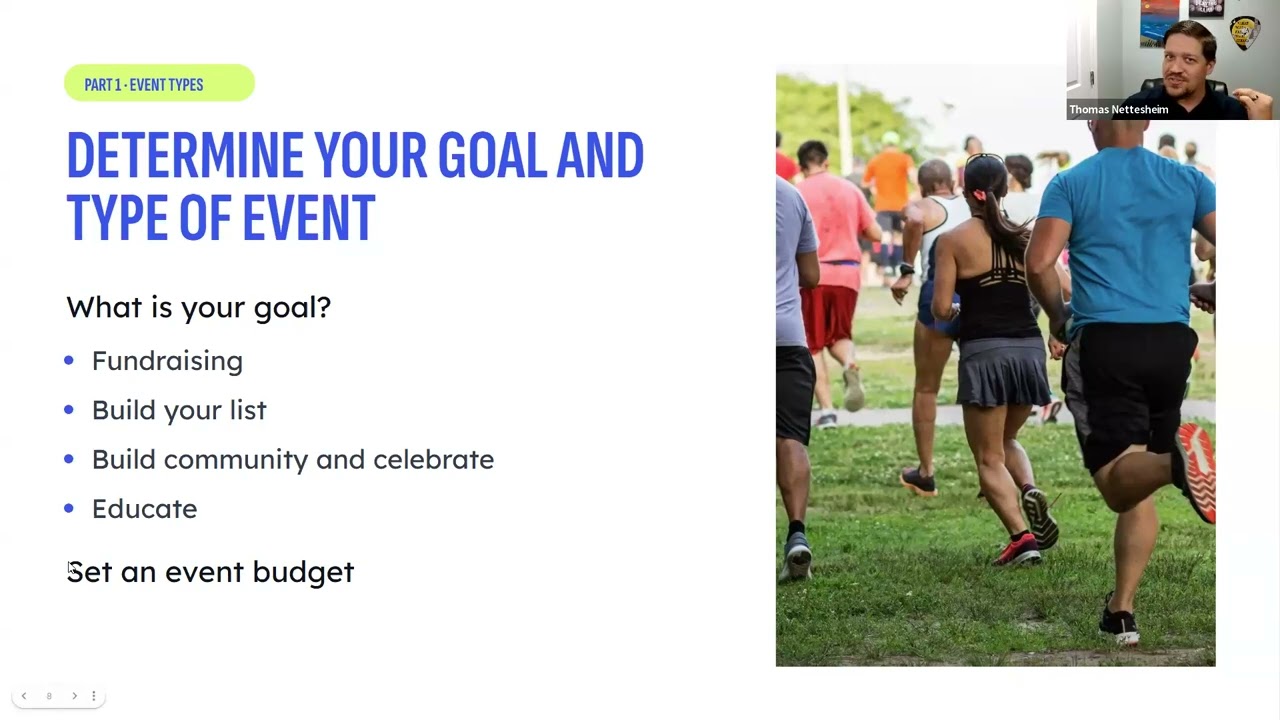
goal? This is any sort of marketing.
This isn't just event marketing, but
this is anytime that you're doing any
sort of communication, anytime you're
wanting to get the word out, you got to
have a goal in mind. Begin with the end
in mind, right? So, what is the goal of
the event? Don't just have an event to
cross to check a box to say you've done
an event. Have a goal in mind.
Fundraising is pretty much always going
to be part of that, right? You're always
wanting to have some sort of return so
that at least you can cover the cost of
that particular event. Whether that be
just renting the space or whatever the
case may be. There always want has to be
some sort of option there. But then
you're also wanting to build your list.
You're also wanting to educate. You're
also wanting to build that community and
that celebration and that opportunity
for pictures and for showing people what
you are doing in the community to get
the word out. So set that goal and then
you'll see this kind of asterisk down
here at the bottom. Set an event budget.
Be careful with that because if you
don't set a budget that can pile up
really quick, right? And if you have
these events where you've done a few
different annual events or whatever the
case may be, set those budgets, plan
accordingly. That's so critical so that
way you don't just burn through your
marketing spend and burn through your
budget in an event that isn't quite
optimized for what you're looking for.
So have that budget as much as possible
at the front for you. So here's a few
ideas. Raffles, gallas, if you've done a
gala before, you know that those are
super fun, but they're a lot of work.
Maybe there's some other things that you
can do kind of in tandem with that that
are a little bit easier, such as maybe a
5K walk, or you could have partnerships
with other businesses or silent
auctions. what kinds of events will show
people what you do and be a fun way for
them to do that. One thing that we did
for the nonprofit that I worked with, so
our nonprofit did um awareness for
things like human trafficking awareness
and education and things like that. And
we actually had a volunteer who painted
who did um who did glass art. And so
what they would do is they actually
hosted a class where they brought all
the materials and then we did a glass
art piece where we built like a mirror
or we built some sort of uh glass art
piece and it was just a reminder. It
allowed us to share a little bit about
what we did but it also was a reminder
of from broken to beautiful was kind of
the the tagline that we brought along
with it to bring that healing and that
hope. So that was just an example of
something that we did that was really
great, really personal, really great
opportunity for people to connect. So if
you have something that is your your
mission, you obviously have a mission
statement, you have something that
you're doing, think about a creative way
to incorporate that into the event
itself or the type even of event that
you are hosting. So what kind of options
are in here? What are some of those
things that you can do? So hopefully
you're penciling down some ideas here.
Event ideas that build loyalty and drive
awareness. Food and beverage tastings,
VIP dinners. If you've got those people
who are some of your more premier donors
or some people that have sponsored in
the past or have been key volunteers
over the years, do those VIP dinners. Do
those connections. Help them feel like
they are such pivotal people in your
mission and what you're doing. Offer up
those opportunities. again, partner with
another organization. You know what the
greatest thing that you can do is show
camaraderie. Unfortunately, I think
there are times where nonprofits can get
that fear of siloing. Maybe they're
interfering or they think that being
able to have a few different people in
the same mission, maybe that they're
conflicting or that businesses and and
those connections are are trying to
cause um friction in in the community.
But I'm a big proponent of if you can
work together, if you're accomplishing
the same mission, if you're partners in
helping your community, take advantage
of that. Do some sort of community event
where you bring a bunch of people
together so that people can just come
and see what those services are. That's
a great opportunity to show that
camaraderie, show that connection in the
community that you are doing. And then
of course, if you have those partners,
those sponsors, and they're willing to
host an event and maybe have proceeds of
that event come to you, that's something
that's a great opportunity, too, because
you're making that connection with
somebody who's doing business with that
organization, but also that that
organization is benefiting you. So, be
open to those types of opportunities as
well. And sometimes those are even a
lighter lift for you because you just
have to show up and talk about what
you're doing. Talk about your mission.
So be open to those types of things as
well. Movie nights, networking, all of
these are great ideas to build that
loyalty and to drive that awareness both
in the community as well as with
potential sponsors and potential big
donors that you have.
What about education? I said most of
these things are fundraising, but you
know what? Education is also key, right?
If people know why you're there and they
know why they should support you and
that you are experts in your mission,
that's going to really help build that
trust. That's going to really help them
understand the value of donating and
volunteering and connecting with you. So
if you have workshops, if you have skill
building, if you have ways that you can
share what it is that you are doing in a
more formal educated way, whether that
be a webinar or some sort of virtual
workshop or again, as we've talked about
before, something in person, that's a
great way for you to show your expertise
and to be able to help them be your
voices in the community and share with
that. so that way they can get on fire
for the mission that you have as well.
Talks and panels are great. Hands-on and
experiential learning is great. Being
able to have those panels, whether that
be people you've done work with as part
of your mission, being able to connect
with them and have those testimonials,
have those panel discussions, so that
way people can see the value of what you
are providing is a great way for people
to see that return and be able to
connect with you on that.
Now, this one's interesting, too.
Pop-ups. Do you have a way to just throw
a table up, get a nice tent in there,
maybe you need some shade. I'm over here
in Florida, so we always need something
to keep us shady. But you do want to
have, if you have a way to do a popup,
have a way for people to connect with
you at a park. Have a way for people to
get more information from you. And
they're on a specific event date. Like
today is National Dog Day, I believe.
So, if you're in the pet business, might
be a good day to have a popup if you
want to throw that out after you uh wrap
up the webinar today. But having ways to
meet people where they are to be able to
learn a little bit more about you is a
great way for you to raise that
awareness about what you're doing. The
key here is what's in it for them. You
want people to get on fire about your
mission, but they have to see what's in
it for them. So, whenever you're doing
any sort of event planning, don't just
do it just to do it. Be very
intentional. Even ask questions in the
community. You could send out if you're
sending out newsletters or sending out
campaigns or anything like that. Ask
them what would be something that would
resonate with you. What types of events
are you looking for? And use that as
inspiration as you are continuing to
move forward with your event planning
for that particular year and the years
to come.
We talked about this a little bit.
monetizing your event to cover those
costs. So, ticket sales, you can, of
course, do free events and do donations.
That's one way to do it, but you can
also do ticket sales as well.
Sponsorships, sponsorships are great.
Again, that allows businesses to show
that they care about the mission in the
community, and that allows them to be
able to have more um access to people
that they may not have otherwise had
access to who are part of your mission.
So, those partnerships are key there.
merchandise. I've done walks where
they've provided t-shirts. So, having
different options for that is is an
option as long as it makes sense for you
from a cost perspective. Content.
Content is going to be good because if
you can show people everybody having a
good time at the event, right? If you
have the ability to post those things on
social, if you have the ability to put
those things on your website to get
those testimonials live at the event,
that's also a great way for you to be
able to get those connections, build
that loyalty, and be able to expand on
that auction items and then also
donations from people who can't attend.
There are going to be times where the
event just doesn't quite work for
somebody, but they want to make a
donation. Have that opportunity for
people to do that. It's a great way for
people to still be part of your mission
even if they can't attend that
particular event.
All right, so we talked about different
types of events. Now, let's talk about
how to master event promotion. What can
you do for event promotion? Sometimes
this is half the battle, right? You you
have this event, you really have a lot
of hard work that you've put in. You may
even have a great keynote speaker or
you've got a band that came in or
whatever the case may be. You've got
everything geared up and it's going to
be an amazing event and then you have a
hard time getting people to register.
And if you're anything like I've
experienced, people like to wait until
the absolute last minute to register for
anything. We had the same thing happen
with our wedding. People were waiting
till the last minute and then when that
deadline hit, people were like, "Hey, I
still want to register." And we say,
"Sorry, you can't come." Right? We run
into that same issue. People like to
wait until that last minute. So, how do
you stay top of mind? How do you stay in
front of people to help them with
registering for your event and getting
it on their calendar?
So, let's talk through multi-channel.
What does this mean? Multi-channel
approach. So, don't just send out one
newsletter and call it a day. Don't just
post on social and call it a day. The
idea here is to have a few different
ways to be able to connect with people.
So you can create an event and most
event tools have a landing page that you
can point people to, right? So you point
them to a landing page, they can
register for it. That's great, but how
do they know about that landing page?
Send out an email. Send out an invite.
Send out a save the date. I would say at
least four to six months in advance
depending on how big that event is just
to get on people's radar and then send
out those reminders as much as you can
without of course being super
overwhelming but at least having a few
more touch points of a month before a
couple weeks before whatever that
deadline is for registration purposes.
send out something that same week that
says last week to register. Like for
real, you got to get on this or you're
not going to have a seat. Make sure that
you have that fear of missing out and
that time sensitivity in some of those
communications that you're sending out
via email.
Moving to the social side of things,
have those save the dates on social, but
also have if you've done the events in
the past, if you've had testimonials or
stories, incorporate those from last
year. include any imagery from the
previous years. And if this is your
first time doing it, really talk through
the value of what it is that you're
doing and why people are wanting to get
involved. Have those volunteer
testimonials or something that will
provide that value for them. Provide
some facts as to why the event is
happening so that way people know the
value of them being part of that. And
then you can also do text and SMS. This
is a great way for you to send out those
quick hit reminders about the event.
This will just be very short
information, very quick, saying, "Hey,
don't forget to register. Registration
ends this Friday. Have the link." Very
simple. These are going to be your VIPs.
People who opt in to text messaging from
you. Those are your VIPs. Those are
going to be those people that you want
to send out those communications to very
quickly because they're the ones that
are really excited about what you're
doing. If somebody follows you on
social, that's great. If somebody joins
your mailing list, that's even better.
Somebody gives you their personal phone
number to send text messages, that's a
big deal. So, make sure that you have
that opportunity as well.
If you have a storefront or a popup or
ways that people can connect with you in
person, there's also a bunch of great
offline options here that you can do for
events. Easiest one is going to be QR
codes. Have little flyers with a QR code
anywhere that people can see them. They
scan the QR code, they register for your
event. You can make it so that they can
be registered by somebody at the front
of the organization or of the uh
nonprofit that you're serving where they
can register using a tool like Constant
Contact for registration, but have some
offline options for people to register
as well. You could do good oldfashioned
paper forms if you want. Usually that's
a little bit tricky, especially if
people don't have the greatest
handwriting like me, but having as many
different ways for people to connect.
And one other thing that we've done that
is sometimes helpful too is if you have
a smaller event that you're just raising
awareness and education, something like
that, have a signup sheet right there.
Have people sign in. They don't mind.
They're there. They understand that most
of the time when you're registering for
something, there's at least some sort of
check-in mechanism so that you can have
the um the um opportunity of who's
actually attended versus registered,
things like that. So have it at those
existing events that you're doing as
well.
All right. So what do you do with that
landing page? Now this is funny. So
there was one time that I had an event.
This was when I was first starting doing
events. I made this beautiful flyer. In
my opinion, it may not have been that
great, but to me it was a very good
flyer. It had all of the details that I
thought I would need to do. It had a
nice picture. It had who was going to be
there. It had where it was going to be.
It had the details of what was going to
happen at that particular event. And I
say, "Okay, if anybody has any
questions, let me know." Somebody in the
back raised their hand and said, "So,
what day is it?" I'd forgotten to put
the actual date on the flyer that I sent
out. Always got to check those things,
guys. Always got to check those things.
So, who, what, when, and why? What's
going to happen? the description of
what's happening at the event, when it
is, why it matters, why people should
show up, and then that call to action
for them to be able to register. Now,
this one over here, use real imagery as
much as possible. If you could use
imagery from you instead of AI imagery,
things like that, that just makes it
even more personal. There's more
connection. There's more relationship
there. So, even if you have somebody
with an iPhone or something that is able
to take some pictures along the way, you
don't necessarily need those
professional photographers, per se,
although they're also very helpful to
have and they'll usually help you with
certain deals if you ask them. But
having those image images that are you,
that way they're seeing familiar faces
and they could say, "Okay, the person on
this flyer is the person I'm going to
meet at this event." It just adds that
personal touch and it's a great way for
you to be able to do that. So, even just
having somebody there who can answer
those questions is a great way to do
that. And then social proof, reviews or
awards, finding ways to show what's
happened previously is a great thing for
you to do. And then when you're talking
about the email, the emails need to be
short. Need to be short and sweet and
hard to beat. Have that picture, have
that paragraph, have that call to
action. And then if you have people who
have attended previously, if you have
people who have been volunteers or who
have made donations in the past, you can
segment and be able to send out specific
types of emails to specific people. And
that's a great way for you to have those
targeted groups. That's one thing that's
really helpful for collecting
registration is you can go back to those
people who registered in the past and if
they had a great experience, tell them
to bring somebody. You could even
consider some sort of bring a friend
discount if you wanted to do that. But
have some sort of connection with them
to say, "Hey, thank you so much for
attending our event last year. We want
to have you here again. Here's some
information." great way for you to send
out that more personalized invitation to
people who have attended or donated
previously.
When it comes to social photo carousels
featuring the events in the past,
engaging design and graphics, leverage
things like Canva to be able to get
those images popping. Still include
personal faces, but you can add some
pizzazz to that. user generated cont
content or a contest some sort of setup
there where people are able to help you
get the word out for their friends,
testimonials, video teasers,
collaborations. We've talked through
those already, but having those pieces
and being able to do those quick
snippets of information as part of
promoting that event is going to be key.
And when you're talking about social,
that's also another time to have those
save the dates, have things speckled in
throughout the rest of your content that
you're doing, and then have a couple
really big pushes towards the end of
that registration process.
SMS, we talked about this, those VIP
constituents, those people who have
gotten connected with you. Include some
sort of special offer if you can, that
call to action to register. you've got
160 characters to work with. So, make
sure it's nice and short. This is going
to be the shortest bit of information
that you're giving them, but also the
most personal and most impactful. So,
make sure that you are very intentional
on the SMS side of things here. So, a
key thing here with SMS, number one, you
got to have those optins. People have to
opt in specifically for text messaging.
Just because they give you a phone
number does not mean that you can send
out these types of text messages. So
having a tool or having a way to collect
those is going to be key for that. And
then from there, think of SMS as those
quick hit VIP type situations. You don't
just want to randomly send out text
messages to people. You want it to be
extremely intentional about whatever it
is that's happening. Maybe you have some
sort of emergency situation that you're
responding to and you need some
volunteers. You need people to engage in
a different way and you need some more
emergency needs there. That's a great
way to do that. Or if you have an event
coming up, of course, saying last week
to register is a great way to do that.
Or even if there's some sort of personal
message that you want to send to them
and say, "Thank you for coming. Thank
you for being part of that." is really
really great to do that.
All right, so providing reminders to
register. I've talked about this a
little bit, but the idea here once again
is don't just one and done.
Get an invitation out. Get that save the
date. Get on people's calendar and start
promoting as soon as you're possibly
able to do that. You may not even have
all of the details of the event yet, but
if at least you have a when and a where,
that's a great starting point. Say,
"Hey, we got this coming up in October.
We've got this coming up in January."
Save those dates as much as you can and
as quick as you can. Provide those
reminders. Don't forget, don't forget.
And then a last chance. at least have
those three pieces in place so that way
people can have that sense of urgency
and be able to connect with you. We all
know life happens. We all know people
get busy. But making sure that you put
those pieces intentionally in place
because chances are you might forget too
if you don't plan ahead to be able to do
that.
All right, so we talked about QR codes
here, but this is also just a a quick
reminder. You can use a QR code
generator or some of these other tools.
If you use the constant contact side, we
actually have a QR code generator that
automatically happens when you publish
the event and I can show that to you in
the demo here in a moment. Shortened
URLs are helpful so that way it's not a
super long URL for them to have to open
up. But have as few different ways
whenever you put your flyers out for
people to register and QR codes are
usually the best way to do that.
All right, last but not least, let's
extend your success beyond the event.
So, as I mentioned before, the event is
great. Gearing up for the event is
great, but what are you doing
afterwards? What are some things that
you can do to help continue that
conversation?
First off, send a follow-up email. A
great opportunity for you to do this at
the very least is if people are
registered, they attend the event and
there's pictures, give them the link to
the photo gallery. Easy way for you to
have a response and a connection to
them. Thanking them for coming is huge.
But then another thing here is asking
for feedback. This is something that is
so critical when it comes to events
because you want to know, you have
ideas, you have visions of how you think
an event would work, but the people who
are there firsthand, a lot of times they
will have really great feedback for what
would be successful for next time. So
asking questions like what went well?
Will you plan on coming next year? What
is some feedback that you think would
make next year's better or whatever
those events are? Ask for that feedback.
Not only is that encouraging engagement,
it shows that you are listening and it
shows that they are a key proponent in
what you are doing in the events and
also in the work that you do. So don't
be afraid to ask for feedback and then
of course ask them to subscribe. Again,
we want to make sure that we're very
clear about what we're doing with
people's information when they register
for events. So just because they come to
an event doesn't necessarily mean that
they want ongoing communication. We like
to assume that and there's a little bit
of that implication in the states, but
it's always good to just double triple
check, especially if you're in Canada or
you're in working in Europe and some of
those other places that have more
explicit permissions. It's always good
to have that paper trail.
All right. So, rating items on a scale,
leaving comments, something related to
those next steps. This is a very simple
survey. You can dig a little bit deeper
if you wanted to do that. I've usually
I've I've also done parts of my surveys
where I say, "Rate the speaker, rate the
food." You know, some of those things
are are really helpful for you to be
able to gather if it's making sense, if
what you brought to the table makes
sense. If you did any a walk event in
Florida in August and you provide
feedback that says, "Hey, maybe we
should do this in January when it's not
so stinking hot, right?" Having that
opportunity for people to leave those
comments is a great way for people to do
that and have those next steps there.
And then recapping your event, sharing
those images, having that opportunity
for people to hear what happened. And
the other thing here too is those
results. Be willing to share those
results of what happened at the event,
how many people attended, how that
connects to last year, how much you you
earned during that time. If you're able
to share that information, great. But at
the very least, people see faces. They
recognize the value of what you're doing
because they see you in action. And
again, if you can get those
testimonials, if you can get people to
share what their experience was, that's
a great opportunity for you as well. And
then people can also leave comments and
feedback on social as well. If they do
leave comments, make sure you respond to
every single comment, good and bad. You
don't just want to keep the good ones.
You want to be able to have that
conversation and that dialogue as much
as possible. Of course, if somebody is
just not uh giving you constructive
feedback, then you can take action on
that. But if it is something that is
valuable to you for the events moving
forward, respond to those as much as
possible.
All right. One thing that you can do
after the event is done, when you get
those optins of people who have
subscribed, you can also do an
automation here. the automation. The
whole purpose of this is to send out
those follow-ups and give them those
particular u benefits to joining you and
your mission as a nonprofit. So, first
email, they came to your event, so they
may know a little bit about you, but
you're also only able to say so much in
the 30 to 60 minutes or few hours even
that you have of that particular event,
right? So tell them about your
organization. Tell them about what
you're doing. Include a testimonial in
that particular email. Features and
benefits. Whatever it is that you offer,
whatever those pieces are in your
mission that you provide is a great way
for you to share that second email.
Maybe have that go out a week or a few
days later. Email testimonial or some
sort of a client testimonial, excuse me,
or some sort of press release or
something that shows what you're doing
in the community. And then lastly,
asking for that donation or for them to
make a a purchase of some sort of merch
or something that is helpful for you to
be able to further your mission. Having
those emails with not all of them asking
for a donation, maybe having some sort
of call to action there to get them to
connect with you, ask questions, and
then having a donation specific campaign
once they've seen a little bit more
about what you're doing is a great way
for you to have a nurturing of that
relationship and changing them from a
subscriber to a lifelong relationship
with you. Again, the key is that
relationship and that connection with
you.
All right, so here's some kind of final
thoughts before we jump into a demo. And
then I'm also going to show you um what
the special offer is with Tech Soup and
Constant Contact. You want to make sure
you stick around for that because
there's actually a two-parter. It's
going to feel like a bit of an
infomercial, but you know what? It's
okay. And it's all really, really good
stuff that I'm excited for you to take
advantage of. But event marketing
strategies for building lasting
connections. One, choose an event that
shows value. Shows value in who you are,
value in what you do, and value to them.
What is in it for them? How does this
connect back to what you are doing? And
how can they get involved? Don't just do
events to do events. Don't just do an
event that somebody else has done with
huge success. Maybe talk to them about
it. see the value of it, but if it
doesn't quite connect with what your
mission is, take that and translate it
into something that can take the good
stuff out of those conversations. Learn
from each other and be able to pick that
event that shows value. Doing that
multi-channel approach, don't just
settle for one newsletter or one social
post. Make sure that you have a schedule
of communication as much as you possibly
can. Again, four to six months out if
possible for a save the date, maybe a
month or two months beforehand as a
reminder, and then a week or two before
the actual deadline is a great place to
start from a timeline perspective.
And then, of course, follow up. Make
sure that you are following up with that
information, with how the event went,
collecting that feedback, making sure
that people see that you are valuing
their opinions and their thoughts, and
then being able to follow up. If
possible, reach out to those registrants
individually, even with cards or
something like that. It's a huge event
that might take some time, but as much
as you can add that personal VIP touch,
you're going to be able to make a great
impact in your relationships there. All
right. Now, I'm going to I'm going to
flip the script a little bit here. I'm
going to show you a little bit of
Constant Contact, but I do want to show
you the actual value here of what you're
able to do with the Tech Soup discount.
So, hope the guys and the team behind me
don't mind. But I want to show you the
special offer. The uh but wait, there's
more, which is kind of like that late
night infomercial I'll show you in a
second, and then we will get into the
demo and do Q&A. But I think this is a
really great thing to start with. So, if
you are a new customer to Constant
Contact, you are able to request your
access code through Tech Soup, and
there's a $5 admin fee between now and
September 4th and 5:00 p.m. Pacific
time. If you sign up through that setup,
you get 50% off your Constant Contact
monthly subscription for as long as you
need the account. So, make sure that you
are doing it directly through Tech Soup.
You get that access link. That's going
to be a great way for you to be able to
leverage Constant Contact and especially
over the next week or so, you've got
that lower admin fee.
Here's the But wait, there's more. Okay,
so there's Techup Plus. Here's an
opportunity for you to be able to take
advantage of TechUp Plus. There's going
to be 50 orgs that if they activate a
new Constant Contact account by
September 11th, they will also receive a
one year, one free year of Tech Suit
Plus. So notice the dates slightly
different here. September 11th for this
particular opportunity, but if you sign
up before the 4th of September, you'll
get that $5 admin fee. So that's a great
way for you to do that. And the other
thing is you will also get a exclusive
four session deep dive on growing
through constant contact. So this is
specifically for these 50 orgs here. So
you receive this information and if we
get more than those 50 signups then it
will be selected at random. There will
be 50 organizations and you'll receive
an email a week later essentially
letting you know that you have TechU
plus and that you're able to register
for those four session deep dives there.
So wanted to get that in your ear. We'll
put the link in the chat of how to sign
up on that. With that being said, I am
going to show you a little bit of
Constant Contact.
All right. So, this is the Constant
Contact interface. Constant Contact is a
digital marketing tool that allows you
to do things like email newsletters,
social posting, event promotion. And
we're going to focus again on the event
side of things here so that you could
see what is available for you and then
uh we can talk through how to promote it
and then we'll take questions at the
very end. So I'm going to do a petwalk
event because it is National Dog Day
today. I didn't make that connection
while I put this together, but you know
what? It worked out. So I'm going to
show you how I got there. The event is
made, but I'm going to show you how I
got here. You've got the ability to put
a title, a description, what type of
event it is, physical location of the
event itself,
when the event is, who the event contact
is going to be. You fill out all of this
information to create the event itself,
and then you can also have the imagery
that you want to do there. Now, I know
this is an AI image. You're not going to
do that. But just for the sake of
example today, this is the flyer that we
have. And then you also have this
opportunity for tickets. Now, in this
case, I have it as a free event, but you
can also do payments here. So, you can
connect a Stripe account or a PayPal
account to be able to.
There's um processing fees and things
that you'll want to keep in mind as you
build this out. But you also are able to
have your registrants absorb those
should you want to do that as part of
the registration process. But that's
just as simple as going in here,
changing the price. You can have a few
different options in here. You can have
a range. So have an early bird special
or something like that should you want
to do that. Generate a printable ticket
if you'd like to do that. Make a ticket
required for all registrants. And you
could even have specific promo codes or
ticket prices that are available based
on them putting in some sort of code
there. And then you can have a form
itself. So you could have it be as
simple as first name, last name, email
address. I have a pet's name option
here. You can have food allergies here.
There's a bunch of different types of
questions that you can ask that we could
help you build if you decide to move
forward with us on this, but you can
have custom fields or any of the phone
number, address information, things like
that. And then once the event is done,
you are able to publish it. And then
when you publish it, you'll get both a
landing page that is automatically
generated for you.
It'll look like this. And then people
can register for it right there.
Or you can also just have the
registration link itself where people
can go through and register for the
event right here. And notice I have that
keep me updated. This is that
subscription aspect that we're talked
about before so that people can join
your list that way.
You also have the ability to create an
event invitation as well.
Very simple here. And then they could
just register. You can customize this.
And then one other thing that you could
do just as a side note is if you ever
have an event where you just need kind
of a yes or no hand raising type
experience, you can also do what are
called RSVP
um RSVPs in the body of the email here.
So, if I go down here, that's what this
is. So, this doesn't connect to a whole
registration flow. All it is is I send
an email to them. I have the location. I
have where the event is. And all they
would have to do is say, "I'll be there
maybe or I can't make it." And then you
would get that list of the people who
clicked on those specific things. So
again, if there's no cost or you don't
have additional details, this is even an
easier way for you to just get those
hand raisers on your actual registration
there.
And then from here, you are able to get
the registrant information and the QR
codes as well. So let me go back here.
If I want to share the QR code that goes
to the landing page, I just click on
this. This is the QR code for that
registration or that landing page,
excuse me. This is the QR code for the
actual registration form itself. So,
it'll really depend on if they need to
get more details on the event itself. If
that's the case, then you'll do the
landing page QR code and then they'll
register after that. If it's a very
simple flyer like a walk and you just
have that flyer have the quick pieces of
information they need, the QR code to
the registration form is perfect. That
way they just register and they're good
to go.
And then from there, you're able to see
who those registrants are. I can click
in here. I can see that I've registered.
I could see what kind of ticket if you
have multiple different tickets. There's
a little bit of editing that I can do on
the details. I can cancel registration.
So this would give you that ability to
collect that information and then be
able to export it so that you could then
do those follow-ups as needed to those
people who have attended the event.
So very very simple tool that you can
use. You can leverage this for the email
side of things for social. If you wanted
to put something directly on your
website, we even have a widget that you
can put that will grab a list of all of
the events that you have coming up if
you have multiple and people can just
click on the one that they want to
register for directly from your website.
So you can be as robust as you want on
this particular setup here. So, just
wanted to show you a little bit about
how you could leverage Constant Contact
for the event, how you can do those
promotions as well. With that said, let
me jump over here and let's take some
questions. I know there's quite a few in
here. So,
let me jump in here.
All right. So, the first question I have
is from Isabella. Do you have tips on
starting SMS? So, we talked briefly
about this, but the key here is going to
be ask for permission first. Make sure
that they know that you are sending text
messages to them. That way, number one,
they're expecting it, but number two,
they don't just opt out or think it's
just somebody um sending them a text
message that they didn't sign up for.
It's the same type of thing as email.
But just making sure that uh you do that
permission and we have landing pages
that can help you with getting those
signups or if you have a a way to get
people to opt in through forms that they
fill out. That's a great starting point.
And then from there, keeping those text
messages short and sweet. Have a quick
call to action to go to the website, to
go to the registration form, but making
sure that you don't just do it every
time you send out a newsletter or every
time you do social. We want it to be
very intentional and very precise to who
it is that you're sending and what it is
that you're sending to them. And then
just make sure that it's 160 characters
or less. Now, one thing for if you
leverage Constant Contact for the SMS,
and a lot of the tools are the same way,
it does have the name of the business
and a reply stop to unsubscribe at the
bottom of every text message. That's a
requirement for um you know federal laws
and things like that. So keep in mind
that that will take some of that
character limit. So you probably have
between 120 and 130 characters to be
able to work with when you're doing
those text messages. So just keep that
in mind. But that is another great way
for people to know that it's coming from
you and to be able to make those
connections. Really, really great
question. Hopefully that helps.
And then Ann, uh, great, um, segue. So,
if you do want to sign up for SMS, yes,
you do have to register. It is going to
be 10 DLC phone numbers if you register
through our system. We will use 10digit
phone numbers that the text messages
will come from, but you do register for
it. You do um, fill out your paperwork
that is the same name as what you have
in your tax documentation. You provide
your EIN number, all of those things.
It's a registration process that usually
takes a few days and then once you're
approved for that then you could start
collecting those phone numbers to be
able to send those text messages.
Really, really great question.
All right, so um and I'm probably going
to say it wrong, but but Deji, I see
your question. Give me just one second
to read through it here.
Okay. So the question is for um civic
organizations and for organizations
where you are u working with a few
different groups like government
entities and things like that. How do
you connect with businesses? That's a
really good question. You can have some
events that are essentially neutral,
right? And then people can can join and
connect and you can actually ask for
those partnerships across the board. And
as long as people are for your mission
and as long as people are connecting
with you and they care about what you're
doing in the community as that civic
organization, then they'll connect with
you on that. And you could provide, you
know, what the event is, what it is that
you're doing. Those are great ways for
you to be able to do that. But keeping
that event as um open as possible to the
different groups is a great way for you
to do that. Or if it is something that
is very particular, trying to find that
group that would pertain to that
particular um type of event. So I know
that's not the best uh answer, but at
least starting off with any of those
kind of neutral ground um events that
you can do is a great way for you to be
able to connect with that. And then if
people are willing to connect with you,
then that's a great way for you to be
able to do the partnership there. It can
definitely be a little tricky.
>> Thomas, I might um if you can hear me, I
might just add to that, right? Like you
just have to ask, right? Uh you know,
the worst thing you get from a business
is, "Hey, no thanks. We're not
interested." Um but you won't know until
you ask.
>> Absolutely. Great call out, Rafie. I
appreciate that.
All right, let's see. We've got a couple
more here. Please keep the questions
coming. Um, let me
Okay, so Isabella has tried to do
surveys, so that's great, but there's
been just a little bit of a hard time
getting feedback on that aspect of
things. Post on socials, have a paper
form.
Okay, so Isabelle is actually going to
be doing a raffle as part of the survey
follow-up, which is a great opportunity
to do that. Ultimately, you're gonna get
a small percentage of people that
actually take the time to fill out that
survey. But the good news is those are
going to be your invested people, right?
So don't necessarily worry as much about
the quantity of responses as the quality
of the responses, right? So if you have
an event for 100 people and only 10
people complete that form, those 10
people were in it. They were invested.
They were poured in and they were
excited about what you're doing. So much
so that they took that five minutes to
be able to fill out that survey. You
could definitely do a raffle. One thing
that I have actually seen other people
do as well is as part of the event, they
actually had a QR code at the table that
was actually people were able to fill
out a quick little survey very very
quick right at the event itself. And
that was even another way so that way
you didn't have to worry about them
missing an email or worry about them
going back to their social pages.
Hopefully, if the event was so great,
they're already posting on social and
you're already starting to get some of
that feedback. collect that information
too if possible. Have some sort of
hashtag or have some sort of fun way for
people to post on social as part of the
event and that way you can kind of
follow along with the feedback that
people are getting on that aspect of
things too. But I wouldn't focus so much
on quantity of responses as quality. by
all means do that raffle, have those
opportunities for people to provide that
feedback, but um really just give that
those opportunities and take advantage
of the feedback that you do receive
there. Really great question.
All right. And then Darby, let's see
here. Okay.
Okay. So, this is in reference to the
four emails. So, it doesn't have to be
four emails. That was just a
recommendation. You can have at the very
least that welcome email. You could have
a second email that shares a little bit
more about what you do. I would say
within about that first month of them
communicating with you. So, have that
immediate one, have another one maybe a
few days or a week later, and then maybe
wait a week, week and a half for the
third, and then a week, week and a half
for the fourth. That way it's not too
much, but it is staying top of mind and
you're striking while the iron's hot, as
they say, for those communications. But
really, part of it is going to just be
um some testing and just making sure
that you're offering the communication,
you're offering the different uh options
that are available for them. And then
tying that in with follow-ups if you can
do call follow-ups or a note followup
that says, "Hey, thanks for attending."
if you're able to hit them in a couple
different touch points, that's going to
definitely help from that perspective.
So hopefully that helps. But I would say
if you do do three or four emails, have
it within that first month of that
initial of of them connecting with you
is a great place for you to for you to
start there.
All right, I think we got all of the
questions. Let me just double check and
make sure there's not anything in the
chat or Rafy or Jimmy if there's
anything else that you're missing.
Otherwise,
just wanted to take a moment to say
thank you. Thank you for taking some
time. We're coming up on things like
Giving Tuesday, which is crazy to think
about already that we're almost at the
tail end of the year here. But hopefully
this was beneficial. Hopefully this gave
you some ideas on how you can leverage
events and how you can stay in
communication with your constituents and
with those people who are getting behind
you in your mission. Make sure you take
advantage of the Tech Soup offer to be
able to get that $5 on the admin fee for
up till September 4th as well as the 50
orgs that if you sign up by the 11th,
you'll be able to take advantage of
TechUp Plus for a year and that
exclusive training. I really appreciate
you all. Thank you again for coming and
for what you are doing in your
communities. Hope you have a good rest
of your day. Thank you.