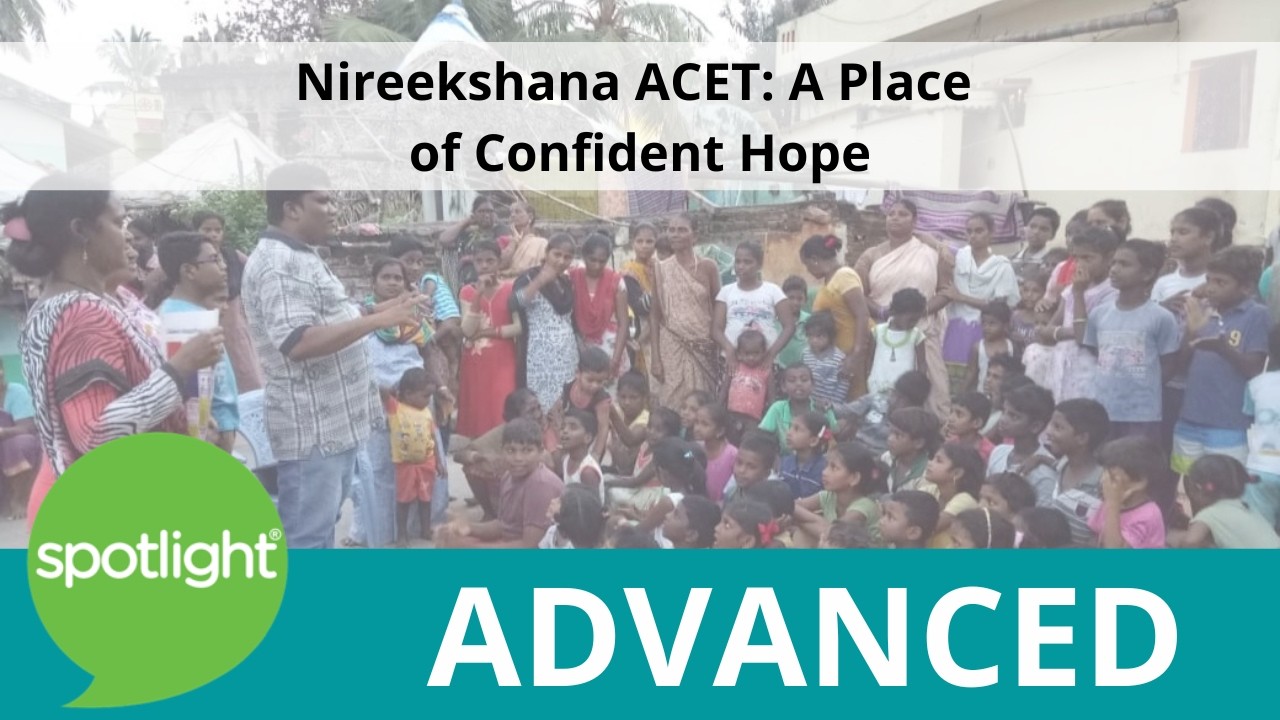
Nireekshana ACET: A Place of Confident Hope | ADVANCED | practice English with Spotlight
Watch on YouTubeVideo summary
The video introduces Nireekshana ACET, a medical clinic in Hyderabad, India, dedicated to treating patients with HIV/AIDS and leprosy. The name combines "Nireekshana," which means hope in the Telugu language, with ACET, standing for Action, Care, Education, and Training. When HIV/AIDS first emerged in the late 20th century, it caused widespread fear and stigma; people avoided those infected, believing they could easily catch the disease, while many patients died without access to proper treatment or doctors. Similarly, leprosy, an ancient disease affecting the skin and muscles, was met with terror due to visible lesions, leading to social isolation for sufferers.
The story of Nireekshana begins with Dr. Sue Jay Sunitha and his wife, Dr. Luvanya Sunitha, who initially worked at a leprosy research center but noticed a surge in HIV cases among their patients. Moved by the plight of a young child born to HIV-positive parents, they decided to shift their focus to treating HIV/AIDS. Facing rejection from building owners who refused to rent space for such a clinic, the couple started operations in their own living room, using a sofa as an examination table and sharing meals with patients. This personal touch transformed their perspective, helping them realize that these individuals were no different from anyone else, fostering a sense of dignity and community among the sick.
As the clinic grew, it moved from the living room to a guest room and eventually into a donated building filled with old machinery, which was cleaned up to serve as a proper facility. Nireekshana became one of the few places offering quality care when the Indian government lacked effective programs and many doctors were still afraid to treat HIV patients. The clinic provided not only medical treatment using affordable antibiotics like cotrimoxazole to prevent infections but also counseling, vocational training for women left alone by their infected husbands, and financial aid for school fees. Through these efforts, thousands of lives were changed, with many former patients becoming trainers themselves and seeing their children grow up healthy and educated.
Today, Nireekshana ACET stands as a beacon of confident hope, reflecting a significant turnaround in the fight against AIDS in India. Statistics show that AIDS-related deaths have dropped by 81% since 2010, and new HIV infections have fallen by nearly 49%, placing India ahead of many other nations. The clinic embodies a special kind of hope that expects improvement rather than despair, offering patients the belief that they will live to see their children grow up. By combining medical expertise with deep compassion and practical support, Nireekshana has turned a crisis into a story of recovery and resilience, proving that love and action can overcome even the most daunting health challenges.
Read the full video transcript
[music]
>> Welcome to Spotlight Advanced. I'm
Gillian Woodford.
>> And I'm Patrick Woodford. Spotlight uses
a special English method of
broadcasting. It is easier for people to
understand, no matter where in the world
they live.
>> [music]
>> India was dying. A disease was
spreading. The more people got sick, the
less others wanted to help. [music] No
one wanted to get the disease. People
died from it.
Some who were sick never told anyone.
They did not want to be avoided. They
did not want to lose their friends and
family.
They died without getting treatment.
Other people with the disease tried to
get help, but there were not enough
doctors, or the treatment was not good.
India was in trouble.
>> [music]
>> Someone had to do something. Someone had
to sacrifice. Someone had to act, even
if he did not have all the answers.
>> Today's Spotlight looks at Nireekshana
ACET.
Nireekshana means hope in the Indian
language Telugu. ACET means Action,
Care, Education, and Training.
Nireekshana is a medical clinic in
Hyderabad, India.
The clinic treats patients with HIV,
AIDS, or leprosy.
>> HIV means Human Immunodeficiency Virus.
It is a virus that attacks the human
[music] body's immune system.
The immune system defends the body
against germs [music] like bacteria and
viruses that can cause diseases.
>> HIV and AIDS first appeared in the 20th
century.
For many years, HIV was not recognized.
The first cases of AIDS were officially
reported in the United States in 1981.
>> If a person with HIV does not get
treatment, the virus can lead to [music]
AIDS. AIDS means acquired
immunodeficiency syndrome.
It is a disease that weakens the body's
defense against [music] illness.
It is the most advanced stage of HIV.
People with AIDS who do not get proper
treatment will die within 1 to 3 years.
>> Leprosy is a disease that affects the
skin.
It leaves red patches or areas on the
skin called lesions.
Leprosy can weaken a person's muscles.
It can also cause a person to go blind.
Leprosy has been around for thousands of
years.
>> Both leprosy and [music] HIV are
contagious. This means they can spread
from one person to another.
For many years, people were frightened
of catching leprosy [music] from someone
who had it. They were afraid of the
strange lesions on the person's body.
They did not want to look that way.
>> When the first cases of HIV and AIDS
were reported, people were scared. They
believed they could easily get the
disease from someone.
AIDS killed many people.
It took years for doctors to discover
proper treatment to stop the disease
from getting worse in a person's body.
People did not want to be around someone
with HIV or AIDS. They did not want to
get the disease and die.
>> In 2003,
Dr. Sue Jay Sunitha was the director of
a leprosy research center in Hyderabad.
His wife, Dr. Luvanya Sunitha, was a
scientist at the center.
The doctors began seeing more patients
with HIV at the leprosy center.
These HIV positive patients could not
find help anywhere else.
>> Dr. Sunitha also saw the number of his
leprosy patients decrease.
He thought it was time to concentrate on
HIV and AIDS patients.
One day, a mother and father brought
their little baby girl to Dr. Sunitha.
The parents and their daughter were all
HIV positive.
Dr. Sunitha said,
>> "My heart was drawn to that child. I
carried her in my hand.
I felt that I needed to make that change
from leprosy to caring for people with
HIV."
>> [music]
>> Dr. Sunitha and his wife were both
followers of Jesus. They knew the
Christian Bible teaches believers to
help the sick and suffering.
They left the leprosy center to start a
clinic for people infected with HIV and
AIDS.
They continued to treat leprosy
patients, but HIV and AIDS cases were
reaching record numbers in India.
Millions of people were infected with
HIV.
Over 100,000 Indians died [music] each
year from AIDS.
>> Many building owners in Hyderabad were
willing to rent rooms to the Sunithas
for their clinic until they discovered
it was for HIV and AIDS patients.
Then they said no.
Building owners did not want anything to
do with HIV or AIDS.
>> For 6 months, the Sunithas looked for a
place where they could open their
clinic.
While searching, Dr. Sunitha worked at
medical [music] camps all over Hyderabad
caring for HIV and AIDS patients.
[music]
Finally, his wife, Lavanya, suggested
they open the clinic in the living room
of their home until they found a
building. [music]
They used their sofa as a medical
examination table.
They kept their medicines cool in their
small refrigerator.
They named their clinic
New Ricks Shana Asset.
>> More patients began visiting the
Sunithas' home.
Dr. Sunitha treated 150 people in his
living room each month.
Some of the children started asking
their parents if they could eat with the
Sunithas.
Soon, the Sunithas were making lunch for
all the patients.
They were sharing their plates and
glasses with HIV and AIDS patients.
Dr. Sunitha had always believed that
these patients deserved proper medical
treatment and care.
But it was not until he opened his home
and shared meals with them that he
looked at them in a new way.
Dr. Sunitha said,
"That is how God taught us.
That is how we learned that these people
[music] are no different from us."
>> The Sunithas ran New Ricks Shana Asset
in the living room of their home for a
year.
Then, a Christian organization helped
them move the clinic upstairs to their
[music] guest room.
The Sunithas saw patients in their guest
room for a year and a half.
>> Finally, [music] a Christian minister
from Korea visited the Sunithas.
The minister wanted to help them.
He found a building nearby that used to
make audio cassettes. It was full of old
machinery and broken cassettes.
The minister told Dr. Sunitha,
>> "This is the place you should move into,
and I will pay [music] the rent for
another 2 years."
>> The Sunithas slowly cleaned up the
rooms. They saw more patients. New Ricks
Shana became popular in Hyderabad. It
was one of the only places where
patients with HIV and AIDS could get
quality treatment.
At the time, the Indian government did
not have a good program to care for HIV
positive patients. Many doctors were
still scared to treat [music] HIV
patients.
Before long, Nireekshana Asset was
helping 1,000 HIV positive patients
[music] each month.
Dr. Sunitha and his workers offered each
patient time with a doctor. They offered
counseling [music] for HIV positive
patients.
Other hospitals could not offer [music]
each patient this type of personal
attention and time.
>> Dr. Sunitha's treatment was effective.
He read that in studies in Africa, they
had used a simple medication called
cotrimoxazole.
It was an antibiotic used to treat
bacterial infections.
By using cotrimoxazole,
Dr. Sunitha was able to prevent over 20
infections in an HIV positive patient.
Also, the medicine was not expensive.
This medicine helped many patients'
illnesses from developing into AIDS.
It kept the disease in the HIV stage
[music] where it was manageable.
>> Nireekshana helped many women
>> [music]
>> whose husbands had infected them with
HIV and then left them.
The women were alone, sick, and had no
way of making money.
Workers at Nireekshana [music] Asset
taught these women how to cook, make
soap, and sew.
They wanted the women to learn practical
skills that they could use each day to
live and make money.
>> The clinic also began helping families
who could not pay to keep their children
in school.
They provided enough money to [music]
pay the school fees.
Over the The 20 years, Nireekshana Asset
helped at least 600 children receive an
education.
>> One of the many women Nireekshana Asset
helped was named Lakshmi.
Her husband would not stop drinking
alcohol. He had HIV and gave it to
Lakshmi.
Their house was in very bad condition.
Her husband would not help her. He later
died of AIDS.
Lakshmi thought about selling her body
to make money to support her three
children.
She visited Nireekshana.
Dr. Sunitha treated her.
Lakshmi's health slowly improved.
Nireekshana Asset's workers taught her
how to sew.
They taught Lakshmi how to feed her
family better food.
After several years, Lakshmi joined
Nireekshana Asset as a trainer. She
helped other women just as she had once
been helped.
>> Nireekshana Asset was also able to help
Lakshmi's three children go to school.
The workers at the clinic were able to
watch Lakshmi's children grow up.
Two of the children went to school and
became nurses.
The other child went to college and got
a job in the financial industry.
>> For years, Nireekshana Asset fought
through the worst of the HIV AIDS crisis
in India.
Slowly, people got better.
According to Anuja Jaiswal, senior
assistant editor at The Times of India,
Nireekshana Asset and other clinics and
hospitals around India are now winning
the war against AIDS.
Jaiswal [music] wrote,
>> "AIDS-related deaths have dropped 81%
since 2010.
This is one of the biggest drops
globally.
New HIV infections have fallen by almost
49%.
This places India ahead of what is
happening in the rest of the world.
>> The word Nirikshana means hope. But it
is a special kind of hope. It is the
type of hope that expects things to
improve.
It is a confident hope.
For the Sunithas and their faithful
workers at Nirikshana Asset, they offer
this hope to their patients every day.
Their patients believe they will not die
tomorrow. They will be healthy. They
will live to see their children grow up.
>> Have you ever known someone with HIV,
[music]
AIDS, or leprosy?
Did you spend time with them?
>> [music]
>> Have you always felt comfortable around
them, or did it take time to adjust?
You can leave a comment on our website
at www.spotlightenglish.com.
You can also find us on YouTube,
Facebook, TikTok, [music]
Instagram, and X.
You can also get Spotlight [music]
episodes delivered directly to your
Android or Apple device through our free
official Spotlight English app.
>> The writer of this episode was Peter
Anderson. The producer was Michiyo
Ozaki.
The voices you heard were from the
United Kingdom and the United States.
All quotes were adapted for this episode
and voiced by Spotlight. No AI or
artificial intelligence was used in this
episode.
Spotlight episodes are written, voiced,
and produced by real people for real
people, no matter where in the world
they live.
This episode is called Nirikshana Asset,
a place of confident hope.
>> We hope you can join us again for the
next spotlight episode. Goodbye.
>> [music]