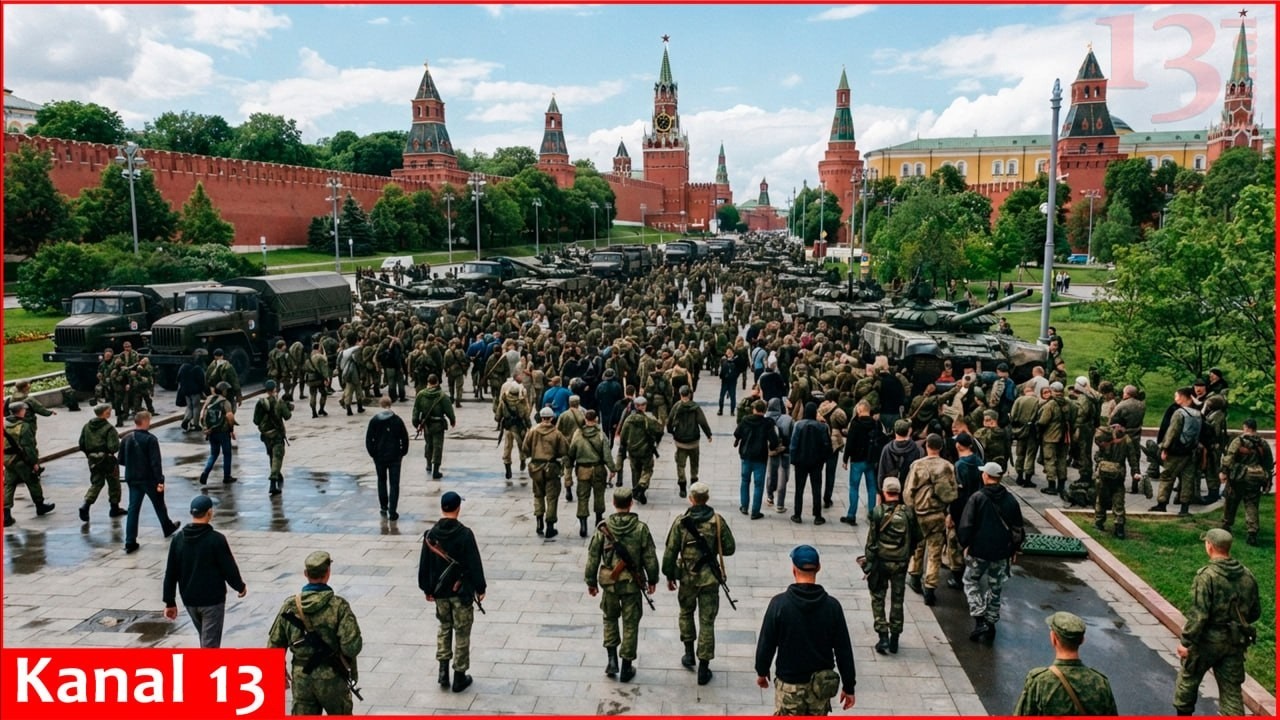
Newly mobilized troops in Russia threaten to deploy weapons against the Kremlin
Watch on YouTubeVideo summary
Following recent reports from The Wall Street Journal citing US administration sources, Russian authorities are reportedly considering a second wave of mobilization after the September state Duma elections to address a critical shortage in contract soldiers. This potential move is driven by the Kremlin's need to sustain its offensive operations in Ukraine and achieve full control over the Donetsk and Luhansk regions as voluntary enlistments decline. Unlike the initial conscription efforts, this new draft could compel individuals with minimal military training or those who explicitly refuse combat duties to join the ranks, a scenario that experts like Ruslan Pukhov suggest might become inevitable if Vladimir Putin insists on his goal of completely occupying Donbas without abandoning it.
The political ramifications of such a decision are expected to be severe for the Kremlin, as evidenced by growing domestic resistance where some citizens have openly declared their willingness to resist being drafted. For instance, reserve officer Dmitry Rogan stated that upon receiving weapons, he would turn them against those who mobilized him, highlighting the deepening social unrest within Russia. While former President Dmitry Medvedev has denied immediate plans for a new draft by citing 200,000 volunteers signed in the first half of the year, analysts argue these figures may not be sufficient to offset massive casualties reported this year alone, which include over 131,000 deaths and hundreds of thousands more wounded.
Experts warn that while further mobilization might allow Moscow to prolong a war of attrition by absorbing heavy frontline losses and strengthening defensive positions against future counteroffensives, it is unlikely to fundamentally alter the strategic outcome of the conflict. John Herbst from the Foundation for Defense of Democracies notes that such a massive draft would constitute a major strategic concern not only for Ukraine but also for its Western allies. Ultimately, resorting to mass conscription could signal that Putin has recognized the war is on a losing trajectory yet chooses to double down rather than moderate his demands, risking further exodus from Russia and escalating domestic instability against an increasingly unpopular conflict.
Read the full video transcript
The authorities of the aggressor country
are considering a new wave of
mobilization after the September state
Duma elections, the Wall Street Journal
reports citing sources in the US
administration. According to the
publication, the reason was a decrease
in the influx of contract soldiers,
which complicates the Kremlin's plans
for a further offensive in Ukraine and
the capture of the entire territory of
the Donetsk and Luhansk regions. As the
Wall Street Journal notes, unlike the
first wave of mobilization, the new
conscription could include Russians with
minimal military training or those who
are unwilling to participate in combat
at all. Ruslan Pukhov, director of the
Moscow-based Center for Analysis of
Strategies and Technologies, also spoke
about the possibility of such a
decision. He believes that if Vladimir
Putin doesn't abandon his goal of fully
occupying Donbas,
>> [music]
>> he may have no choice but to declare
mobilization. The publication notes,
however, that the political consequences
of such a decision could be very painful
for the Kremlin. Some Russians are
already declaring their readiness to
resist mobilization. For example,
53-year-old reserve officer Dmitry Rogan
told the newspaper, "As [music] soon as
they give me a weapon, I will shoot
those who mobilized me." Further
mobilization would help Russia prolong
the war, but probably wouldn't
fundamentally alter its outcome. John
Herbst, deputy director, Russia program
at the Foundation for Defense of
Democracies, FDD, told Newsweek.
"However, a draft the size that Zelensky
warned of would be a major strategic
concern for Ukraine and its Western
allies," said Yuri Boyechko, CEO of Hope
for Ukraine, which helps communities on
the war's front line. "Sheer numbers
allow Moscow to sustain a protracted war
of attrition, [music] absorb heavy front
line losses, and fortify defensive
positions against future
counteroffensives, he told Newsweek.
Former Russian President Dmitry Medvedev
denied mobilization was imminent, saying
that 200,000 volunteers had signed
contracts [music] to serve in its armed
forces in the first half the year.
Russia's parliamentary elections on
September 18th to 20th will be
choreographed in favor of the ruling
United Russia party in a result Putin
will use as a mandate to push the
militarization of society for a
long-term war that shows no signs of
ending. Rumors of a new post-election
draft have abounded all summer as the
Kremlin seeks to replenish casualties,
which Zelenskyy said ahead of his White
House meeting with Donald Trump,
numbered 225,500
losses this year alone.
Including 131,000
killed. If Putin does decide to mobilize
again, it would mean he has recognized
the war is on a losing trajectory, but
has opted to double down rather than
moderate his demands, said Hardy from
the FDD, a Washington D.C. think tank.
Putin has thus far avoided this option
because it carries significant costs and
risks. It would trigger another mass
exodus from the [music] country and
could spark domestic unrest against an
increasingly unpopular war, he added.
>> [music]