New Discoveries - Lecture 23 - MeerKAT Detects the Faint Hydrogen Glow of the Distant Universe
Watch on YouTubeVideo summary
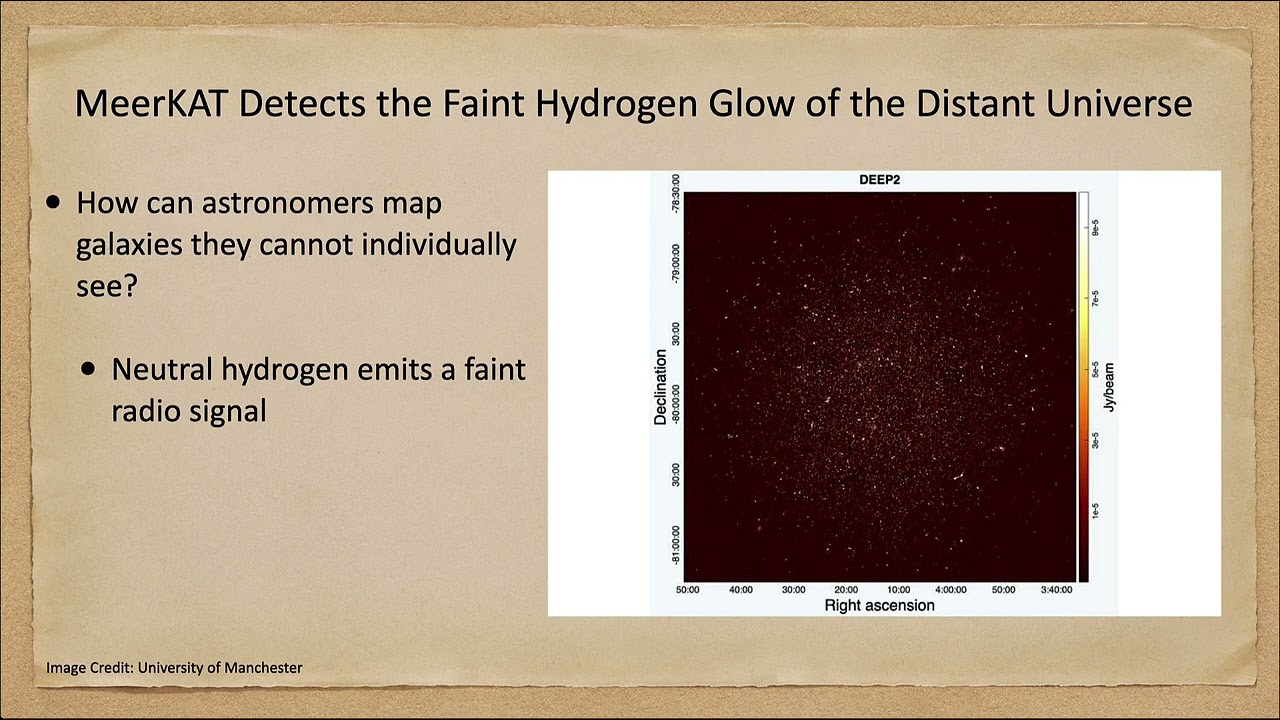
Astronomers have achieved a significant breakthrough by using the MeerKAT radio telescope to directly detect the faint collective signal of neutral hydrogen from the distant universe. Traditionally, mapping galaxies involved identifying and measuring individual objects one by one, but this method is insufficient for studying enormous volumes of space where galaxies are too far away and dim to be seen separately. Instead, researchers employed a technique called hydrogen intensity mapping, which measures the combined radio brightness produced by neutral hydrogen across vast regions rather than resolving each galaxy individually. This approach allows scientists to observe the "glow" of a distant city without needing to identify every single light bulb, effectively revealing how neutral hydrogen is distributed across cosmic scales that span millions of light years.
The detection relies on the characteristic 21 cm radio signal emitted by neutral hydrogen, which gets stretched or redshifted as it travels through the expanding universe. This redshift provides crucial information about when in cosmic history the emission originated, allowing astronomers to determine the depth of the signal. However, extracting this extremely weak cosmological signal is a formidable challenge because it must be separated from much brighter foreground emissions, human-made radio interference, and subtle instrumental effects. In this study, researchers successfully isolated the hydrogen signal using approximately 96 hours of observations collected in 2018, marking the first time such a direct detection was made solely from radio data without relying on complementary information from optical galaxy surveys.
This discovery enables the construction of a three-dimensional picture of the universe by combining positional data on the sky with redshift information to map hydrogen distribution through both space and time. Since neutral hydrogen is closely linked to galaxies and their evolution, these maps offer new insights into how large-scale cosmic structures developed over billions of years. The observations traced variations in hydrogen from two specific periods in cosmic history at redshifts of approximately 3.2 and 0.44, representing radio waves that had traveled for roughly four to five billion years to reach Earth. This capability means astronomers are no longer limited to locating individual hydrogen-rich galaxies but can instead measure the collective distribution of hydrogen atoms across the cosmos.
The implications of this result extend beyond current capabilities, as the data was originally collected when MeerKAT had just begun its science operations and was not specifically designed for intensity mapping. The fact that the signal was already present in the existing data highlights the potential for future surveys with MeerKAT and the upcoming Square Kilometre Array to utilize this technique even more effectively. By learning how to recover faint radio glows from beneath stronger signals, astronomers can now map structures that would otherwise remain hidden, fundamentally changing how we understand the distant universe. This shift demonstrates that sometimes the collective signal contains all the necessary information, allowing us to see the universe clearly when we stop focusing on individual galaxies at a time.
Read the full video transcript
Greetings and welcome to the
introduction to astronomy. In this
episode of new discoveries in astronomy,
we will talk about how astronomers used
the Mircat radio telescope to detect the
faint collective signal of neutral
hydrogen from the distant universe.
So, let's get started.
How can astronomers map galaxies that
are too distant and faint to detect
individually?
Normally, we might imagine finding one
galaxy, measuring it, and then moving on
to the next. But when astronomers want
to study enormous volumes of the
universe, there is another approach.
Instead of identifying every galaxy
separately, they can search for the
combined radio emission from neutral
hydrogen distributed among many
galaxies.
And a new mircat observation shows that
this extremely faint signal can now be
detected directly.
Neutral hydrogen produces a
characteristic radio signal known as the
21 cm line. As this radiation travels
across the expanding universe, its
wavelength is stretched or redshifted.
That means astronomers can use its
observed wavelength not only to detect
hydrogen but also to determine
approximately where in cosmic history
that emission originated.
There is a problem, however. At
cosmological distances, the signal is
extraordinarily faint. Astronomers must
separate it from the much brighter
foreground radio emission, human-made
radio interference, and subtle
instrumental effects.
So, the challenge is not simply
receiving radio waves. The challenge is
extracting a very weak cosmological
signal from [snorts] everything else the
telescope detects.
The researchers tackled that problem
using about 96 hours of observations
from Mircat in South Africa.
And rather than attempting to detect
neutral hydrogen in each distant galaxy
separately, they used a technique called
hydrogen intensity mapping.
With intensity mapping, astronomers
measure the collective radio brightness
produced by hydrogen across a large
region of space.
Think of it as measuring the glow of a
distant city without needing to identify
every individual light bulb. The
individual galaxies do not have to be
resolved as separate hydrogen
detections.
Instead, small variations in the
combined 21 cm emission reveal how
neutral hydrogen is distributed across
very large cosmic volumes. And in this
study, the researchers detected that
intensity mapping signal directly from
the Mircat radio observation alone.
That distinction is important. Previous
reliable detections at these distances
have typically depended on combining
radio measurements with information from
optical galaxy surveys. Here Mircat's
radio data provided the direct
detection.
The researchers detected hydrogen
emission from two periods in cosmic
history at red shifts of approximately
32 and 0.44.
The radio waves they measured had been
traveling toward us for roughly 4 to 5
billion years.
And the measurements trace variations in
hydrogen across scales of several
million light years. In other words,
astronomers are no longer limited to
asking where individual hydrogen-rich
galaxies are located. They can begin
measuring the collective distribution of
hydrogen atoms across enormous regions
of the universe.
This is where intensity mapping becomes
especially powerful.
Position on the sky gives astronomers
two dimensions. The red shift of the 21
cm signal provides information about
depth. Together, those measurements can
be used to construct a three-dimensional
picture of how hydrogen is distributed
throughout space and cosmic time.
And because neutral hydrogen is closely
connected with galaxies and their
evolution, those maps can help
astronomers investigate how largecale
cosmic structure developed over billions
of years.
Future larger surveys could therefore
provide a new way to study both galaxy
evolution and the distribution of matter
across the universe.
There is another interesting aspect of
this result. The observations analyzed
in this study were collected in 2018
when Mircat had only recently begun
science operations. They were not
originally designed for hydrogen
intensity mapping. The signal was
already present in the data. What
changed was the ability of astronomers
to isolate and interpret it. That is
part particularly encouraging for future
surveys with Mircat and eventually the
square kilometer array where intensity
mapping is expected to become an
important cosmological technique.
[snorts] This discovery in illustrates
an important change in how we map the
distant universe. We do not need to see
every galaxy individually. Sometimes the
collective signal contains the
information we need. By learning how to
recover the faint radio glow of hydrogen
from beneath much stronger signals,
astronomers can begin mapping structures
that would otherwise remain hidden.
Sometimes the universe becomes visible
when we stop looking at one galaxy at a
time. So that concludes our discussion
on Mircat detects the faint hydrogen
glow of the distant universe. We'll be
back again next week for another new
discovery in astronomy. So until then,
have a great day everyone and I will see
you in class.