New Discoveries - Lecture 21 - ALMA Reveals a Twisted Magnetic Field Around A Newborn Star
Watch on YouTubeVideo summary
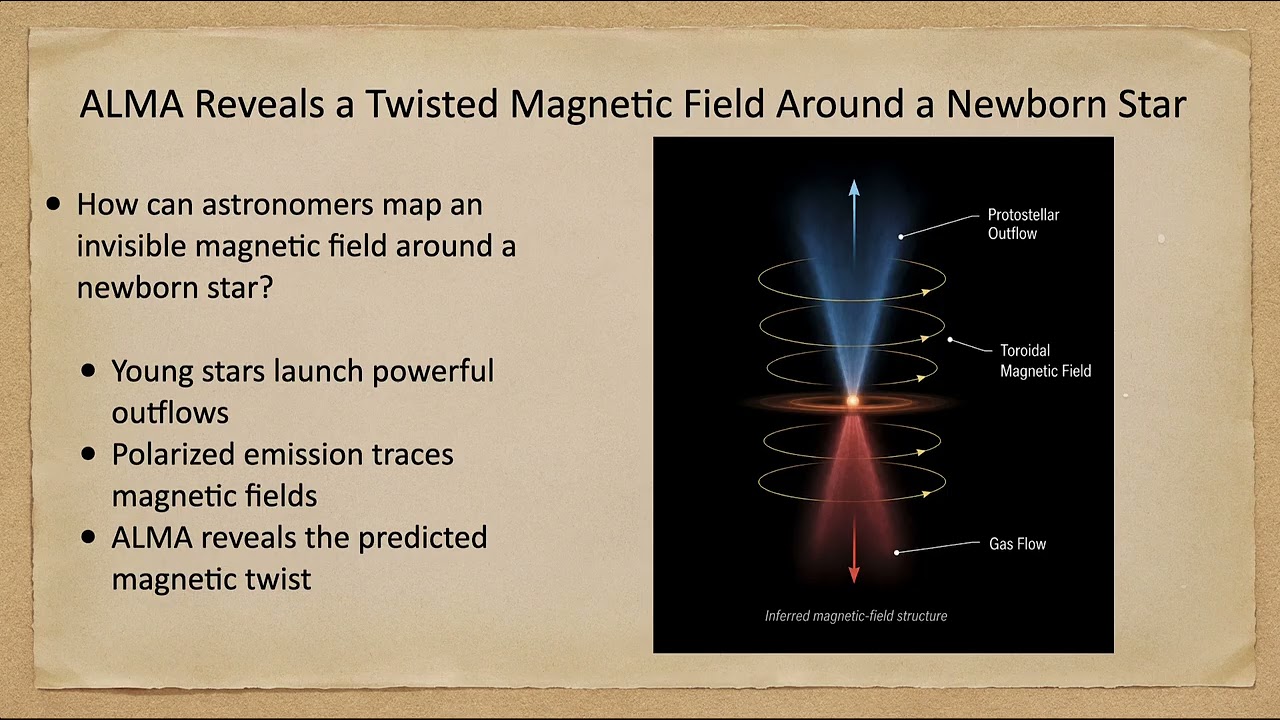
In this episode of New Discoveries in Astronomy, scientists explore how astronomers mapped the invisible magnetic fields surrounding a newborn star using the Atacama Large Millimeter/submillimeter Array (ALMA). Located within the Perseus molecular cloud about 960 light-years away, the nearby star-forming region NGC 1333 hosts a very young double star system known as NGC 1333 IRAS 4A. While direct observation of magnetic fields is impossible because they cannot be seen with traditional telescopes, astronomers detect their presence by observing how these fields influence matter that emits radiation. Specifically, the team measured faint polarization in the emission from carbon monoxide gas within the outflows, which reveals a preferred orientation in the electromagnetic radiation reaching Earth.
The new observations provided roughly 30 times greater resolving power than previous measurements, allowing researchers to examine magnetic field structures just a few hundred astronomical units from the young star. Contrary to earlier assumptions that magnetic fields simply run outward with the gas, the reconstructed geometry showed a strong toroidal structure where the field wraps around the outflow axis like rings surrounding a tube. Although the measured field strengths were only a few thousandths of a gauss—small by everyday standards—they are significant across the enormous scale of a protostar. This specific configuration closely matches the structures predicted by decades-old theoretical models of magnetically driven stellar outflows, confirming long-held hypotheses about how these fields behave near forming stars.
These findings address a fundamental problem in star formation regarding angular momentum. As young stars grow by pulling gas and dust inward, they accumulate significant angular momentum that must be redistributed or removed to allow continued growth. Magnetically influenced outflows provide the necessary mechanism to carry material and angular momentum away from the forming star. By twisting around the outflow, these magnetic fields help organize the protostellar jets and broader outflows, effectively acting as a brake that prevents the star from spinning too fast and disrupting its own formation process.
Beyond confirming theoretical predictions, this observation offers astronomers a new tool for studying magnetic fields in star-forming regions by linking field twisting to electric currents in the gas. The scientific significance lies in the method itself: since magnetic fields are invisible, scientists must rely on how light from matter responds to their presence. By measuring polarization orientations across many points, an invisible field becomes a testable physical model because the matter carries its signature. This approach transforms abstract theoretical concepts into observable reality, providing direct evidence that magnetic fields possess the specific geometry needed to organize and regulate the complex dynamics of newborn stars.
Read the full video transcript
Greetings and welcome to the
introduction to astronomy.
In this episode of new discoveries in
astronomy, we will talk about how
astronomers detected a twisted magnetic
field surrounding the outflow from a
newborn star.
So, let's get started.
>> [snorts]
>> How can astronomers map a magnetic field
they cannot actually see?
Magnetic fields may play an important
role in the formation of stars. But
observing those fields directly is
extremely difficult.
Instead, astronomers have to look for
ways that an invisible magnetic field
leaves its signature on matter that we
can detect.
In the nearby star-forming region NGC
1333,
astronomers have now measured one of
those signatures with remarkable detail.
NGC 1333 lies within the Perseus
molecular cloud about 960
light-years from Earth.
Within this active stellar nursery is a
very young double star system called NGC
1333
IRAS 4A.
Young stars grow by pulling gas and dust
inward from their surroundings.
But at the same time, they can send some
material back into space through narrow
jets and broader outflows.
That creates an important problem.
For decades, theoretical models have
suggested that magnetic fields have
become twisted around these outflows as
the young stellar system rotates.
But actually resolving that magnetic
structure close to a forming star has
been extremely difficult.
To investigate the field, astronomers
used the Atacama Large
Millimeter/submillimeter
Array, or Alma.
Rather than trying to photograph the
magnetic field itself, Alma measured
something much subtler.
Faint polarization in the emission from
carbon monoxide gas within the outflow.
Polarization describes a preferred
orientation in the electromagnetic
radiation reaching us.
By carefully measuring that orientation
across the outflow, astronomers could
infer information about the geometry of
the magnetic fields threading through
the gas.
The new observations provided roughly 30
times greater resolving power than
earlier measurements, allowing
researchers to examine magnetic field
structure only a few hundred
astronomical units from the young star.
In other words, the magnetic field
remained invisible, but its influence on
the radiation gave astronomers a way to
map it.
And when the researchers can
reconstructed that magnetic field
geometry, they found something theorists
had predicted for decades.
The magnetic field was not simply
running outward with the gas. Instead,
it showed a strong toroidal structure.
That means the field wraps around the
outflow axis somewhat like rings
surrounding a tube.
The gas moves outward while the magnetic
field is oriented largely around it.
The researchers measured field strengths
of a few thousandths of a gauss. Small
by everyday standards, but significant
across the enormous
surrounding a protostar.
Most importantly, the observed geometry
closely match the structure predicted by
models of magnetically driven stellar
outflows.
That matters because young stars face
another fundamental problem as they
grow.
The material falling toward a forming
star carries angular momentum.
If the system cannot redistribute or
remove enough of that angular momentum,
continued growth becomes difficult.
Magnetically influenced outflows
provide a mechanism for carrying
material and angular momentum away from
the forming star.
So, these observations are not simply a
picture of an unusual magnetic shape.
They provide direct observational
evidence that the magnetic fields have
the kind of geometry needed to help
organize protostellar outflows.
The researchers also found a
relationship between the fields twisting
and electric currents
in the gas,
potentially giving astronomers another
tool for studying magnetic fields in
star-forming regions.
There is something especially useful
about this observation from a scientific
point of view.
Astronomers cannot see a magnetic field
directly. Instead, they measure how
light from matter responds to its
presence.
From polarization, they infer
orientation,
and from many of those measurements
together, a larger structure emerges.
An invisible field becomes a testable
physical model because matter carries
its signature.
So, that concludes our discussion on
Alma reveals a twisted magnetic field
around a newborn star.
We'll be back again next time for
another new discovery in astronomy.
So, until then,
have a great day, everyone, and I will
see you in class.