New Discoveries - Lecture 20 - An Ancient Asteroid Bombardment Recorded on the Moon
Watch on YouTubeVideo summary
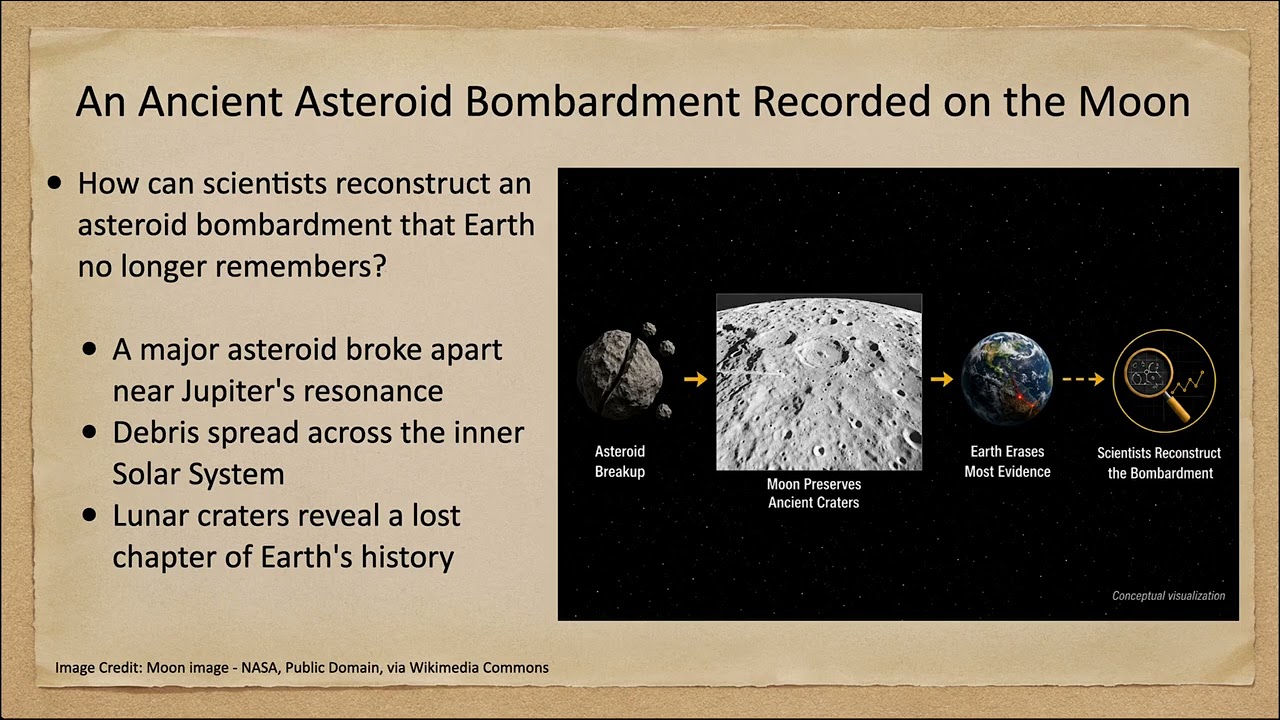
About eight hundred million years ago, the inner solar system experienced a dramatic surge in asteroid impacts that likely originated from a catastrophic collision involving an ancient body known as the Eulalia parent belt located between Mars and Jupiter. This event was particularly significant because it occurred near a gravitational gateway called the three-to-one resonance with Jupiter, which acted as a funnel directing debris out of the main asteroid belt and onto new orbits crossing the paths of terrestrial planets like Earth, the Moon, and Mars. Computer simulations indicate that this mechanism scattered fragments toward these rocky worlds, creating an extended period of increased bombardment rather than a single isolated event.
The duration and nature of this impact surge were influenced by two distinct processes: some asteroid fragments entered Jupiter's gravitational resonance immediately following the initial collision, while others drifted into it over tens of millions of years due to the Yarkovsky effect. This subtle force arises when asteroids absorb sunlight and slowly re-radiate that energy as heat, causing them to shift orbits gradually until they cross resonant zones. Consequently, the bombardment was not instantaneous but likely lasted for more than one hundred million years, providing a prolonged window during which Earth and its neighbors were struck by debris from this shattered family of asteroids.
Scientists confirmed the occurrence of this ancient event primarily through lunar evidence, as Earth's active geology—including weathering, flowing water, and plate tectonics—has erased almost all physical traces of impacts that happened hundreds of millions of years ago. In contrast, the Moon lacks these erosive forces and preserves a pristine record of craters stretching back billions of years, allowing researchers to compare crater ages with computer models of the Eulalia breakup. The timing matched remarkably well between the lunar impact records and the simulated debris field from the asteroid collision, suggesting that this specific family was indeed responsible for the recorded surge in impacts on both Earth and its satellite.
This study highlights a fundamental principle in astronomy where evidence is often preserved in unexpected places to reconstruct lost histories of our own planet. By reading the geological archive left behind on the Moon, scientists can investigate events that Earth's dynamic surface has long since hidden from view. The discovery demonstrates how one world serves as an extension of another, allowing humanity to uncover chapters of solar system history that would otherwise be forgotten forever due to planetary evolution and erosion.
Read the full video transcript
Greetings and welcome to the
introduction to astronomy. In this
episode of new discoveries in astronomy,
we will talk about how a shattered
asteroid may have bombarded Earth and
the Moon about 800 million years ago.
So, let's get started.
How can scientists reconstruct an
ancient asteroid bombardment when almost
all of the evidence on Earth has
disappeared?
>> [snorts]
>> About 800 million years ago, something
may have dramatically increased the
number of asteroid impacts throughout
the inner solar system.
Today, Earth's active geology has erased
most of those traces
of those impacts.
But, another world has preserved the
evidence.
Researchers believe the story began in
the main asteroid belt between Mars and
Jupiter.
>> [snorts]
>> A large asteroid, known as the Eulalia
parent body, suffered a catastrophic
collision and broke apart.
What made this event especially
important was its location.
The asteroid lay beside a region of
space called the three-to-one resonance
with Jupiter,
a gravitational gateway that can
redirect asteroids out of the main belt
and into the inner solar system.
Rather than remaining safely in the
asteroid belt, many fragments escaped
onto new orbits that crossed the paths
of the terrestrial planets.
Computer simulations show that this
resonance scattered asteroid fragments
toward Earth, the Moon, Mars, and other
rocky worlds.
>> [snorts]
>> The bombardment was not a single event.
Some fragments entered the resonance
immediately after the collision, while
others drifted into it over tens of
millions of years through a process
called the
Yarkovsky effect, a tiny force
produced as asteroids absorb sunlight
and slowly re-radiate that energy as
heat.
The result may have been an extended
period of increased impacts lasting more
than 100 million years.
But how do scientists know this
bombardment really happened?
The answer comes from comparing Earth
with the moon.
Unlike Earth, the moon has no weather,
flowing water, or active plate tectonics
to erase ancient craters.
Its surface preserves a long history of
impacts stretching back billions of
years.
Researchers compared the ages of the
large lunar craters with computer models
of the Eulalia breakup.
The timing matched remarkably well,
suggesting that this ancient asteroid
family could have produced the impact
surge recorded on the moon.
Earth was almost certainly struck as
well.
In fact, because Earth is larger and has
stronger gravity, it would have
experienced even more impacts than the
moon.
Yet very little physical evidence
remains because our planet constantly
reshapes its surface.
This study demonstrates how scientists
can use one world to reconstruct the
history of another.
By reading the impact record preserved
on the moon, they can investigate events
that Earth's own geology has long since
hidden.
One of the remarkable things about
astronomy is that evidence is often
preserved in unexpected places. The moon
is more than Earth's nearest neighbor.
It is a geological archive that has
quietly recorded events our own planet
can no longer remember.
By learning [snorts] how to interpret
that record, scientists are uncovering
chapters of the solar system history
that would otherwise be lost forever.
So, that concludes our discussion on a
shattered asteroid may have bombarded
Earth 800 million years ago.
We'll be back again next time for
another new discovery in astronomy.
So, until then,
have a great day, everyone, and I will
see you in class.