New Discoveries - Lecture 19 - How the Moon Records Earth's Magnetic History
Watch on YouTubeVideo summary
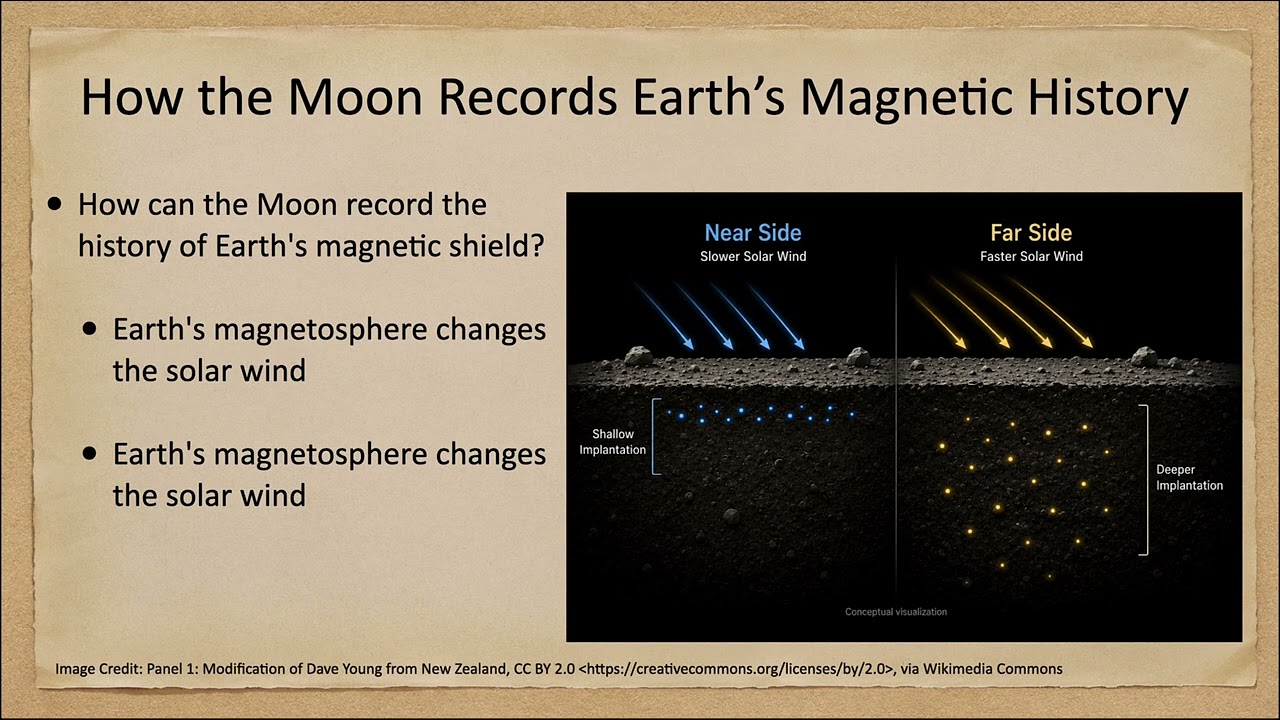
The Moon serves as more than just a silent companion to Earth; it acts as a natural archive that preserves unexpected records of our planet's magnetic history. Although the Moon lacks its own global magnetic field and atmosphere, allowing solar wind particles to strike its surface directly, recent findings reveal a significant difference between its two hemispheres. Samples returned by China's Chang'e 6 mission showed that while the far side is exposed to fast, undisturbed solar wind, the near side often encounters slower particles that have already been influenced by Earth's magnetic environment as they pass through our magnetosphere before reaching lunar orbit.
This distinction was confirmed when scientists directly compared soil samples from both sides of the Moon for the first time, specifically measuring noble gases trapped within the regolith over billions of years. The analysis demonstrated that solar wind particles hitting the far side penetrated deeper into the lunar soil than those arriving at the near side, a result consistent with the theory that Earth's magnetosphere slows down and alters the energy of incoming particles before they reach our satellite. These implanted noble gases provided crucial evidence proving that Earth's magnetic shield actively shapes the space environment experienced by different parts of the Moon long before humans ever landed there to collect such data.
Rather than observing Earth's magnetic field directly, researchers are now reading a long-term record preserved inside lunar soil itself, illustrating how astronomy often relies on measurement and inference rather than direct observation. This discovery highlights that invisible particles from the Sun, once shaped by Earth's magnetism, become tiny clues locked away in rocks millions of miles away, effectively turning the Moon into an external hard drive for our planet's history. By learning to interpret these subtle chemical signatures, scientists can reconstruct how Earth's magnetic shield has evolved over geological time and gain a deeper understanding of the complex, continuous conversation occurring between the Sun, Earth, and the Moon.
Read the full video transcript
Greetings and welcome to the
introduction to astronomy.
In this episode of new discoveries in
astronomy, we will talk about how lunar
soil has revealed an unexpected
connection between the Sun, Earth, and
Moon.
So, let's get started.
How can the Moon tell us something about
Earth's magnetic field?
At [snorts] first, that sounds
surprising.
The Moon has no global magnetic field of
its own, yet scientists discovered that
its two hemispheres preserve different
records of the solar wind.
Those differences were revealed by
samples returned from China's
Chang'e 6 mission.
And they suggest Earth's magnetic shield
has been quietly influencing what
becomes recorded on the Moon's surface.
The Sun continuously releases a stream
of charged particles known as the solar
wind.
Because the Moon has almost no
atmosphere and no global magnetic field,
those particles strike the lunar surface
directly.
But [snorts] Earth's magnetic field
changes that picture.
As the Moon orbits Earth, the side
facing Earth can sometimes encounter
solar wind that has already been slowed
within Earth's magnetic environment.
Meanwhile, the far side remains exposed
to the faster, undisturbed solar wind.
That means the Moon's two hemispheres
experience slightly different space
environments.
The [snorts] breakthrough came from
material returned by the Chang'e 6
mission.
>> [snorts]
>> For the first time, scientists could
directly compare the soil from the
moon's far side with samples collected
from the near side.
Researchers measured noble gases
trapped inside the lunar soil.
These gases were delivered by the solar
wind over billions of years. The result
showed that particles reaching the far
side penetrated deeper into the regolith
than those reaching the near side.
That difference is exactly what
scientists would expect if the far side
receives faster, more energetic solar
wind.
The implanted noble gases became more
than just chemical measurements.
They became evidence.
Scientists concluded that Earth's
magnetosphere slows a portion of the
solar wind before it reaches the moon's
near side.
That change changes how deeply the
particles become embedded in the lunar
soil.
Rather than observing Earth's magnetic
shield directly,
researchers are reading the long-term
record preserved inside the moon itself.
This is another example of astronomy
relying on measurement, inference, and
evidence rather than direct observation.
The discovery reveals that the moon is
more than a silent companion to Earth.
It is also a natural archive.
Because noble gases remain trapped in
the lunar soil for immense periods of
time, they preserve evidence of how the
solar wind interacted with Earth's
magnetic environment.
Future lunar samples may even help
scientists reconstruct how Earth's
magnetic shield has changed over
geological time.
We often think of the moon as preserving
the history of its own surface. This
study reminds us that it has also been
preserving part of Earth's history.
Invisible particles from the sun, shaped
by Earth's magnetic field, become tiny
clues locked inside the lunar soil.
By learning how to read those clues,
scientists are uncovering a long and
subtle conversation between the sun,
Earth, and the moon.
So, that concludes our discussion on how
the moon records Earth's magnetic
history.
We'll be back again next time for
another new discovery in astronomy.
So, until then,
have a great day, everyone, and I will
see you in class.