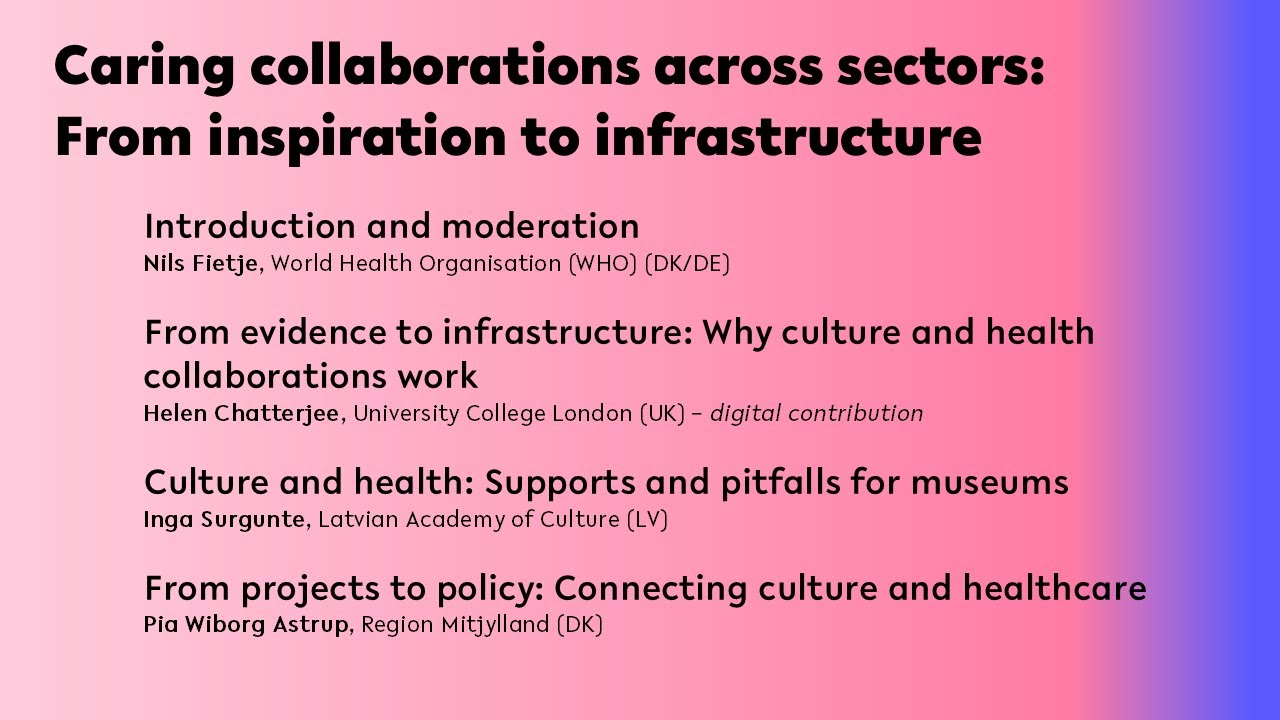
NEMO European Museum Conference 2025 | Caring collaborations: From inspiration to infrastructure
Watch on YouTubeVideo summary
The 2025 NEMO European Museum Conference centered on the theme of "caring collaborations," exploring the vital intersection between culture and health as highlighted by Neil Fitia of the WHO Regional Office for Europe. Over the past two decades, the field of arts and health has gained significant prominence, supported by strong evidence regarding its benefits for mental well-being and museum engagement. Helen Chaty presented nearly twenty years of research from University College London, emphasizing that current efforts largely focus on vulnerable populations, such as cancer patients and those with dementia, to improve quality of life and address social determinants of health. A key development discussed was the creation of a free "creative well-being measure" toolkit designed to quantitatively assess psychological impacts, while projects like "museums on prescription" demonstrated tangible improvements in skills acquisition and lifestyle changes among previously isolated older adults through formal referral pathways known as social prescribing.
Implementing these initiatives across different regions has revealed both successes and significant sustainability challenges. Inga Ina Swe shared the Latvian experience with a pilot program launched in 2022, which successfully enhanced mental well-being and museum accessibility but struggled with fragmented legislation, insufficient training, and a lack of national funding. Similarly, Pia from the Central Denmark Region outlined a strategic approach involving capacity building, research innovation, and policy development to ensure long-term support. She explained a new funding model where hospitals gradually assume costs after an initial two-year period, arguing that arts-based interventions are cost-effective compared to traditional medical treatments. However, the panel acknowledged the persistent issue of "sectoral thinking" in budgeting, where cross-sectoral initiatives often fall through cracks despite their recognized value, necessitating strategic advocacy to align financial responsibilities across ministries and sectors.
To build effective ecosystems that transcend these siloed structures, the conference emphasized a shift from short-term funding cycles to strategic organizational changes where museums embed community health as a core activity. Success is increasingly linked to reciprocal funding increases and the creation of dedicated "creative health connector" roles that manage partnerships between cultural institutions, healthcare teams, and community organizations, preventing individual museums from bearing the full burden. The discussion also addressed the debate over evidence standards; while insurers often demand Randomized Control Trials (RCTs), panelists argued that such methods are impractical for complex community interventions and advocated for alternative approaches like natural experiments and qualitative data, noting that only a small fraction of healthcare actions currently meet gold-standard evidence criteria. Practical advice included conducting internal strategy reviews, actively reaching out to healthcare partners without expecting immediate solutions, inviting health professionals into museum spaces, and articulating outcomes in terms of reduced medication use and hospital visits.
The session concluded with a forward-looking perspective on engaging the business sector through Corporate Social Responsibility initiatives and highlighting hopeful developments such as endowed professorships that integrate arts and health policy. With evidence suggesting that cultural engagement saves billions annually in the health sector, the panelists stressed the need to value existing practical knowledge alongside rigorous scientific data. The conference ended with an invitation for attendees to collaborate on a new WHO Europe policy brief focused on museums and health, aiming to foster sustainable partnerships that leverage the unique strengths of both sectors to improve public well-being. Ultimately, the event underscored that while challenges like funding fragmentation remain, strategic collaboration and policy alignment offer a viable path forward for integrating arts and health into national frameworks.
Read the full video transcript
My name is Neil Fitia. I'm a technical
officer at the World Health Organization
Regional Office for Europe which is
based in Copenhagen and I have the
pleasure of being the uh the chair
today. First of all, I wanted to say
thank you very much for the invitation.
Um it's an unusual space where WH is
beginning to operate. culture and health
is a is a new space and the bridges
between the cultural sector and the
health sector aren't fully constructed
yet. They're maybe in some places they
are and in some places they're not. And
I think part of our journey today is to
explore a little bit how that has worked
in in what places and and uh and what
maybe they're what some tips might be um
in relation to that. So I'll say a
little bit about my background, the work
that I've been doing, but really we're
here to hear from our experts. So um
we'll uh we'll we'll get to that bit as
quickly as possible. Um arts and health
is a space that's been around for many
many years. Uh many people are probably
already familiar with arts therapies um
that probably go back uh over a hundred
hundred years or so. But the field of
arts and health is something that's been
um coming to the four becoming more more
and more prominent probably over the
last 20 years. and and it's a space
where practitioners from the arts and
practitioners from culture can intersect
with health and and health outcomes. And
we published a report on this in um in
2019 where we were looking at the
evidence base for the support of uh um
for how culture and the arts can support
health. And even though it was not what
we call in in in the health sciences a
systematic review, it it was a scoping
review. had looked at all the evidence
that we could find over the last 20
years. We were very confident that the
evidence was strong enough for us at WHO
to promote the space and to uh um enter
in it more firmly. Um most of the space,
most of the research in the space takes
place in the mental health arena. So
it's often about how arts and cultural
participation can help to improve mental
health. A lot of it is around singing
and and song and and dancing in fact as
well. But a very strong component about
this is also around museums and health
museums and and healthcare. So I'm very
pleased that Nemo has taken this uh um
theme to heart and that you are all
exploring it and and exploring the ways
in which museums can contribute towards
uh towards health. So on today's journey
with today's panel we're going to go
from um a kind of broad research
perspective which u um Helen is going to
to give us towards a practitioner
perspective a perspective on the ground
implementation which we'll hear from um
Inga and then we'll hear from Pia about
how all of this can be politicized in
some ways how how we can strategize
around the political dimensions of
integrating the two um the two parts
So um to start with we have u the
wonderful opportunity to have Helen
Chaty with us. Helen is joining us from
London um via uh via a uh um the
internet. Helen is an award-winning
researcher at University College London
where she um focuses on the intersection
between arts and health and in
particular she's been a pioneer in the
space of museums and health. So we're
very pleased to have you with us
virtually Helen. Um, the floor is yours.
>> Thank you, Neils, and thanks to all of
you for inviting me. I hope you're
having a wonderful conference, and I'm
very sorry I can't join you in person. I
hope you can all hear me. Okay. Uh, but
if you have any technical difficulties,
just shout at me and tell me to to do
something. Um, it's a great pleasure to
be here. I'm going to share some slides.
So, um, I'm just going to talk to you
for about 10 minutes and talk to you a
little bit about the kind of work that
we do, um, and a little bit of an
overview of the evidence base as Neil
says around museums, culture, heritage,
and hell. We've been working in this
space as a research group for around 15
nearly 20 years at the university. I
used to run our university museums and
that's how I got involved in thinking
about health and thinking about working
with communities around improving
aspects of health and well-being. So
that's what led me into this work and
really giving me unique insights I guess
into um the opportunities but also some
of the challenges around working in this
space.
Neil's mentioned the WHO the World
Health Organization report and actually
we now really really benefit from a huge
wealth of evidence in this area. Um in
the UK we we made great strides over the
last 5 to 10 years gathering together
the evidence base for a huge quantity of
work across the UK and beyond in the
space. And here's just a small snapshot
of some of the the types of evidence
that exist. Things like those scoping
reviews that Neil's mentioned from the
the World Health Organization, other
reports um from people like Daisy Fan
Court. There's whole journals as you may
know dedicated to arts and health and
I'm really pleased to say that museums
have started to feature increasingly in
many journal and academic outputs
through to then the wider remit of arts,
culture, museums and health. So things
like access to nature and the links
between nature, gardening and the
outdoors and its links with arts and
creativity.
And up there on the top right hand side
of the screen, you can see a report that
really made a massive difference to us
in the UK um around creative health,
which was really the first attempt to
bring together a largecale review of the
vast swades of evidence. That report
published in 2017 contains over 1,000
references. So it's a really great place
to start and I'm pleased to say there's
whole sections around museums.
So what do we do? We do research around
the impact of cultural creative
participation. So we work across a wide
range of sectors to do that work. And we
really couldn't do that work without
this collaboration across all of those
cultural community arts uh nature museum
uh providers that are are providing
inter uh interventions, activities,
programs that are targeting communities
with a specific purpose of improving
health and well-being. And as part of
that ecosystem, the uh partnership with
health, social care and other third
sectors providers really really
important. and I'll talk more about
that. And we've worked with a huge range
of audiences. Typically, our work has
focused on inequalities and working with
vulnerable or marginalized audiences.
And here's just a list. And I'll just
highlight some of those people working
around mental health service usage,
cancer patients, stroke survivors, and
people with dementia. And it's really
those communities and working with those
audiences that I guess have given us the
greatest insight into understanding what
we're interested in is how can we best
evidence the impact of arts, cultural
and museums engagement on different
aspects of health and well-being. For
us, a big part of that was thinking
about how do we measure it? Um and uh
part of that was I guess working
particularly more on the clinical side
where a lot of our clinical colleagues
across health and social care were very
uh connected to the need for having
quantitative evidence that led us to
develop our own measurement toolkit and
I won't through talk through the
development of that toolkit today. Uh
you can access it. It's available for
free. But we worked on that toolkit for
two years with 30 different museums and
arts organizations and over 200
participants to develop a more creative
way for assessing psychological
well-being.
And again, I won't talk through that
co-production process, but that was
really really important to work with
both providers, referers from the health
and social care sector and really really
importantly the participants engaging in
those activities. So thinking about what
kinds of toolkits, methods and
approaches can work best for capturing
the impact of creative participation.
And so we we produced this creative
well-being measure which has really
helped us to help understand these
different dynamic aspects of engaging in
creative um and arts activities. And
that's led us to work collaboratively
with many different organizations and
individuals as I've talked about and
many many different projects. And a key
focus for that has been really is
thinking about how can we make that
research impactful and available to
people outside of academia. So we work a
lot with lots of different types of
organizations, policy makers, local,
regional and national organizations as
well as international organizations to
think about accessibility.
Um, some of the the sorts of research
that we've done is really focused, as
I've said, on thinking about working
around specialist communities perhaps
who have not had access to arts and
culture for various reasons, perhaps due
to isolation, perhaps due to
sociodemographic or socioeconomic
reasons. And that's led us to think
about working in partnership with
organizations who are really focused on
working with vulnerable communities. Um
and again I won't talk through the
details of this research project but
that's just one research project where
we work very much around what we would
call mixed methods gathering a lot of
quantitative qualitative and creative
data to help understand the impact of
creative participation. In this project,
museums on prescription, where we were
testing how museums could work more
collaboratively around social
prescribing, working with referers in
health care and gathering lots and lots
of data and evidence from all of the
different players. I'll just go back one
slide. Uh all of our projects involve
partnership with many many different
collaborators, the referers on the
health, social care, and third sector
side of things through to the arts and
cultural organizations. and like I've
said the participants themselves. Um,
and we really couldn't do this work
without that partnership.
And these are just some of the findings
from this particular project that I
wanted to highlight in terms of
understanding how we can capture impact.
And here you can just see really
important aspects of improvements to
people's perceptions of the quality of
life including things like learning and
acquisition of new skills. really
importantly in this project the fact
that people who for this cohort we
worked with around a hundred different
participants and most of them had died
and had never never visited a museum or
had only ever been say once in their
life and they were an older cohort of
people. So seeing that cohort starting
to visit museums off their own back,
continuing to visit museums after in
this case what was a 10-we intervention
and talking about how that's led to
healthier lifestyle changes has made a
huge impact for us.
And I won't talk again about outcomes
specifically. I think many of you who
are delivering work in this area will be
familiar to these outcome in relation to
these outcomes. But some really
important ones for us over the years
that all of our research projects have
shown are where we see engagement in
creative arts museum- based activities
leading to things like increased
optimism, hope, self-esteem, a sense of
identity, opportunities for meaning
making and all of that we know is really
really important in terms of people uh
having agency over themselves and their
lives and really importantly for us
thinking about how engag Engagements of
this type can also help tackle what we
call the social determinance of health.
And over 70 to 80% of our health is
actually not determined by clinical
factors but in fact by our
sociodemographic socioeconomic
socioultural factors that govern our
life where we are born where we are
where we live where we work and where we
die. So it's really important I think
for us to capture the great impact that
cultural engagement can have on those
aspects because we know they are
directly improve linked to improvements
in health.
So for us just to finish off this is
really I guess uh this image captures
where we think the role of arts,
creativity, museums and cultural
engagement fits in and where we see the
best kinds of engagement or where we
have all of these elements at play.
physical engagement uh depending on what
people's abilities are emotional so good
psychological
uh engagement cognitive engagement so
that really important critical thinking
that's important for all audiences but I
think in museums we can really show how
critical cognitive engagement can happen
we talk a lot about increased learning
and skills acquisition and of course
really importantly the social element
and at the heart of all of that I think
is creative engagement and that's what
we think really leads to be uh improved
health um and well-being. And these are
just a few takeaway messages just to
finish off um that we have found over
many years of working in this space. And
again, I won't run through all of these
because I think we'll perhaps pick up
some of these themes in our discussion.
But I've talked about the importance of
collaboration and partnership working
and many of you will know that the
importance of building sustainable
partnerships, the importance of thinking
about cost and funding. We know that
funding is a massive issue. Um, but
really the importance of moving away
from very short-term programs because we
know that there can be many challenges
with that and we're often uh siloed into
uh organizing our work into short-term
interventions.
My timer is telling me to stop so I'm
going to finish off there. But just to
flag that um for us really working
collaboratively across the whole sector.
We set up a national center for creative
health which is a strategy organization
and we work very closely with the
culture health and well-being alliance
which is a national sector support
organization. We've really found that
that national working together
collaboratively as a set of individuals
and organizations has been really
helpful for us in trying to understand
what works well but also what some of
the challenges are around delivering
that work and for example that has led
to the development of a creative health
quality framework to help understand
what good looks like. So I hope that was
useful. I'm really excited to hear our
next talks and look forward to to
engaging in a in a Q&A session
afterwards. So I will stop sharing and
hand back to you.
>> Thank you very much Helen
and Helen. We're going to keep you in
the spotlight for a minute more. So
thank you so much for for really an
excellent presentation and apologies
really for h forcing you to compress all
of the last 15 20 years of of knowledge
and research into into 10 minutes.
That's uh it's a hard ask, but I I
wanted to follow up on on something in
particular. You mentioned social
prescribing or museums on prescription,
and I think it's a really important um
part of um of what we're talking about
because it's the kind of the links the
link between um people who who are have
certain health conditions or or health
challenges with the cultural sector and
with places like museums. I'm just
wondering um for those of for those of
us in the room who may not be familiar
with museums on prescription or or or um
social prescribing, can you say a few
words about that uh about that concept?
>> We might have lost
>> ah we might have lost
>> Yeah, sure. I mean the idea of social
prescribing is is it
>> Yeah, sorry. Yeah, we we can uh um we
can hear you but uh you're you're a bit
frozen but maybe things are back to
normal now.
So go for it. Okay, just let me know if
you can't hear. So, social prescribing
refers to the referral from a health
care professional, any health care
professional. It might be a GP, it might
be somebody who works in social care to
a source of support in the community.
Um, I would actually say in the UK and
elsewhere, we know there's a big
practice of social prescribing now many
parts of the world. Um actually most of
the work that goes on in the arts and
cultural sector doesn't involve a formal
referral from a health care professional
but social prescribing in the UK became
endorsed by the NHS um and uh has been
accepted as a formal referral pathway
within healthcare.
>> Does that give you enough enough detail
Neil?
>> Yeah absolutely. So um and the
connection is a little bit poor. So we
we might come back to you um in a moment
after the um after the other talks. But
I just maybe wanted to underline the
fact that um a the UK is probably ahead
of the game here. It's a concept that
was introduced in the UK by um by UK
researchers by the NH NHS. But
nevertheless, I think it's it's a very
interesting and dynamic space where the
two sectors are really beginning to
collaborate together. And and I think
this is part of what we want to discuss
here a little bit about the challenges
of of having two sectors um that
sometimes don't uh don't speak to each
other. So Helen, we'll we'll leave it at
that for for now and uh and come back to
you during the the Q&A. Um but now I'd
like to introduce um Ingga Ina Swe. Um
Inga is a a research assistant at the
Culture and Arts Institute of the
Latvian Academy of Culture. She was also
um up until recently a delegate from
Latvia on the open method of
coordination group um that was looking
uh that was sponsored by the European
Commission and looking at culture and
health and how the two um sectors could
or should work more effectively
together. Um and she's going to tell us
a little bit more about the practical um
implications of an arts and and health
and museums project on the ground. So
Inga over to you.
Thank you so much. It's a really big
honor as you can see and joy and
overwhelming experience to be here and
to share um the Latan perspective uh and
maybe the context of the Baltics with
culture and health and after a very very
inspiring and impressive uh
presentations of yesterday where we saw
that in many countries this cross-
sector collaboration is already taking
place since years and decades. I will
share the the Latian case. Um, and the
developments here are quite recent. In
2022 in SE's municipality, three museums
and one heritage site inspired by guess
who? Helen
uh the guide uh museums on prescription
and the publication on five ways to
wellbeing. We established the experiment
the pilot program museums on
prescription. There was I must admit
quite dilant at that point but thanks to
that we were noticed by um Denmark and
other countries who joined uh together
in the interact project arts and
prescription that adopted the UK uh AOP
model to the Baltic states and we were
one of the piloting partners. So the
greatest um innovation uh that came uh
thanks to this project was that we
reached out and we established a
collaboration framework with our
referral channels as we call them in the
project and as you can see uh by the
quote some of them were uh very
open-minded uh surprisingly and we
developed uh our museums and
prescription program in a more solid and
strategic way than in the very
beginning. So it was um consisting of 8
to 10 weeks of uh around 16 activities
and we're working with mixed groups. So
people of different ages, different
social and health backgrounds. And I
would like to share uh benefits how we
see them from this program and they go
beyond health outcomes. But first and
foremost, of course, we would wanted to
support our audienc's participants and
to improve their mental well-being. And
that is what happened. And here you see
them and you will see more of these
wonderful people as I continue.
Also, our collaboration partners, social
and and health professionals said that
their work uh was easier thanks to this
program because we were one-of-a-kind uh
service for these audiences where was
with whom they sometimes were struggling
to find some some extra um activities.
Um but next to that when we look at the
museums we saw that museums really
really considerably improved the
accessibility because they had to do it
when meeting those audiences. Also uh
through the referral channels we had the
chance to um enlarge the the audience uh
to have the so-called audience
development or engagement audiences that
as Helen mentioned would normally not
come to the museum or had stopped for
some reason coming to museum locally. We
also saw a very positive social change
uh if you could call it improved social
climate because people in these mixed
groups were meeting uh in unexpected
ways, people who normally don't meet in
the community.
And when we think of culture
professionals and artists, we saw this
program as an extra opportunity for new
job uh and new income for culture
professionals and involved artists. Also
new cultural and artistic practices were
developed. Like here you can see a
teenager and a senior together with a
composer and musician composing a
surrealistic symphony. And everyone was
very uh surprised by the result. And for
the involved cultural practitioners and
artists, it was like a new realm of uh
creative practice being more more so
socially impactful and seeing what it
really changes uh in these people's
lives. Now when the project is over um
we are trying to somehow transition into
something more permanent and those are
our challenges. Of course, unlike in
many other countries, in in our
situation, we are lacking local or
national uh regulations and funding. So,
we are very realistic that there won't
be any national or or municipal funding
at the moment. Also, we feel obliged to
continue um working with these groups
that we have engaged and um we don't
know really how to ensure sustainability
of the program. We also saw that the
training was offered to the museums and
artists but it was not enough. We also
mapped gaps in the training and more
training uh is needed. Also
psychological support and supervision is
needed and we can't do evaluation on our
own. Only this international project uh
involving international researchers was
allowing us to do so. And uh the last
challenge that I think is a bit scary
one that museums are so enthusiastic
about this program, they want to just
fix it all on their own. They they feel
very empowered, but maybe it's not uh
very realistic and not the best idea.
And just to give you a bigger picture,
not uh fully reading this all, but we
see a similar situation in all three
Baltic states. And maybe some of your
countries could also be similar. there's
dependence on EU projects and lack of
national funding and and and
legislation,
very fragmented education and and
research uh activities.
So, three steps that we've been able to
make. Um first of all a couple of weeks
ago we organized an awareness raising uh
conference uh on culture and health and
this is the last panel um that uh
invited um representatives of ministries
of culture and health and two leading
universities of the two fields to
discuss and to dream about future
culture and health cross-sector Latvia.
Also, Latin Academy of Culture is a lead
partner in the Arasmos Plus project that
has established the very first lifelong
learning educational program for the
Baltics on Culture and Health. And we
also during the same conference
announced the establishment of an NGO,
an association culture and health Latia.
And it will have the mandate from the
municipality to carry on with the
museums and prescription program and
have very basic seed funding. And still
we are aware that we will have to do a
lot of fundraising. And another aim uh
of this association would be trying to
bring together and support the emerging
uh new professional community of culture
and health in Latvia.
Thank you for listening.
Thank you very much Ina. And may I
recommend to uh to all of you who are
interested in this space um the the arts
on prescription team put together a
really tremendously informative guide
for arts on prescription which is
available online. I'm sure we'd be happy
to share the u the link for those of you
who are who are interested and it's a
really tremendous uh um resource for
anyone who's interested in in this
space. Uh before we move on to Pia, I
have a quick question because you you
mentioned uh you I think you said at the
beginning of your talk that you were
surprised um about the the interest in
this project from um different
professionals and practitioners. Can you
say a little bit more about your
surprise and and well I guess the
reactions or the forthcomingness of the
people that you were you were surprised
by?
>> Yes. So when the project started and and
uh this in this consortium of 13
partners from seven countries, everybody
said that you will meet very resistant
health professionals and they won't take
you serious. So we uh took screenshots
of the WH
uh scoping review and we're presenting
and presenting them one after another to
to somehow convince them. And that was
the remark that we got from the head of
the thesis hospital that it's like um
chief uh health organization in the
municipality like stop this we are
educated just tell us how we will do
this
>> so um it was a surprise for us we were
ready for kind of a fight
>> and but also um as we were not sure
about medics we also invited the social
services department the job agency
and uh rehabilitation center that have a
elderly care home and all of them
agreed.
>> So we were hoping for at least one but
all of them were on board from the very
first meeting.
>> I think it's I think it's a really
important point um to make that uh we
focus a lot of on evidence. We focus a
lot on on making sure that what we're
doing is evidence-based evidence in
informed um and I think we can take
comfort from the fact that it is but
often the conversations are much more
practical in nature. um often the
conversations with the healthare in the
healthcare setting um with healthcare
collaborators also in in in museums and
cultural practices it's more it's often
much more about the how and and uh uh
and the practicalities.
Pia, you're going to round up this uh uh
this conversation and it's all on you to
uh to bring us home. Pia is is the head
of innovation and sustainability. Two
very important words as we as we heard
from um Ingga's presentation just now.
um at Central Denmark region where she
spent the last eight years helping to
develop arts and health projects,
initiatives and um strategies. And I
think you're also uniquely placed um in
the sense that you routinely work
together with both sectors with the
hospital with the healthcare sector with
the um creative sector.
>> Um so we're very keen to hear from from
your insights.
>> Over to you.
>> Thank you very much. See if I can
succeed in combining everything.
Uh yeah, I only have one slide with me
today, but uh I only had five minutes.
So one slide I think is enough for five
minutes. But uh thank you for the
opportunity to be a part of this uh
conference today. It's a great pleasure
also to be a part of this more cultural
uh conference than I normally attend to.
Normally I'm more together with the
healthcare system. So this is a great
pleasure. So also sorry for maybe saying
something wrong and mistake or whatever
um for for your normally um
presentations. So but yes I uh I
represent the central Denmark region.
You are a part of sensor gen region
right now here in Hors is a region uh
with 1.5 million inhabitants. So that's
a bit about the the size and uh in our
region we have five uh large hospitals
and we also have a lot of social
institutions which also works into this
field but I also represent a great
ecosystem with a lot of really important
stakeholders in the culture field. I
also represent an ecosystem with a lot
of good universities, a lot of good
schools uh who also works uh with
educating uh clinicians to work in also
this field. So uh it's not only me who
is representing hospitals. I also feel
that I represent the whole ecosystem
today.
And yes, we have been working with this
field for eight years. Uh maybe a little
bit longer in fact, but I have been
working with this field for for the last
eight years. And uh it's been a field
that we that has been growing up from
the bottom. A lot of flowers has been uh
picked and supported and we've put water
onto it. Um but in the last uh I think
maybe five years we're trying to work
more and more systematically with this
area because of the things that Ingga
says because of the things that Helen
said is important to make sure that this
this really important area makes uh uh
becomes a success and becomes a really
strong part of our healthcare system
because we believe that these solutions
that these two sectors can find together
is is the way that we need to have our
healthare system in the future.
I have three points with today. The
first one is about capacity building
because these three points that I have
is really important to work on on three
different levels. Here in our region we
need to have focus and we also need to
have it on national and international
level and partnership that's something
that's really important for us because
we know we can never succeed by
ourselves.
uh so and it's also more fun to be
together with other and other brains and
other insights and competences to
develop uh the good initiatives.
So in our region we have the we have uh
started a partnership together with our
university for example together with our
municipalities with our cultural
stakeholders a partnership we call hats.
We just announced a web page in Danish
but then you can practice your Danish.
But uh this uh this is a partnership
where we uh bring together the knowledge
that we have but also to uh develop all
the good initiatives that we have and to
help each other in the different sectors
in national level. It's it's uh there
has been some movement the last years
that we need to gather up across uh
Denmark. I know it's a small country but
still we work differently in our uh
country in this field. So we have been
together with some partners from both
the healthcare sector and the cultural
sector to build up a new national
alliance. We took the first step
together but right now we are waiting
for the national politicians to put the
yes button so we can hopefully create
this national alliance to work on the on
the large national agendas in this
field. And then finally the
international we need to combine every
layers. So that's also why we use a lot
of our energy in Brussels for example to
push down the this agenda also in
towards the the commission and few weeks
I went there together with Niels and
other good people to put an extra
pressure on the politicians to see that
this area is something they need to
combine into all areas uh in when we do
policies. The next one is research and
innovation. And again, we can do things
here in Denmark, but you do amazing
things in other countries in Europe. So,
we need to share together with each
other all the good initiatives that we
uh that we develop in the countries, all
the good science that we develop and we
need to share that because we don't need
to do everything ourselves. we can just
share uh and I think that's really
important that we because it's also
really uh strong uh no not strong uh
tough to develop all these uh studies so
that's why we need to help each other
with this as well and innovation that's
really important as well that we also
this several years trying to work with
this field in a new way uh because we
need as a healthcare system to uh to
demand for help. We have a lot of good
solutions to help our patients and our
citizens but we need to uh find out what
are our core challenges in the
healthcare system and then ask our
ecosystems, our partnerships, our
stakeholders to help us find the
solutions. So we are right now in these
uh these days trying to figure out what
are our core uh challenges and then we
are going to invite for example the
cultural sector to say okay how can you
help us and then we would try to not
talk and see what can we come up with
together. So working more in an
innovative way is uh the way we also
would like to work forward. And then the
final thing I would say a little bit
about is about policy because we
couldn't have had this journey the last
8 10 years without having a political
focus all the time. Uh and we have been
having our own politicians really close
to us. Normally we have politicians like
this uh far away in our arm. they cannot
come too close. But in this area, they
have been really interesting to follow
it very closely. Uh and if we also
thought that if this this field should
have the right impact in our healthcare
system, they need to see it and feel it
and uh see how how great difference it
does for patients. So working really
strategic with the polit uh the
political level has been really
important and uh we just had our first
policy in our region. And I also think
my um president from our council
yesterday told about we had this first
politics on arts and health and that's a
really strong first step and I hope we
will one day also have a national policy
maybe a European policy uh at the end
but this is a really important things to
build when you won't build upon when you
need to have this area as a core part of
our healthcare system.
>> I think it will start there.
>> Thank you very much.
Thank you very much for a beautiful
presentation with just one slide. I
think we can all take some advice from
you about PowerPoint presentations.
That's fantastic. Um I wanted to I
wanted to follow up with you. Well
actually before I say anything just a
word of warning in a moment we will open
the floor for conversations. So if you
have a question uh if you want some
clarification if you want to contribute
to the discussion it's not only about
questions and answers. because I think
it's also we're also very we're also
very keen to hear from you about your
experiences in this space. So start
thinking about what you uh you might
want to ask. Before we uh we do that um
Pia one of the things that I I feel
central Denmark region has been
particularly good in in this space is
the question of sustainability and here
I don't I don't mean sustainability in
the environmental perspective I mean
sustaining projects going beyond
pilotitis not just having one pilot
project after another but actually
investing
>> in pilots for what you are supposed to
invest in in i.e. A pilot is supposed to
test whether something can work and if
it can work then you should um continue
it or find ways of making it
sustainable.
>> I I suspect there's probably no secret
sauce or or um one sizefits-all
solution, but can you say a little bit
more about how you've managed not just
to water the flowers but to but to grow
them?
>> Yeah. Well, I have to stress out that we
are not uh finished yet by having only
sustainable good models in our region.
But yes, it's it's true that it's
something we have been really focusing
at because a lot of good uh projects
have been living its life in our region
for many years. But as you also see if
when the funding stops then we have a
lot of uh patients and citizens who will
have a a lack of uh initiatives in their
lives which makes a really huge
difference and that's why we need to
take it serious to find okay then how
can we work with this um and uh for the
last uh 6 months we have been working on
a framework to see how can we help new
initiatives to become sustainable
projects. uh so we from the beginning
can have some discussion now how do you
uh create your initiatives? How do you
talk with different stakeholders who who
will pay who will benefit to have
different conversations about how you
can make this project sustainable?
>> And another part is that we have uh for
until now it has been the cultural
uh cultural part of the region who has
been paying for all these initiatives
and with the new health reform we also
had this push that in the future the
region unfortunately cannot work uh with
the culture sector anymore. what we can
work with but we cannot fund it as we
have been doing until now. But we also
believe that the healthare system also
need to uh be the ones who uh who will
pay the bill for this as at the same
time they pay for uh the medicine and
they pay for the beds and so on. So
that's why we also been working on how
can we see how are the costs for the
different initiatives but we have a lot
of dialogues together with the CEO of
the hospitals to say this is yours you
need to take over we will start with the
first two years and then you will take
over and you have two years to find out
how you will find the money in your
budget
>> and we also had the experience that
these initiative are not that expensive
>> and when you look at a budget in a
hospital it's huge
>> so the money is there is just a to
prioritize it.
>> I think um I want to hook on to that uh
that that issue that you raised about
who pays for what. I think one of the um
conversations that I find myself
repeatedly having is because it's cross-
sectoral work. Um the the bill can
sometimes fall through the cracks. Um
the culture sector might expect the
healthcare sector to provide funding.
the healthcare sector might provide
might expect the culture sector and in
the end nobody can agree on a budget and
and projects don't get get implemented.
Um you mentioned that in central Denmark
region it is mainly the the cultural
space um so far that is uh is is
supporting these projects
>> and I think Inga you mentioned that in
fact in uh um in in your example there
are still questions about who funds what
and and perhaps there isn't kind of
money for sustainability at all yet. Can
you say a little bit more about uh um
this this the cross- sectoralness of the
of the funding support in in Latia?
>> Yes, I can talk about the municipality
that I work for. Um yeah, we've done um
of course uh calculations and uh we see
that um some of the expenses can be
covered by existing resources by
reallocating uh resources that are
already there. for example,
um the fees uh for artists or or um
salaries of the museum people involved
or transportation costs that social
services can sometimes cover. So there
is a part of it that can be rethought in
a way and and reallocated but then there
is this part that it still costs
something extra. You can't only cover it
by by the budgets you already have. And
this is where this question emerges who
will pay for that and on municipality
level as I mentioned at the moment we
the solution was to fund this um uh
independent uh NGO a separate body who
will try to do fundraising and and uh
solve the the missing find the missing
part when we uh reach out to our
ministries uh it looks a little bit
different I don't know how stiff the
sectoral thinking is in other countries
But in Latvia we all always get this
response that all the planning and
budgets are are really very very um like
enclosed limited to sectors and it's
very difficult to have like proper
cross- sectoral collaboration putting
money together also owning the results
because I I didn't expect a debate on
who will then uh own the the results the
benefits the outcomes
>> this kind of um discussions I think we
have reached the point where ministries
are very willing and they understand uh
the value of collaboration but the way
they have use are used to operate is not
allowing it and I don't know uh how to
move from that maybe you have an advice
>> but this is how it looks on the national
level
>> thank you
>> maybe I can
>> because I think there's both a short
term and a long term in this in the
short term we of course need to find out
how can we continue with the good
communities that we have but in the long
term for us it's been really important
to to make sure that this field is a
part of the legislation in Denmark so
it's important that for example now we
are going to have a new law in health
promotion so we need to have this area
in this new law so we there will also be
funding in different ministries and not
again from the cultural sector but also
from the healthcare and also with the
new law that came with the reform that
just came to the migr healthare system.
It's also very important two lines is
now in the health legislation. So it
always gives us the access to also have
this discussion with other ministries
and ask them to collaborate but that's
not so easy to get them to collaborate
but to find out where to put
>> this area into different legislation and
not only in one sector. M Helen, um I I
want to go back to you with with a
similar question because I think we
sometimes look to the UK as a um as a a
space where um at least it feels from
the outside that the health sector is
really quite bought in. um it's bought
into this uh this conversation and uh um
but can you say a little bit more about
how um financing happens for um you know
museums on prescription or or or arts
and health interventions that happen in
at museums? How does that work in the
UK?
>> Yeah, sure. I mean the first thing to
say is funding is a huge issue in the UK
as I think it is everywhere and
typically most of that funding does come
from the arts sector, arts council or um
charities that support like the national
lottery heritage fund for example. Um so
yet although there is increasing buyin
from health what we are not seeing is
the transfer of cash to support that
buyin. So that is still a journey we're
going on. And um for us for example a
big motivation behind setting up the
national center for creative health was
around the strategic changes that are
needed to persuade health. I think for
us typically the funding has been um
held back and those strategic changes
because of the evidence base um because
it was seen to be that uh for example an
arts intervention would be competing
with something like a clinical
intervention which is really unfair to
make the same judgments about for
example cost and value and cost benefits
in the same way because it's really
really hard to evidence the economic
impact of what we call nonclinical
community- based interventions but I
think Pier and Inger made really good
points um about how we can shift the
scale towards understanding the kind of
ecosystem approach that is needed. So
although typically most of the work that
happens in this space I think across the
world is kind of short-term funding
dependent where we've seen big strategic
changes is within organizations as says
where they've really changed the kind of
core work to being the delivery around
health and well-being and sometimes that
means whole structural changes across
organizations. So for example, in the
same way that we saw in the museum
sector around the integration of
education and access. So we see a a big
upturn in posts like museum well-being
offices and posts that are dedicated to
thinking about embedding community
health and well-being as a core
activity. And what we have seen in the
UK is that that is then rewarded by
increased and uplifts in funding from
different sources. So that kind of
strategic investment in reorganizing
your organization as a kind of community
asset. Then we see um reciprocal changes
in funding. Um and I think Inger also
made a point about the kind of
partnership role and the and the support
of that ecosystem. And again where we've
seen successes is where we've had
investment. we've decided to invest in
these regional what we call creative
health associate roles or connecting
roles. So it's a huge uh time resource
and and uh money investment for each
individual organization to maintain a
partnership and a connection with all
the different kind of health care and
community partners that are needed to
support community health and it doesn't
really make sense for each organization
to do that individually. So we've been
exploring this role of having kind of
dedicated units that are there to
support those partnerships. That of
course still needs funding but we think
that that is a more effective role at
kind of local and regional levels that
they then link those units kind of
creative health connector roles. They
make the links with the health and the
social care, the population health
teams, and they then make the links to
the community organizations who are
delivering community-based services in a
much more efficient way. So, we're
really arguing for more investment in
that space to support the partnerships
needed to deliver that ecosystem so that
each individual arts organization
doesn't have to do that for themselves.
>> Thank you. Thanks, Helen. And maybe it's
also worth mentioning even though it's a
little bit peripheral um that the the
fundamental question about the kind of
social return on investment or in fact
the economic impact on health that
participating in arts and participating
in culture inherently has. That's also a
question that's being tackled in in in
various places. And I do believe that
the the UK government in late 2024
published a report on how much money um
is saved annually on the basis of
cultural engagement in relation to
health. Yeah. So what are the cost
benefits of engaging just engaging in in
at the status quo? What is the what are
the cost benefits of engaging in health
um that cultural sorry engaging in
culture that cultural institutions bring
with them? And I think uh the the the
figure was something in the region of 8
billion um pounds annually are
contributed to the the health sector.
All right. So we've reached we've
reached the point where I'd really love
to have a little bit of Oh, I was ah
look at that. The hand is already going
up. I was going to do a little little
game where we all break down the silence
and break down the fourth wall and and
talk to each other. I think I might I
might encourage us to do that anyway,
but I I will come back to you in a
moment. So maybe we can just spend 2
minutes um speaking with somebody who
sits next to us about what we've heard
and what we find interesting and uh
maybe a articulate begin to articulate a
question that we might have and I'll
bring us back into the room in in in 2
minutes and then I'll I'll go straight
over there with the with the first
question. So find a neighbor and uh and
have a quick exchange about anything
that you think has been interesting over
the last uh um few minutes.
All right, I'm going to invite you to uh
I'm going to gently invite you to wrap
up your conversations
and to join me back here on the stage
so we can uh ask our colleague who was
who was so fast with her hand. I really
want to give her the floor but we we we
do need to give her our attention. So if
uh if I can ask you all to come to
conclude your wonderful conversations.
This is always the challenge with this
uh with this trick is that you start to
talk with your your uh your neighbors
and the conversations become more
interesting than anything else.
All right. So, we had a question over
there. If you wouldn't mind briefly just
introducing yourself and then uh um
asking your question or or your comment
or your your experiences with culture
and health. The floor is open please.
Over to you.
>> Perfect. I have I raised my hand because
I have a very provocative question.
>> Very good.
>> So, I'm Sophia Vitman. I'm from Vienna
Museum Booster and we're setting up a
project uh f next phase of the research
project called future museum where
well-being will be a major piler of this
project and we're going to bring
together research from four continents
to bring enough evidence of why
insuranceances have to pay for museum
visits.
insuranceances. Uh however, insurance
companies require evidence and uh as my
whole family are psychiatrists, nobody's
perfect. I know very well from the uh
healthc care sector that clinical trials
they go forward when there are
pharmaceutical companies behind because
they are financing all of the clinical
trials and the travels of my dad and
sister and not only. So does it mean
that we as museums have to sell
painkillers, vitamins or Viagra at the
end of the museum visit
>> in the museum shop?
>> I think that's I think it's a good it's
a great question. The question around
evidence I think is u um is broadly a
really important one and I'm very
pleased that you brought insurers into
this conversation because typically we
learn from from what has uh been going
on in the UK um and in the UK with the
NHS you have a a public health system
that's free at the point of access you
don't typically have insurers insure I
mean there are insuranceances in the UK
but they don't play the same role as
they do in Austria and Germany and lots
of other parts of of Europe. So, how do
we get insurers involved is a really
good question and the question around
evidence uh um basis is is very
important as well. Helen, I'm going to
come to you first. Um and I'm going to
slightly repurpose your question because
I I I'm going to latch on to the
question of um RCTs. So, for those of
you who are not familiar with that, it's
randomized control trials. They're
considered to be the gold standard of
evidence in the medical space. Um but
they also bring with them some
challenges. So Helen, I'm I'm going to
ask you if you can say a little bit
about randomized control trials, how
they apply to the space, but how how one
also might like to challenge the notion
that we really only need to we can only
approve something if it is has had RCT
level um evidence behind it.
>> Yeah, I mean what a great question.
Thank you for that. And and it does
bring into question that the that the
value of different kinds of evidence and
the the issue I was talking about of how
we're held up to this gold standard
which is really impossible for us to
meet. It is actually impossible. The
reason it's impossible is because within
randomized control trials, RCTs depend
on having controlled variables. And what
that means is that you can control all
the different confounding effects that
may come into play in a particular
intervention. So if we just think about
a standard museum program or set of
activities say as part of a a fiveweek
or 10 week program that may involve
everything from museum tours, they might
involve uh lectures, they might involve
some object handling, they might involve
visiting the galleries. How can we
possibly control for the types of
activities that would be going on in a
creative community cultural space like
that? The issue is is that we can't. And
so typically when many of us all over
the world have been trying to um
undertake randomized control trials
within the kind of community spaces like
museums or libraries or even outdoors in
in outdoor spaces. One of the big issues
is that we're held to these standards
that are only really designed for uh
really operating clinical interventions.
So many of us do what we call quai
experimental or or natural experiments.
That's essentially the kind of research
that we do where we're trying to control
for as many variables as possible. And
we're trying to collect as much
different types of data both
quantitative and qualitative that help
us to understand the impact of of the
intervention that it's having on
different aspects of what we call the
biocschosocial
body all aspects of the body. But these
are still really really difficult
experiments to run and that's why it's
it's really really unfair that we're
held to these standards. But I guess my
stance has really been to try and push
uh those funders and those people that
value that kind of type of evidence to
get them to understand why we need to
think about different kinds of evidence
and why we need to fund different kinds
of research. So at the minute I'm
working actually with the UK research
and innovation uh council which is what
funds huge amounts of our research in
the UK. It's taken me five years, but
I've been um working with them on a new
program, which is a 30 million pound
research program. But it took a lot of
convincing of me essentially talking
like we're talking here to people who
were used to funding for example very
specific kinds of medical research, uh
economic types of social research. Um
but I think through having these
conversations and really critically
showcasing the kinds of activities and
the kinds of experiences that
participants have and actually hearing
from participants and providers
themselves. So showcasing evidence in a
different kinds of way has I think
started to help shift the dial. So we
are in the UK seeing more research
funding dedicated to this really
important area of research. There's
still a long way to go. We're still not
getting lots of RCT type opportunities,
but we are seeing opportunities for
funding, particularly in the UK around
green social prescribing
um that are now we're seeing larger
amounts of funding for this kind of
research. Not nearly as much as we need,
but we are starting to see the dial
shift. So, so I hope that helps. And I
think it's a really important question
about insurance. We're starting to see
insurers in the UK asking about social
prescribing and thinking of it as as if
it could be included in their portfolio
of authors.
>> Pier, did you want to jump in on that?
>> Yeah, I was just to add because I really
uh I'm I'm really pro research
dot full stop. But I'm really pleased to
hear you Helen said that we need to look
at different kind of data, different
ways to use data. uh and when I discuss
with my politicians there's a okay we
have been talking about evidence for so
long time now we know there are so many
good studies we know this is working we
could see it when we visit uh the
initiative so just continue just stop
focusing on that we need to have this uh
evidence in every step we take and
another fact uh maybe don't say too loud
when you leave today is that in the
Danish healthcare system we only have
evidence for 10 to 15% of what we do in
our healthare system. The rest is
something we think is a good way to uh
treat the patients. 10 to 15% of what we
do we have evidence in the healthare
system. So I think we will manage with
what we already know also in this field.
I
I think I'm going to um I'm I'm going to
nuance that a little bit. I think that
15 to 20% is around
>> 10 to 15
>> oh 10 to 15 um% is around RCT or gold
standard level um evidence I think uh
but when people in emergency settings
when doctors have to respond um it's not
always a question of uh uh of being able
to pick something that has RCT level um
evidence. So I I think it's a really
important distinction that there's a
huge part of what happens in in medical
um um spaces across the world that is
not quote unquote RCT gold standard
level um evidence.
>> In I also wanted to add a bit of rock
and roll comment in from our
municipality. Nobody ever asked us for
evidence and uh actually um we had two
universities in the project working on
evidence and the results were sometimes
confusing. Uh in some uh aspects the
well-being was decreasing and not
improving and nobody cared. uh none of
the referral channels or decision makers
uh were started questioning the program
because in those very local small
settings it was clear that it made
positive difference because people um
from those so-called underrepresented
groups they started requesting this um
service they they wanted to be in the
program those who participated in first
pilots were constantly asking can we get
uh again in into the program and
referrals were reporting that these
people are returning to job, they they
feel better, they use less medication.
Uh so nobody asked for scientific data
and uh those questions at least in our
context appeared only when we went to
ministries and tried to put it on the
national agenda. Then we uh there is
this debate on a big pilot national
pilot with locally relevant data. But
I'm wondering maybe sometimes really it
it uh it's worth starting small and
really making obvious change for for
real people and then this um um good
news is spreading as uh word of how do
you call that word of mouth. M so maybe
just to go back to our our original
question. First of all, fantastic
project really would be delighted to
hear more about it um and how you go
because insurers are an important part
of this journey for a large part of the
European healthcare um kind of
experience. Um but also
don't necessarily expect a certain type
of audience. I think the insurers
themselves might be much more
forthcoming, much more interested in the
space than you perhaps anticipate and
the conversations might not be as
challenging as you think they they might
be. So, in the same way, we're hoping
for openness amongst them, be open
yourselves about the kind of
conversations that that you might have.
Anyone else? Uh any other comments or um
we've got one hand here and we've got
another over there. Maybe we'll since
the mic is already over there, we'll
we'll uh go to the gentleman in the gray
sweater. if you wouldn't mind
introducing yourself briefly.
>> Yeah. Hi, my name is Jacob. I'm head of
secretariat at the Danish Cultural
Association. We have a very uh nice and
strong partnership with uh the central
region in Denmark and Pia and her her
people regarding the National Alliance
on Culture and and Health. And one of
the things I just wanted uh to hear your
reflections about is um the fact that uh
one of the reasons why these
partnerships are hard is because you
have at least in most European countries
a public health care system that from
the outside might seem as a mastadon
like this big uh comp complex uh system
that is very centralized and and
organized where where when you look at
the cultural sector you have the exact
opposite uh where you often see that
each cultural institutions be it a
museum or theaters or libraries are sort
of their own island uh building projects
and and and managing uh what their their
what they do. Uh so this uh creates some
challenges regarding building actual
ecosystems and strong partnerships
especially when you want to address the
the point that that Pia was making about
building building political momentum uh
because partnerships are not just about
the patient or the citizen. They are
also about having a strong united voice
uh uh towards the the politicians. uh
and what I wanted to hear your
reflections uh about is just how to in
general address uh this issue but also
the value that we might be missing
focusing this is of course I recognize a
a museum's organizations uh conference
but I know pier that you've been working
uh building alliances between all sort
of Shangra and cultural institutions and
I think there is a a missed value when
we actually talked together
um on different cultural sectors,
different parts of the cultural sector,
something magic happened uh because they
can actually learn a lot from each
other. And in in the central region
region of Denmark, you are the one
building this conversation, but in other
places uh there's not a central region
that owns this theme. So that that
conversation has to be built different.
Uh so could you just elaborate a bit on
that?
>> Great question or great sets of
questions. I feel is a complex uh um set
of questions.
I would say if I if I if I may just kind
of respond, are you from the cultural
space, the culture sector? Yeah. So I
think uh um your sense of the um public
health space being a kind of massive
centralized slightly intractable
confusing space is probably because
you're not so in it. From my side, who
is who is in that space? I look at the
culture space and think, "Oh my
goodness, how uh how non-entralized uh
and confusing and uh so part of it is
about those bridges, right? Connecting
those bridges and walking over those
bridges and experiencing the language,
the kind of the the culture, the the the
spaces from from the inside. But but I
think that the question was to you Pier
and essentially about your success in in
bringing those spaces together and maybe
with some reflections about you know
lessons learned or or tips and tricks
for for for others who'd like to do the
same.
>> Well the thing one of the main main
things is again that we know that from
our side in the region we cannot solve
uh all our challenges ourselves. So we
always need to open our hospital doors
and ask uh the cultural life, the uh
technology sector uh all different kinds
of ecosystem which is surrounding us. Uh
but that's not uh that's also new for
the regions to just open the doors and
let other uh partners inside our walls.
uh but I think it's a it's a mindset
that has been we been pushing forward in
in our region for the last many uh years
that we need to open more up because we
can see the value of bringing new
perspectives to the table. Uh and uh
this uh intervention and this area is
also born and raised in in the region
where we uh only work with development
and not in our uh operation field in the
hospitals. So our mindset in uh in
regional development is also different.
Uh so we're trying to take this culture
with us into the hospitals uh and to uh
make our hospitals see that if they go
out open the doors and get new voices
inside they will get much more uh
information they get much better
solutions.
>> Uh so I think it's that's a part but I
think it's really important in these
conversations. I remember when we built
hearts, we had uh this workshop where we
had to say okay, what do uh what do we
uh bring to the table and what do we
what are we looking for in the other
stakeholders? So try to see to to do
this puzzle to see what our what is our
different interest and where do we have
some common goals. uh to so to to do
this um puzzle first is is really
important and by the end of the day we
all wanted to uh do a change and do a
different for people in our society. We
everybody wants to work with quality in
what we do. Uh so this is uh this is
some of the things that brought us
together and if you just find these four
or five uh components that bring us
together then it's then you start the
first part of being uh partners.
The other thing that that I feel like I
I've heard from all three of you is that
in in all in each of your countries
there's an attempt um or in fact in some
ca in in the UK this has already
happened of of creating an institute a
space at a at a national level that
tries to have a foot in either camp
right uh I understand pier that that's
kind of a process that's happening now
in in in Denmark and uh and Helen I
wonder if you can say a little bit more
about the the national center for
creative creative health um that I think
has that position, right? It it is
literally something that spans the two
worlds.
>> It is exactly that. I mean, a really
great question again because um I think
what we what we can see is that both of
those ecosystems are equally intractable
to the other. So what we know from
health is that there is a huge uh
ambition and desire to recognize the
value that community organizations
assets uh have but that they as you as
you say Neils that is really it's such a
huge ecosystem they all operate
differently they have different sizes
it's not clear how what the services are
that they're offering for communities
likewise for the for people in the
community at the creative and cultural
community sector accessing and
understanding that health system is
really complicated. So that's really why
we set up a national center for creative
health was to try and bridge that gap
and those roles that I talked about the
creative health associates are exactly
that at a local and and regional level
and their job is um to bridge that gap
and help understand what each of those
parts of the ecosystem want from the
other and to build and maintain and
develop those partnerships. But the the
question uh that was asked by by that
gentleman also made a really good point
about collaboration across cultural
organizations and I'm not sure if it's
the same uh across other cultural
organizations but typically in museums
across the world we tend to be quite
siloed. we tend to do our own work, do
our outreach work with a particular
audience. And I think there is huge
benefit in a lot of the work that we've
done is collaborating across cultural
organizations to develop a coherent
offer is actually also really
cost-effective and less resource
inensive. So instead of for example
offering a weekly activity from one
museum, perhaps there could be a local
offer that coordinates activities where
each week there's a different offer from
a different organization.
Um, and that's what this idea of a kind
of local and regional connector role can
offer. And we're seeing increasing
benefits for that kind of collaboration
across and within the cultural sector,
which is hugely beneficial, but again
does require resource. And at the minute
in the UK, that resource for those
connector roles still comes from the
arts sector. It comes from the arts
council. And we're still some of the
health authorities are starting to
provide financial support for that but
still it comes from the art sector and I
think that is a shift that we still need
to have.
>> Thank you. Yeah,
>> I would just like to add that the um EU
OMC group report is also suggesting the
same thing. First of all on EU level
creating a focal point that would be
responsible for this cross- sector
collaboration and also suggesting that
member states do the same. And I think
it's really uh indicating that it's not
enough that the two sectors are ready to
collaborate. They are so different and
we often speak of having different
languages, a different
everything. So it's recognized that we
need like a third space uh for these two
planets to to meet and and to create
like uh yeah uh a new platform
collaboration of for collaboration
starting with strategy but also um
administration and management.
So, we've mentioned the OMC report a
couple of times, open method of
coordination. Um, again, I' I'd then
encourage you to have a a look at that
report. It was published a couple of
weeks ago. Um, and it is a is a kind of
call to arms for both sectors to work
together and provides a little bit of
background and inspiration about how
that might happen both at the European
Commission level, but then also at the
at the national level. I think Julia,
you had a um a question. Um, over to
you.
>> Hello everybody. Um, Julia from Nemo.
Um, yes, I had a question, but it was
partly uh responded to uh in the long
conversations. I did want to ask Pia
based on your experience uh what you
think are the basic ingredients for say
replicable frameworks that we can use
because we've seen a million good
projects but uh we want to go beyond
project tasers as you uh said already
but I'm going to slightly alter my
question because I think we have touched
upon that already. So very concretely
you have many museums here and a lot of
them are museum umbrella organizations.
So the sector organizations that speak
for the museums in their country, what
would you suggest museums to do in order
to make them more visible or to bring
them into the dialogue as allies in for
the healthcare system?
>> That that's a great question that I can
literally just throw out at um at each
one of our panel members. So Inga, I'll
I'll start with you.
Well, as uh I said, we had a couple of
weeks ago a coach and health conference
in Latvia and that was one of the core
questions for the final panel asking
this to practitioners, to policy makers
and to researchers and they agreed on
one answer and they said that first step
is coordination having someone uh an
organization or a person taking that
task because it will be it will take
long. It will be a long process and uh
uh somebody has to commit to it and I
think it same applies to museums. If you
want to be part of the game, we have to
be part of this coordination process
that brings together the two sectors and
and look and is looking for a place for
for each um actor.
>> In the wonderful WHO language, we call
this a focal point. So having a focal
point, I guess is what you're saying at
an institution that is looking at uh the
health and wellbeing impact.
>> True. That was the idea behind the that
we have just founded.
>> Pia,
>> yeah, I think that firstly I would
recommend that uh as a museum you
reflect what is our goal, why do we want
to enter this uh this arena? What value
can we bring in? What is it? What is our
strategy? And and uh why do we
specifically want to act with this
population for example? So that you have
uh been doing some homework uh in your
own organization. Uh and then next I
think in for us we we
um we do some calls on new initiatives
uh where we want uh uh culture actors to
just find a hospital to knock on the
door and say we would like to uh know
you better. We would like to
collaborate. So that's one way just to
knock on the doors and start to um to
take the challenge and then of course
it's easier when you have somebody who's
bridging like we have in here in our
region where we have a core team who
works in this field but I think it's
important that you you more just uh go
into the healthare system and and say we
would like to collaborate but not come
with the solution in the beginning and I
hope that other healthare systems around
Europe is not just closed on what they
would like to ask, but I'm more uh
willing to go into collaboration and go
into some uh co-creating together
instead.
>> Helen, what about you? What is your
recommendation to museums?
>> Yeah, Pier and have made such brilliant
points. Um I guess just to add that um
what we have found at a local level for
an individual organization as Pier said
just reaching out to local health or
care partners and you know inviting them
into the space one of the greatest
assets that we have in museums is our
wonderful spaces our staff and our
collections and um being able to
articulate that offer in a way that
showcases how that supports community
well-being. there's already a wealth of
evidence that you can direct those
people to, but inviting them into a
space and really critically inviting
them at a time when you've got
participants who can talk about uh some
of those outcomes. We've already talked
about the health and well-being outputs.
Um Ingram mentioned really important
things that that matter to healthare and
decision makers. Things like reductions
in medication, reduction in in hospital
visits, um less healthare utilization,
getting people back to work. these are
the kinds of outcomes, health and social
outcomes that that those um individuals
and professionals are looking for. So if
we can articulate our work in that way,
I think that's really important. I think
um the question also related to um
museum kind of sector support
organizations or umbrella organizations
and we have found the culture health and
wellbeing alliance in that space has
been really really beneficial as having
a kind of national advocacy role to
bringing together the evidence base the
resources supporting that sector and
they they're hugely respected across the
health care sector in the UK. So I think
those organizations also have a role to
play in supporting that advocacy and
supporting that partnership working and
and upskilling our knowledge around what
do we mean by articulating our
contributions to health and well-being.
>> Thank you Helen. Did you want to come in
on that just briefly?
>> Just one more very simple idea uh
inviting the health partners to museums
to experience the activities themselves.
That in our case was really uh
changemaking. maybe not as the first
step but as a second one and then it
answers many questions.
>> Yeah, I would also say uh repeat a point
that Helen made a little earlier. It's
one that we included in our 2019 report
which is a very basic recommendation to
museums to just consider the health
impact that they can have the health and
well-being impact that they that they
can have. I mean for in many cases uh I
know this museum is is uh sorry this uh
conference is making that clearer but I
think in many cases that's still a bit
of an unknown. the language is still
unknown, the concepts are still unknown
and just familiarizing um oneselves with
that and re recognizing that it can be a
part of the strategic work that a museum
does is a is I think a really important
first step.
I'm a little bit uh we're we're
beginning to run out of time, so I think
I'm I'm going to take one quick question
and and uh we'll uh um try to quickly uh
answer it and then I think we'll we'll
have to wrap up. But I'm glad we got a
question from this side of the room. I
was beginning to worry that uh I was too
focused on my right. Please.
>> Uh hello everyone. I'm a Valina from Ber
City Museum and I have this maybe naive
yet a bit topic question or or the idea
but what if instead of going to the
ministries and our sectors of yeah
ministry uh find this uh um business
sectors who are also maybe even want to
be social engaged and social responsible
and try to convince them and maybe
through that we will reach not only the
needed the amount of money, but even our
voices would be more heard because they
have quite a huge marketing campaigns
and so on. So, this was my maybe
possible idea for us.
>> I think it's a great it's a it's a great
point. Um I'm not sure we have any
experience um on our panel. Does anybody
feel that they uh Yeah. Um Helen does.
But just before I go there, I think it's
part of the same question as bringing
insurers um on board, bringing other
kind of stakeholders in this space on
board. So this is certainly not a
exclusive conversation just to be had
with the health sector. Um but it just
happens to be the the predominant place
where the conversation is taking place.
But uh but Helen, maybe you have an
example of a kind of business um
collaboration in the space.
Yeah, it's a really really fantastic
point and it's something that in the UK
we've been thinking more and more about.
We've just done a really small pilot of
working with businesses in in our local
area here in London. Um and there are
some examples of cultural organizations
having very active partnerships with
business. Um the best examples are the
football clubs uh who who do have their
own charities and funding support and
they have started to collaborate with
you know they're obviously hugely
financially successful entities but
starting to collaborate with local
community organizations like libraries,
museums and and other community
organizations.
But I think it's it's a really
underexplored area. All businesses of
course have a whole sector around
corporate social responsibility and um
we've started to speak a lot to
businesses who are interested in
thinking about what that CSR as it's
called could mean by walking more
closely with community organizations and
community assets like museums. So a
really fantastic point and I think
definitely an area for future
exploration. I think what we're
interested in is what could a model for
business for health partnership look
like? We've called it the community
diamond. Um and um yeah, really
interested if anybody's got any examples
of it, we'd we really love to hear more.
>> Thank you, Helen. I think I'm going to
draw ah what we've got very one. Of
course, of course. How could I say no?
>> Just very shortly, thank you for all the
work that you've been doing opening the
doors. I just wanted to share a very
hopeful moment from the Netherlands.
Last year they installed an uh endowed
professor arts and health at the Edosmus
health for school policy makers and
management. And one of her first
long-term things she put on an agenda is
welcoming in health in the policy makers
program for the policy makers of the
future. really integrating the concept
of health the what it will do in terms
of cause but also for the health
professionals how art can support them.
So I thought it was a very uh hopeful
step as well in terms of bridging those
two worlds. I just wanted to quickly
share that.
>> Thank you very much. Um and I would say
there are lots of hopeful moments in the
last couple of years. this space has
developed really rapidly and u and a lot
of countries particularly in the
European Union are are really thinking
about how to bridge those uh um those
sectors. So I'm going to wrap up now and
if I if you wouldn't mind having uh the
the final slide um on uh the screen and
I'm going to ask for you all I don't I
don't often do this but in this case I'm
going to ask for you to take out your
mobile phones because I'm going to put a
QR code on the um on the projector in a
moment. Um, and that's because at WH
Europe, together with the J Arts and
Health Lab, an organization that we work
together closely with, we're beginning
to uh um try and figure out how to write
a policy brief in this space. Um, so as
part of what we do at WHO Europe, we put
out these policy briefs and we've uh
done something on youth mental health.
We've done something on climate in the
environment. We've done something on
forcibly displaced people. And it's a an
opportunity for us to reach out directly
to policy makers and decision makers in
a particular space. However, up until
now, we've kind of stayed in our lane
and we've always talked to health spaces
uh or health decision makers. Now we're
keen to um take the learning that we
have around um museums and health and
speak to cultural policy makers and um
and cultural practitioners and museums.
So we feel like we need to collaborate
even more than usual. We need to really
reach out to the sector. So um I
encourage you to fill in the form if you
think this is a space that you might be
interested in collaborating with. Um,
obviously there's a lot of lot of you in
the room and we won't be able to work
with all of you, but we'll be able to
keep all of you informed throughout this
journey. So, if you're interested in in
joining, maybe sign up. Um, if you're
interested in just being informed, tick
the box that you'd like to be informed,
and we hope to hear from you and and
hope to be in touch about this uh this
project on our journey. So, that's it
for now. Um, I wanted to thank our uh
panelists, Helen, Ina, and Pia. I think
you've done a wonderful job at kind of
coming at this from different angles and
and sharing with us uh your experience.
It's been really eye opening also for
me. I I find these uh these
conversations incredibly helpful. And of
course, I wanted to thank all of you not
only for listening and paying attention
today. Hopefully you have, but also for
being interested for being interested in
the space and for for the work that uh
that you do. So, thank you so much. And
I think there's some uh um housekeeping
now that uh that about the next step.
So, thank you very much.