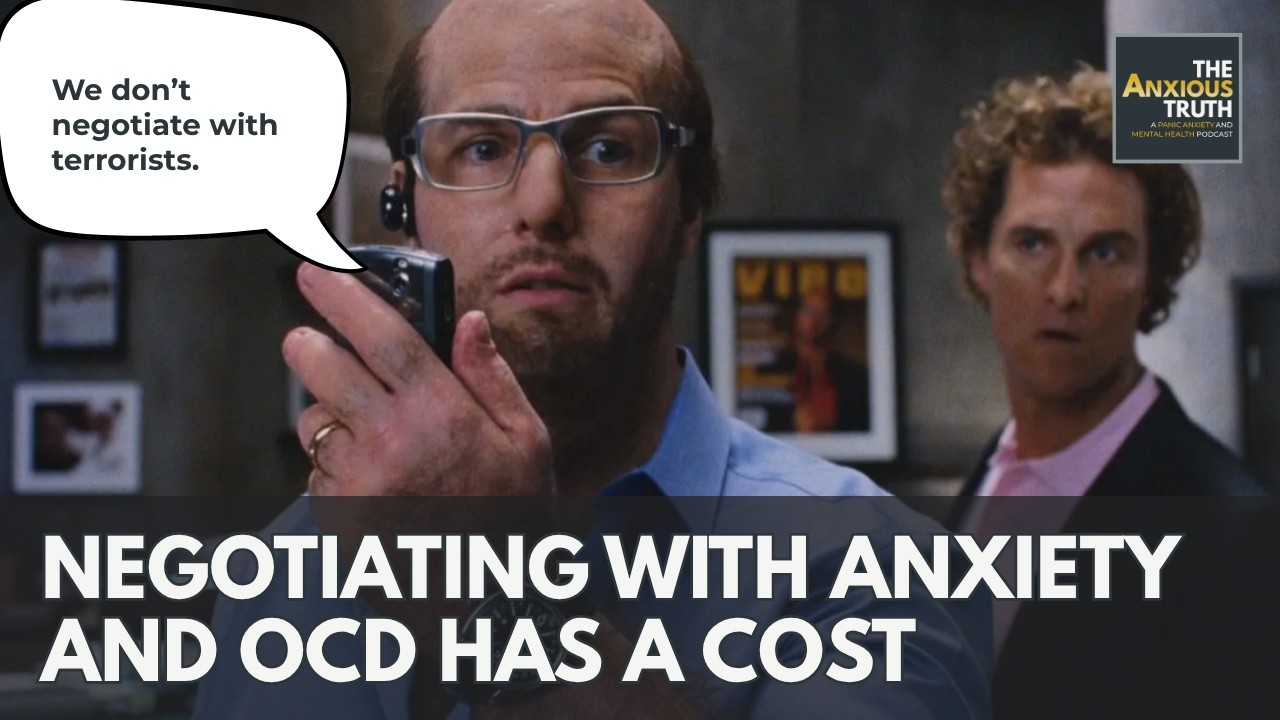
Negotiating With Anxiety and OCD Comes At A Cost (Podcast Episode 352)
Watch on YouTubeVideo summary
Bu bölümde Drew Linselada, kaygı ve Obsesif Kompulsif Bozukluk (OCD) bireylerinin anlık olarak hissettikleri korku ve rahatsızlık karşısında kaçınma davranışları, güvenlik önlemleri ve ritüeller gibi uyum mekanizmalarını "akıllıca" veya "güvenli" bir adım olarak algıladıklarını vurgular. Her tekil eylem o an için makul görünse de, zamanla bu küçük fedakarlıkların birikimi yaşam alanını ciddi şekilde daraltır ve hayatı neredeyse tanıdık olmayan bir hale getirir. Bireyler, yoğun bir kaygı dalgası içindeyken kaçmak veya ritüel yapmak gibi davranışların doğru olduğunu düşünürler çünkü bu eylemler kısa süreli rahatlama sağladığı için o anki mantıklı çözüme dönüşür; ancak bu geçici rahatlık, sürecin tekrarlanmasını tetikleyerek sorunun asla bitmediği bir döngü yaratır.
Konuk, kaygı ve OCD'yi terör örgütleriyle benzeterek, bireylerin bu durumlarla "müzakere" yaptığını ve onları tatmin etmek için sürekli daha fazla şey istediklerini anlatır. Teröristlerle müzakere edildiğinde verilen her küçük taviz, örgütün gücünü artırır ve asla bitmeyecek şekilde taleplerini yükseltir; benzer şekilde kaygı ve OCD ile yapılan anlaşmalar da bireyin hayatından parça parça kesintiler yapmasına neden olur. Örneğin, sadece bir kapak silmek veya bir sosyal etkinliğe gitmemek gibi görünen küçük eylemler bile zamanla yaşamın her alanına yayılarak kişinin işlevselliğini bozar ve değerlerine uygun şekilde yaşama yetisini aşındırır. Bu süreçte bireyler, "sadece bu sefer yapacağım" diyerek kendilerini kandırmaya çalışsa da kaygı asla tatmin olmaz ve hedef kriterleri sürekli değişerek daha fazla kontrol ve güvenlik talep eder.
Bölümün temel mesajı, farkındalığın bu tuzağı kırmadaki en kritik rolü oynadığıdır; çünkü tetiklendiğiniz anda ne hissettiğinizi ve kaçınma dürtüsünün sizi nasıl kandırdığını objektif bir şekilde gözlemleyebilmek, müzakere etme eğilimini azaltır. Ancak bu değişimin anında gerçekleşmeyeceğini kabul etmek önemlidir; sosyal medya veya internet koçlarının vaat ettiği gibi tek bir bölüm dinleyip sorunun tamamen çözüleceği bir sihirli değnek yoktur. İyileşme süreci, her gün küçük adımlarla ilerler ve bazen geri adım atmak kaçınılmazdır; önemli olan, büyük bir kaygı anında bile "dur" diyebilmek ve ritüeli bırakmak gibi görünüşte küçük olsa da aslında çok değerli olan bu küçük zaferleri kabul etmektir. Bu yavaş ve sistematik ilerleme, bireyin kaygıyla müzakere etmeyi bırakıp kendi kapasitesini test etme yolunda attığı her adımda kendini güçlendirmesini sağlar.
Read the full video transcript
Anxiety and OCD will suggest course
changes, avoidances, safety behaviors,
and rituals to help you feel safer and
more in control of things in any given
anxious moment. Now, alone, each of
those little accommodations feels
reasonable, like it's no big deal,
right? You're just being cautious, just
being safe, and what's the harm? But
when we add all of this up over time,
life quickly becomes highly restricted
and almost unrecognizable, and then you
have a real problem. So, let's talk
about that now.
Hello everybody. Welcome back to The
Anxious Truth. This is episode 352 of
the podcast we are recording in
September of 2026. In case you're
listening from the future, I'm Drew
Linselada, creator and host of The
Anxious Truth. I'm a therapist that
specializes in the treatment of OCD and
anxiety disorders practicing in New
York. I'm a former sufferer of the very
things we talk about on this podcast. uh
an author, podcaster, clearly social
media guy, and this is something I love
doing every two weeks, episodes of The
Anxious Truth. So, if you're new here
and you've just stumbled upon the
podcast, welcome. I hope you find what
we're doing helpful here. And of course,
if you're a returning listener, welcome
back. I hope you find today's episode
helpful, and thank you for supporting my
work. So this week I want to talk about
how just being cautious just in case
sort of uh engaging in your rituals or
your avoidances in any given moment
might feel like the right thing to do
and how it's no big deal. But it is a
big deal because if we add up each one
of those little individual things over
time we see a really big impact. Before
we get into that just a really quick
reminder that the anxious truth is more
than just this podcast episode. There
are way more resources linked on my
website at the anxioustruth.com
including links over to my newsletter
which comes out hopefully once a month
that's free. The books that I've
written, the short workshops that I've
produced, uh disordered, which is the
podcast I do with Josh Fletcher every uh
every Friday. That's at disordered.fm,
but I'll link it on my website. Uh and
the disorder community, which is where
Josh and I spend our time. I'm kind of
hanging out there. So, if you want to
interact with me or Josh or other people
that are sharing the experience that
you're sharing, you could check me out
over there as well. Of course, none of
those resources are required. You can
just listen to this episode and leave if
you want. Hell, you can leave in the
middle of the episode if you want. Uh,
but if you're finding this work helpful
and you want more, head on over to the
anxioustruth.com. So, let's get into
this week's topic. Uh, because I don't
want to go too long. Let's talk about
the neverending cycle of OCD and
anxiety. People with anxiety disorders
and OCD. And yes, I know they are not
exactly the same, but they are adjacent
in the book, and we're going to treat
them as very similar. Uh, people with
anxiety disorders and OCD are driven to
perform escape behaviors, rituals.
They're driven to to avoid things. They
are driven to perform, uh, compulsions
and rituals, uh, and generally do
anything they can to feel safer from
intense feelings of discomfort or fear
or anxiety or uncertainty or doubt or
overwhelm. Sometimes the things that an
anxious person or someone with OCD does
to feel better in the moment are
behavioral, but sometimes they're mental
or both. Uh, some you can see, some are
kind of hidden from the rest of the
world because they're almost entirely
inside your own head. Now, we've talked
about this thing over and over in this
podcast. So, you can go back and listen
to any number of the previous 351
episodes or listen to the disordered
podcast and you're going to learn about
avoidance, control strategies gone
wrong, safety behaviors, compulsions,
rituals. Go back and listen to all the
other stuff and you'll learn more. The
summary for today is you feel terrible
right now. You act now in a avoidant or
compulsive way. You feel a little better
now. And then you repeat that cycle
forever and wonder why it never ends. So
in the heat of the moment, when you're
in a triggered moment, when a giant wave
of anxiety or uncertainty or doubt
crashes over your head and you feel like
it's drowning you and taking you under,
all of those avoidances and escapes and
compulsions and rituals kind of feel
like the right thing to do, don't they?
I mean, I get that. I I was where you
were, too. It felt correct in that
moment. And they tend to lead to sort of
temporary relief from the terrible
feelings, which makes them feel even
more correct. This is part of the cycle.
The part where if you're a longtime
listener to this podcast or disordered
and you say, "Well, I get what you're
always saying. I get what you guys say
on these podcasts, but when I'm
triggered, it all goes out the window,
right? Because you can hear me talk
about this stuff all the time, but in
the heat of the moment, it sure feels
like the right idea to escape or avoid
or compulse or ritualize, but afterward
you haven't achieved your goal, right?
You've you've ritualized simple tasks or
spent hours on compulsions or once again
retreated from your life and followed
the fear, the anxiety, the OCD, and at
some point you hate that you did it. So,
in the heat of the moment, it felt like
the right thing to do and it felt like
no big deal, but you keep doing it and
you don't understand why and why can't I
figure this out? I don't get it. I think
there's a second sort of gotcha, right?
So, in the heat of the moment, you are
scared 100%. There's no doubt about
that. But once the emergency passes,
when cooler heads prevail, you may try
to find the resolve to not let not let
that happen again. So, next time you're
going to promise yourself, I won't be
fooled. I'm not going to be tricked.
This time, I'm going to face the fear.
I'm going to do acceptance and floating
and allowing. I'm doing willful
tolerance. I'm not going to compulsor
ritualize. I'm no more. That's the last
time. It's not going to get me again.
And listen, I I get that. I used to do
that, too. And that's really admirable.
But then that huge spike of discomfort
the next time makes it difficult to
access that courage, that resolve, that
anger, that defiance in the heat of the
moment. And you repeat the cycle
already. But there's a second gotcha
that tends to poison or sort of wreck or
taint what feels like an otherwise
decent plant. This is the part where not
only does the individual compulsion or
avoidance or control attempt feel
reasonable and correct because it works
and you feel better. It actually feels
like no big deal. It's just one small
thing, one skipped event that you didn't
even really want to go to, right? It's
just a few minutes of extra shoe tying
or counter wiping or reciting specific
prayers or song lyrics or tapping or ice
packs. It's just one lunch thing that I
don't go to. It's just one social event.
It's just a I just need a me day. I'm
going to go back to the sofa again
because I need a mi day. It feels no big
deal, right? It makes you feel safer and
it feels like that individual avoidance
or that individual ritual or compulsion
doesn't seem to have that much impact.
What's the big deal? It's just one
little thing. So, what's the harm? The
thing is, that's not wrong. Each
individual fear and control-driven
response to an anxiety or OCD episode
seems reasonable, even when calm. It
made me feel better. And none by itself
totally ruins or changes your life on
its own. No one little ritual,
compulsion, no one little avoidance
behavior, safety behavior, escape
behavior, no one little saving behavior
on its own totally changes your life.
they each individual one tends to be
kind of small and at face value given
how little impact each appear to have if
you examine them sort of in a vacuum it
starts to feel like giving in and doing
that one thing because anxiety or OCD
tells you you should is just being smart
or cautious or even efficient. The
second gotcha here right tends to lead
to statements like I'll just do this one
thing so I could feel better and move on
because if I don't do this one thing
then I'll be stuck or something bad will
happen. It might sound like, "Wouldn't
anybody want to make sure they aren't
having harm thoughts? I mean, it's it's
no biggie. It's just being cautious,
right?" Or you might say to yourself,
"It just feels so risky to give up my
calming or fixing things, so I'll just
do them a little. That'll be fine. Just
a little. Does Does any of this sound
familiar?" And again, I get it because I
used to do that, too. So, I want to talk
about how giving in and rationalizing to
a certain extent by saying, "Oh, it
makes me feel better. It feels safer.
and it's no big deal. What's the impact?
That's like negotiating with terrorists,
if you will. We can look at OCD and
anxiety almost like terrorists. One of
my favorite all-time silly scenes in any
movie is Tom Cru Tom Cruz in um uh the
movie Tropic Thunder. It's a silly
little movie. I don't know how you know
how old it is. It's a goofy. It's not
going to change anybody's life. But Tom
Cruz plays Les Gman, this way over the
top movie producer, and he does this
crazy like monologue. He's yelling at
the the flaming dragon guys. is they're
kidnappers and terrorists. Uh, and he's
screaming at them. All right. Uh, it's
just a goofy movie. But after Les Gman
finishes one of his tirades at Flaming
Dragon, they call back later to increase
their extortion and ransom demands.
They've kidnapped one of the movie
stars. And Les totally disrespects them
and winds up literally hanging up on
them. Like, he dumps all over them on
the phone and he hangs up on the phone.
Hangs up on them. And he declares to the
people in his office, "We don't
negotiate with terrorists." And it kills
me every time. It's it's just funny.
It's a funny scene. It's over the top.
It's a silly comedy, but Les Gman has a
point in Tropic Thunder, right? We don't
negotiate with terrorists because when
we give them anything, then they know
they have us and they never actually go
away. And the same applies here. When
you start to rationalize things like
escape or control or avoidance or
ritualization or compulsion as
reasonable or frame it as just in case
or just to be safe, then you are
negotiating with your anxiety or your
OCD and they are for all intents and
purposes terrorists, right? They insist
that you do things that you don't want
to do to satisfy them and then once you
do them, you have to keep doing them.
They never actually go away. They they
don't hold up their end of the bargain
at all. It's not a bargain. It's
control. They will always push for more.
They are not reasonable. Anxiety and OCD
are not logical. They don't know how to
bargain. They'll just keep taking more
and more and more. And in the moment,
which makes it so hard in a in a
triggered moment to to not do these
things in that moment, they only want
what they want. They will not listen to
alternatives. They do not care. And when
you give it to them, then you have a
bigger problem than you already had
because now they're going to start
harassing you in all kinds of different
areas of your life and looking for all
kinds of different vulnerabilities to
exploit and rituals to add and parts of
your life to take away from you. So if
you are thinking, well, it it feels like
the right thing to do because it makes
me feel better and what's the big deal?
It's only one little thing. You're
negotiating with a terrorist. Anxiety
and OCD is like a terrorist. They're
never going to go away. Now they know
they got you, right? So I have to be
careful and if you have started with one
little ritual say with OCD and noticed
how over time it has grown and gotten
bigger and bigger and morphs different
themes different rituals or even anxiety
like what started as two panic attacks
turned into full-blown can't leave the
sofa agorophobia you get this like when
you give in and rationalize each each
individual escape or safety behavior it
never goes away it actually starts to
grow. So if we add it all up right, the
major takeaway from today is that it is
true that in most cases any individual
ritual, compulsion, safety behavior,
being saved, tapping, ice packs,
whatever, avoidance, I'm not going to go
to the birthday party, I'm not going to
go to the park because what if I can't
handle it? What if I panic? What if I
need help? Each one of those individual
things seems like it might be
reasonable, makes me feel better, I feel
safer just in case, right? Who wants to
take a choice? It feels warranted. I
mean, my my anxiety was just so powerful
that the sensations in my body were just
so powerful. The scary thoughts just
felt so real. It seems warranted to do
the avoidance or the escape or the
ritual. And it feels that one individual
thing like no big deal. Let me just
negotiate. I'll ask OCD if I could just
ritualize a little bit here. See if it
lets me off the hook and then we'll
we'll we'll be good. No, we're never
good. It's going to take more. When you
add up all of your rituals, your
avoidances, your control strategies,
your regulating tools, your, you know,
acronyms that you have to follow to calm
down in a panic attack. All of those
safety behaviors, if you add them all
up, suddenly you start to see that the
terrorists are everywhere and you have
to ask their permission to do anything.
Like, they just start to run the whole
ship. Your life gets smaller and smaller
and it gets harder and harder. Your
ability to function on a daily basis
starts to degrade. Restrictions mount.
Anxiety and OCD keep adding more rules
and guidelines. The goalposts keep
moving. You give them what they want,
but then we want more. A little more.
You've never actually ever satisfied it,
right? Like if you're listening to this
podcast, I'm guessing that you you
understand this because no matter what
you do, to appease, to do what it tells
you, to follow the just in case, to feel
safer in the moment, to just just be
smart and don't take that kind of risk,
then okay, cool. I figured that out.
Nope. The goalposts move and it just
wants more. It'll just keep telling you
to do more and more and more and more.
All right. Um, so there's no
appeasement, there's no bargaining, and
there's no being reasonable with this
sort of thing. It doesn't matter that
one OCD or anxiety accommodation in the
heat of the moment is no big deal. What
happens if you look at the functional
impact of all of those accommodations,
all of those escape and safety behaviors
that you've built into your life? What
does it look like when you add them all
up? What's the total cost of that
strategy? What's what's the total impact
on your ability to function and be who
you truly want to be and live according
to your values and engage with the life
you want? We care. I care as a
therapist, right, that specialize in
this area. I care about the total impact
and the cumulative cost. If you sit in
my office as a therapy client and say,
"Oh, what's the big deal? I only just
wiped my kitchen counter for five more
minutes." I would say, "Sure, if you got
five minutes to kill, no worries. You're
right. In that moment, do what you want
to do." I'm going to ask you, "Yeah, but
can you stop doing that? And what else
do you do?" Like, or was it only one
minute, now it's by? Was there only one
compulsion and now there's 10? Do you
used to only avoid one thing? For me, I
I just have to avoid driving on the
highway. And the more and more I gave in
and negotiated with that, the smaller
and smaller my life get where I couldn't
even walk out the door in most cases,
right? So, I care about the total
impact, the cumulative cost. How is that
impacting your functioning? Is your
functioning degrading over time? That's
what I care about. We never as a
therapist and even in this situation
where clearly a podcast or a video is
not therapy. But in this context, I
still never care about the one ritual,
the one avoidance, the one superstition.
Like I don't care about each one of the
things by themselves. They're almost
irrelevant. I care about what happens
when we add them all up. And I want you
to to really look at that, too. So, as
usual, we're going to say, "Okay, great.
Thanks, Drew. That's 15 minutes of my
life. I'm not getting back. So, what do
I do with that?" Well, I sound like a
broken record sometimes, but the reason
why we use mindfulness as part of this
is that awareness is part is a big part
of this as usual, right? No surprise
there. I talk about this all the time.
One of the reasons why we use principles
of mindfulness in this approach to
anxiety and OCD is that mindfulness is
just increase increased awareness.
Remaining aware of this trap, right?
This is a trap. Oh, look, there it is.
There's the urge to rationalize and
negotiate in this in this heat of the
moment. Oh, look at that. It's happening
again. That process is playing out. That
awareness is the most important part.
Now, why? Because in a trigger moment,
if we're going to rely on things like
the ACT trilex, and I'll I'll try to
link past episodes in the description
that talk about we talk about the three
part points of the trilex about a year
or two ago. If we try to use the act
trilex to keep us out of the avoidance
and control strategy trap, we kind of
want to be able to accurately and
objectively describe that moment without
telling stories or making predictions
from what we feel. Right? So, we have to
be aware of the process. We don't have
to get we don't want to get caught up in
the stories and the interpretations and
the content. Otherwise, we get trapped
and we start to negotiate and we
rationalize and it's no big deal. I'll
just do this one thing and I'll be fine.
It looks sort of like I've just been
triggered and now I'm afraid and that
makes me want to insert whatever you
feel the urge to do so that I can feel
better. I got to go get away from this
feeling that feels like a good move and
like no big deal. But doing this one
thing makes my life worse. So it is a
big deal. You see how like this
statement that I just made, you know,
I've been triggered. I'm afraid. It
makes me want to do the safety thing.
feels like a good move, but it's making
my life worse. You could apply that to
almost any. I don't care what your OCD
theme is. I don't care what health
threat your health anxiety is attached
to. I don't care if you have sleep
anxiety. I don't care if you have panic
disorder. I don't care if you have GAD
and you ruminate to try to feel better.
You can apply that sentence I just gave
you. That's a sentence of objective
awareness of what's actually happening
across all of those contexts. The
specific symptom, the specific thought,
the content, doesn't matter. Right? If
you can see that process unfolding that
way and identify it well then you kind
of won half the war already because the
second part once of the trilex once you
do that is once that once that has been
you know this is what's actually
happening I'm in a triggered moment one
option in the triggered moment would be
to do the usual save yourself negotiate
give in okay I'll just do this one thing
if you let me off the hook that's one
option I'll I'll give in and I'll
negotiate with anxiety and OCD the air
quotes terrorists I'll give in to that
one demand because it does seem to solve
a problem at the moment that feels like
a real problem. What's the big deal?
It's just this one thing. But the better
option is to not do it. Like I have to
not do that. I have to experiment here.
I have to explore my capability and my
capacity to handle this distress and
this discomfort. What if I can accept
that like discomfort doesn't
automatically mean danger? The feeling
isn't confirmation of the problem. The
feeling is the problem. If I can accept
that and start to experiment with my
ability to tolerate that and watch it
ebb and flow on its own, then there's no
negotiation in there that there's no,
oh, just this one thing. There's no just
in case. There's no, oh, it's it's no
big deal. There's no, oh, this feels
like a good move. Oh, that was too
risky. There's no more negotiation. It's
okay to acknowledge that the fear makes
you want to rationalize and negotiate
and give in, but ultimately we have to
make a brave choice to not do that
anymore. And that's why we need the
awareness of this process. You get
triggered, you feel afraid, and now you
feel the urge to save yourself from that
or fix things. And that makes you want
to give in and negotiate with your OCD
and your anxiety and rationalize that ah
I just feel so bad. I got to do this
this one time. But that never happens
that way. So in the end, it really is
sort of a little by little process,
right? I know there's a lot in this
episode. I feel like there's a lot in
all these episodes at Psycho Education
for you on the internet, right? But like
I'm going to try to wrap this up with a
reminder that nobody instantly
eliminates all the rationalization,
negotiation, and compulsions or safety
behaviors. Nobody. Nobody's going to
listen to episode 352 of The Anxious
Truth and instantly have their OCD just
collapse and they just never ritualize
or compulse ever again. No agorophobic
will listen to this episode of the
podcast and say, "Oh, I can't negotiate
with the terrorist in my head." And
suddenly they're out on a world cruise
and love and life. It doesn't happen
that way. That's not a thing. And never
never let social media, the internet
coaches, wellness gurus, unethical
people promise you that. That is not a
thing. You might want to do that and I
would love it if you could do that.
Hell, I'd love to be able to do this one
podcast episode and then like just
retire and lay on a beach because
everybody will get better. But it
doesn't work that way. You may want
that. I want that for everybody, but it
doesn't work that way. Maybe hearing
this episode will get you feeling all
maybe jazzed up and inspired. And now
that you can see, oh, I'm negotiating
with a terrorist. Now you're feeling
like you can re that's it. I got this
now. I can really hold my ground the
next time. I'm going to change
everything because now I know what this
is. But the odds of that happening are
kind of slim. And that's okay. If I were
your therapist, I would never expect
that sort of like instant change,
instant outcome. What I would work with
you on is sort of chipping away at that
old framework and that old strategy bit
by bit. I took a walk around the block
and I really felt like I wanted to run,
but I finished the walk. I did the extra
two minutes around the entire block. I
was driving and practicing my driving
exposure and I really wanted to slam on
the brakes and pull over and call my
partner to talk me down, but I didn't. I
got through those two or three minutes.
I finished my drive. That doesn't feel
like a big deal, but that is a big deal,
right? The pulling over, the calling for
help, the saving yourself once again
from a panic attack or feelings of
anxiety. That's the thing that in the
moment feels like the right thing and no
big deal. But that is a big deal. That
is a big deal for the wrong reasons. If
you choose not to do that and you make
it one small little move forward by
continuing your exposure or putting down
the rag and stopping the wiping or
whatever it is your OCD is telling you
to do, I don't care how small that
change is. That counts. That's a win. I
would I want you to do that little by
little, bit by bit. Just remember that
every time you make a little change and
learn a little something about your
anxiety, your OCD, and yourself as part
of that process, that is a win. That's a
giant win. Even though it comes
incrementally and sort of
systematically, you got to be
consistent. You're going to fail
sometimes. You're not going to be brave
some days. I went through it, too.
That's the way it works for everybody.
This episode, understanding that like,
oh, it is a big deal if I avoid right
now. That's going to add up. Cool.
maintain that awareness, but it doesn't
mean everything's going to change
overnight, right? So, just like each
specific I think this is maybe the
biggest thing that I want you to take
out of this as we kind of wrap up the
episode. Just like each specific moment
of compulsion or ritualization or
avoidance can't ruin your life by
itself, no individual exposure or act of
tolerance or floating or flash of
insight can fix your life all by itself.
So one uh one bad exposure cannot ruin
your whole life. One avoidance or escape
or ritualization cannot ruin your whole
life by itself. And no individual
winning exposure, successful exposure,
episode of willful tolerance will fix
your life all by itself. Keep that in
mind. Otherwise, you could get stuck in
a trap. You don't want to do that thing
where it's like, "Okay, I got this now."
And then, "Oh, I don't got it." Like, be
nice to yourself. Be patient. And keep
in mind so you don't wind up being
disappointed in declaring yourself a
failure that this is the way it works
for everybody if it all goes out the
window again and you wind up giving in
rationalizing or negotiating. It
happened to me. It happens to everybody.
It's okay. It's part of the process,
right? So I guess that's it. That's
episode 352 in the books. 22 minutes.
Not too bad. Usually I ramble much
longer than I wanted to, but I think I
did okay this week. Hopefully you guys
hung out till the end and got something
out of this. Uh, just a favor. If you're
listening to this on Apple Podcast or
Spotify or some podcast platform that
lets you rate or review podcast and you
think The Anxious Truth Deserves it,
leave a fivestar rating because it helps
the podcast. If you really really like
it, maybe write a quick review and tell
people why you like the podcast if
you're so inclined because then that
really helps more people find the
podcast and get more help. And that's
why I do this to begin with. So, uh,
yeah, I'll come back again in two weeks
with another topic. Might have a guest
in two weeks. I'm not sure if we can
arrange that or not, but I'll be here.
I'm not sure what I'm going to talk
about, but uh uh but I will be back.
Thanks for listening. Thanks for hanging
out. Thanks for supporting the work that
I do behind this crazy microphone. Uh
look at the the description of the
podcast episode. I'll link those other
episodes for you on the ACT trilex. You
can click on the link in the podcast
description and send me a text. Believe
it or not, I won't see your number, but
if you want to send a question, you can
do that. If you want to interact with
[music] me a little bit more, you can
head over to Disorder.fm and check out
the community over there. And of course,
[music] if you want more, you can listen
to Disordered every Friday because that
comes out weekly. Thanks for hanging
out, guys. I'll see you in 2 weeks. We
are out.