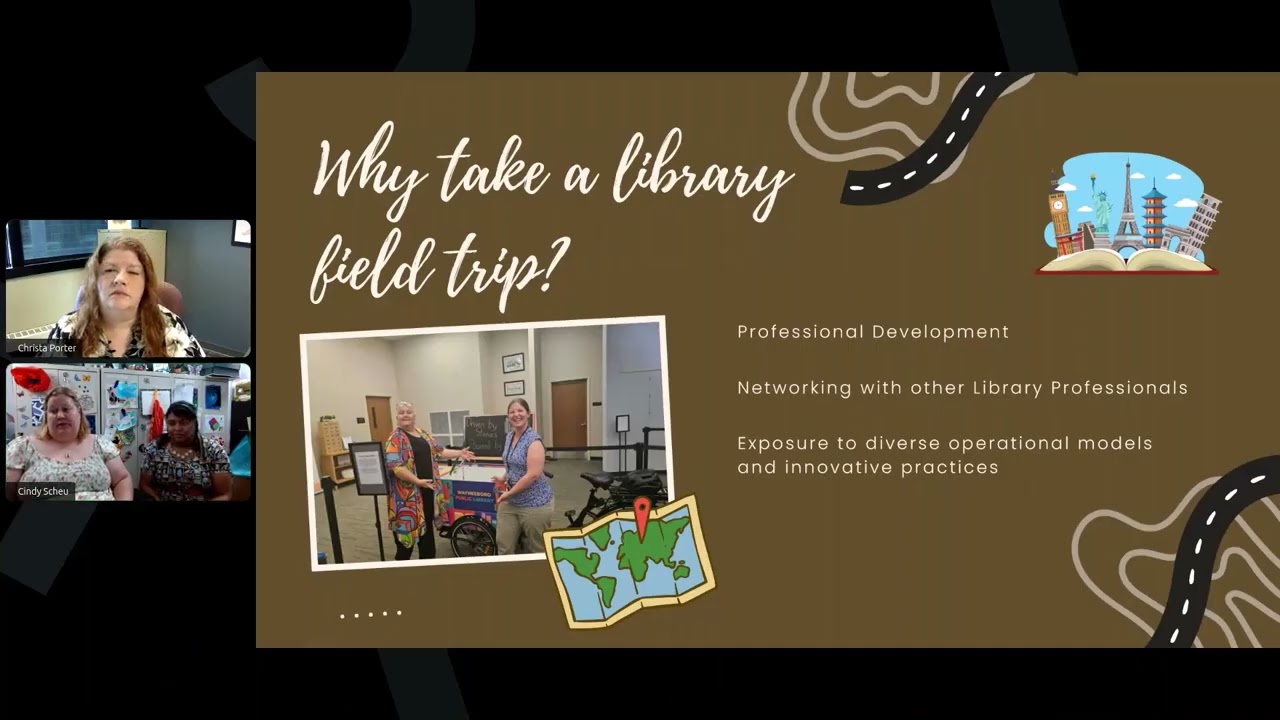
NCompass Live: Who Doesn't Love a Field Trip? Staff Development Through Library Visits
Watch on YouTubeVideo summary
Cindy Shu and Michaela Harvey from the J. Robert Jamerson Memorial Library in Virginia demonstrated how a small rural library can overcome budget constraints to foster professional growth through strategic field trips. Despite limited resources, their team organized two successful visits: one in October utilizing an SUV during a festival closure to reach three sites, and another in May using a van to tour the University of Virginia, Waynesboro Public Library, and the Green Valley Book Fair during quieter periods. These experiences were pivotal in reducing the isolation often felt by rural librarians, as they established genuine relationships with peers at other institutions and formed concrete partnerships, such as coordinating book fairs and creating research referral networks with local universities.
The trips yielded significant operational improvements and tangible enhancements to their library services. Inspired by what they observed elsewhere, the staff adopted new display techniques like "browsing bins" for children's books and began showcasing cookbooks on their sides for better visual appeal. They also integrated mixed media formats, including videos and art, into their exhibits and developed specialized memory kits for patrons dealing with dementia or Alzheimer's. Furthermore, insights gained from visiting larger collections helped them adjust checkout limits to allow more books per patron, directly improving service efficiency based on best practices observed during their travels.
Beyond immediate operational changes, the visits provided a unique educational perspective that broadened the staff's understanding of library resources and history. Cindy highlighted her team's rare opportunity to interact with historical collections at the Library of Virginia, where they learned how visitors can trace family histories across counties using genealogical resources. This exposure challenged personal assumptions about ancestry and emphasized the value of stepping outside familiar research boundaries to discover new information. The segment also noted that these field trips serve as a cost-effective alternative to expensive conferences for libraries with tight budgets, making professional development financially feasible by grouping staff members for shared experiences.
To ensure future success, the librarians implemented careful strategic planning and administrative protocols, including securing board approval by framing the trips as essential work duties rather than vacations and managing travel costs through rentals. They learned to time their visits around local quiet periods or special exhibits, such as a dinosaur skeleton display, to maximize engagement and minimize disruption. The program concluded with an invitation for viewers to access recordings and slides from the Nebraska Library Commission's archives dating back to 2009, while also promoting the upcoming "Big Talk from Small Libraries" conference where Cindy and Michaela have submitted a proposal for the 2026 event, continuing their commitment to supporting rural library communities.
Read the full video transcript
Good morning and welcome to this week's
edition of Encompass Live. I am your
host Christa Porter here at the uh
Nebraska Library Commission. Uh
Encompass Live is the commission's
weekly webinar series where we cover a
variety of topics that may be of
interest to libraries. We broadcast the
show live every Wednesday morning at 10
a.m. Central time. But if you're unable
to join us on Wednesdays, that's fine.
We do record the show as we are doing
today and it will be available for you
to watch later at your convenience and I
will show you at the end of today's show
where you can access all of our show
recordings.
Um both the live show or in the
recordings are free and open to anyone
to watch. So please do share with anyone
you think might be interested in any of
the topics we have on encompass live. Uh
[snorts] for those of you not from
Nebraska, the Nebraska Library
Commission is the state agency for
libraries. So we are similar to your uh
whatever state library. Uh so we provide
uh training and consulting and resources
and databases to all types of libraries
in the state. And so we will have shows
on encompass live uh useful to all types
of libraries uh public, academic, K12,
corrections, museums, historical
societies. Really our only criteria is
that it is something to do with
libraries.
Uh we have Nebraska Library Commission
staff that sometimes come on and do
presentations for us about services and
programs and resources we offer uh
through the commission here in Nebraska.
But we also bring in guest speakers and
that is what we have with us today. Um
with us today we are um going on a field
trip. Yay. Well, we're going to talk
about going on a field trip. We all
would love to go on a field trip
sometimes. [laughter]
Um and uh Cindy and Michaela are here uh
from the uh Jay Robert Jamerson Memorial
Library in Virginia and they are going
to talk to us about uh this program that
they've been doing with their staff uh
going uh doing staff development through
their library visits. So I will send
yeah hand it over to you Cindy and uh
Michaela to uh introduce yourselves and
tell us all about what you've been doing
at your library.
>> Good morning everyone. Thank you for
being here. I'm Cindy Shu, the library
director at the J. Robert Jamerson
Memorial Library in Appamatics County,
Virginia.
>> And I'm Michaela Harvey, our youth
services specialist. And today we want
to talk with you about something a
little different from your typical
conference session, the library field
trip, and why we think every library, no
matter how small, should be taking them.
>> So, we're a small rural public library.
We don't have a huge staff or a huge
budget, but over the past year, we've
taken two staff field trips to other
libraries, and they've genuinely changed
how we think about our own work.
>> We want to share with you what we did,
what we learned, and how you can do it,
too.
>> So, pause for dramatic effect. Who
doesn't love a Who doesn't love a field
trip? Let's get into it.
>> Yes.
>> Not all those who wander are lost.
That's JRR Tolken. and it's become a bit
of a motto for us on this journey. Let
us tell you our story.
>> Our first library field trip was in
October of 2025 and it actually came
about because of a local festival. Our
library had to close for the day for the
row festival in town. So instead of just
taking the day off, we decided to make
it a professional development
opportunity. And four of us piloted into
a rented SUV or as Cindy called it a
land yacht and visited three sites in
one day. Cumberland County Public
Library, Mlotheian Public Library, and
the Library of Virginia in Richmond.
>> It was a packed day, but it gave us a
great first taste of what a field trip
like this could look like. Our second
field trip was this past May, and it was
a bigger undertaking. This time, seven
of us went, so we had to rent a van
instead of a land yacht. We chose May
specifically because it's a quieter time
of year for us. No summer reading rush
yet, no major holiday program, so it was
a natural window for professional
development. On that trip, we visited
the University of Virginia's Shannon
Library, the Waysboro Public Library,
and we also stopped at the Green Valley
Bookf Fair. That last stop wasn't just a
fun add-on to the day. It was actually a
business trip disguised as a field trip.
We've been working with Green Valley to
bring one of their book fairs to our own
library. So this was our chance to see
their operation firsthand, meet the
people we'd be coordinating with and
understand exactly how their setup works
before we try to replicate a version of
that at home.
>> Walking their warehouse and talking
through logistics in person gave us a
much clearer picture than any phone call
or email could have. How they organize
inventory, how they structure a fair,
what they need to hook from a host site.
That visit directly shaped how we're
planning our own event with them.
>> Two trips, two very different scales,
four people versus seven, an SUV versus
a van. But both grew out of the same
idea. Get out of your own building and
go see how other people are doing this
work.
>> So, what did we actually take away from
all of this? The biggest thing,
honestly, wasn't a program idea or
shelving trick. It was the
relationships. My staff and I made real
connections with staff at other
libraries who do similar jobs to what we
do every day. Now, that matters more
than people realize. When you're a small
rural library, it can feel like you're
on an island. But now, we have people we
can call or email when we're stuck on a
problem because we've met them. We've
toured their space. We know how they
work. And beyond the relationships, we
came back with a whole list of ideas,
new program concepts, new shelving
styles. We saw cookbooks displayed on
their sides instead of spines out. And
we saw libraries mixing media formats
right into their book displays. And we
saw memory kits designed for patrons
living with dementia and Alzheimer's.
>> And this is the part that we're proudest
of. These weren't just ideas we admired
and forgot about. We've already started
mixing media into our own displays back
home. And we're actually actively
developing memory kits for demention
Alzheimer's patrons at our library right
now. That's really the test of whether a
field trip was worth it. Did anything
change when you got back? For us, the
answer was yes.
So, let's step back from our own story
for a minute and talk about why we'd
recommend this to any of you, regardless
of the size or type of library you work
in. First, professional development. A
field trip is a genuine team building
opportunity, but it happens in a low
pressure environment. You're not in a
training room with a slideshow. You're
walking through someone else's building.
You're having conversations. You're
noticing things together. and staff bond
differently when they're doing that side
by side.
>> Second, networking with other library
professionals. This gives you direct
knowledge transfer between individuals.
Not a webinar, not an article, but a
real person explaining how and why they
do something. It's also a low stakes way
for staff to practice their
interpersonal and communication skills.
And don't underestimate it. It's the
perfect opportunity for exchanging
business cards and building your own
professional network, not just your
directors. Third, the exposure to
diverse operational models and
innovative practices. Every library runs
a little differently, even within the
same state or the same size category.
Seeing those differences firsthand, is
genuinely inspiring. It gives you real
concrete ideas for adapting programming
and policies back at your own library.
And it opens the door to actually
implementing new programming and
policies once you're home.
>> And sometimes it's not just inspiration.
Our Green Valley Bookf Fair visit turned
into an actual partnership we're now
bringing to our own library. So it's not
just a nice day out. It's professional
development, networking, and exposure to
new ideas. Get that through all three in
a single trip.
So, when is the right time to actually
do this? Honestly, it depends a lot on
your own library schedule. For our first
trip, the decision was made for us in a
good way. We already had to close for a
local festival. So, instead of an idle
closure day, we turned it into a
development day. If your library has a
day like that coming up, it's a great
lowcost opportunity.
>> For our second trip, we made a more
intentional choice. We picked a quieter
time of year for professional
development rather than trying to
squeeze it into a busy season. Think
about your own calendar. Is there a
stretch that's naturally slower for you
where taking a day away wouldn't create
a backlog? And the other thing to watch
is for special events or exhibits at
other libraries. And ask yourself, does
a library nearby have something
happening that your staff should rarely
see? We actually timed that our second
trip specifically around this. It landed
right before our own summer reading
program, which of course was dinosaur
themed that year. So, it lined up
perfectly for us to visit Public Library
and see their amazing tenant skeleton on
display, which of course was on loan
from the Virginia Museum of Natural
History. And that kind of alignment
between what you're planning back home
and what another library has on exhibit
is exactly the kind of thing worth
timing a visit around.
>> One thing we can't stress enough though,
before you lock in a date, you need to
check that the libraries you want to
visit are actually available and willing
to host you that day.
>> Your own schedule is only half the
equation.
>> I mean, we learned this ourselves. A
library might have exactly the program
or exhibit you want to see, but if their
staff is short-handed that week, or
they've got their own event going on, or
they simply can't spare someone to give
you a tour, the timing just isn't going
to work. So, reach out early and confirm
before you build the rest of your
itinerary around them. It's worth
reaching out to two or three libraries
at once when you're planning. Honestly,
rather than falling in love with one
destination and then finding out too
late that they can't accommodate you,
having a backup option keeps the whole
trip from falling apart over one
scheduling conflict. So, pay attention
to your own schedule, pay attention to
what other libraries have going on, and
confirm their availability before
anything else. Sometimes the timing
picks itself, but only if you check.
So once you've decided you want to do
this, there are a few questions worth
asking before you start planning
logistics. First and most basic, what do
you actually want to learn by visiting a
particular library? I mean, don't just
pick a destination because it's nearby.
Pick it because it offers something
you're genuinely curious about. From
there, get specific. Are you looking for
programming ideas, new ways to run a
storytime, book clubs or maker programs?
Are you looking for organizational
ideas, how they arrange their
collection, their workflow, or their
space? Or are you primary primarily
looking to meet other library staff and
learn from their experience directly?
And practically speaking, do you have
contacts at the libraries you want to
visit? Having someone on the inside who
can facilitate an actual tour, just not
just a self-guided walkthrough, makes an
enormous difference in how much your
staff gets out of the visit. And
answering these questions upfront shapes
everything else, which libraries you
choose, how long you stay, and the
questions you want to ask when you get
there.
Now, let's get into the actual
mechanics. How do you pull one of these
off? You, of course, start with the
timing. Figure out what time of year
works best for your library. What's your
least busy stretch and can you actually
close for the day or do you need to plan
around keeping the doors open? Next,
decide, is this a departmental trip or a
whole library trip? Depending on the
size of your library, it may be much
easier to send just one department at a
time. If you take the entire staff, you
will need to close the building for the
day, which is exactly what we did both
times since we're a small library and we
didn't have the coverage to split it up.
Then travel considerations.
How will you actually get there? Think
about if the weather might affect the
trip and decide ahead of time who's
doing the driving. In this case, Cindy
did. And just as important, contact the
libraries you're visiting early enough
to make sure someone will actually be
available to give you a tour. and answer
questions. I'll be honest, don't just
show up and hope for the best.
>> Another consideration is a specific
route and combination of libraries you
want to hit in a single day. Your staff
have scheduled hours you don't want to
blow past, so you need to map out drive
time between each spot stop, not just
the time you'll spend touring once
you're there. It's [snorts] easy to
underestimate this. Three libraries that
look close together on a map can still
add up to hours in the car once you
factor in actual roads and traffic.
Build in a buffer and don't be afraid to
trim your list down to two stops instead
of three if the driving time doesn't
leave enough room for a meaningful visit
at each one.
Budget is the next piece. What's your
professional development budget and does
it allow you to either borrow or rent a
van big enough to transport your staff?
We've rented an SUV or land yacht for
four people and a van for seven. The
right vehicle really depends on your
group size. So figure out early since
rentals need to be booked in advance.
And finally, what are you going to bring
along? Will you pack lunches or plan to
catch lunch at a restaurant sometime
during the day? And make sure you ask
ahead of time whether anyone on staff
has special dietary needs so no one gets
left scrambling to find something to
eat. And none of this is complicated,
but thinking it through ahead of time is
what separates a smooth, productive trip
from a stressful one. [snorts]
And thank you so much for joining us on
this journey today. We want to leave you
with one more quote. The world is a book
and those who do not travel only read a
page. That's St. Augustine and we think
it applies just as much to library work
as it does to life in general. You don't
need a big budget or a big staff to do
this. You just need a rented vehicle. I
bought a rented landot,
a willingness to close your doors for a
day, and some curiosity about how the
library down the road does things. If
you have any questions about how we
planned our trips, budgeted for them, or
approached any of this, we would love to
hear it from you. Thank you.
Okay. Do you have a slide with any
contact info or
>> I unfortunately did not put that in
there.
>> Okay, that's cool. We can do that later.
>> Sorry.
>> That's something and that's actually um
a good question. actually since we
mentioned that um someone did ask uh
about the slides being available and yes
usually um if you're willing to share
the slides we will post them up um so
yes they will be available later um with
Cindy and Michaela's contact info on
there if you do want to ask them any
questions but we do have some questions
that did um pop up while we you're going
through your presentation so um we will
get we will ask those so thank you so
much for uh this the the presentation
this is some I thought this was a very
fun thing obviously Um, like you said
the beginning, you know, who doesn't
love a field trip? Um, that's probably
one of our favorite days of school when
you hear field trip day. We are not
actually going to sit in the classroom
all day.
>> Very much so.
>> Yeah. Favorite time of of school. Uh,
and we really should talk about going on
field trips more often. You know, we go
on vacations and things, but we need to
call them something else. Um, so I do
have some questions that I did grab
here. And if anyone does have any
questions, yes, type into the questions
section of your go to webinar um
interface and I will grab them all from
there. I'm just clicking over there to
get that open. There we go. So um we can
do this. So um yeah, thank you everyone.
Um
someone wanted to know, let's see what
we got here. Um
did Okay, so uh you all came up with
this idea. Did you have to um how did
you get um either admin or library board
buy in on this? Did you need to work
with you know presenting this to your
library board that we're going to be
doing something offsite? Um how did that
uh how did you get that kind of a
>> it had a few pieces that went with it.
Part of it was that when we closed for
the railroad festival, they still want
us to work.
>> And and the the year before we did it,
we had a confrontation with people who
were representing the railroad festival
and I didn't want that to happen again.
So, I went to my library board and was
like, "Look, you know, we want to do
professional development that day, but
doing it here is not really a viable
option because we won't have a parking
lot to park our cars in." [snorts]
>> Ah,
>> so we um
>> the festival like takes place in your
parking lot or throughout the whole town
or
>> It takes place on about five streets
around us.
>> Ah, okay. That's part of why we have to
shut down between that and the fact that
they actually caused $10,000 worth of
damage one year from flooding the
bathrooms and grinding food into our
carpets.
>> Oh my gosh.
>> And it also got stuck stuck in our book
drop too.
>> Yes.
>> So yeah, we just shut down for the three
days of the festival and we use it for
other things.
>> Sure. Makes sense.
>> Yeah. But we decided that we would do
the field trip instead. And it was such
a wonderful opportunity because the
first three libraries we chose
were one was the s same size as us, one
was a bigger one and then of course the
library of Virginia which is like our
head thing. Um but we did I did have to
run it by my library board and they were
on board for it. Um the county itself
did question why we were doing it, but
once the library board approved it, they
were like, "Okay." So, yeah. [gasps]
>> Hey, it's it's just like I mean, you
mentioned about the whole networking. I
mean, that's something you do when you
go to like a a conference or an actual a
meeting. Um
>> it's just the same kind of connection
you can make just going to them at their
library.
>> Exactly. And that was what I told them.
I'm like, you know, we're going out to
meet people. The question that we got
from the county was, well, what happens
if you're in a wreck on it? I'm like,
the same thing that would happen if they
were, you know, going to the post office
here and we're in a wreck. You know,
it's part of your job. If you're going
to do it, it's part of your job.
>> I think they were more worried about the
workers compensation part of it than
anything.
>> Well, yes, it is work time and it would
be covered as normal. if we were driving
to the state annual conference we would
and something happened then the similar
situation. So that's what someone did
ask so and I guess kind of you answer
your question the library was closed
that first one so but then so it was
paid time this isn't like
>> yes it is paid time
>> because that situation with the library
being closed. Yeah.
>> Um the first one at least. Yeah. And the
second one you just said we're going to
pick a day and many libraries do do
that. I know we have our main library
here, Lincoln City Libraries, has a um
professional development day and they
announced it ahead of time. Everyone
knows this whatever Friday um the
library is shut for staff to learn and
you know get um bring in a speaker, do
whatever it's it's done in the library
traditionally, but um it's a very common
thing in libraries now to shut down or
you know we need to keep our education
up. We need to keep learning and and
knowing more about how to serve youth.
So generally you don't get a lot of push
back on that from people. Do you get any
from any of the community saying or any
>> we we had people being like well do you
really need to do it? Um but we chose a
day that's not traditionally very busy.
>> Yeah.
>> Um so that was a consideration that we
did, you know, take into consideration
because you know we don't want to
inconvenience people and for us Fridays
are very quiet. So, we did we did it on
a Friday.
>> And you give people enough heads up they
can plan around it. It's it's only one
day. Um Yeah.
>> Exactly.
>> You know, there's there's holidays and
things, times when you're closed, too,
that maybe people are like, "But I
wanted to to to return a book to get a
book." It's okay. Come back tomorrow.
[laughter]
Um
you mentioned you were small. I don't
remember. Did you um What is your
population served officially? We serve
about 16,000 people in our county.
>> Okay.
>> Um and there are eight of us in the
library.
>> Okay. So, are you officially the county
library or just
>> You're the county library. Yes.
>> Okay.
>> Virginia is very strange for how
counties and cities are delineated
because um technically our town is a
separate entity from the county. Uhhuh.
>> So while we are in the town of
Appamatics, we actually belong to the
county of Appamatics.
>> Okay.
>> And it's it's weird because the the town
owns our parking lot, but the county
owns the building.
>> It makes for fun times sometimes.
[laughter]
>> All right. That's a fun budget thing to
figure out what money goes to taking
care of what. Huh.
>> Interesting. Okay.
Um, so when you uh see we got here uh so
did you not everyone knows the geography
and where all these libraries were. So
were you visiting things that were out
outside of your county? How
>> Yes. Um the first trip the Cumberland
library is about a 45minut drive from
us. So it was two counties over
>> and then the Library of Virginia is
about an hour and a half from us. So
when we when I planned it, I had to look
at the routes to see what was the most
optimal route that we wouldn't get stuck
in traffic because we had to take into
context Richmond rush hour traffic to
>> and which ones we could get to have a
decent amount of time and then get to
the next along with getting lunch in
between.
>> Sure. Sure.
>> And when we went the other direction, so
like if you look at the state of
Virginia, you know, it's kind of a
triangle. We're kind of in that middle
of that triangle.
>> So, the first time we kind of went to
the northeast and then the second time
we went to the northwest.
>> Okay. So, it's nice to be centrally
located then for something like this.
>> Yes. Yes, it definitely helps.
>> Um,
would you ever know all the libraries
you did were in Virginia. Um,
is there would you ever go like to
another state? Is that any sort of
reason not to for one of these things
maybe?
>> No reason that I would know of. Um we
are close enough to North Carolina that
it's within about an hour and a half
that we could get to North Carolina as
well.
So,
>> I know here in Nebraska, we're
>> Oh, sorry. Getting to some of the other
states is a little bit longer of a trip
and we don't want to do the overnight
thing necessarily,
>> of course.
>> But I have heard of other libraries that
are closer to the border that have gone
up to Maryland and um West Virginia and
stuff.
>> Yeah. know, here in Nebraska, we're a
very big state and it's uh not a big
deal to say, you know, I'm driving three
hours to do this thing and then driving
home three hours just because everything
is so spread out and with all here with
all the um the ranches and the and the
corn fields. And I know it's it's a you
know cliche, but it is true. It's it's
most of our land is for the cattle and
the and the um agriculture. Um so
traveling Yeah.
Yeah. Uh, all right. So, uh, you
mentioned that you rented a car and
someone was wondering about is was that
a specific um was there a reason to rent
rather than just say, "Oh, someone has a
personal van or
>> it was the none of us have a big enough
vehicle to put everybody in it." Um, and
I wanted us to be able to discuss the
libraries after we got out of them. So
like as we were going to the next
library, we were talking about what we
liked about that library, what we
necessarily didn't like about the
library, how we could um bring that back
to our library. So it gave us that
opportunity of being able to, you know,
have that discussion in between,
>> be all together in the same car,
>> right?
>> Absolutely. Yeah.
So, someone wants to know, oh, the Green
Valley Bookf Fair. What is What exactly
is that? What is Green Valley? You said
something about warehouse.
>> Someone wants to know more about what
does that all entail?
You know, of course, we're getting the
whole Scholastic bookf fair vibes. Is
that what we're talking about or
>> kind of? Yeah, it's um it's a book fair
up in Harrisonburg, Virginia. And it
used to only be open five times a year,
but now it's open all year round. They
have three warehouses of books that you
can go in and buy and they are they're
not brand like they're brand new books
but they're not like just released
books.
>> So you get them at a discount. So like
average price there is like $6 for a
book.
>> Kids books run about $2 a piece. Adult
books about six kind of thing. And they
have everything you can imagine. And
sometimes they have things like crafts.
They right now they're having costumes
for Halloween
>> during at Christmas they have a big
Christmas like decoration thing that
they do
>> and stuffed animals.
>> They have tons of stuffed animals and
yeah we have loved it so much because we
use it a lot of times to get books for
our summer reading that we give away.
And so
>> some of our prizes actually came from
there too for
>> a lot of our prizes came from there
because they do have toys and crafts and
all of the stuff in addition to the
books.
>> It's kind of like a librarian's dream
place. [laughter]
>> Yeah. Is this an open to the public
thing or is it
>> It is open to the public. Yes.
>> Oh wow.
>> Yes.
>> That seems dangerous. [laughter]
>> It's very dangerous. Oh yes. And I will
be going up in about 3 weeks to pick out
our books for the book fair
>> cuz unlike Scholastic, we actually get
to pick the books out that we want to
sell.
>> So you can actually kind of like do it.
It's kind of like Scholast Scholastic
for kids, but this one could be
something for like the adults. Kind of
like a nostalgia feel of going to a
Scholastic book fair when they were in
school.
>> Right. Right. So this So you said you
went there to see about doing So have
other libraries done this so you get
that. They work with quite a few
libraries to do it.
>> Okay. So, Oh, so they bring stuff to you
to
>> We actually have to go pick it up.
That's the only real difference. But we
get a percentage of what we sell like
with Scholastic and stuff. So,
>> but if you're ever in Virginia, that's a
good place to visit unless you're trying
to fly back with a bunch of books.
[laughter]
>> Oh, plan on shipping.
>> Find [clears throat] a post office.
Yeah.
Um, let's see. Uh,
all right. [clears throat] I've got a
couple of questions here. Trying to see
which one was okay.
>> But I can say that you can look it up
online. Green Valley does have a website
and they do sell through their website.
They just don't have everything on it
>> and they do ship. So,
>> yeah. Okay. [laughter] Good. Good.
We're, you know, libraries are always
looking for new pl new places and good
places to get new books from. Um,
>> uh, you know, a lot of scrambling from
when the whole Baker and Taylor thing if
that was something you were doing. And
so, we're always looking for new
>> new resources, uh, to make up for that.
Yeah. Um, someone wants to know, can you
talk a little bit more about the
shelving idea you learned um,
specifically about cookbooks, shelving
them on their sides? What? Yeah, I'm
wondering about that, too. Okay. So, um
it was a way to break up the shelf
itself. So, um it was something that the
librarian had taken from Barnes & Noble,
actually.
>> Oh, sure.
>> They stacked them on their side.
>> Oh, okay.
>> Cuz you know when you're looking at a
cookbook, you you don't want to be like
this the entire time. And so, they just
turn them on their side and it wouldn't
be the entire shelf. It would just be
like the book um end part of it.
>> So, and then it wasn't every shelf.
They'd look three or four of the same
type or color and stuff and it was
seasonal. So, they could change it out.
If it was Christmas thing, they would
have Christmas themed cookbooks. If it
was Easter, they'd have Easter themed.
And it just broke up looking at the
shelf of just having this row of
cookbooks. It broke it up for better
visual appeal. Mhm.
>> And then we also saw where they mixed um
videos in
um if you have a certain theme or um
display, they would mix videos in with
it. Mix um art books in with it. So,
like if it was say um Easter, they would
have the books you can read, Easter
movies, but also crafts that go with it
because we had a lot of libraries now
have the library of things.
>> Yes. Yep.
>> So, we have um maker kits that we will
mix in with the books and stuff.
>> So, they're not just totally separate.
Everything, you know, I'm interested in
this topic. Here's all the things we
have about that topic. whether it no
matter what uh format.
>> Yes, exactly.
>> Oh, that's very cool. Yeah, I I've seen
some libraries that do like um bags of
like combos like here's the book, here's
the movie, here's a maybe a stuffed toy
like you said Miguel or something to go
along with it or a game or a craft.
>> It kind of shows, you know, the wealth
of what a library has by putting all of
it in one spot for a display.
>> Yeah, definitely.
Cool. All right. Um,
>> I think one of the ones they're thinking
about possibly coming up because we're
going to have a cat cafe as part of a
grant that we have. And yes, we're going
to have adoptable cats in the library.
Everybody here is excited and
volunteering for that day.
>> Cool.
>> Um, [laughter]
>> I would,
>> but we also are having hot chocolate and
tea and stuff. So, as one of the
displays, we'll have something about
cats, but we also have like a makaker
kit that's hot cocoa bombs.
>> Oh. So, you know, you kind of mix it all
together and make a dynamic display of
it.
>> Nice. Um, okay. Uh, someone wants you to
explain. Oh, I've know about this. Yeah.
Can you explain about the memory kits? I
think you said it was all the time
>> for dementia and [clears throat]
Alzheimer's. So, one thing that we have
found with dementia Alzheimer's, because
my mother passed away from Alzheimer's,
is that they go back to an almost
childlike state after a while and they
like to be able to feel things and mess
with things and look at pictures that
they recognize. So they come they have
come out with books that have pictures
from like previous uh for example books
of dogs or books of cats or books from
the 1960s that just are pictures. That's
all they are and they can just go
through it and it helps with the memory
of it. And then they have um I for they
have puzzles and stuff that are made for
people with dementia and Alzheimer's.
They're bigger pieces. They're patterned
in certain ways that help them be able
to see it easier.
And there are little hand games because
a lot of people with dementia,
Alzheimer's
need to be doing something with their
hands, not just talking like I am at the
moment, but um like there's the fidget
toys. It's basically fidget toys
>> for older people.
>> And like they have mats that they can
tie things. They have um mats that you
put stuff into pockets. And it's just a
fidget thing and you just put it all
into a bag and somebody can check it out
and then they can you it helps kind of
keep their memory from going as fast
as it does without it.
>> Yeah, I have I have heard of of the
memory kits and and that this is a some
libraries doing that. Um, we actually
did do a session on Encompass Live a
couple years ago about memory initiative
with lots of tips and tricks about it
too. Um, but I've seen other libraries
doing doing that same kind of thing. Um,
>> yeah, a couple of us here have parents
or had parents with dementia or
Alzheimer's, so we're pushing it really
big because it does help.
Um I think uh possibly looking into
working with um ARP
uh they may have uh programs for that.
Uh we have here in Nebraska creative
arts or creative arts is a group that
does things that are specifically train
uh programming for um
well for older people and just not not
necessarily just dementia but just
anybody like 55 and older but definitely
that kind of thing is available there as
well. It's a very
>> Have a couple of places like that around
here as well.
>> Cool. Um,
where is this? Okay,
we had another question. Where'd it go?
Where'd it go? There it is. Okay. Uh,
uh, someone wants to know, uh, can you
share some of the things you learned
when you visited the University of
Virginia library? um specifically things
you might not think of at an academic
library that can be applied to a public
library.
Was there things there that
>> you learned more from it than I did
because I used to work at an academic
library so I knew what they would have?
>> Oh my gosh. Um
>> or am I putting you on the spot?
>> I think you put me on the spot with
that. Um, I can tell you some of the
things that really fascinated people
were um the scanning capabilities
of books and documents and how things
are cataloged cuz like we pull down
especially in public libraries a lot of
times we often pull down stuff that's
already cataloged. We pull down the mark
records and all of that.
>> They are the ones that make those
records. M
>> so you know that to me was an important
thing for my people to see was that
where that information is coming from
because their whole cataloging
department is broken out by language and
by specialty and you know all of that.
So it's not just that somebody has
thrown that information up on the web
somewhere.
>> It's actually being parsed out in a way
that is reliable.
>> Well, I can tell you actually what I
liked about that. It's the preservation.
If you've had like old documents that
are like from the 1970s or the n even
like the 1960s that you want to keep
preserved, they actually have the
capability to kind of preserve that
document in its entirety to keep the
integrity of it but still make it
available for people to look at. Mhm.
>> And one thing that a lot of public
libraries don't realize, I think, is
that if you work with the university,
you could create those partnerships to
have the stuff you have historically on
hand to be preserved. Like they may not
necessarily house it there, but they can
scan it and you can house it on your
server kind of thing. [snorts]
>> So, it's creating those partnerships
with a university or college. [snorts]
Yeah, that we we
keeping historical documents it is such
a hard thing. Yeah. And most many public
libraries and probably the smallest ones
don't have the capability, the knowledge
at all to do that. Um
>> and we don't have the funds to buy the
cameras,
>> right? Right. Yes. Yeah.
>> Cheapest ones start at 25,000. So
[laughter]
>> Yeah.
>> Yeah. And you need like special giant
scanners maybe for like big things like
maps or big documents or
>> scanners, special paint, no windows.
There's this whole list of stuff.
>> Even the temperature has to be kept.
>> Even the temperature has certain
>> degrees.
>> Uhhuh.
>> Yeah.
>> Awesome. Yeah. We have a program here in
Nebraska called Nebraska Memories where
we will um scan things, items for
libraries. We don't do the whole storage
of them afterwards, but we can get them
digitized and be available online. And
that's what UVA does a lot of.
>> Yeah.
>> Um, University of Richmond did a lot of
that as well. That's where I worked at
as an academic librarian. So,
>> um, so do you think that connections you
made with these academic librarians will
help with other things in your work? I
know what it was I was thinking about
was because there's a lot of things we
talk about in libraries is making
partnerships with other libraries and
jumping to the other types of libraries.
um
like I know in a public library you may
have someone coming in and doing a
research paper on something for school
or for college and you know can you then
refer them to I know an academic
librarian who I can call now or
>> yes and that that's part of it you know
UVA is a little bit further from us but
we do have what
it's up to 10 now that we know of.
>> Yes.
>> Longwood Hampton Sydney the seven that
are in um Lynchburg. Yes.
>> And then CBCC. We have 10 colleges
within 30 minutes of us.
>> Oh wow. Okay.
>> And you know knowing the librarians at
those we can always direct students and
be like you know and that's students
that come in here like high school
students we can be well you know
Lynchberg has this particular database
that you can use online
and help them learn how to research in
their own way. Like our high school here
also partners with the community college
and so a lot the community college in
our area doesn't have a library on
campus. Their campus is in Lynchburg. So
a lot of students will come here looking
for stuff as opposed to going to
Lynchburg for it. Mhm.
>> But having those connections with those
universities and colleges, especially
the research librarians, helps because
we can be like, "Hey, go up here to CBC
and Lynchburg and talk to this person
>> because they that's their specialty
[snorts]
>> and now we know them." Yeah. Making
[clears throat] that connection. Yeah.
>> Cool. All right. So, are there any other
uh spec uh programs or things you've
instituted from these field trips at
your library?
>> Um, not from the field trips, but other
things because I'm a big proponent of
library tourism. Um, and everybody's
like, "What is that?" [laughter]
Um, everywhere I go, I find the library.
>> That's something we do as librarians.
It's like ingrained into our genes, I
think. Yes.
>> Exactly. And you know, we have brought
things here that we have seen just when
we've traveled. We have we started a um
meal in a bag program here that has
become a food pantry that is available
all the time. I saw it in a library out
in Montgomery, which is out in the
southwestern part of Virginia. Um
oh, the the browsing bins. We got that
from Mlotheian Library. It just flips
all the kids books to face out. Mhm.
>> It has really helped with, you know, the
kids. They love being able to see the
bright colors and the pictures and they
just love flipping through it real fast.
>> Even increasing our limit of checkouts.
What other libraries were doing was
originally our checkout limit was 20
books and at least three movies, but
that still left with crowded space for
the books that we have currently. So
talking with other directors and seeing
what their checkout limits were and
seeing how they implemented it in their
policies, we were able to up the limit
to 50 books now in 10 movies so that we
can see more books are check more books
getting checked out. But it still leaves
us enough time to see what books haven't
checked out to where we can um delete
them from our system because it's like,
okay, we're seeing what's checking out,
but now we can see what's not being
checked out,
>> which gives us the space to get new
books.
>> That's a good that's a good idea. And
the the whole point is you want the
things items to be out of the library to
be out to people using them
>> used.
>> Yeah. And Yeah. And I get that Michael
is an awesome way of thinking about
Yeah. the more you let them borrow that
you can see the more things that are
popular.
>> Yes.
>> And then it kind of reveals, oh, and
here's all the four ones left behind
that are not. [laughter]
>> You probably were really great when you
first bought and we first had you, but
>> you're bad for them and then we find
them new homes.
of [laughter] course,
>> which was to um be able to separate out
the favorites of the kids, which now we
have a separate section of like the
favorite picture books or the favorite
holidays because we have like at least
like 20 or 30 books of Christmas books
just just Christmas,
>> of course.
>> And of course, the character books are
like majorly popular with the kids. So
that's why we had to have them separate
because we've gotten so many of them
because they've been requested so much.
They literally go out the door. The
moment we put it back on the shelf, it's
gone literally the next minute.
>> Think like gluey.
>> Yes.
>> That bin constantly stays empty. So,
[laughter]
>> well, that's awesome. Yeah. Um, have you
uh heard of any other libraries doing uh
field trips like this?
>> Two others that I know of. Um, but
they're both university libraries.
I learned about it personally from the
University of Richmond. Um we were
undergoing renovations and we were they
were planning for a huge renovation. So
they took us to a whole bunch of
different libraries to see what we could
use for ours.
>> Oh, I've heard of I know people Yeah.
libraries have done that. Like yeah, we
we know we have a specific thing that
we're doing and want to go and visit and
see other libraries for that specific
purpose. Yeah. And the other university
was Shannondoa University and they like
to go meet people. So, so they choose a
lot like they choose one library at a
time to go visit so that they can really
get to know the individual that is their
equal at that library.
>> Oh, okay. Interesting.
>> So, it's really dependent upon what you
want to get out of it
>> because there are so many different
options for what you're looking for.
Definitely. Yeah.
All right, we're almost we got about
fiveish minutes, five to 10 minutes left
in the hour. Does anybody have any other
desperate last minute questions that you
want to ask? Um
Cinder Michaela, uh type in the question
section. Um
let's see here. Oh, well of course
something pops up right as I'm talking
about it. Uh
oh. Uh can you share any uh key think
points that you learned from visiting
your state library? How was that go?
>> That was an interesting visit because um
the people that we usually directly work
with
are kind of separated from the library
itself. So while they are considered
Library of Virginia workers, they don't
work directly with the books and the um
actual historical things that are there.
And so it was neat to actually see how
it is organized.
Um, and they're actually getting ready
to go undergo a major renovation to
bring them from like 1992 to at least
2026.
Um, and it was really
interesting to see the different people
that were using it.
um the mix of people and what they were
doing because it is
>> more towards a genealogical historical
library. So you can go in, they have a
whole section that has, oh, you're from
this county. Here's all of your stuff.
>> So yeah,
>> nice. Yeah, I was
>> I mean, and honestly, that's actually a
really good place to go for if you're
wanting to know something about history.
Like if you wanted to know more about
your ancestors, you may have found out,
"Oh, I lived in AppMax my whole life,
but my ancestors actually came from
Witzville. I actually came from
a different county." I'm like, "Wait, so
I grew up here, but my fam my family
history actually is from a different
county over here." Yeah.
>> So, there's a lot that you don't realize
when you're researching, and it's making
sure that you kind of branch yourself
out. Don't stick with what you know.
that's like what you're used to. Go
ahead and try to see what something
what's different. Go ahead and try to
see what else can you find out because
you never know what you're going to
unlock if you don't actually go looking
for it.
>> You may be surprised. Yeah.
>> Yes.
>> Good or bad? But yeah. Wow.
>> I was curious about that, too, since
like I said, we are the state the state
library here in Nebraska. Um, and we do
have many of our shelves are full of the
oldest items that you can go walking
through and we are open. Yeah. People
can come in and and see things or just
call our reference desk and ask about
things. Um,
>> and that was one of the reasons I wanted
to visit there is because people don't
realize you can visit those libraries.
>> We're not just here for the libraries.
We're here for the the citizens as well.
Yes,
>> we are funded and and uh have some of
our directors of what we do comes from
our state legislature. Yeah, [laughter]
we're here for the citizens. Cool.
[sighs]
All right. I think I was going to ask
you and I forgot. Okay.
All right. Any other questions? They
seem to have slowed down a bit. I think
people got their questions answered. Um
but as we said, the slides will be
available. Um maybe Cindy add one with
uh your if your contact info on there if
you're willing to do that whatever you
want to include.
>> Definitely.
>> And that will be available to everyone
after
the show here. So anybody have anything
else they want to add? I've gotten all
the ones that I saw earlier
and asked everything I wanted to ask.
[laughter]
Oh. Oh, I know. Um do you have another
field trip planned? Do you have some
another one you're planning on?
>> Um, not yet. Um, we do have another
railroad festival coming up,
>> but I'm going in a slightly different
route this time with our professional
development. We're going to do something
a little more creative where we actually
do hands-on art-based things for
professional development because
>> I find that being creative also opens
your mind to other ideas
>> while you're doing something. So, we're
going to see where people want the
library to go.
So,
>> cool. All right.
>> But we will probably do another one in
the spring like we did before because
that seems to be the best timing for us
to do trips
>> before that summer reading really takes
over everything.
[laughter]
>> Reading person.
>> Yep.
We're in that nice we wrapped it up and
we can relax for a bit and think about
other things right now.
>> Yep, pretty much.
>> Yeah.
>> All right. All right. I don't see any
other questions coming in. I think we
will uh do our wrap up here. Um so,
thank you so much, Cindy and Michaela.
This is so cool. Um I wish my library
would have gone on uh we need to go on
field trips more. Definitely
meeting other librarians, networking.
That is a thing that a lot of people say
is one of the most important things
about attending conferences, attending
meetings sometimes and not to say
anything about presentations because
like that's what this would have been a
presentation could have been a
presentation at an actual you know
conference. Um sometimes the best thing
you get is they call lobby con uh
convention in the lobby meeting people
going out and doing things and this is
another way of doing that just taking it
to those libraries. Well, the other
thing with field trips is, you know, not
every library can afford to send
everybody to a conference.
>> Exactly.
>> But if you group it all together, you
might be able to afford to take
everybody on a trip.
>> Yeah. And those people at that library
you're visiting maybe can't afford to go
to a conference that you would be going
to, so you would never have met them,
>> right? Exactly.
>> Without going to them. Yeah. So, on both
sides. Yeah. We're all struggling with
budgets, definitely. That's a big thing.
And all across the board. So, anything
you do, you can do to make it easier on
everyone, which is why we also have this
show, this weekly show. We know
libraries can't always travel everywhere
to attend presentations and do things.
So, this hopefully helps people get the
spread the word about cool things they
are doing that you all are or um to
learn about things that other libraries
are doing. That's our goal here.
>> Wonderful.
>> Yeah. All right. I think I'll work on
get my wrap up here. So, thank you so
much, Cindy and Michaela. This was
awesome. Thank you everybody for
attending. Um as I said the uh slides
will be available, the recording will be
available afterwards and I am going to
pull presenter control back to my screen
here to show you.
There it is uh where you can get to all
of this. So, if you use whatever um this
is the session page for today
um but if you use whatever is your
search engine of choice and type in the
name of our show and Compass Live,
you'll come up with here our um main
page or our archive page.
Um
these are our upcoming shows and right
underneath them is a link to our
archives. Um every the recording should
be available by the end of the day
tomorrow at the latest. Um, as long as,
uh, all the technology cooperates with
me. Um, everyone who attended today's
show and registered for today's show
will get an email from me. Um, letting
you know when it's recording is ready.
Um, this is where they go, their most
recent one at the top of the page. And
this is last week's. There will be a
link to the recording, which our
recordings are kept on the Nebraska
Library Commission's YouTube channel for
everyone to watch. And then the slides
would be um, depending on wherever um,
we'll have a link to that, too. Uh
this is um you can search if you want to
see if we've doing it while we're here
on the archives. You can search to see
if we've got a a show on a particular
topic of interest to you. Uh you can
type in whatever you want here. You can
search the full show archives or just
most recent 12 months if you want
something very current. Um but that is
because this is our full show archives
and I'm going to do a quick scroll here.
So watch your eyes going back. I didn't
scroll all the way down but you can see
here 2018. Um, going back to when
Encompass Live first premiered, which
was in January 2009,
so 2026, this is our 18th year. We're an
adult. Yay. [laughter]
Um, so, but do pay attention when you
are watching any of our recorded shows,
uh, because they are all here going back
2009. They all have an original
broadcast date on them, so you know when
they first went live. Um, some of the
shows we find to watch stand the test of
time, have good, useful information, but
some information may become old and
outdated. Resources may have changed
drastically or no longer exist anymore.
Links might be broken. Uh, people will
work at different places than when they
presented for us. Uh, so just keep an
eye on that. But as you mentioned
earlier, this is something libraries do.
We keep things for historical purposes.
And as long as we have a place to host
our recordings, which right now is our
YouTube channel, we'll always have them
out there available for you.
Um, when the recording is done, as I
said, it'll be posted on there. I'll
push that on our social media as well.
We have a Facebook page for Encompass
Live. If you'd like to use Facebook,
give us a like. We promote here's
promotion about our upcoming show, our
show going live, uh, meet our presenter,
and then when the recording is is ready,
we post about that here as well. Uh we
also use the library commission's um
Instagram uh we don't have our own for
the show uh to post and we use a little
hashtag little abbreviation of EN
complive to put out that information.
Uh one last thing I will mention because
I just uh did it yesterday and it
actually is related to this presentation
today. Um another thing that we do here
through the uh Nebraska Library
Commission is Big Talk from small
libraries. It's a free online annual
conference always the last Friday in
February. And yesterday I opened up the
call for speakers for our 2027 event.
And this is something that Cindy and
Michaela actually submitted a proposal
for the 2026 one. And we always get more
proposals than we can fit in one day.
It's we don't have multiple sessions
going at the same time. So when I run
out of room on that day, um I I invite
any proposals that came in that didn't
fit to come on our encompass live. So
that's how I first heard about what
Cindy and Male were doing. So if you
have something cool you are doing at
your small or rural library, please do
submit a proposal. Um we try to keep all
of our presenters are just from
libraries with an FTE or population
served of 10,000 or less generally. We
do accept bigger ones depending um but
that's you know this is the smallest
libraries, the rural ones like you were
talking about can't travel to attend
something um or to present at something.
this is an event for you. Um we are
co-sponsored by the Association for
Rural and Small Libraries. So they will
be uh um promoting about it as well. So
please do submit a proposal um
for Big Talk. We do have social media.
We have an Instagram and also a Facebook
page for um Big Talk. Let's got this
over here. Yeah. Um, so if you want to
follow the conference online, you can do
it either through our Facebook page or
our Instagram page as well. And there's
my call for speakers. This is the 16th
annual Big Talk from small libraries. So
I went with a color scheme of pink kind
of sweet 16. Um, or you could say it is
an homage to our wonderful Dolly Parton.
Uh, all right. So that wraps it up for
today. So submit this proposal. Uh next
week we'll be back um talking about
publishing uh beyond PDF publishing open
educational resources with press books.
Uh Craig Finlay and Jay Cely who are
from our Nebraska University of Nebraska
at Omaha Chris Library will be talking
about a program they've been using at
UNO to get um books published for their
faculty. So please do sign up for that.
Any of our other upcoming shows that we
have here on the schedule.
All right. So thank you again everybody
for being here. Thank you Cindy and
Michaela. Good to see you and hopefully
we'll see you all on a future episode of
Encompass Live. Bye-bye.