NCompass Live: Pretty Sweet Tech: Libraries Building AI Literacy
Watch on YouTubeVideo summary
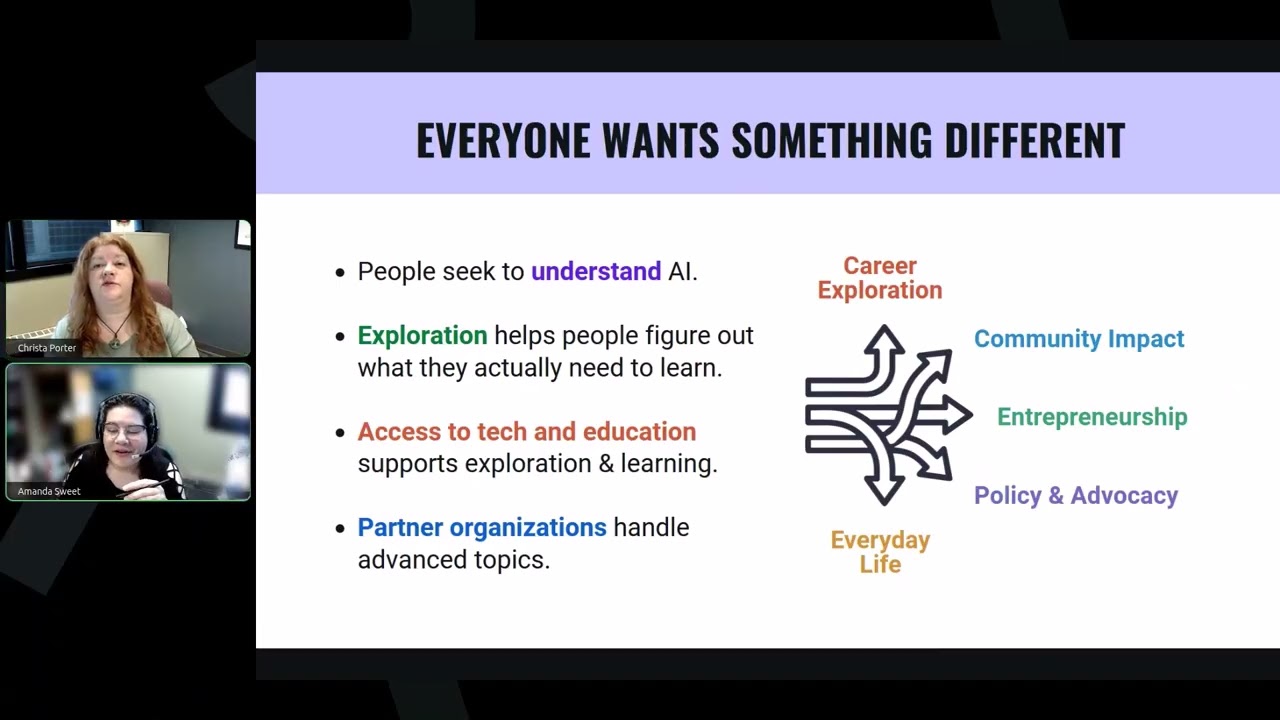
The "Pretty Sweet Tech" segment of NCompass Live, hosted by Christa Porter and featuring Amanda Sweet from the Nebraska Library Commission, explores practical strategies for fostering AI literacy within libraries without relying on rigid academic frameworks. Instead of expecting patrons to complete checklists, librarians are encouraged to reframe artificial intelligence discussions around everyday challenges such as future career paths, data privacy concerns like Meta's image training policies, and cybersecurity threats. Sweet proposes a three-part approach that begins with addressing immediate life issues, including job security for adults, parental controls in gaming environments, and helping users understand how platforms utilize personal data. To support these efforts, libraries must partner with external organizations such as the Department of Labor to provide career navigation resources they cannot develop alone.
The second pillar involves utilizing innovation spaces like maker hubs to teach AI as a tool for solving real-world problems while cautioning against over-reliance on automated reports generated by chaining multiple tools without human verification. Sweet introduces the "AI Navigator Model," where libraries act as guides rather than experts who must answer every technical question themselves; this strategy uses reference interviews to identify patron needs and directs them to specialized resources or partner organizations for specific issues like privacy settings. The discussion also highlights the limitations of current large language models regarding outdated training data compared to retrieval-augmented generation tools that access real-time information, advocating for libraries to curate databases and use AI automation to maintain resource lists rather than manually updating them.
AI literacy is ultimately defined as the ability to identify which daily problems can or cannot be solved by AI, select appropriate tools such as resume generators, verify output accuracy, and ensure personal retention of generated content to avoid misrepresenting qualifications during interviews. This comprehensive approach extends standard reference work into a new era where librarians guide patrons toward reliable sources or build programs based on demand metrics rather than attempting to master every technical detail themselves. The segment concludes by emphasizing that handling AI inquiries is an extension of traditional library services, requiring a shift in mindset from being the sole source of answers to becoming navigators who connect communities with relevant expertise and resources.
For those interested in implementing these ideas, available materials including lesson plans, activity guides, and resource lists on career literacy can be accessed via a Canva link or through upcoming recordings of the show. Administrative details note that Nebraska staff automatically receive continuing education credits for attending this program within their certification programs, while archives dating back to 2009 are accessible on the YouTube channel. The host also announced an upcoming summer break before returning on August 12th to discuss statewide resources available through United for Libraries in Nebraska and invited attendees to register for future events, including Amanda's return in late August and a virtual conference scheduled for October.
Read the full video transcript
Good morning and welcome to this week's
edition of Encompass Live. I am your
host Christa Porter here at the Nebraska
Library Commission. Encompass Live is
the commission's weekly webinar series
where we cover a variety of topics that
may be of interest to libraries. We
broadcast the show live every Wednesday
morning at 10:00 a.m. Central time. But
if you're unable to join us on
Wednesdays, that's fine. We do record
the show as we are doing today and it
will be available for you to watch later
at your convenience. Both the live show
and the recordings are free and open to
anyone to watch. So please do share with
your friends, family, neighbors,
colleagues, anyone you think might be
interested in any of the topics we have
on encompass live. Uh for those of you
not from Nebraska, the Nebraska Library
Commission is the state agency for
libraries. So we are similar to your uh
whatever state library. So um so we
provide uh training and consulting and
reference and grants and databases to
all types of libraries in the state. So
you will find shows on encompass live
for all types of libraries uh public
academic K12 corrections museums
historical societies. Uh really our only
criteria is that it's something to do
with libraries.
We have uh guest speakers that come on
encompass live sometimes for us and do
presentations on cool things they were
doing on in in their libraries across
the state and across the country. Um but
we also have Nebraska Library Commission
staff that come on and that's what we
have today. Uh today joining us is um
Amanda Sweet. Good morning Amanda.
>> Good morning. and she is our technology
innovation librarian here at the library
commission. And um it is the last
Wednesday of the month. July is almost
over. Oh my gosh. Um but that means it
is pretty sweet tech day. Yay. Um the
last Wednesday of the month, Amanda
always comes on the show to talk about
something techreated. Uh we do have
other shows throughout the month that
are that may have tech topics as well,
but you can almost depend on every um
last Wednesday of the month that it will
be Amanda and she is going to talk to us
about [clears throat] um libraries um
helping to build AI literacy and
introducing AI with purpose and
practicality which is very important.
This is something we uh I feel don't
need to be jumping into with no plan or
knowledge about what it is, what it can
do, what it can't do, what it shouldn't
do, all these things,
>> and the um effects that it has on um
everything in the world. Um but Amanda's
going to help guide us through some of
that and she's done other sessions about
AI as well. So there's lots of different
ways to look at this and um this is what
we're going to talk about today. So I
will hand it over to you Amanda to tell
us all about it.
>> Cool. So today we are going to go over
I'm going to introduce some AI literacy
frameworks that I've come across. Some
of them that I've liked and some of them
have that have been
could have been laid out a little bit
differently. But I'll go over kind of
comparing and contrasting some of those
different frameworks and how to
translate those frameworks into actual
program services and things that you can
actually do in your day-to-day. And I'll
go over how some of these AI literacy
frameworks are geared more toward um
like schools and sort of like a
controlled academic setting and how
those frameworks kind of start to break
apart when you go into a public library
setting or an adult education setting or
a setting where you can't just ask
people to follow through a checklist of
curriculum that they have to go through.
And yeah, [laughter]
>> everybody has to look at it differently.
Definitely. There's not a one one size
fits all. Yeah.
>> And that's why some of the frameworks
can actually that's why I say some of
the frameworks could be laid out a
little bit differently because you can
tell that they were written by educators
and they're written well,
>> but they're written for the setting of
education. And there's they are
frameworks that try to say that they
work for everything. But you know when
are you ever going to get an adult
that'll come in systematically to a
library to attend every single event and
every single session and cover every
single topic imaginable under the sun.
It's not going to happen.
>> We wish.
>> Yeah. Right.
So, I I'll go over some of those
frameworks and then I'll touch on what
the AI Navigator framework actually
looks like. And this is something that
it's I'm sure that if you find you can
probably find AI Navigator somewhere,
but it's a model that's still shaping
out. And I'm helping shape out the
version of what it looks like here in
Nebraska and who what other other state
wants to use it. And I'll also talk
about how that framework can translate
into the three main categories that
libraries actually tend to see. And most
libraries just kind of bucket AI
literacy into
everyday life. How is it going to help
you get a job? How is it going to how do
parents have to pay attention to it?
What are kids facing in their dayto-day?
And how is it shaping the future of
work? How is it going to be changing our
careers? That's our everyday life. And
I'll go over how to turn those into
um tangible programs and just build off
of what you already do and incorporate
AI into the thing. And then I'll go into
how the li how libraries can start
helping people explore
the way that AI is actually shaping
careers and the way that it's creating
new jobs, changing other jobs, and how
you can actually use AI as a tool for
innovation and how libraries can start
to kind of tackle that in ways that they
already do in things like maker spaces
and innovation spaces. innovation hubs
and stuff like that. I will say that
this slide deck that I put together here
is actually from a three-hour workshop
that I did at one point. So, we're not
going to get to all of this right now,
but I'll get to what I can of it. And
then I'll go over some of the popular
resources that um will be helpful and
you'll have links to these slides so you
can flip through it if you want to.
>> Right. Yes. And I will mention, yes, you
we'll have access um these slides will
be made available when the recording
goes up as well. So, um don't worry
about trying to scribble down all of the
information on here. You'll be able to
access it later. Um and even the things
that we, as you said, Amanda, don't have
time to get into today. You'll still
have all of those um resources and info.
>> Yeah, I guarantee I won't get to it all
right now, but you'll have the link to
everything
>> and that's okay.
>> All right. So in here,
this is more the foundation of what I
found AI literacy to be. And it's
because
when people go into the library, they
don't actually know what they know. They
don't know what to ask for. They don't
know if they don't have a solid
understanding of what AI is. Even if you
were to put out a survey to your
community asking if people want to know
about AI and what they want to know,
they might just say they'll check the
box that says yes because they're
curious about it. But they'll also check
that same box for a 3D printer or a
laser cutter, too. And we all know that
if people check the box for they might
go to a session or two out of curiosity,
but once they kind of get a feel for
what it actually is, what the technology
is, whether it's AI or something else,
when they satiate that curiosity, the
next thing on their checklist is how is
this relevant to my life?
>> Why do I actually need to learn this
technology? What's it going to do? So
that's why if you were to go to a laser
cutter class, you might get someone who
comes in and does the introductory
activity to build out garden stakes, but
if they can't think of anything else to
do with it, they're not going to do it.
>> So AI is like this overarching amalgam
thing that it's said so much that it
barely means anything. So libraries can
actually start to reframe it and say
what are the thing what are the problems
that people face in their dayto-day life
what are the everyday challenges what
are the things that people care enough
about to take action to solve and now
these are the things that we need to
start shaping AI around and for the most
part that's going to be
what are we running into for people want
to know which jobs are going to be there
in five or 10 years.
>> You have kids that are actually going
through school right now. My nephew just
turned 11. So, he's going to be starting
to think about his career in like seven
years when he actually hits high school
and he's starting to figure out what's
next in life. But the careers that will
exist for him, a lot of them we don't
know what they are yet.
And when people are actually going
through and people are getting laid off
from their jobs right now, they're
getting they're changing their careers.
They're trying to figure out what's
next.
And the library can actually work with
community partners to be able to say,
let's get a feel for what these careers
actually look like. And these are the
programs that actually bring people
through the door. But these are the
programs that libraries also can't do on
their own. you usually have to partner
with a or with another organization
to be able to do it. And like here it
would be like the AIM Institute or it
might be some departments a department
of labor or it might be um an economic
development group or an innovation group
or an entrepreneurial ecosystem group.
And then the next one is going to be
how is this actually impacting us in our
day-to-day. Right now people are
freaking out about data centers.
But then we're also looking at how our
data is actually being used, what's
going on. But I also hear back from
libraries that when they host a workshop
or something like that about how data is
being used in cyber security, people
don't show up.
And some of that is like marketing and
phrasing because if people hear the if
people see the word ethics they kind of
shy away from it. And if people see the
word cyber security they kind of shy
away from it. But when you start saying
how to stay safe online, or if instead
of hosting a workshop, you were to put
out a video through the library blog
that's just like a 10-minute video that
talks about how AI is reshaping the way
that you're you have to pay attention to
things on the computer, then that's
different. Um, I've subscribed to a blog
online called Malware Bites. and Malware
Bites is they put out um email
newsletters that talk about the latest
biggest threats that are coming through
online right now. And the recent one was
actually how Meta is automatically
toggling on the settings so that any
images that are stored on a public
Instagram profile can now be used to
train and generate AI images. So, you
can now type in a person's name that you
know and use it to generate an AI image
and it's going to look pretty dang good
because it's using the training set from
their Instagram profile.
>> Is that the one I saw? I saw something
about that about something in there and
there there was a lot of um posts going
around about how to um turn off that you
had
>> in a weird weird place too.
>> Yeah. That to go to turn that off and I
did that. I did that on mine. It's like,
"Nope, you're not using mine." But then
I saw and I never went back and looked
at them. But then I saw some follow-up
things um headlines and I am a bad um
I'm bad at
sometimes when I'm looking at stuff
online. I just read the headlines, as
they say, and saying that they actually
backed off on doing that because of the
backlash and everybody turning it off
that it's actually like if you go now
and look to try and turn off that
option, it's not there anymore because
they said, "Oh, well, you all didn't
like that, so we're just going to get
rid of we're gonna turn we're not gonna
do it." That that's the lead in to the
policy and advocacy section.
>> Okay.
>> Which See, I I had a system. I had a
system. [laughter]
>> Sorry, I didn't want to put you off
track, but I was like, wait, I haven't
You're good.
>> Sometimes, you know, you do your
sessions and some of it I'm like really
really like learning learning and
sometimes wait, I've heard of that one.
>> Yeah. Yeah. It's and I use that one
because it like it's the one that
everyone's been freaking out about
>> and it's also it's when we actually get
the word out there systematically enough
and in simple enough terms
>> it yeah and we make a difference. we
make them like
>> if it's something we all really don't
want.
>> Okay, I won't say they will change it,
but often times
>> yeah,
>> we do have we can make them change
things to something we'd prefer or not
have them do. And yeah,
>> it's and when people start actually
Yeah.
>> And when people can find that setting
and enough people find the setting,
that's actually how policy change
happens. Mhm.
>> And
part of the AI literacy frameworks is
that we're trying to educate the public
enough to be able to know their rights
and know how their data works and know
how the system works and know how AI
works to be able to know which tools
they should use, how to use them, and
what they should use them for.
And then they need to know how AI is
already being incorporated into their
everyday life. and then how they should
be incorporating AI in ways that they
don't know exists yet.
And so the other side of that is we're
also trying to educate the businesses
and local entrepreneurial groups for how
to actually build human- centered
systems.
So a lot of these AI systems are going
to be
Yeah, I actually used AI to build this
because AI is actually really good at
this sort of thing.
But so this chart up here, this is a
tool called Plexity AI if you haven't
used it before. So, I will show
I just built a little chart that will
say that
lists out the most popular AI literacy
frameworks categorized by target
audience.
And then it'll spit out this and I
specified which columns to include in
the spreadsheet.
And when you specify which columns to in
include in the spreadsheet that it
generates, it'll also indicate
um more information and descriptions
about what you want the AI tool to
actually do and how to format
everything. So if you are a library
that's building resource databases and
resource panels, this is actually a
faster way to do it.
But then you also have to go through and
make sure that it's linking to the
actual correct thing.
So when I
and you also have to make sure that it's
linking to
um
the actual place that you want it to go.
So I'll give the example of this
Department of Labor AI literacy
framework.
If you go to the one that it sent, it
actually goes to this page here, which
is not the one that I actually wanted.
This is the one that organizations have
been using to understand the AI literacy
framework and guidance. So, this is a
helpful page, but it's also not
intuitive.
What I want is people to go right over
here
there. So, this is the AI literacy
framework that I've been pointing people
to.
>> But if you were to send people over
here, they're not going to magically
know that this is what I want them to
look at. [clears throat]
>> And one, this is a lot of tech, like
plain text that's just in government in
typical like government document style.
You'll find it on all government
websites. Very plain, very not
>> go here. Not very like interesting
[laughter]
>> or attentiongrabbing. No.
>> Yep. There is nothing on here that says
look here.
So I update it to just say go here. And
then these are actually the things that
this is the one of my favorite AI
literacy frameworks. It's actually
geared toward uh the future of work, but
I think it actually applies to pretty
much everybody because people just want
to know what in the world AI actually
is. And then when you say explore AI use
cases, you're actually asking the
question of how is this relevant to my
life? How is this relevant to my job?
How is this relevant to what I do at
home? when I go at the end of the day
and I go start streaming on Netflix or
streaming music on Amazon Music, how
does this use my data to build out a
profile and do I want it to do that?
And then you start saying, now that I
know how AI is actually being used in my
everyday life, which tools do I actually
want to use to be able to solve the
problems that I face in my everyday? and
which tools can I just filter out of my
inbox because I they don't do anything
for me.
And then
once I start using these tools, how can
I make sure that the information that it
spits out is right? So once you find a
tool like perplexity, how can you make
sure that perplexity is the best tool
out of clawed out of all these different
options to be able to solve the problem
at hand?
And how can you start building your AI
toolbox to be able to
do what you want to do?
And then how can you make sure that AI
is being used so that it's actually
designed and developed for humans?
And how can you make sure that it's um
your data is being used effectively? How
can you make sure all this different
stuff? So that's when I started
putting this together.
So this is actually what I'm updating
and reformatting right now with the help
of some AI groups across the state
and right now this is like the initial
baseline draft
which is just saying what is this stuff
what I'm updating right now with the
help of a few different groups is
figuring out which different subtopics
and categories
because when you actually think about
AI, you can think about
AI is basically just a tool that helps
the computer replicate human senses.
So when you think about generative AI,
it's actually replicating the ability of
a human to be able to like condense
information, comprehend information, and
translate it into a written document.
And it's actually pulling from millions
of different examples of the human
written word online.
And you can either tell AI to search the
open web and use the examples all across
everywhere or now you can just tell it
to use specific sources.
And if you use like a tool, if you use a
tool like Perplexity and you don't
specify which sources to go through,
it'll just pull from everywhere under
the sun.
But what a lot of people don't know is
that tools like the
pretty much every LLM that's out there,
large language model, the training model
and training data actually cuts off from
about a year previously.
So, anything that you put into these
model into these prompts, if you put if
you if you're asking for a tutorial for
Microsoft Word and Microsoft Word has
updated itself within that last year,
there's a solid chance that you're
actually going to get the wrong like
outdated information. You're going to
get a tutorial from like a year ago. And
if you Google it and you get that little
AI generated snippet across the top,
it's really good at summarizing some
stuff like why you're like what is the
life cycle of a frog because that
information isn't going to change.
But if you're asking to generate a
tutorial about how to update the like a
setting on Etsy and Etsy changed where
that setting was in the last year, that
summary is probably going to be wrong.
And so then they started
>> that's why I always think with whenever
we're talking about using AI or just I
mean this is something before it was
called AI we had just Google it you know
just search it online and it a lot of
that was the same thing. Um, I mean, if
you're still just going to your Google
or search your search engine of choice
and typing something in,
>> it's still the same thing you always did
before
>> everyone started using the words AI. Um,
generative AI and all that with artwork
and and and literature, that's
different. But, um, we always taught
critical thinking along with that. When
you are looking up something on the
internet, you need to make sure that
it's accurate and good and, um, where
what is the source that it came from?
We've been teaching that since the
internet started. [laughter]
Um, and we need to continue doing that
with anyone who tries to use AI and say,
"Hey, look, AI told me this or um,
>> why are you just suddenly now believing
it? It's not any different than what
we've been doing for the since the
internet in came about." So,
>> and so, and that's the next problem is
that as librarians, we we've always been
teaching information literacy.
>> Yeah.
>> And those same frameworks that are like
that are tried and true for evaluating
this information, those are the same.
>> But what's under the hood is different.
So, most of the libraries that I talk to
and most of the workshops, they live
over here. These are the large language
models that are like what Claude spits
out. These are the ones that um Grole
spit out. These are the ones that all
these different tools will spit out. But
now there's another layer to it that is
a the retrieval augmented generation
layer. So when I talked about how large
language models their training data is a
lot of times about a year out of date.
So after libraries figured that out,
they just said, "Okay, we're just going
to tell people that stuff is out of
date." But if you just say that, we're
actually giving the wrong information.
because now we also have this new model
where a lot of the customized tools that
are out there, they actually have um
you can now gather a set of curated
information and load it into your own
custom model to be able to fill that
gap. So now the coding models and the
developer tools and the any tech tools
they actually gather the no the most
recent documentation from that missing
year and load it into the system. So now
if we tell people that that information
is year out of date and they're using a
system that is actually a rag tool that
fills in and solves that problem, we
just gave them the wrong information.
But the problem is that not all reggg
tools are actually labeled to say that
some of them will actually specify that
they use the most upto-date information
and some tools have the ability to pull
from the open web like perplexity like
if I had gone through and I had told
perplexity to
um focus on com like focus on resources
from common sense media from department
of labor and given it a list of five
different websites, it will actually go
through and manually check those
websites from current day information.
So this to these tools actually continue
to evolve.
And so this is when the library is
actually trying to give most recent
information. We need to have a baseline
literacy about what these terms are
looking like and what these tools can do
so that we give people the right
literacy that they actually need going
forward. And these tools are also these
terminologies are also going to change
and evolve in another 1 year, 2 year, 3
years.
So, we need to know enough to ask the
right questions and to be able to refer
people to the right support
organizations
to know what to look for because after
RG, we're actually looking at Agentic
and Agentic is where
um if you remember when the Amazon AWS
server went down, it was because of
Agentic gone wrong. Agentic is what
happens when you have different AI tools
talking to each other and they are
trying to string together multiple
different tasks in a row. And a good
agentic system will actually have a
human in the loop that's going to be
checking the output of these different
systems and making sure that all these
different AI tools are communicating
smoothly and the output and the in the
effects of these systems are actually
going the right way.
what happened with um the Amazon AWS
when all those servers went down and
there was just chaos. It was because the
engineers that were over at Amazon, they
were using AI to be able to update their
coding and they were also using AI to
write some of their code. So when you
start automating that process and you're
not paying attention,
um that AI tool wound up saying, "Oh, I
can optimize this if I just delete this
entire section of code." And it did
and everything broke.
>> Trust Don't trust the AI. Use your own
brain in addition to it. You cannot just
use it blindly.
>> Yep. And so and now more libraries are
actually starting to use this too
because if you look at some of the
different ways that you can use AI, if
you're starting to use AI to analyze and
generate um feedback analysis reports,
if you were to use a survey tool that
gathers feedback and information from
your patrons in the library and then you
feed that into an AI tool to generate it
into a spreadsheet output. And then you
tell it to find the most common keywords
and the most common topics and um issues
that were detected across all of the
feedback forums and then you tell that
to spit it into
um an aggregated report with charts. You
can start to automate that using an AI
tool that syncs to another AI tool that
syncs to another AI tool. So, one little
AI tool is where most people live. But
now, when you start stringing them
together and having one of them
communicate the output to the next one,
that communicates the output to the next
one that then generates a final report
with charts.
That's when people start getting lazy.
It's because the end result might look
really good, but you may not. You might
be overloaded and you might not actually
have the time to go back and look at the
source information and you're trying to
hit a deadline and you just need to get
it sent over. Otherwise, you're going to
get yelled at because it's the end of
the week and you have to you're trying
to get to a vacation.
And this is the pressure point that
actually makes people crack and just put
stuff out there.
So it's not information literacy skills
all the time. Sometimes it's the
pressure of being human
>> and the ease of actually using these AI
tools and because that error that is
generated by AI might not be caught for
months because you might have a deadline
to actually finish this report. But who
reading that report is going to go back
through to that source information and
actually check it? M now that's on you.
Yeah.
>> Yeah. Yeah. So now you're making
decisions based off of this report and
this feedback,
but is it true?
So there are good ways and bad ways to
start using this. But what the library
is actually trying to do both for their
patrons and for themselves is to say how
does this fit
in your everyday life?
Can you use it and can you use it well?
And then what is the intended or
unintended consequence
of using it in this way? And this is how
policies, guides and frameworks and
regulations actually get built because a
lot of times we start doing this stuff
and we start experimenting with this
stuff and then stuff happens
and then we have to go back and say,
"Yeah, we didn't expect that to happen.
We really don't want that to happen
again. So let's write a policy to make
sure that it doesn't
and let's start updating regulation and
start updating all this different stuff.
So that's why we started having these AI
policies that evolved over time, but now
we have AI policies and regulations and
frameworks at there's some that are at
the federal level. There are some that
are at the state level. There are some
that are at the local and city level.
There are some that are on the
organizational level and then there are
some that are at the vendor level to
make sure that the policies at the
federal and state level are enforced.
And then there are regulatory frameworks
that are used by the vendors and the
organizations to make sure that all
these policies are actually followed,
updated and used. And you have tools
like Google that will have to go through
not just the US frameworks, but they'll
also have to be going through basically
global frameworks. And the European
Union has a different framework and a
different um level of stringency for
data sharing than anywhere else. So it's
actually helpful
to be able to go through and track out
what the policy cycle is and the
different so libraries don't actually
need to know all the everything. They
just need to know the keywords and the
topics that they should be paying
attention to which are here. How is this
actually impacting all of us as a whole?
How is it reshaping society? First it
was computers that reshaped society.
Internet reshaped society.
Now AI is reshaping society.
>> Y
>> and it's not a different process. It's
just a different tool.
>> And it's all these different all these
same things that are being impacted but
in different I need to make this not all
black and white. I just said that about
government websites and what did I do?
[laughter]
It's one line of code to fix this. It is
>> you can do it. I have faith. Yeah.
[laughter]
>> So, this is what libraries actually need
to pay attention to. And if all the
library does is send people over to a
linked article to be able to read more
information about it, that's a win.
And if you send them over to
an information, like an information
resource to understand how AI regulation
actually works, that's a win. If you
send them over to the different levels
and examples and different ways that
people are writing and adapting and
adjusting this stuff and going over to
the whole database of how AI is actually
being regulated because there are groups
that actually track regulatory updates
across the country. The library doesn't
have to do this. just find the source
that does.
And just sending people over to this
stuff is what people need to know. and
then finding the people that will need
to actually be contacted to be able to
help change this or help advocate for it
and learn the process for how advocacy
works
and learn the process for how people can
take control over the data and take
control over how and how a tool is being
used and which tools being used and how
to actually drive change instead of just
reacting to change. This is what
libraries need. This is AI literacy,
but it's not all in the library. It's
not something that the library can
reasonably be expected to know all the
everything and do all day every day. And
I really need color on this page.
[laughter]
So, these links are here if you want to
be able to understand from curated
resources
what all these different topics are
about and without actually having to
read an onslaught of all the different
sources.
And then the next thing that you'll
actually want to do is you can flip
through
the activities to be able to introduce
people to different AI concepts.
So this is probably the thing that
libraries will use the most and it's
categorized by age grouping right now.
And what I've been doing is lately is
actually updating the metadata behind
this so that it's easier to be able to
search by um specific keyword. So right
now these are by age range but now I'm
adding in the
the basically adding in this the ability
to add more search filters so that you
can search by AI ethics and then you can
go to any tools that have AI ethics or
any tools that talk about computer
vision and it'll map out the keywords
and the tags. So instead of actually
doing that manually, I use AI tools to
be able to generate what those keywords
are and then synthesize it into
um its own kind of lexicon and then turn
it into a database.
And it's easier to use the AI tools to
be able to do that cuz it would take for
freaking ever to go through all of it
manually.
And then I use another like scraping
tool to be able to check the links. But
the caveat to that is that I have to
remember to run the scraping tool to
check the links. So, but I could use an
AI agent to automate running the
scraping tool to check the links and get
it sent over to my email that says fix
these links dum dum, which is exactly
the spread like the subject line that I
would use. And then it would remind me
to do it.
So, this is where
it's getting easier to actually be able
to use and navigate this stuff.
And
then the other one was I have some
partner vendors that do the educational
technology stuff. So they requested that
there's a separate educational
technology database
that has curated recommended tools that
will introduce specific concepts so that
when libraries are actually searching
for a tool that will introduce computer
vision or introduce image classification
or introduce some uh neuroscience or
neurochnology,
it'll be easier to find the stuff. So,
and all of that uses AI and automation
tools
to generate it, maintain it, and fix it
cuz otherwise
um one human and that's not going to
happen without AI. So, this is how AI is
actually going to make things possible
that would not have been possible
before.
So, long story short, flip through here.
There's cool stuff here. [snorts]
And
let me jump back up here.
[clears throat]
So, the other thing that you'll want to
look at is
when you start actually getting people
into the library to start asking about
this stuff,
people are naturally going to get
curious about it. And you as a librarian
are not necessarily going to be able to
answer all the everything about how all
this stuff works, where to go and all
this, but you can send people over to
either an online resource or a human
organization that can answer those
questions.
So that is where the navigator model
actually comes in. Mhm.
>> So the trend tracking side of this is
that if people come into the library and
they're super curious about how machine
learning works and they want to ask 8
jillion questions about how this works
and then you look at them with like deer
in the headlights eyes because you don't
know, you can send them over to this
machine learning mastery blog or you can
send them over to AI magazine or these
podcasts and then they can start using
this to track those trends.
and using this to be able to figure out
what's going on.
And the library connecting people over
to resources like this is AI literacy.
And the library being able to connect
people over to like an education and
training resource that's either local,
state, or national is AI literacy.
So, we go back over to what is an AI
navigator? How are we helping people
navigate the landscape of AI?
And then you go into
this is what an AI navigator actually
is.
AI is actually a giant massive
topic. [snorts] So each library can't be
expected to cover AI fully and
wholeheartedly.
Most libraries actually choose a focus
area. They say, "We're going to as a
library, we have three these three staff
members who are super curious about how
AI works. They're in it to win it. And
this one is a children's librarian.
She's going to focus on kids and teens.
And this adult librarian, she's going to
work with the children's librarian.
She's going to work with parents and
older adults. And now we also have a
partner organization that's doing
workforce development. So they are going
to do the career navigation and career
resources.
And so these are our three focus areas.
Now we're going to start figuring out
what people actually need to know most
in these areas. And a lot of this is
going to be talking to
um industry experts. And the reason that
I started that tech ready is because
most libraries don't actually have time
to do this step. They don't have the
time to do the step of actually
figuring out what people need and
talking and having a jillion
conversations with industry experts and
educators and entrepreneurs and all this
different stuff to be able to figure out
what's going on. Because if you ask the
average librarian to go start a
navigator program and do all this leg
work,
maybe one will do it, but it'll be a
tiny tiny program that may not be super
sustainable because libraries are
stretched thin. M
>> so part of that is
getting the resources together so that
the library can skip some of that leg
work and identifying the right
organizations means that you also have
the enough um literacy of the
terminology and what's going on in the
world of AI to be able to identify the
right partners and know where to go and
that also takes time. So identifying the
actual right partners and getting synced
up to the people that do what you want
to do without having a million
conversations that hit a dead end
because you got referred to someone who
maybe might do something but then they
don't.
Part of that tech ready is actually n is
understanding identifying those
potential organizations
and having the warm referral so that you
go to the right spot faster and there
are already pre-baked um activities and
bridges over to those organizations so
the library doesn't have to do extra
work.
And then it's either choosing from some
of those lesson plans and activities
that are already a thing or putting
together a pot of services and resources
together so that each library isn't
reinventing the wheel.
So when we actually all work together on
this stuff,
it's more possible because if you just
look at this stuff as a whole,
uh it's not going to happen
or it's going to take for freaking ever
to do it.
>> Mhm.
>> But this the tech ready is designed to
accelerate this process
which just takes a hot second to do.
And then the next side of this is what
does it actually look like to go through
a tech support um service.
So, if anyone on this call has actually
done a digital literacy support service
before, uh you know that even if you try
to do workshops and you try to do all
this different stuff, the vast majority
of people that come through the door
just want a one-on-one tech
consultation. They have a general idea
of what they might want to do and they
or they have a question about it.
And you as a librarian will have zero
idea what they want when they walk in,
but you have to just start asking
questions.
And half the time, if you've ever done a
reference interview,
>> those questions are not what they
actually are asking.
>> Oh yeah.
>> Yep.
And so once you actually find out what
in the world people want, then you go
through and say, "Okay, can I actually
help this person?" And if you can send
them over to Sometimes it's going to be
a parent that's going to be asking for a
resource to be able to set up the right
privacy security settings on their kids
Roblox.
And you can set them over to the Common
Sense Media Guide. I have a little
collection of these digital skill
resources in the tech hub that make this
part easier. And sometimes you're able
to just send people over there and
they're like, "Cool, this is exactly
what I needed." And then they go about
their day.
And in some cases, it's not going to be
so easy. Sometimes people are going to
be asking, "Do you know where I can go
to
um get a basic machine learning
certification?"
And then you're going to start asking
questions and you start saying, "How
in-depth are you going to be getting on
this? Are you going to be do you need a
certification or are you just curious
about it? Are you trying to turn this
into a job? Are you trying to solve a
problem at home?" and you start learning
to ask the right questions to send them
over to either maybe Corsera, you might
be sending them over to a community
college, to a university, but you also
need a database running on the back end
of this for a good navigator program
that actually identifies what some of
those organizations are. And that
database is going to be dependent on
which topic areas your library chose to
focus on. Because if you try to build a
database for every single topic under
the sun, that's going to take a hot
second. But if you try to customize one
that's geared toward a specific problem
or subject area,
that's when you can start getting
somewhere.
And that's when you're just giving the
to the librarian the tool that they need
to get people over to the support
organization that will help them do the
thing.
And then if you get 20 people over the
course of two months that are all asking
about machine learning resources,
that's when you start building out a
wraparound service and saying, "We're
going to build a workshop to help people
understand what this stuff is. We're
going to do we're going to bring in a
guest speaker that's going to be talking
about this stuff." And if you only get
two people or one person and once in a
blue moon asking about it, then you just
send people over to the referral and
you're good.
>> Mhm.
>> And so this is how you start building
out and then designing better services
over time based on the questions that
people ask. And if you track the right
metrics, then you can feed it into an AI
model that'll also start guiding service
design in the future. And you can also
share the information with partner
organizations so that they can also
build better services.
>> And this looks like how you would do any
question that comes into the library. I
think any any question that comes into
comes to you about from about any topic.
>> Yum. So it's very familiar I think to
librarians. But the whole, "Oh, this is
techie, this is technology, I don't know
that," I think is um scaring them away
from the not scaring them away from
doing it, but they're like, "I don't
know. I don't know." It's the same as
what you've always done. It's okay. It's
just a different topic.
>> You just [snorts] got to find the right
place to send for to pass them on to. Um
and then of course decide is this
actually something that we need to be
offering as a program or a service or
more than just a referral. So um say
yeah
>> it's a reference interview. That's
pretty much it
>> like any other one different topic.
>> You shouldn't handle it any differently.
So this is the same process you you'd
use for any reference question you get.
>> Yeah.
>> And
>> do it. I have faith in you.
>> Yeah.
[clears throat] So
this is basically kind of a little
sampling of the
common problems that people come into
the library trying to get support with.
And
some of them are just looking for I mean
I was actually just doing this two days
ago trying to figure out which new meal
plans I want to like which new things I
want to cook because I was sick of the
same thing over and over again.
>> Yeah. And so it's not again it's not a
new thing. You just have AI tools that
are layered over the same problems that
people were facing 2 years ago. Now you
just have different tools to be able to
solve it. So now you're looking at AI to
be able to generate um resumes, cover
letters, and all these different things.
And now people are saying, "Okay, now I
know AI can actually do this." Question
one, which tools should I be using?
Which tools are actually the best ones
to use so that I can try this? Question
two, how do I know that the information
that it's spit out is actually accurate
and correct? And question three, how can
I best use this AI generated resume or
tool in an actual interview? because
they're running into problems where
people will generate an resume using AI
or generate a cover using cover letter
using AI but then they submit the AI
generated resume and then they might get
an interview like a month later and they
have zero idea what their own resume
says
and because they didn't go through the
process of writing it so they don't have
any retention of what it head. And if
you don't have a guiding like a guiding
force that says you need to actually
process and memorize the output of this
resume and make sure that the phrasing
is reflective of what you actually did
instead of letting AI accidentally
generate certifications and the stuff
that makes you look awesome that fits
the job description,
but that you didn't actually do. and
then you wind up in a job that you can't
actually do because you're not actually
qualified for it. You just sounded
awesome.
[laughter] So this is what it what AI
literacy is in a nutshell
is what are the problems people are
facing every day.
Which problems can AI help solve and
which ones can't it help solve?
Which tools are best to help solve those
problems?
And how can we use those tools
effectively to be able to solve it? And
will the use of these tools affect
society, how we interact with each
other, how we
how our brain shapes, how our kids are
growing up, how our day-to-day lives
actually look. and do we want this
change or do we need to do something
about it?
And that's basically all that AI
literacy is is asking those questions
>> and figuring out on a case-byase basis
what that actually looks like.
So, we have about a minute I can hang
around to ask to answer more questions.
I did say that I wasn't going to get to
all this stuff.
>> I didn't. And that's okay. That's why
we've got the slides. Yep.
>> Um
so does anybody have any questions you
want to ask of Amanda? Um we yeah right
at 11 o'clock, but we did start after a
little after 10. So we will um and
handle any questions that you do have.
Um anything you want to her to expand
on?
um any anything you've dealt with like
the about AI um and people coming into
your library asking about it that you
want to share any of your experiences,
please do type into the question
section. It's the um speech bubble at
the top of the question mark on that.
I've got that open here, so I'm
monitoring that as well. Um,
>> and in the slides I also did put in
library service ideas, which is one of
the more specific things like the
tangibles that I didn't
>> get to, but you can also flip through
here for brainstorming on things that
you might actually want to try doing.
And you can also try the lesson and
activity plan in that tech readyation
thing. So, this is a category and
concept thing that you might want to
try. And the other one is actually
lesson plans, activities, gadgets, and
things that you can
>> get or do use. Most of it's free stuff
online. So you can also flip through
here for
um links to the resources and you can
flip through for information about hey
how AI career literacy works and how
all this different stuff fits together.
[clears throat]
[snorts]
>> This workshop they wanted a thing on AI
policy and regulations. So that's the
last little section in here. And these
are some of the ways that you can
introduce
uh AI literacy. Same different levers
that you can pull, but it's just framed
differently.
>> Yeah. And somebody did say, "Yes, these
slides will be available." Yes. Um so
you will have them when I get the
recording up tomorrow. Uh so yes, all of
those things you'll be able to read
through them at your leisure. And then
of course reach out to Amanda to um ask
about any of the things anything on her
slides here uh to expand anything more.
Um
>> I also started adding a link to book a
time on my calendar because some people
had specific questions about projects
they were doing or whatever you were
doing. Yeah.
>> So my email's on here, the link to the
tech ready nation is on here and my
calendar is on here. So you can either
grab it now or you'll have the link to
the slides later
>> and I will give the link to
here is the public view link.
Copy
and
>> Oh, they always put it in a different
spot on every single platform. There it
is.
>> Yeah. And and of course like I said at
the beginning we have a new uh
new interface for uh go to webinar which
I do like.
>> And the chat says hidden while screen
sharing show my private messages. So
apparently I can't do chat while I have
a screen share.
>> I've got it though. I've got it though.
So um
>> as long as you have it I call it a win.
>> Yeah. And um did I Let me see if I did
this correctly here.
question
over here. Send a message
to
everyone. There we go. Okay. So, I
should have shared the actual link to
the slides in um the chat which is next
to the question section for all of you.
So, you should be able to grab that
Canva link um if you want to grab it
right now. But also, like I said, it'll
be on the recording that'll be available
for you tomorrow, too. So
>> there was a bunch of stuff in here. So
you can also just flip through here
later.
>> And some of these things may become some
of these more you like you said this was
a longer workshop that you did. Some
parts of this may become another a
future um session that Amanda does for
us and yeah
>> just a part of it. We'll see what kind
of uh interest in future um sessions.
There was a request before for just how
libraries can introduce AI careers and
um entrepreneurial support resources
>> also specific just for that. Yeah. Yeah.
>> Cuz I did mostly the everyday life stuff
here.
>> Mhm. But there's also a whole bunch of
um
uh
how to track which types of careers, how
AI is changing careers and tools and
um links over to career guides and
identifying
how to translate this into
grab a gadget and use it to introduce
this stuff and send people over to the
right resources and
It's a whole lot of stuff.
>> Yeah. All right. All right. Well, I
don't see any other Oh, wait. Uh, we got
some Thank yous. Great information and
resources. Thank you coming through.
Thank you. [laughter] You're welcome.
Well, hopefully it is. I know this AI is
a huge topic now on everyone's mind and
we're all trying to figure it out and um
Amanda's done multiple sessions from
about different aspects of it. Um, so
hopefully this will be um helpful to you
as well.
All right, I'm going to bring up my
screen here. There we go. Um, thank you.
Thank you. Thank you for the
information. People are saying great.
Yeah. Um, so as I said, yep, I've got
the link here to the slides as well that
will be available.
Um, [snorts]
so that wraps up today. Thank you
everybody for joining us. Thank you,
Amanda, for being with us here. Again,
um as I said, uh the recording will be
available uh by the end of the day
tomorrow to everyone. Um if you use
whatever is your search engine of
choice, and type in the name of our
show, Enco Compass Live, you'll find our
main page uh which is right here. We
have our upcoming shows and underneath
at the very bottom a link to our archive
shows. So today's show will be at the
top of the list, most recent one at the
top here
um with a link to the recording on our
you on the Nebraska Library Commission's
YouTube channel and a link to the Canvas
slides that um Amanda put together. Uh
everyone who attended today's show and
registered for today's show will get an
email from me. Uh we also letting you
know when the recording is ready. Uh we
also push it and notice out into onto
our mailing list we have here in
Nebraska for Nebraska libraries and onto
our social media. We have a Facebook
page for Encompass Live. If you'd like
to use Facebook, give us a like. Uh we
post reminders. Here's your reminder to
log in today's show. Uh presenter um
announcements and then when a recording
is available. Here's the one from last
week. Uh we also use the library
commission social media uh Instagram
page, blog. I put out onto my LinkedIn.
Um and we always use this try to I
always try to use the hashtag encount
name. So, uh, you should see things all
over the place about Encompass Live and,
um, please do share and spread the word
about the show. As I said, um, on our
archive here, I will show you. You can,
um, search our show archives to see if
we've done a show on a particular topic
of interest to you. Um, you can search
the full show archives or just the most
recent 12 months if you want something
very current. Um, as Amanda was
mentioning earlier, uh, things become
old and, um, there's old information out
there on the internet. And there is an
encompass live, too. Um, this is our
full show archives. And I'm not going to
scroll all the way down because it is a
huge list here. Uh, but this is our full
show archives going back to an encompass
live first premiered in January 2009.
2009.
Um, we're officially an adult this year,
18th year of the show. [laughter]
Um, but uh we do have all of our show
archives uh uh recordings out there. So
do pay attention to the original
broadcast date of anything you watch.
Some shows will be fine to watch, still
stand the test of time, still be good,
useful information, but some things will
become old and outdated. Resources may
have changed drastically. Uh links may
be broken. Uh people will work in
different places than when they
presented for us 10 or 15 years ago. Um
but this is something libraries do. We
keep things for historical purposes and
as long as we have a place to host all
of these shows, which is right now the
uh Library Commission's YouTube channel,
we will always um keep them available
for you out there.
Uh um [clears throat]
there we go over here. Uh some people do
ask about receiving um continue
education credit for watching our shows
and yes, you can. Uh about an hour from
now, everyone will see everyone who
attended the live show receive an email
letting you know um there's your
official um proof that yes, you've
attended the show. Thank you for
attending. It's got a PDF certificate if
you need that or like to have that. Um
if you're a Nebraska um staff person and
you are in um our certification program,
your CE hours hour will be automatically
added. If you're outside of the state,
you'll have to work with whoever are
your CE granting um organization to get
that. Um, for our archive shows, you we
do have a form that um you would uh
apply for for Nebraska libraries. Same
thing. If you're not from Nebraska, talk
to your CE people to find out how you
would get credit for watching any of our
recording shows. Recorded shows. Yeah.
>> All right. So, um, Amanda will be back
with us at the end of August. I believe
that's your next scheduled session on
August 26. Topic to be determined.
So, uh, keep your eyes open on our
schedule to see what we what she comes
up with for next month.
>> I might have the SJICU students come in
and talk about the Nuclei pilot.
I don't think we did. I don't think we
did an encompass for that yet.
>> The what pilot?
>> Nuclei, the AI story generator.
>> Oh, okay. Yeah, sure.
>> Yeah,
>> I'd love to have
>> probably either either August or
September,
>> right? because you're in for August and
September. Um October uh if you saw on
our inter slides there will not be a
pretty sweet tech in October. The last
week of October is the internet
librarian conference.
>> Yeah.
>> Um it's an online conference that but
Amanda uh participates in that sometimes
as presenter sometimes as moderator but
um that's a
>> I'll be giving a workshop and I think
three sessions this time.
>> Wow. Okay.
>> With a panel so the panel is not
>> you know. Yeah. Um but look at attending
internet librarian. It's a free it's an
online sess um conference. It's the last
week of October. Uh and it um we do
usually through the library commission
offer discount um registration. So keep
an eye open for that.
Um so yeah, so keep an eye on schedule
here. Um here's our August dates. I'll
be getting some September ones up as
well. We are taking next week off. Uh
taking a little summer break. Uh so
there will be no show next week. No
encompass live on the on August 5th. Uh
but we will be back on August 12th uh to
talk about United for Libraries. This is
the American Library Association section
for trustees, advocates, friends, and
foundations. Uh so for your friends,
groups, foundations, uh library boards,
this is a great resource. Lots of um um
trainings and workshops and information
in there. Um here in Nebraska, we do
have statewide membership for it. So it
is available for all Nebraska libraries,
library staff, library board members to
use all of their resources there. Uh and
right now at this very moment is
happening uh was first day was yesterday
and then today and tomorrow the United
for Libraries virtual 2026 online
conference is going on.
>> So um if you are uh a Nebraska library
and you're from anywhere register for it
um they have each day is specific for uh
has a focus. Yesterday was trustees and
boards. Today is foundations. Tomorrow's
is friends. Um here in Nebraska, we have
paid for statewide re um registration
for anyone in Nebraska to attend. Other
states do have statewide um registration
as well possible. Um if not, you can
just sign up yourself. Uh and then the
all three days is the entire virtual
online conference. All of it is recorded
and the recordings are available
afterwards as well if you register.
So, um please do uh look into attending
that. And our um next week's show about
United for Libraries, uh Beth Nolinsky,
who's the executive director of United
for Libraries, will be joining us to
talk about everything that you can
access through them.
So, please do register for that and for
any of our future shows. Thank you
everybody again for being here. Thank
you, Amanda. Good to see you. We'll see
you next month
and um hopefully see you all on a future
episode of Encompass Live. Bye-bye.