NCompass Live: How to Start & Sustain a Health & Fitness Literacy Program in Your Library
Watch on YouTubeVideo summary
Nicole Miller, the Library Director of the Canon Falls library and a certified group fitness instructor, presented a comprehensive guide on how libraries can expand their traditional literacy mission to include health and physical literacy. She defines these concepts as the ability to access information for good health and the competence to remain active throughout life, arguing that libraries play a crucial role in helping patrons make informed decisions and sustain activity habits. Her program successfully evolved from simple walking groups into structured initiatives like "Fit Fridays," which now offer four weekly sessions tailored for older adults aged 60 to 80. These classes focus on manageable 30-minute segments of resistance training, chair yoga, and rhythmic walking, effectively breaking down the recommended 150 minutes of weekly activity into achievable goals while educating participants that daily movements like housework also contribute to their physical activity targets.
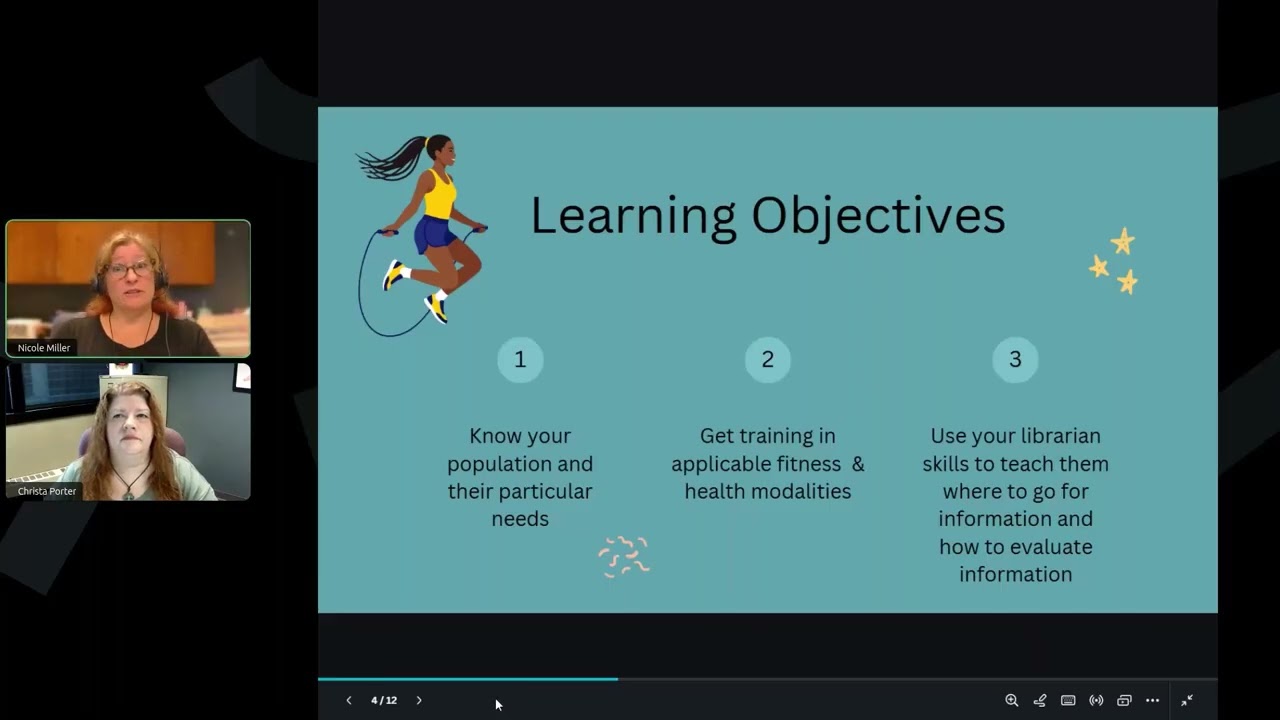
To ensure sustainability and community relevance, Miller emphasizes that librarians must first understand their specific demographic needs and survey patrons before investing resources. Rather than hiring expensive external instructors, she recommends obtaining affordable certifications from organizations like AFA or ACE, noting that self-certification costs around $500 compared to over $5,200 annually for outside professionals. The approach must remain weight-neutral and evidence-based, utilizing reliable resources such as the National Library of Medicine, Examine.com, and PubMed, while strictly avoiding fitness staff offering nutrition advice in favor of referrals to registered dietitians. Essential equipment remains minimal, consisting mainly of Bluetooth speakers with licensed music subscriptions, resistance bands, yoga mats, and chairs, allowing libraries to leverage existing program budgets or seek donations from Friends groups to fund these initiatives.
Building a robust support network is vital for addressing diverse community needs, and Miller encourages partnerships with local emergency services for fall prevention, retired doctors, physical therapists, mental health specialists through NAMI, and public health departments. To maintain program continuity during staff absences or recovery periods, the library utilizes recorded classes hosted on their YouTube channel, ensuring that patrons can still access valuable content regardless of staffing fluctuations. The logistics of running these programs should be flexible; class frequency should adapt to community interest rather than adhering to a rigid schedule, and libraries are advised to test demand with one-time guest instructors or local clinic visits offering stretching and spinal exams before committing to long-term certifications.
The session concluded with administrative details regarding the availability of recordings and slides on the Nebraska Library Commission's YouTube channel for those seeking continuing education credits, which are automatically emailed as PDF certificates to attendees within the state. The host also promoted various outreach channels including Facebook, Instagram, LinkedIn, and mailing lists to help libraries connect with potential partners and participants. Looking ahead, the next episode of NCompass Live will feature "Pretty Sweet Tech," focusing on a new WordPress multi-site option designed specifically for Nebraska public libraries, continuing the series' mission to provide practical tools and strategies for library professionals.
Read the full video transcript
[snorts]
Good morning and welcome to this week's
edition of Encompass Live. I am your
host Christa Porter here at the Nebraska
Library Commission. Uh Encompass Live is
the commission's weekly webinar series
where we cover a variety of topics that
may be of interest to libraries. We
broadcast the show live every Wednesday
morning at 10 a.m. Central time. But if
you're unable to join us on Wednesdays,
that's fine. We do record the show as we
are doing today. and it will be
available for you to watch later at your
convenience. And I will show you at the
end of today's show where you can access
all of our show recordings.
Both the live show and the recordings
are free [clears throat] and open to
anyone to watch. So, please do share uh
with your friends, family, neighbors,
colleagues, uh anyone you think might be
interested in any of the topics we have
on Encompass Live. Uh for those of you
who are not from Nebraska, the Nebraska
Library Commission is the state agency
for libraries. So similar to your uh
whatever state library. Uh so we provide
uh training and consulting and databases
and grants and um resources to all types
of libraries in the state. So you will
find shows on encompass live for all
types of libraries uh public, academic,
K12, corrections, museums, historical
societies. Uh really uh the only
criteria is that it's something to do
with libraries.
We [clears throat] have Nebraska Library
Commission staff that sometimes come on
and do presentations for us uh about uh
programs or services that we're offering
through the library commission, but we
also have guest speakers that we bring
in and that is what we have this
morning. Uh joining us is Nicole Miller.
Good morning Nicole.
>> Good morning. [clears throat] and she is
uh joining us from the uh Canon Falls,
Minnesota um library
and she's going to talk to us about um
health and physical literacy program and
doing that on at your library. Um
there's lots of literacy programs that
libraries do and this one has got kind
of a different kind of uh twist to it.
Um but it is something a lot of
libraries are doing getting people
active. So excuse me, sorry, got a frog
in my throat. I'm going to hand it over
to you Nicole to tell us all about how
you've been doing this at your library.
>> All right. Thank you. Um so, um welcome
to this webinar and I hope you learn a
lot. Um
this is also the first webinar I've ever
done. So, please please be compassionate
with me. Okay. So, I'll go ahead and see
if I can go over to my next slide. There
we go. Okay. I'm going to tell you a
little bit about me and my library. I'm
the library director here at the Canon
Falls Library in Canop Falls, Minnesota.
We're about 30 minutes south of St. Paul
and I have about 3,000 total registered
users and my population service area is
about 8,000 people and we have about
36,000 visitors annually.
Um, so that's my library, that's my
community. I have been a librarian since
2012. I and I have my MLS.
I've been a group fitness instructor
through AFA since 2019.
And currently I'm working on my my
reertification
with through a different organization,
ACE. Um, and I'll get into that a little
bit more later because there are
multiple organizations through which you
can get your certifications.
I'm also a professional gymnastics
coach. I did that long before I was a gy
a librarian. And so I've been a USA
gymnastics professional member since the
90s. So, um, I love fitness. I love
moving my body. I love teaching people
about their bodies. And I believe that
libraries are about literacy in all
their forms. So we talk about
book literacy, textual literacy a lot
and digital literacy. And so I'm
thinking about it. My approach is to
expand to physical and health literacy
to help our communities really
understand
their bodies and where to look for
information about their bodies and who
are reliable sources and where they can
get reliable s um information. And
because we're we're librarians, we're
trusted resources. So, I want to help
you to understand all of that so that
you can help everybody.
Um, oh, and I also forgot. I've been on
the Let's Move in Libraries Advisory
Board since 2018, and that is really
what got me started in this whole um,
health and physical literacy
trajectory in my library because I
thought that was pretty cool. And I'm
kind of addicted to fitness and health.
>> That's with Lstra, correct?
>> Yes.
>> He's been on the show before a few
times. Yeah. He's done some
presentations for us.
>> Yeah. He's pretty cool.
>> Yeah. Doing great work with that. Yes.
Getting people up and about. Yeah.
>> Yeah. And I really loved what he was
doing. So, I was like, I think I'm I'm
gonna get on this.
So, okay. I'm going to go to the next
slide and I'm going to define health
literacy and physical literacy since I
already talked about it. So, health
literacy is the ability to access,
understand, and use information and
services to promote and maintain good
health. The result of having good health
literacy is that people with higher
health literacy skills are more likely
to make informed health decisions, which
can lead to better health and longer
life. So when we're helping people with
their literacy, we're helping their
health. Physical literacy is the
physical competence, confidence, and
motivation to be active for life. When
people have that physical literacy, they
have high uh they're more likely to be
physically active, have better health
outcomes, and are able to maintain
physical activity habits throughout
their lives. So, as you can see, these
go hand in hand. And when we're um
when we have a good solid approach, then
we have patrons who are coming in to the
library and they have better health.
They're more active. They're not going
into assisted living as as soon. They're
not falling as much or if they are
falling, they're recovering more quickly
or they're not really getting hurt.
So um there are the definitions and I am
going to provide Crystal with the slides
and I have links in on every single
slide for information. So
>> yes I should have mentioned that yes the
slides will be available with the
recording afterwards. So don't don't
worry about trying to scribble all the
write all this down. [laughter]
>> Um just you know sit back you take some
notes if you want to but you don't have
to write all this down. You will have um
these slides um tomorrow.
>> Yeah, exactly. go back and read over.
>> Yeah. So, yeah, please don't worry about
that. Um, okay. So, next I have my
learning objectives because at heart I'm
a teacher. So,
what I would like you to come away from
this webinar is to know your population
and their particular needs. Every
community is different and the people
who are coming to you to with their
health and literacy and physical
literacy needs might be a little
different than the people who are coming
to me in my library. So I really implore
that you get to know your your patrons.
You already know them anyway. Uh my
second objective is um to help you know
where you can get trained in applicable
fitness and health modalities because it
is cheaper
for you to get the training than to pay
somebody else to come in and do it
um by a lot. My third objective is to
help you know
um or to help you use your own librarian
skills because we're librarians to teach
people where to go for information and
how to evaluate that information. That's
also digital literacy. So see how it all
blends in together.
>> It's all connected.
>> Yes, it all is connected.
Okay. So, this I'm I I figured I should
kind of get into where where it started.
This particular slide um is pretty much
where I got started. Back in 2018 when I
started this, I had um I had gone to the
Move Your Way library or sorry website.
Um, and the the recommendation for years
for physical activity has been at least
150 minutes per week of moderate
intensity aerobic activity and at least
two week days per week of muscle
strengthening activity. Um, you and
I thought, yeah, that's really good. And
then I looked at all of the data that
the CDC was putting out and the the
older people get, the less physical
activity they're getting in particular.
>> Um, and the data is changing. I I'm not
really able to find really um good data
right now for the the current crop, but
back in 2018, it was [sighs]
it it was pretty sad,
and it it still is. So, I decided to
look around and do a community scan of
Canon Falls and find out what
is needed in my community. And there was
nothing in my town where people could
try out different exercise modalities.
And there was nothing that was
affordable for people who are on a who
on a lower income or fixed income. And
that is the particular
um
demographic that has the the the
greatest trouble with getting enough
physical activity.
So [snorts] that was really where it
started. And I I tried out first with
walking groups and that had limited
success because, you know, you're
walking outside, you don't know what the
weather's going to be like.
Um the the timing was kind of off. This
has evolved over time. And I um I made
handouts for people that for every
season of what kind of activity you can
do that counts as physical activity. and
that's not exercise. That went over
really well. I'll I'll send that out to
you, too, so that you can put those out
if you want to.
>> And then in 2019, that's when I got um
certified in group fitness instruction.
And it's like I think $400 for a
two-year certification,
>> which is really, really doable.
And then I started out classes once a
week on Fridays. I called it fit Fridays
at that point and the the point was to
do it at lunchtime a halfhour class like
for every six weeks we'd try out a
different modality of exercise and
then over time it evolved into four days
a week and Monday Thursday I do
resistance training with resistance
bands. Tuesday I do chair yoga so that
people are working on their balance and
Thursdays I do something called walk to
the rhythm which is um it's it's like
walking in place to music and we talk
and it that's a moderate intensity every
class is 30 minutes that because that is
meeting helping to meet these physical
activity require or recommendations not
requirements
And it's also getting people in the
door. It's also helping people with
building community, which is a big need
in the country right now. And
people are making friendships, making
friends. It's um helping people
socialize. There are so many different
positive aspects from these classes. And
through trial and error, this is what
has h what's happened. and I've kind of
ended up specializing in older adults
because that's who really wants to come
to my classes. So remember, your
community is going to be different from
mine and you might end up having a
completely different demographic than I
have and just go with it.
So next um yeah so that goes into what
is your target population and what are
their health and fitness needs. My
particular population who are coming to
my class are older adults. They're
generally women in their 60s and 70s
sometimes in their 80s.
And um
then I really do educa try to educate
them on getting enough activity in their
physical activity in their lives. Um and
like letting them know that walking,
heavy housework, yard work, DIY projects
around the house, um moderate intensity
cardio and resistance training all
count. Everything counts.
playing with your kids or your grandkids
in the yard, that counts. So, um that is
lowering the bar for people to help them
understand that physically they don't
have to go do a workout that they might
not enjoy, but just moving is is helpful
because people aren't getting enough
movement. And when you break down that
150 minutes of activity per week, that's
about
um if you go five days a week, it's 30
to 35 minutes. That's why my classes are
about 30 to 35 minutes.
>> That's much less intimidating than two
and a half hours when you say it's
actually [laughter]
>> Yeah.
>> Yeah. Exactly. And so I really break it
down for people so that they understand
and they're not intimidated by it. And
you know that's all that health and
physical literacy like let's break it
break it down for people.
>> Um and then I also talk to them about
how the exercise affects their bodies.
Like when they complain about when I
make them jump I say but this is helping
your bone density. It's helping your
bones get stronger. If you have
osteoporosis, this can help reduce or
reverse the osteoporosis.
If you have osteopenia, the resistance
training will reverse the osteopenia.
And walking, getting cardiovascular
exercise, that's going to strengthen
your heart. So, um it just talking to
people about h how [snorts] and why
activity is important, but also it's not
just activity.
remember that I'm talk I'm focusing
mostly on the physical activity but it
so much more and I do incorporate more
um and to meet their health literacy
needs I want to feel help them feel
confident about where to look for
reliable information sometimes I'll
print out studies um or abstracts of
studies and I'll just talk to them about
this is a a a relevant study that has
come out recently about
food nutrition and I'll even talk to
them about well you and you know that
they had a very small sample size so we
are going to want to wait for more
information about this before we can
really
trust everything that that this is
saying because you know that it's also
hitting the news um if there's a meta
analysis I'll tell them this
metaanalysis is the gold standard a
about this particular health topic and
so is this is giving us really good
reliable information.
So that is helping them with their
health literacy needs because it then if
they're turning on the news or reading
the news and they're getting some kind
of news about health
but the s the sample size from this
latest study is small. they they need to
understand how how to use their
discernment about these studies.
>> And um I also really recommend when they
need to go to the doctor because they'll
come to me and say, "Oh yeah, this
really aches." And and I tell them,
"Okay, you know, that sounds like a
medical issue. You need to talk to your
doctor or this is a movement issue. I
really think you should go to a physical
therapist because physical therapists
are masters at movement. They're experts
in movement. Whenever they ask me
anything about diet, you know, you
really should go see a registered
dietitian for that. I'm that I can't
answer that question because I don't
know your specific health needs. This
just this goes along with a lot of the
kind of questions that we get as
librarians in libraries of legal
questions, more intense medical
questions. Um I you know the caveat I am
not a lawyer. I cannot help you with
your you answer these legal questions. I
am not a medical doctor. I cannot I
cannot give you that kind of advice. You
need to go to the actual professional.
Yeah.
>> Yes. Exactly. And I mean as far as
particular movements, Yep. I am an
expert. Like
if you really want to know how to do a
perfect handstand, I'm your person.
[laughter]
And if you want to learn how to get good
scores at meets, I can help you. But
it's not going to help the [laughter] my
older adults coming into the library.
So, okay. And then now we're going to
move on to relevance fitness
certifications. There are some
specialized ones. And the I have links
on all of these. Chair One Fitness is um
it's all chair based. So if you have a
lot of older adults or if you have
people who are um have who really
struggle with mobility, this is a really
good um specialization.
And it's it's basically it's chair
aerobics basically [snorts]
and it's fun. Um, and when I had gotten
that that certification,
it had to be in person, but then since
co now you can do the majority of
certifications online.
Jerry Fit is one that um, Noah Lenra
recommends through Let's Move in
Libraries. That again is one that's more
chair-based for older adults who have
who are mobility challenged. And that
also uses if I recall correctly um
dumbbells, lowweight dumbbells and for
resistance training. Uh if you are feel
like yoga is your thing and your
population would really like to do yoga,
yoga and renew teacher training is a
really good quality one. And um I've
actually been working on getting that
that certification for a while. I really
really like the quality of the
information that they're providing.
There are some that are kind of iffy,
but I I do believe that Yoga Renew is a
good quality one. And it is also
um in the past couple of years, I think
it was last year, they started working
with ACE, the American Council on
Exercise
to be a subcertification for um yoga
under that.
and I'm getting reertified under ACE.
So, for more generalized um
certifications, and I really kind of
prefer this, the more generalized
certifications because I figure since
we're overall a health and fitness
literacy program, we're generalists and
we want to help. We want to send people
to specialists. So then I really highly
recommend that as many people in your
library have CPR, AED, and first aid
training no matter what. You never know
when somebody's going to have a medical
episode.
>> And it helps to be able to quickly do
that evaluation while somebody's calling
911.
Um, and then as far as the group fitness
or personal trainer, these four that
I've listed are all pretty solid. I
currently have um mine through Apha. I
can't remember what the acronym stands
for. I'm sorry. I'm terrible about
remembering what acronyms stand for. Um
I and Apha is associated with NASM. NASM
does more personal training. um
certification. Apha is more of the group
fitness and um ACE does both. And then
Nidita um they're actually out of
Minnesota. I haven't um really looked
into any of their the course any of
their courses. Um but they seem pretty
solid and I had put that in because when
I did this presentation in Minnesota, I
figured if any librarians in Minnesota
wanted to do that one, they could. Um,
>> Epha is I think this is it. Athletics
and Fitness Association of America.
>> Yeah, that's it.
>> Yeah.
>> Yeah. And um
>> those are links to all those pages
anyways, right?
>> Yes, there are. And then you can look at
the prices of
what you want to do. Look at that the
requirements, what they're going to
teach you with those certifications.
Um, I opted for group fitness because
that's more of a generalist and it's
about half the price of personal
trainer.
And so then if I have only one person
show up for class, I'm like, "Nope,
sorry. That that's personal training.
I'm not certified for that. So go find a
book."
>> You know, it's a good time to check out
some books.
>> This program does increase circulation,
too.
So, that's a nice bonus. Um, oh, and
then there was a a caveat about all of
them that I really wanted to to point
out. Every single one of these offers um
some kind of a certification to be a
nutrition coach. And that's something
that I really would
recommend that you you stay away from
because that then is becoming a pseudo
specialist in something that could cause
harm. Because I do see in online forums
and whatnot that there are people who
are are personal trainers who have these
these nutrition certifications, but
they're giving inaccurate nutrition
information or they're giving
information that um is very generalized
that is
that does not take into account that
everybody has specific nutrition needs.
And that's and for example, if somebody
has one kidney like I do, they have to
watch their protein intake.
And actually letting you know the
recommendation is one gram per kilogram
[snorts]
of body weight. So if you see one gram
per pound, that's way too much protein.
That's not what we should be getting.
This is information to know that
>> it makes a big difference. And if you
have any kidney trouble, you don't want
too much protein. So, um that's why I
always say just, you know, go see a
registered dietitian. Don't don't take
any kind of recommend health um
nutrition recommendations from a fitness
professional of any shape or form. And
so, I really really really recommend
that strongly for you.
Um okay. So then uh the next slide I am
talking about getting amassing your
resources.
Um there you can join the NA network of
national library of medicine and NLM
that's free. They have a lot of
different trainings. Um they even have
um classes and workshops on that are all
online that you can get for how to help
your patrons
assess health information.
>> Uh and they even have certifications for
that. They have um book clubs on
specific health books and
I think that is really darn cool. So
that's a really good resource for you
and you get an email from them few times
a week. Um you can also get the move
your way guidelines from the US
Department of Health and Human Services.
There is a rather large PDF of like
indepth of the research that they did
and all of the recommendations that they
have that was published back in 2018.
they haven't updated it.
And so we'll use that latest that they
have.
Uh this is one of my big things. Become
acquainted with the Academy of Nutrition
and Dietetics. It's called eatright.org.
And that will also explain to you the
diff difference between a nutritionist
and a dietician. how in some states in
the US there are um
there like the there are different
requirements to be called a dietician
and a nutritionist. Some states you can
just call yourself a nutritionist and
and there you go. Other states you do
have to pay for certain kinds of
certifications and and um continuing
education. For to be a registered
dietitian you have to get a degree in
it. You have to uh like a therapist, you
have to do a certain number of
internship hours. You have to take sit
for an exam
to qualify for certification. And then
they have continuing education hours.
So, a registered dietician receives
years more
nutrition
information, nutrition um study
>> than a doctor does, than a medical
doctor does. I I found out medical
doctors only get maybe a couple of days
of nutrition
>> in all of their their work. So, always
always talk to a dietitian.
Um,
>> specialists, that's what they're there
for. That's what they've gotten their
special focus on. Yeah.
>> Exactly. Yeah. So, knowing our scope of
practice
and um there's also the consumer health
information specialization, which is
CHIS.
um that
[laughter] it's funny because that one
it costs like a $100, but they'll wave
it for you.
[laughter]
It's kind of funny. But that is is also
it's like a I think like a five or six
part
class where you learn a lot about
health and physical literacy and the
resources so that you can
then help your patrons find everything.
Um I love this website examine. It's a
database which had um I get their weekly
newsletters that come every Monday and
they take all of the latest studies
about nutrition and health and they put
them all together in this database and
then they will they'll show the abstract
and then they actually look at it and
then they'll do a little blurb on well
you know
this has a small sample size. This is a
metaanalysis.
Th This is pretty good. You can get a
subscription to this database for your
library. It is pretty cheap. It's like
I I want to say maybe 10 cents per
hundred people
in your population, something like that.
It's it's doable.
Um but the the newsletter is free.
[laughter] So, um, but if you sign up
for it and you really like it, then you
can I suggest you go ahead and look into
getting that database available for
people in your library for for your your
community to research for themselves.
And then if you're not acquainted with
Medline Plus and PubMed, get acquainted.
I love them. Um, one of them I always
get them confused. Um, I think it's
PubMed that publishes the the research
like you get to read the studies and
about anything health related. I've gone
to doctors and said, "Yeah, I I'm a
librarian and I know PubMed." And
because if I say, "Well, I like to do my
research." Then they they cringe and
then I say, "Oh, but I know PubMed." And
then they smile [laughter] and say, "All
right, I know I can trust you. You know
what you're talking about. All right."
And they've even said, "Oh, okay. You
know what? Go do more research on there
and then let me know what you think."
>> So that that is very reliable. And then
Medline Plus, I believe, is the one, and
I could have them backwards. Um, that's
the one that's that's more for for lay
folk. That's just it. It's written for
the regular person to read about
regular health issues and they're all
from the National Institutes of Health.
>> And there are actually more
uh websites like they've got one on that
is about alternative medicine. They have
one that is on um different medications
and um if drug interactions and whatnot.
Uh there there really is a lot. I wrote
an article about that for our newspaper
last year. Um I'll have to see if I can
find it. Maybe I can send that to you
too.
Um yeah, and you are correct. Yeah,
Medline Plus is definitely for you know
the lay person, not for the medical
professionals. And PubMed would be a
much more um [snorts] advanced. Yeah.
>> Yeah. Yeah. My my note for myself is
PubMed is for the nerds who like to read
the studies. [laughter]
That's a good description. Yes.
>> Thanks. [laughter and gasps]
>> Okay. And then my the next thing I
wanted to talk about is really think
about your message. Um I I really want
to stay in the spirit of equity of
access. So I stay weight and health
neutral in all of my messaging. Um and
the health and wellness community has a
lot of biases and particularly fat bias
even though there is strong evidence
that your BMI which is completely
>> that's a whole another horrible that's
another discussion. Yeah.
>> Yeah.
>> Not not something anyone should be
looking at and paying any attention to.
>> Exactly. Yeah. Um, so there is a lot of
evidence that your weight has very
little to do with your health
>> and that there are a lot of skinny
people, it's called skinny fat, who are
just very unhealthy, but there are a lot
of people in larger bodies who are
extremely healthy. So, I really really
strive to remain very neutral about
that. Um, and I stick to evidence-based
information with my community and um,
the the information the the sources that
I look for, I try to really be as
inclusive as possible and educate people
about movement. I want to educate them
about just like movement. F like
you're you're going to do have your knee
range of motion. If you um go beyond 60°
in like if you're squatting and your
degree angle is beyond 60° that's
actually healthier for your knees if you
squat to only 30 to 60 degree angle
which is a very very mini squat. So, you
know, when you have people who have knee
problems, suggesting that they go a
little bit deeper is healthier healthier
for them.
>> Um, yes. So, and then, uh, some of these
places that I've gotten good information
have been a newsletter from Reagan
Chastain. It's called weight and
healthcare. I think I might have
forgotten to put that in. So, you might
want to write that one down. Another one
you might want to write down is the fat
doctor. This is a doctor in the UK who
um recently published a book and uh
sends out newsletters and also talks
about um it really is very size
inclusive and and breaks down the
research on weight. I do did provide the
link for health at every size and
intuitive eating. Um again remembering
my scope of practice is I'm not a
registered dietitian but I will suggest
that people look at health at every size
and intuitive eating because they help
it helps people
be more aware of their bodies. Um,
intuitive eating is actually very
strongly evidence-based
and they have 10 principles
and it helps you feel sated without
worrying about your your body. Um, and
health at every size is really just re
showing how
you can be healthy at whatever size you
are. A couple of other books that I
recommend are The Wellness Trap and The
Anti-Diet by Christy Harrison. She has
um two podcasts. I listened to them for
a while. They're fabulous. And she talks
about the whole history about fat phobia
and everything. There are many more
books, too, but those are a few that I
recommend to help you with your
messaging.
And then um so you've decided that you
want to get start glasses. You want to
have them. Think about your equipment.
Have a good quality Bluetooth speaker. I
have happened to have a little Bose
speaker. Um I have subscription a subs
subscription to the power music app. It
cost me about $100 a year and everything
is um the the copyright is specifically
for fitness classes. So I can play it in
public because I really want to follow
copyright laws because I'm a librarian.
>> Yep. That's something we're all very
much aware of, I think. Yeah. And it's
good to know that there is a place to
get that. Yeah. [snorts]
>> Yes. And there's also Yes. Music. Yes.
With an exclamation point. Um, and
they're both great. I just happen to
prefer power music. Make sure you have
good chairs because
you might be doing some kind of fitness
classes with chairs. Um, and then I have
fitness or sorry, resistance bands like
the kinds of that physical therapists
use. Uh, the like the one that the the
pink one that the lady in the white
picture
>> is holding. What I ended up doing was I
bought rolls of them, long rolls, and I
cut them because that was more cost
effective. The storage is very minimal
for that. It takes a shelf on a cabinet
and I can teach 20 people with them and
I have various different um strengths of
the rolls and I'll tell the people,
"Yep, you like for this one, if your
should if this particular exercise is
using our shoulders and you have
shoulder issues, you might want to just
stick with the yellow. If you're feeling
stronger today, go with the red." And
you know, for legs, we're doing black
today because that's the heavy one. And
I want to make sure that your legs are
strong because that way your your your
quad muscles are stronger which will
make your femur stronger. So if you fall
you won't break your femur because the
mortality risk a broken femur is very
high.
Another thing you might possibly be
interested in would be some yoga blocks
or yoga mats. You can get those very
inexpensively at wholesale suppliers
um even um
even from Amazon.
And um I have also used YouTube
to record classes during uh during
COVID. I recorded a bunch of classes so
that people could do them from home.
I've had a few of my own medical issues.
I've had a few surgeries in the past few
years. And so I filmed a an up-to-date
class, threw it on our the library's
YouTube channel.
And um then while I was recovering from
the surgery, people would come into the
library. We've got a giant TV in our
meeting room and we pulled up the the
video and then everybody could do class
with me. And the last time they said,
"You know, that one got really boring.
You kept saying the same thing every
single time."
So, they enjoy it. And with the the
chair yoga, they really really loved my
cats because I record them at home. So
that for that I would would just
recommend that you have you could a a
good phone or uh a good iPad and
some kind of stand that you can
mount it from.
Okay. And then partnerships that I feel
that this is very important.
your community is probably going to be
different from my community. So think
outside the box. Think of who the
experts are around you so that
you
can really make use of the partnerships
that are around you. Um I have worked
personally with um our emergency
services to do um falls prevention and
safety because um falls prevention week
is the week of September 22nd
and it's been during that week that I
have um gone with Sulo to the community
center and here at the library no the
senior center and here at the library
and we've done talks about
the risks of falling. He has talked
about
um when um ambulance department makes
answers calls about people falling like
the the the things that they have seen
that have caused people to fall just in
general because you know HIPPA and um
then I when I get a chance and I have
access to mats that I can pull around
then I teach people how to fall safely
because there isn't there's a skill to
it And right now I am working on getting
a grant to buy some good quality mats
so that that and find a place that I
could store them so that for the month
of September I would be able to do a
once weekly class where people would be
able to practice falling. Oh, this is
something I I discovered a couple weeks
ago in Georgia in Atlanta. I noticed
there are a bunch of people in in
Georgia here. There's something called
the fall safety uh is the fall safe
falling safely class. I found it on
Facebook. They are doing some fabulous
work and they are working on a
curriculum to certify people.
So that is super cool. So if that's
something that you might be interested
in, falling is fun when you know how to
do it safely.
[laughter]
Um,
another good partnership is if you have
a doctor who is willing and able to come
to your library and just sit and talk to
people about different health topics
just to
educate them. That would be fabulous. I
we have a Mayo Clinic here in town, but
Mayo is actually really really difficult
to work with. Um, I'm trying to work
work on a recently retired doctor to
come in and do talks, but I think he
retired a little too recently and he
doesn't miss it enough. So, um,
hopefully I can get him to come in and
just talk to people. I had um I did hire
a uh registered dietitian to come in and
do a three-part series of workshops
talking about nutrition and how it
affects your body. And she was fabulous.
She's a professor and and actually
department head at St. John's
University.
And
[sighs]
uh Emily Hying
Um she's the nutrition prof. So if you
wanted to look her up, she is she is
willing to work with other libraries.
She's uh her website is
thenutritionprof.com.
Uh she came in, she asked people, "What
do you want to learn more about?" She
would prepare a lesson plan for the next
class, come in, answer everybody's
questions. It also became very very
clear that the nutrition is very nuanced
and that
it's really hard to a to answer a
generalized question and make sure that
somebody is getting adequate nutrition
for and their own needs are being met.
So yeah, find a registered nutrition
that's near you or if you wanted to talk
to Emily, that's her website. I'll I'll
um I'll have to add a couple slides. Um,
and physical therapists, if you can get
a physical therapist to come in and talk
about movement patterns and why it's
important to just even go maybe go talk
to a physical therapist if you you're
having issues with with pain in certain
areas,
those exercises are very very helpful in
recovery. And if somebody's going if
somebody's injured and they only go to
physical therapy once or twice, really
they they don't have a reason to to
complain if they still hurt because
physical therapy helps. Um for mental
health, uh find mental health
specialists. You can work with your um
local NAMI group, um
National Association for Mental Illness
for Mental Health Programming. We we had
NAMI Minnesota here a couple weeks ago
and we we have them coming fairly
regularly. There's also Lutheran Social
Services that have been coming and doing
some work for us to talk about mental
health and different kinds of challenges
for with different mental
not necessarily illnesses but different
kinds of mental health challenges.
And then I would say talk to your local
public health department to see if they
have anybody who would be willing and
able to come and talk about a certain
kind of health topic. Um
possible topics would be discussions
about vaccinations or dental care.
So, um I do know that they they really
care about those things and they really
want to inform people. And right now
we're kind of facing here in the States,
we're facing a crisis of of people
deciding not to vaccinate
and that is a huge public health
concern.
>> Yeah. Major problem.
>> Yes.
And then here is my last slide.
Um, oh, I completely forgot about that
one, but I gave that information anyway.
So, yeah. [laughter]
So, that's everything I have for you.
And now I'm open for questions. This I I
have my
contact information if you want to learn
>> ask me any other things or contact me
for anything.
>> But yes, I'm
>> Yeah, definitely. Um yes, if anyone does
have any questions, we still have um
about 10 15 minutes left in the hour
that um we can have questions or
discussion. Um if you all have any
questions, type into the question
section. It's the uh speech bubble with
a question mark on it at the top of your
go to webinar interface. If you click on
that, it will open up where you can
enter your question. I'm monitoring that
here on my computer. Um or if you want
to share if you've done any of these
kind of um programs at your library,
we'd love to hear about that, too.
um what have uh you done? Um
so do go ahead and get your questions in
there. We do have a question about um
funding uh funding for um buying the
equipment and you know the the what you
the bands and the weights and whatnot.
Um how is how is that uh handled? I take
that out of my program's budget and
[snorts]
it really like the bands
it they only cost maybe a couple hundred
dollar for all of them
>> for the whole roll. Like you said you
got a roll you said that you then like
cut for
>> Yeah. I got five rolls and all five of
the boxes I think was a couple hundred
dollar and Yeah, it's not bad. and yoga
mats and yoga blocks. Again, I was able
to get I think about 10 of each for
total of a couple hundred.
>> So, that's something that I would even
spread out. And the um I coded I always
code my my continuing education and my
reertification under travel and
training. But [snorts] then again, like
if you have a friends group, you can ask
your friends group.
>> Oh, sure. Oh yeah, there's lots of um
options for this these kind of things.
Um friends group asking for donations.
Uh libraries are always getting creative
with that. Um they just curious like how
much was were these things costing? They
can kind of figure out and see.
>> Um so the certifications those are
things that your So your library is
paying for is covering the cost of your
certifications that you're then using in
these programs. You you're not having to
do that personally,
>> right? Yeah. because I'm I'm not using
the the information to go teach to
Moonlight.
[laughter]
>> I'm using it specifically for the
library. So just like if when I attended
PLA, the library paid for that.
>> So it's
>> Yeah,
>> I I look at it the same way,
>> right? Professional well professional
development, lifelong learning for us is
just as important it is for other um
people. And you need the training to do
the work to do your job if this is a
program. Definitely. Um I know some uh
some libraries and boards administration
may be a little like uh why are you
getting this personal certification? Why
should we care? And that's the reason.
It's because it's for this I'm doing it
for my job not doing it for me
personally. Um if I was and it is
something you can do. I mean you're
talking about doing this with having you
do as the library staff doing it. Um, I
know some libraries do bring in outside
presenters, outside yoga teachers or
chair exercise
people and that would be totally
different. That would be like funding um
to pay a presenter, pay a speaker to
come in for a special event,
>> right? Yeah. And I did the math. It's um
if I have somebody come in once a month
or once a week, sorry, to teach a class,
they're usually going to be charging
like $50 to $100 per visit.
>> And that would be if it if it's $100 per
visit for 52 weeks in a year, that's
$5,200.
That's beyond my program's budget. Mhm.
>> And for me to get the certification
and it costs me
it cost the library
um $300 for the two-year certification
and then
maybe $200 a year for
um reertifications and um continuing
education.
It's a big savings.
>> That's not bad. Yeah, that's a huge
difference. Definitely if you have the
staff that can take it on and do it
[snorts] um themselves, that is
definitely the definitely the way to go.
>> Yeah.
>> Um
all right. Um
other questions? Type into that question
section there. I want to make sure I get
everyone's questions answered. Uh do I
have anything over here? No.
Okay. Cool. Cool.
Oh, someone just says saying we have
done um we've been successful with that
with doing um uh yoga classes in the
library. They seem to be very popular.
Um and they might start expanding into
other um uh types of exercise. Yeah,
yoga does seem to be a big a uh trending
lately.
>> Yeah. Um, I think the the the low impact
of it, especially with uh a lot of us uh
getting older
and not being able to do, like you said,
having bad knees or something. I know
that's um I have a bad one, a bad knee,
and I'm desperately trying to do things
that are
not running, not jumping as much. Uh
>> Yeah. [snorts]
>> And I think that's become very popular.
Yeah.
>> Yeah. And I I teach um I call it chair
yoga and then it's kind of evolved into
chair assisted yoga because I have a few
people who come regularly and they just
do
the regular yoga flows without any kind
of assistance. But then I have other
people who need help help with the
balance. So
>> yeah,
>> they can do like mountain pose standing
or sitting. they can do. I I make
modifications to everything which any
good teacher should be doing.
>> Yeah.
>> Um and so that
>> most people should be able to do the
classes.
>> Um someone does ask and I'm not sure if
you had mentioned earlier or not. I
don't recall. Um how many classes are
you doing like in a week or a month?
We're doing four a week.
>> Um, but like this week we have book sale
in the meeting room all week long. So
I
no classes this week, no classes next
week and then I completely forgot
there's a week between [laughter]
another week between
um
yeah before Labor Day. So, we aren't
going to have any classes for three
weeks and that that's my recuperation
time [laughter]
and there like we'll take a week off
every now and then. And everybody's
totally fine with that.
>> But usually you said it's like four four
a week.
>> Yeah.
>> So, not not too long.
>> Yeah. It's 30 minutes. I get a chance to
move so
[laughter]
>> it's good for you as well as the teacher
as the instructor. Yeah. Exactly. All
right.
>> Oh, and you don't have to do it that
often. You can just do a class once a
week.
>> Well, like you said earlier, it's going
to depend on your community, too. Um how
much how much they are um involved in in
in uh
what kind of response you get. That's
what I was trying to say. Yeah. To it.
And yours might be less, your might be
more. Yeah.
>> Yeah. My my people kept asking for more.
And I mean they they ask me for
Wednesdays and I say I can't do
Wednesdays.
>> I'm on desk on Wednesdays.
>> It's just not going to be a thing. Yeah.
And it's okay. Um
>> Oh, interesting. Uh this another comment
here. Um our library had a local clinic
visit to teach us stretching exercises
and free spinal exams.
>> Oh, nice.
>> Yeah, this was very successful and I
think yoga would attract patrons in our
small community. Yeah, this is one of
our smaller libraries here. Yeah,
absolutely. Um
>> yeah.
>> Yeah, try something like that if if you
And that's that's actually an
interesting idea there there that this
librarian says before you're sure your
community is really into this um and you
put in all the work of you getting
certified and you creating this program,
bring in someone else for like a one
time,
>> you know, do a one shot uh uh and uh see
is it popular? Do people respond? we get
a lot and then maybe this is something
we need to develop ourselves.
>> Yeah. Oh, and I I forgot that I had even
done a survey before I even started to
find out if people were interested.
>> Oh, sure. Yeah.
>> Yeah. Yeah. Don't spend the money before
you know that you that there's a want
and a need for it.
>> But but I also provided um resources so
that you can do other things without
have getting the certifications.
Oh yeah, there's lots you can do
without, you know, just to get started
with it. Yeah, that you don't have to go
all the way through getting those
certifications and things, but as it
gets bigger, you're definitely going to
want that because you're going to have a
lot [sighs and gasps] a lot more
questions and things that you're going
to need to be able to answer up to a
point as we all know.
>> Yes.
>> Um, but definitely. Yeah.
>> Yeah.
>> All right. We just are a little after 11
o'clock here and [clears throat] I do
want to be respectful of people's time
as much as we can. Um, anybody have any
uh desperate last minute questions you
want to ask of Nicole or anything you
want to share about what you're doing at
your library? Type in that question
section there. Um, thank you so much
Nicole. This was uh great information.
Lots of uh fun things to do and I think
like you said very important. Uh we are
all getting older and everyone and my
parents and us need to just be moving
better [laughter]
and it is did um I know I was better at
it precoid yes that kind of I don't know
broke something [laughter]
uh and trying to get back up on that
horse again and it helps having
something like this just to remind me
yes you can do it there are there is you
know in the library absolutely like you
said litery is literacy and there's all
types of literacy
and that we can be helping with.
[snorts]
>> Yeah. I I really really do try to let
remind people that li the library is
about literacy in all its forms and I've
gotten my library board and my staff on
board with that.
>> So that's what we say to people. We're
we're about literacy in all its forms.
All sorts of type. Yep. Having that buy
in and support is also very important.
>> Yeah.
>> All right. We have some thank yous
coming in. Thank you presenters. Uh
great info. I'm going to take this back
to my library.
>> Cool.
>> Exactly what we like to hear. All right.
So, thank you Nicole. Thank you
everybody. There is her contact info. As
I said, the slides will be available
afterwards of the recording as well. Um
so I'm gonna pull presenter control to
my screen here and do my wrapup. There
we go. All right. So, thank you, Nicole.
Yeah, send me your slides and any other
um I think you're mentioning other uh
resources that you want to share as
well. Um send that to me. Um the
recording will be available by the end
of the day tomorrow as long as Goto
Webinar and uh YouTube uh cooperate with
me. That's where I post our recordings.
Uh this is our uh main show page. If you
just search encompass live, the name of
our show on your search engine of
choice, you'll come up with this page as
well as our archive page. These are
upcoming shows, but underneath there's a
link to our show archives,
most recent one at the top of the page.
Um, and that is where uh today's will
be. Everyone who attended and registered
for today's show will get an email from
me when I send it out to our mailing
list, but you also get it directly from
me um letting you know when the
recording is ready. As I said the um is
this one we didn't have slides last
week. Yeah, we did the week before. So
there'll be two links at the end of the
session, one to the recording on our
library commission YouTube channel and a
link to the presentation slides.
Uh while we're here, if you do want to
see if we've done a show on any topic
you might be interested in, we do have a
search here uh a search box, general
search box, keyword search. You can
search our full show archives or just
most recent 12 months if you need want
something very current. And that is
because this is our full show archives.
And I'm not going to scroll all the way
down, but as you can see, this list just
goes on and on. Um, this is our full
show archives going back to when
Encompass Live first premiered, which
was January 2009.
So, we're getting up there. [laughter]
And we have all of our show recordings
here. So, um, just do pay attention when
you watch something to the original
broadcast date. Uh, if I scroll down
even farther, here we go all the way
back to 2016. Um, some of the shows we
find to watch stand the test of time.
Um, be good resources, but some things
will become old and outdated. Resources
may have changed drastically.
U, might not exist anymore. Uh, links
may be broken. People are going to work
at different places than when they
presented for us. Um, but this is
something libraries do. We keep things
for historical purposes. And as long as
we have a place to uh keep all of these,
which right now is the library Nebraska
Library Commission's um YouTube channel,
we'll always have them up there
available for you to watch.
Um you can see here too, if you want
continue education credit for watching
any of our live or recorded shows for
Nebraska Library staff, we have special
forms for you as a librarian or your
library board to submit. Um, anyone who
attended our live um, show like right
now, you will get an email automatically
sent to you from the Goto Webinar system
saying and that thank you for attending.
This is your proof of attending that has
a PDF certificate attached to it. So,
for the live show, we push that out to
you. Um, if you're from another state or
and you are watching for CE, uh, you
will need to talk to whoever issues is
your CE granting organization to, um,
find out how you get, uh, credit for
watching, um, our recording shows.
[gasps] We also have a Facebook page,
Enco Compass Live. If you like to use
Facebook, give us a like. We post
reminders on how to sign up for the
show, meet our presenter, and I do post
when the recordings are available as
well. So you can see on here we use the
hashtag and complive. Uh we also use the
library commission's YouTube channel or
not sorry not YouTube uh Instagram. Uh
we have a blog on our website. We have
mailing lists in Nebraska. I post things
out on my LinkedIn. So we try to spread
the word anywhere and we can. Like I
said it is a free show open to anyone.
So um please do help us spread the word.
But if you give us a like on on the
Facebook, you'll get notices about what
we're doing here.
All right, that wraps it up for today.
Next week, we will be back with Pretty
Sweet Tech. Uh, usually the last
Wednesday of the month is Pretty Sweet
Tech Day. That is when Amanda, our
technology innovation librarian, comes
on the show and talks about something
techrelated. Um, we'll have other shows
throughout the month that are also tech
focused, but you can depend on Amanda
being here, except for sometimes when
she's off on conferences or doing other
things. And uh, next week she's going to
be talking about our new WordPress
multi-sight option here in Nebraska. Uh,
we are changing. We have offered um
Nebraska here at the Nebraska Library
Commission, we have offered free
websites to public libraries for
[snorts] 10 or 12 years now. uh I can't
remember how long ago, but um we are
switching up how it works, how the
program works, and we have a new
multi-sight option. So, if you're
interested in that, um please do join us
next week to learn about all that's
happening with our Nebraska libraries on
the web service that we offer and what
your options will be as a Nebraska
library.
Um, and you can see we've got our other
shows starting to fill in here in the
fall. So, keep an eye on here as I get
more dates confirmed and things coming
in for September and October.
All right, so thank you everybody for
being here. Thank you Nicole for sharing
all this great um information. Hopefully
we all get a lot more active in our
libraries.
Thank
>> you.
>> All right, thanks a lot everybody. Bye
bye.
>> Bye.