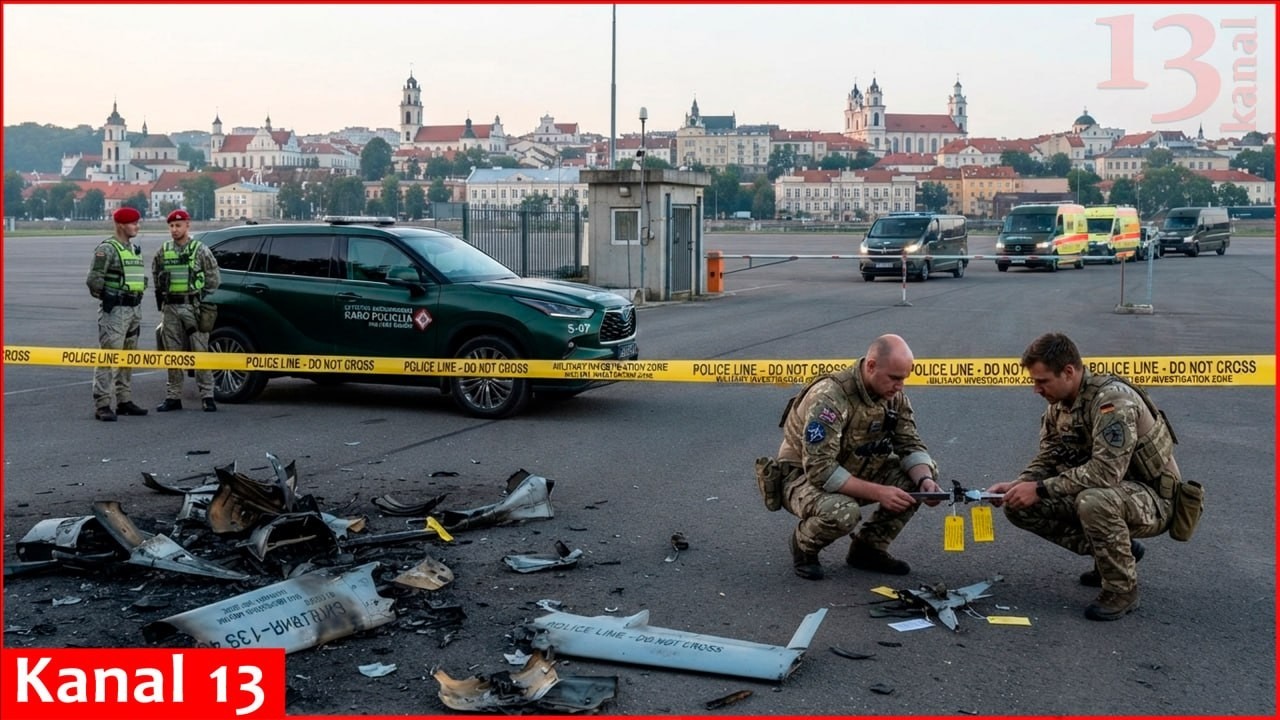
NATO fighter jets shot down Russian drone for the first time; another war in Europe
Watch on YouTubeVideo summary
NATO fighter jets have successfully intercepted and shot down a Russian drone for the first time within Lithuanian airspace, marking a significant escalation in regional defense efforts. Following the incident, Lithuanian President Gitanas Nausėda announced on social media that the military had warned the population via mobile notifications before the threat was neutralized. He expressed gratitude to his allies for their prompt response, emphasizing that such readiness is vital given Russia's escalating aggression against Ukraine. The successful interception demonstrates the collective security capabilities of the alliance as it strengthens its defensive posture in the face of increasing threats from the east.
The timeline of the event unfolded rapidly after midnight when fire and rescue departments reported a drone entering Lithuanian territory, triggering an air danger alert across several areas. Approximately thirty minutes later, officials confirmed that the intruder had been destroyed mid-air near the village of Prakeniai in the Kaisiadorys district of the Kaunas region. Vilmantas Vitkauskas, head of the National Research Center for the Protection of Humanitarian Affairs, stated that military police and other services were dispatched to the scene to identify the drone's type, parameters, and flight purpose. Preliminary data suggests the object likely entered Lithuania from Belarus before moving westward toward the Kaunas lakes, where it was eventually brought down without reported injuries or immediate damage.
Intelligence reports indicate that Russia is considering using captured Ukrainian-made drones to attack critical infrastructure in the Baltic region, a strategy designed to create confusion regarding the origin of attacks and conceal responsibility for strikes on NATO territory. Lithuanian Defense Minister Robertas Gaidys confirmed this assessment, highlighting the strategic intent behind such operations. This context adds urgency to the recent incident, as it suggests that drones entering from Belarus may be part of a broader Russian effort to destabilize the region by exploiting perceived vulnerabilities in allied defenses.
In addition to the intercepted drone, media reports noted a separate incident on March 23rd where a drone crashed and exploded near a lake in the Lavysas village within Varėna district, close to the Belarus border. An engine similar to those used in various drones was found at the crash site, though no explosives were initially detected by army officials. Despite the absence of immediate evidence of explosive devices, authorities caution that their presence cannot be ruled out and continue searching through the night to recover debris and determine the full scope of the threat. These events underscore the persistent aerial dangers facing Lithuania and its NATO partners as they navigate an increasingly volatile security environment in Europe.
Read the full video transcript
NATO fighter jets shot down a drone in
Lithuanian airspace for the first time,
Lithuanian President Gitanas Nauseda
announced on social media. According to
available information, the Lithuanian
military warned the population in
advance through notifications sent to
mobile phones about a possible air
threat. Nauseda thanked his allies for
their prompt response to the drone
intrusion into the country's airspace.
The drone, which had just entered
Lithuanian airspace, was destroyed by
NATO fighter jets. "I thank the allied
personnel for their prompt response," he
said in a statement. The Lithuanian
president noted the importance of such
actions against the backdrop of
increasing Russian aggression against
Ukraine. "Given Russia's escalating
aggression against Ukraine, such
readiness is vital for our region.
Together with our NATO allies, Lithuania
will defend its airspace." Lithuanian
LRT reported that a few minutes after
midnight, the fire and rescue department
reported that a drone had entered
Lithuanian territory and a probable air
danger was declared in several areas of
the country. Approximately 30 minutes
later, it became known that the drone
had been shot down in mid-air. At 1:00
a.m., Vilmantas Vitkauskas, head of the
National Research Center for the
Protection of Humanitarian Affairs,
confirmed on LRT that the drone had been
shot down in Kaisiadorys district Kaunas
region and according to preliminary
data, near the village of Prakeniai. The
article states that Lithuanian military
police, police officers, and other
services were dispatched to the scene.
"Units went out to determine what kind
of drone it was, its parameters, and the
purpose of its flight," Vitkauskas
explained. According to the head of the
NKVC, the drone was shot down in a rural
area near the Kaunas lakes. According to
him, there is no information yet about
any injuries or damage caused. It will
be difficult, but the search continues
into the night. "We will make every
effort to find them as quickly as
possible." The head of the NKT stated.
According to preliminary data, the drone
likely entered Lithuania from Belarus.
Yes, from Belarus. Then Lentvaris,
Trakai district. This object was moving
west, the head of the NKT said,
describing the drone's preliminary
trajectory. Media previously reported
that a Lithuanian military intelligence
report stated that Russia is considering
using captured Ukrainian-made drones to
attack critical infrastructure in the
Baltic region. Specifically, the report
noted that Russia could use captured
Ukrainian drones to create confusion
about the origin of the attack and to
conceal responsibility for any strikes
on NATO territory. Lithuanian Defense
Minister Robertas Kaunas also confirmed
this assessment. Media also reported
that on the night of Monday, March 23rd,
a drone crashed and exploded in the
village of Lavysas in Lithuania's Varėna
district, located on the border with
Belarus. The drone crashed and exploded
near a lake. An engine, similar to that
used in some drones, was found at the
crash site. According to a Lithuanian
army major, no explosives were found,
but that doesn't mean they weren't
there.