Video summary
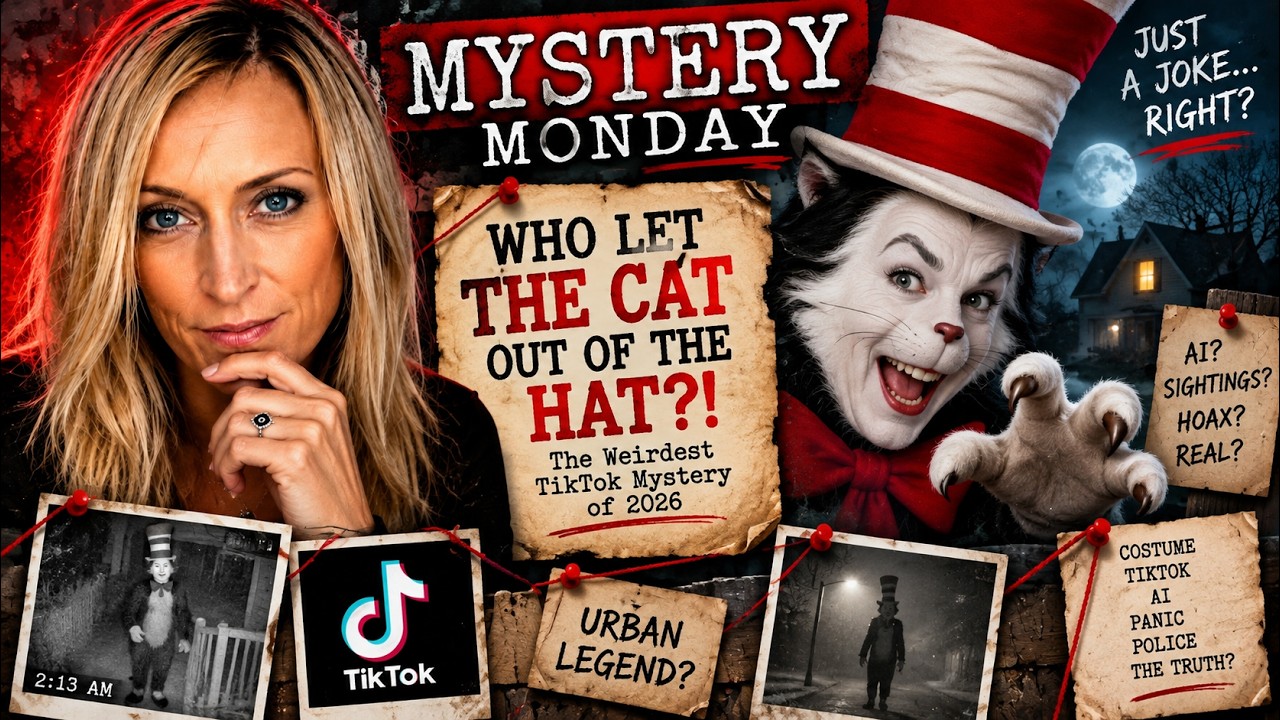
This week's Mystery Monday episode investigates one of the strangest internet phenomena of 2026: the transformation of Dr. Seuss's beloved character, the Cat in the Hat, into a terrifying urban legend. The story began on TikTok, where users repurposed clips from the 2003 Mike Myers movie and paired them with creepy music to suggest that a giant, human-sized version of the cat was wandering neighborhoods in the UK and Ireland. These posts quickly escalated, prompting real police responses, including statements from Irish authorities who clarified that many of the frightening images were AI-generated rather than actual sightings. Despite the lack of physical evidence, the narrative gained traction as people shared blurry photos and fake security footage, creating a global sensation that blurred the line between fiction and reality.
The mystery deepened when the original costume worn by Mike Myers was put up for auction, fueling conspiracy theories that the character had been trapped inside the suit like a poltergeist or even linked to Michael Myers from the *Halloween* franchise. While some creators claimed to have bought the costume to test it for DNA, investigations revealed that the sightings were largely manufactured through digital manipulation and artificial intelligence. However, the impact of these hoaxes was far from harmless; as the story spread to the United States, posts began referencing specific schools and communities, leading law enforcement to investigate individuals who shared threatening content. This highlighted a critical shift where internet jokes evolved into potential crimes, causing genuine fear among parents and forcing institutions to increase security measures.
Ultimately, the episode concludes that while there is no evidence of a homicidal cat roaming the streets, the true horror lies in how easily modern technology can manufacture proof and manipulate public perception. The narrator argues that we have entered an era where photographs are no longer automatic evidence, as anyone can generate convincing images with simple prompts. This phenomenon mirrors historical urban legends like the Slender Man but is amplified by algorithms that reward fear and shock, turning a children's book character into a global threat in the span of days. The story serves as a cautionary tale about the power of mass belief and the importance of discernment, reminding us that while we may not be able to stop the creation of fake images, we must remain vigilant against emotionally investing in narratives that could manifest real-world consequences.
Read the full video transcript
Before we get into this week's Mystery
Monday, just a quick note. This episode
is a pre-recorded podcast-style episode
because I am currently traveling. I hope
you enjoy this fun little Mystery Monday
while I'm away, and then we'll get right
back into our deep dives into the
Godmakers and the work of Fritz
Springmeier.
And just a quick disclaimer, I'm using a
few selected TikToks throughout this
episode to help tell the story and
illustrate some of the things that we're
discussing. These clips are being used
for commentary, criticism, and
educational purposes under fair use.
I've also included links to the original
creators and their content in the
description box below. So, please go
check them out and support their work.
Now, with that out of the way, let's get
into one of the strangest internet
mysteries of 2026, the Cat in the Hat.
So, I have some questions.
And those questions involve the Cat in
the Hat.
Yes, that Cat in the Hat,
the children's book character,
the red and white striped hat,
Thing One, Thing Two, Green Eggs and
Ham, and apparently
unaliving.
Hopefully not actual
unaliving, probably.
But, this is where things get weird
because all over TikTok and other social
media platforms, people have been
posting images [music]
and videos claiming that a giant,
terrifying, human-sized version of the
Cat in the Hat has been wandering around
neighborhoods, looking through windows,
standing in driveways,
hanging around children,
and apparently preparing to visit
various towns. And people, rightfully
so, are freaking out.
So, on today's Mystery Monday, we're
going to investigate the strangest
mystery that I have seen in a long time.
We're going to ask, who started this?
Why did everyone suddenly become
terrified of the Cat in the Hat?
And why does the actual movie costume
look like something that escaped from a
psychiatric hospital?
And perhaps, most importantly, how did a
children's character become an internet
urban legend?
You guys, welcome back to Mystery
Monday. This started off so long ago on
this channel. This is my favorite day.
It used to be that we would find these
like niche little mysteries around the
world, and we would do these quick
little videos about them. And then, of
course, as my research evolved and
developed, the Mystery Mondays got
longer and longer and longer, too. And
so, today, I thought that I would bring
it back. I would bring Mystery Monday
back [music] to its original
format, which is covering things like
urban legends. And of course, in 2026,
some of those urban legends exist on the
internet. Now, I hope this is an urban
legend. I really sincerely hope this is
an urban legend, because if this mystery
turns out to be what everyone fears it
is, then, my friends, we are in trouble.
Um but anyway, we're going to get into
it when we get into the episode. Before
we get into the episode, though, you
guys know what to do. Please hit that
subscribe button and give us a like.
Also, leave us a comment. I want to
know, have you heard of this internet
conspiracy, this urban legend? What do
you think? What do you think about it
all? I've been following it for a while
because I'm fascinated
>> [music]
>> with weird stuff like this. And for
those who are new here, most of us on
this channel actually believe the world
is [music] a lot stranger than we've
been told it is, which is really scary.
So, leave us your thoughts in the
comment section. If you want to leave us
a comment to help the channel out and
you don't know what to leave, leave us
your country flag. I would love to see
where you are in the world. We have such
an international group here on this
channel and so it's really cool to see
where you are coming from. You can also
help us out by hitting that hype button.
Also, a big thank you to our Patreons,
our producers, our Substack donors, and
of course, our YouTube members. Without
you guys, this channel would not be
possible.
If you would like to help support the
work that we do here on Esoteric
Atlanta, all that information is down in
the description box below.
>> [music]
[music]
>> Videos showing a life-size Cat in the
Hat lurking outside windows and chasing
people through UK streets are spreading
online. But there's one big question,
which, if any, are real and which are AI
generated? The videos have spread across
TikTok with accounts claiming sightings
in different parts of the UK and
Ireland. The videos even prompted
Ireland's national police to respond.
They said in a post that the Dr. Seuss
character is causing havoc in areas of
Ireland. Police also said they believe
the images they'd seen in their area
were created using AI. The posts have
attracted millions of views and
reactions. Some commenters described the
images as creepy or frightening, while
others are encouraging the cat to come
to their city next. CNN contacted
creators behind several of the posts and
got conflicting claims about whether AI
was used. One account declined to
explain, telling CNN to scurry along.
After police say a post from a fake
South Yorkshire police account claimed a
killer cat was on the loose, the force
dismissed the claim and later told CNN
they haven't received any reports of Cat
in the Hat sightings, adding, "We can
also confirm no recent sightings of his
associates, Thing One and Thing Two."
>> Okay, so I guess we have to start at the
beginning.
Because apparently in 2026, we have
collectively decided as a society that
the Cat in the Hat needs to become a
horror villain. And honestly, I blame
the 2003 movie. Because let's establish
something.
The Cat in the Hat from the original Dr.
Seuss illustrations,
he was cute. That's the cat that I grew
up with, with the books. And I was born
in 1983. We grew up with the Dr. Seuss
books, with the cute little illustrated
cat. But the Cat in the Hat from the
Mike Myers movie, no, that was
absolutely horrifying.
That thing was already halfway to horror
before TikTok
even got involved or was invented.
And apparently somebody else noticed
this, too. Because during the summer of
2026,
clips from the 2003 movie began being
repurposed on TikTok with disturbing
captions and creepy music.
The innocent children's movie was being
reframed as horror.
And that became a meme. Then the
internet does what the internet does
best. It escalated.
>> Okay, this whole entire Cat in the Hat
situation is going way too far. The
costume that made such a family-friendly
movie is now straight out of a horror
film. After purchasing the creepy Cat in
the Hat costume, Natalie Reynolds
decided to film it overnight to see if
it would move. And you have to watch
what it did.
>> So, last night I set up ring cameras to
see if there was going to be any
paranormal activity going on with my Cat
in the [music] Hat costume. And the
video that I posted of the ring camera
footage, you see the glass box slightly
move forward. And it was happening
around 1:30 a.m.
>> Yep, the whole entire glass case moved.
>> [music]
>> So, she decides to hire a psychic to see
if there's actually a soul trapped
inside of it. You know what happens when
you play around with psychics, okay?
Nothing good. Even if it's just one
friendly ghost inside of that costume,
okay? Because she brought that psychic
into her home, she's going to have a
million bad ones. That house is going to
be the next Conjuring home. Bro, the
next thing you need is a priest. Better
yet, she should get rid of the costume
altogether. Like, take it to Matt Rife's
museum or something.
>> See, y'all thought I was crazy when I
told you that the Cat in the Hat was
trapped in a box
in the wax museum.
Well, I got some more information for
you.
Not only was the Cat in the Hat trapped
in a box in a wax museum,
he's now
free.
It's all starting to make sense. So, his
costume from the Cat in the Hat 2003 is
for sale at the prop auction online. So,
I'm prepared to do something. Something
crazy.
I'm going to place a bid.
I'm going to buy
the Cat in the Hat costume. The original
costume that Michael Myers wore.
The bidding started at $6,000.
I placed [snorts] a bid.
Haven't met the reserve yet,
but I'm going to keep going.
I'm going to buy this Cat in the Hat
costume, you see.
I'm going to test it
for human DNA. And I'm going to prove to
you
that Michael Myers was trapped in the
wax museum
in that suit
all this time.
He went mad.
They finally released him. He was
banging on the glass, going crazy.
And now his costume [music] is for for
sale. I don't know where Michael Myers
is, but I'm going to prove to you that
all this time when you all said I was
crazy that he was no very no in a in a
wax [singing] museum. It's not possible.
You said no.
He was.
When I get this suit
and I have it tested, [music]
I'm going to come back with the proof to
prove to you
that it all ties together.
>> Now, here's where things get really
interesting.
Because around this same time, the
original Cat in the Hat costume worn by
Mike Myers in the 2003 movie was put up
for auction.
And if you've never seen this thing
outside the movie, you need to. Because
when you take that costume out of a
brightly lit Hollywood production and
put it in a photograph by itself, it
looks like something you absolutely do
not want standing at the end of your
driveway at 2:00 in the morning.
The auction helped fuel the online
conversation. People were posting
photographs of the costume. People were
saying it was creepy. People were
turning it into horror memes. And
suddenly, the cat wasn't just a
children's character anymore. He became
the cat.
Then came the alleged sightings. People
began posting photographs and videos
supposedly showing the Cat in the Hat
outside homes, on streets, near cars,
outside windows. And here's where we
have to slow down because these weren't
simply blurry photographs of someone in
costume. Many of these were AI-generated
or digitally manipulated. Police in
Ireland specifically addressed the
rumors and said the supposed sightings
were the result of AI-generated imagery.
In other words, the Cat in the Hat was
not actually hiding in people's
driveways, right?
Which frankly is probably good news
because imagine having to explain to
your neighbor, "Yeah, I called the
police because the Cat in the Hat was
outside, allegedly." And here's the
fascinating part. The fact that
something is fake doesn't necessarily
stop it from becoming real. And I don't
mean physically real. I mean socially
real because once enough people believe
something is happening, people begin
reacting to it. Someone creates an
image. Someone else shares it. Someone
makes a TikTok explaining it. Someone
else says they saw the same thing.
Another person creates a fake security
camera video. Then someone says, "He's
coming to my town." And suddenly
everybody's talking about it. And now we
have an urban legend. And this is how
folklore has always worked.
The technology changes. The mechanism
doesn't. And this fact, guys, brings me
to two different ideas. First of all, we
have the idea that there actually is
something nefarious going on. That there
is some sort of spell work, allegedly
we'll say, going on with the Mike Myers
costume.
But we also have the idea of of
this
where we get poltergeist from, we'll
say. Where if enough people believe
something, it manifests itself. So
sometimes the scaryness isn't the legend
itself. The scaryness is is if you
believe a legend enough, it can become
real. And personally for me, that's how
I think a lot of the powers that be, the
establishment, the beast system over
many different lifespans have been able
to conjure things up by creating a mass
belief in something.
But before we go further, you guys, just
a brief word from our sponsors.
What if I told you that you don't need a
gym, expensive equipment, or even a
traditional ballet [music] bar to get
stronger? And what if I told you that
you can start exactly where you are at
any [music] age?
Welcome to Fusion Body Studio. We're an
online movement studio where we combine
fitness, [music] movement, and ancient
wisdom to help you build a stronger,
more connected relationship with your
body.
And today I want to introduce you to one
of our newest classes, [music]
a 60-minute low impact, no equipment bar
practice filmed right here at my
mother's house.
And here's something that makes this
class especially meaningful [music] to
me. My 70-year-old mother is joining me.
I wanted to create a class that
demonstrates [music] something I truly
believe, that movement is for every
single body at every single [music] age.
You don't have to be young, athletic,
flexible, or experienced [music] to
begin and to simply move. This class is
perfect if you're brand new to bar,
getting back into exercise, looking for
a low impact workout, or simply want a
practice that challenges your body
without [music]
beating it up. And you don't need a
bunch of equipment. All you need is a
chair, table, countertop, or another
stable surface that you can safely
[music] use as your own personal ballet
bar. That is it.
The entire class is designed to be done
without [music] equipment, but if you
want to add a little extra resistance,
you can grab a pair of light dumbbells
or a bar ball. You'll work your legs,
glutes, core, arms, [music] balance,
stability, and posture all through
controlled intentional movement. And one
of my favorite things about barre is
that you don't need huge movements to
create a powerful workout. Sometimes,
the tiniest movements create the biggest
burns. But Fusion Body Studio is about
more than just working out.
>> [music]
>> We believe movement can be a doorway
into greater body awareness, learning to
listen to your body, understand it,
strengthen [music] it, and ultimately
become more connected to it. So, if
you've been waiting for the right time
to start moving, this is your
invitation. You can start where you are.
You can modify. You can take it at your
own pace. And yes, you can absolutely
get stronger at 70, 50, 30,
>> [music]
>> or anywhere in between. If you'd like to
try Fusion Body Studio, go to our
website and use discount code Bryce20,
[music] that's b r i c e 20, all caps,
at checkout. You will receive 20% off
your first 6 months, plus [music] a
7-day free trial. So, grab a chair, find
a little space, and come and move with
us. We'll see you inside Fusion Body
Studio.
>> And then the cat crossed the Atlantic.
The trend began appearing in the United
States. Posts started claiming that the
cat was coming to various towns and
communities. And then things became
considerably less funny, because some
posts began referencing schools,
students, and specific communities.
Police departments started responding.
Schools increased security. And in some
cases, law enforcement actually
investigated people responsible for
making or sharing threatening posts.
Now, there have not been arrests
connected to posts associated with the
trend. And this is where I want to make
something very clear.
There is a huge difference between
making a ridiculous meme and making a
post that causes people to believe a
school or an individual is being
threatened. That's no longer just
internet silliness. That's potentially a
crime. So, please, please, please don't
do that.
Now, let's ask the obvious question. Is
there actually a Cat in the Hat cereal
on a liver?
Hopefully not. There is no credible
evidence that there is some giant
homicidal children's book character
wandering around America.
The original rumors were allegedly
debunked. The creepy images were
frequently AI generated. And the
sightings don't establish an actual
physical cat. So, is the mystery solved?
Well, not exactly, because the real
mystery is much more interesting.
Think about what just happened. You
start with a fictional character. You
take an old movie. You add creepy music.
You generate some fake photographs with
AI. You post them online.
People don't know whether they're real
or not. Someone shares them. Someone
else adds a story. Someone else creates
a fake eyewitness account. News outlets
begin reporting on the controversy.
Police issue statements. And then the
police statements become part of the
story. Now, people aren't just asking,
is this real? They're asking,
why are the police talking about it?
And that makes it feel even more real.
And that's how legends are born.
And we've seen versions of this before.
The Slender Man phenomenon, the 2016
creepy clown sightings, creepypasta, the
backrooms, and now the cat in the hat.
But there is a major difference between
the Cat in the Hat story and older
internet legends, AI.
Because historically, if you wanted to
create a convincing photograph of
something that didn't exist, you had to
be pretty good at Photoshop. Now, trust
me, guys, this is how I do my
thumbnails. You can type, "Create a
grainy security camera image of the Cat
in the Hat standing outside a suburban
house at 2:13 a.m." And then, boom,
you've got yourself a nightmare. And
that's fascinating and absolutely
terrifying. Because we've entered an era
where the photograph is no longer
automatically evidence. A photograph
used to mean someone was there and the
camera captured it. Now, a photograph
can mean someone typed a sentence and
that changes everything.
But I have to admit, there is something
absolutely hilarious about all this
because humanity has survived wars,
economic collapses, political scandals,
AI, and apparently we draw the line at
the Cat in the Hat. "Ma'am, there's a
6-ft tall feline in a striped hat
outside my window. Did you see him?" No.
"Did anyone else see him?" No. "Do you
have a photograph?" Yes. "Is it AI?"
Probably. And this is why I think this
story is absolutely worth talking about.
Because underneath the jokes, there's a
very serious questions.
Why are humans so willing to believe
images?
We've always been susceptible to
stories. We've always created mythology.
We've always taken strange events and
turned them into a narrative. But now,
we have machines that can manufacture
evidence and social media systems that
can reward emotional reactions.
Fear gets attention.
Shock gets clicks.
And the stranger the story, the more
people want to share it.
So, perhaps the real monster isn't the
cat in the hat.
Maybe the real monster is the algorithm.
So, let's review. Is there an actual cat
in the hat serial on a liver?
Probably not. Are the viral photographs
real? Many have been identified as
AI-generated or manipulated.
Did the original 2003 costume help
inspire the trend?
It appears to have played a role in the
explosion of the interest.
Did the story spread from the UK and
Ireland into the United States? Yes.
Did some of the American posts become
serious enough that police and schools
got in involved? Absolutely.
And did some people apparently get
themselves into real legal trouble
because they took the joke too far? Yes.
So, what started as a creepy internet
joke turned into an international urban
legend and eventually became a
real-world public safety issue. All
because somebody put a red and white hat
on a cat. The scariest part of this all
is that we have the power
to turn these spells into reality. Now,
of course, you guys understand that I
have to be very careful about what I say
on YouTube regarding this stuff.
So, please understand that even though
I've taken this Mystery Monday as kind
of in in jest, as a joke, I don't think
it actually is a joke. Because even
though I know that these this viral
thing is all AI-generated, how easy is
it for the beast system to get us to
emotionally create things where things
never existed just because they got us
to believe something. And that belief
was all they needed to spark that thing
into a reality.
And that I think shows the greater
lesson for myself and for everyone out
there listening. We have to be really
careful what we believe and really
careful with what we put our energy
into. Now, when I say put our energy
into, I'm not talking about researching
things. You can research something
without being emotionally attached to
it. I do it all the time.
Right? It's when we become emotionally
attached to the outcome that that thing
becomes real.
So, when you look at these internet
viral hoaxes or whatever they are, make
sure that the creepy music, that all the
the bells and the and the whistles
involved in telling that story doesn't
hook you in to becoming a part of a
spell to create a bigger story.
Make sure that you can practice
discernment and look at things as just
an academic study instead of something
you're emotionally invested in.
And that, my friends, is your mystery
Monday. But now I want to know what you
think. Did you see these Cat in the Hat
videos?
Did you believe them when you first saw
them? And be honest. If you looked out
your window at 2:00 a.m. and saw this,
would you investigate? Or would you
simply move?
Because personally, if I saw a Cat in
the Hat outside my house, I'm not
investigating anything. Thing One can
have the house, Thing Two can have the
car, and the cat, he can have the entire
neighborhood. I'll see you guys soon.