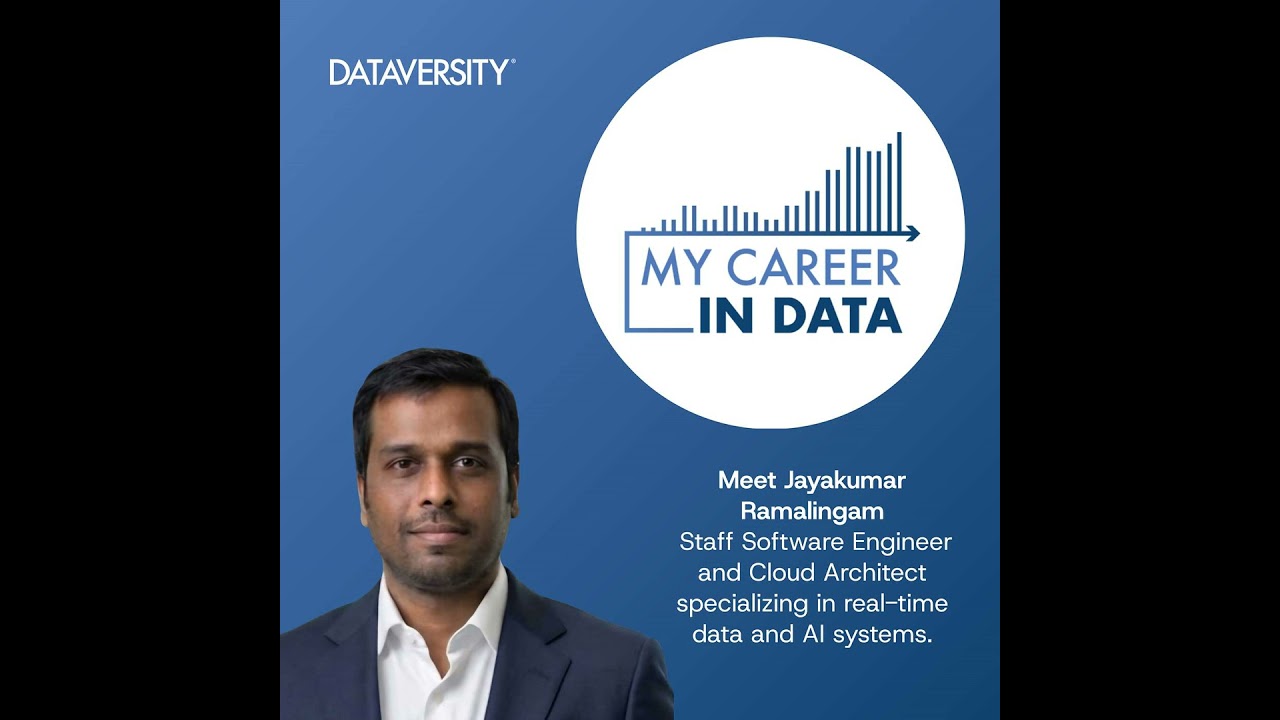
My Career in Data Season 4 Episode 13: Jayakumar Ramalingam, Staff Software Engineer and Cloud Ar...
Watch on YouTubeVideo summary
Jayakumar Ramalingam, a Staff Software Engineer and Cloud Architect at SiriusXM, shares his journey from a curious child with no fixed career dream to a leader in data personalization. He explains that his role involves designing software systems that deliver relevant recommendations across multiple digital platforms, including mobile apps and connected devices. His work is deeply rooted in collecting vast amounts of user data through various pipelines, processing it to create meaningful insights, and continuously evolving the system based on user feedback. Jay emphasizes that this process is not just about serving recommendations but also about maintaining strict data governance, security, and privacy standards while ensuring the technology adapts to changing user behaviors.
His career path was shaped by a natural curiosity rather than a predetermined plan. After choosing computer engineering for practical reasons before college, he found himself addicted to coding and quickly transitioned from traditional software roles to big data environments like Hadoop. He worked in fintech, retail pricing, and automotive image analysis, each role expanding his understanding of distributed systems and data pipelines. Eventually, he sought a more direct impact on the user experience, which led him to SiriusXM. There, he embraced new technologies like agentic AI, viewing them as enablers that increase opportunities rather than replacements for human expertise. He believes that while the specific responsibilities of data professionals will change with technology, the demand for skilled individuals who can manage and leverage data responsibly will continue to grow.
Jay offers valuable advice for those aspiring to enter the data field, stressing that there is no single correct path. He encourages newcomers to focus on understanding core concepts rather than mastering every tool immediately, as enablement tools now allow professionals to jump in with basic knowledge. The most critical traits he identifies are curiosity, problem-solving skills, creativity, and strong communication abilities. He notes that effective communication is essential for understanding real-world problems holistically, often revealing that data already exists or solutions are simpler than initially thought. By fostering an open mindset and asking questions, professionals can continuously learn and contribute to a community where everyone helps make each other's work better. Ultimately, Jay's story illustrates that passion for learning and the ability to adapt are the true foundations of a successful career in data management.
Read the full video transcript
Hello and welcome. My name is Shannon
Kemp and I'm the chief digital officer
of Data Diversity and this is my career
in data, [music] a data university talks
podcast dedicated to learning from those
who have careers in data management to
understand how they got there and to
talk with people [music] who will help
make those careers a little bit easier.
To keep up to date in the latest data
management education, go to
data.net/subscribe.
Hello and welcome to my career in data,
a podcast where we discuss with industry
leaders and experts how they have built
their careers. I'm your host Shannon
Kemp and today we're talking to Giaumar
Roma Lingham from Sirius XM.
Today we are joined by Jakumar Roman
Lingham, a staff software engineer and
cloud architect at SiriusXM. And
normally this is where a podcast host
would read a short bio of the guest, but
in this podcast your bio is what we're
here to talk about. Jay, hello and
welcome.
>> Hey Shannon,
thank you. Thanks for thanks for having
me.
>> Thanks for being here. I really
appreciate it and I'm excited to hear
your story here. So tell me, you are a
staff software engineer and cloud
architect at SiriusXM, a satellite
streaming company. And as a staff
software engineer and cloud architect,
it's a very long title, I love it. What
is it that you do? I work in Sirius in
the personalization area. It's like
where I design and build software system
that supports personalization experience
and recommendations.
Uh like so many should be aware like
Sirius is something that you uh listen
from the car but it's more than a car.
Uh you have multiple digital platforms
like mobile and uh and like multiple
connected devices. So that's it. Sirius
also has Pandora. So that's where I work
on the personalization area about it. So
my role as a staff is more like you know
the personalization where it's as
personalization it is. So something that
we create relevant data to the [snorts]
users. So obviously it's highly
datadriven because you collect large
volumes of information and generate
multiple signals from the users to make
the customer experience better. Right.
So my role is uh kind of both directly
involving in the engineering
contributions of it across multiple
systems and component as well as
architecturally support multiple
systems. So how the data is being
collected from multiple system how it
flows through the systems and eventually
how we are able to serve the
recommendations to the end clients.
>> Oh that is so cool. I I love that. And I
I mean I want to don't want to admit how
much I rely on those personalization
systems. I love when some I get great
recommendations based off of the
platform getting to know me. Um it makes
my life so much easier. So that's very
very cool. You're the first person I've
talked to who uh who helps design and
use that that data. Um
so so what data are you looking at you
know and how are you uh working with
that data in your day-to-day job to
decide you know and to to make those
personalizations.
Uh yeah so like personalization as I was
saying data is the center of it right
like so you collect uh various relevant
information across the systems like
there are like uh you can't even imagine
like the number of datas that is been uh
the as an organization collects from the
users. So we have to collect those data
information. So that collection part
itself like involves multiple pipelines
where uh you create like multiple
pipelines to get those information
available to the recommendation systems
on different timelines right like some
can be like bad some can be like near
near line something like that. So uh and
then once I have those pipelines created
those datas for me and then use those
data how you make those data more
recommendable like the one good thing or
bad thing about recommendation is there
is no like a certain output like uh you
cannot say hey this is the expected
output or something. So it serves well
for some it may not for some. So uh it's
so [snorts] my work doesn't end with
just serving the best recommendation. is
also like you know uh collecting a
feedback of it like looking at the user
engagement of it and then uh make sure
how you improve and also reuse those for
the training purpose of it and then
there are multiple aspects so where you
kind of the system you have to make sure
it evolves continuously as well I also
create like use data for creating
multiple dashboards that's not just
metrics that we use within the system
that's like used widely to give a real
impact on the how the user engagements
are like how the business impacts are
there are like you know uh multiple
metrics also I try to work having said
uh doing all this an obvious uh thing
that keep in mind is like you know the
data governance and the security aspects
of the users. So we we do uh maintain
the privacy aspects of it not just like
you know scraping multiple datas. So
with all that you know like kind of uh
end to end in simple terms it's know
it's like a continuous loop where
multiple pipelines to collect it process
it create a user experience within the
defined governance and then uh and then
you know continuously eving on the
feedbacks yeah throughout the data.
>> Oh very very very very nice. Yeah you
know um I I I listen to a lot of music.
I love music and I love when I get
suggestions of new music to listen to
and try cuz I don't know that I would
reach out and try otherwise like I I get
fixed into my routine, right? But I love
it when I'm and when I get suggestions
uh and I like it, right? And I like the
opportunity to to
thank you for what you do. [laughter]
Um
>> and one more thing to add is now that we
are on a podcast series exam is one of
the largest network of the podcast not
just the music. So it has multiple
aspects of it like you know sports talk
a lot of things there a lot of podcasts
you know very good great podcasts
>> very cool I love it. All right so yeah
so we'll be sure to listen to the
podcast here. [laughter]
Um okay so Jay tell me um so let's back
it up a bit. Let's talk about how you
got into doing such cool things. Um
>> tell me is this when you were very young
uh say six years old what was the dream
did what did you want to be when you
grew up what did you say to yourself I'm
going to become a staff software
engineer and cloud architect what was
the dream
>> yeah [laughter] uh to be honest I didn't
even know that the role existed back
then so when I was really young not even
young like even to some extent I was I I
never had like you know a fixed
uh fix the profession or something like
uh someday watch a good movies
[laughter] or see some inspirational
characters and oh no I want to be that
that profession you know so it keeps
changing uh so I would not say I was
like you know very specific about the
preparation but eventually once like as
I started growing up like getting near
to the college I still you know I kept
uh took the common stream where multiple
options are available because being the
going to be a first graduate of the
family I didn't had a push or like you
know guidance where this is what I'm
going to do. So I kept my options open
until I uh went to the college. I mean
right before college and right before
college that's where I decided like
options was like you know way the
medicines or like engineering back then.
So I chose engineering for the practical
reasons. [laughter]
[clears throat] It's uh humorously you
can say like you know the time to
market. So I want to get my career soon.
So start my career soon. So I uh chose
computer engineering and then once I
start it was no looking back you know I
was so so fond of it and I was so uh got
addicted to the coding aspects of it
like back then coding was not fun. So
[laughter]
>> so it's not it's not as helpful as now
it is so you have to do it not I was
even doing without some editor's help.
So but then I was closely aligned and
then you know then then no looking back.
So that's how we eventually got into the
computer science engineering.
>> Oh, so it was a choice then. Yeah,
[laughter]
your choice.
Yeah. Oh, that's very nice. Uh so then
what so you major in engineering? So um
what's the [clears throat] first job out
of college?
>> Uh yeah the straight away I went to like
a big consultancy back in India. So into
a fintech. So as I was seeing I was I
had enough exposure to the coding
aspects of it but [laughter] it's
totally different like uh the first
opportunity I got you know like I was
working on a fintech like the financial
transactions management wow and I was
like wow of course coding is not just a
part of software engineering and there
are like many aspects to it so slowly
getting involved to it like you know we
think or we as we start the career we
think like oh I have certain data then
how I'm I'm going to serve it to the
customer. That's all we think. But
eventually you know you know uh behind
the system like uh how you see those
transactions providing those like you
know the business value or the fraud
detection multiple things that happens
behind uh that gives a lot of insights
and slowly getting uh the web scale or
the distributed large number of scale uh
that informations that we try to
I got into. So slowly getting exposure
into that. Uh the same consultancy I
also moved to another retail the Home
Depot side of it and then I was the
pricing and merchandising area. So again
another uh high dataentric information.
uh but uh I was fortunate enough to you
know like get exposed to the big data
Hadoop that's that's when it was
evolving and that gave me a lot of
experience you know not just the
distributed system like you know so we
were already the pricing merchandising
side of things are done but with the big
data something that was not possible
earlier uh with the amount of compute
and storage options that it gave uh you
know like the volumes of volumes of data
that was able to process and gave a
giving a proper insight for the pricing
really really uh you know was um a big
learning curve for me and that's where
like more getting towards the data side
of it and getting learning the
pipelining the the batching and then
those things uh that's where you know
got learned to the from the software
engineering to a data side where you uh
handle huge number of data which
eventually before that would have been
running for months or something but we
are doing it for like few hours and then
getting a lot of insights out of it and
lot of benefits out of it. So that was
one transition that I made uh that
pricing and then also I've uh for some
quite some time I also worked on the
automotive part of it where I was uh
real time price report generation of
vehicles just based on images like you
know you have to do a lot of complexity
and then like commonly available data
and then you lot of fun stuffs all the
way and but all these were like you know
I somehow felt it is like you know I
have enough exposure but it's uh I
wanted to a product side of it where I
can get into the real user experience
side of it like where I have impact on
the real direct user rather than like
the those so far I had some indirect uh
exposure so that's when I got the
opportunity to the serious XM so that's
where I got to another side of like you
know uh getting to the training aspects
of it and the agentic aspects of it like
more learning uh and then working
closely with the you know the data as
well as the user centric information. So
that really was exciting partic
that is very nice. It's not the first
time either that I've heard somebody you
know
have that curiosity and the passion like
lead them into a direction of wanting to
uh make a difference with the customers
and and in and
managing data that way. And it's
interesting like you say getting into
the agentic stuff. Um
how are you keeping up on the tech as
you go through your career? I mean uh
you know you like you say when you
started out the coding is was so
different from what it is today right
and now you're working with agentic AI.
Um
how do you keep yourself up to date and
learning and um you know is it are you
learning after you take a job? Are you
always learning or how what's been your
kind of your process there?
>> Uh yeah, that's one of the great aspects
of this career right like software
engineering there you can't never stop
learning keep because things keep on
evolving. So learning is something you
have to do uh simultaneously because
things can't imagine things that we are
doing today uh was even uh feasible like
like even just few few years back right
so uh to keep update is like um uh as
soon as I see something new uh like I
try to understand the basics of it
rather than you know mastering against
it. So always some knowledge helps what
it is rather than you know staying away
from it. So that really help when I get
a chance to get it uh whenever I get a
chance to have uh go at it so that it's
I already have some basic information
that I'll run out of it won't and then
you know immediately going that
curiosity goes and then you can go ahead
and uh immediately switch whenever it's
possible.
>> Nice. I like it. [music]
Entrylevel
analyst to executive data leaders, data
delivers the [music] most comprehensive
training in the industry, led by experts
who are actually doing the work. Upskill
with ondemand courses, earn exclusive
certifications, and join a global
community of data pros committed to
driving real [music] change at
datarcity.net.
>> What's your favorite way to learn? Is it
reading?
>> That also keep evolving. I remember back
in days like where I have to you know
run behind books [laughter]
and like get keep track of books and
then learning from books and then
eventually you have like you know the
lot of courses and stuffs but now I now
it's more of a creative learning right
like you don't you have to you know
learn uh from a book or something you
can directly have [clears throat] lot of
options to ask questions directly so now
how I learn is like I keep myself with
the tech updates but whenever there is a
questions I I'll be like hey what how
they are solving it what is they are
doing it how this problem is I always uh
you know closely relates to some of the
real world problem that I'm seeing or
facing not just from my work even from
outside I do something personally also
in software also any other things that I
um visualize I try to learn like hey how
things are getting done like I know uh
at least tech side trying to be you know
we cannot be masterable but I can at
least be jack up for me so that's how I
keep uh you know like um keep updating
whatever that's coming new and try to
learn yeah
>> oh very nice so what's been your uh
biggest lesson so far in your career
>> uh biggest lesson is like like we are
talking the obvious lesson is you know
never stop learning and you can't you
know especially in the industry where
like if the data or tech or something.
So that is one of the key aspects of it
and uh other thing is obviously is the
communication aspects of it right from a
individual aspects as well as you know
the project aspects from individual uh
you got to keep your communications both
the vertical up the layer or the
horizontal even with the nonext because
the more [clears throat] you communicate
the more you understand the problem. So
it's not about you know building a
perfect solution. Actually to me to be
honest there is no perfect solution. So
uh because the more you communicate you
know like sometimes you communicate with
the product or the customer they're like
no we don't even care about that
information. So so it's always uh you
know the communication helps you to see
the problem as a holistics view right
like rather than certain focus that's
how because sometimes some datas are
easily available we are not even aware
of it. you are trying to you know
generate it or like you know complicate
it but through communication that's
where we listen and oh these datas are
readily available or like you know we
don't even have to do this so those sort
of information really helps and as a
personally as part of communication you
ask a lot of questions that's where you
kind of learn like oh okay oh this uh
this can be done like this this can be
like this so that is uh [snorts] one of
the big lessons you know that uh uh I
learned and obviously as part of tech as
I and learning and curiosity and being
creative also one of the things that
needs to be there. It's that is my
favorite commonality and uh amongst the
data community and you know everybody
who I come across is I love that
curiosity. I love the the questioning
it's just it helps I think everyone uh
that in the community is like has such
an open mind like you know I want to
learn teach me how why you think the way
you think and how and then I'm going to
write a solution to to help make your
life better. Right? [laughter]
It's it's just awesome. Um so so tell me
Jay um I mean you worked with data pract
your practically your whole career you
know so what is your definition of data?
>> Yeah that's a good question like for me
data is a obviously representation of
something right something that happened
or like something but obviously the same
data can be like represent different
things based on the context different
context. So it's currently what I'm
working on the data that is that was
something yesterday is not totally uh
different what it is today. So uh so
those are like basically it's a
representation of something but by
definition uh I mean we would have been
exposed to the structured and
unstructured data right like structured
is something where you have it in your
like a table or like a known format
storage and then it flows across
multiple system and then you deliver to
the customer but there are uh
unstructured data also like you know not
just the text format like any other
format. So I think uh with this AI
tooling so we have the leverage now to
you know process those unstructured so
you don't have to be uh totally reliant
on structural flow so there is
unstructured flows where you can that
also helps you to give some sort of
representation that I was saying like uh
so uh but necessarily it's not about you
know having lot of data into it's about
like exactly finding out what those data
is and then finding a better context and
quality to include it. So uh to leverage
a greater insight. So that is the
definition aspects of it like the
structure and unstructured of it. Uh but
as an uh like as an organization like
you know we keep uh growing as a data
like huge number of datas. So I think um
uh yeah so you know the more we
democratize data uh as within the
governance so that's how you know it
helps the representation part of it.
>> Yeah absolutely so tell me do you see
the importance of data management and
the number of jobs working with data
increasing or decreasing? I you know I
start when I started the podcast I said
over the next 10 years but now it's
moving so fast [laughter] like with AI
the introduction of AI that just sounds
so far but just you know even in the
next year the next few years you know
where do you see the job market going
data
>> u yeah definitely I cannot answer for 10
[clears throat] years obviously but yeah
I think uh I still see it should
increase definitely because uh the way
things are going on you know obviously
the the more technical transformation
the companies are doing obviously we're
going to end up with lot of data I know
like you know there are AI tools
>> [snorts]
>> uh so I think definitely the
responsibility of the data engineer or
like any person working with the data
will change uh but I think the there
should not be any disc disturbance
within the like the number of uh people
that's going to work you know so the
reason being I still these tools AI or
anything as a enabler not not yet a
replacer. So with the enabler it gives
provides more opportunities right like
even back then as I was saying you know
in adoo it provide lot of opportunities
to you know process with the huge amount
of data where that was not an option
before that now again similarly now we
have opportunities where companies were
like worried oh we don't want to explore
it it might take months it might take
too much effort but now I think with the
amount of productivity you have with
because of these tools so companies
obviously going to open more
opportunities oh we can explore this
time to market is not that bad. The
investment is not going to be bad. We
can try out. Uh so that obviously is
going to create more opportunities at
least in the some next few years. So
that I see the opportunity is definitely
going to be increased but the
responsibility aspect of it the
day-to-day activities of it that will
change you know that um but obviously
the performance also is going to be
improved. So and obviously more roles is
going to happen. Definitely it's going
to open up.
>> Uh I agree. So what advice then would
you give to people looking to get into
career in data management?
Um yeah I I would not say there is like
you know one path to data management
like see I myself was entered into the
computer science and then software
engineering and then I'm translating to
big data and uh so but I should be like
you know as we are discussing earlier
the curious aspects of ATP are really
into like the data or something uh just
you know jump right into it like you
know understand the basic concept of it.
So now we have lot of enablement so you
don't have to like you know master
everything. So it's kind of
understanding the basic concepts and
then you know trying to leverage what we
have. So it's uh more of no you know not
sticking to any particular tool or
something like not dwelling on any tool
like you know uh try to understand the
concepts and then uh gain those even I
would also get into the practical
knowledge of it like I was saying think
of a real world example and get your
hands into it. if if not possible at
least get into the the work that others
are doing and then you know have a
exposure to it so [snorts] that because
I see even in some of my friends who are
nontechnical getting into data so but at
the same time I see some people you know
like oh you know it may not suit me I'm
not the expert on that like know with
the with the amount of enablement that
we have you don't have to expertise
yourself and then jump into data so
[laughter] I think you can have some as
long as you have the problem solving
skills and you have the creativity and
uh you have the problem solving ability
that should be uh good enough and then
uh once you start learning the basic
concept and gain some practical
knowledge that should be a uh straight
away a good option to jump into any data
or like start your career in data.
>> Uh I couldn't agree more. I mean, that's
why part of why I this podcast, right,
is so people can hear all the different
ways you can work with data and the
different paths um to into a career in
data. There's so many different paths
and and ways uh to get into it because
as you say, as long as they're curious,
willing to learn and constantly learn,
you know, and have that problem solving
skill, then that's
>> um so important. And you know the
communication you mentioned earlier too.
I mean it's so
>> yeah it's it's so important. It's part
of why we offer our communication class
and our training program cuz it is so
important part of such an important part
of it.
>> Yeah because we have to explain you know
like it's not it's not about working you
have to even to understand a problem you
have to communicate with the multiple
people and then to solve the problem you
have to come. So that is also comes as a
key skills as part of the data.
>> Yeah. Oh, such good advice. So Jay,
thank you so much for taking the time
and sharing your story with us today.
>> Oh, thank you. Thanks for having me.
Thanks for the opportunity to express
ideas. [laughter] Yeah.
>> Yeah. And um we'll uh you gave us your
LinkedIn to post. Um so we'll get that
posted if you people want to reach out
and say hey and learn some more and just
meet up. Um, again, that's a great part
of the community is just the the
outreach. So, thank you so much.
>> Thank you. Yeah, I'll be happy to, you
know, address and if anyone wants to
reach me. Thank you.
>> Oh, thank you. And to all of our
listeners out there, uh, if you'd like
to keep up to date in the latest in data
management education, you can go to
data.net/subscribe.
Until next time, stay curious, [music]
everyone.