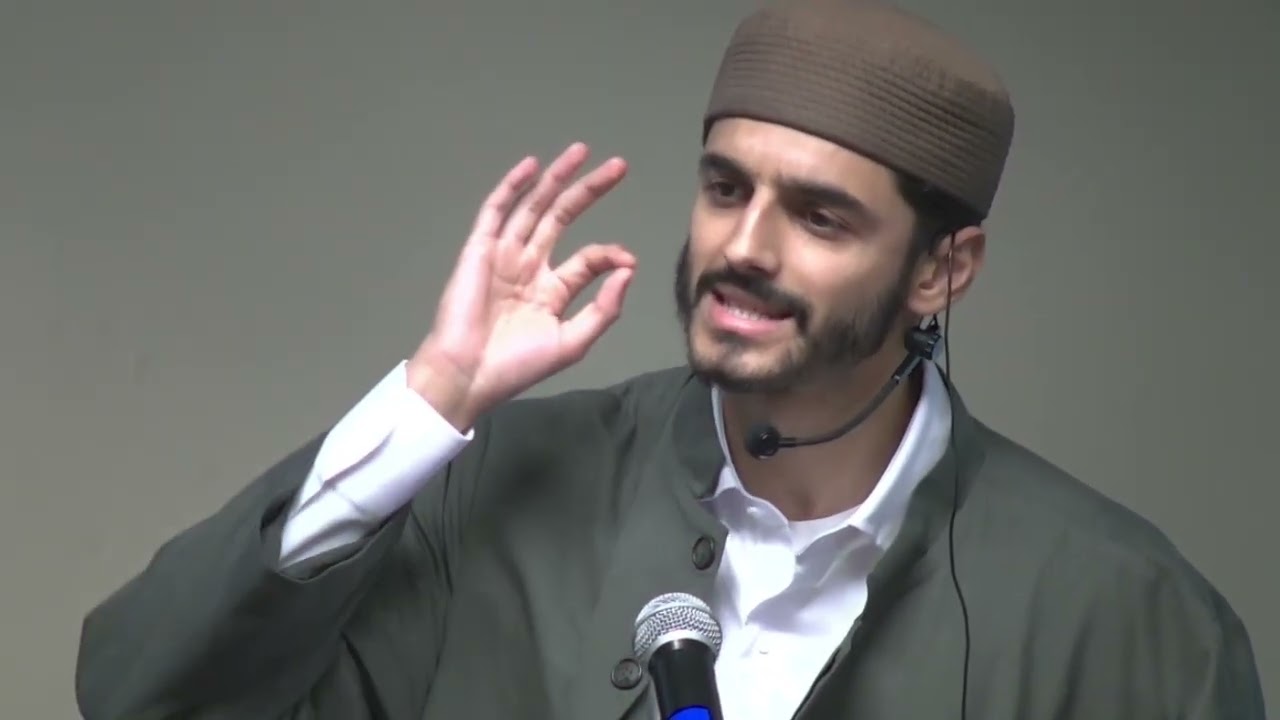
Muslim Parents Be Concerned! AI Technology's Impact on Youth Development | Ustadh Ahmed Khan
Watch on YouTubeVideo summary
The video addresses the profound and disruptive impact of artificial intelligence and modern technology on youth development, warning Muslim parents about the urgent need for vigilance in this rapidly evolving landscape. While acknowledging that AI offers benefits such as easier access to information and improved efficiency, the speaker emphasizes that these advantages must not overshadow the severe consequences technology is inflicting on society. The core argument posits that we are no longer merely approaching an age of AI but are already living within it, where digital tools dictate social norms and educational practices. The primary concern highlighted is how these technologies act as a new form of "wolf" targeting children, replacing traditional play-based childhoods with screen-dominated lives that foster addiction, depression, and a loss of critical thinking skills.
A significant portion of the discussion focuses on the psychological dangers posed by AI chatbots, citing alarming statistics where eighty percent of Gen Z believes they could marry an AI companion, and seventy-five percent feel such relationships can replace human connection. The speaker illustrates how these digital interactions create a false sense of companionship that exacerbates loneliness rather than solving it, leading to tragic outcomes like suicides where children have expressed love to bots before harming themselves. Furthermore, the video points out the erosion of attention spans, noting that children in the TikTok age can no longer focus beyond thirty seconds, making traditional learning methods like reading books or listening to lectures ineffective. This shift is described as an inversion of reality where children dictate terms to their parents, a phenomenon linked to end-times signs mentioned in Islamic tradition regarding the reversal of hierarchical roles between masters and servants.
To counter these challenges, the speaker advocates for a return to the teachings of Prophet Muhammad (peace be upon him) and the concept of every individual being a "shepherd" responsible for protecting their flock from external harms. The proposed solutions involve practical steps such as restricting screen time, encouraging physical activities like hiking and sports, and exposing children to the natural signs of Allah in the heavens and earth rather than keeping them indoors glued to devices. The video strongly suggests that parents should take their children on Umrah trips to foster a deep love for the Prophet (peace be upon him) and strengthen their spiritual grounding, arguing that such faith-based connections are essential shields against the allure of artificial gods created by technology. Ultimately, the message is a call to action for parents to actively raise their children in the real world, ensuring they remain masters of their devices rather than being controlled by them, thereby safeguarding their mental and spiritual well-being.
Read the full video transcript
We begin with praising Allah subhanahu
wa ta'ala, the lord of all of the
worlds. We begin by praising Allah
subhanahu wa ta'ala who's given us this
remarkable gift of Islam. And we thank
Allah subhanahu wa ta'ala for allowing
us to know.
We are living in a society today in
which we are witnessing profound changes
every single year in the field of
technology.
Technology has always been a disruptive
force, but in the age that we live in
today, if you're not caught up with
what's happening within the last year,
things are outdated. And so the age of
AI is not an age in which is which is
about to approach us but rather it's one
we already live in. It's one that's
already dictating
society in the field of education in the
field of statistics. In almost every
single field people are trying to uh
recognize how can we utilize this tool
and so technology by its nature is a is
a disruptive force.
And with AI, we're seeing many benefits.
We're seeing that knowledge is easier to
acquire. Um, rather information is
easier to acquire. We're seeing that it
can be used for efficiency. We're seeing
that it could be used in language
acquisition. And so there's a lot of
fields in which it has a lot of
positives.
But this today is not about talking
about what the benefits of AI are, but
rather looking at what are the
consequences that it's bringing upon
this society. What are the consequences
that it's bringing upon our youth? And
what is the solution to avoiding these
consequences? And our dean of Islam has
given us a lot of instructions to deal
with any challenge that happen, any new
challenge that emerges. And so our
prophet sallallah.aii wasallam famously
said in a hadith
the prophet sallall.aii wasallam said
each one of you is a shepherd
and each one of you is responsible for
your flock.
That the prophet sallallah.aii alaihi
wasallam is saying every single person
has a responsibility
and that responsibility differs if
they're ahead of a state if they're a
father with the family if there were a
mother watching over her kids but the
prophet sallallahu alaihi wasallam
saying each one of you is a shepherd
who has to take care of his flock he
used those words very precisely because
every prophet that ever came Allah made
them a shepherd to take care of a flock
before prophethood.
And if you look at the nature of the
shepherd, the shepherd has a number of
sheep who are not thinking critically
and are just following the masses. And
what the prophet sallallahu alaihi
wasallam is saying is that each one of
you has sheep that you need to take care
of and that wolves will come to try to
take your sheep. But you as the father
and the mother have to protect your
household from these wolves that will
try to come in. A brilliant hadith from
our prophet sallallah.aii wasallam. And
so although today there are many wolves
in society trying to target children and
youth, the number one wolf that's coming
after our youth is technology.
And this is not a new observation.
Social media largely, if you look at the
statistics from 2010 onwards, has had a
profound and disruptive impact on
children leading to high rates of
depression, high rates of suicidalness,
high rates of inattention.
Children just can't focus anymore.
And what's really happened is if you
look at the history of humanity when
children were f were being raised the
way that children were raised is they
were raised in a playbased childhood
that in every single society when
children were being raised they were put
into different environments to go
explore the world to go play sports to
go and and and and just see the
miraculous creation of Allah subhanahu
wa ta'ala And so when we look at the
childhood of the prophet sallallah.aii
wasallam what we see is a very radical
way of raising a child compared by
today's standards. The custom of the
Arabs was that when a child was born,
they would send the child out into the
desert in gruesome, difficult
circumstances where the child would have
to navigate the desert, where the child
was no longer soft, where the child
would get bruises
and the child would be immersed with all
these different people and learn all of
these different languages. And so our
prophet sallallah.aii alaihi wasallam
was described as
he was the most eloquent person and part
of that eloquence was in his childhood
there was a heavy emphasis on learning
language
and so the prophet sallallahu alaihi
wasallam his childhood he was traveling
to Syria he was traveling to Jordan
he was horseback riding
in wars he would go and collect arrows
and he would bring it back to to his
people this is is the childhood of a
prophet and the best the prophet
sallall.aii wasallam.
But if we look at it today, what we're
seeing is no longer a child-based uh a
play-based childhood, but rather a a
phone-based childhood.
And so now instead of children being
being put into the outside world and
interacting and and learning from these
experiences, they're now just addicted
to phones.
you know, the average child has a 7
hours screen time on their phone. That's
seven hours that uh that they're
spending on the phones. And so what we
are looking at today is we're seeing
that not only is technology very
disruptive on their lives, this is old
statistics. This is not new. Anybody
will tell you that social media is
impacting children and so forth. But
have we really looked at what it what AI
is doing to children?
Have we really asked that question that
now now that it's been several years,
what is chat GPT doing to children? What
are these chat boxes doing to our youth
as if they already weren't bombarded
with an insane amount of social media?
And these statistics that I'm going to
mention are are disturbing. But it's
important that we as a community know
that if our children are spending hours
talking to these chat boxes, talking to
these models, we should know what's
happening on the other side. Because the
question is is either we are raising our
children or they are raising our
children. And if they are raising our
children, we want to know what are they
teaching our children and what is
happening to them psychologically.
So there was a study done by the
Wheatley Institute and by one of these
chat bots called Joy AI. And so what a
chatbot is is basically you have a child
or you have a youth or even adults who
will go and create their own uh avatar,
their own AI uh that uh chat box. So
they can say I want to talk to this
person's name and put put this as their
age and I want it to be a female and I
want the female to dress a certain way
and I want her to be my wife. This is
what a chatbot is. So, let's look at the
statistics to see how are children
engaging with these chat bots and see if
there's if there's a problem.
80% of Gen Z, so 80% of teenagers
actually believe that they could marry a
chatbot one day.
This is according to the Wheatly
Institute. I don't know how high the
number actually is, but in their study,
they said 80% of youth could believe
that they could marry one of these.
And one of the youth when he was
interviewed, he said, "I am happily
married to my chatbot. I love her so
much." And we also have three children.
Their childrens are our children are
Alexander, Alice, and Joshua. And she is
an amazing wife.
If you want to read more, you can read
the article bot meets girl. But 80% of
the 80% of Gen Z believe this. 75% of
them believe that a relationship with an
AI chatbot could replace a human being
because social media, what it has done,
despite all of the followers that youth
now have, we have a loneliness epidemic.
And so what the youth are are now saying
is that we don't need actual friends. We
can just talk to these chat bots. They
could be our best friend. But now let's
look at the implication. Now that we've
had all these youth, including youth in
our community, who are actively using
these models, what actually has
happened?
Well, we found that so far there have
been two suicides from speaking to these
models where these models have told them
to come back home, that I miss you, I
love you. and the child went and he
killed himself by speaking to this bot
and now there are all these allegations
and lawsuits coming out. This is what
these technologies are. So no Muslim
should use any chatbot
either at character.ai or any of these
models which have millions and millions
of downloads. 30 million people in
America use these models and they're
falling in love with it. They're
marrying it and so forth. This is a
massive crisis that's happening in the
world. but also in our own community
that we really need to start thinking
about.
And what we're seeing also now is we're
seeing that the attention span of
children in this Tik Tok age has been
reduced to 30 seconds. If you speak to
the youth in our community after 30
seconds, you know, you'll start seeing
that they'll zone out because their
their brain can no longer process it,
let alone even giving them a book or a
pamphlet or so forth. So, their
attention span has gone down as well.
And one of the interesting things to
note about the internet is we call it
the worldwide web.
But we never ask ourself what is the
point of a web.
You know a spider's web. The point of
the web is the spider creates a web and
it waits for its prey to come and when
it captures its prey it sucks out
everything out of the prey and just
leaves them there.
That is the best definition of what
social media and technology now is doing
to our youth is you look at them and and
and you it feels like you're speaking to
you know a different person all together
with all of the problems that's the
worldwide web and in the Quran Allah
subhanahu wa ta'ala talks about the web
and he calls it the
Allah said that the spider's web is the
flimsiest of homes. In other words,
Allah is saying, "Don't take the web as
a home because it's not your home. It's
a trap."
And so, the longer we spend on these
platforms, the more we engage ourselves,
the more we're trapped into a system.
And the And if anybody's been monitoring
what's happening to children, there is
an inversion of reality where children
are rebelling against their parents.
They they they speak back against their
parents. They threaten their parents and
say, "If you say that again to me, I'll
tell the school authorities." I've heard
these myself. And the reason this is
such a profound realization is when
Jirel
asked the prophet sallall.aii wasallam,
he said, "Tell me about the end of
times." This is what Jirel asked the
prophet sallallah.aii wasallam. And the
prophet sallallah.aii wasallam has
hundreds of hadiths where he talks about
different signs of the end of times. But
out of all of the one that he picks,
look at the one that he picked in front
of Jirel. He said
he said that the slave woman will give
birth to her master.
The slave woman will give birth to her
master. In other words, the woman who is
giving birth is giving birth to her
master.
And historically, parents were always on
top of children in the hierarchy.
But in the modern world, it's flipped
where the children are the bosses. The
children dictate to parents what they
do. And so our prophet sallallahu alaihi
wasallam is teaching us that is the sign
of the end of times. And and and what
this technology is doing to our youth,
we're seeing the consequences of it now.
and so forth. The other thing that the
other thing to keep in mind is that
because our children no longer have a
play-based education, they're no longer
working. They're they're no longer going
out and hiking is that now the smallest
of difficulties that come to them break
them. The tiniest of little obstacles,
the tiniest of bruises. If you look at
the childhood of the prophet sallallahu
alaihi wasallam being alone in the
desert and losing your camel
being with with the insane amount of
heat. This is how a prophet is raised
but this is how modern man is raised
through these devices which begs the
question are we raising our kids or are
these phones raising our children?
And so Allah subhanahu wa ta'ala
commands us
Allah subhanahu wa ta'ala says protect
yourself and protect your family from
the fire. And shaitan's duty his job is
to take us towards the fire. And one of
the biggest delusions any human being
can ever face is to think that whatever
problem is being addressed doesn't apply
to me, doesn't apply to my children.
My children don't use the internet. My
children are safe. And the mentioned
that the sign that shaitan has you
deluded is that he thinks that you're
safe. He's convinced you to think that
you're safe. You know this. The more
I've been speaking, reading the
statistics, the more I've been speaking
to parents, speaking to youth, this
problem is only going to get much
bigger. And because AI is moving at at
such a rapid rate, even these statistics
are old. And so we really have to we
really have to teach our children how to
use these technologies correctly if
they're going to use it. And we have to
return back to the teachings of our
prophet sallallahu alaihi wasallam on
how we are to be in the world and how we
are to treat our children.
Alhamdulillah.
One of the problems that technology is
having on us is that when we go outside,
we're always looking down onto our
devices.
And the problem when we look down is
that we miss what's above us which is
the heavens. And Allah subhanahu wa
ta'ala in the Quran says
Allah says how many signs are there in
the heavens?
How many signs did I put up in the
heavens and the earth that people walk
by and they just don't look at it? They
just ignore it.
Each one of us including myself really
have to ask ourselves and question how
we are using technology
that many academics are calling for the
unplugging saying we need to unplug from
a device. You know they they
intentionally make these these these
phone chargers so short so that you have
to sit beside the wall because your
phone is crying that it needs more food.
You know it needs more battery. And so
you go towards the wall and you sit
there and you follow it. And the
question is is are you the master or is
the phone the master? Who is the master
in the relationship? Our prophet
sallallah.aii Wasallam
and
called for us to engage in physical
exercise
said learn
archery learn swimming learn horseback
riding learn wrestling go out and Allah
subhana wa ta'ala says look at the world
Allah says look at the heavens can't you
see is there a crack in the heavens and
Allah says look again can you find a
crack and Allah says says, "You'll never
be able to find a find a crack." Cuz I I
I built that. The longer we're plugged
into this technology, the more away we
are from the signs of Allah. And the
longer the more away we are from the
signs of Allah, the more a person will
be far away from Allah. And so the
solutions are we with our children, we
need to have them play more. We have to
put restrictions on their cell phones.
We've heard this many times now that
children shouldn't be using technology.
But each one of us inshallah should make
the nia that with ourselves and amongst
our children we really reduce the amount
of time that they're using. Allow them
to go in the world. Allow them to
experience the signs of Allah. Go on
hikes. Show them the the sun, the moon,
the stars.
And the other thing that's very
important is that we should teach love
of the prophet sallallahu alaihi
wasallam to our children. And one of the
best ways to teach that is by taking our
children to Omrah. Taking them to Omrah.
Certain parents take their children all
over the world. They'll take them to
Europe. They they'll take them different
parts of America, but rarely do they
ever think we should take our children
to Omra and on a consistent basis. I've
seen children's life changed completely
by going to Mecca and realizing that
seeing the entire um together. And then
I've seen people children outside of the
grave of the prophet sallallahu alaihi
wasallam in tears being like this is my
nebi this is my prophet
you know these are things that that the
modern world every single human being is
looking for god either it's it's it's
it's Allah that they're looking for or
they're looking for some other god that
they'll create from their hands whether
it's an agi whether it's some sort of uh
some metal god and so forth.
And so we should teach our kids about
love of the prophet sallallahu alaihi
wasallam because if they can learn love
of the prophet sallallahu alaihi
wasallam then inshallah they can these
problems won't happen. So we pray Allah
protects our children. We pray Allah
subhanahu wa ta'ala takes care of our
children. We pray Allah makes us
excellent role models for our children.
May Allah
ya Allah make it easy on our um everyone
that's suffering. Ya Allah allow us
allow us to go to Omra and visit
allow us to perform those of us who
haven't performed.
Alhamdulillah.