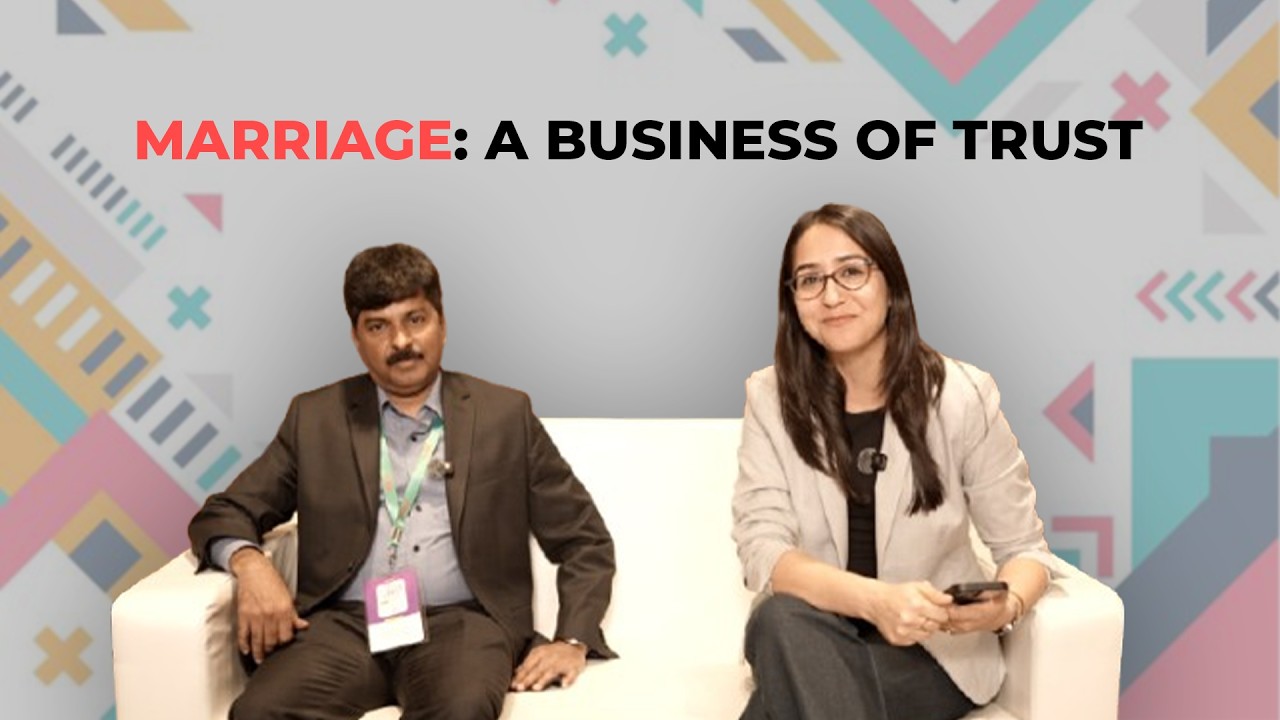
Murugavel Janakiraman on Trust, Tradition & the Modern Indian Consumer
Watch on YouTubeVideo summary
Murugavel Janakiraman emphasizes that building a trusted matrimony platform in India requires replicating the deep cultural nuances of real-life matchmaking within a digital environment. Since marriage is one of the most significant decisions in an individual's life, the platform prioritizes trust by rigorously filtering profiles and collecting sensitive personal data such as horoscope information before adding them to the site. This approach ensures that the online experience mirrors traditional offline processes, including community verification and cultural alignment, which has allowed the company to grow from a single brand into a network of over 300 specialized sites catering to various communities, professions, and linguistic groups.
The dynamics of the Indian consumer have shifted dramatically over the last two decades, moving from a parent-led decision-making process to one driven primarily by the individuals seeking marriage. While parents remain involved as supportive passengers rather than the primary drivers, young people now take charge of shortlisting potential partners based on evolving criteria that extend beyond traditional metrics like age, height, and occupation. Although the majority of marriages still occur within specific communities or sub-communities, there is a growing segment of users who seek matches based on shared hobbies, interests, and personal "vibes," reflecting a modernization where professional status and socioeconomic factors are weighed alongside cultural preferences.
Artificial intelligence plays a significant role in shortlisting potential partners by analyzing vast amounts of data, yet Janakiraman argues that algorithms cannot fully replicate the magical, intangible connection that leads to a successful marriage. He illustrates this with the example of doctors who often prefer marrying other doctors regardless of community lines, suggesting that certain professional bonds transcend traditional social boundaries. Ultimately, while technology can assist in filtering options, the final decision rests on human intuition and what is often described as divine will, acknowledging that among billions of people, finding that single, perfect match remains a unique journey that cannot be entirely predicted by data alone.
Read the full video transcript
There are 8 billion people on this earth
and you're going to get married one
person.
>> They say that matches are made in
heaven. That's what for the longest we
believed in.
>> Get only one match. [music]
>> That one match has to best match.
>> How do you actually build that trust?
>> People don't want to go outside of
India. You know which I call it the
collaborative matchmaking technology
[music]
>> help people to find the right life
partner.
>> So what does it take to build a brand
which people trust with one of the most
important decisions of their life and
that's marriage. So to discuss more on
it, I'm joined by Mr. Murugville Janaki
Raman. Thank you so much, sir. And you
know, thank you so much for taking our
time for this conversation today.
>> Thanks for having me. Yeah.
>> Yeah. So sir, my very first question to
you is that you know, matrimony is a
category built very heavily on trust
because that's how marriage as a
constitution in India works. So my
question to you is that how do you
actually build that trust of the scale I
would say?
>> So we've been doing for so almost like
two and a half decades.
>> Sure. So right from the beginning uh we
are very clear we want to build the most
trusted matimony platform because
>> as you rightly said when it comes to
marriage trust is one of the important
things
>> and also and no other platform take so
much of personal information like
matimoney platform we take horoscope
information also
>> so we take so much of personal
information so that being the case also
people trusting our platform for the
most important decision of their life
which is marriage. Yeah.
>> So in order to build the trust right
from the beginning I'm talking way back
in 2000 we to ensure that each and every
profiles are you know filtered then
added to the platform. You can't just
like that you create a profile on mat
many money platform not only profile
photos to ensure that the platforms
built on the trust also that we have
built a cultural nuances uh you know
into that online platform what's
happening in the real life world we're
able to bring it to the online. So like
you know autooscope matching and you
want to add a verification service and
allowing parents use the platform. So
basically and again finding a match
between your cultural preference like
community sub community. So basically
everything was revolved around how to
build the most trusted matimony platform
replicating what's happening in the
offend world into the online platform.
So that helped us to build the most
trusted matimony platform also the
approach what we took that helped to
that that helped us to have the strong
connect with the consumer we not a
single brand so today we run 300 plus
matrimony site so while bat matimony is
a flagship brand you have tamil matimony
marathi matimony then a community site
as well based on the cast and also a
special site like you know doctor's
matimony defense matrimony specific
specific things so what happened these
combination of these the individual
brands specific speak to the particular
community combined with the the the
future what he implemented helped us to
apart from the brand building the
investment what you done and all the
thing helped us to build the the most
trusted matimony brand also over a
period of time the millions of people
got married
>> that's added to the trust and
credibility so so what publicity and
incidentally I got m service so
>> that's so that's so lovely good to hear
that
>> yes yeah
>> yeah and um I think you're the right
person to kind of um you know help us
and understand the changing dynamics of
the
>> you know Indian market right now I'm
speaking from your uh perspect you know
what has changed most about the Indian
consumers and their approach towards
relationship as it's no longer same as
it was you know say 25 years back today
youngsters their approach towards
marriage has changed drastically they're
looking from their partner what they're
basically looking for their partner is
no longer same what same our parents
were looking
>> uh so your take on that
>> thing is that couple of things uh one is
that uh you know as the country
progresses the average age of people
getting married that would increase.
>> Okay.
>> Yeah.
>> And while there are people still want to
marry within the community which is
still there in India majority of
marriage happen within the community
that has not changed.
>> Again the people are beyond the
community and the cultural preferences.
There are people look for you know you
know people matching their maybe hobbies
or interest or you know that having that
vibe. Okay. That's also people look at
whether this person you know I'm I'm I'm
able to kind with the person also. Yeah
V is a thing. So there are people talk
about okay whether to have the vibe with
other person. So we are also able to
address some of the changing preference
of the customer. You know it was not the
case when you started the platform. We
didn't have the hobbies and interest. So
today we can find uh you know you know
alliances based on even hobbies and
interest as well. Yeah.
>> So we are trying to bring that apart
from the cultural nuances try to help
people to find matches based on the
preference as well beyond that cultural
preferences or beyond socioeconomic
preference. Normally people want to look
at know age, height, education,
occupation then the community. Now you
also have the features like okay we can
find matches based on obies and interest
or though that percentage is small I
wouldn't say large percentage because
still as I told majority of marriage
happens on the this cultural preferences
but again these are some of the changes
which you are adopting with those
changes as well. Yeah,
>> I want to know like how much of a
professional um say when there is a
professional person who is looking for a
partner there
>> is what what do you understand from the
data perspect how [music] is it if the
particular professional is looking for
in specific directions you know is is
that is also something which is
calculated because I believe culture
part is something which which is equally
important as you were mentioning as it
was before
>> not much have changed there isn't it
>> yeah that not much change we're still
there largely
But having said that look at you know
what kind of there is thing people look
at you know 40 years ago what kind of
job what kind of people would have
preferred you know people would have
preferred the government job or bank
employee
>> and late '9s or early 2000s it was IT
guys in the US you know they are prefer
today is the other way around
>> what is it
>> people people don't want to go outside
of India they're not muchuh the interest
towards and the girls want to go in fact
today I feel that people outside of
India they're finding difficult to find
the aliens and all that because not many
girls want to go outside of India
because today the country is progressing
many things are available in terms of uh
as a country you know uh facilities and
other thing so as they know as depends
on how the country progress or certain
certain uh jobs gets preferred and all
the things okay
>> so definitely 1.8 it was it okay today
all jobs are getting paid very well
there's no more you know it enjoys that
kind of elevated preference as like in
the past
>> but having said that uh uh as I told the
country is one thing but things like
doctors is one thing very very unique
doctors prefer doctors
>> okay that's the reason we have doctor's
matrimony it is not the case with
lawyers
>> it is not the case with the other
professions okay so so while you are
taking matrimony but doctor is very
interesting that you The preference of
doctors is to find
>> just a doctor
>> doctors because they think the doctors
understand other doctor better. So it's
even beyond other communities okay as
long as the person is doctor the people
are willing to go over that the
community they know more it's not
confined to the community when it comes
to doctor they're okay to similar
communities or even other communities as
well.
>> Okay. Okay. And how about you know um
how do you actually balance tradition
with the expectations of youngsters
these days more you know now digital
consu customers also coming up. Earlier
the platform was very different now
digital
>> and of course I would want to add the AI
perspects also into this question itself
but with artificial intelligence which
is so much you know talk of the town
these days.
How has basically metrimony and the way
it process have changed from say
traditional media to the digital now and
of course now with the emerging uh
artificial intelligence.
>> So let's talk about how the the
matrimony uh such as change were a
period of time. So when he started
almost 25 years ago, it was it was
parents.
>> Okay.
>> And parents were in the driver's seat.
>> Yeah.
>> In the sense that they are the one
taking decision you know and sort of uh
and the son or daughter were largely you
know accepting the decisions of the
parents and all the because the parents
were the one helping the boy or girl to
the life partner. Today is not the case.
Today more than 70% of the profits are
created by the individuals. Also the
country has changed. The parents are no
more in the driver's seat. They are in
the passenger seat. Yeah.
>> So it is the youngsters on the driver
because parents do understand it is the
boys or girl going to you know get
married and it's their life. So they
know more you know largely I'm talking
about at [snorts] least you know
majority of the cities or major or good
personal population they understand okay
it is youngster they need to take a
decision but me as a parent I support
the entire matchmaking process. So I
would say that from parents and driver
seat it's become like more like
youngsters or the boy or girl in the
they are taking decision this and that
know whom they want to get married or
they are shortlist in the alliances
parent do get involved in the
matchmaking process at a certain stage
>> so they want to be part of the
matchmaking process but no more they are
driving the decision okay the decisions
are largely driven by the youngsters I
think the shift is happen thanks to
movies thanks to the country okay people
also understand it is individual
decision okay I think that shift has
happened Okay.
>> So, and parents are happy as long as
>> me being that that you know the entire
process fine as long as I'm not
eliminated and unlike incess
unlike in the west.
>> Okay. At least at least you know it's I
call it the collaborative matchmaking.
>> Okay. So it's not that you know so
parent choosing or youngsters choosing
it's you know it's marriage happening
with the concern of all the you know the
people parents and youngster but
youngsters are the one driving the
agenda by and large at least in
majesties and all that.
>> Okay. And speaking of artificial
intelligence
>> yeah sorry yeah I forgot that that's
okay. So you know um speaking of
artificial intelligence they say that
matches are made in heaven. That's what
for the longest we've believed in. So
has you know with the emergence of um
artificial intelligence has algorithm
taken over the whole concept or how's it
like
>> see basically definitely marriage a
marina you know we facilitated through
platform like us
>> I think that look we can definitely le
artificial another know technology we
need to leverage a technology help
people to find the right life partner
one thing when it comes to I was just
sharing it also what makes two people
click it's something magical
which you kind of no algorithm can
predict.
>> Sometime we think these are two best
match and they don't get connected with
each other.
>> Sometime relationship manager sins
profile hesitantly.
>> Mhm.
>> Okay. But they get connected.
>> Yeah. Because you know what get
transferred you know what makes the two
people that's what you know that's
something like you know there is a
>> element what you talk about god's
edition you know marriage made in heaven
now thing
>> because I sometime wonder okay oh these
people are want to get married okay
great
>> okay because you know so you know when
you talk to relationship manager so
>> it's very very interesting that you know
how this whole thing happened because
look at know there are 8 billion people
on this earth and you're going to get
married one person
>> and who is that person you So what makes
while we can definitely give all these
algorithm you know all those things
>> but finally what makes people click
>> and choose and which one to
>> yeah yeah it's very very interesting
while algorithm
>> can help to short list but al cannot set
in fact I remember we used to talk in
the past
>> it's not a thousand of matching pro you
got to get only one match okay
>> that one match has to a best match
>> and no matter what be the algorithm a
and all the thing we cannot tell this
alliance is is a right alliance no other
it won't happen like that
>> okay
>> it can give some preferences but
individually when people meet they have
to decide okay they want to get married
but only god's grace and god's decision
all
>> on that note thank you so much sir it
was lovely talking to you and for all
those insights uh thank you so much
>> thank you so much okay thank you thanks
for having