MRMCD2026 - Trespassing the Walled Garden: Teaching Linux to Speak Apple's Low-Latency WiFi
Watch on YouTubeVideo summary
The presentation focuses on enabling Linux systems to utilize Apple's proprietary Low Latency Wi-Fi technology, which is essential for seamless features like screen mirroring and remote control within the Apple ecosystem. This protocol operates at the link layer of the IEEE 802.11 standard, specifically leveraging the Enhanced Distributed Channel Access (EDCA) mechanism to prioritize voice traffic over other data types. By assigning the highest priority access category, the system minimizes latency through specific timing parameters such as Short Interframe Space and random backoff timers, ensuring that critical real-time data is transmitted with minimal delay. Additionally, the technology relies on Real Simultaneous Dual Band capabilities, allowing devices to maintain separate links for standard Wi-Fi communication and low-latency peer-to-peer connections simultaneously.
To understand how this works under the hood, the speaker analyzed the internal communication between macOS and Broadcom wireless chipsets using user-space debugging tools like LLDB. The investigation revealed that the operating system configures the hardware via specific Input/Output Control (IOCTL) messages and control rings, which instruct the firmware to create dedicated interfaces for low-latency traffic. A key discovery was the use of Traffic Identifier 7 to distinguish low-latency Wi-Fi packets from standard AirDrop traffic managed by the Apple Wireless Direct Link protocol. The research also uncovered that Google had inadvertently leaked details about these proprietary configurations in their Android driver source code, providing valuable insights into how parameters like transmission opportunity lengths and contention windows are set within the firmware.
Bridging the gap between macOS and Linux proved challenging due to hardware diversity and the closed nature of Apple's firmware, but a solution was found using Azalia Linux, which runs on Apple hardware while supporting open-source drivers. By extending the Broadcom firmware driver with custom flow rings and submission/completion rings, the team successfully replayed the exact IOCTL communication sequences observed on macOS within a Linux environment. This approach allowed the system to dynamically manage traffic for both standard Wi-Fi and low-latency applications, achieving a packet loss rate of approximately 3% in quiet environments during live demonstrations involving Bluetooth discovery and ICMP packet bursts.
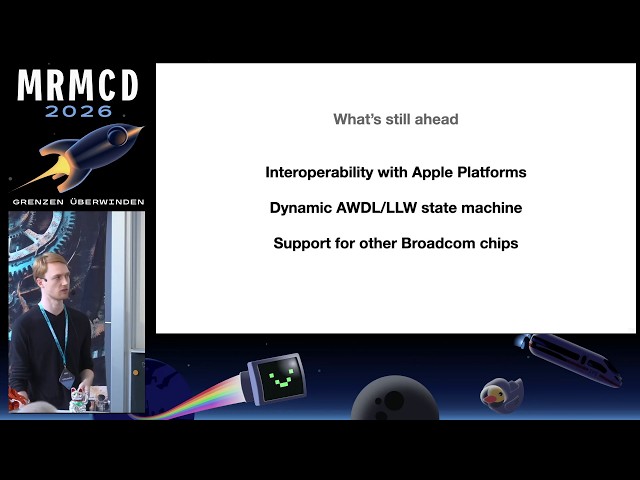
The project aims to achieve full interoperability between Azalia Linux and Apple platforms, though current limitations include a static state machine on Linux that needs adaptation to match the dynamic behavior of macOS devices. Future work involves making the Linux implementation more flexible to support master election processes and expanding compatibility to other Broadcom chipsets, potentially through softmac approaches rather than firmware modifications. While the research confirms that traffic identifiers are standardized across IEEE 802.11 amendments and used by various devices, the specific low-latency configurations remain tightly coupled with Apple's ecosystem, making cross-platform support a complex but promising endeavor for open-source communities seeking to break into the walled garden of proprietary wireless technologies.
Read the full video transcript
A warm welcome from my side to this last
slot at MMCD 26. [snorts]
This talk is titled trespassing the
world garden teaching Linux to speak
Apple's low latency Wi-Fi. Before we
begin talking about this link layer
protocol, a quick note on myself. I'm a
PhD student at the House of Platner
Institute in Potam and I'm researching
at the chair of Hiska Classen um at the
chair of mobile and wireless security.
Besides that, I'm a fellow researcher at
OpenUAS. We publish information, give
conferences and webinars on European and
German cyber security regulation. So if
you know anything about UNUNIS tour or
UCR,
UNCCCS, all of these European
directives, then visiting our website
might be a worthwhile thing to do.
Last year in December 2025, I already
gave a talk on the internals of low
latency Wi-Fi and which concepts are
making it a low latency protocol.
The question that arose after this talk
was of course how do we bring this
knowledge now to open platforms and how
we can can we reimplement this protocol
in order to enable people using Linux
for instance to use low latency Wi-Fi.
Now before we begin elaborating on this
question, let me give you a short recap
about what low latency Wi-Fi
actually is. So suppose you own an
iPhone or an iPad and a Mac. Then in the
Apple ecosystem, you can do a bunch of
cool stuff like mirroring your um Mac
screen to an iPad and use it as an
external monitor.
You can also use your mouse and keyboard
input in order to remote control your
iPad from the keyboard input attached to
your Mac. If you own an iPhone, you can
use your iPhone's camera with continuity
camera as a webcam on your Mac. And with
iPhone mirroring, you can remote control
your iPhone that is out of proximity
from your Mac.
Now all of these features mostly
transmit video data. They operate under
real-time constraints and they use this
link layer protocol called low latency
Wi-Fi.
low latency Wi-Fi in this deck here as
I've just mentioned is located on the
link layer and therefore
deals with some concepts we already know
from the ITLE E 80211 amendments E N and
AC
and to give you a quick oversight of um
what these concepts are about I would
like to elaborate more on the enhanced
distributed channel Access EDCA
classifies network traffic into four
different access categories and from
background to [snorts] voice network
traffic the priority for channel access
ascends. So low latency Wi-Fi yeah uses
this access category with the highest
priority for channel access which makes
it very fast
on a technical level. This um works as
follows. So suppose your device has
control frames available and um needs to
send them over the medium. Uh what it
does is it waits for a very short amount
of time for a short interframe spacing
and um yeah starting from when the
medium becomes idle and once this
duration elapses it can send for
instance acknowledgement frames.
Now, in case your device has voice
traffic available in the queue, it
doesn't just wait for this very short um
short interframe spacing, but for an
arbitration interframe spacing, which is
the short interframe spacing plus two
more slots.
Once this AFS elapses,
it elaborates um and checks if the
medium is still idle and then initiates
a random backoff timer. This is needed
because other devices on the network
could of course also have uh voice
traffic cued and if devices would then
immediately start sending data um they
would um collide on the medium and uh
the data would be corrupted. So this is
why we need these random backoff timers
um to be initialized
and yeah once the um timer there elapses
and the medium is still idle the device
can then start sending data on the mech
layer for as long as a transmission
opportunity allows it to send.
Now the these parameters the AFS the
back the random backoff timer and the
transmission opportunity are all very
specific to the access categories in
ITLE E 80211E.
And when we compare the parameters
across all of the different access
category is it becomes clear that the
traffic in the access category voice has
uh the shortest duration until it can
send traffic at least on average and
therefore it also gains uh the channel
access fastest on average.
Low latency Wi-Fi complies with these
parameters
as it turns out and in newer revisions
it could also send data for longer.
However, this is currently not used in
recent implementations.
There are of course a couple of
different other concepts from the ILE
ED211 standards. I won't cover them here
now but if you are interested in them
feel free and go ahead and watch my talk
from 39C3.
I would like to highlight
one more uh hardware capability that low
latency Wi-Fi builds upon and this is
called real simultaneous dualband. This
allows devices to establish on the link
layer two separate links on two
dedicated frequency bands. So devices um
your device could have one um link to
your access point for regular Wi-Fi
communication and then another one um
for communication
um with with another peer device that
uses uh low latency Wi-Fi.
The question of course is how do we
configure the wireless chip on a Linux
device so that it uses RSDB and all
these different concepts um from the ITE
E211 standards such as EDCA
and the journey here begins by
identifying suitable trace points on Mac
OS in order to trace the communication
between Mac OS and the firmware which
which we want to know more about.
Now with a little bit of knowledge of
how Mac OS is structured, we can very
quickly identify what we need to trace
exactly in this operating system.
In user space, we have a bunch of
different binaries that for instance
implement uh the application layer of
sidecar display.
And these binaries call into a data
structure called the dwaret cache which
contains a lot of frameworks. Frameworks
that for instance can also handle
network related tasks and frameworks
that call then into the kernel cache
into the kernel space. In recent Mac OS
implementations, the network stack has
moved out of the kernel space into a
dedicated domain in user space. And this
is the part that is very interesting for
us when we want to trace the
communication with wireless chips.
So this driver kit process is not only
um responsible for managing interfaces
and cues and it e211 concepts and states
but it is also responsible for
configuring wireless chips.
The great advantage here is that the
driver kit process is a user space
process which enables us to attach it to
any regular debugger like LLDB
which in turn is much more flexible than
usual means of kernel debugging. So
using LLDB we can basically trace any
address in this driver kit process we
want and especially interesting here are
functions that issue so-called IOAS IOS
are um means of communication between an
operating system and Broadcom wireless
chips and we will take a look um at IOAS
and how they work on a technical level
in just a second but I think you get the
basic idea um of how we can now trace
the communication between um Mac OS and
the wireless chips on both the receiving
side and the sending side during a
sidecut play session just by attaching
this process to a debugger like LLB.
This already brings us to tracing
wireless chip configuration.
Very interesting here are as I already
said the so-called IVAs. Iovas are
basically just strings the host sends to
the firmware attached and um appended by
some payload and in combination with the
string the firmware then knows what to
do exactly and what to configure about
its antennas.
This IVA interface create is especially
interesting here because by default
wireless chips of course have one
interface enabled by [snorts] default.
For instance here um for communication
with your access point.
So on the operating system you would
have then an interface and this
interface would then be used by the chip
um to accept data and send data to your
access point. um using its internal
interface. Interface create now creates
a second interface of type two and type
two tells the Broadcom chip that this
interface is dedicated to AWDL and low
latency Wi-Fi communication just because
it's baked into the firmware. AWDL is
another proprietary protocol by Apple
that is used in features like um
AirDrop.
So this is a very special interface and
it's explicitly created
and on Mac OS you could access this um
interface using interfaces like AWDL0
and LLW0
in order to send data to nearby Apple
devices for instance.
So as you can see AWDL and low latency
Wi-Fi seem to be highly intertwined and
not really distinguishable from each
other at least when it come when it
comes to the implementation in firmware.
What happens on a technical level here
is that Mac OS issues so-called message
buff messages.
There are two rings available for that
so-called control rings. one for the
submission side from the host to the
firmware to the device and one in the
opposite direction um which is called
then the completion ring.
So in case Mac OS has an IO over
available um that should be transmitted
to the firmware, it would just place a
so-called um I octal messages onto the
control submission ring,
allocate a dedicated buffer where it
places the IVA and its payload in the
shared memory. The firmware then reads
this Iova,
creates the interface and informs the
Mac OS host via the completion ring that
the interface has been successfully
created.
As just mentioned, these control rings
are used for um issuing I octals and
Iovas and more. We will come to that
later on. Another very interesting I
over is HP2P. HP2P stands for high
priority peer-to-peer.
And as it appears, Google has leaked
what HP2P actually does in um drivers
and Broadcom drivers for the Android
platform. And as you can see, HP2P seems
to configure anything and everything
what we know about the internal concepts
of low latency Wi-Fi. So this is
basically the IVA that configures what
makes low latency Wi-Fi fast in
firmware. As you can see, we have
configuration parameters for the
transmission opportunity length, the
contention window or the random backoff
timer and more frame aggregation
mechanisms like AMDU and AMSDU uh which
I talked about in my talk at uh 39C3.
Of course, there are a bunch of other
different IOS. The important takeaway
here is that these IOAs help us learn
what Mac OS teaches the firmware to do.
And secondly,
these IOAs build the foundation for
bringing low latency Wi-Fi to Linux.
Because in an ideal world, we would just
take the communication we observed on
Mac OS and replay it as it yeah as we
observed it on Mac OS on Linux.
However, Linux is a bit more
complicated. There are different
wireless chips. Even if Broadcom chips
are installed on Linux systems, then um
they might be different wireless chips.
Different wireless chips in turn mean
different firmware and different
firmware means that there's probably no
support for these priority proprietary
IOS we just saw.
So at this point this is a real road
blocker. However,
there's a solution to this which is
called Azah Linux. Azah Linux has the
great advantage that it runs on Apple
hardware which makes it ideal for
tracing IOS on the same platform where
we also are testing our implementation
for low latency Wi-Fi and Aahi Linux
uses Mac OS's firmware
and this enables us to
really replay the Iova communication we
saw on Mac OS under Linux and we can be
sure about that the firmware that the
wireless chip will accept and behave
exactly as we observed it on Mac OS.
For this purpose, we extended the
Broadcom Fmec driver. Um, as you can
see, there are dedicated files now for
AWDL and low latency Wi-Fi files that
hold the communication recorded under a
Mac OS.
I won't go into much further detail into
how and which functions we added but I
want to highlight one thing about um
what we extended in the Broadcom driver
the Broadcom fullme driver. So recall
again that in um the communication
between Mac OS and the firmware or now
also on Linux there are so-called
control rings used for configuring the
wireless chip for instance for IO over
communication but also to create data
structures that are called flow rings.
Flow rings also existed um previous to
um our amendments.
So flow rings are usually used um to
transmit packet data.
So once um user space wants the kernel
to transmit packets,
these packets and um data about these
packets um sent to the wireless chip and
the wireless chip then can transmit the
packet data via its internal interface.
Our implementation now adds more flow
rings. Flow rings for the AWDL traffic
and low latency Wi-Fi traffic. As you
can see for low latency Wi-Fi there's
only one flow ring a flow ring for the
access category voice
and for AWDL there are more flow rings
as AWDL can also transmit traffic in
other access categories.
As you can see
this one flow ring has in parentheses uh
the T7. T stands for traffic identifier
and these traffic identifiers map to the
access categories we observed um in the
um EDCI parameter set.
So for instance um AWDL can transmit
data that is um flagged with the traffic
identifier 0 to six and low latency
Wi-Fi is this protocol dedicated to the
access category voice with the traffic
identifier 7
and this is why there's only one flow
ring um attached uh and linked with this
traffic traffic identifier 7.
Of course, there are more submission
rings uh more completion rings from the
firmware side. One uh transmission
completion ring for confirming to the
host that data was sent over the medium,
one ring for informing the host that
data is available for reception. And as
it seems right now, there are dedicated
rings for low latency Wi-Fi specifically
um for transmission and reception.
However,
there is um these rings um we could only
observe on Mac OS. On Linux, these rings
are currently not used.
rings. We also added uh rings for debug
information because um this these rings
were also leaked in the Google source
code.
So in essence, we add four very static
completion and submission rings and flow
rings that are allocated dynamically for
AWDL traffic and low latency Wi-Fi
traffic.
Let's give you some examples for how
sending and receiving traffic. now works
for low latency Wi-Fi. So suppose user
space has packet data available to be
sent via the network.
The packet therefore arrives at um
kernel space is put into this shared
memory flagged with the traffic
identifier 7. The firmware then picks
at first the um the host informs
the firmware that data is available in
the flow ring. Now
the firmware then picks the packet data
up, transmits it via the interface of
index 2 and informs the host that the
packet data was successfully sent.
Receiving traffic is also quite
straightforward. So when packet data
arrives at the host uh at the firmware,
the packet data is put into the shared
memory and using the receive uh
completion ring the host is um yeah
informed that data is now available in
shared memory
and the formula also flags this packet
data with more information. uh this
information in this case is that the
data was received via this second
interface. This already helps the host
to distinguish whether this is meant for
access point communication
or for communication via AWDL and low
latency Wi-Fi. However, this information
is not sufficient in order to make out
whether this is meant for low latency
Wi-Fi or AWDL specifically.
And this is where the traffic identifier
becomes important at the receiving side
because using this traffic identifier 7
now um the device knows that incoming
traffic is meant for low latency Wi-Fi
and traffic with the traffic identifier
um below 7 belongs to AWDL.
To wrap this up a quick demo.
So
here we have
um on the left hand side uh a device
that listens for incoming Bluetooth low
energy
um messages.
The devices therefore discover each
other via Bluetooth low energy and uh
the right hand side machine now runs um
yeah a burst of ICMP packets via the
interface for low latency Wi-Fi also one
on uh AWDL0
for AWDL
and as you can see the current
performance in relatively quiet
environments is that we get yeah a loss
of um 3% of packets.
So right now we have working uniccast
and broadcast traffic for low latency
Wi-Fi and AWDL
with driver and kernel level support on
Azahi Linux.
And what's still ahead is that we want
to bring interoperability
between Azahi Linux and Apple platforms
um for low latency Wi-Fi and AWDL.
Of course, there needs to be um there
yeah we need to make some adjustments to
the um state machine on Linux currently
because the setup is very static. So we
want it to become more dynamic and adapt
to the dynamic AWDL
um state machine which is necessary in
order to participate in master election
that is done also on Mac devices. And of
course, support for other Broadcom chips
is desirable um but will probably not
happen with firmware adjustments, but uh
more likely using a softmack approach.
We would like to thank the NLET
Foundation for funding this project and
if you have any input today, feel free
to talk to me. Thanks. [applause]
question.
>> Thank you so much for this. Is there any
attempt of doing this without portcom?
>> Uh, currently not.
>> Thanks.
>> Yes. About these traffic identifiers,
are they something specified by Apple or
are they part of the
>> They they are standardized. They are
standardized in the le e211 standards.
Yeah.
>> So does any other uh any other device
use these traffic identifiers?
>> Yes. In case uh EDCA is used uh traffic
identifiers are also used. Yes.
>> They are part of the frame format.
>> Are there further questions to the
speaker?
Uh you mentioned that you found some of
the uh information you needed uh by um
looking into the Android source code. Is
this in any way related to the uh recent
support for Airdrop in Quick Share?
>> Um I don't know that exactly. So there
are certainly references to AWDL as well
um in the source code. But I guess as
this um part of the code likely also
comes from Broadcom because it's their
driver for Android, it's probably just
um that Broadcom put it in there and
forgot to leave it out. That's my take.
Yeah.
>> Further questions.
Um, while we're on the subject of
reverse engineering things to make them
compatible, um,
do you also think like you maybe able to
like stumble more easily into things
related to supporting OWE on some
Broadcom chipsets uh, on Linux?
>> Owe opportunistic wireless encryption.
>> Ah, okay. Um, I haven't looked into
this, so uh, probably not. Thanks.
further questions.
So, thanks again for your contribution
here and uh applause.
[applause]