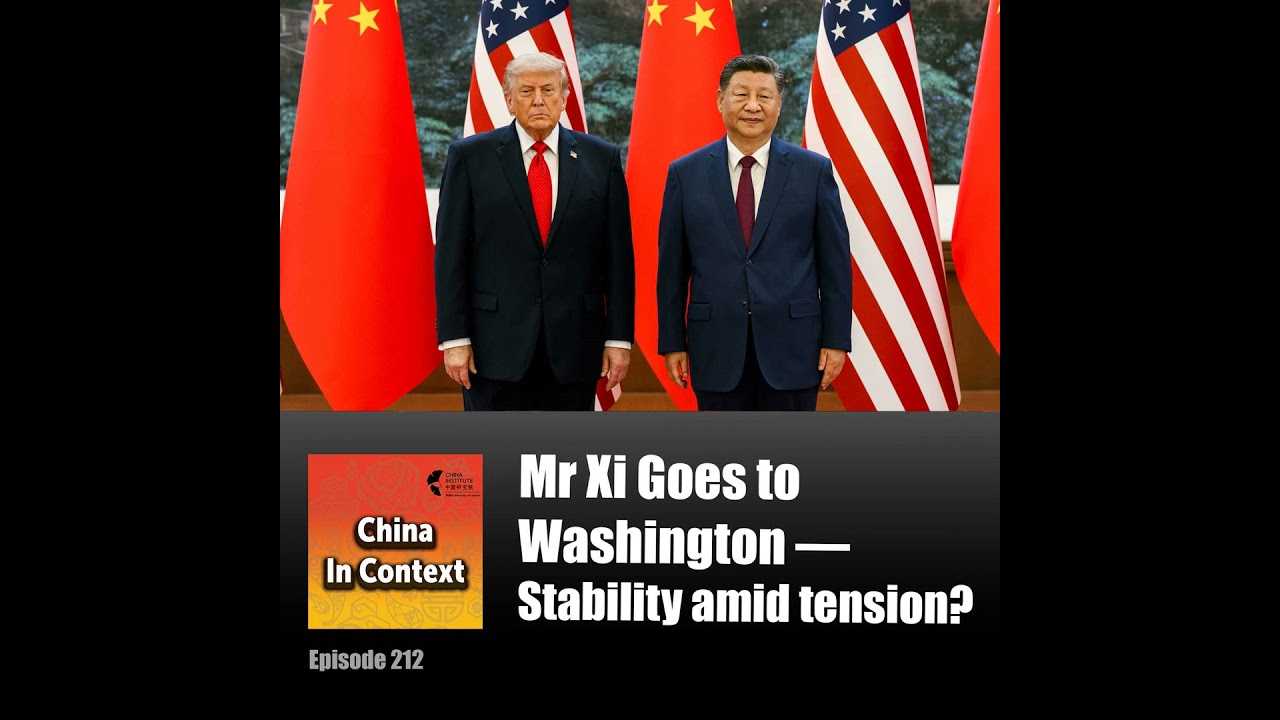
Video summary
The recent diplomatic engagement between the United States and China, highlighted by President Donald Trump's visit to Beijing and subsequent interactions in Washington, represents an attempt to stabilize relations amidst persistent underlying tensions. While the summit yielded agreements on trade truces, agricultural purchases, and the establishment of boards for commerce and investment, significant friction points remain unresolved. These include US restrictions on advanced chip exports and electric vehicle imports, China's dominance in rare earth minerals, and ongoing anxieties regarding artificial intelligence safety and military sales to Taiwan. The dialogue also touched upon sensitive geopolitical issues such as Russian oil sanctions and developments in Greenland, illustrating a complex landscape where economic interests compete with national security concerns and ideological differences.
A central theme of the discussion is the shifting internal dynamics within the US administration, particularly the rising influence of the Treasury Department under Secretary Scott Bessent, who prioritizes trade deficits and economic rebalancing over the more sanction-focused approach previously led by the Commerce Department. This structural shift suggests that China policy is still being molded in "wet clay," with competing interests between national security hawks and those focused on commercial engagement. Furthermore, the urgency of domestic US issues like AI regulation and energy costs has pushed China to the political back burner, leading to a pragmatic approach where both sides may agree to "talks about talks" rather than resolving deep-seated strategic disagreements. The administration's willingness to pause major arms packages for Taiwan and engage in private sector dialogues indicates a desire to manage competition without immediate escalation, though trust remains critically low on both sides.
Looking beyond the current Trump presidency, Chinese policymakers appear to be adopting a long-term strategy that views any US leader as a competitor rather than a potential partner, regardless of their political affiliation or rhetoric. Beijing is acutely aware that while President Trump may seek economic dominance in the AI arena, future administrations could revert to more traditional containment strategies, prompting China to push for maximum leverage during this window of opportunity. The conversation around AI has evolved into a critical battleground where both nations recognize that whoever dominates this technology will likely define the geopolitical landscape of the late 2020s and 2030s. Consequently, efforts are being made to foster private sector interactions and establish frameworks for managing technological diffusion, acknowledging that while blue-sky innovation often originates in the West, China excels at scaling and commercializing these technologies globally.
Ultimately, the current state of US-China relations is characterized by a fragile coexistence driven by mutual economic necessity and a cautious avoidance of direct conflict, even as strategic rivalry intensifies. The extension of trade truces and the focus on domestic economic challenges in both countries suggest that neither side is currently prepared for a new trade war, despite the rhetoric from hardliners. However, the fundamental nature of their relationship remains one of competition, with China striving to become self-sufficient in technology while the US seeks to maintain its lead in critical sectors like AI and semiconductors. As global attention shifts toward immediate crises in the Middle East and energy markets, high-level diplomatic breakthroughs on issues like Taiwan or human rights are less likely to animate public discourse, leaving the future of this strategic partnership to be shaped by behind-the-scenes negotiations and the evolving realities of technological competition.
Read the full video transcript
Welcome to China in Context from the
Soaz China Institute at the University
of London. I'm Duncan Hwitt. Donald
Trump's visit to Beijing in May this
year, the first by a [music] US
president in almost a decade, was seen
as a chance to reset relations after a
year of tariff [music] wars and tension
in the US over Chinese technology.
President Trump came away with Chinese
pledges to buy more US agricultural
goods and Boeing aircraft and the two
sides agreed to set up boards of trade
and investment and build what they
called a constructive relationship of
strategic stability. One of the other
outcomes was this month's visit to the
White House by Cining accompanied by
First Lady Pong Yuen and a delegation of
Chinese entrepreneurs and company
bosses. But there are still many sources
of tension. In the run-up to this visit,
talks were held between the US Treasury
Secretary Scott Bessant and China's Vice
Premier Hurley Fong with the aim of
extending the temporary one-year trade
truce, which the two sides agreed last
October. After the meeting, Beijing
announced that it would tighten controls
on the export of precursor chemicals for
the drug fentinil, which the US accuses
China of supplying to Mexican drug
cartels. Bessant and her also discussed
establishing a USChina AI dialogue
amidst global anxiety about the safety
of artificial intelligence. And there
has been speculation that Washington
could further delay the delivery of a 14
billion arms package to Taiwan, an issue
which remains a major source of friction
between the two countries. This follows
Donald Trump's unprecedented
acknowledgement that he had discussed
the issue of weapon sales to Taiwan with
President Ci in Beijing. But other
causes of tension remain from US
restrictions on the imports of Chinese
EVs and on the exports of advanced chips
to China to Beijing's dominance of the
rare earth sector. So, how far can this
latest summit between the two leaders go
to resolving such concerns? Well, we're
joined today by the historian of modern
China, Professor Rana Mitt, former head
of the China Center at Oxford University
and now St. Lee chair in US Asia
relations at the Harvard Kennedy School.
Rana, thank you so much for talking to
us on China in context. Now, Donald
Trump has continued to speak positively
about his relationship with Cining.
Indeed, some analysts have suggested
this summit was time to impress his
voters ahead of the US midterm elections
in November. But we've also just seen
the passing of this new bill in Congress
threatening sanctions against countries
which import Russian oil as China does.
We've seen a deal between Denmark and
the US over Greenland, which Donald
Trump has said will restrict Chinese and
Russian expansion there. And we've also
had an acknowledgement that the US has
deployed weapons in space, something
which has caused anxiety in China. So,
how does all of this fit together with
the two nations pledge to form this new
stable and constructive relationship?
>> I think what it points out, Duncan, is
that it is still very much wet clay in
terms of the way in which China policy
is being constructed here in Washington.
And no less than that, we should note
that it's still pretty wet clay or
perhaps the uh soft uh soil of the the
Yellow River Valley on the China side as
well where actually they're first of all
looking to adapt to a fast changing set
of American positions and also working
out what they think is in their own most
likely interest. So I would say that
structurally some of the things you're
talking about seem to be a product of
what at least from the outside uh
observers of Washington suggest is a
variety of competing interests within
the administration and then the kind of
you know final chess master end of game
uh checkmate move which I'll describe in
a in in a moment. So in terms of the
interests, first of all, one of the
things that has been of most interest to
China policy watchers in the last let's
say 6 months or so is the rise in
significance and heft and agenda setting
of the Treasury Department and Scott
Bessant, the Treasury Secretary in
particular. I mean he was always someone
who was obviously quite prominent within
the the the current Trump
administration, but his new centrality
to China policy on questions of trade
and also questions of technology. And
we're talking of course about AI amongst
other things there has been widely
noticed
>> because at the at the beginning of this
Trump 2 administration it was very much
Howard Lutnik the commerce secretary who
seemed to be leading on all of the
sanctions against China for example.
>> Yes. And I think the commerce department
of the secretary of commerce Howard
Lutnik still you know very much has a
voice in the game for what we can see.
And as you say, a lot of the clamping
down of very particular types of chip
sales and so forth seem to have at least
some of their origins in commerce. Also,
of course, the figure who in other
circumstances you might think would be
more involved with China policy and to
some extent is and that's of course
Secretary of State and National Security
Adviser Marco Rubio. And there's no
question that obviously he has
significant and important input into
China questions and the state department
continues to maintain a very important
office of China coordination. And there
are other areas which deal with that.
But I think many people, you know, you
don't need to know the world situation
much to know that South America and the
Middle East have been taking up a lot of
oxygen. And so from that point of view,
the shift towards a more Treasury
Department, commercial, trade, and
technologydriven argument about what to
do next with China, I think is what
we're seeing. And I mentioned that
there's a sort of grandmaster kind of
move at the end. Well, that of course is
the president. That's Donald Trump who
in the end will be the decider. Everyone
agrees. They agree on nothing else. They
agree that in the end what Trump wants
the China policy to be will be the China
policy.
>> But as you say, I mean he he has also
been fairly distracted by events in
other parts of the world. Do you think
that he he has really been focusing much
on all of these issues that we just
mentioned? things like uh how China
would respond to the Russian oil
sanctions or the Greenland deal or or
the space weapons for example. I've read
certainly from some reports that uh the
Chinese side felt that the US hadn't
hadn't really made a huge amount of
preparation for this visit and it's all
being done quite last minute really.
>> My sense is that that absolutely is the
Chinese reaction. It was the Chinese
reaction as well to the May summit. But
I think the American side, I would say
that there are are two things they might
say in response. First of all, you know,
in a more freewheeling society and
definitely a more freewheeling
administration perhaps, you're not going
to have the kind of minute-by-minute
preparation that the Chinese authorities
are obviously used to in pretty much
everything they do. Whenever Xiinping
makes a foreign visit to anywhere, it's
going to be very heavily choreographed.
It'll be worked out who will say what at
what point. So I think the question of
just different national styles is part
of it and also different
administrations. I think it's probably
true [snorts] that some US
administrations would have done more
kind of sherper work as they sometimes
call it. But I refer you back to what I
was saying earlier. There are different
interest groups it would appear within
the administration who have different
ideas of where to go. There are
traditional national security hawks who
you know warn that the most important
issue in dealing with China is to deal
with security and safety and
infiltration and intelligence issues. Um
national security council I think would
fall in that category even now probably
state department to some extent. The
treasury and commerce departments are
looking much more at trying to fulfill
an agenda of the US economy needs to
essentially rebalance in all sorts of
ways including a trade deficit with
China. What are we going to do about
that? And right now, I think it's fair
to say that the latter is probably a bit
more where the president might be.
People I've talked to who are closer to
that world would say that of all the
issues that insensim right now, the
trade deficit with China is really the
driver and therefore things that deal
with that issue are central to it. That
said, there's one other issue we're
talking now about matters of the last,
you know, few days. The AI question is
something that is climbing up the
domestic agenda in the United States. We
have midterm elections coming up in
early November.
>> This is the question of whether there
should be more regulation of AI because
of all these concerns that have been
expressed recently.
>> That's right. Well, there's at least two
things that um you know, I think nobody
in January, you know, less than a year
ago would have guessed would have
occupied the midterms by the time we got
to September, October, November. One of
them is the question of AI regulation,
which is now the most immediate issue.
you know, are various versions of um AI,
you know, leaping beyond their uh
guardrails and and infiltrating each
other and actually even before that over
the summer, the growing concern over
data centers and energy usage by data
center. So, those are domestic US
issues, but they're being tied up into
an argument about China because when
Trump is is asked, you know, why
shouldn't we regulate? Why shouldn't we
try and make this dangerous singing
technology a bit safer? He says because
then we'll lose to China. You know, I
think his phrasing was whoever wins AI
wins. That is very much, it seems, what
he believes. I wouldn't bet against Xi
Jinping these days believing that
either. The Chinese AI proposition is a
different one from the American or
Western one. AI is already much more
embedded in society. It's used in
actually pretty forward- facing areas
like healthcare. It's certainly almost
certainly being used much more in the
Chinese side in the military and other
areas that we just don't know much
about. But I think the idea that having
a dominant AI structure is going to be
one of the big tech arenas of the late
2020s and 2030s is now firmly held in
the leadership in Beijing and
Washington. The difference is that
Beijing won't talk about it very openly.
But um nonetheless, both sides now have
a vested interest in trying to work out
if there are meaningfully talks they can
have between the two sides. And so going
back to the summit, that's one of the
things that's clearly, I think, going to
be an area of significant interaction
and discussion. Not in terms of, you
know, that they're going to be able to
decide what to do, but the agreement
perhaps to have, as people sometimes
say, talks about talks. That might be
where if the US and China find that
their next important area of interaction
is and frankly, that will go probably
beyond the end of the Trump presidency
in a couple of years time. It will
probably shape Xiinping, assuming he
goes for a fourth term as general
secretary, which seems likely. It will
probably shape a great deal of his
fourth term in terms of where China goes
next as well.
>> Cigin Ping has has made it clear that he
does want China to be involved in
setting the standards for AI. And I mean
in the current climate, do you think
there's any chance that the two sides
can seriously find any common ground on
these issues other than perhaps that
neither Donald Trump nor CJ Pink seems
to want too many other people telling
them how their AI should be run?
>> The likelihood that any entities I say
entities rather than countries because
the EU obviously would be one of the
regulators as a kind of multi-ount
country confederation. the idea that
anyone except the Chinese and the
Americans will talk to each other about
these issues I think is becoming rapidly
smaller and I think because the level of
trust between the two sides is still
very low really I mean this is about
kind of rescuing a relationship that has
been on very very stony ground uh I
don't think people who are policymaking
in Beijing have any reason to think that
they have good lines of communication on
a long-term level into the US I don't
have a sense that there are Washington
actors who have kind of deep and
meaningful engagement with what's going
on on the Chinese policy front. It often
seems like something of a blank.
[snorts] Having said that, I think we're
at a kind of plateau area. The last
summit, the one in May, seem to sort of
put a floor under a variety of issues,
including, you know, trade for the for
the moment. And I think because the tech
and AI issue has been accelerating so
fast and so unpredictably, both sides
feel they're on the back foot. So there
are a couple of factors that may make it
a slightly more positive environment for
at least starting talks about talks or
even talks about talks about talks.
Number one is that I think there is an
increasing sense of the urgency of
working out whether the technology can
be at least at some level regulated. I
mean if not necessarily government
regulation, [snorts] internal
regulation. I think actually one area
which hasn't necessarily been very
prominent but may become important is
private sector to private sector
conversations. Uh clearly the CEOs of
the big tech outfits in the US talking
to the functional equivalents on the
Chinese side will become more important
and that I think actually does happen in
many cases already. Now one could argue
that because the Chinese side is
obviously not going to do anything
without consultation with the communist
party you know clearly this is not a
genuinely a separate sector of society
on the other hand in the current
environment it's clear that American
industrial strategy is now much more
tied up with what the state wants the US
state wants as well and there's a sort
of strange kind of interaction in which
on the one hand the official position
not least from vice president Vance is
that the company should deciding these
things for themselves. But the flip side
of that is that nonetheless, the US
government self-evidently has a very
strong and active interest in working
out where the private sector takes AI
next, certainly in terms of being able
to compete with China. So, private
sector entrepreneurs and key actors
could talk to each other with the
knowledge that they have at least some
channel conversation in each case back
to their own governmental bodies and
that might make a difference. Uh I'm not
saying that's what's going to happen.
[laughter]
I'm saying that there are signs that
that's already somewhere in the wider
mix and we should sort of keep an eye
out to see whether that particular
channel perhaps goes further in a way
that frankly getting two rooms full of
diplomats or bureaucrats even presidents
beyond a certain point just may not do.
It's striking that there was expected to
be a large Chinese industrial delegation
coming with Cining
reciprocally for the US tech leaders and
other industrial leaders who went to
China with Donald Trump in May which
obviously included Jensen Hang from
Nvidia and Tim Cook from Apple and Elon
Musk. Of course, it was expected that
Xiaomi and BYD and one of the other big
battery companies CL and electronics
companies like Highense and some of the
car related companies would be coming
with Cining. But there there were
apparently had been suggestions
according to some reports that Beijing
had proposed that the business leaders
should have their own roundt just
between executives. But this was
rejected by the White House. But but in
the context of this tension over things
like AI and of course the chips and
there's constant twoing and throwing
between China and the US over chips and
which Nvidia chips can be exported to
China for example that's been regulated
and then relaxed and there's plenty of
discussion about it still going on and
then Huawei in China of course coming
out with all of its own new products
attempting to sort of get round these US
sanctions and Huawei at the same time
being sued in a criminal case in in New
York at the moment accused of uh trying
to copy robot technology from the US
telecoms industry which they of course
deny. You have all of these factors
going on but do you think Donald Trump
does have a clear vision on what what he
wants to happen? You know in some cases
he's actually been criticized by some in
the US the more hawkish fraternity for
being too lax on China in these areas. I
think that in terms of a direction of
travel and a kind of end goal, what
Donald Trump likely wants and again I
cannot speak for uh you know the uh
intentions of the president of the
United States. I don't think there's
necessarily a huge secret about it. I
mean he's had an idea for a very long
time and it's called MAGA make America
great again and that's the vision I
think and if the arena for greatness
whatever that is is technological
I was going to say superiority but let's
use the word dominance because you know
I think that that's not out of place
here that's what it would be now what is
the arena in which technology would be
dominant you know 25 years ago it would
have been owning the internet well if AI
and many people you know obviously many
people who have shared prices to protect
making this case. That doesn't
necessarily mean it's untrue. If the
next arena is basically AI and its
applications, then I think Donald Trump
wants the United States to be the one
and only ideally dominant actor in that
arena. And if China is to be a player
and you know let's be frank the way
things are going it absolutely will be
then he wants it to be number two and a
player that in some ways is still
derivative of what happens in the US.
Now if you look at the reality of where
we are right now uh midepptember 2026
that's not an inaccurate description of
where it is now. You can see a sort of
hinge point moment in which the US AI
sector is highly valued although with a
valuation that has fragility in it. uh
still largely driven by closed systems
famously um and still for the moment a
significant period of time not
unbeatable but significant period of
time ahead in terms of of of development
um and with an innovation capacity at
the kind of blue sky level that China
doesn't yet rival. China on the other
hand has scale. It has the capacity
capacity to take existing US technology
and make it more than the sum of its
parts. the phenomenon of distillation
which a lot of listeners will have heard
about in which basically China you know
draws on huge numbers of sources from
around the world including the United
States and kind of uh essentially
orients them into Chinese openweight
models that essentially drive more
traffic in the direction of of China. In
other words, from truly open-source
models that anyone can take and adapt to
ones that actually the intellectual
property remains in China, but the
capacity to use them is disseminated and
diffused elsewhere. So, you can see
already different sorts of commercial
and technological ecologies emerging.
>> I mean, of course, the US has criticized
China and accused it of of copying its
AI models via this process of
distillation.
>> Oh, sure. And in a literal sense that
that's true. The problem is that we've
seen with so many other technologies
that this happens in Britain a great
deal as well that blue skies invention
is still often much much more productive
certainly in the US and sometimes in
Western Europe as well. You know you
think of the smartphone we think of the
the battery EVs um lithium batteries and
so the vast majority of these things are
invented from first principle in the US
or elsewhere in the in the liberal
world. But what China always has been
able to do in the last you know 30 or 40
years is to take the existing technology
whether purchasing it through a joint
venture or simply by putting a thumb
drive into a laptop somewhere you know
whatever the method may be take the
framing the technology and then make it
faster, cheaper, larger scale sometimes
more effective and then reorient that
back into commercially scalable
capacity. So, China didn't invent the uh
basis of solar and wind technology, but
it dominates in those sectors. China
didn't invent AI either, but it knows an
awful lot about how to produce it, scale
it. Uh it has brands which are beginning
to come up on the outside that have
global resonance in terms of LLMs and
chatbots, Deep See, Kimmy, whole variety
of names that people know. I mean, a lot
of people are saying that one of the
things that may end up tripping up China
is not necessarily to do with the lack
of technology, but the lack of compute
or indeed the lack of energy provision.
And that's one of the reasons why it's
finding all sorts of new projects from
driving hydroelectric power in the west
of China to actually working out ways in
which simply it can dominate the market
for compute in and outside China to be
able to drive those models. Uh so you
know looking at the areas in which both
sides are seeking to uh essentially
overcome resource constraints may be the
most interesting question of the next 3
6 12 months.
>> We've obviously saw that during this
visit by Donald Trump to China in in the
spring that the the two sides said that
they were going to set up these a board
of trade and a board of commerce that
would sort of help to create a framework
for trade disputes in the future. And of
course some and some scholars I believe
argued that the introduction of what was
called the constructive relationship of
strategic stability which many people
felt was sounded very much like a a
Chinese government type idea just in
terms of the language that was used that
this would make it much harder for
Donald Trump in particular to spring
sudden sanctions on China. Do you think
that there is despite all of these
tensions over issues like a AI and uh
chips that there is there is any greater
sense now that the two sides are at
least going to find some way of
coexisting in these areas? You know, is
is that what these frameworks actually
could lead to? or was it really a a way
for the two countries to just sort of
shove their differences and just get on
with their own targets over the next
couple of years, which for China
obviously includes becoming self-
sustainable in technology?
>> Well, the honest answer is that none of
us know yet. Uh because a lot of this
architecture, if you want to put it that
way, is changing very fast with the
board of trade and board of commerce. I
genuinely don't know. I I mean I heard
talk like many people um back in I want
to say May June when that was being
talked about a lot. I haven't heard a
lot about them since maybe they're in
process and then there'll be more. The
most recent piece of trade news I mean
within the last 48 hours as we record
this was as you said earlier in this
conversation about the new tariff hammer
as some people are calling it based on
Russia sanctions that the United States
meaning the president can use if he
wants to punish countries that buy you
know Russian oil and fossil fuels. The
biggest buyers of that Russian oil are
number one China, number two India,
number three I think is Turkey, number
four is a kind of concatenation of EU
countries. So, are you going to put
sanctions on China? I don't think so.
Can you put them on India? Well,
actually, the Trump administration did
sort of do this about half a year ago
and uh the Indians not unreasonably
said, well, if you don't like us buying
Russian oil, why aren't you sanctioning
the Chinese? And the real answer is
because then they'll stop us getting
critical minerals. But of course, they
couldn't say that. So, in other words,
what that tariff hammer is for in terms
of the sanctions is unclear. I think
it'll be un unlikely to worry the
Chinese too much in that case. In terms
of the wider environment, I mean, I
think one thing that at the the summit
yet again the Chinese will push a bit on
is language on Taiwan. We had a bit of
that in in May. But I think that they
are now from what I can tell so driven
by vibes as well as policies. The vibe
being that they are thinking more and
more that actually Taiwan status will
change at some point in the nearish
future. There have been sort of
discussions on blogs and other places
about this and one of the issues is
whether or not they are able to
influence a possibly already febrile
domestic Taiwan political situation
around the 2028 January election.
Clearly the election of a non DPV
president of some variety would serve
the aim of opening up negotiations over
whatever there is to talk about. One of
the things that did appear to come out
of Donald Trump's visit to China in the
in May was that Beijing had apparently
pledged to buy 200 Boeing jets and but
also that it would start buying more
soybeans again, which it had used as a a
retaliation for American sanctions and
had been buying more of them from Brazil
and South America, that it was going to
buy more American beef and poultry and
things that it had limited in the past.
I don't know how substantive that has
turned out to be, but obviously you
raised this issue of China having great
leverage because of its dominance now of
the rare earths and minerals uh sectors.
>> Is there a feeling in the US that Donald
Trump for all of his gung-ho rhetoric
towards China early in his second term
has now had to cool that down? and and
you know he has been criticized by some
hawks perhaps for being not as hard on
China as they would hope. I mean we've
seen all these congressional committees
and hearings over the last couple of
weeks in the run-up to see Jinping's
visit. Some of them calling for the
release of Jimmy Lie in Hong Kong, the
the jailed newspaper tycoon. Others
calling for the release of other
dissident, for the administration to
take a tougher stance on human rights.
Is there a sense that Trump got anything
substantive out of his trip to Beijing?
And how is all of this playing with his
traditional base among among US voters
and politicians?
>> I think the best way I can answer it
actually is fairly concisely, which is
that as someone who's, you know,
currently living in the United States,
looking at what is on people's minds at
the moment, China is a backburner issue
in US politics at the moment. As far as
I can tell, it hasn't always been.
Sometimes it's been very prominent at
least because you know the president and
his opponents have have brought it up.
Uh [snorts] it's still a very important
policy issue but in terms of in terms of
setting the political world al light
it's very much about domestic economic
politics. Uh the Iran war continues to
be something that obviously is you know
burning in the background but um China
negotiations are not really something
that animates much of the politics at
the moment. people running for office
for the Senate or the Congress at the
moment don't seem to be pushing the
China issue, whatever that would be. So,
in that sense, I think we're actually in
a moment, maybe that's good, where the
two governments are going to be talking
to each other about what's on their
minds and perhaps, as you say, not going
much beyond a few sort of slightly milk
toast uh trade agreements here and
there. maybe agreements, talks about
talks about talks on AI, some perhaps,
you know, slightly ambivalent language
about Taiwan. You know, these are going
to be more the things of an inside
conversation than something that really
animates US politics at the moment.
>> And you mentioned the issue of Taiwan
and you also mentioned Marco Rubio, the
Secretary of State, who of of course
before he joined the administration was
famous for his hawkish attitude towards
China, particularly in the context of
Taiwan. you know, was seen as a great
supporter of Taiwan. Now, we saw that
when President Trump was in Beijing in
May that he said that he had discussed
arm sales to Taiwan with Cining,
something which many people saw as an
unusual acknowledgement at least, and
also that he was quoted as having
listened to Cining and said, you know,
we don't want to have someone in Taiwan
who's going to try and go independent
because the US is selling them weapons
packages. and they put a major weapons
package, you know, these go through
regularly to Taiwan, but they put a
major package worth, I think, 14 billion
US dollars on hold. And there's now the
question of whether that will be further
delayed in an attempt to sort of appease
Cining.
>> Well, that also has to do with whether
it would get through the Taiwan
legislative UN as well because actually
the domestic consensus for particularly
the opposition KMT uh for putting it
through is not necessarily that.
>> Absolutely. I mean, obviously it's
controversial in within Taiwan politics
as well, but there was some blowback in
the US when all of this first came out
in May when President Trump was in China
with some people really accusing him of
of selling out Taiwan. How is that
playing now? And is that still a very
live issue or, you know, as you say, is
that also just on the back burner
>> in terms of shaping the conversation of
US politics and international relations?
It's really pretty back burner. I mean I
I can't stress how much at least in this
country if people are thinking about
international politics they are thinking
about Iran because it's having a very
direct effect specifically on gas
prices. People are paying more for
gasoline. They're paying more for
diesel. And again if you talk about even
at the next level up of international
partnerships and the difficulties that
are being caused there I think a lot of
the Gulf countries Saudi uh Gata um Oman
and so forth their perception is that an
Iranian regime has now been embedded
rather than defeated and can now control
the straits of through the Houthis can
control the Baband that oil supplies
from there to much of the rest of the
world including China are potentially uh
problematic or or worse than that these
are the sorts of conversations that
people are having at the moment. Just
again something that seems in some ways
unconnected but I think really isn't um
as we speak some sort of agreement seems
to made between the US and Denmark and
Greenland on arrangement there and it's
one that's been touted as giving the US
you know kind of long-term security
looks remarkably the same security
guarantees that they had under NATO
agreements. In fact, the point being
that there may be I have no insight
info, but there may be a decision that
getting into another row about Greenland
now at the same time the Middle East is
not sorted is not worth it. And they're
coming up with a deal where you can
declare victory and go home on Greenland
is useful. And the same may be true in
China and even on Taiwan issues that
basically saying it's all fine, we've
won and taking that off the news agenda
may be a key decision at a time when
unfortunately the Middle East question
can't be wiped away in quite the same
way because its day-to-day effects in
terms of those gas prices at the pump
are still very visible to everyday
voters. Do you think that China feels
that it did make significant progress in
terms of Taiwan or at least in terms of
perhaps influencing Donald Trump's
thinking on Taiwan during that last
visit? I mean, is Beijing, as some
analysts have suggested, basically sort
of satisfied that it's more or less got
as much as it can from the US on Taiwan
for the time being and that this issue
won't be such a huge part of the talks
this time round?
>> It probably won't be such a huge part.
Yeah, I I think that broadly speaking,
they'll have thought that they're
getting pretty much what they're going
to get. It's certainly not, you know, as
confrontational position as it was, you
know, maybe during the middle of the
Biden administration even. However, I
think that they will also be doing a bit
of, you know, double or quitsing in
terms of thinking where to go next.
Because if you believe that Trump is as
good as it gets in terms of taking a an
unconventional view of the US asurances
towards Taiwan, then you probably do
want to get back in and see if you can
push to something that is outside what
have been the norms in terms of of a
deal because, you know, that's kind of
what Trump does. And if you're China,
you know that perfectly well. You may
also think that it's possible that the
next president of the United States, if
it's Vice President Vance becoming
president, may be even less inclined to
get involved in the outside world. Or
you could think, but the next president
might be Marco Rubio, or it might be a
more traditional Democrat or it might be
someone else completely. And those
people may decide that actually a more
traditional position on Taiwan from the
United States should be restored. At
which point if you're Beijing, you may
have thought well actually we probably
should have pushed Trump harder. So you
have to decide whether that's your
moment now and whether you'll get
anything from it or whether actually you
just decide to work with as I mentioned
before that wider sense that overall
Taiwan's situation globally is being
narrowed and therefore actually what you
really need to do is just to keep
pushing and wait and change the facts on
the water and the facts on the ground.
And going back to some of the sort of
nitty-gritty issues, is it your
expectation that the current trade truce
as it were over tariffs and and so on
will just be extended? There's been talk
of some deal that the two sides would
each reduce tariffs on $30 billion worth
of of goods. I don't know whether that's
a sign that the US is actually realizing
it does need some cheaper Chinese
imports after all. But uh again, this
seemed to be a huge issue for much of
2025 and now does feel like it's it's
much lower profile. So are they able to
somehow push some of these issues to the
side for the moment?
>> Yeah, my my bet because I think the uh
current agreement was for a year in
October of 2025 and we're coming up to
October 2026 now. So it'll be decided
within a few weeks anyway. Um is
basically probably push the button on
same thing again. you know, maybe put it
in for two years rather than for for a
while or whatever. But, you know, they
they'll they'll decide that. I don't
have a sense there's any appetite either
in Beijing or Washington for a new trade
war. And the reasons on the American
side are obvious. We kind of discussed
them a little bit with the the midterms.
Let me just stress something on the
China side. My last trip a few weeks
ago, I was a bit takenback by how
downhearted everyone I talked to, this
could be, you know, academics, ivory
tower or otherwise, could be, you know,
business entrepreneurs, could be DD
drivers, uh, you know, people driving
their ride share cabs, saying that they
just felt economically on the downturn.
They did not feel that things were
sparking up. They didn't feel the
domestic economy was creating
opportunities for them. Uh, if it was
the entrepreneurs, they seemed, you
know, nervous about investing. Of
course, China has, as you know, one
economic factor that is very different
from the US and and the others, even
though some of the gloom is the same.
The different factor, of course, is
deflation, uh, which sounds like it's
great in terms of prices until you
experience it, at which point actually
investment and purchases tend to shrink
because everyone sort of assumes the
prices will go down further. And that's
particularly true, of course, with the
horrific deflation in property prices
with all those people who have mortgages
bought at the height of the property
boom and have properties [clears throat]
that they can neither service nor sell.
So that factor is, I suspect, very much
on Chinese policy makers minds. And the
idea that you would then make it worse
with a massive trade crisis is clearly
very unpalatable. And at the same time,
as I've said, I don't think anyone I
know in Washington is very keen to
decide that the best thing to do is to
kind of get tariff rates going up and
have another USChina trade war. There's
been some discussion about whether there
could be any significant change from the
US side in terms of attitudes to Chinese
EVs which at the moment have these huge
tariffs basically are unaffordable for
people in the US whereas they're making
rapid strides into Europe and certainly
in the UK but uh there's been some
suggestions that Trump might at least be
encourage thinking of encouraging China
to start manufacturing EVs within the
US. We're seeing obviously these battery
makers from China who are so dominant
coming on this trip with CGMPing. Is
that an area where you think there could
be any significant change or is is the
need to protect the US auto industry
still too great really
>> for the moment? I'd be surprised about a
move going in that direction. I I've
talked to some of the people involved
with negotiations. The way that they
phrased their frustration with the
Europeans was, "You may want to allow
the Chinese to come and basically hollow
out your auto industry. We're not going
to allow that to happen in in the United
States." I think it will be difficult
for the US to do that in quite that
form. partly because well there there
are a variety of reasons but I think
that because the North American auto
market has been so integrated until now
with Mexico and Canada and because
relations with Canada in particular at
the moment are an extremely dubious
state. the trust environment which
actually you would have to have between
Canadian and US and indeed Mexican
leaders to reimagine the North American
auto manufacturing environment with
Chinese investment and Chinese IP in
particular involved in it in a central
way. I just don't see how politically
that works at the moment. And just one
last question, you raised this idea of
the the kind of debates on AI will, you
know, continuing way beyond, for
example, Donald Trump's presidency. Do
you think that Beijing is really now
looking at the world beyond Donald
Trump? I mean, are they sort of
thinking, we've only got a couple more
years of of this guy to go and we're not
going to let him interfere with our sort
of longerterm strategy?
>> Yes, I think so. I mean, I think that
there's still plenty of attention, how
could there not be, on Donald Trump and
what he's up to? Because I think in the
very short term, they are still working
out, are there things that we can attain
while he holds the presidency that just
may not be possible with any other
president of any other party. But the
basic premise of China's engagement with
the United States, which I think has
really been true for perhaps 25 years or
or so, is that the United States will
not be a partner for China. You know,
[clears throat] the two will be in
competition. I I remember speaking to a
senior Chinese military figure, I know a
couple of years ago, who said that he
thought that the central question really
of geopolitics was whether or not the US
or China could avoid conflict. And I'm
sure you'll find many on the US side
saying something similar. So in that
context, China has considered and will
consider any US leader to at the very
least be a competitor, a rival to China.
And I don't think, you know, even Donald
Trump steps back from that idea. You
know, he wants a competition that is
perhaps more economic. Uh he's not
interested perhaps, I'm sure he's not
interested in a a kind of military
confrontation if he can avoid it. But
Europe, Japan, South Korea have been
much more surprised by the developments
of the last two years because I think
they really did not perceive that a US
president would essentially cast them as
adversaries. Canada too. China is not
remotely surprised to be cast in that
particular mode and therefore to that
extent any president even Donald Trump
is sort of a variation on a theme as far
as they're concerned. If the next
president were to be Vance, Rubio, Gavin
News, I suspect, uh, whoever it might
be, they will still regard that person
as someone who has the containment, the
constraining of China as a key
geopolitical goal, even though their
methods or their language may be
different.
>> Well, Rana emitter, thank you so much
for joining us on China in Context.
>> Huge pleasure to be with you, Duncan.
Look forward to the next time.
Well, that's all we have time for on
this episode. You can find out more
about Soaz China Institute events on our
website, sosas.ac.uk.
But for now, thanks for listening and
goodbye.