Video summary
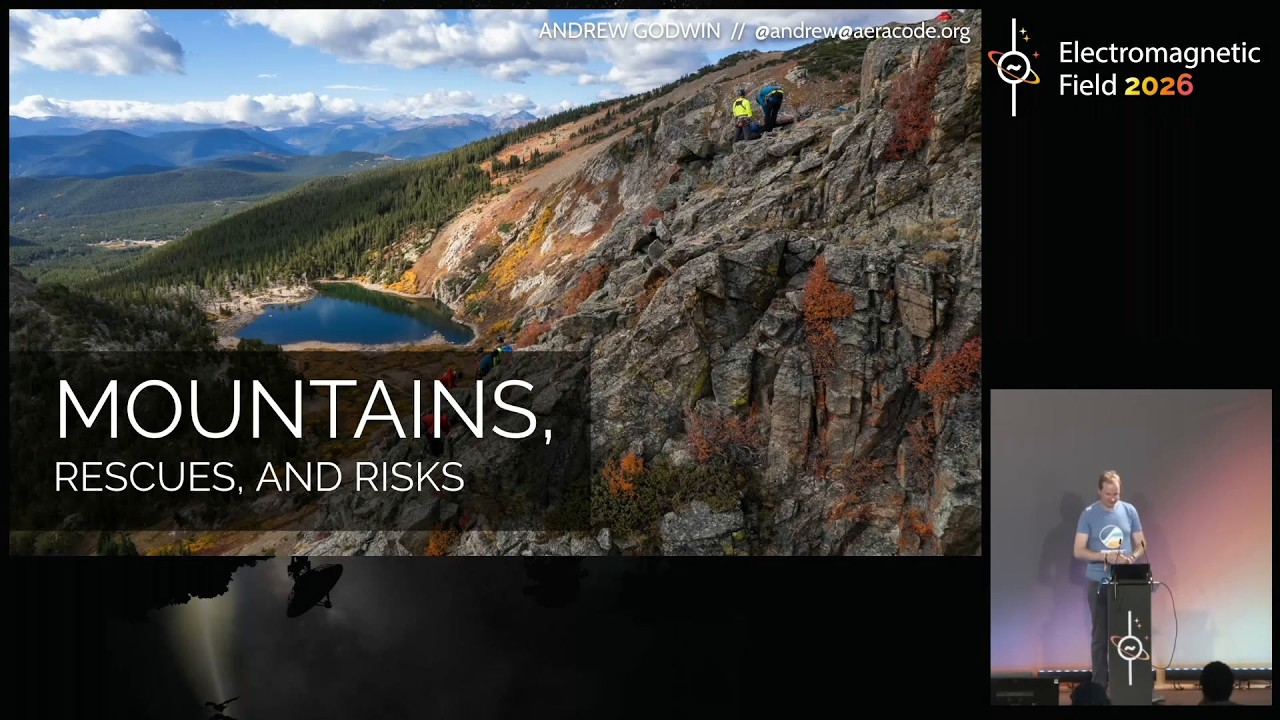
Andrew Godwin introduces himself as a volunteer professional with extensive experience in mountain rescue, having worked since 2018 and specifically in field operations since 2025 based in Denver, Colorado. He explains that while public perception often imagines dramatic helicopter rescues, the reality of mountain rescue is far more grounded and involves three distinct phases: search, rescue, and recovery. Search involves locating lost individuals who may have contacted emergency services or been reported missing by companions; rescue entails physically extracting those who cannot evacuate themselves due to injury or difficult terrain; and recovery refers to the dignified retrieval of deceased individuals from the field, which is often overlooked but remains a critical part of the mission. Godwin emphasizes that these operations are conducted entirely by volunteers who are highly trained professionals, operating under strict safety protocols without financial compensation.
The core of mountain rescue revolves around managing risk through a matrix of consequence and likelihood, where teams focus heavily on reducing the likelihood of accidents because the consequences—such as death or severe injury—are inherently high. This necessity drives a culture that prioritizes slowness over speed, ensuring that every action is deliberate to prevent errors, and establishes a clear command structure where any team member can halt operations if safety is compromised. A fundamental principle guiding these efforts is a strict priority list: the rescuer's own safety comes first, followed by the safety of the entire team, and finally the subject or patient. This hierarchy ensures that rescue missions never endanger the responders to an unacceptable degree, as a team cannot be effective if its members are injured or exhausted.
Technological advancements and evolving tactics are reshaping how these teams operate, with a shift away from extensive searches toward precise GPS-based responses enabled by satellite messengers and smartphones, though social media sometimes encourages inexperienced hikers into dangerous situations. Godwin highlights the future potential of using drones to deliver supplies or equipment to remote locations, which could reduce the physical burden on human teams and allow for safer approaches in high-altitude environments where helicopters may struggle due to weather conditions or density altitude. Despite these innovations, the work remains physically demanding and slow-paced, requiring teams to hike heavy gear up steep slopes and navigate complex terrain like ice fields and canyons, often relying on backup plans when air support is unavailable.
The talk concludes with a strong emphasis on learning from failures through a blame-free approach to near misses, which are viewed as valuable opportunities to improve processes rather than occasions for punishment. Godwin warns against "heroics," where individuals push themselves beyond safe limits to solve problems quickly, arguing that such actions hide systemic issues and prevent organizations from truly improving. He also notes the importance of early communication, urging people in the US to contact rescue teams immediately when trouble begins rather than waiting until conditions worsen at night, as medical transport costs money while ground search and rescue is free. Ultimately, the mission is about maintaining an excellent safety record by acknowledging risks head-on, fostering a collaborative environment among diverse agencies, and ensuring that every person involved returns home safely.
Read the full video transcript
Hello everyone.
All right, as mentioned, I'm Andrew
Godwin. Um I have been helping out with
EMS since 2018. I started just doing a
few shifts in the info tent, and now I
have been in this field since last
Wednesday. I have been building this
festival. It's very nice to have you all
turned up. It's also very weird. It's
been quite an empty field for a week.
So, it's wonderful to have you all here.
Um in other related things, I have been
doing mountain rescue
um since 2023.
I started doing much more field work
last year in 2025.
Um and as somewhat of a related note to
this, I do live in Denver, Colorado, and
so we have a few mountains around there,
as you may understand from your
knowledge of Colorado.
Before we go any further, I want to give
you a content warning. This wasn't in
the schedule, but I should reinforce it.
I'm going to discuss death and severe
injury, but in abstract terms and no
specific details.
This is all throughout the talk. There
is no specific section I'll warn you
about, just so you know this is in here.
All right, let's start with a little
what is mountain rescue. Uh people often
have very Hollywood sort of enabled
visions of what mountain rescue is.
There's people dramatically swooping in
by helicopter, dropping on ropes,
plucking people off the side of
mountains.
That happens very occasionally, but it's
mostly not what it is, and we'll get to
that. As a background to where I
volunteer, I uh work with Alpine Rescue
Team. We're based just west of Denver,
Colorado, along the I-70 corridor,
covering three different counties in
that area.
Uh we are one of the busiest mountain
rescue teams in the United States. I'm
not sure there's a ranking thing, like
the Washington teams definitely beat us,
but we're pretty busy, generally 150 or
more missions per year, um which is a
quite a decent mission load. The team
has been going since 1959,
so we are closing in on
in a little bit here like you know, some
very significant milestones.
The team is approximately 70 people who
are field active. But in general does
vary quite a lot and is entirely
volunteer run. No one on the team is
paid. However, the team is all
professionals. It is a very strict level
of training as we'll talk about and so
we refer to ourselves as volunteer
professionals.
Now, search and rescue specifically or
mountain rescue is actually composed of
three things. You may hear backcountry
rescue, mountain rescue, search and
rescue.
There is a third element not often
talked about. So firstly, there is
search. Search is finding people who are
lost. Sometimes they have called us or
somehow otherwise got in touch with us
maybe by satellite messenger and said,
"Help, I'm lost." Often it is friends or
family or hiking partners or similar
reporting, "Hey, this person was due
back and it's been so many hours since I
last saw them. I don't know where they
are." There is of course rescue. Rescue
is once you know where a person is, how
you get them out of the field because
often they can't do this themselves. It
can be medical reasons, it can be a
number of things, but often you know,
they are just unable to walk themselves
out
either due to their own personal
situation or due to the terrain and
technical
access involved. And then finally, the
part we don't talk about a lot publicly
is recovery. If someone does die in the
field, we do not leave them there. We
will make every effort we can to get
them back out of the field and back to
their family. We don't do all
recoveries. Recoveries are obviously a
lower priority than rescue.
There's a couple of people who are just
so difficult to get that it would place
too many people's lives at risk, but
generally we'll get everyone out. Um, as
you can imagine, a search often leads
into a rescue or recovery, but both can
also start independently. Um, and as
we'll talk later in the talk, um, these
days we get more and more of rescue and
recovery straight away without the
search element.
Also, it's very warm in this tent. My
goodness.
All right, let's talk about the terrain
we're working in. There's roughly three
categorizations of terrain.
Um, these are not strict. One of the
favorite phrases in mountain rescue is
it depends. And I've put some degree
things in here. These are just examples.
The actual truth is it depends.
Um, but sort of the context and the
consequences we'll talk about is what
matters. So, flatland rescues we think
flatlands are anything under about 15°.
Um, while Eastnor here is hilly, it's
considered flatland. Um, generally what
this means is there is no need for a
rope system for any kind of safety
aspect. We may use one to pull someone.
So, we have a thing called a litter,
which is basically a structure with a
wheel on the bottom. Uh,
we will often just have an extra rope on
the front and put someone on that to
hold it along. But generally you're not
relying on the rope system for safety.
Um, it's generally reasonably easy
reasonably easy to navigate. You can
still have hazards like water crossings
and shale and sort of slippery ground
underneath.
Low angle is what you consider sort of a
moderate slope. Um, this is places where
we need rope systems for safety, but
they're not taking full body weight. A
general example is like, you know, quite
a steep hill. If we've got someone on
this wheel litter, often the wheel comes
off for this bit, coming down that
slope, we're going to want to have a
rope on there because it would be pretty
bad if that any part of that system or
that person was not attached. Like
they'd go a decent way down the hill.
Um, they would probably stop, but it's
not a great thing.
High angle is anything where the rope is
supporting someone's full body weight.
This is very high consequence. At this
point, if the rope breaks, it is very
very bad. Generally, as you can imagine,
the risk increases as you go further
down this scale.
Now, there are other elements to
mountain rescue. Um we do have
helicopters in Colorado, where I
volunteer, we have the wonderful Flight
for Life in their distinctive
helicopters.
Um we do not always get helicopters.
They are fickle beasts. They like things
like no clouds and no high winds. And
also, uh I'm sure many of you are aware,
Colorado is very high elevation. The
highest peaks in Colorado are 14,000 ft
or 4,200 m. Um that is very close to the
design ceiling of helicopters. Like this
is a very small medical helicopter. Most
of the ones you're probably just seeing
in cities in in Europe are much bigger.
They're turbine-based. We have these
ones because they can just about make it
up those top peaks. But in the summer,
as the air gets hotter and less dense,
density altitude kicks in, sometimes
they can't make it. We have We have
other options I'll talk about later when
talk about some missions.
The overall thing, though, is that
backcountry rescue has many different
fields. Mountain rescue is one aspect of
it. There are many other pla- parts of
the planet that are also inaccessible,
unhospitable, or otherwise.
Um
there's a general set of rescue teams
with each specialty. For example, there
is desert rescue, there is canyon
rescue, there's ice crevasse and and
glacier rescue, which we actually do due
to our terrain. Um there is cave rescue
and a bunch more. Generally, all these
fields overlap. Um for example, in
Colorado, we have a lot of old gold
mines. If someone is trapped in a gold
mine, we will not enter, but we'll call
cave rescue team to come help. And also,
we have a couple of cave rescuers on our
team who have sort of been back and
forth. But in general, it's very
multifaceted. Teams tend to specialize.
You wouldn't want, for example, a
mountain rescue team going to do a big
search in the big flat because it's a
desert. They're not equipped for it, but
they can probably help out at least to
some basic level.
However, all of these are risky places.
And so, let's talk about risk. Um what
is risk? Right? Like it's kind of an
abstract concept to most people, but I
want to really try and like clarify in
this talk in a couple of ways. So, the
main way I think about risk is on two
axes. This is a classic risk matrix. You
may well have seen this before, but
essentially we have consequence and
likelihood. And the combination of these
inform how risky something is. If
something is of low consequence, that
means if it happens, the outcome is not
going to be too disabling or too bad to
you. Even if it's very likely, it's at
most probably going to be a a medium
risk, right? Like a lot of things are
like this. And probably the physical
planning is like this, too. It's like,
"Well, this might well happen, but the
outcome is not very bad." On the
opposite end, if something is very, very
severe consequence, and I think in this
case we're talking about, for example,
death or major disablement by breaking a
limb or other body part, um
that is very, very difficult to manage.
Even at a very low likelihood, that's
still a medium risk because the
consequence is so severe.
As you can probably imagine, mountain
rescue is a pretty high consequence
thing, especially in high angle as I
talked about earlier.
Um
you are in situations where a single
rope can be suspending one or two or
maybe a few more people. Um and for
reference, mountain rescue is also often
weight constrained. We hike all the gear
in from the base of the trailhead all
the way up to the person in the
situation. And so, we cannot afford in
some cases to carry extra ropes or
safety gear or redundancy. Um people who
work in, for example, urban rescue would
carry many more ropes and do much more
safe systems. We just can't carry all
that stuff up. So, we do work closer to
our safety margins on rope. The safety
margins are still very, very generous,
but we are a lot less than some other
people in other situations would do cuz
they have the flexibility of having
basically infinite weight capacity and
vehicles.
Now, we can't really control the
consequence. The terrain is the terrain,
the access is the access. As technology
has improved, it's improved a little bit
as we'll talk about, but we can control
is the likelihood. If you can't control
one of those two axes, you control the
other. And this is true of most risks.
Generally, likelihood is the thing you
are able to control. Not all of them,
but most of them. And so, we really
focus, given we have a naturally high
consequence situation, on making the
likelihood as low as possible to manage
that risk as best as we can.
Some of the key things here I'm going to
call out. First of all, obviously a very
strong safety culture. And this comes in
a few different aspects. So, first of
all, we do not rush. We do not run
towards things. If you encounter a
mountain rescue team prepping to go on
something, you may think they're being
rather slow and not being very urgent.
That is very deliberate. They are doing
things in a predictable fashion cuz as
the phrase goes, slow is smooth and
smooth is fast. If you rush, you will
miss things. If you miss things, you are
adding to your likelihood of getting
into a high consequence scenario. That's
not good. The other thing, um much like
for example places like aviation and
flight deck management, um we have a
very strong culture where anyone can say
stop and we will stop. It could be the
most junior member on the team. Um I
joined uh the field side last year with
a group of well, no, 15 other people. Um
two of us have called stops probably in
the first 6 months. Uh one of them was
not needed, but the point is you stop
cuz stopping is safe. And so, we proceed
at a very reasonable rate. We always
have the ability to stop. That is a big
part of our safety culture.
um and that is really enforced in a lot
of mountain rescue teams around the US
and honestly internationally as well
around the world.
Training is also very important as it
mentions here. You don't want the first
time you do something for a while to be
in the field on a real mission. We do
more training roughly per hour than we
probably do missions. I It's probably
close, and but we train a lot. We have a
training every week in the classroom. We
have a training every 2 weeks in the
field. The field trainings are often 5
plus hours long. We cover loads of
different scenarios, but the point is
every member of the team that goes to
these trainings should have encountered
all the different major kinds of
scenarios at some point in the previous
6 months or so. And so when it comes to
the real thing, you've got practice, you
you know what you're doing, you're not
encountering it first time. As we'll
discuss, there's always something new
for every mission. The point is to try
and again bring that likelihood down as
fast as you can.
Finally, clear command is really
important. What we don't want is someone
turning up, running into the field, and
trying to self-solve things themselves.
And in the best case, it's probably
duplicate work and there's wasting
effort. In the worst case, it could run
counter something else we're doing and
be dangerous.
Mountain rescue, while a volunteer
organization,
is not a democracy. There is a strong
command structure.
Um obviously, it's not, you know,
dictatorial. Everyone who is at the top
of that structure is in
really wonderful. They've earned their
place. They listen to feedback really
well. And outside of the field, we'll
debrief, we'll make notes, we'll
critique each other. In the field, we
have a strong command structure and what
is said happens. If you disagree with
it, if it's safety-related as I
mentioned, you can raise it. If it's a
nitpick, you don't say anything, you get
on with it. Because debasing the problem
for 20 minutes is 20 minutes you could
have spent going and helping the person
who's currently having a bad day.
Now, that's
part of it, but a big part of mountain
rescue is the people.
Um this is somewhat surprising to some
people, too. We have a strict priority
list in the field of who is your
priorities.
The number one priority is always you.
If you want out of the field at any
time, if you have some personal medical
problem, you come if you just don't want
to respond that day cuz you're having a
bad day or there's been, you say, a
death in the family,
you come first. This may mean that the
rest of the team has less people to deal
with. That's not a problem.
The team is not useful if its people are
not useful. The second priority is the
team.
It is no We are no use to other people
if the team is not in good shape. Um if
we have to enter a situation that
endangers the team to save someone, that
is a very, very carefully calculated
risk. We will not do it if the danger to
the team is too great.
Um generally, we always find ways to
mitigate it. I've not heard of a case
where we just didn't get to someone, but
we may take a longer and safer route to
someone so so that we mitigate the risk
to the team.
The subject or the patient then comes
third. They are important. It is our job
to get them out or to find them, but
they are third in the list of priorities
and they're not first. And we'll talk
about heroics a little bit near the end.
Now, obviously, when we go and find
someone, or rather rescue someone or
recover someone generally,
we know the situation is probably
dangerous.
Because
something bad has already happened to
them. So, by the nature of the
situation, unless it's, you know, maybe
they got like altitude or mountain
sickness, um which also can happen to
anyone, right? Some team members get it
occasionally. You are already in an
increased risk environment because you
are naturally where someone has had
something bad happen to them. So, we
have to go into the situation with as
much knowledge as possible. Generally,
um when the we call the RP, the
reporting party, which may be the
subject as well, calls 911 in the US, um
the call taker is taking as many notes
as possible. We get all of those out of
the system. We'll then often call back
and ask for more notes. Generally, our
goal is to get as much information about
what happened so that we can not
encounter the same problem on the way
in. Um sometimes we get nothing, but
generally we'll get something and we can
identify bad terrain and also figure
out, for example, oh, like an avalanche
is a classic example, like if an
avalanche has happened in location, it
is paradoxically now safer where the
avalanche happened exactly, that slide
has released the energy, but everywhere
near it and on the way in is likely
still very high avalanche risk terrain.
And so, navigating that is a big part of
the problem.
So, I'm going to talk about a few
missions we've had um just to illustrate
some of these. Um this is, I think, my
fourth mission on the team. Uh it's one
of the most famous we've had recently.
Um there were two people hiking up uh
Torreys Peak, which is one of the 14ers
in Colorado. That's mountains over
14,000 ft. Um they were lost. They were
on the phone with one of our mission
coordinators when they were both struck
by lightning while on the phone with us.
Um
Now, what's good about this is this is
the fastest I've ever known about
someone being hit by lightning, right?
We have the immediate notification. Um
being hit by lightning is never good.
The survival rate's higher than you'd
expect, but it can cause rather nasty
disabilities. But, these two people, and
you'll notice like it's June. June in
Colorado means snow on the mountain
still. It's not out of out of thing yet.
It's cold up there. And so, we embarked
on a roughly 8-hour mission to get up
there and get them out. Now, this
picture, which I think I am the person
on the left, if not, I'm slightly left
out of shot here.
Um
It is difficult to get up there. It is
terrain that our normal medical
helicopters cannot get to. And so, given
that, we called the Air National Guard
in the US, who have a Black Hawk. Black
Hawks can get there, but they are not
always able to make it out to us. Like,
they're great. [snorts] We We really
enjoy working with them, but sometimes
other things come up or they can't get
the aircraft out to us. And so, we had a
plan B, cuz we always have a plan B, and
we started hiking five ground teams up
to this person from around 10,000 ft to
14,000 ft um in the winter across hard
ice. This is a long process. Uh me and
these other teams that were here got to
13,000 ft. That's 4,000 m before the
Black Hawk finally turned up. This is me
and everybody else watching it land on
the peak of the mountain and picking the
people up. Um but we had a backup plan.
Like, we may well have had to take these
people down by ground. That probably
would have been a overnight 18 hour
slog. Um and we were prepared for it. It
wouldn't have been great, but we have to
have that optionality. And as I
mentioned earlier, right, we often do
get air support. Like,
they will come out for any injury to
life risk to life or limb or sight and
the other things is what they go with.
Um but there is always a backup plan. We
never rely on air support turning up.
The mountain weather in Colorado is
incredibly variable and risky. It can
gust over 70 mph. We don't want to rely
on that. Um this mission happened last
week when I was here. I'm gutted I
missed this cuz I was here building this
festival. Um but some people were
scaling a wall in Clear Creek Canyon and
fell and were stuck on their rappel rope
at height on high on the canyon wall.
The team had to do I had to go over a
river
with a rope here as you see, go back
around the top of the wall, go down and
pick them off. Um this is a very complex
mission. It took a lot of people a long
time, but it's also exactly the thing we
train for. And specifically, so you see
here like on the left is what we call
Tyrolean, which is a river traverse by
rope. On the right you see there is
what's called a pick-off, which is
someone going down on a rappel with a
rope system to rescue someone who's
stranded. We practice both of these
things separately, but obviously rarely
together. But every mission does take a
different set of skills. And so it's a
very important that when you enter into
a mission you don't know what you have.
You have to have as much optionality as
you can. If your menu of things you can
do is bigger, you can
generally become a safer and more
reasonable approach to things, which is
obviously always the goal.
The last mission I'll mention here uh
directly is
uh we had this is a while back. Uh there
was a search for uh two members of the
Maness family who went missing on Mount
Blue Sky, pictured here, um at the time
called Mount Evans. Um
we did a search for
many days. They were not found. A small
crew of key men and the search was then
called off because the conditions got
too difficult and enough time had passed
where like we believed they had no
chance of making it and at that point
they were deceased.
Um a small group of people kept
searching and then 3 months later
they eventually found both of them and
got them out of the field.
The key thing here though is like this
took a huge number of other mountain
rescue teams from other local counties,
a lot of the local sheriff's office, and
five people like a large number of
different agencies. Every agency we
worked with is fantastic. Like they're
all great in different ways. Um I have a
lot of specific respect for our
firefighters who can both drive a UTV
over terrain faster than you can ever
imagine, but also are out there right
now fighting wildfires in Colorado. Um
but everyone involved is really
important.
One of the difficulties is though that
every agency, every group, every
organization has its own language, its
own phrasing. It's very difficult to
overcome
acronyms, code words, even codes. One
example is uh we have codes for us if
people are
in need of help or deceased or alive,
they are numeric. So, for example, MRA
code one, MRA code two. These are
different to the US police codes, which
mean different things. If you say code
four, a mountain rescue person will hear
one thing and a police officer will hear
another. That is often a problem. So,
being specific is very important to
avoid risk and confusion.
But, let's talk about the overall
technology perspective on mountain
rescue. So, one of the things I've been
talking to a lot of our uh more
experienced members about is searches.
We do not do a lot of searches anymore.
People are getting lost less. Um, most
of our missions now are
someone rings or satellite 911, we get
an exact GPS location. Like, oh, they're
exactly here. We go there, find them,
and get them out. Um, we do do searches.
They happen, of course, but they're far
less common than they used to be, at
least based on the reports and
discussions I've had with various
people. Um, a lot of this is down to
technology. Everyone out on the mountain
now generally has a device that can
locate them on a map to exactly where
they are. And this helps them find their
way out or tell us where they are. But,
it can hinder as well. And sometimes
it's things like social media. Um,
people post Instagram pictures of
amazing trails. Like, oh, it's beautiful
up here. Come on. And like, actually
it's a very technical difficult access
route. And so, people are attracted to a
a wonderful thing, as they should be,
but they maybe are like a little bit in
over their head. And so, both of those
things mean we do we do less searches,
but often we have uh more rescues of
people who
have a little less experience in the
situation they should be in. Though, of
course, many rescues are just like
someone just had a bad accident, right?
We There's no blame culture. People just
have a bad time with it. We're here to
get them out.
Um the technology of rescue is also
changing. Um I am the head of drones for
our team. Um pictured here in the
background is uh one of the the big
ones, as I like to call them. Um we are
looking into carrying all our supplies
in via drone. This we're not quite there
yet. It's probably next decade, but
there's a future in mountain rescue
where we are not hiking all our gear in.
We are flying it in 20 mph in a straight
line. This will almost certainly change
how we approach our safety systems
because we can then get stuff in
quicker, but much like helicopters, the
drones can also not always fly. On the
plus side, we can consider a drone more
expendable. There is no human life at
risk. They're flying over empty forest,
right? It's not a huge problem. Um and
we can put gear on them that's not
particularly at risk. At worst, it's
money lost. Um but this is going to be a
big element of how we sort of continue
to modify risk. For example, we could
also like we could drop supplies at
someone if they can't reach them easily.
We can buzz over some water, a radio,
and some food for them and have them
just be a bit more comfortable for
another 4 hours as we get there. But
there's a There's a lot of this to come.
That said, um one of the things about
mountain rescue that again I said at the
beginning, it's not all helicopters and
swinging in and saving the day. A lot of
it is waiting around and a lot of it is
driving. Generally,
you go somewhere, you stage, you send a
few teams in, you're doing it slowly. It
is not the kind of thing for people who
want to go go go and cannot stop. Um we
have a very strong filtering process for
new applicants. Um there is a
motivational speech and then we have a
demotivational speech uh to the new
applicant classes um which tries to tell
you all the bad sides of things. Um, and
also a whole interviewing screening
process to ensure that someone isn't
here for the glory. They're here because
they will continue turning out for the
next 5, 10, 15, 20 years. They'll learn
their craft, they'll learn the skills,
and they will become someone who's got
that option of different skills they can
do and be able to really make every
mission that much safer.
The key thing though is it's human
nature to ignore risk. Um, we tend to
not want to think about things we don't
like. That includes risk. Um, it is very
important to come and acknowledge it
head-on. If you ignore risk, you can't
deal with it, you can't reduce the
likelihood, you can't manage it. We
always talk about risk. One of the
things on the the team is very up front
about like whenever whenever a near miss
or an absolute miss happens, we talk
about it. I want to make very clear in
our entire history the team has never
lost a single person. There've been no
deaths of a team member in the field.
It's never happened. We have an
excellent safety record. Considering
what we do, it's incredible. But, we
always talk about and especially we talk
about near misses. We'll get to that in
a second. But, the key thing you have to
avoid is heroics.
Heroics happen everywhere. It happens in
organizations, it happens here at this
festival even. I'm I'm guilty of this.
People often see [snorts] a problem and
push themselves to extremes to overcome
the problem.
Heroics
are sometimes needed, but in doing that,
what you are doing is hiding the
failure. You have taken a process
failure and you have stretched yourself
thin. Remember, you come first to try
and paper over that failure. And now
you've done is you've made you you
you've lost information. You've no
longer captured the fact that this thing
failed, and so we can't prevent it
again. And so look, we all occasionally
do heroics, obviously. Like they happen
occasionally. They are not a thing we
ever plan around or rely upon or
encourage because they just make the
whole thing worse. Like you're just
hiding information and preventing us
learning. And so I I ask all of you in
in general life, if you see someone
doing heroics in an organization and
making things work, sometimes it's good
to let failure happen as long as the
failure is of low or medium consequence
and propagate upwards. That's how an
organization learns. That's how an
organization improves its process.
Near misses, as I mentioned, are a gift.
A near miss is the most perfect thing
you can get. You had the failure, you
know how the failure happened, but the
consequence did not happen. Every time
you have a near miss, we have a
blame-free debrief. We work out what
caused it and we modify our process to
match. Um we have had a couple in
trainings, in fact, where in the
training that exposed a process failure
and we got the ability to learn from it
without even having a subject or a
patient on the line, which is even
better. And so every time you near miss,
it is an incredible event you should be
gloriously happy about and you should
never blame the person or the process
that did it because almost every failure
is a Swiss cheese model where four or
five different things aligned and it
found that perfect route through all
your processes and now you've got the
perfect example to make them all better.
Finally, one last note, um we always
talk about this.
In both the US and the UK, mountain
rescue is always free.
Please call us when you think the
problem is starting [snorts]
or beginning. Don't call us when it's
become night time and things have got
worse. This is more of a problem in the
US because obviously in the US the
perception is that you pay for emergency
services. Um ironically, there are
places in Europe where you do pay for
mountain rescue, but in both uh these
countries, you do not pay for it and we
would prefer you call us as soon as
something seems wrong and like let's say
you're like, "Oh, I'm
I'm up here without a torch and it's
getting a bit dark. Don't wait and then
call us 3 hours later when it's very
dark and you can't find a way out. Call
us soon, and then we can probably talk
you out over the phone using landmarks,
for example. Um one thing to mention, if
you do go to the US, this applies to
mountain rescue. This does not apply
apply to the ambulance or helicopters,
unfortunately. But if you do find
yourselves in the US, know that if you
are able, you can refuse medical
transport, and so search and rescue will
kick you out of the field. To an
ambulance, you can go, "Thank you very
much. I do not want the ambulance. I'm
going to go in my friend's car to the
hospital." This is a wonderful
workaround. Um either way, that is the
overall uh view of mountain rescue. Uh
if you have more questions, you can find
me. I'll be hanging around the tent for
a bit. Um but thank you very much for
listening to the talk, and I hope you
have a great EMF.