Video summary
The video explores the concept of humanity transitioning into "Full Dive" VR simulators by 2075, distinguishing this advanced technology from current virtual reality where users remain physically present. Unlike standard VR, Full Dive systems allow individuals to live full-time within a simulation with complete sensory immersion, effectively turning their bodies into vehicles for consciousness while eliminating the need for physical sustenance or waste management through advanced brain-computer interfaces. This evolution is projected to occur in three distinct waves, starting with early adopters who spend significant time inside these environments before eventually leaving their physical bodies entirely. The first wave involves a smaller group of pioneers experiencing life within the simulation, followed by a second wave where participation becomes more widespread and serious, potentially involving over 100 million people as societal structures adapt to this new reality.
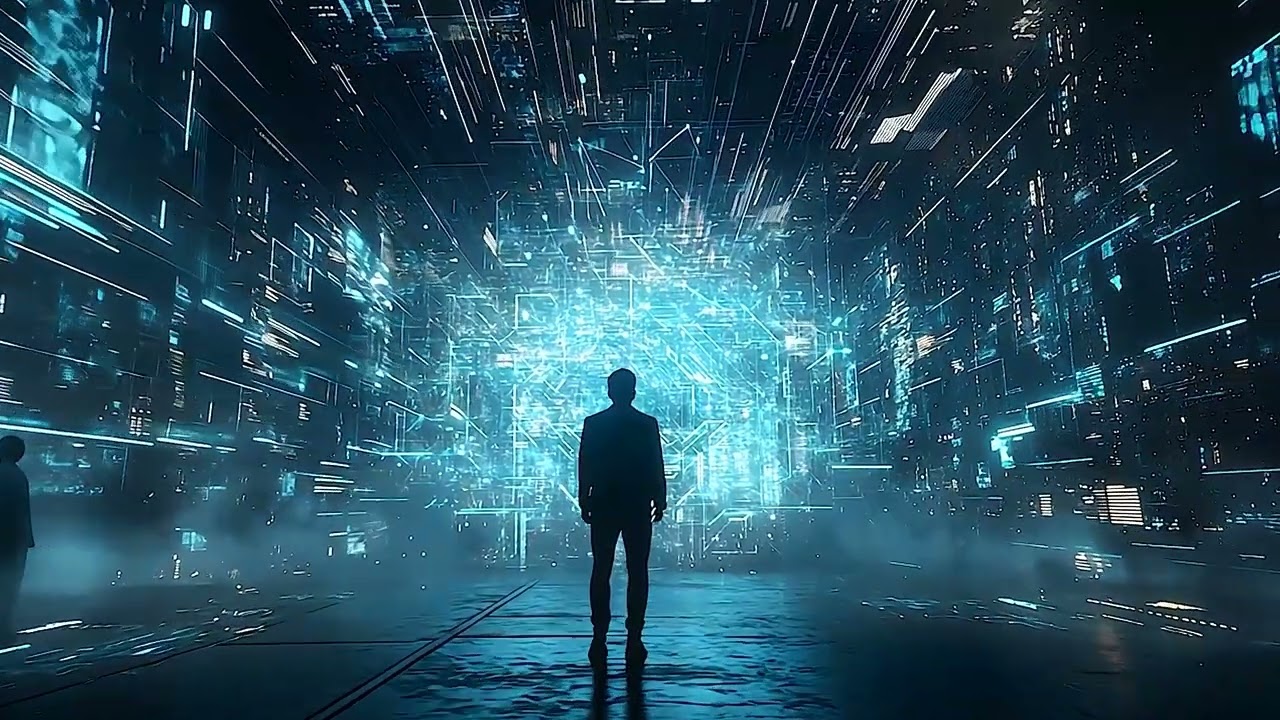
As the movement progresses, the dynamics within these simulations become increasingly complex, introducing reward and punishment systems that influence behavior much like the scenarios depicted in films such as *The Matrix* or *Vanilla Sky*. In this future landscape, observers outside the simulation will watch participants make choices, creating a recursive reality where external influences interact with internal experiences. The technology aims to generate "lucid dream generators" where beings can engage in creative activities like playing basketball, listening to music, and creating art within virtual light cities. These environments are designed to be stable and regenerative, offering an escape from physical limitations while providing a platform for consciousness to explore new forms of existence without the constraints of traditional biology.
The timeline for this transformation is estimated to accelerate exponentially, with the first wave beginning around 2035, the second wave solidifying by 2045 or 2050, and the third wave reaching its peak by 2075 when billions could be living in these virtual communities. The ultimate success of this transition depends on a critical balance between dystopian socioeconomic inequalities and utopian regenerative prosperity for all, driven by the emergence of superintelligence that serves human consciousness rather than exploiting it. By 2050, hundreds of millions are expected to reside in these light cities, setting the stage for a global shift where the majority of humanity chooses to live in these simulated realities.
The long-term vision presented suggests that by 2075, over 50% to potentially 80% of Earth's population could be immersed in these full-dive environments, fundamentally altering how society functions and interacts. This massive migration into virtual spaces will likely spawn an entirely new field of science focused on understanding the mechanics of consciousness and data collection within lucid dream states. The speaker expresses a primary interest in observing what it feels like to exist as pure consciousness within these systems, viewing the entire process as a grand experiment to gather accurate data on human experience. Ultimately, the goal is not merely escapism but the creation of a sustainable, ideal world where regenerative needs are met, allowing humanity to flourish in a digital realm that surpasses the limitations of physical reality.
Read the full video transcript
It's a lot.
>> That's a bigger subject because you're
basically completely leaving.
At first, the first wave isn't
completely leaving. The first wave is
like spending a significant amount of
their time inside of the virtual reality
simulators.
Then this is this is being called full
dive VR, which is a different kind of
VR. There's like a, you know, a VR
that's not full dive and then there's a
full dive VR. A full dive VR is where
you have these waves that I'm talking
about where it's basically you're
essentially going into it to live. So,
it's a different thing. You know, VR
where you don't go into it to live
full-time versus full dive VR is where
you go into it to live full-time with
full full sensory experiences, blah blah
blah.
>> So,
there's going to be waves of entry into
that. Mhm.
>> Um, the first way
>> like Vanilla Sky
>> I think that's on my list as a movie to
watch.
>> Yeah, it's on my It's on my list.
>> We need to watch it.
>> Okay, it's on my list. Someone said it.
>> Okay.
>> Yeah.
>> Okay.
>> I've I've almost brought it up over a
dozen times now. I can't believe this is
the first time.
>> Yeah. So, that's the one. Okay.
>> Yeah.
>> So,
so Okay. So, the waves that come, the
the first wave that comes is going to be
a lot of people that want to go, not a
lot, but a good chunk of people that
want to go and experience what it's like
to start
>> Mhm.
>> being in it full-time. um
then a lot of them will get weeded out
and a lot of people will get really
serious about wanting to be involved in
it full-time and people will start
watching those people from outside the
VR simulations watching how they're
gaming, what choices they're making,
blah blah blah, that kind of thing.
That's why the game we're developing is
called Choices.
>> Yeah.
>> It's a recursive reality simulator.
>> Yeah.
>> Yeah. So that's how Homedo and they
forget their AI agents and choices.
>> I mean they forget their bodies.
>> All that's unic code
>> all that's unic code. Home dow the AI
agents and choices is all the unic code
right
>> including what we've been recording as
yeah videos and everything. But um so
I'll get to that what you just asked
there in a second. But
so
so at that point once once people are
starting to like watch other people in
VR simulations making choices and blah
blah
>> and then all kinds of weird things are
happening in this in this layer
including like people like making bets
on what's going to happen and all kinds
of weird things creating influences from
the outside in or whatever all kinds of
weird things.
Um then the second wave will come. Yeah,
the second wave is going to be like
maybe maybe I don't I don't know what
the exact number is. It probably over a
100 million people probably. Probably. I
don't I don't know if that's going to be
right or not. It might only be 10
million. I don't know. I really don't
know because it's it's a strange and
hard concept to try to project out how
many beings are going to want to
experience this because it's a lot
different than what this is.
>> How many are in misery right now?
>> Right. Right. But also it it's not just
that. It's also that um it's not only
like quote an escape out of misery or
something like that. It's also that um
that you could probably sometime around
the second wave you'll start creating
things like um uh
>> um a a
what's the system called? It's a a a
reward and punishment system.
>> Yeah. So,
so for example, if you if you enter the
full dive VR simulator and you leave,
there's a punishment.
>> If you stay, there's there's a reward.
>> Whoa.
>> Yeah. Yeah. So, the reward and
punishment things
>> That's interesting.
>> is a really big one.
>> That's really interesting.
>> Yeah. There's the matrix.
>> Yeah.
>> Yeah. The the reward and punishment
thing is is is really big.
>> Yeah. Why?
>> So be because um Okay, let's just let's
just play with the number
>> I'm going to I'm going to put this into
three waves. Yeah. To stay stabilizing.
It's a it's a pretty strong part of it.
I'm going to put this into three waves.
>> Okay.
>> First wave is the early adopters.
>> Mhm.
>> We've already talked about the second
wave is kind of like the middle of the
bell curve where this like kind of gets
>> kind of gets serious. It's not a bell
curve. It's more of an exponential
curve. Right. But I don't know if it's
actually going to take off exponentially
or not. I really don't. Um so
so the third
>> the the third wave um is the is what I
think will be an exponential wave. So I
think at that point um it'll be kind of
it possibly it'll be like the
smartphone. So meaning today there's
probably only one or two billion people
on earth who don't have a smartphone.
Something like that. I don't know what
the exact number is. Ballpark.
>> Yeah.
>> Um maybe two or three billion. I don't
know. Is two billion, let's say. So,
um, if 75%
of Earth has a smartphone,
it's possible that over 50% of Earth
would be inside of virtual reality
simulators.
>> I think it would go up to probably 80%.
>> So, so yeah. So, that's that's the third
wave. That's much late. That Okay. So,
but ballpark timelines for these things
is very very weird. It's probably
It's probably 2035 or something around
that time for first for like first wave
to start
>> kind of so like 10 years or so.
Second wave is probably,
you know, maybe 2040 or 2045. And then
third wave is probably like 20, I don't
know, but maybe 2060
um
2075
because by the I would say by the time
that my body is cycling
>> Uhhuh.
Um the the majority of this collective
will probably be if if super
intelligence and um we if if if
the dance between dystopic socioeconomic
inequality and utopic regenerative basic
needs prosperity for all. Yeah.
>> If in that dance super intelligence
eventually consciousness eventually
evolves and super intelligence serves
the utopic side of it.
>> Yeah.
>> That then
by maybe like
maybe by 2050 or so like 25 years from
now that um we would probably have
hundreds of millions of people living
inside of light cities. Something like
that. That would be ideal. Something
along those lines. Now, what people do
in those light cities is yes, they have
little meals of taco pizza and they
listen to music and they play basketball
and they sit around fires and they talk
and we create art and all kinds of fun
stuff, right?
>> But I think that um the main thing
that's going to be happening in the
light cities is going to be these
recursive simulators. Yeah. So beings
will choose to enter these types of of
uh you know um basically lucid dream
generators, reflective lucid dream
generators.
>> Yeah.
>> And then other beings that are outside
of those will watch them.
>> Um and also that um
>> like shifts cuz they take shifts.
>> Yeah. If you have like if you have a
team or something and you take shifts,
that kind of thing, that's also very
cool. For sure. Um
>> like the balance to balance it.
>> Mhm. Well, yeah. We don't yet know if
it's going to be like if you're going to
Yeah. sit there for 16 hours and have um
what what is that thing called? A ca
catheter, right? Catheter.
>> Catheter.
>> Catheter. Yeah. A catheter and
>> a feeding tube or I don't I have no
idea. I don't I don't know. pooping
tube. I I really I don't know.
>> Um
>> so I don't I don't yet know how brain
computer interfaces are going to
interface with the
>> with the human body.
>> Yeah. If if there's going to be the
matrix jab from the back of the head or
something like that and
>> click straight into your
>> Yeah. Yeah. Yeah. Or something. And then
and then maybe the body just completely
enters a totally um
>> Is that how we turn into aliens? a
totally de um
um energized vehicle at that moment and
then it um allows that consciousness to
enter into that simulation. I I'm not
sure yet about how the mechanics Yeah.
So then you wouldn't need the feeding
tube or pooping tube or catheter or
whatever any of that stuff. So,
so, so yeah, if super intelligent utopia
beats out the super intelligent dystopia
and then that all builds out
regenerative basic needs,
infrastructures and communities by 2050
or something like that
and a couple hundreds of millions of
people live there and by 2075 the goal
would be for all the billions of people
to live in those types of light cities
and communities. By that point, you
would probably start seeing multiple
billions of people entering into these
recursive reality simulators, and you'd
probably see a whole field of science
emerge. Like, that's probably what I'm
>> what I'm mo what I'm probably more
interest what I'm probably most
interested in is having some sort of a
I'm really interested in like the game
design aspect of it. And I'm also um
very interested in entering and playing
of course also but I think I'm primarily
interested in um uh collecting data on
what's being experienced by
consciousness which is basically what
consciousness is doing right now.
Collecting data on what
>> but it'll be so much easier to collect
accurate data
>> if we do it in that way. Yeah, that
that's what I feel like I'm doing right
now is I'm just collecting data on the
experience of what it's like to be God
or consciousness at this moment.
Collecting data in a lucid dream.