Video summary
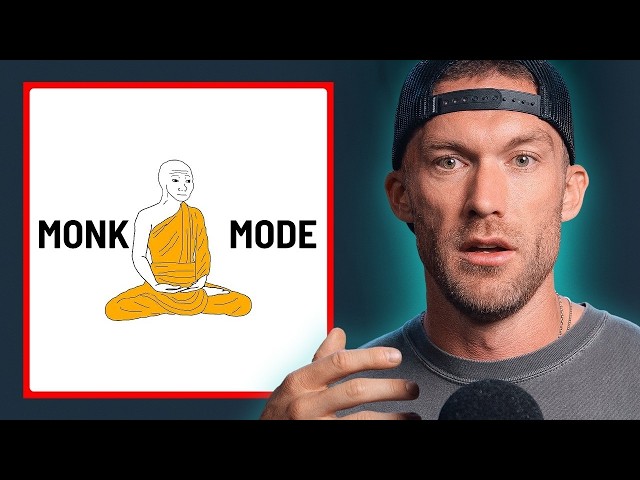
The concept of "Monk Mode," a self-improvement strategy gaining significant traction since 2014, encourages men to retreat from social obligations and daily distractions to focus on introspection, isolation, and personal improvement. Originating from the Illimitable Man blog, this approach advocates for minimizing junk activities to calibrate one's direction and confront weaknesses before formulating a plan of action. Proponents view it as a serious commitment that can become an addictive lifestyle once fully engaged, offering benefits such as fine-tuned focus and increased social market value through dedicated periods away from the world. The speaker acknowledges their own extensive experience with this method, citing credentials including 2,000 days without alcohol since 2017, over 500 caffeine-free days, thousands of meditation sessions, years of gratitude journaling, hundreds of yoga practices, and specific back rehabilitation routines using Stu McGill's exercises. Despite these impressive achievements made largely in a bedroom setting, the speaker argues that while Monk Mode has facilitated major progress, its reliability creates a significant problem: it justifies retreating from risk-taking and adventure by repackaging isolation as noble self-development. This dynamic can make reintegration into society difficult, particularly for individuals who already lean toward introversion or sheltered routines, potentially causing them to abscond further away from building essential real-life support networks. A critical flaw identified is that the extreme practice of private improvement often results in a failure to perform effectively in public. The speaker illustrates this with an anecdote about a friend preparing for a bodybuilding competition who adopted militant routines and rejected social invitations; after the event, he struggled to return to normalcy because his isolation had become permanent rather than temporary. This phenomenon aligns with Bill Perkins' observation that delayed gratification taken to extremes results in no gratification at all. When private practice becomes obsessive, it can consume an individual's life, preventing them from reintegrating into the world they sought to improve for—specifically to function better as a business professional, career mover, friend maker, and partner finder. To mitigate these risks, the speaker proposes that Monk Mode should be periodized with strict deadlines rather than pursued indefinitely. A duration of three to six months is suggested as an ideal sweet spot, though beginners might require longer while more developed individuals could manage shorter stints. The core issue lies in how isolation exaggerates existing predispositions toward unsocial living instead of correcting imbalances; therefore, the ultimate goal must be integration—the "fourth eye"—which involves bringing lessons learned in solitude back into public life to function effectively. The discussion concludes by noting that while Monk Mode is a powerful tool for growth, mainstream content often fails to address the challenge of reintegration because it lacks commercial appeal compared to extolling its virtues. The speaker emphasizes that personal development strategies should not become obstacles to living a full life but rather foundations for better public performance. By setting clear end dates and maintaining an awareness of the danger of becoming addicted to isolation, individuals can harness the benefits of Monk Mode without losing their connection to society, ensuring they remain capable of showing up in the world as improved versions of themselves ready for real-world engagement.
Read the full video transcript
I've been thinking about the dark side
of monk mode. So, monk mode has grown to
huge popularity over the last few years
as a self-improvement strategy,
especially for men. Maybe on the
internet you have seen these videos
about monk mode, retreating from the
world to focus on the three eyes of
introspection and isolation and
improvement. And
it's been talked about since 2014. Was
the first time I read of it? On the
Illimitable Man
blog. He says monk mode is a temporary
form of men going their own way by
cutting yourself off from the rest of
the world for a while so that you can
fine-tune your focus, and calibrate your
direction, and confront yourself. You
acknowledge your weaknesses, and then
you formulate a plan of action to deal
with them. So, the focus is on
minimizing your time contribution to
social obligations and junk activities
because these consume so much of your
time while yielding little to negligible
increases towards your social market
value, right? Monk mode is a serious
commitment that shouldn't be half-assed.
You're either doing it or not. And it'll
be a struggle in the beginning, but once
you've fully engaged it, it becomes a
beneficial, productive, and dare I say
even addictive lifestyle. So, that's
from the original blog post in 2014. And
look,
for all that I can criticize it, I've
gone full monk mode tons of times
throughout my life with really great
success. All of 2017, all of 2018,
mid-2019,
basically straight through COVID until
2021 when I moved out to America. I've
cut out alcohol for 2,000 days in the
last 8 years. I've done 500 days without
caffeine, over 2,000 sessions of
meditation, 5 years of daily gratitude
journals, over 300 sessions of yin yoga,
500 hours of Stu McGill's big three to
try and rehab my back. This just sounds
like the recipe for a very autistic
breakfast, I'm aware. But this is all
done as well in a bedroom in Newcastle
upon Tyne in the UK, sat on my own,
usually first thing in the morning.
Okay?
I've done the monk mode thing, right?
That That's my Those are my credentials.
And almost all of the most important
progress that I ever made was
facilitated by a concentrated period
like this.
However,
monk mode's reliable effectiveness,
especially for men, especially for men
that are prone to a bit of introspection
and isolation,
creates a huge problem.
And the dark side is the final two words
from that blog post that I read,
addictive lifestyle.
The problem is monk mode justifies a
retreat from your life,
a retreat from risk-taking and
adventure, and repackages it as
self-development.
It makes you feel noble in isolation,
but it does that so effectively
that it can become hard to bring
yourself back out. And that means if you
already have a tendency to live a
sheltered, routinized, unsocial life,
you are encouraging yourself to sort of
abscond further away
from ever building a real life support
network, which is actually the thing
that you need most in the long run.
Right? The reason that you're doing all
of this work, the isolation, the
introspection, the improvement, is to
reintegrate to society and be effective,
but it's so addicting that a lot of the
time people who do monk mode
just never reintegrate. And I saw this
with a friend like 15 years ago who was
competing to go into a bodybuilding
competition. He already was introverted
and socially shy, and then his upcoming
fitness competition justified 8:00 p.m.
bedtimes and militant routines and
rejecting all social invites,
and the competition came and went,
but the routine didn't change. And it
took years for him to re-venture out
into
some sense of normality.
This is largely a personal reflection,
too, right? The
allure of perpetually working on
yourself
is very high. And improvement is
rewarding.
But if you're not careful, you can spend
the rest of your life focused on
isolation, introspection, and
improvement
at the expense of the actual reason that
you did monk mode in the first place,
which is to be able to show up in the
world in a better way.
Bill Perkins says delayed gratification
in the extreme results in no
gratification.
With monk mode, you practice in private
so that you can perform in public.
But private practice in the extreme
results in no public performance.
So basically, don't obsess for too long
in solitude for personal growth,
or you'll struggle to reintegrate. And
the solution is,
I think, periodize.
Set a deadline for your monk mode to
end. 3 to 6 months is a really good
sweet spot, in my experience. You can do
longer if you've never done it before.
You can do shorter if you're sort of
more developed on your journey. But
yeah, man, I
I really [ __ ] earned my stripes,
right? Doing the isolation, the
introspection, and the improvement.
I
the more that I did it, the harder it
was to integrate,
which I guess is the fourth eye.
Isolation, improvement,
uh uh introspection, but then the fourth
one, which is the one that you're
actually here, is integration. Like, how
do I bring what I've learned in private
back across into the public? I am trying
to make myself a better person so that I
can
function more effectively in the world,
be more successful in my business, move
along in my career, make better friends,
find a partner that I love. You know,
just function in the world in a better
way, but
it does repackage
isolation as nobility.
And again, if you've got that
predisposition, if you're the sort of
person who tends to spend time on their
own already,
this is going to push you in a direction
that you're already moving in. It's
going to exaggerate your predispositions
as opposed to correcting the imbalances.
And uh yeah, look, I love monk mode. I
think it's great. Just no one that's
either done a video on it or tried to
create a [ __ ] course on it
has talked about the challenge of
reintegration publicly because it's way
less sexy. Everybody will want to extol
the virtues of why it's great, and it
is.
Given that I'm basically trying to
uh dispel comforting myths about
commonly held personal development
strategies. I've learned from over a
thousand podcast episodes that the
easier you make your health routine, the
more consistent you'll be. It's like
golf, right? You want to keep it simple
and not mix a bunch of pills. You want
the eye of the tiger, not the
DUI of the tiger. That's why I'm such a
huge fan of AG1. One scoop contains 75
vitamins, minerals, probiotics, and
whole food source ingredients in a
single daily drink. And now they've
taken it a step further with AG1 next
gen backed by four clinical trials. And
in those trials, it was shown to fill
common nutrient gaps, improve key
nutrient levels in just 3 months, and
increase healthy gut bacteria by 10
times even in people who already eat
well. Gone are the days of needing to
buy a lot of pills in the gym parking
lot from some juice bro in a Cybertruck.
But if you're unsure about it, AG1's got
a 90-day money-back guarantee, so you
can try it every single day for 3
months. And if you do not like it, they
will give you your money back. Right
now, you can get a free AG1 welcome kit
that includes a bottle of D3K2, an AG1
flavor sampler, and that 90-day
money-back guarantee by going to the
link in the description below heading to
drinkag1.com/modernwisdom.
[music]
Congratulations, you made it to the end
of the clip, and the full-length episode
is available
right here.
Go on.