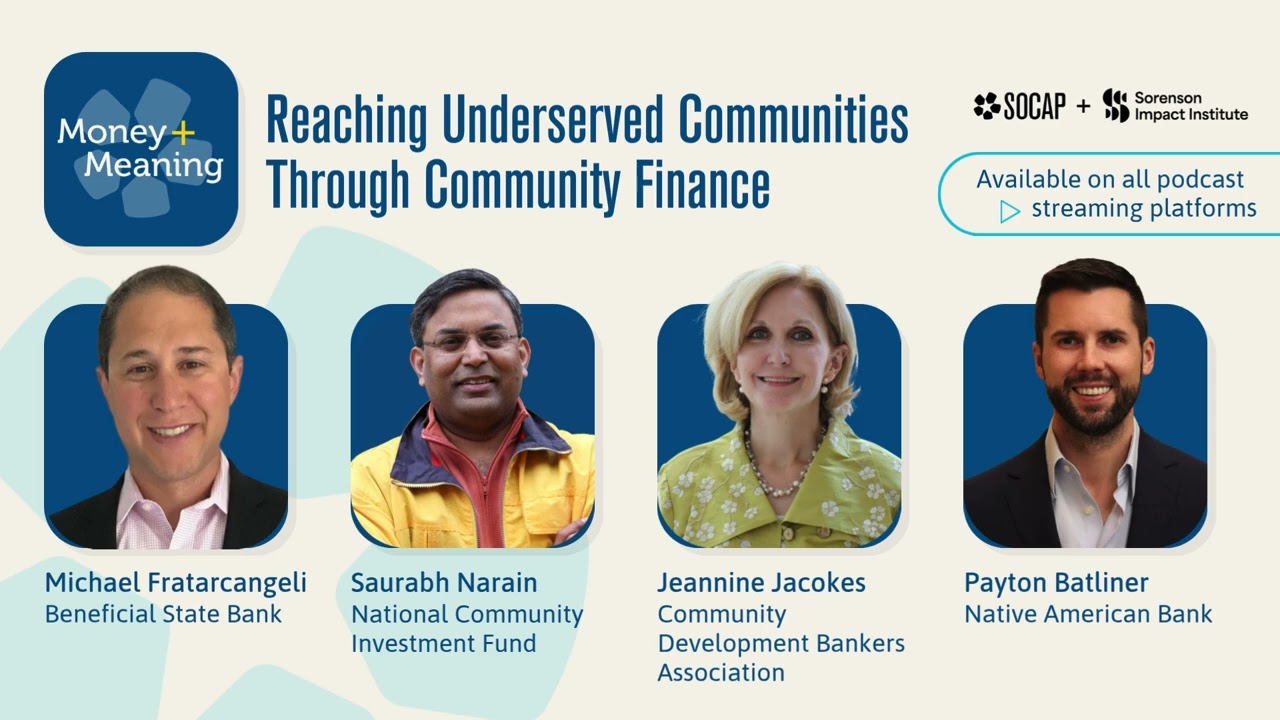
Money + Meaning — Reaching Underserved Communities Through Community Finance
Watch on YouTubeVideo summary
The Emergency Capital Investment Program (ESIP), a $9 billion initiative under the U.S. Department of the Treasury's Economic Stimulus Act, is transforming Community Development Financial Institutions (CDFIs) by providing long-term growth capital at favorable terms, such as a 2% dividend rate. This funding has enabled banks like Native American Bank and Beneficial State Bank to significantly expand their asset sizes and finance large-scale projects in underserved areas that were previously unfeasible due to capital constraints. Through this support, these institutions are now able to fund critical infrastructure, affordable housing, and healthcare facilities while leveraging tools like New Market Tax Credits for deals within tribal communities, effectively breaking down barriers that once limited their operational reach.
Despite these transformative gains, the panelists highlight ongoing challenges, particularly in securing sufficient long-term, low-cost deposits from non-profits and individuals to safely leverage new capital within regulatory limits. Success in sustaining impact without relying solely on federal subsidies requires institutions to evolve their business models by potentially increasing risk tolerance or finding alternative funding sources. Furthermore, there is a pressing need to improve public understanding of safety mechanisms like the CEDARS insurance system, which allows deposits up to $250,000 or more to be fully FDIC-insured through reciprocal exchanges among thousands of banks, thereby addressing misconceptions about lending safety in low-income and tribal communities where default rates are actually minimal.
To effectively reach underserved populations, these financial institutions employ strategies that go beyond traditional competition, fostering organic partnerships and industry networks where they refer deals to one another rather than fighting for the same customers. Banks actively avoid redlining non-native groups and partner with local CDFIs and regional lenders when a project falls outside their specific credit parameters, allowing them to handle massive transactions like $40 million deals that developers often underestimate. Customer acquisition is driven by embedded community sales teams and transparent marketing that highlights mission alignment, such as Native American Bank's portfolio being 95% invested in tribal nations, while tools like deposit calculators help illustrate exactly how funds are deployed to support local growth.
Ultimately, the episode underscores that while bipartisan support for CDFIs remains strong despite political shifts, the sector must continue to innovate to maintain its momentum and educate the public on available impact investment opportunities. By combining robust capital access with collaborative networks and transparent communication about their safety and mission, these institutions are proving that they can safely serve high-impact communities. The path forward involves not just securing more deposits but also building better infrastructure, such as online banking capabilities, to increase participation and ensure that the vital work of community finance continues to thrive in an evolving economic landscape.
Read the full video transcript
Welcome to Money and Meaning, a podcast
where we connect with people around the
world who are working to unlock the
power of markets for impact. I'm Amanda
Lee, Vice President of Programming and
Operations at SOCAP Global. This podcast
series is hosted by SOCAP Global and the
Sorenson Impact Institute.
SOCAP Global convenes the largest and
most diverse community in impact through
live and digital experiences that
educate, spark conversation, and inspire
investment in positive impact. We work
under the leadership of the Sorenson
Impact Institute, which helps
organizations achieve their impact
vision. The Institute is proudly housed
at the University of Utah David Eccles
School of Business.
Each episode of Money and Meaning
features stories of amazing people who
are leveraging the power of capital
markets for the betterment of people and
planet in a just and sustainable way.
In this conversation, recorded at SOCAP
25, we explore how targeted investments
in underserved communities are
delivering real, measurable impact, and
what that means for the future of
community finance.
The conversation spotlights the broader
movement to close financial gaps and
create long-term economic opportunity
with the goal of not just celebrating
progress, but of charting a path forward
for deeper, more aligned investment in
community development. Enjoy the
conversation.
First of all, um, you know, sort of
investing in, you know, sort of local
communities is really a very, very
important thing because of, you know,
sort of what it means in terms of the
livelihood of the individuals that are
living in those places. Now, we're going
to be focusing on public-private
partnership, and we're going to be
looking at a very specific program, and
that's called the Emergency Capital
Investment Program. And that's a US
Department of Treasury program. It was a
Recovery Act program that is really
unique because of the fact that it was,
um, you know, imagine in a sort of, you
know, if you We all know how hard
fundraising is. And imagine if, you
know, you know, sort of somebody just
magically said, "Here. Here's all the
capital you need to really have
substantial impact." That never happens,
but it actually did happen, you know,
sort of as through one of the Recovery
Act programs, which is EESA. So, what
we're going to do here is we're going to
talk about that program in terms of what
some of its early results are. And, um,
you know, sort of what the impacts are
on the institutions and what that may
mean in terms of, you know, sort of, you
know, future models for investment. Now,
you know, sort of what I'd like is if we
could have, um, each of our, uh,
panelists sort of just introduce
themselves and their background. We'll
start with Saurabh.
Thank you.
Thank you, Janie.
Uh, and thank you to Sukey for the
invitation for this important panel. My
name is Saurabh Narayan. I'm president
and CEO of, uh, a nonprofit community
development financial institution, CDFI.
Uh, we invest in CDFI banks and minority
banks, and we invest in low-income
communities nationally.
Uh, we've been in the business for 30
years. Uh,
and in banking for 40 years. I don't
know how that works, but
Thank you. Yeah, thank you. I'm Payton
Batliner. I'm the chief lending officer
at Native American Bank. We're
headquartered in Denver, Colorado, but
we got our start up in Montana on the
Blackfeet Reservation back in about
2001.
We just opened a branch up on the
Tulalip Reservation just north of
Seattle about an hour.
Um, so we're expanding and a lot of that
is thanks to EESA and other, you know,
public-private partnerships that we've
leveraged in the past to grow the bank.
So, happy to talk about that more. Thank
you.
Do I have to press anything here?
>> No, no. I think you're good.
>> just speak. Um, hey, everyone. Uh, my
name is Mike Federkanczly. I'm the CFO
over at Beneficial State Bank. We're a
certified B Corp CDFI based out of
Oakland. We were founded by Tom Steyer
and Kat Taylor to change the banking
industry.
My CEO was supposed to be here, but he
flaked as of Friday. So, unfortunately,
you're stuck with me. I'll try my best.
Usually, I'm more behind the scenes.
He's the face of the company, but
excited to share some of the the great
things that we've been doing with ESIP
so far and what we want to do in the
future.
All right, very good. Now, just to level
set because I'm sure, you know, some
people in the room know what the ESIP
program is, but many others probably
don't. So, just by way of background, in
2020, and this was in the midst of, you
know, sort of the kind of the COVID, you
know, sort of crises and, you know, some
of the economic fallout and then sort of
some of the kind of social unrest that
was happening at the same time. Congress
and the Trump administration worked
together to basically create really an
unprecedented which was about a $12
billion
package. And this was really intended to
be, I'll say, anti-recession, but it was
more than that. It was really focused on
trying to provide
long-term investments into CDFIs, which
are community development financial
institutions for those that don't know.
And these are
basically financial institutions. They
can be banks, they can be credit unions,
they can be loan funds, they can be
venture capital funds that are focused
on serving low- and moderate-income
communities. And at least 60% of their
activities has to be focused on that.
Now, the ESIP program was focused on the
the banks and the credit unions, which
are, you know, the depository, the
regulated entities. And so, you know,
this was the act provided, it was $12
billion total, $3 billion went to the
CDFI fund, you know, through some of the
programs over there, but $9 billion went
to ESIP. And ESIP was really intended as
kind of long-term growth capital for
depository CDFI banks and credit unions.
Um, Um, and I'm wondering if Kathy Mann
is here. Is she here? Is she in the Oh,
there she is. Perfect timing. Kathy, um,
CDBA, uh, my organization, uh, was, uh,
one of the leaders in terms of getting
this enacted by Congress and Kathy was
one of my partners in crime in terms of
in terms of getting it done. And she's
from Inclusiv, which is, um, the trade
association for the CDFI credit unions.
So, thank you, Kathy. Perfect entrance.
So, um,
so anyways, what ESOP was really
intended to do was to help these
institutions do even more and really
scale up the level of activities they
were providing in the low-income
communities with a real intent on trying
to unlock access to capital for some of
the hardest-to-serve places or let's
say, you know, the smallest of
businesses or nonprofit organizations or
others that make a real impact but have
a hard time in terms of accessing
capital. So, um, you know, really the,
um,
the value of these this capital to
mission-focused institutions cannot be,
you know, sort of overstated and it's
been very successful to date. Now, most
of the institutions got their money in
2022, so we're still early in the
trajectory and our our two bankers are
going to tell us a little bit about what
this has enabled them to do already.
Um, but just a couple of stats and this
is from the summer of 2022 when most got
their money through December 2023, the
ESOP participants reported total
originations of $58.3
billion.
And, you know, was divided amongst
different kinds of activities, but you
know, the vast majority of them, you
know, are were what they call qualified
or deep impact activities, which are
some of the hardest hardest to, uh, do
activities. So, I guess with that, what
I'd like to do is I'd like our, uh,
bankers, you know, we're going to start
with them in terms of questions. You
know, so first, you know, sort of and
maybe I'll start with Mike and then
we'll go to Peyton. You know, sort of um
how has the ESOP investment opened new
opportunities for your bank and how has
it changed the way your bank approaches
its work? Yeah, um great question. So I
sort of step back and look at it from
our mission.
Uh our mission is to help
uh more people and help people more. Um
so if you think about capital I don't
know if there's a lot of bankers in here
or if they're non-bankers um
and apologies I just got this on Friday
so I've been I mean I have to read off
this a bit. Um but capital in its
simplest uh form is one of the two
critical inputs you need to grow a bank.
The other being liquidity which is
essentially deposits.
Um so we're a $2 billion bank today but
in theory with the additional capital
that we received we could be a $5
billion bank
um based on yeah sort of allowable
capital ratios.
Um so we're not trying to grow for
growth's sake. We're trying to grow
because of impact. But if you just think
of it and do sort of simple math and
say, well, if they're $2 billion today a
billion three of that is loans, you
know, you can grow to $5 billion now all
of a sudden our loan book might be able
to grow to $3 billion, right? And so now
as long as the loans that we're making
are of equal or greater impact than the
loans in existence, then we just made,
you know, a much uh a much bigger
impact. So I can give some examples of
the programs that we've done. Maybe uh
Peyton can just kind of share, you know,
what his uh bank has done and then I can
go back to to some of those examples.
Yeah, and I'll I'll follow your
framework there.
>> [clears throat]
>> Uh when we received ESOP funding about
$37 million back in uh 2022 we're about
a $200 million bank. So an order of
magnitude smaller, right? Um but I mean
it's been transformative. We're now a
$400 million bank. We're capitalized to
the point where we can grow to $800
million kind of organically.
Um so that is a a
impact for what we do out in the native
community.
Um and I think we'll talk about specific
projects that we're funding, but it
really allowed us to punch above our
weight, right, in building community
facilities, critical infrastructure,
financing projects, getting partners
that would never play with us involved,
and that's that expertise piece, right?
Capital's important. You need to have
the minds behind it to actually be
willing to work on these projects. Um so
we have some really innovative projects
that we've done with these dollars that
brought people together and built just
critical infrastructure that communities
need.
And and in terms of the capital, I I
know Janine kind of mentioned the
background on it, but um not only did
they give, they actually all of you
actually came from US taxpayers, so
thank you very much.
Um
Uh not not only did they give
unbelievably favorable terms. Um the the
the essentially the dividend rate we're
paying on this capital is 2%, so
the biggest and best banks in the world
couldn't even get close to getting that.
So it it's it's much appreciated by the
banks that did receive it because
otherwise they generally have a much
harder time raising capital, and if they
do, it's at a much higher rate. Um so
again, that just affords us a better
ability to deliver on those projects.
And to the extent we deliver on the
lending uh that Janine had mentioned, I
mean, we as a CDFI and
a Native American bank as a CDFI and
MDI, sort of by definition are going to
be doing that lending within those
communities, uh but this just allowed us
to enhance it, and to the extent we do
more and more, we're effectively able to
get that dividend rate down even
further, which again is just more
capital for us, which means more
reinvestment there.
Um we have a bunch of different
verticals within our bank. Um
some we're looking to expand further,
and I can talk about a partnership in a
second, uh but one of our core
portfolios that we have is in the auto
lending space. We had actually acquired
a bank about 7 or 8 years ago uh in the
California Central Valley. Um and and so
our focus there is twofold. There's some
really nefarious lenders out there
in terms of how they approach auto
lending. And so we've tried to change
what we do there with our partners and
and and how we treat our customers. But
another program that we've been able to
been able to grow more significantly is
what we call our auto refinance program.
So I can give you some sort of real
world examples there.
That's most of our originations today.
So you may have a customer that
maybe they didn't have the best credit
a year ago to go to an auto loan and it
might have been in the high teens, maybe
mid teens. And as they've improved their
credit and we also have services that
actually help people improve their
credit or at least give financial
counseling.
We can go out there and redo their loan
at something like 8%, right?
So that's a 5% differential. And if you
kind of equate that, you know, math to
let's say on average the the loan size
is about 30,000. That's $30 a month.
That's meaningful for the the types of
communities where we're investing in. So
that's one of the big programs where
we've been able to
while we're already doing it, now we can
go double what we were going to do
before. Again, that's that greater
impact.
The other thing that we have a huge
focus in is in the affordable lending
space or affordable housing space. As
you know, um
the cost of housing keeps going up
across the the country. It's really
really tough for
people at the lower wage scale to be
able to afford stuff. You know, we as an
organization actually just kind of on a
side
have a program where we're paying our
our sort of a lowest
experienced people above market cuz we
believe in in more of that equity. But
nonetheless, not all firms do that and
it just it's tough for people to afford
housing. So in as much as we can support
that affordable housing space.
And it was not only the ESIP that
allowed it to allowed us to do it, but
as a CDFI, at least prior to this
administration, we were eligible for
significant grants
that were great in that we were able to
redeploy those grants to other nonprofit
developers in the affordable housing
space such that, you know, they may get
a reduction off their interest rate or
maybe there's a closing cost credit that
went back. And by doing so, they in some
cases went from not being able to
financially afford a project to being
able to financially afford it. So, in
some cases it's a question of like, can
we actually build that affordable
housing or not? So, that's been a great
program where the ESIP's given us the
capital, but then that's been coupled
with, you know, some of the CDFI
programs. Unfortunately, that's if, you
know, you follow that, that's
that's not in the greatest shape right
now with this administration, but I know
there is bipartisan support for it, and
so I'm hoping that that'll rebound
because
regardless of sort of the color of your
state, like the the congress people have
acknowledged that this makes a huge
difference. It's like almost reinvested
for I think I've heard it, Janine,
what's it? 8:1, 10:1 back in the
community
with that. But, those are two examples
for us.
We also have a focus on climate-related
lending. I would say that's not as
seasoned as our other portfolios, so
we're looking to see how we can deliver
more
on those fronts.
Do you want to give some examples of
what you've been able to do with the
money?
>> So, kind of structurally,
what do banks need? We need capital to
raise our legal lending limit so that we
can finance bigger projects and loan
loss reserves, so if things go wrong,
right? So, ESIP fundamentally did that
for us and allowed us to play in a space
where we could go after projects that
were supported by other public programs
like new market tax credits, if you've
heard of those. Structurally, it's a
pain if you're not 10 million and above
in deal size for those types of of
projects. So, when we applied for ESIP,
it was health care and housing um that
we were primarily targeting. And we
funded a number of health care-related
deals that are 20 million and above for
us, which is amazing, right? Um one
specific deal, which our chief credit
officer 2 years ago won an award from
NAFOA, the Native American Finance
Officers
um convention for the deal of the year,
which was with Lakota Ray or LCO. Um it
was a $44 million health care deal. We
bundled new market tax credits. NABE
provided Native American Bank provided
$20 of source loans into the new market
tax credits uh structure. And then we
also paired that with a USDA guarantee.
So, I mean, we used all of the And we
brought in five CDFIs, four Native and
one non-Native. So,
um
talk about just putting all the pieces
together to solve a critical problem,
which was health care, you know, in an
underserved area, right? So, and we've
done that with Pawnee. Um we've done
that with Pit River. Um we've built
housing with Dry Creek um
Rancheria. And we also rebuilt the
Denver Habitat for Humanity headquarters
with these dollars. So, you know, we
kind of
we do a lot with a little, right? So.
So, very good. What I'm wondering uh
both Peyton and Mike, how has
the uh this program and the receipt of
this money, how has it changed just sort
of the way your bank approaches its
work?
You know, from a you know, how you're
looking at the future and so forth.
Yeah, I mean,
we talked about the scale. Um I think
one of the other things for us that I
think is worth mentioning is how can we
scale um
more effectively? Um so, with this
capital, we're actually able to redo our
entire technology stack. We had one that
um didn't quite meet the needs of the
strategies we're trying to go towards.
So, we did spend the better part of 2024
instead of focusing on growth converting
our entire technology stack. That's
going to enable us to do more, deliver
more
across the spectrum of, you know,
customer or
um
personal consumer customers, larger
commercial customers, and it's already
starting to pay dividends in that
because we've talked about sort of the
the lending that we do, which makes a
difference in the communities. But, even
the deposit taking, even though we're
the ones that are taking in money, you
know, when you're providing the right
financial education,
when you're providing the right services
and advice for the small businesses to
be able to effectively manage cash and
run their business, that's part of the
whole sort of banking ecosystem.
Um and that's one of the ways that's you
know, enabled us to do that. You know,
fortunately we have a
really thoughtful board. You know, for
us they've sort of reaffirmed our
strategy this past July of
um
you've got the new technology.
You've got some critical hires. No more
excuses. Go get that into the community.
So, we're we're we're really pushing to
do that. I will say, you know, one of
the challenges that we would have as
well as them is
at the end of the day we're still a
bank. We're heavily regulated industry.
We have to run our bank in a safe and
sound manner. So, as much as I can sit
there and say we could in theory go from
2 billion to 5 billion. If we went from
2 billion to 5 billion in short order,
you know, we we'd have our regulators
knocking down our door because we have a
fiduciary duty to our depositors and the
FDIC fund, right? You're covered sort of
250,000 or less, but we have a lot of
large large depositors, big nonprofits,
big for-profits
that those deposits aren't insured. So,
if we're not running our bank in a safe
and sound manner and something would
happen, you know, then they're going to
lose you know, their money. So,
obviously that that's first and
foremost. How do we approach it from
also a risk management appetite so that
that comes into play in all the
decisions that we make as an
organization.
>> [clears throat]
>> Yeah, and
we're also updating our tech stack,
which is a process. Yeah.
So, yeah, absolutely. It kind of frees
you up to think about, you know, what
what do our customers need, borrowers
need, depositors need, treasury
management, what services do we need to
provide for for large relationships,
right? Where we we didn't really think
about that before because we were too
small.
So, now we can have those relationships
going forward. And tribes are getting to
be very sophisticated organizations with
complicated business processes. They
need banking partners that can
facilitate, you know, their needs and
what they you know, what their growth
plans, right? Which, you know, Native
American Bank at $200 million can't do
that for a large, you know, casino,
gaming, hospitality, right? Tourism
tribe. So, you know, we want to get
there eventually. So, it's allowed us to
think about that. How do we grow
to make sure we're not only meeting
those critical infrastructure needs for
tribes and their members, but also how
do we bank tribes as, you know,
entities, right? So,
that's absolutely critical. And then the
last thing I'll say is patient capital.
It's allowed us to be patient as we
develop these deals, these new market
deals.
They can take almost 2 years to put
together and put all the pieces
together.
And tribes are governments and they come
with the same administrative complexity
that any other government comes with.
So, patient capital's extremely
important, you know, to have that there
is is critical when we're structuring
these projects at the beginning.
Let me ask one more question. We're
going to go to Saurabh.
You've talked about a lot of the
opportunities and how it's changing your
institutions, but what have been the
challenges? You've had, you know, this
is like, you know, magic fairy gives you
a big bunch of capital and capital has
always been the thing that holds
everybody back. So now you get the
capital. But what are some of the
challenges because you guys got this
these resources at a time when the
economy was not behaving, you know, sort
of in a way that was particularly made
it easy. So I'm wondering if you can you
can speak to that.
>> [snorts]
>> What Yeah.
Whoever wants to go first.
Yeah,
human capital, right?
>> capital is what We had to expand
what we did and how we did it and learn
how to how to finance and structure
these more complicated deals working
with third parties and consultants,
right? These new market tax credit you
get on a closing call and there's 20
lawyers on there, right? From all
different entities. Um so I mean it we
had to grow that capacity internally to
be able to do that. We wanted to lead so
that we could bring in deposits, which
was a key part of this, you know, that
that you have to bring in deposits to
facilitate that growth as well and we
did that by bringing in the construction
deposits, right? And and leading those
projects on the construction management
deposit side and drawdowns. So that was
kind of a a unique way that we kind of
managed that, but as those run off, as
these projects get built out, those
deposits run off our balance sheet. So
we need other partners to come in and
begin banking with us as well. So that's
what we're looking at now. Yeah. Mike.
Yeah, and
I I think the keyword for me is that
it's patient capital, which is
phenomenal. My my CEO likes to say it's
all carrot and no stick. Um we could
literally out and stop doing our
lending, not that we would cuz that's
not who we are, but there there there's
no penalty in doing so. So it really
enabled us to be patient
and get that infrastructure built cuz we
don't want to build build it on a you
know, uh, foundation of sticks. So I
talked to you about the technology, um
um,
uh, piece that we did that enabled us.
We we had made some critical hires, a
chief operating officer, making sure
that we had that foundation in place,
um, before we started layering on. Uh,
this way, as we grow, we knew it was
sound and secure. Um, uh, just from, you
know, what what Payton said, the other
critical piece for us is, uh, deposits,
um, building that liquidity. So, you
know, the way a bank works is, you know,
it's essentially for every dollar of
capital, you know, you can have $10
worth of assets or loans, but you need
the other nine to be filled out with
deposits or or other funding, but you
really want it to be deposits, otherwise
you run into run into some risk issues.
Um, so anyways, it it's given us, uh,
the chance to be patient, um, get
through the things that we needed to get
to, um, but now for us, you know, what
we're trying to step on the gas a little
bit and really, you know, get this money
in into the communities that we have.
Um,
we don't have that same new market, uh,
challenge that, uh, Payton mentioned,
but, um,
we as an organization, um, and who we
stand for as a mission, uh, I I think
about 60% of our customers, um, are 60%
of our deposit balances are from
non-for-profit entities, um, and so
they're facing their own challenges
right now. So, while we do a great job
retaining our customers and keeping them
and continue to grow them, because of
the challenges that they're facing, um,
while they're still staying a customer
of ours, you know, we're seeing some of
their deposits start to run their cash,
I mean, their cash is our deposits start
to run off because, uh, some of the
grants and other sources of funding is
is starting to dry up. So, now we're
thinking sort of strategically, how do
we continue to deliver for those
organizations,
but really expand who else, uh, we can
bank, um, that's still part of, uh, our
our mission, um, uh, universe and and
grow that way.
All right, um,
we're going to go to Sarab and from the
I get his perspective from the impact
investor sort of what this means. But
before I do that, I wanted to note that
we are going to be doing a Q&A and you
have somebody who Han, do you have
somebody who's somebody's going to be
passing out I guess pieces of paper. So
if you want to write down your questions
and they'll bring them up here to us. So
Sarab, you know, Sarab from the
perspective of uh you've worked with
banks for a long time. You know, Sarab
you have an investment portfolio that
includes a series of different mission
focused banks and you've also done deals
yourself on this. Um you know, the ESOP
program has provided a really great
opportunity for you know, the CDFI banks
and credit unions to grow and to scale
and to do more. But they've also some of
the big challenges have been
raising deposits, raising new
investments. And so while they have this
new investment capital that helps them,
the only way they can turn it into
impact is by finding deposits. So you
know, um and that's been really elusive.
You know, many of them have their
organic deposit bases in their
communities, but they need so much more
in order to really totally, you know,
sort of put all of this new capital. So
you know, what should bank CDFI banks be
doing differently or what, you know,
sort of should they do that they haven't
been doing to attract depositors?
Thank you, Janine.
Uh firstly, let's do the numbers again.
$9 billion
as uh was it Mike or Peyton who
mentioned 10x is the leverage, so it
becomes $90 billion.
Times 60% is the certification
requirement is $54 billion.
Times let's call it a turnover of 3
years, so that's whatever it is $162
billion.
That's the amount of new capital that
can be invested in low-income
communities for impact.
The banks are open for business and
they're looking for high impact
you know projects that can deliver the
impact that they're seeking and I'll
come back to the deposit question
because that's related.
To be able to get to that 162 billion
dollars that I just talked about, we
need to raise those deposits.
And those deposits either come through
construction
related deposits that come in through
normal non-profit
customers or through you and I. This is
a room of impact investors. We need to
make sure that every cent of our deposit
goes into CDFI minority banks.
And that will only help
you know them grow and grow scale for
creating the impact that we're all
seeking.
So then you know the question becomes
what is the rate and what is the term of
these deposits?
And I often say that
a deposit is not useful to the
institution if it is not one of these
three things if not all three.
It's long-term.
So if you give me three months deposits,
it's okay but it's not okay. You give us
five year deposits and Mike's going to
love you and Payton's going to love you.
It's got to be lower rate.
And it's sometimes got to be uninsured
but you know that's a different uh
kettle of fish that you know different
people can think about.
So what banks need to do is to
demonstrate that this money is being put
to good use.
And both Beneficial and Native American
Bank have done a tremendous job of
talking about where the money is going
to be put to use so the impact. Now the
impact is an elusive question you know
we all talk about impact. Impact is
different for different people.
You know, somebody wants job creation,
somebody wants housing, somebody wants,
you know,
affordable housing.
So, different kinds of measures of
impact are there. Now, what banks need
to do and are doing a very good job of
just now,
some of the work that you're doing, some
of the work that we are doing, is to
sort of segment our customers to meet
their impact needs.
So, somebody wants job creation in
San Jose, California, well, we can
create a bucket which sort of meets that
need or Oakland in California or in in
Alaska, you know, you just opened a
branch in Alaska, yes.
So, we need to be able to segment the
impact creation. As well as I think in a
certain sense, we need to be close to
market, you know, we've got a pretty low
cost of funds, lowest to cost of
capital. So, we can be pretty
competitive,
you know, in terms of the rate that we
offer. So, we have a surplus deposit
that we place with our banks and we are
able to get a pretty pretty good
interest rate from our institutions. So,
I think the banks need to sort of step
up. This is a moment of strength
where we can take on a very large
position with these institutions, but we
can open up behave lot more, you know,
market friendly manner as well.
All right, well, let me ask you another
question, a follow-up, you know, sort of
what you have said. Now, you know, sort
of we have this program and you know,
sort of it's a it started in 2022.
Treasury, the US Treasury Department,
which is the owner of these securities,
they have a 10-year hold. So, you know,
sort of we're still sort of young in the
program. We've already had some pretty
impressive results.
Just to give you a sense of scale, there
were 93 banks that were selected to
participate in the ESI program and about
83 credit unions
that were selected. Um, so
how do you think this program sort of
will impact how investors see this group
of institutions in the future and you
know, what will they want to see from
the performance of these institutions so
that when we get to the end of that 10
years um, you know, sort of they'll be,
you know, even more interest, you know,
sort of in this in this group of social
enterprises, I will call them.
So, we are an impact investor in a CDFI.
Our portfolio has about 15 16 banks. We
know another 100 banks around the
country.
Uh, we've done some work in our past
life in credit union world.
Uh,
part of billion dollars of the 9 billion
dollars sits in our banks in our
portfolio.
We are really excited by this thing.
We're excited not only from the impact
perspective, I talked about the impact
aspect of it, but also from the
valuation perspective.
Uh,
if you think about it,
if you get again, I'll do the math on it
and do it quickly.
Uh, 2% capital times 10, so that's the
cost of capital is 0.2%.
If you're earning a margin of 3% just
now, that margin is suddenly gone up to
5%, 4 and 1/2 5%. So, as an investor,
I am very excited because all our
institutions will get valued at much
higher multiples than uh, they have ever
been in the past. This is a single
largest gift in the context of the title
of this panel, this is single largest, I
call it a gift, partnership between the
public sector and the private sector for
the purpose of creating impact and I
think these guys are doing a fantastic
job in that answer.
All right, very good. Um, now getting to
one of the points that Mike, you know,
sort of alluded to earlier in his
remarks.
Um, You know, the economic fallout is
what created, you know, sort of the
atmosphere that this program was the
economic fallout from COVID as well as
some of the other, you know, I'll say
social unrest, you know, sort of, you
know, after the death of George Floyd as
well as just the concerns about, you
know, stabilizing the economy is what
led to the creation of it. You know, and
this was at that time it was the
Congress and it was the Trump
administration. So, now here we are fast
forward a number of years later. We have
a new Trump administration. And despite
the partnership that there was during
the first administration to create this
program, the last 9 months have marked a
really dramatic change in a sort of in
terms of the, you know, sort of the
position of the administration towards,
you know, sort of this industry. So, how
has the changes in the political
environment, you know, sort of affected
your institutions and how do you think
CDFIs should pivot in the current
environment? And that second one's for
you, too,
Sarab. So, Mike, do you want to go
ahead?
Yeah, yeah, I mean, I go back to our
vision.
Help more people and help people more.
That's sacrosanct. We're not going to
abandon that.
But it doesn't mean there
there won't be changes in terms of how
we approach things, right? So, I
mentioned affordable housing lending. I
mentioned some partnership with CDFI
that enabled us to do some loans that
maybe we otherwise couldn't do. So,
we're still going to make loans, but now
maybe we have to do it a little bit more
on market terms
because we don't have that subsidy to
help it out. So, we're in
we're looking at alternative sources of
grant-type funding to help facilitate
that, but we're also saying, you know,
we as an organization need to stand up
without that
and maybe deliver it in in different
ways. So, Sarab talked about sort of
low-cost deposits. That's been
you know, sort of a bread and butter for
us
and again it unlike maybe you know your
traditional community banks
you know we're not just trying to drop
that to the bottom line. We do want to
show that as a bank we can
be profitable like other community banks
not for the sake of just making money
but again I go back to why our founders
found this bank in the first place was
just to show that a bank can do good and
still be profitable and if that
holds then you makes the other banks
start to emulate it in terms of the
practices
that are out there for us.
So it it has created challenges for us
when we're trying to figure out the best
way to battle through it
but as long as we keep our North Star
around a mission
there may be some changes to it but you
know we're still driving towards that in
sort of every decision that we make.
Payton Yeah.
>> [clears throat]
>> For those that don't know a couple weeks
ago
the CDFI fund employees those are the
federal staff that run the CDFI fund
received a letter saying that they might
be riffed by December 16th.
>> Meaning meaning terminated.
>> Yeah yeah reduction in force. So public
private partnership if we don't have the
public component to partner with right
there's not that private development and
that private capital that Michael
alluded to which is a one to eight right
$1 of CDFI fund dollars managed by those
critical staff right comes out into our
communities there's 64 native CDFIs. How
many other CDFIs are there 14? Oh
there's 1400.
>> Yeah 1400-ish.
That one to eight right so $8 of private
capital flows into that model.
That goes away if you don't have staff
on the other side to actually assist us
in running these critical programs. So
Yeah and the ironic thing about this is
that the CDFI still have really strong
bipartisan support even though the Trump
administration proposed zeroing out the
programs in the new year,
the House Republicans actually put the
money right back in again. Now, the
Senate hasn't acted yet, but you know,
sort of this is just sort of showing
some of the chaos that we're dealing
with right now where the administration
is saying we don't like this, the
Congress is saying we do like this, and
not just the Congress, but it includes
the Republicans, too. So.
>> Right. Yeah, absolutely. I mean, wide
bipartisan, you know, support for that.
Um
Like
along with, you know, administrative
turmoil is the government shutdown,
right?
We're right now waiting to close on four
deals, $26 million,
right? They're just sitting there. We
have approvals in hand. We just need the
staff on the other side, right? So that
we can close. So, literally sitting on
our hands, sitting on capital. We have
another one like that that's slated to
close in December, a big affordable
housing deal that from what I'm hearing
now, because of it, it may not actually
push to next year. So, you know, every
delay you have is is one less month or
two less months of, you know, someone
being able to be in a home. So, it it is
real and tangible for people.
So, good. Your thoughts? And how we
should behave differently?
Uh
Well, not necessarily how we should
behave differently, but you know,
[laughter] sort of
you know, sort of just in terms of, you
know, kind of the pivot. How do How do
we How do we manage this environment?
Well, before I go there, I want to say
thank you to Janine and Kathy for the
easy program. I mean, I think these guys
were the architects of putting that
program together. A lot of money that's
coming, and I really appreciate that.
Thank you.
>> [applause]
>> It's under recognized, and that's why I
said it's important to sort of say it.
Uh
>> [clears throat]
>> So, you know, as an impact investor,
uh you know, firstly, I will just
continue to sort of talk about the
business model a little bit more. You
know, I often call myself a tough love
kind of a guy. You know, we need to
evolve our business models such that we
do a lot more things as big guys and
gals.
You know, larger loans, larger deposits,
larger sort of, you know, oomph factor.
Uh
And I think
whether it's the Republicans or the
Democrats, they all want success in the
local market.
And you know,
Mike and Payton are right. Without some
of the CDFI fund subsidies, some of the
harder to do deals will not be possible.
But this is a moment in time where we
have received really low-cost capital.
And we can invest
for long-term growth. So, we need to
step up and you know, demonstrate to the
politicians who are, you know, uh
who as as Janine rightly pointed out,
who provide bipartisan support to the
sector and strengthen their arms.
And strengthen the arms such that they
will continue to provide long-term this
thing. So, as examples, you know, if
there is a tough deal where there's
affordable housing or a nonprofit
facility
and it requires some subsidy, can we
step up either, you know, take a higher
level of risk, can we find other
philanthropic partners, can we find, you
know, other local city and state
government money to make those deals
happen and demonstrate that, you know,
these institutions uh can can get to the
next level of of scale. Uh
these are very difficult times.
Um
but this is a moment in time where we
can evolve.
All right. I think we're going to open
it up for questions. Does anybody have a
little a a with a question on it they
wanted to uh
bring forth or if you just want to stand
up and ask your question, that's fine.
Yes, Steve. How well overall are these
loans or
the program itself
in terms of
people paying them back?
>> [clears throat]
>> Are they rated default?
So, there's no issue or argument if
they're performing anything.
Uh well, to keep the program going,
like, what's the
collateral Yeah. Yeah, that that it's a
great question and one I get asked a
lot, you know, what is what is it like
lending to tribal communities?
When we're lending to a tribal
government or tribal tribal program, the
default rate is zero. They're not going
to let their
health care facility go
bank, right? Their tribal administrative
complex, that's generally what we see.
So, extremely low default rates. Um
tribes can set their own codes, they're
monopolies, they're sovereign entities.
When we're lending to a tribal utility,
they're a monopoly that can set their
own rates, right? So, they're I think
it's kind of a a good thing and a bad
thing that banks don't know, you know,
how stable lending to tribes is is that
I don't have to compete as much with
them, right? Um the other ones that that
don't want to learn about this. Um so,
yeah, I mean it's it's been pretty
amazing. Yeah.
I I I can tell you that
>> [clears throat]
>> in our portfolio
uh
the non-performing loan rates,
the loss rates
are minimal,
consistent with what Payton just said,
minimal. And outperform the peers in the
market.
This is a very strong story. It's a
story of CDFI banks, minority banks,
credit unions operating in the toughest
markets
and having the best quality of assets.
And, you know, it's it's the you know,
the world of
investor community who don't think
beyond the next 15 minutes in that
sense, will often say, "Oh, working in
low-income communities is very risky."
No.
There's experience sitting here of the
last, you know, 30 years even as a CDFI,
which demonstrates it's not as risky.
The difference between perceived and
actual risk is very small.
All right, very good. Uh the other
question we got is um what is your
recommendation on how to access ESIP
loans? Uh we're a nonprofit providing
affordable housing for disadvantaged
populations like those who are formerly
unhoused or incarcerated.
Our bankers, how do you find out how how
do you find out how to access
>> please. I'll I'll connect you with our
lending team. Um uh so, in all
seriousness, um
uh you know, we do affordable housing up
and down the West Coast. We're in
Oregon, Washington, and California. But,
I think for something even like that, we
would consider um you know, going
outside of our footprint. So, I don't
know who had the question, but please
come see me and I'll uh exchange
information and we can and and connect
you with our credit team and and see if
that's a viable project that we could
support within our credit box.
Yeah, and we have a nationwide
footprint. Um
and we we don't just bank natives,
right? In the tribal communities, right?
We'll we'll bank anybody. We can't
redline against, you know, uh non-native
communities just like, you know, other
banks can't redline native communities.
So, um
we often bring in whatever local CDFI is
in the area or regional CDFI. We refer
to CDFIs if, you know, the deal's not
good for us, go talk to them. They might
be able to, you know, work with you on
that deal, bring it Sometimes there's a
little TA that's needed at the front end
of deals that we as a bank can't
necessarily provide. So, we'll refer to
those partners as well. Okay. Now, there
are about 1,400 CDFIs across the
country. Not all of them are ESIP
participants. Like I said, 93 banks, 83
credit unions approximately that are
participating in the program. But, I
think probably CDFIs across the country,
you know, if you've got a good deal, if
you've got a an affordable housing
project, you know, sort of you should go
talk to them. So, sorry, were you going
to say something?
No, I was just going to say that is very
This is a national convening, yeah,
global convening, but at least from a
national perspective, you probably find
a CDFI anywhere in the country.
So, talk to one. Uh and it's very easy
to access the names on the funds
website.
Uh but also, you know, the important
thing to keep in mind is with E-SIP, we
have the ability to take on larger
positions.
What, you know, Payton described earlier
was a $40 million transaction, yeah. $40
million transaction, which wouldn't have
happened otherwise. And most developers
would say, "Ah, these CDFIs are small
guys." No, they're not.
They can do a lot more today, yeah, so.
Okay.
Um something for uh Mike and Payton. How
do you find the loans to do? Because
often at conferences like this, some of
the sessions I've sat in for the last 2
days, you know, I sometimes hear from
nonprofits and for-profits, they're
like, "Oh, I just can't find anybody
interested in doing the kind of deal I'm
doing." How do you find How do you find
the customers that, you know, become
your borrowers? And, you know, sort of
what, you know, sort of you know, what
would you recommend for somebody who's
looking for for capital right now?
Yeah, I mean, we have a great uh sales
team that's embedded in the community.
So, they're attending events like this,
other ones, um getting their name out to
know that, you know, we do uh these
types of mission lending. And and it's
just building that those partnerships
organically.
Um so, so that's how we source a lot of
our stuff, but I would say we're even
going further now with E-SIP. Um we
talked about some of the scale of our
other businesses like in auto,
um but another example is um you know,
we're about to partner with another
non-bank CDFI who originates mortgage
loans um for sale. So, we're going to
start uh getting a program where
purchasing those. It helps us from an
ESIP standpoint. It will also allow us
them
um because they're selling that and they
sort of churn mortgage loans they they
originate and sell that all other things
equal they can start doing more little
mortgage loans. So, if they have an
outlet for those types of loans um with
a bank like us or some other bank then
they can continue to do more of it. So,
you know, that's one of the ways we
partner. Uh it sounds like I think what
you described Janine is sort of maybe a
little bit more one-off. Um
uh you know, honestly whether it's uh a
CDFI which would be preferred if you
have something that's sort of
specialized in in in aligned from a
mission standpoint. Um but you can reach
out to just any community bank, right?
Some of the community banks that aren't
CDFIs are still in support of those
types of activities. So, I'd encourage
you one, you know, if you have some
specific deal that's, you know, maybe
talk after this. But more generally if
something comes down the road or you
need lending, um there's just, you know,
different banks in in the area. And I I
don't want to take it even further
because
a lot of times banks have sort of
stricter rules in terms of um you know,
operating, you know, how long you've
been operations for, whether you're
profitable, that sort of thing. They're
just, you know, they they have, you
know, what we call sort of a tighter
credit box. Um but to the extent a bank
doesn't work, um
there's what about 1,100 non-bank CDFI
loan funds um that I'll also could
potentially facilitate um
uh uh a loan funding for you depending
on, you know, who they are and what type
of loans uh they they play in.
Is it So, I'll kind of echo that is that
behind the scenes I think a lot of
people think banks are competing for
deals. We're often referring between
each other saying, "Hey, can you peel
off a piece here, participate here? We
can't do this deal. This is, you know,
something that I think you would like."
So, definitely those behind the scenes,
you know, uh industry networks. Also,
you know, I've been in I was born in
Indian country. I was born on a
reservation. Uh
Um I've worked in it my entire
professional life. A lot of people at
the bank have as well.
Um so, you know, community connection
and getting out there I'm also on the
board of the Denver Indian Center. So,
you know, really kind of being community
oriented is how we find deals. The
Moccasin Telegraph is fast. So,
um you know, when there's new
developments out there,
um it often lands at the bank right kind
of as a first brush. Now, oh, is this
something that Native American Bank
could get um involved with? Um and yeah,
it's uh
it's interesting. We need to do a better
job marketing. A lot of people ask me,
is that a real bank?
>> [laughter]
>> So, um yeah, we absolutely, you know,
need to get out there and market our
services and what we do and um get
people outside of the community, right?
Um involved in our bank, in our mission,
and what we provide to these
communities. So. Okay. I'm going to see
if Oh, yes. Question in the back. Um my
name is Morningstar Community Capital,
and you can
definitely affirm it's a real bank
because you can invest in it.
>> Yeah.
And they're also a positive investment
that you'll see in the services they
offer that uh indigenous parties there,
but we work with a lot of families and
foundations on how they can get their
right to justice across different asset
classes. And it's been interesting and
quite frustrating that people don't
always prioritize cash.
Um and you want to do the sexy part of
impact investing, and I'm curious how
you've been able to get that to be more
of a priority in the conversation cuz
it's so opportunity and authentic and
not perceived
um with getting people to really step up
and do it. Uh it's something we're all
working on and hopefully we'll all be
more effective in that.
So, so, uh you know, I'm the chief
lending officer, but about a month ago I
took over our Treasury Management
Services department as well. So, I want
to know the answers to that question.
How do we get more social depositors
that are interested in putting their
money with an MDI, right? How can we
better tell our story, convey, "Hey,
we're going to
this money will land in 95% of our
portfolio, loan portfolio is with
tribes, tribal nations, tribal
entrepreneurs, right? It's going to land
in Indian country and make an impact.
How should I best tell that story,
right? I think coming to events like
this helps, but um
I will learn, right?
>> Well, all of the foundations or you
know, those representing DAFs or impact
investing
uh operations, the thing that you need
to know is you have cash that's sitting
there in your account. And if you put
it, you sort of in a CDFI bank, and you
know, sort of all these are FDIC
insured, it can be 100% insured by the
federal government. Mike. Yeah, no,
that's great. And uh um so, I'm not on
the treasury side. I mostly sit behind a
desk and crunch numbers and I get the
sales team going out trying to source
them, but same sort of community events.
Again, we're B Corp, so they participate
in that. Um they're just active in the
community uh for us. Um but when I think
of of a deposit, like
you're almost sort of whether you're a
consumer or business, you know, you're
almost stating your values with where
you put your money, right? Um because
banks take that deposit and turn around
and lend it. So, if you think about the
practices of banks that are doing good,
you know where those funds are going to
go. If you have banks that aren't
necessarily doing the things that align
with your values, it's going to go there
if you give it to them. Um one of the
things that's really cool for us um is
we have what we call our deposit
calculator. Um so, it's not as if you
give us a deposit and we go take it and
apply it to a specific project, but we
can show you the pool of deposits that
we have and then the loans that they're
invested in. So, you can get a general
sense of the types of activities.
Obviously, yours sounds great. 95% um
back to, you know, Native American
enterprises. For us, it's a little bit
more dispersed, but you can still get a
sense and I know our team used that
quite frequently, whether it's a
consumer walking into the bank or in
their RFP process for larger depositors.
But, you can really see that impact you
make and and and that's a key and
critical thing for us.
Thank you, Morgan, [clears throat] for
that question. Hi.
I think
one is the impact which everybody is
talking about and I think the work of
CDFI banks and credit unions is just,
you know,
unparalleled.
I also think that there is lack of
knowledge of some of the new systems
that have come into It's not that new.
So, for example, you know, back in the
day we had started something called
CEDARS, you know, and not many people
know that you can get insurance for up
to 50 million dollars or 100 million
dollars now. No, it's it's Well,
the way that it works is any deposit you
put in a FDIC insured financial
institution This too for credit unions
well, it's up to $250,000,
but through a product called CEDARS and
you may not know about it, but every
every bank in the country knows about
this this product. What What you can do
is, let's say you want to put a million
dollars in, let's just say.
The way the CEDARS network works, it's
really
an exchange of I'll say sort of charters
amongst, you know, sort of thousands of
banks across the country. So, you could
put a deposit in, let's just say Native
American bank or Mike's bank, and you
put a million dollars, they keep the
250, they send the remaining
750 out to three other banks who then
make reciprocal deposits back into their
institution. So, they get a 100, you
know, they get a whole million dollars
that they can re-lend out.
>> Yeah. So, you know, if you think that,
oh, it's just a small amount of money,
250,000,
it really isn't, you know, sir, because
you can actually go much, much higher
and get it fully insured. Yeah, and you
know, and the idea is, you know, without
getting into the nitty-gritty of CDARS,
if you got
a million dollars in that example, if
you got 10 million dollars, if you have
money coming in from different places,
put it in the American Bank and
Beneficial State Bank, you get 100%
insurance
from the government. That's just the
fact.
And if I think there's an education
aspect of this thing, there's a
knowledge aspect of this thing. I think
you guys are doing, you know, So,
somebody asked me this question today.
So, with that, and the third thing that
we need to do is to get better systems
where we can open online bank accounts.
Again, many institutions are sort of
investing in technology to be able to
receive money online, click a button,
like ING Bearing, whatever it's called
now, yeah, Capital One. You know,
um, you know, they started this whole
thing about, you know, open an account
with a click of sitting in the middle of
the night, I want to transfer 250,000
into a bank, I can do it.
These banks can do it today.
So, I I think there's a little bit of
education about what is possible, and
then the infrastructure, you know, that
is being put together.
All right, Jan. Why don't you ask by
show of hands whether or how many in the
audience are already banking with a
CDFI?
Oh, awesome. Great question. With a show
of hands,
how many have worked with either, you
know, financial services through a CDFI
bank or credit union, or maybe a loan,
you know, sort of through, let's see how
many we have.
Oh, wow. Okay, that's a that's a good
number. Good. Good to hear it. Good to
hear it. All right, very good. So,
that's a question, Jan. Thank you for
answering it or asking it.
So, anyways, do we have any last
questions before we wrap up?
All right. Okay, that being the case, I
want to thank I want to thank Mike,
Payton, and Sarah for sharing their wit
and wisdom with all of us.
>> [applause]
>> Thank you for listening to this episode
of Money and Meaning. If you were
inspired by the conversation and are
interested in getting more involved with
the SOCAP community, join us at the next
SOCAP. Learn more and register at
socapglobal.com.
Be sure to subscribe to Money and
Meaning wherever you get your podcast to
be notified of our next episode's
release.