Video summary
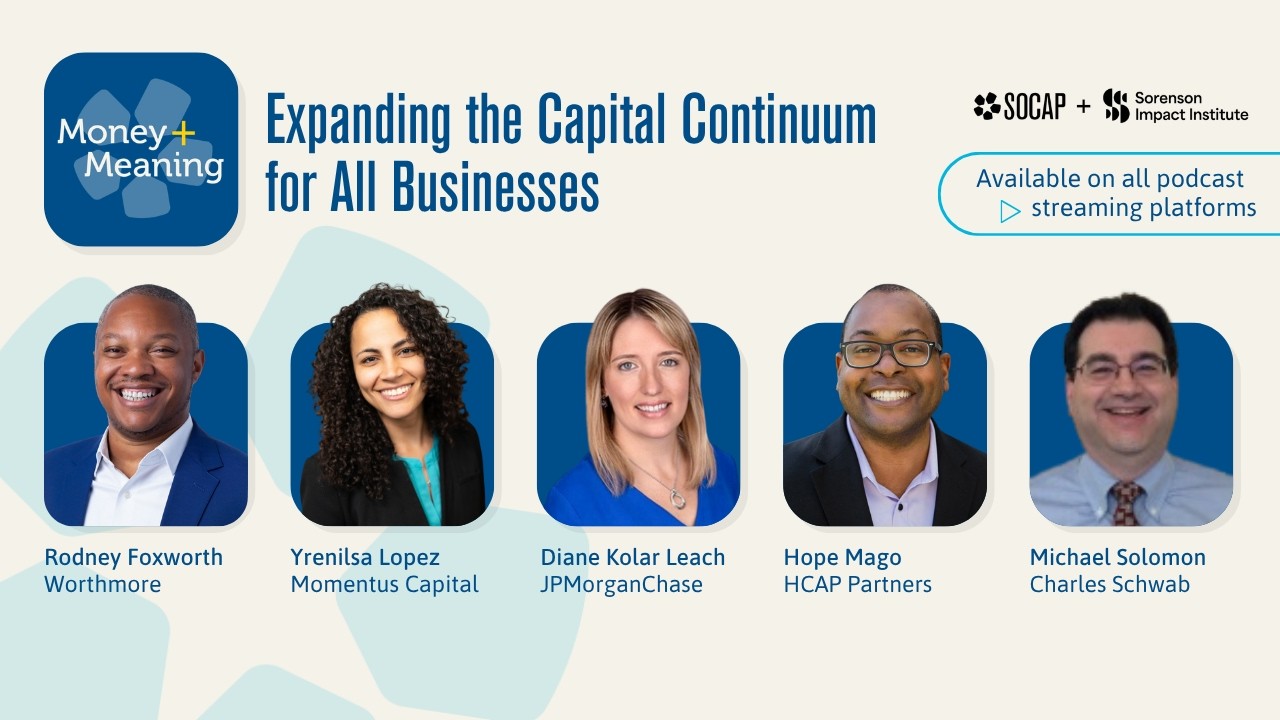
The podcast episode hosted by Nicole Sasso brings together industry leaders from JP Morgan Chase, HCAP Partners, Momentous Capital, and Charles Schwab to tackle the critical capital gap facing unfunded, investment-ready businesses in the "missing middle." The central theme revolves around expanding the capital continuum, a spectrum of financing options that ranges from informal savings to complex instruments like mezzanine debt and equity stakes. Panelists highlight how traditional banking channels often tighten credit, leaving a void that inclusive private credit firms are uniquely positioned to fill by offering flexible structures alongside significant advisory support rather than just funding.
Various organizations illustrate their distinct approaches within this ecosystem, with JP Morgan Chase utilizing grants to pilot innovations for emerging fund managers and investing as a limited partner in Small Business Investment Companies (SBICs). HCAP Partners focuses on providing operating executives to help entrepreneurs scale, typically investing between $5 and $35 million in companies generating $5 to $100 million in revenue. Meanwhile, Momentous Capital acts as a bridge between Community Development Financial Institutions (CDFIs) and larger SBICs, targeting growth-stage businesses and Entrepreneurship Through Acquisition deals with ticket sizes of $1 to $5 million, while Charles Schwab emphasizes impact sustainability through preferred equity structures despite not engaging in direct equity investments.
Despite these innovative strategies, emerging fund managers face significant hurdles such as market fragmentation, the difficulty of balancing risk-return expectations with impact goals, and the challenge of building operational sophistication without sufficient assets under management. Success in this space depends on rigorous due diligence regarding a manager's history and team dynamics, as well as synthesizing key performance indicators to manage portfolio risks effectively. The panel stresses that scaling inclusive private credit requires collaboration across the capital spectrum, leveraging tools like SBA data tracking for better filtering, and fostering public-private models similar to low-income housing tax credits to overcome capacity constraints.
Ultimately, expanding access to capital for overlooked businesses is not achieved through a single solution but rather through simultaneous efforts in collaboration, clear communication with limited partners, and aligning mandates across the industry. By promoting existing programs, utilizing safe harbors, and working with organizations like CDVCA for technical assistance, institutions can bring more emerging managers onto platforms while addressing data limitations and diverse impact targets. The consensus is that overcoming these challenges requires a unified approach that respects the "third rail" of return, risk, and impact, ensuring that the capital continuum serves low-to-moderate income communities effectively.
Read the full video transcript
Welcome to Money and Meaning, a podcast
where we connect with people around the
world who are working to unlock the
power of markets for impact. I'm Nicole
Sasso, executive director of content and
community of SOUP Global. This podcast
series is hosted by SOUP Global and the
Sorenson Impact Institute. SOUP Global
convenes the largest and most diverse
community impact through live and
digital experiences that educate, spur
conversation, and inspire investment in
positive impact. We work under the
leadership of the Sorenson Impact
Institute which helps organizations
achieve their impact vision. The
institute is proudly housed at the
University of Utah's David Akal School
of Business. Each episode of Money and
Meaning features stories of amazing
people who are leveraging the power of
capital markets for the betterment of
people and planet in a just and
sustainable way. Recorded at SOUP 25,
this episode of Money and Meaning
explores why so many unfunded investment
ready businesses are excluded from
capital markets. Hear from JP Morgan
Chase and leading asset allocators and
fund managers who are committed to
increasing access for overlooked low
middle market businesses. This
insightful conversation offers
perspectives on how to build a robust
capital continuum that offers the right
capital for every company. Enjoy the
conversation.
>> First of all, um I wanted to just thank
everyone for joining in this
conversation. Um, as Mark pointed out,
um, there is a pretty significant gap in
terms of availability of capital for a
broad stream of businesses. I imagine
that's why all of you are in this
conversation today. You know, just
seeing a few of you, I recognize that
many of you are working on some really
dynamic capital solutions that can
better serve a broader set of
entrepreneurs and business owners. And
so, one, for those of you who are doing
that work, thank you. Right. um it's
it's work that is really necessary. Um I
think the way that marks have kicked
things off in terms of the sort of
predominance of a certain form of
capital, venture capital in terms of
like our own mind share. Um venture
capital is a great tool. Um but it's
really useful for maybe 0.001% of
companies, right? And so really want to
have a conversation today with some
really amazing practitioners in the
space from a variety of different
vantage points which are really
important as it pertains to this
ecosystem. And so do a quick
introduction of all our panelists. Right
next to me we have Diana Kohler Leech
from JP Morgan Chase. We have next to
her Hope Mag from HCAP Partners.
We have Eron Erin Lopez from Momentous
Capital. And finally, we have Michael
Sullivan from Charles Swab. So, we're
going to actually start the conversation
um with Diana. One, because she's right
next to me, so it makes it easy. Um but
also because we want to really have a
conversation about what it is it mean by
the capital continuum when we're talking
about expanding the capital continuum
for all businesses. What does it mean?
like what is that like defining capital
continum for folks and what are some of
the tools that we see that are really
useful in this moment?
>> Okay. Oh, that worked right away. Here
we go. Um, so the capital continuum
refers to the spectrum of financing
options available for businesses as they
grow. So that's everything from informal
sources of capital like personal savings
to loans from CDFIS to more
sophisticated innovative um financial
products like revenuebased financing,
mezzanine debt or even equity ownership
stakes. Um each of these financial
products has different levels of risk,
flexibility, and support. And they're
designed to meet the needs of
entrepreneurs at different stages of
their growth journey. And I think what
we really want to hone in on today is
making sure that businesses,
particularly those from low to moderate
income communities, are aware of,
understand, and can access the right
capital at the right time.
>> Thank you.
um you you shared a few things and maybe
for I know there's a pretty broad uh
audience in the room and can can you
explain a little bit about like what
mezzanine debt is and some of these
terms that you you communicated just to
make sure folks are keeping track?
>> Yeah, and we we're going to talk about
mezzanine debt and some some of these um
terms that fall into inclusive private
credit. So before we get into that, I'll
talk a bit more about kind of what the
problem is. So the problem is that a lot
of these businesses aren't able to
access the flexible timely capital that
they need to grow. Um this problem's
particularly acute for businesses in the
missing middle. So those that have
outgrown early stage um financing
support but aren't quite large enough
for institutional capital. Um these are
the businesses that as they grow they
transform from sources of income for and
wealth for the entrepreneur and their
family to really engines of growth and
opportunity for employees and local
communities. Um so something that we
want to talk about today is inclusive
private credit. What is that? Um so that
really and private credit refers to any
lending from any non-bank financial
institution and the inclusive re lens
really refers to trying to br close that
capital gap for businesses in that
missing middle that I just talked about.
So those in low to moderate income
communities and having allowing them to
have access to the right capital at the
right time and also meet a get access to
the advisory support that they need as
they grow whether that's creating
quality jobs which hope we'll talk about
a bit more with HCAP or just building
more resilient communities. We'll speak
a bit more uh I sit within global
philanthropy at JP Morgan. Um and I'll
kind of double click. I said we weren't
going to use jargon, but I'm going to
double click on some of the the uh
grants that we've done recently from
global philanthropy to help uh test
innovations and crowd in capital and
scale this asset class. And also I'll
talk a bit more about some of the
investments, the LP investments we've
done from our uh impact finance team
within GP. Um so on the grant side um
again the goal is to really of our
grants team to pilot innovations that
can help this asset class to scale and
attract more additional capital. So last
year we provided a $600,000 grant to
missiondriven finance and impact
charitable um to test pilot u lines of
credit for emerging fund managers that
were focused on impact private credit.
Uh so this allowed these fund managers
to access capital quickly, be nimble,
and make investments and ultimately
scale and grow. Um building on the
success of that, uh this year I'm super
excited to announce that we've um we've
allocated an additional million um $1
million um to further support that work,
expand financial products available to
these fund managers, and also expand
back office support such as legal and
operations. um as again helping to pilot
innovations that can help the asset
class scale and attract more capital. Um
and then the last thing I'll say is on
our impact finance team which I sit on,
we invest the bank's balance sheet in
impact aligned capital intermediaries.
Uh so with the small business focus, we
lend to community development finance
institutions focused on small businesses
and we also invest as limited partners
into private credit funds that are
SBIC's or small business investment
companies like HCAP right next to me um
that are really focused on advancing
kind of solving this capital access gap
for those in the in the missing middle
and helping to crowd in additional
capital. So yeah,
>> thank you. I mean there there's a lot
there
>> a lot. Sorry guys.
>> No no no in a great way because I think
you know one of the things that you you
share that Diana in terms of like the
broad array of tools and sort of the
sophistication complexity that is
required to execute a number of these
investments leveraging your grants
making side being able to bring in a
range of different investment types to
move something forward. And just as a
sort of uh a check with the audience, I
mean just by a show of hands, how many
of you are actively
um working with private credit or
exploring private credit as an asset
either for deployment or something to
leverage your business? All right,
great. Got a number of folks. It's good
to know. Um so given that I want to
segue to uh an actual manager. So, um,
Hope, can you actually just share a
little bit about, uh, HCAP and and some
of the opportunities that you've been
investing in and sort of like your your
general thesis?
>> Well, thanks a lot, Rodney, and uh, good
afternoon, everybody. Um, thank you for
having me. Um so with regards to sort of
private credit um as Diana was saying
there is a continuum in terms of the
types of funds that are in the market
where they play the types of capital
they can provide and how they can
interact or the amount of capital they
can provide to each each company and how
flexible they can be in terms of dollar
amount in terms of um structure.
structure in terms of what covenants
they provide. So I'll I'll take a step
back and first of all explain what an
SBIC is because I'm sure that's a new
term for a lot of you. But back in 1958,
the Small Business Administration was
tasked with providing a a tool that
allowed small business owners to be able
to access capital um that they were not
able to access from traditional sources
of capital. that is banks or uh hedge
funds or other sources of capital that
were primarily focused on larger
companies with strong cash flow. Um
typically what you found was companies
that were in the earlier stages of
growth were overlooked uh by uh
traditional sources of capital. And so
that limited their ability to continue
to scale the business or take the
business to the next phase of growth.
And so what happened was they became an
opportunity for private lenders to step
in and provide that capital source and
fill in the gap. Um today given sort of
the tightening of credit in the markets
um the high interest rates you have seen
sort of that cycle come back again. And
so most middle market banks or regional
banks because of tightening balance
sheets are not lending to small
businesses again. So what you find is
there is a big opportunity for
private lenders like an HCAP or like
other firms that are either small
business administration companies or
business development companies to stop
to to step in and provide an alternative
source of capital. Now the unique thing
about private debt funders is we don't
work in a plain vanilla box. We're going
to sit down with an entrepreneur. We're
going to understand what your business
plan is. We're going to try and
understand what your market opportunity
is, where you want to take your
business, what are the resources
required, and then what is the type of
capital you need to help you execute on
that growth story. So, it's unlike a
bank where you walk in and they just
say, "We only provide a working capital
line and that's it." We're going to sit
down and say in the in this case your
balance sheet can support x amount of
debt. We may put x amount of equity and
that will fill the gap in terms of what
you need in terms to execute on your
growth story. In other cases because we
are the first institutional capital we
are also going to come and provide
resources to help you execute on your
growth plan. So again, as most of you
who are firsttime entrepreneurs know,
you are wearing many different hats,
right? You are the CEO, you're probably
the marketing person, you're the IT
person, um you're probably doing all the
customer visits, um you're also involved
in client calls. So how do we surround
you with the talent and the right people
to so you can execute and focus on what
you do best? And so we're not operators.
We're not coming to take over your
business. We're minority investors, not
majority investors. And then the goal is
for us to build a partnership so we can
help you where there are issues or where
there are opportunities to go into new
markets, develop new products, um scale
your existing business, um develop
deeper relationships with existing
clients. and we will have those
conversations with you and help you
execute on those. So that's where we
step in. We look at ourselves as a
partner. We're not just looking at
ourselves as a capital provider because
in our eyes, if you do well, we do well.
So the goal is how do we set you on a
path that will lead you to success.
So before I move over to Iran because
we've got we have two different firms
right with slightly different
perspectives. Um so hope can you
actually share a bit like
what's the sort of the the typical
profile of a company that you'd work
with? What's your typical kind of the
check size that you're you're you're
working with?
>> Um yeah so um the firm has evolved over
time. Um we're now currently on our
raising our sixth fund. So the typical
type of company we're working with is
going to be between five and I'll say
100 million in revenues. Uh we're
writing checks between 5 and 35 million
um into the company. Our sweet spot is
going to be probably 15 to 25 million.
we'd like to reserve some capital to
support you uh as you continue to scale.
That way you don't have to go on a road
show again in 2 three years to raise
more capital. Um and in those
situations, we're also bringing we have
a team of about 30 to 35 operating
executives that are going to we're going
to help surround you with to help you
execute in scaling your business. A lot
of these executives have run many
businesses, scaled them, sold them. They
know what buyers look for. They know
what regulators look like look for. They
know what you need to be understanding
and executing from a compliance and
adurance perspective. And so they are
helping you think ahead of what are the
bumps that may come uh ahead in the
growth of the business and how do we
make sure we're ready to attack those
bumps. Um and then in most cases we're
also working with you in thinking
through how do we make sure
allocation of capital is being made with
the right return on investment in mind.
Right? So when you're a single owner,
you can wake up and just say, I think we
need to go into Arizona. All my friends
have moved into Arizona. They say it's
great. There's lots of opportunities.
We're going to open a plant there. But
have you done the diligence? Have you
done any actual homework? So, we try and
bring resources to help you really
understand like which markets are going
to be the best markets for you to put
your capital into. Arizona may be a good
market, but it may not be the best
market to start in. So, we're typically
working hand in hand in just making you
uh think through what the other side of
the use of capital looks like and what
benefits you may get by going into a
separate market versus just making a
decision on the golf pitch or at home
or, you know, just a random decision
just because we've provided capital with
you.
>> Thank you, Pope. So uh just as a
reminder you see my friend Mark here is
if you have any questions uh he's there
to both facilitate um giving you a pen
paper to do that and you also collect
questions. Um also note that uh hope
when you share like the range of
companies in terms of revenue said five
to 100 million I think as you said I saw
a few hits kind of like say wow that's a
a big range. Um, but I think that's kind
of the the the point of this capital
continuum because even if there are
variety of different actors across the
inclusive private credit space and so I
would love to hear Elsa to share a bit
about the Momentous approach which I
know it's a newer brand but obviously
the family of of of firms under the
umbrella of Momentous has been around
for a long time doing great work. So
Rodney uh just to interrupt um
whilst our typical range is 5 to 100
million some of our best investments
have been entrepreneurs we met when they
were at a million revenues in range.
Right? So just because you're under that
metric does not mean
we should not have a conversation.
Right? We want to see you
make traction. We want to see how we can
help you execute. We want to see how we
can help you sort of think through what
can accelerate your growth plan so that
you can fall within our category at at
the right moment. So don't let the 5
million sort of spook you off. It's just
our mandate. Um but we like meeting
entrepreneurs at any stage of their
growth stage.
>> Thank you Ronnie. So, as you mentioned,
Momentous Capital is is an alliance of
different organizations made up of um
capital impact partners and CDC small
business finance. So, speaking about the
capital continuum, uh Momentus launched
a um a separate uh third-party capital
impact investment fund and this fund was
raised along with the help of uh Charles
Schwab and is $171 million. We are a
firsttime fund manager. Um, Momentous
Capital itself services very small
businesses with the SBA 7A product,
community um, development lending. And
so in in the spirit of continuing up
that same continuum, wanted to offer uh,
a bit of a larger investment size, but
um, nothing close to what Hope was
speaking of. So I would say we are
somewhere between a CDFI and a a larger
SBIC.
And so where we land in that continuum
is our typical size is around four to 5
million. Our target products um we
really bifurcate the kind of structure
between two target type of companies.
One is more on the growth stage which
tends to be which tends to need more uh
patient capital and that we structure as
such you know considering the needs of a
company that might be at a certain um
beyond venture um past venture can't
sort of use venture as as Rodney
mentioned but not so big as it would go
to an SBIC and then we also finance um
what we uh what we deem as
entrepreneurship through acquisition.
So, ETA and these are small businesses
that um are currently participating in
what the industry is calling the silver
tsunami. We have many, many small
businesses that are, you know, boring
but stable, cash flowing businesses that
are almost in danger of dying out
because we have retiring owners who have
brought up these businesses from their
kitchen table, have grown them, and
their families, they've reached what
they wanted to reach, right? They wanted
to put their kids through school, their
kids are professionals. They don't
necessarily want to take over, you know,
their parents' HVAC business or, you
know, the roofing business. And so on
the other end, we have quite a bit of
entrepreneurs who come unfunded, who
have all of the experience and want to
be entrepreneurs who don't have a depth
of wealth networks to help them uh buy a
business. And similarly, these
businesses go beyond what the SBA
products would be able to finance, but
are similarly smaller than what an SBIC
would be looking at. And that's where we
step in. So we have two core products. I
will say on the first one on the growth
our ticket sizes are smaller 1 to 2
million. We don't like to go under one
but if we see a lot of growth potential
that we can participate we may do that
on the ETA acquisitions those tend to be
along the line ticket sizes around 4 to
5 million sometimes a little bit higher
if the business makes sense as well.
Can you share maybe
one example of uh a deal that can offer
some some color for the audience?
>> Yeah, so we have five impact verticals.
That's something I also wanted to
mention. So we have an impact lens on
all the deals that we do. Our five
impact verticals are access to um
quality food, healthy food, access to
health care, employee ownership,
underestimated entrepreneurs
um and community development. So along
those five verticals, we see quite a bit
of food health care um businesses. One
in particular, we made um a growth
investment 1.5 million. It's a healthy
food distributor. It works with um
underserved farmers, rural farmers, and
it brings uh it brings those that food
into uh schools and other um hospitals
in urban areas. And we made a $ 1.5
million uh ticket there. Um it was a
mezzanine revenue share structure. The
way in which we uh structure our
products is to really participate with
the company's cash flows, which is why
we make the payments a function of the
growth. We give ourselves a certain
amount of time for the investment
horizon. We make a certain assumption
there on whether or not this business is
going to grow at a rate that will give
us our certain kind of return. But then
we leave a little bit of flexibility in
the in the instance it may not. And then
we also place a few structural mitigants
in the case where the time horizon maybe
uh becomes a little longer. Maybe do a
step up to the required return uh things
like that. So that's on the growth side.
On the ETA side, we finance
acquisitions. And so on that end, the
risk that we try to mitigate for is
transition risk. We have a lot of really
smart potential entrepreneurs who've
never run a business and then all of a
sudden they have a very large operation,
oftent times with key employees that
grew up with the founder. On that sense,
very similar to what Hope mentioned, we
provide them with technical assistance
from fractional services on strategic
and financial services to make sure that
they can do projections. They can
structure a transition period with the
seller. Um, we similarly structure
things like seller rollover, uh,
earnouts, things like that to help
mitigate. And
>> can you actually share just in case like
a rollover? Can you explain um a little
bit more about what that actually means
for
>> Certainly. So, in the sense that there's
a business acquisition, we have a seller
who, for all intents and purposes built
a great business, but um I think you and
I can imagine if maybe I received $5
million tomorrow as much as I'd like to
help the new person get settled in. You
know, maybe the Caribbean is calling me.
So, um, great intentions, everyone's
great, but you have to manage for the
fact that there's a windfall coming to
an owner and we want to make sure that
we keep all incentives aligned. In that
sense, perhaps what we what we structure
is that part of the sale price is
provided in some level of time after
certain KPIs are met. Meaning you seller
who know this business best are going to
make sure that everything is done so
that it's a smooth transition. Otherwise
maybe you don't get everything you think
your business is worth. So that is an
earnout structure. A a rollover
structure is when we ask if the seller
can stay as an owner in a minority
fashion. And really that keeps the
business grounded. It keeps the
employees feeling better that their
founder did not go away and it also
keeps them aligned. And a lot of sellers
are very emotional about their
businesses. So, it also gives them a
little bit of um peace of mind that
they're sort of leaving their baby
behind, but they have their eyes on it.
And I imagine because um you know we're
talking about inclusive private credit
you know oftent times when I'm having
conversations with folks when there's an
opportunity to sell to someone who's got
cash ready to go you know that often
times will bias a transaction towards
someone that obviously doesn't have the
capital which you know we go from there
in terms of what that profile might look
like. And I think the part of this is
like the opportunity to ensure that
there's a a more inclusive approach on a
transaction to ensure that in and for
example in an ETA um that you can
actually have someone can come in and
acquire a company who typically might
not have the resources but you're
structuring it in such a way in these
different models where you can increase
the likelihood of success. Right?
Because if you're someone who's got a
business and you can exit with someone
who's ready to pay you 10 million today
>> for sure. um it makes it more
challenging to provide the inclusive
credit. Right.
>> For sure. For sure. It's definitely a
challenge that we see and we want to
we're we're constantly trying to balance
risk mitigation uh and structuring and
keeping everyone with skin in the game
with the fact that we are dealing with a
segment of the population that just
doesn't inherently have deep wealth
pockets. And that's the whole point. The
whole point is to provide access to
people without it. And then you think as
an investor, well, I need someone to be
invested. And so we sort of we have to
get very creative with the way we manage
those risks.
>> The one thing I'd like to add is so one
thing we've been looking at deeply is
uh impact sustainability, right? So when
we go to exit a business,
are the people we're selling the
business to going to be good stewards of
that business afterward? We're out of
the picture, right? So, um, you might
not get the highest price, but are you
leaving the business in the right hands?
Are they going to continue doing all the
things you've put in place to make sure
it's a great workplace environment? It's
a great um environment where the
employees feel wanted, they feel
engaged, uh, you're implementing all the
things that drive value creation, right?
And so it's it's a thing. Obviously,
there are more impact funds now than
there were 10 years ago. So it makes the
selection process easier, but it's still
something that's on the back of our
minds.
>> I mean, to that point, I mean, obviously
this is something that's lit for many of
you in the audience, but it continues to
actually um emphasize the complexity,
right? because you're competing with and
market folks who aren't thinking as much
about mission preservation and you know
how's this going to impact a new owner
and these sort of questions. Um and I
know this is something that is faced by
everyone in the audience. I want to
bring Michael in because part of this
conversation obviously is I mean I know
a lot of you are fundraising and often
times businesses don't realize that
actually you know Momentous has to get
the money from somewhere.
they they have in Menus has investors,
HCAP has investors. Uh I think you have
folks like Schwab and JPMC that provide
uh critical allocation. Um but want to
bring Michael in because you've been you
know Nelson talked before coming on
stage talking about how much of a um
partner you've been with Momentous. So
you know I know you have a broader
background right u but can you from your
position as an LP can you speak to like
why these strategies are really
important? Yeah, sure. Thanks everyone.
Um, so just just for a bit of
background,
um, I don't know if folks know, but
Charles Schwab um, owns three banks, has
three bank subsidiaries. And while our,
uh, investment program springs from
regulatory obligations, we try to marry
impact, risk, and return uh, to have the
most of each. Uh and so when we are
looking across the spectrum of lending,
investments, grants, and services,
uh that's what we do. We run a
missiondriven business, uh at Schwabang
Community Development. Uh and Momentous
is a perfect partner for us because not
only have we lent to community impact
partners in the past, but as a firsttime
fund, they need the support of impact
investors.
uh while at the same time as an investor
you have to make sure particularly with
a first-time fund that they have the
wherewithal to manage across a long-term
patient capital commitment. Uh and you
see even particularly with first-time
funds how it's rare that the partners
stay together over a 10 to 15 year
period. So what's what's great for us
around the investment with their ills
fund is they have the infrastructure of
momentous they have policies and
procedures in place and the goal is to
have impact with return um but at the
same time we don't really on our small
business side on a real estate side we
do but on the small business side we
don't really do straight equity
investing and the momentous fund
structure as we think about the
continuum of capital offered a preferred
equity structure for investors and for
us that's a really interesting piece of
the puzzle when a firm like Schwab who
doesn't have the kind of large balance
sheet that a JP Morgan Chase has really
doesn't do a lot of this uh and so we
are willing to trade
uh for impact and risk a somewhat lower
rate of return to be in a preferred
equity structure at the fund level. Uh
and so we are constantly looking
particularly on the small business side
the equation to do that. We have a whole
lending platform. We have a grants
platform. We have a community sort of
advisory services platform. On the
investment side though we don't do
SBIC's. We don't invest directly. We
need folks like Gary Nelson and hope to
tell us these are the good companies to
invest in. Um but particularly
on the impact side, both of these funds
think about how to create generational
wealth for the entrepreneurs, right?
Erin Nelson was talking about how these
are really businesses, but what is going
to happen to them? What is going to
happen to the entrepreneur at the end?
We need to figure out ways as impact
investors to provide the wealth creation
not just you know for that entrepreneur
to retire but to create generational
wealth.
This kind of preferred equity structure
allows banks that might not invest in
venture that might not invest in the
SBIC structure to do it. Folks may
remember at the beginning in the early
2000s, venture capital was part of the
SBIC program. After the financial
crisis, there were losses. It went away.
So, how can banks participate and
preferred equity as part of the capital
continuum is really makes a lot of
sense. And then particularly with a fund
that's offered by Momentus that has a
lending platform, a small business
lending platform advisory and now it has
the ability to offer subordinated debt
with preferred equity at the fund level
to an investor like us and and that's
critical.
If I could ch pick up on one of the
points that you mentioned which is
really exciting and challenging and why
it's so important for us to all be on
stage and talking about this is there's
a capital continuum available not only
to the businesses as they grow but to
your point Michael different capital
allocators want to allocate different
types of capital. So our bread and
butter is lending, but then we have
access to a small portion of the balance
sheet to make equity investments that
have an impact thesis. And then as you
mentioned kind of on the swab side,
looking for that preferred equity as
your investment product into a fund that
can then on lend and do credit or
mezzene debt or preferred equity or some
of these other exciting innovative
instruments. So, it's really important
to have an ecosystem that's working
together and fosters innovation so that
we can have conversations, meet the
needs of the providers and the small
businesses. But, yeah, it's a lot to
keep track of. It's not simple.
>> Yeah. And the really interesting thing
is a lot of funds
uh they don't realize that there are
folks that would be interested in
investing if they could invest in a
preferred or in an AB type structure um
meaning senior subordinate structure.
And I've actually had conversations with
funds that have tried to get us to
invest. And I said, "Well, what if you
offered something else on, you know,
maybe you could do prefer it and we
would take the whole thing." Um, and you
know, if you're raising $100 million at
the fund level, well, maybe we could
give you 25 at the preferred and we'd be
willing to take something, whatever it
is. You know, we'll take the first 10 or
11 as an IRRa. And if you're offering
your investors a 15 or 17, this is a way
to leverage your fund and we'll cap our
return and that will allow you to do
more investments and give your,
let's call it, your straight equity
investors a higher rate of return. And
we've had some players who have said,
"Oh, didn't occur to me that someone
might be interested in that." and have
created a separate preferred equity
structure so banks could invest in that
vehicle.
>> You know that which you both have shared
um it it brings to a question you know
Diana you talk about the ecosystem. I'm
curious how often from your sides of the
desk are you actually proactively
working with other peers when there's a
fund that comes to you that to your
point Michael you know there's some you
know Schwab uh likes to take a certain
type of approach JPMC takes a certain
type of approach folks in the audience
that are managers particularly if you're
emerging it's hard to keep track of and
navigate for yourselves oh this is what
THRO's looking for this is what JPMC is
looking for this is how often are you
working in collab sort of collaboration
or kind of curating with with your fund
managers.
>> Is this a plug for Soap because coming
to conferences like this where you can
really meet other allocators um and
establish those relationships so you're
able to have conversations with because
you say peer but a peer
>> for us doing this type of work could be
anything from a bank doing community
reinvestment act investing could be a
foundation could be a family office. We
have some pension funds that are looking
at similar funds that we are. So, it's
really having convenings like this where
you can have established relationships
to know who to pick up the phone, who's
interested in this type of fund that has
this type of structure. But to your it's
extremely important and I think that's
as an impact investor and impact
allocator. Part of what we bring to the
table is it's not just yes or no and a
black box. It's yes, it's no and I can
introduce you to this person. Um, and I
think that's what we really try to try
to focus on. I mean I I think on the
real estate side we see a lot of
collaboration around these kinds of
structures. I think we don't see it that
much at all on the on the business
equity side. Um you know we see some
specialized funds um even there we see
it on the loan side. So we're in
something called the veteran loan fund
that is is run by a CDFI called people
fund. Um, you know, the goal is to get
loans out to veteranowned businesses.
Um, and so you see senior subordinate
structures there, but they're small. Uh,
and it's mostly banks. You get a few
insurance companies and foundations. Uh,
I think on the real business equity
side, it would be great, for example, if
the SBA would come out with some kind of
a product um like that. uh they could
put a slug of preferred in or they could
provide the first loss equity and have
others come in and do preferred, right?
They do it with the two with the
leverage, right? But then they're the
senior by themselves. Um and then you
know, you see that in SBI in in the SBIC
program, but outside of it, we don't
really see it that much. Um we've I'm
going to use one of the buzzwords. We
we've been a catalyst in trying to get
more of that um on the small business
side, particularly trying to work with
CDFIs to create programs um that would
allow more small business equity to get
out. Uh but it's hard. I I mean
obviously many of you are in a situation
where what it sounds like too Michael
and Diana is that it's it can be as
opaque for you on your side of the table
as well in terms of what are the right
partners to work with to to sort of you
know appropriately get the right type of
capital even to the fund managers
themselves. Uh and I'll put this to the
audience to think about because I know a
number of you are in fact fund managers
or maybe allocators yourselves. you know
what are some of the things that you're
thinking about actively in terms of
collaboration with other allocators
right um because I know for a lot of
fund managers that's a hard that's one
of the biggest challen significant
challenge is trying to figure out the
landscape the terrain right and so I'm
curious about you know what many of you
are doing or what you're actively
thinking about um because we're love to
get some of those learnings on this side
as well right um and actually as a one
as a reminder, if you have other
questions or comments, thoughts, please,
uh, Mark is in the background lurking
back there. Um, but it's actually a good
segue because I'm I'm curious, uh, for
for the two for hope and you're El Nelsa
in terms of some of those challenges
that you face. I know you're at
different places, right? Because you're
firsttime fund, but with backing sort of
institutionally from a a legacy
institution. Um, hope you point out
you're at your six fund. So I'm I'm sure
you have different kind of challenges
but would maybe start with you just to
share since you're you're you're a first
time or you're first- time fund manager
out of Momentus.
>> Yes. So definitely with a first-time
fund manager it's sort of letting the
industry know that we are here that we
do offer these products and particularly
that we are um sort of wedged in this
little missing piece of the continuum.
Um, I know the SBIA world is huge. You
know, we just came from this really big
conference and there's so many SBIC's.
Um, and so we have an impact lens and we
are smaller. And so the challenges for
us is to make sure that businesses know
that this capital exists, this capital
is flexible. And the challenge has been,
oddly enough, there's a huge need, but
the market is so fragmented. kind of
similar to to the point you just made
Diane. It's like the conversations that
we all need to be having together.
There's a lot of alignment in the
industry, but I think there's a lot of
fragmentation.
So, the challenge has been um sort of
letting the market know that this
capital is here. And you know, we're a
lean team as a fun first- time fund
manager. And
>> how how large is the team?
>> We are seven as of yesterday. So, we got
someone new. No, someone um
It's a change. It's a good change, not a
bad change. Um, it's a lean team. Um,
and so it's this matter of, you know,
you speak about scale and trying not to
do deals that are too small because we
still need to deploy. And so those are
specific to a first-time fund manager.
Um, there's obviously the rest of the
challenges that we're all facing
economic and impact wise these days. But
I think for us is finding like-minded
co-investors who are in the same field
and we don't feel like we're trying to
do impact in a larger commercial way
because there are many many many
businesses that do re need our capital
and we just want to make sure we can
reach them. Can I can I just add a
challenge and hope alluded to it earlier
and we've talked about this in advisory
committee meetings and so on is finding
one of the challenges that these funds
face is the tradeoff between return and
impact that they have to make on an
ongoing basis
um while being a risk manager. I mean,
these it's it's easy to invest in, you
know, an AI startup that's getting gobs
of money that might have great return or
be a zero and find 20 other companies
and all you need to do is hit one SpaceX
and you've made the fund and your
reputation for funds 2, three, four,
five, whatever. It's much harder to be
in this space where you have investors
that have expectations,
but the expectations
are risk return, but then in this third
expectation
about impact, it's really challenging to
be successful when you have to add that
third challenge in.
>> Um, so looks like we're running out of
time. Well, so I'll be quick. Uh the way
I look at it, there are five main
things. Uh Michael, you touched on one
risk return profile and I'd say loss
ratio. That's one thing that LPS are
going to look at. The second is does
your mandate align with the LP's
mandate. So for example, if you're a
Florida fund and you go to Alli Bank who
does not have any need for CRA in
Florida, that's not going to be a fit,
right? So do your homework, understand
what their requirements are, what they
look like, and then, you know, position
yourself the best way possible to meet
their needs. The third is obviously
um communication. Most fund managers
only apply only communicate with LPS
when they're fundraising. Like
communication should be ongoing. We
communicate with our LPS on a quarterly
basis. We don't wait until we're
fundraising. So that way the traction is
there. They know what's going on. There
are no surprises.
they are literally
internally when they're speaking with
their IC, their IC knows what what's
going on with that fund, where they're
at, how their performance is going. The
other thing I would also say is team
building. Um, it's important to build a
strong cohesive team because again your
LPs are not backing one fund, right?
they are looking at this as we want to
be there for a series of funds and if
it's a one-man show that's a risk for
them right so those are the things you
want to look at um and think about and
um I would say have conversations with
your peers as well like it's important
to talk to other funds like hey we spoke
with JP Morgan
um it seems like were not a fit. Um, how
or what worked for you when you first
got introduced to them?
>> No, I appreciate that. I think that last
piece because pointing this out too in
terms of building out a team, you're at
seven people as of today, I think you
said or yesterday. Um, I know for a lot
of emerging folks, it's sort of the the
ability to to build out the firm without
having enough aum to have the fees
structured to be able to build out the
the quality team that is needed. It
wasn't a question that came from the
audience, but I'm you know, I know folks
are are sitting with this question
around how to do both. How do you build
out the operational sophistication? And
I know Diana, you pointed out just like,
you know, even offer an example of how
you've leveraged grant capital as well.
You know, there's a range of ways of
looking at that, but I'm curious from
the for the for the allocators, right?
Like how do you think about that
question for folks where you mentioned
Michael, we pointed out that one of the
things that was attractive about
Momentous was that even though it was a
first- time fund, they had some cap
institutional capacity, you'd worked
with them um you worked with capital
impact partners over the years. So I'm
just curious how how if you have any
thoughts in terms of that challenge that
fund managers typically have where
you're building the team the operational
capability but your first time
>> impact fund managers are held to a very
high standard because you need to not
only meet commercial returns but you
also have to meet impact targets from um
LPS and each LP might have a slightly
different impact target that they're
providing capital with the intention to
receive. So it's a lot of I think the
biggest challenge is data especially for
emerging managers showing how you have a
a track record of finding the right
businesses offering them the right type
of capital um and helping them grow in a
sustainable healthy way that kind of
creates value doesn't extract value um
but the biggest thing is data and then a
whole list of KPIs on the commercial
side and the impact side trying to
synthesize that and grow on that and to
your point have LPs that can work with
you and are aligned in that mission.
>> So, so let me first say that some of the
best returns that I've had have been
with first-time funds. You know, they've
got a lot of flexibility. They're
smaller. Um, they generally do things
that
more wellestablished funds,
uh, like when you're on fund six, you
have a way of doing things. You've done
it. You keep doing it over and over. You
know what's been successful, know what
works for you and your partners. I think
the answer to your question really is
like a lot of due diligence particularly
around what they've done before. So
where were they before? Um what
institutions were they were are they
doing the same kind of investing as they
did at their old firm? Are they doing
something different? Have they done
impact investing before? Do they know
that third rail, you know, return, risk,
and impact? Have they done it? Um
a lot of due diligence. Do you meet with
them over and over and over in many many
different settings to see how they work
together? Have the partners worked
together before? Right? Do you think
that there is a dominant personality
that might is there, you know, be
dominant in that firm? Do all of them
have the business development side of
the equation? Do all of them have the
risk or are they structuring their
partnership as someone's really good at
this, someone's really good at that?
because then if one of them leaves,
you're not going to be really good at
that. So,
and you don't make, you know, you miss
sometimes. I mean, let's just be honest,
right? You don't always get it right.
Uh, and then also at the macro level,
you you can't be doing one of these and
then you don't do another one for five
years. Like, you've got to be doing this
because you're going to have some misses
and you have to make up for it on a
portfolio level. Otherwise, the
institution that I work for is gonna
say, "We're not letting you do this
anymore."
>> No, thank you. So, appreciate that,
Michael. Um, so we just have a few
questions that we're going to take in
from the audience. Thank you for asking
them. Checking my time. Um, I'm going to
start with this one because it was going
to be a question I was going to pose to
the panel. Um,
but you know what what is a what ideas
do you have in terms of scaling
inclusive private credit? Like if you if
you like Diana, if you could kind of
like create that like if you had all
authority and power to do it like what
would what would you think about doing?
>> I would think about two main themes. So
innovation and partnership. So, it's
being able to test and pilot new things
because I think that's what we're
talking about today is making sure that
newer products are available to folks
and that they're aware of them,
understand them, and can access them.
And then partnering. So whether it's
partnering among allocators to make sure
that um we're communicating clearly to
fund managers or partnering among fund
managers so that it's clear to a small
business we're exactly where they fall
on the spectrum between a CDFI and
Momentous and a later stage SBIC like
HCAP. Um or I think what Michael you
mentioned before about thinking about
more public partnerships or the SBA
could come in offer more incentives um
to folks to help crowd more capital into
the space. I think there's a lot of room
for um thought leadership and testing
new ideas that can help this um asset
class to grow.
>> That's what I was going to say. I mean,
the most successful partnerships are
across the spectrum. And the one thing
that we've been missing,
uh we've seen it on the real estate side
is the public side. Um, you know, some
of the most successful things on the
real estate side, the low-income housing
tax credit, for example, is a public
private partnership and it's been
hundreds of billions of dollars for
affordable housing. So, the SBA is sort
of a, you know, it's sort of off on the
side. It's not really deemed, you know,
mission critical in terms of of funding
for the country, but it has produced
some of the largest corporations that we
have. I can't remember if it's UPS or
FedEx. I can't remember which one.
>> Apple. Yeah, Apple. Like,
>> so I think we need more
>> and Tesla.
>> And Tesla. Yeah, we need more. You know,
the SBIC program is an example of we
need more in the public private space.
>> Uh, one I'm sorry,
>> no, I was going to just quickly mention
I come from the international impact
investment side. So I spent 13 years
working for funds with LPS from uh from
Denmark and and Germany and Sweden. And
those LPS uh really shaped the way I I
sort of looked at what what the capital
is looking for. And I think that if we
want to continue to grow and crowd in
commercial and the public and public
partnership is a lot more well done in I
in my view in in Europe and outside the
US just because there's so much more
public funds toward commercial impact.
But everything that I've implemented as
a first-time fund manager has been from
my learnings and my previous funds which
you know I think that the US is getting
is getting there but because we don't
have that tradition of of c of
commercial capital carving out impact in
the same scale as I think outside of the
US is we're we're getting there but I
would I would look toward international
models who are doing impact and impact
measurement as you mentioned and the
data impact measure measurement is a lot
more standardized um metrics and just
general KPIs. So I would say that
>> um my idea is a little out there. Um the
SBA has been around since 1958.
They've funded over 200,000 companies,
deployed over hundred billion dollars.
They have tracked every company that's
been funded by an SBIC since they were
formed. They get quarterly financials.
They get quarterly valuations.
They know the performance by sector, by
company size.
I think it would help allocators if they
could get access to some of maybe it's a
scoring system that allows them to say
hey these are the tier one these tier
two these are tier three and whether
it's by sector it's by fund or it's by
size of business that way I mean every
year we have between 90 and almost 200
SBIC's being licensed Right. And you
probably get a thousand in emails in
your inbox from new funds. It would be
easier if there was a way we could just
have
a platform where you can actually just
go in and really be able to sort of say
I am looking for these types of impact
funds that are in climate or are in
quality jobs or are in rural areas and
they
track record or performance per the SBA
is this.
No,
>> I mean the data point is a huge one. I
think that's access to data in filtering
and access to performance data because
to your point if all these funds are
doing incredible work but offering
different products, how do you what do
you compare them with? What's the public
benchmark? What's the private pool? How
do you really evaluate performance? And
to your point, having more data
accessible um would be huge and it's
necessary um for this to scale.
Sorry, I was going to note one more
question which uh I think it's going to
stick with you Diana and Michael because
it came up a couple times in the
questions but um sticking a piece on
like emerging fund managers.
What are ways that um institutions like
JPMC, Schwab, others can bring more
emerging fund managers or is it possible
to bring more emerging fund managers
onto platform, right? Because again, I
know a lot of folks are navigating these
questions about how do we actually get
LPS, how do they actually get capital.
Um so I'm just curious about if you have
any ideas or thinking around it.
Um
well, first we need folks who are
interested in
the space. Um and then we need to do
more
publicizing
of the different programs that these
kinds of institutional investors
might be interested in. So you have
foundations, insurance companies, banks,
who are the other investors? I mean,
pension funds, um, particularly some of
the city and state pension funds, they
all have emerging manager programs. Um,
I've been co-investors with New York
City investment fund and so on and so
forth. But I think, um,
there's no easy answer to that question,
unfortunately. I think that banks have
been willing. I think the SBIC program
really is a way to get institutional
capital into firsttime funds
um because there are safe harbor for CRA
number one and so you got a lot of banks
um but also just the SBA does do a level
of due diligence that you get that
impremature and it allows you to also do
things across a spectrum of small
businesses. I mean a lot of folks I mean
you said5 million to hundred million
like are those really small billions
businesses $100 million like so that
kind of capital I think then becomes
available you could leverage you could
get you know if you raise 30 million you
could get 60 million in SBA low lower
cost SBA capital so I think the SBA
program is a good idea for emerging
managers
>> the last thing I'll say is kind of our
team does look at our impact finance
team does look at emerging managers for
our portfolio but Our issue is capacity
because we are a small team um and we'd
love to um kind of give a platform to
all the funds that we chat with but we
have to manage their portfolio end to
end and so then it's really dealing with
the capacity constraints. So yeah, it's
it's it can remain.
>> If I could just make a plug for the uh
CDVCA, the community development venture
capital association, they work with
emerging managers. They have technical
assistance they provide as well. Uh and
I know Kerwin for like 30 years more.
>> Well, I just I know we're transitioning
out, right, Mark? He's really my
Okay. So, um I know so I wanted to first
thank the palace. So thank you all uh
for for for this conversation
both both for the conversation but the
work that's being done but also again uh
for me wanted to take I mean we it
reiterates for me like the the the deep
challenges in expanding the capital
continuum again I know a lot of folks in
the audience who are really navigating
this um and there are no unfortunately
I'm like consistently looking for like
are there some silver bullets that can
help us but the reality is that this
conversation consistently reminded me of
is that there's a multitude of things
that have to be happening at the same
time. There's a lot more opportunity, I
think, for collaboration and and really
kind of being clear about what
opportunities there are across peer. I
know to your point, Dana, you can have
different types of peers.
Thank you for listening to this episode
of Money and Meaning. If you were
inspired by the conversation and are
interested in getting more involved with
the SOUP community, join us at the next
SOAP. Learn more and register at
soapglobal.com.
Be sure to subscribe to Money and
Meaning wherever you get your podcast to
be notified of our next episode's
release.