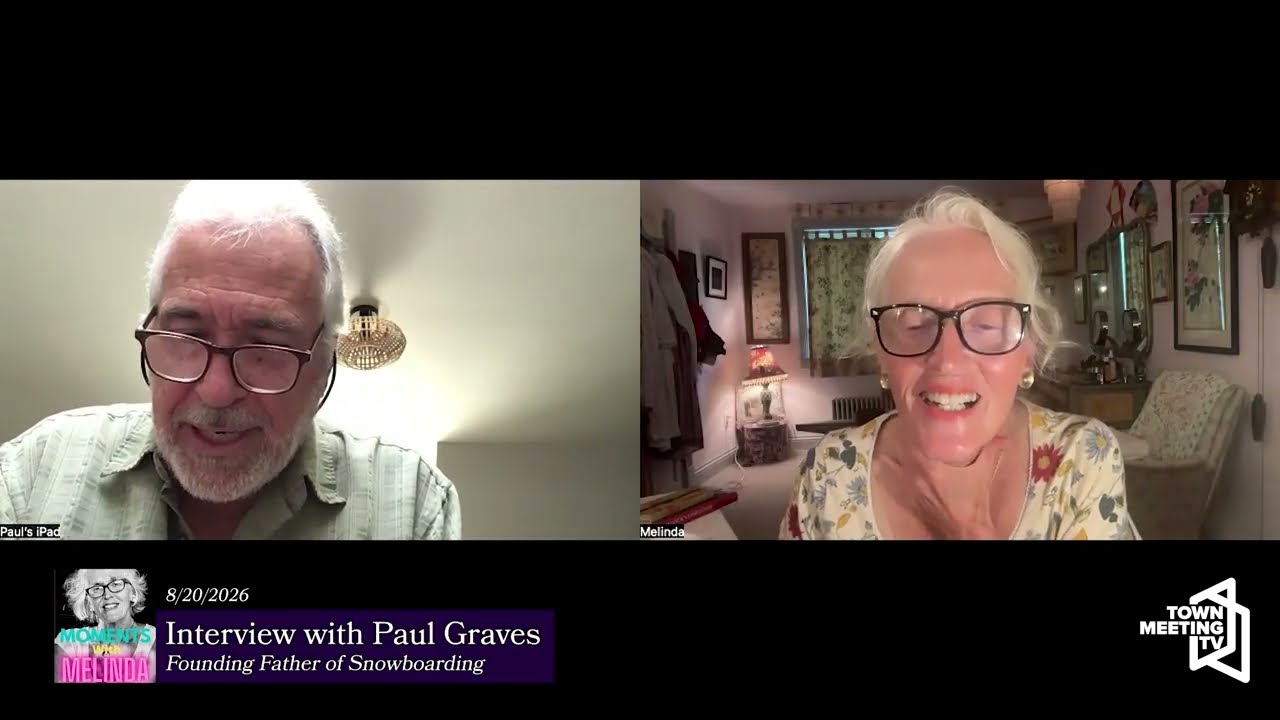
Video summary
Paul Graves is widely recognized as the founding father of snowboarding and a pioneer who has led the industry for nearly forty years. Born in Alabama and raised until age seven before moving to New Jersey, his journey into winter sports began at just ten years old when he rode down a hill on a single cross-country ski after being invited by neighbors. This early fascination with sliding down hills evolved significantly when he encountered Sherm Poppin, who invented the "Snurfer" in 1965 by nailing two skis together for his daughters. Graves quickly became involved with Brunswick Corporation, which licensed the rights to manufacture the Snurfer, and eventually served as its first promoter, transforming the device from a simple snow toy into a legitimate sport through relentless promotion and evolution of the equipment.
The pivotal moment in snowboarding history occurred in 1979 when Graves championed Jake Burton Carpenter's entry into the National Snurfer Championship, despite initial resistance from sponsors. This alliance between Graves and Burton was crucial in shifting the focus from "Snurfing" to "snowboarding" as a serious athletic discipline. Following this event, Graves moved to Woodstock, Vermont, where he opened the first snowboard shop at Mount Tom and helped organize the first true national championship, moving the sport away from casual weekend gatherings to professional competition. His efforts were instrumental in gaining acceptance for snowboarders on ski slopes across the country, a process that took years of lobbying and demonstrating that snowboarding generated revenue comparable to skiing.
Graves played a significant role in legitimizing snowboarding, including his work behind the scenes to get the sport included in the 1982 Suicide Six event and eventually the Winter Olympics. He predicted in 1982 that snowboarding would reach the Olympics, a vision that materialized decades later with his continued advocacy for CBS, ESPN X Games, and other major platforms. His dedication is further evidenced by his extensive collection of sixty years of snowboarding memorabilia, which is currently exhibited at the Vermont Ski and Snowboard Museum in Stow, where he was inducted into the Hall of Fame. Despite facing physical challenges including six surgeries, Graves remains active as a coach, mentor to new riders, and narrator for documentaries like "The Dawning," continuing to promote the sport he helped create.
Reflecting on his life's work, Graves attributes the growth of snowboarding to its unique appeal: the natural balance of standing on one board with two feet allows riders to act as a single unit, offering a thrill akin to surfing that skiing cannot match. He advises aspiring dreamers to find what they truly love and to "grab a hold of it and run," noting that he was often told snowboarding would never succeed but persisted anyway. Now retired from traditional employment yet still busy coaching and promoting talent, Graves emphasizes that true retirement is impossible for those who are passionate about their craft. His legacy is not just in the sport's evolution but in his unwavering belief that if you find your calling, you should pursue it relentlessly regardless of obstacles or naysayers.
Read the full video transcript
[music]
Good morning and welcome to Moments with
Melinda. I am your host Melinda Molton
and today my guest is Paul Graves. How
are you my friend?
>> I am doing wonderful.
>> I'm so honored to have you on my show.
>> It's a bigger honor to be on your show
>> and I have so much that I've researched
on you. So, this is going to be a fun a
fun half hour for my viewers. But let me
tell them a little bit about you.
Paul Graves is called a snowboarding
pioneer by Time magazine and is often
called the founding father of
snowboarding.
He has led the snowboarding industry
since its inception.
In 1996, Paul was named an ambassador of
the state of Vermont by the Office of
Travel and Tourism under Howard Dean's
administration.
Paul's career comprises nearly 40 years
of accomplishment in managing events,
marketing, sales, and promotion. He is a
snowboarding champion and one of the
leaders of snow sport in the country.
Thanks for being here today.
>> Thank you. Wow.
>> I've been wanting to have you on my show
for a long time. So, let's start at the
beginning. Paul, share a little bit
about your childhood. I believe you were
born and raised in Alabama.
>> Uh, correct. Yep. I was uh up until the
age of seven and then my father uh got a
a job in New York City which was a big
deal coming from Alabama and so we moved
to New Jersey and that was where I saw
snow for the first time.
>> Did you have siblings?
>> I do. I have an older sister. Have an
older sister and I have a younger
brother. Um,
>> and what did your dad do and your mom?
What'd your mom do? [clears throat]
>> Well, my mom for a long time was just
that classic mom at home holding
everything together. My dad was a uh in
the early years a traveling salesman.
And then, like I said, he he got a big
break to go uh to New York City uh with
US Borax, the old 20 mule team company.
And uh so that's what took us up north.
>> Well, now Paul, your your computer sort
of moving. Can we keep it stable?
>> That's me, Melinda.
>> Okay.
>> Maybe if I set it down and just sort of
>> Oh, don't do that. No, no, no. Keep it
the way it was. But but just try just
try not to move too much. It's
>> it's um and this is for television, so
we got to be be a little careful here.
All right. So that's much better. Thank
you. So now so thank you for that. And
so your mother held down three jobs
while your dad worked for the for the
mule team of Borax. Beautiful. That's
good to know. So now you I want to talk
about when you were 10 and a friend of
yours, a friend of your father's friend
of your dad's told you to go into the
garage and grab a single cross-country
ski to slide on and you spent the entire
day standing up with both feet on that
one lone ski. Talk to us about that day
and what you remember.
>> I I remember that day uh clearly. Uh it
it it was neighbors across the street
and I got invited to go to the local
town hill and uh I did not have uh the
only thing that I had snowreated was one
of those aluminum saucers
that you know back in the 60s you would
sit on and slide down the hill. So, um,
I I was told to go in the garage, the
neighbor's garage, and and pick out and
something to take to the hill. And I I
don't know why, but I picked up one
wooden crossount
ski
and threw it in the car and went to the
hill. And yes, you are right. I spent
all day long uh taking a lot of verbal
abuse as a 10year-old of of you know
what are you doing where's your other
ski and I just didn't know anything
about winter sports at that time other
than
the that thrill that sensation of trying
to
basically surf down the hill. Uh, it
grabbed me and it it has never let go.
>> Wow. Incredible. What a story. Well, in
1965,
Sherm Poppin of Muskiggon,
Michigan. He took his children sliding
down a hill on two skis that he nailed
together. and he received a patent for
the surfer in 1968 and later licensed
the manufacturing rights to Brunswick
Corporation. Now, Brunswick was so I
don't know how Brunswick became
impressed by you, but talk to us about
that and about Mr. Poppin and and and
the and and your and your introduction
into Brunswick.
>> Sure. Well, Sherm is the man. Um, you
know what? He came up that day with uh
it it actually he he had two young
daughters. It was Christmas day
and his wife was doing what every wife
does on Christmas, you know, putting the
meal together, blah blah. And she told
Sherm to get the kids out of the house.
They were driving her nuts. So, uh, his
oldest daughter, who I'm I'm friends
with to this day, Wendy, uh, had a pair
of little JC Penny
uh, skis, children's skis, and
for whatever reason that day, Sherm
took a little cross piece of wood and
nailed those two skis together,
and they started playing around. They
lived on the dunes of Lake Michigan in
Moskegan. And uh so the the gorgeous
part of this story was there there was
no game plan. He just did it. His
daughters were having fun sliding. And
uh the story that Sherm always shared
with me was that by coincidence
the CEO of the Brunswick Corporation,
which at the time was
uh heavily involved in bowling alleys
and pool tables.
and he drove by. He was being
chauffeurred to work one day and he
drove by this slope and saw some kids
sliding on this item. He stopped, got
out of his car, and within a week he had
made a deal with Mr. Poppin
to uh
build the first SNER
uh which was classified as a snow toy.
But the crazy part is that the snurfer
was a leftover piece of wood
from the curve of a pool table.
And so this guy recognized that he could
take a scrap from their other business.
And so anyhow, the SNER was launched.
>> So what's a SNER? What is it?
[clears throat]
>> The SNER was
it looked like one single water ski and
it had no bindings. It had staples on
the top and put a little rope on the
front for to hold on to as you slid down
the hill.
And
I is I remember the store I was in. It
was WT Grants. And I bought my first
SNER for $5.99.
And then got all my friends in the
neighborhood to buy snurfers. And we
started terrorizing backyards and golf
courses and back hills. And I I it just
was the most fun
that I could have as a kid. So,
>> but Sherm Poppin must have made some
money off of his snurfers, did he?
>> Shernm Poppin did well. Uh, he uh, yes,
it turned out to be a a lucrative
licensing agreement with Brunswick
and after a few years, I'll
[clears throat] end this original story
here. Uh, Brunswick
made a decision, okay, we think we've
had a good run and they were going to
give it up. and the executives that were
running the program said, "No, no, no,
no. We're not giving this up." So, they
actually left for,
excuse me, a new corporation
called the Gym Corporation,
and they continued to make SNER
uh into the 70s, and I got involved
uh
>> Yeah. My next question is if Brunswick
was impressed by you and then something
happened. I mean, you didn't weren't you
pulled into this sport?
>> Yes. Here's another coincidence that
took place. I lived in New Jersey at
that time. And uh as it turned out, an
executive with the Brunswick Corporation
happened to live
uh in roughly in my neighborhood.
And I was just one of those kids that uh
once I found that out, I knocked on his
front door and one thing led to another
and I became
uh
basically the first
proriter for uh the Schnurfer company.
And uh all through the 70s they used me
to
do demos and exhibitions and radio
promotions and so you know slowly over
time.
Uh
>> so Paul you started making changes to
the SNER didn't you?
>> Yes I did.
>> Talk to me about that.
>> Oh I can't hear you.
I don't know.
>> Can you hear me now?
>> I can hear you now. Yeah.
>> Okay. Um, yeah, just through evolution,
um, it was never a snow toy to me. It
was a it was something I used all winter
long. And its biggest issue was you
stood on this board with no bindings.
And so one of the first things I did was
cut up an old leather belt and I screwed
it into the surfer for straps.
Uh so the board would stay on my feet
and then started to experiment with
shapes and it needed to be longer, it
needed to be wider. And so, uh, I I I
>> And and Jake and and Jake Burton, I
mean, he was a snurfing enthusiast.
>> Yes.
>> So, so talk about your first meeting
with with u with Jake Burton.
>> Well, that's that's a pretty interesting
part of the history. Um,
at the time all through the 70s when I
was trying to promote this as a sport, I
there I was a solo act and I went to a
uh a trade show, a sporting goods trade
show and I I think it was 78
and I saw this guy who wasn't in the
main hall. They had him under a
stairwell and he had a card table and it
ended up being Jake and we met and um at
that point in time he Jake started
Burton in 77 but it didn't really take
off until the 80s. But anyhow I I
recognize that here's a kindred spirit.
This guy believes like I believe.
But our big moment came in 1979 at the
National Nerf Championship.
>> Keep going. You keep going in and out
and you are moving a lot. Could you set
your iPad up on a book or something
against something so it's steady?
>> Sure.
>> I think you holding it. It's just
wobbling and I don't I want my producers
to to be relatively happy with this. So
>> I hear you. All right. Let me
>> Let me try this.
>> They can edit this part.
>> Is that too much overhead glare? No, I
think it's better as long as it's
steady.
>> Okay.
>> You don't touch it because I don't want
the sound to go away.
>> Okay.
>> All right. You're good. You're good.
Okay. Continue on.
>> So, in 1979, I was out as the uh
featured writer at the National Smurfer
Championships.
And that was the year that Jake came to
the competition. Now, at this up till
this point in time,
there was nothing but surfers.
And so Jake showed up and wanted to
enter the contest. And the uh the Gem
Corporation basically said, "No, no, you
can't. You're not riding a Smurfer." Uh
and I went to bat for Jake. I kind of
went against my uh sponsors and said,
"This is a championship. you know, if he
wants to ride, I I insisted that he be
allowed to ride. So, they created a
category of one. Um, and so Jake uh won
his division that day. Um but the beauty
of that was that um shortly after that
event in 1979, the Gym Corporation
called it quits. And so Jake and I uh
kind of formed an alliance uh trying to
promote what we were now calling
snowboarding rather than snurfing. So,
>> so now before you get there, I'm going
to I'm going to hold you back just a
bit. You did a commercial for snurfing
and you received a royalty check and I
believe that that impressed your father.
Uh, and then you then you did create the
National Smurfing Association in 79.
Talk to me about that moment with your
dad when you when you because I'm sure
he was like, "What is my son doing?" And
then you end up getting this royalty
check. Talk to me about that.
>> Yeah, that that was really crazy. Um
that commercial came out of that 1979
event and um in the other division I
kind of threw out the window. It was
just a downhill event and I was starting
to introduce spins and flips. Um so I
kind of threw away my downhill run and
got fancy. And so uh be because of that
I got the uh invitation to appear in a
commercial for Labot's Blue Beer out of
Canada.
>> How old were you?
>> I was at this point in time 24ish.
>> Okay. So Lebat. Okay. Go ahead. And so
my dad, you're right, he he did not
understand what I was doing at all. He
really wanted me to follow in his
footsteps
and work, you know, with the company
that he was with, but it it just wasn't
in the cards. So I did not have support
until
um I did the commercial. But it we shot
two weeks in Canada and Colorado with
Jay Walter Thompson, big ad agency. It
was a big deal.
And [clears throat] I had recently moved
to Connecticut, but my mail was still
going to my home in New Jersey. And so
one night my father called me and he and
he always called me son. And he goes,
"Son, you got a lot of envelopes here at
the house." And I I was like, "What are
you talking about?" And and because I
didn't understand
the Screen Actors Guild and all of that,
which we had to join. But anyhow, he he
he goes, "Well, you better come get them
because I think it's money." So once he
realized and it was money, it was uh a
shocking amount of money um to where
every month one of these checks was
showing up as as royalty payments. So
that was his
reckoning that well maybe this is going
to work out all right.
>> My son is a brilliant genius. So now
this led you to join up with Jake
Bergen, who of course is now deceased.
Um, and your snow snurfing morphed into
the snowboarding. So talk to us about
that time when you when you developed
this relationship with Jake and how that
that kind of brought you to did that
bring you to Vermont where you and your
wife Denise opened the first shop at
Mount Tom. Is that what brought you to
Vermont? Well, [clears throat] Jake had
had just moved to Vermont and I we my
wife Denise and I got married in
December of 1979.
And I knew then that we were either
going to move up to Vermont or to
Northern California because I I kind of
tricked my wife into believing that this
could happen. But we ended up choosing
Woodstock, Vermont because Woodstock has
a really rich uh winter sports history
and it had a good vibe and and it was
about 40 minutes away uh from Jake. So
yeah, I I helped Jake in his early years
um but not as an an employee. We we were
always separate individuals, but Jake
decided to to make Burton snowboards,
and I chose to make snowboarding a
sport.
>> Here it goes. Yep. Um, and so yeah, I I
bet your next question is going to lead
to the 1982 championships in Woodstock.
But
>> well it well it does. But after you
opened this first snowboard show, you
became one of the sport's earliest rider
representatives
in professional
uh snowboarding and after you moved to
Vermont and started Snowboard East, one
of the steps that led to your organizing
the first OG invitational weekend which
c which just celebrated its 40th
anniversary in 2022. Yeah. So I am there
now with you. So, my friend Paul Graves,
>> well, moving to Woodstock was was the
the right call and um it took a little
time because it didn't matter if Jake or
Tom Sims or any of the other earlier
names. We were forbidden from getting on
a mountain. You know, they just did not
want us there. And so
that's when I left that 79 Smurfer
event. I knew that we had to get
serious. We we had to stop treating it
like a a frat party on the weekend. And
you know, and so I I did I opened the
first snowboard shop um in
>> Mount Tom, right?
>> Uh yes, the the Mount Tom in Woodstock,
not the one in Massachusetts, right?
>> The one in Woodstock. Yeah. So back
again that was when uh Lawrence
Rockefeller lived in Woodstock and was
the face of the Woodstock in Resort
and they they were very kind to me. I I
made it clear that I moved to Woodstock
with this mission
and uh it took a couple of years from 79
to late 81,
but I kept lobbying Suicide Six
and they finally agreed to host the
first I the first true national
championship that you know that like I
said wasn't a beer party at over a
weekend in Moskegan.
So that was a big deal.
>> So in the 1970s and 1980s, ski areas did
start to open their slopes. Um and but
there only and today there's only three,
I believe, skiers in the country that do
not allow snowboarders on their slopes.
>> Correct.
>> But you were probably instrumental in
opening up the sport around the country,
right?
>> Yeah. it. There was years of um
just going to ski area after ski area
and it was across the country and into
Canada. And you know as our numbers
grew, participants grew,
um you know, we started rental programs
and once the mountains understood that
our money was the same color that the
skiers used, that they were welcome to
take that money from us. But um that
wasn't until the mid80s before that
acceptance really showed up. So, you
know, there were 20,000 people recently
who were jammed into City Hall Plaza in
Boston to watch the big names in
snowboarding defy gravity. And I'm
wondering whether you had something to
do with that big event. Did you?
>> Um,
not directly. No, I I didn't. But, um,
>> but that's amazing. 20,000 people.
>> It's unbelievable. And you you know, you
get we have these superstars now. and
and that Boston event we featured Zeb
Powell and
20,000 people
>> people
>> and the research firm FactMr estimates
that the global snowboarding market is a
310
billion dollar industry and you were one
you were very responsible for the rise
of this sport. Why did snowboarding grow
in such popularity? What do you think?
What's the magic there? I'm not a
snowboarder. I'm a skier and I ski at
Mad River. So, I'm sure all the
snowboarders are mad at me, but anyway,
that's my mountain. Um, so talk to me
about why did it grow in such
popularity?
>> I wish I could write that book. All I
know is, and I've said this since I was
10 years old,
the thrill of surfing a mountain. And I
I'm not a a diehard skier. I I have
skied, but skiing never upped the energy
level like snowboarding did. And it was
something new. Uh
there was a revolution that took place.
And
>> is it easy? Is it easier than skiing?
>> Is it is it because you don't need boots
because you can just
>> tie wear any boots? I believe it is
easier, but the reasons are balance and
a natural stance that we all have. When
you strap into a pair of skis with boots
and poles
that is a whole different sense of
balance. It's an unnatural balance
versus two feet on one board and your
body acts as one.
That's a really simple explanation, but
it is awesome. And
>> so, yeah, I Well, I I mean, I've thought
about getting into it, but everybody
says, "No, mom, you're going to fall.
You're going to fall on your butt all
the time. It's going to hurt your back."
And so, I've never gotten into it. But
did you help snowboarding get into the
Olympics? And talk about the evolution
of the sport over the years in Olympic
competition because it's changed. They
used to go through gates and now it's
much more sophisticated. talk about that
transformation and were you involved in
getting it in the Olympics?
>> Uh [clears throat] yes, I was involved.
Um and that all came out of of wanting
the sport to be legitimate. And so
after my 82 event at Suicide 6, which
depending on what side of the fence you
were on as a snowboarder, we came out of
Woodstock going, "We killed it."
Unbelievable. You know, we took on
mountains. We had
competitors that had never ridden a
mountain, had never been on a chairlift,
and showed up that weekend and and we
did it. On the other side of the fence,
you had the ski industry that was
watching very closely.
And we got through that weekend with no
serious injuries, meaning no breaks,
nobody went to the hospital, but we had
crashes that are still shown today from
that event,
which those were the growing pains. now
getting but
coming off [clears throat] that 82
event, Vermont Life, a magazine that I'm
sure you're fully aware of.
>> I am,
>> did a an amazing cover story on
snowboarding and where they thought it
was going to happen. I predicted in 1982
that we were headed to the Olympics. I
didn't know when, but that's where we
were headed. Um, so that movement really
didn't kick into gear until the 90s.
Um, but I worked with uh CBS,
had the uh 98 Olympics,
and that's who I had worked with behind
the scenes
uh not only them with the Olympics, but
also with the uh ESPN X Games. that was
another uh area that I worked really
hard on to to you know to bring to the
masses.
>> So you were you were instrumental in
that. Well I also I want to talk to you
a little bit about you narrated the film
The Dawning. Talk to us about this film
project and where my viewers can see the
film.
>> Wow. The Dawning. Um
that makes me tingle. Um
Gary Land with East Street Archives is
one of snowboarding's
premier uh film
areas. Gary anyways has through cameras
and film documented the rise of
snowboarding.
Uh they approached me uh
for the main reason they approached me
was I have a 60year collection of
snowboarding. I mean I've saved
everything from the time I was 10 years
old. Again I don't know why. It's just
something that I did. Um, so we uh
it's it's a beautiful documentary on
basically the birth of snowboarding. Uh,
it you can see it. It's on YouTube. Uh,
>> when did it come out, Paul?
>> It came out about a year and a half ago.
>> Okay. So, has that ever been presented
to the International Ski History
Association for an award?
>> No. I suggest you do that. So, are you
still snowboarding? I do. I suggest you
do that. And I and I will look it up on
YouTube and as my viewers should. The
film is The Dawning. The narrator is
Paul Graves. So, are you still
snowboarding?
>> Um, I still can snowboard. I have my
legs have paid uh a very high price.
>> Um, because if you think about it, I
wish I knew the vertical feet. Every
time I came down a mountain, I had to
walk up that mountain.
>> So, I've had six surgeries. You know,
I've had every procedure there is.
>> So, do you still snow surf? Do you ever
>> I again, I can, but I pay a heavy price.
>> What about What about any Do you have
any grandchildren? Do they Have they
ever tried snow surfing? I have uh five
grandkids and uh one more in the oven as
they say. And
>> lucky man. You lucky man.
>> I have um I teach them. Yes. I I'm I'm
two in and I still coach. I'm proud to
say that even though I uh you know it's
the the pain of riding isn't worth it,
but I I I still coach at a private
boarding school. Good for you. Now you
know you were inducted into the Vermont
Ski and Snowboard Museum's Hall of Fame.
I think a very famous filmmaker made a
little piece about you.
>> Yeah. This guy named Rick.
>> Guy named Rick Molton. Who the is
that guy?
>> Now talk to us about this museum and
your relationship with it and how how
did it make you feel to be inducted into
Vermont's premier um organization?
it.
>> Well, that's a multi-prong question. Um,
I got invol I was the another thing I'm
proud of. [clears throat] I was
approached I don't know
15 maybe 17 years ago. Do you remember
Bill McCullum?
>> Yes.
>> Okay. Well, I was approached by Bill who
was was on the board uh of the Vermont
Ski and at that time the Vermont Ski
Museum
[clears throat] and then I was honored
to get invited to be on the board,
but again found [clears throat] myself
solo. I was in a room full of skiers
trying to, you know, speak for
snowboarding.
Um,
so I was very honored to do that. I've
taken it seriously.
Uh, yes. I think it was 2016
they honored me [clears throat] by being
inducted into the Hall of Fame
and move forward to today. And I don't
know if I'm jumping ahead of a question,
but the museum in Stow right now is
featuring an exhibition of my collection
of 60 years worth of snowboarding
memorabilia.
Uh, so I encourage your listeners uh and
fans of winter sports to try to make it
to the Stow Museum and see this
amazing collection of of snowboarding
history.
>> And they also had the Red Bench lecture
series which you which you did and I I
think that's online. So my viewers
should go to Stow. It's right in the
center of town. If you've not been to
the museum, the Vermont Ski and
Snowboard Museum, go to it. And Paul
Graves's um 65 years of of collections
of his hoarding, all this stuff these
years is being exhibited. And if you're
a snowboard or a skier enthusiast,
>> Absolutely.
>> So, what keeps you busy nowadays, Paul?
Well, you do like, you know, I think
I've retired three times and it just
never seems to pan out. I I do have a
good amount of of time for myself and my
family, but again, I I coach I I uh
>> You do interviews?
>> I do interviews. I do a lot of, you
know, work still for snowboarding and
new riders. I uh I love promoting upand
cominging talent. Uh so I just try to
stay out of trouble.
>> So you know what? We don't we never
retire until we're in the grave. I think
we repurpose we repurpose our lives and
and we end up being more busy. I think
when that comes because we're not
sitting doing a job and you know
garnering a salary. We have time to just
do the things we've always wanted to do.
And so we repurpose Paul. We never
retire. So, what words of wisdom would
you give to my viewers about achieving
their goals and stepping up to meet
their dreams as you have in your
lifetime? What are your words of wisdom?
>> Well, I think if anyone's lucky enough
to to find something that
[clears throat] they they just love. I
mean, you can't explain it. And um if
you're lucky and you find it, I say grab
a hold of it and
run. Just just follow your dreams.
Everybody told me
that snowboarding would never happen. I
was told I can't even put a number on
how many times I would give an
exhibition to a ski area or just give a
talk.
And [clears throat]
every time I
>> Well, weren't they wrong? They were just
wrong. So, bless your heart for pursuing
and staying on track. No pun intended.
Um, you're a beautiful man and I love
seeing you at the events at the Vermont
Ski and Snowboard Museum host and um,
I'm so honored to call you my friend.
>> Absolutely. Me,
>> you and Rick are two wonderful wonderful
people doing the work and so this is
this is an honor for me. I thank you.
>> Well, bless your heart and I'll see you
around. I'll see you around town. And to
my viewers, thank you for joining and
enjoy this last few weeks of August. And
um go on, get out and and enjoy Vermont.
Certainly a beautiful place to be this
time of year. Thank you, Paul. We'll
talk soon.
>> Thank you.