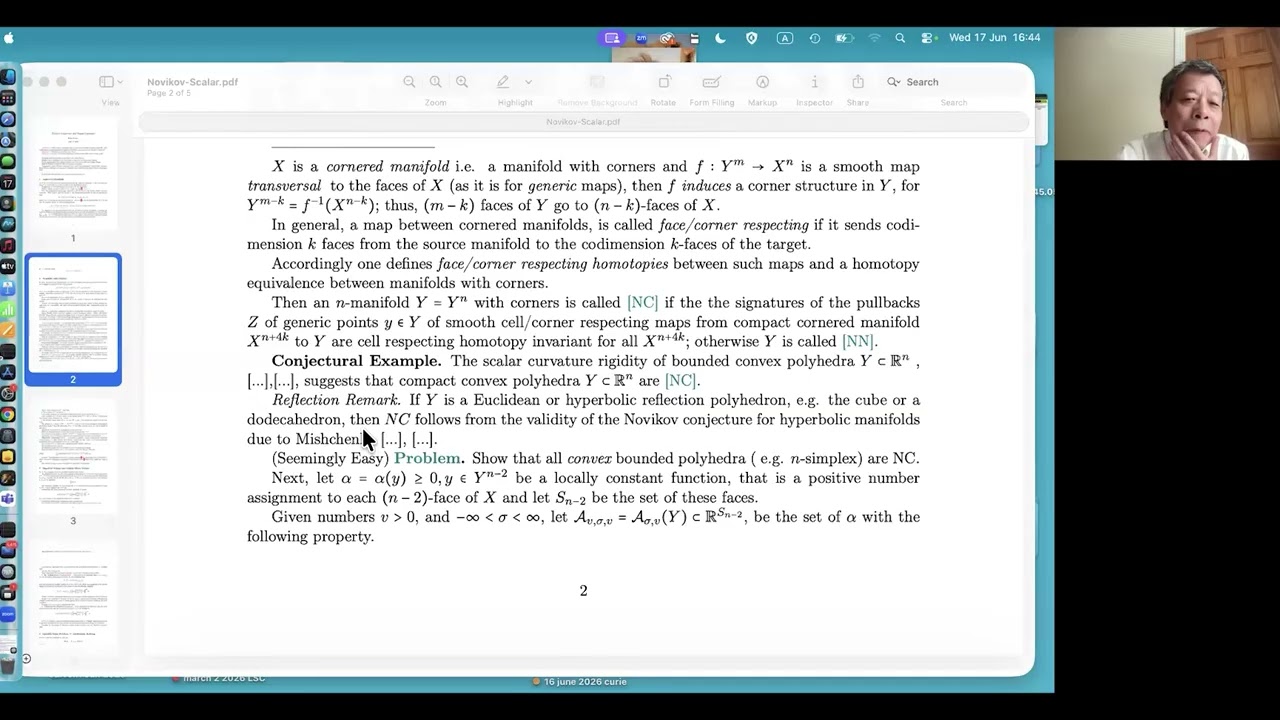
Misha Gromov - Novikov Conjecture and Scalar Curvature with Corners
Watch on YouTubeVideo summary
Misha Gromov explores the intersection of topology and geometry by extending classical concepts like the Novikov Conjecture and scalar curvature bounds from smooth closed manifolds to domains with corners, such as polyhedral shapes. While these conjectures hold true for convex structures like cubes due to reflection group arguments, they become significantly more complex or "sticky" when applied to non-convex corner configurations where standard reduction techniques fail. The discussion highlights a fundamental shift from purely topological invariants, such as the signature derived from homotopy groups, toward quantitative geometric constraints involving scalar curvature on polyhedral domains. This transition reveals that manifolds with corners possess a distinct combinatorial topology that differs markedly from the fundamental group theory of smooth spaces, introducing hidden complexities that challenge existing proofs and suggest potential counterexamples in higher-order polygons like pentagons where regularity breaks down even within Euclidean space.
A central theme involves specific geometric conjectures regarding maps between manifolds $M = P \times S^2$ onto convex polyhedra $P$, particularly focusing on distance-decreasing maps that preserve angles and faces. In such scenarios, it is proposed that if certain capillarity conditions at the corners are met, an embedded sphere homologous to zero must exist with an area strictly less than $\pi$. However, this conclusion holds for triangles via reflection arguments but fails or remains unproven for pentagons due to technical obstacles involving "capillaries" that prevent standard minimal surface methods from working. Gromov emphasizes that while these problems are manageable in three dimensions, four-dimensional arguments become artificial when moving beyond simple cubes to general polyhedra like pentagonal cross-sphere bridges, where splitting methods fail because the target geometry prevents necessary reflections or decompositions found in toroidal cases.
To address these challenges, alternative topological invariants such as simplicial volume and cell-counting variants related to Morse numbers are introduced to provide quantitative refinements that distinguish between even-dimensional negative curvature cases with non-zero invariants and odd-dimensional ones. Gromov argues for a maximal generalization of current formulations to connect operator spectra directly with topology and geometry, noting that proving these conjectures often requires combining minimal surface theory with index theorems for families, as neither approach suffices alone. He concludes that formulating these problems in their strongest possible terms makes them difficult to prove but easier to disprove if false, representing a significant challenge for future mathematical research over decades where unresolved issues regarding irregular minimal surfaces may lead to new geometric visions and objects when standard perturbation methods fail.
Read the full video transcript
[music]
Okay, I want to make a few remarks on
the subject matter which is kind of
obvious and historically you know that
of about 30 or 40 years or two subject
matter were going all along and
Rosenberg here he can kind of one of the
contributors to the big step that
formally
Some question on on scary question
follows from the solution of strong
version of of nical conjecture. Here is
a lot of literature and so on. One of
the question which arise in both
situations is if a spherical manifolds
have
can admit
and another if they satisfy the no of
conjecture. Now when I speak about the
no of conjecture I consider only the
most elementary form of this which is
amenable to various what I want to say
generalization and relating it more
directly to scient so on one hand the
simplest case on the other hand is
caring case sufficiently representative
and uh so so because we don't we can't
answer any of this question just make
another question [clears throat] which
kind of cheating And exactly if indeed
the two things are equivalent. It's not
strong conjecture. is usual no
conjecture usual SC conjecture
and it is if the fundamental class
validate no conjecture then it must have
positive scal and vice versa
and so this kind of cheating but this
kind of may I'm using to think about
that we know we don't know answer to
either of the two if they equivalent or
not and um So
I'm not certain that even was in the
version Rosenberg it is exactly obvious
in either direction but of course I emp
emphasize it is usual no of conjecture
was very very naive and what it says I
forate here. So we have background
manifold about which we care about of
conjecture and consider two other man
manifolds you map into there and
smooth generic map and and take pull
back of a generic point has some
signature dimension is right and if the
signature is hematotopic invariant of
manifold being mapped
take another manifold
and at allotopic equivalence between the
two and this of course this map related
with this commutive diagram if the
signature is invariant is doesn't change
and the homotopus and so what's
remarkable this is a follow from of
novik of brower theory that if y is
simply connected you can have any
signature which you want ex except for
it can vary change hematopy type from x
X1 to X2 you may have any signature of
this pullback except of course for some
dimension what [clears throat] co
dimension is just zero
this is a and and on the other hand
conjecturally if Y is a spherical
manifold it's not so
in and in in general if the core
fundamental class of Y is kind of come
from fundamental group you expect
conjecture this is a kind of essentially
a general form of this that this is
invariant. So when you take another
manifold mapped to your manifold take
pull back of a point and then signature
of this pullback if of course dimension
with multiple of four istop equivalent
to the manifold being domain man the
domain man your source is fixed but
conjecture can show this manifold y it
must be true for all axis and all maps
and this is more or less no conjecture
it's some variation dimension is not
multiple of four but you can reduce to
that and just to this fundamentals to
special case it's very special case on
the other hand it is essentially
everything reused to this case at least
if you speak about rational conjecture
okay so this is understood yeah yes what
I say or I say quickly assuming we kind
of know that yes
>> yes
>> does it make any difference whether we
talk about homotopic equivalences or
simple homotopic equivalences or is this
the same
Well, I'm not ready. I'm not ready to
answer this. I believe it's a material
here.
>> Okay.
>> I believe it the same. But you see
because you stabilize see as much as you
can. All this subtle point I believe of
simple amount of disappear.
>> Yeah. And it's rational anyway. So
>> it's rational anyway. Yeah. Everything
is rational anyway. Signature is
rational. Very
>> good.
>> Okay. So and now I I I just I turn my
major focus is concern manifold discon
for this context seems to be good good
structure and so this definition and
manifold being stratified. So we divide
it in the union of locally closed sets
such that top dimensional set is just
manifold itself in theory of the
manifold. Everything else boundary and
this and now they come the point that
this locally this composition if you
reduce it to small point will be this
the same up toomorphism
that what happens for convex polyhedra
in the paper.
There is some subtle point of convex and
nonconvex by the way right because some
angles you know
equivalent and some not right when you
pass 90 through pi yeah something
happens but let's assume we understand
it's locally
everywhere to a convex polyhedra in the
space or actually positive cone in the
convex cone in the space so this is our
object and this is standard terminology
and as a remark which kind of now we
have manifold with this property and
something related to no conjecture when
all faces are a spherical manifolds
they're covering are contractable and
when inject in embeddings from one face
to another
injective from their respective
fundamental group
this is kind of a creature and here you
kind of mix topology mixed is chotoics
and in fact ktoics carries secretly lots
of topology even if we have a usual
convex polyhedrin in the ukidian space
secretly it carries a lot of topology
for example if it's cube you reflect it
around the faces then you have taurus
and as you know was the first case where
no conjecture was proven by no himself
and this already non-trivial theorem and
this is kind of topology of okmetoatoric
of the cube and the question is how of
that extends to other convex polyhedra
both when it comes to scal curvature or
to no conjunction.
So here here is some reference which I
bring here
now. So what is no of conjecture here?
Now you speak about manifold which are
cornet and then there is natural concept
of a map of manifold corners and it's
modeled by the situation when you have a
generic map from some smooth manifold is
boundary boundary goes to boundary but
not manifold and this x manifold
here x and y sometimes switch who goes
to whom yeah and when you take pull
genetically pull back of a corner
structure you have a corner structure
and more freedom of these corner
structures and And now this how we
define corresponding morphism to the
category of corn and manifold just just
faces go to faces
and and this category you have a topic
vence in everything and you can ask
about no of conjecture exactly
and because you can take pull back of
generic point inside
and and if there is no corners you have
a ball then it's kind of simply
connected situation and then pull back
of a point by no means the signature is
not homotopy invariant again the moment
you have this maps you know what this
category is you know what homotopy of
maps what is hemattopic equivalence for
many for Wisconsin right is nothing but
it's of course this definition obvious
but you you bring in discriminatorics
which become kind of what in my view
pleasant about that that you just you
ask questions not about manif which fund
the mental group but you ask about
polyhedra and if you ask the question I
don't really about you know triangles or
simp because it had this topology
secretly in it and
conjecture is that if you take any kind
of x polyhedrin it satisfies no of
conjecture and I believe now follows
from what people know like you go along
and your guys probably can prove it
easily
for convex polyian
But for general manifold this corners
it's sticky. So when it is suppose it's
foical of conjecture
maybe slightly TK also I don't think
it's horribly difficult when when all
say all faces as biological cells but it
is not and works polyhedron but some
other kind of creature then it's not so
obvious I don't see how to prove it
instantaneously except when it happens
to be for example all corners are 90°
imagine you have
So it's all corners I'm sorry 90°
meaning they are said by isomeorphic to
the corners of the cube so simply as
possible corners then you can defle
reflect this creature you have a
reflection group reflection group is you
know is subgroup of manifold of negative
curvature and no conjure proof for this
case and so you know the answer
>> m here your high signature is like
relative to the boundary
>> no no yes signature for me is pulled
back signature of pull back or a generic
point inside.
>> Oh okay. And that's you know super
naive. You don't have even don't have to
know by the way I emphasize what gology
is cuz signature of manifold can be
defined without knowing what homology
is. All you have to know what are cycles
and that's it
right because what is the signature
because the quadratic form you take all
cycle on the middle dimension the cycle
classes this quadratic form of the
intersection and it has signature
because it's has infinite dimensional
kernel but modular kernel is fin
dimensional and it has his signature you
don't have to mention the word homology
and in the proof often you don't need
any homology it's much more elementary
than homology theory right exactly
nothing. It's just it looks kind of
super elementary topology, right? And
this was so nice in this setting when we
define we don't have all this you know
assembly map you don't need it just just
just about in intersection of that it's
remarkable thing that this such a thing
existically
invariant which you know not completely
real requires a little touch of homology
but really really underra undergraduate
thing and um and and that's about So
again for me there is this high
signature your signature will pull back
of manifold maps of the background
manifold in this background if it's
convex polyhedrin and your maps preserve
faces and hematopy understood in this
category then conjecturally it is
hematopian invariant which is okay
follows from usual no conjecture if all
faces are
say like of the cube or for any kind of
difficult
reflection group which so we can reflect
this around faces formally to to make a
manifold and this is coxic group yeah co
reflection but this simple but if it's
tricky for example if it is simply
done because realize convex so galank I
believe your techniques will easily
bring this to to
you just use instead of a manipulation
with dra you operate the h operator and
and check the signature behave okay this
index of this operator is defined for
many for the boundary and everything
probably will work but I haven't tried
to do that because you know there are
people who know this better but just
simp this is fun just for for simplex it
is a triangle of course I can do it but
I didn't try even for three for three
simple
but you see what's amusing because you
can manipulate this thing with manifold
you glue to manifolds along the face. We
can reflect move this way and that way
and all that because it's manifold this
corners make kind of a category even
with very simple corners you make kind
of cabarism category because you take
think like your manifold times interval
and then out of them you can
take next level time multiply by
something and then you develop all this
kind of categories like a
Cabon categories or more than that but
everything sits in this in this starting
starting point just polyhedra
all this kind of um cabon category kind
of corresponds to cubes but simplic is
already more complicated
and we in the minute I formulate very
specific one specific question I have a
simplex I have another manifold which
has combinatorial cornal structure
simplex you can see the map of such
manifold into the simplex faces go to
faces is homotopia of this map
preserving this property faces to faces
is homotopic equivalence between many
focus corners preserving the faces the
question is if this pull back pull back
of a point signature doesn't change
certainly much more constrained than
usual miracle conjection see it's more
constraint so it might be easier it's
easier therefore I believe if it is
convex polyhedrin in Ukrainian space
it's doesn't look horrible but for
general prehedron you can make obvious
obvious obvious conditions yeah it's not
true for any but if sufficiently
this corner structure sufficiently fine
refine for example take more or less any
structure then take something like
division you make it finer then I'm
pretty certain you have no conjecture
but then it's interesting thing so how
commenator will be most interesting to
see interesting commenatorial
characteristic where no conjecture is
true and when is not. Okay, because this
and and and this is a kind of
interesting thing topology
is kind of really unseparable.
You don't know what you're talking
about. But closer to no of conjecture,
you can see the manifolds where all
faces are themselves as spherical
manifolds and all maps are injective and
then of course is
some inter interpolation but I'm
thinking this category you can make
interesting reduction of one case to
another case but I don't know
but this what I find amusing. So this is
one first question but again coming to
my general
general question is because now I'll
from this moment on I'll turn to I'll
turn to SC but these are
the question yeah the basic questions so
how far you can go from because of
conjecture is topological is
quantitative aspect are kind of slightly
not so clean yeah there is no numbers in
there on the other And looking in
polyhedra you can produce numbers having
purely topological
significance. And here they are
it will be on my next slide. You see
it's here where there
Yes. And another yes just this is what I
want to say. So now how we can make
topology when you have exactly polyhedra
is that
kind of make topological invariant
starting from discriminatorial data and
incorporating scales because g topology
you can think maybe interestingly to
nical conjecture. You can consider all
geometries on on this on on a given
manifold with corners which satisfies
our usual condition. It has scaly
curvature bounded from from below say
all faces I mean convex and angles
bounded from above from by some numbers.
So we have a set of numbers and we
consider only those
where this condition is satisfied there
existic with these properties
metric all angles kind of rather sharp
and scal is rather big so there are
particularly vector of numbers where
it's possible and sometime it's
impossible so I have a set of vectors in
the equation space right it's really
kind of shape which carries a lot of
numeric information what it specific
examples take a simple
simplest example probably cube where
it's probably easy but already simp
maybe rather subtle. The question is
what is the nature of that set and and
if it has kind of significance
topological significance
which may allow you to refine know of
conjecture right not just something true
or not true but something about how
combinatoric of the hidden tell you
about this set because topological is
there is a set
convex set is carries topological about
many it's not like yes yes So as an
inovical conjecture it still kind of
introduces numbers. So that's the
question evaluate this set for a
specific polyhedra and give you a
polyhedral like simplex and give you
some generate some set. So what kind of
set is this? A very simple question. I
didn't try to answer this but I just
want to
>> m your sigma is not necessarily positive
right
>> whom
>> your sigma like the lower bound of scale
coverage. No. Yeah. I I I don't have to
say equal. I mean probably it's not
absolutely clear the same. Probably the
same. I can say I consider only metric
when certain numbers are realized or
which B number bound. I don't think
that's fundamental. But I prefer say
bounded.
I prefer to say bounded. Yeah. But there
is also think about the volume. In a
second we see that volume careful about
the volume and go to negative cvature.
And now we say some about that and this
is related to some theorem by Anderson
and and and thirst
that so what
I'm certainly thirst is perman
shown that you have hyperbolic manifold
and you then change it metric then and
keeping the the volume where it is then
scaly curvature may only go down right
as usual and uh and then it observed by
by Anderson that
it's not just volume but just this
integral
dimension two a minus 3 will satisfy
this condition only goes down therefore
this it follows then the same you see it
wouldn't follow from perman stance but
from the additional argument by Anderson
the Same apply to polyhedra. If you take
hyperbolic polyhedrin
then in dimension three it will satisfy
this kind of condition if it is
reflection polyhedra.
For example when it is cube
or whatever which are many it satisfy
this condition. If you take this
negative part of the scaling curvature
integrated in this thing with 3 over2
power then there will be this for this
formula which is kind of cute right
but it's open for general convex
polyhedrin only for those IC of course
again here we we know that this there
are several in the proof the one is in
inside of the argument by Anderson and
other imper and I guess all of them I
believe again without seriously thinking
but on the surface of things they must
be they apply it usually to to closed
manifold sometime many manifold with
boundary but I think everything applies
to many focus points so you have to
carry this richer flow and etc and again
this usually it works I mean I have no
serious mathematical reason for that but
superficially looking from general
perspect effective it must be so so this
very plausible and but then next level
what happened dimension bigger than
three or three well I don't know how to
prove it but there is a strategy in high
dimension who knows and before I realize
this using that give it for three I
would never conjecture this in higher
dimensions look so so strong
and uh but who knows maybe true
and if not true it might be easy to
count maybe to find counting example
this will be kind of polyhedra because
makes sense for polyhedra it's nice you
can check it for simplices for for small
for big where there are many cases when
this can go wrong right but this is true
probably for any convex polyhedrin or or
in fact for any hyperbolic manifold this
corners doesn't have to be convex it may
be really manifold you may have a lot of
topology but it is all faces flat
hyperbolic flat. So there is some
corners and then there is and then if
you vary the metric
then this this integral can only go
down
only goes down
negative part of scalation must increase
positive kind of immaterial only can
become more negative and uh and this is
nice because kind of rather strong
conjecture and may be wrong but if it's
true of your fun and the dimension trees
there are ways to say something okay
so actually I more than halfway through
then I say formulate some other
conjectures which are
uh which more more traditional this is
also
so okay so what is so maybe I just must
say little interruption
And I suggest I not actually your
question but my your opinion what you
think about that the presence here you
Bernard and just for context. So if you
uh formulate this conjecture in for the
spherical case so with um on spheres. So
do we then have the uh so the kind of
counter examples um as in the um as for
the menu conjecture or is this something
completely different? M conjunction what
what do you
>> yeah I mean that we um have a kind of um
extremality or
kind of um result if you have um
uh so extremity for the half sphere on
the uh so when when you have a metric
it's another story this exactly but my
emphasis here
>> first all this conjecture makes sense
for closed ventil but the emphasis When
there are corners.
>> Exactly.
>> Yes, there are indeed some conjunction
as a result of this
>> type for
these corners. But when you come to
positive curvature, you have to impose
typically condition on the size of the
manifold.
>> Right?
>> Because your maps when curvature is
positive must shrink
somehow controlled by this positive part
of SC negative doesn't happen. So this
are rather coarse statement. they're
much coarser because this doesn't enter
the game. We don't know how to make such
a stronger statement here. So this
causes negative in a way
kind of more superficial may be
>> but you don't know how to prove it and
of course even the sperman theorem the
per first kind of result in this
direction there is this sharp inequality
there are other this some result
involving spectrum of the manifold this
I forgot the name of this lady who woman
who proved it
and uh it gave pretty good estimate for
the relating scaly curvature and in the
first value of second the value of the
universal covering of the manif but this
essentially
constant and but for the volume in
dimension three of course is
the core of the experiment the
I don't think there is anything of the
kind
remote in exactly conjecture disappears
It's exactly completely fail. So and and
and nothing you don't expect anything
quantitative there because just
only it must become much more
quantitative to become interesting right
of course if you look at the no
conjecture for kind of geometric form
when you have this map between map they
pull back no matter how much this map
from quiz isometry how far boundary from
there you know some argument of the
imply no of conjecture of this of the
shape of your
signature is still invariant if you your
boundary kind of moved far away in the
way your map your homotopic equivalences
still keep away from the boundary right
certain proofs have perfectly work there
but they work but I don't know maybe you
know
there really sharp result there
quantitatively asymtoically you can say
what happens but I don't know if There
are sharp quantitative results really
inequality interesting inequality saying
that the signature is invariant if but
again next question what happens if you
slightly viate that in in how much you
have error in this in the signature
right so I
this was my first question what would be
the correct quantitative version of it
but I don't know if it's how plausible
such thing is and here. Well, what I'm
saying
some question which I ask I you may
expect
reasonably kind of
kind of comprehensive answer
but but but of course I don't know but
again just my general kind of thought
was in scaly we go further and fine and
final quantitative results relation
geometry scal it doesn't quite work so
no conjecture
and The question still brought it there
you can have to work just in terms of
direct hip operator and how spectrum
behaves it's another nice and varian
spectrum of the h operating some
spectrum properties related to something
else that's one way to perceive or you
can play topological game but there is I
think some actually
delay in topology
and comics may you can suggest
a way to go.
At the moment it seems to me that you
cannot
ignore discriminatorial aspects of that
maybe fundamental.
If you don't understand them you they're
not the end of the story but one of the
steps you have to bypass. Now let me
again repeat the same question with scal
simplicial volume and again kind of
essentially here kind of was emboldened
by this observation by
of of
refinement of the perman by
Anderson. Yeah, it's little simple
remark. It's not complete trivial that
you can
get back with integrals and that is the
question which again follows from
dimension three from this anderson for
closed manifold and when I speak about
simplicial volume so you represent your
cycle is combination of real combination
of simplices as usual and then there's
inequality and if it is
mainly with corners you insist that you
simply the boundary fits the bound the
faces that your your stratification into
the corners and and accordingly you have
this which were closed manifold follows
in dimension three from Anderson
and uh and this is again nice because
very general statement and again makes
sense for it makes sense for
polyhedra and uh it's everything of
course about negative
case because po this would imply of
course that many pos have zero simply
ial volume which we cannot prove but in
this form we have more examples to work
on when you have this convex polyhedrin
that's one of the points you and and you
they may
special cases here may be quite
interesting and amenable to what we know
so it's another question and and and
then there is another invariant where I
don't know what the sharp constant
should be and I just want to again
repeat the definition which I think is a
kind of nice which is a nice
object besides so you introduce so what
you say we have a manifold and you know
the bound on the scalation and you're
assuming it's negative otherwise this
invariant is supposed to be zero and you
can see the this your manifold and you
can see the such maps very very high
degree for other manifolds and you see
by how much
this the Morse number increases. So how
many critical points you need for morse
function. So what is overall kind of
homological complexity of a manifold
and then this is a again conjectural
statement. I want to edit it because I
didn't isolate this invariant. This is a
count counterpart of of the simplicial
volume but defined not by simplicities
but cells on manifolds and they are
related and then probably I don't know
how and the only estimates which I know
come from
from uh which are known only for
manufacture
of course which have non zero
characteristic if the if they zero
characteristic this environment probably
zero which is by the way I don't know
how to prove this it's it's zero
threedimensional hyperabolic manifold by
way we know about this circle this is a
vibration of the circle theorem so this
invariant is zero but for the fact it's
non zero for even dimensional hypotic is
a well it's just your index kind
argument and some moment you need some
particular presentation some property of
some final project you know something
about this Golang
probably the way you look you said kind
of know more than I do
oh u
yeah that well Chhatu and I have been
well we work on this conjecture yeah we
don't really get exactly the result you
wanted but
>> you meaningfully this with this
invariant. Yeah. How many the Mor
number?
>> Uh I think it's more the simplicial
volume.
>> No, no, but that's another story. With
this volume, it's another story. And
this volume you see the point is we know
the simplicial volume non zero for all
manifolds for all locally symmetric
spaces for most manifold in any sense
and here we don't this is not true. So
the meaning of that is not that this
corresponding wall group of non zero
fundamental class. So essentially what
it says you take this fundamental class
is element in the wall group in this
dimension no conjecture says it's non
zero right
>> but this says if you take a multiple of
this class the rank may when represented
goes linearly to infinity it's much
stronger so this is much stronger not
sing of this variant is a significant
strengthening of the no of conjunction
in terms of the L groups
the number of the cell essentially at
the rank of the so we have quadratic
form and you and which quadratic form
and this all this environment you
iterate them right you don't have
in the naive way you have some algebra
and take some weed group on the all this
algebra so it's quadratic form which
appear there what is the kind of what
dimension non-trivial problem but how it
grows when you iterate and amazingly it
may know simple cases goes
proportionally but but with three
remains it's not so it's not zero but it
goes very fast to zero because because
of the vibrations there so I think it's
very amusing and variant and the fact
topologically even the first example
where it's not trivial when it is for
for human surfaces it's kind of easy if
you take even surface map one to another
with degree D then genus roughly
multiplies by D at least by D right and
it's kind of clear but if you A product
of surfaces is not so clear right if you
map any manifold with high degree D then
the number of cell grows proportional to
D. So you have product of two rem
surfaces of of posive genus and you map
in this product you map many photo of
the same dimension with degree d then
the minimal number of of um cells in the
in the cell de composition grows at
least as fast as the up to constant I
don't know what the constant is of
course the proof
looks to give a reasonable constant
because rather sharp proof using is
index argument and there is no aspire I
remember there is no kind of rather
everything goes out sharply but still it
is kind of interesting interesting
interesting thing what happened there in
in general if you think about many false
locally symmetric spaces and what the
homology of they covering already there
not speaking about anybody map any
degree it's very subtle arithmetic
question right you have JL and Z and You
take some group of arithmetic subgroups.
What the homology of those? Who knows
how they grow up? Especially
when you look at
with coefficients, people like choice
probably have something to say about
that. So it is a very interesting thing
that is still present
topological fact but there is no simple
topological proof of it. It depends on
existence very known example very
particular representation of this group
and usual proof of conjecture as we know
we really need some some flat bundle
with some quadratic form and so it's
just imitating very closely the original
and which does not generalize as far as
I can see for example if you take
um
general even dimensional manifold of
negative curvature we don't know whether
it's true or not and of course I don't
know if there are I think there was a
kind of funny example that's odd
dimensional manifold of constant
negative cure being vibrated over
something I thought recently some papers
came like that which suggest this
environment will be zero so naturally
conjecture that for manifold of odd
dimensional manifold
possible of any kind of odd dimensional
meaning for this environment always zero
but but for the even dimensional say
manifold of negative curvature I guess
it is non zero but we have absolutely no
inkling how to prove it
and what I wrote here with scal curvish
is
kind of well
kind of opposite g bound on
So this is now let's turn to the last
topic
but Misha saw this um statement about
the scala curvature this where you have
also a control of mapping degrees this
vaguely reminds me of something that you
also mentioned here in your old book um
spectral gaps and higher signatures
where you know this is why I I I
realized
there. I mentioned it there and then
>> proved
what was needed for because before I
only could do it for kind of simple
example
from the product. There was some simple
but then he proved representation where
you expect it to be the right
representation
and classical some classical
representation of certain properties
and and but then there is a related
question about characteristic numbers
may or may not be related to what we say
but now come back to skovish now the
following question
that in some sense
that certain environments
can be multiply multiply main for scal
scal adds and you and see there are many
cases when it's not particularly scary
adds but extreme of scaly cover also
adds but extremely you have to define
what it means right so you can using
topology as a multip property of many
property you define some extreal number
the extremal scalation this might be
additive and just specific question
which I want to address which is we
discussed with with Charlie
and where also you can prove something
when there are reflection and no
reflection and here what's amusing the
case look rather hopeless even for
triangles we don't quite know in general
but the first nice symmetric case about
pentagon. So we know something true for
regular triangle something true for
regular square but we don't know it for
pentagon. So this will formulate the
question
and uh
we again we start with convex polyhedrin
and but now we are concerned not scal
curvature on this but scaly curvature on
this polyhedrin cross s2
and geome and we compare geometry of
this product it may be slightly more
general but that's good enough for
exposition which has positive mean
curvature as usual and has all corners
greater than greater than sorry smaller
than the corners of your polyhedrin and
moreover there is a map from your
manifold to this polyhedrin. All angles
go down and the map is distance
decreasing,
right?
And you you want and the scaling
curvature
will be greater than that of a sphere of
a sphere.
And and then you want to say that it
contains inside a sphere which has codic
curvature as big as
of the usual sphere which of course not
true literally but what is to what you
expect it is inequality. So there is a
sphere inside which represent
fundamental. So again you have a
manifold which is kind of looks expected
to be smaller than this this this sphere
but you don't map to the sphere. You map
but you map to this polyhedrin. So
sphere IP is a fiber right and so
there's decent decreasing map all angles
sharper than for the actually metric
product mean
then you have this conclusion that there
is a
surface inside which homologous to zero
multiple of non-zero class it's area
smaller than area of the of the visual
sphere in the way it is kind of smaller
than usual sphere but it's not and and
the proof if it work if the background
were not a polyhedrin that was honestly
closed manifold then it was theorem by
by
you know zoo pronounce his names
correctly
then it is it's done by producing this
minimum surface there we produce minimum
surface in in this class and it has area
less for pi but Here if your domain
where you map reflection polyhedrin for
example maybe cube or
some nice triangle whatever then you
reflect it again you reduce to this case
but if it's not you cannot reduce and
usually split argument we use the cha
completely dies for triangles maybe this
argument by which you discuss it may
work with triangles
for quadruples it wouldn't work because
And this problem runs into very
technical thing about capillaries at the
corners. So if you know if you knew that
capillaries at the corners were okay
then it would be pruned for triangles.
That's it. No no more than that. But but
if you look at this case this pentagon
absolutely there is no visible approach
to the problem kind of absolutely we can
prove nothing which was none of the
method tell you. Of course the dimension
two is special. The same question exists
when we multiply by sphere of any
dimension. But then it's more technical
statement. So what happens? Again you we
say all the same words but now we don't
claim this sphere of small area but
there is a sphere of small kind of
generalized kind of k area or some some
generalized still small sphere where
again if it were closed manifold in
dimension now must be careful about
which dimension
dimension below seven or eight or
something actually the recent
improvement and some recent improvement
we probably up to mention 10 probably
but not more not as much as 11 or 12 but
we you really need honest minimal
subariety not some cheating by blow up
from passia
then you can say that combining this
with some indexic argument you can prove
there are spheres and this has something
to do with this question
many for which cannot be immersed into
bounds domain and ucleian space for
small curvature the same kind of problem
but but this is a kind of key question
which is for kind of you see difficulty
of this problem because none of of known
methods can you give this conclusion
that if you have manifold it's sphere
cross something and it's polyhedrin
there is a small distance decreasing map
to the to this polyhedral domain like
this simplic so and curvature is
positive then you you expect that This
cannot be big in this direction, right?
Because station this direction on the
sphere po kind of model cure goes to
zero. So but we cannot prove it for of
course it's if you know it's something
for square we have have trivial proof
for that some kind of problem rough
rough estimate maybe I'm not certain by
the way but this is a what's so nice
this is a very clearcut conjecture just
about pentagon something we don't
understand about pentagon
and uh even if you say okay not poish
say zero sky say zero kovish She's a
free domain. It's already unclear what
to do. It doesn't help. So I can say is
this a domain in in in in the ukidian
space maybe which had this kind of
features
when maybe is maybe not in a ukian space
but sphere crossbow or something to
avoid irrad problems or can of course
sphere by a disc and then your condition
will be slightly more delicate. But in
principle when this poly
very simple polyhed there is a problem.
So your theorem about angles you see now
has this stronger version right if you
multiply it by a sphere it still leaves
this conjecture. So it's again this
philosophy that all thing about scal up
leave dimension you multiply them by
something and properties still remain.
So it's they behave very nicely under
the product of manifolds and again that
doesn't have strictly a product but
somebody which is mapped to a product as
usual but
the same by the way conjecture with the
spheres you say instead of this
polyhedrin you take closed manifold
which say spherical and then
we have the spherical manif
and the stronger conjecture will
multiply by sphere
You map it some way and there is some
fiber. This fiber must be kind of
morally small and this is a refinement
and generalization of any theorem you
have about and my issue is once you even
accept it and imag
conjecture
because you see we mix on the bottom you
say something which is kind of no
conjecture maybe true maybe not in the
fire sphere was opposite to no
conjunction but it's still clear
opposite and then the product is
properly formulated. Still remember that
in scalature world what happens in no
conjecture world and then exactly if you
start doing that may help you to to to
to make to to make some progress here.
Right. So so
this is this is my my my message that
looking at main visas you have so many
question opened and and and you have to
go go from one domain to another and see
what you can do. Maybe find a how to
crawl inside and see what happens. Of
course many of this conjecture make
completely false but making count
example kind of rather difficult. So far
I haven't seen any convincing example
with
no con simple variation of what we know
but I haven't seen construction very
unexpected construction of many photo
or somebody potentially
breaks some version
don't have that we optimistic and in
this okay so I'm through I don't think
they have anything else to
So and I expect your reaction again
>> because I
>> thank you very much for the talk that's
great
something like that
>> very interesting
>> so if you don't again we don't
understand the two issues ah many focus
corners in this domain no truly
understanding relation with the domain
so I have kind of two edges open. What
is the third? So we have lots of lots of
unknown here. But I love it. But the
last about pentagon for triangle say
maybe even for quadruples if you believe
in some regularity for capillary things
which is kind of plausible but who knows
it maybe on the other hand this
capillarity may break down and then this
may be not true even for triangles. For
regular triangles it's okay. It's called
by by reflection
by reflection.
I mean what I find interesting
fascinating is that uh so usually so
when you talk about the nov conjecture
then you have the simply connected case
okay and then you also have the
non-simply connected case so then you
have higher signatures and all these
these things and but now you kind of
generalize it into a different direction
right you you do not no longer talk
about smooth manifolds closed smooth
manifolds but manifolds with corners and
the fundamental group part is no longer
so important it's kind of orthogonal
somehow it seems to me Yeah, it's kind
of kind of orthogonal, right?
>> Yeah. Mhm. Very
>> but again secretly this
but maybe on the other hand the
structure of this meatoric it secretly
generalizes what fundamental group is
>> yes
>> when it's reflection polyhedron you can
say that's is fundamental group but if
not it's something else it's some object
and I don't know what it is some
interesting object mathematical object
and of course this may be not true maybe
if you start making count example about
maybe completely will collapse is
nothing there. But if if it doesn't, it
suggests interesting
interesting development
in and
>> are these objectives more accessible if
you assume that the homotopic
equivalences that you consider are of a
certain kind of maximum complexity so
that you say okay it's you have some
control on the homotop equivalence that
you are looking at so that you have
>> no but exactly this hemattopic
equivalence in the category of of a
category of corn manifold.
>> Oh okay.
>> Mhm.
>> Of course. Yeah. It is the whole point
otherwise if you don't say it it's just
nothing is true.
>> But then this corner structure doesn't
interfere
and you and the simplest case you take
this manifold multiply it by a sphere
and just ask about this how it changes
my topype. And if your manifold is
really kind of cornered manifold itself
is product of somebody by sphere
probably S1 or will not work S2 I'm not
certain say by3 and then it behave again
like in the simplicet case
this my guess it will kill this this
positive scary will kill will kill
topology kind of interesting
right and you connected so products play
essential at all. Another issue
immediately arising. We take this finite
product. We don't know if if there is a
reasonable way to go to infinite
products, right? Or unspecified product
or something and corresponding because
every time we apply particular zero
cooperator
adapted to this dimension but we can do
it without
efficient way to with unspecified
dimension. might there may be some way
to do it I guess
but I don't know how to how even to
formulate properly
and of course you can imagine some
formulation but I don't know good enough
formulation
that's another issue so again with with
kish my feeling you have to maximally
try to generalize go to the edges what
you know and and this may bring you to
new new new vision what happens right
because we a little bit stuck
And uh we have this problem we don't
know how to solve it. some of course
like irregularity of minimal services
right I think all believe eventually
will be solved by pertubation or
something
but that see in principle we don't know
what to do and one of them with spin
here brings another one we don't know
what to do for fourdimensional manifold
and it is pentagon cross sphere really
nice bridge manifold if it's hexagon
it's okay but for pentagon We don't know
this. He agrees strange you know maybe
it is indeed something hidden there
which maybe not exactly
but this is amusing in my view that we
have this problem
and another again with no conjecture
emphasize we don't have to know even
what homology is and this is not so
stupid we think in those terms maybe
some secret some secret word because
there are any way you may enter it and
develop some general theory of
completely different kind of conction
of course spectrum of the operator how
it behaves in in how influences topology
and geometry
but this I must don't don't quite have
this feeling it's there is no spin here
nothing
But the questioner among us with us and
so forth
and again for triangle you know we spoke
to to explain well this was what he
proves himself dimension three and here
is dimension four and this kind of
subtle regularity theorem for you take
minimum surface which is and boundary
has a corner What happened on the
corner? And maybe in so bad way you just
get it. You can't do anything.
This is when dimension three it's okay
with dimension four is
if you try to apply against this kind of
shyo argument. But this argument become
kind of artificial here because it's not
a product. You see you go from cubes to
general polyhedra. Maybe in principle
it's not true. I mean it's not an issue
and but some estimates need to be must
be there.
Okay. But so I have nothing to add what
I
>> was all I can all I can say about it.
>> Okay.
>> Myself I know I'm too old to think about
I just can offer this to somebody who
may may find it interesting.
>> Yeah. Yeah, indeed. Very interesting.
>> It's intriguing to have such a
conjecture. Yeah.
>> Yeah, definitely something for the
future 50 years. [laughter]
>> So, Misha, did you have some write up
some notes for this?
>> To to say what?
>> Oh, do you have some notes like
>> No, but this what this what's what I
have here.
>> That's all I have.
>> Yeah, they are probably on your
homepage, right? I mean on your homepage
there are many notes. I I am not certain
I put it on my page.
>> Yeah, maybe you can do that.
>> Maybe I have to. I thought about looking
at this book more carefully and I
probably put it on my page.
>> It's very interesting to look on your
page anyway.
>> I Yeah, I doubt
>> I recommend that to everybody.
>> Yeah, I don't think it is. I don't
[laughter]
>> Can I ask a question?
>> Yes.
>> Yeah. So uh this uh area question uh for
this sphere fibers is very this is
somewhat analogous to the euro n minus
two width question for scalar curvature
because instead of saying that you have
a map to a in this case prespecified
pentagon
>> for the fiber of the area is small there
you're asking
>> I map to the pentagon preserving this
corner structure and the map is a decent
decreasing
>> so so so is this formal uh similarity
just formal or there's uh some
connection here. No, but see this
question already if you map to a sphere
and this decreasing map and and if this
pullback will be small it's also unclear
what happens but swear maybe more
difficult even than this because for the
Taurus
you know and for for cubes we we know
how how it works
right and
so right this is a kind of if you have
many photo of certain positivity of SC
negative cv contractioning then the
fibers ought to be small whenever you
can apply of course Shenya method you
have enough room to apply it but this
exactly exactly what you you don't have
here because it's not cube yeah is as a
split your
in in this usual situation multiply by
something which contains inside the cube
it's cube or something bigger than cube
and so you can splitting but here
triangle you can split it but you can
reflect it and then split Seems quite
absurd. Yeah.
>> No, my question was is there this
relation some relationship between core
dimension to uron width and this uh very
uh restricted co- dimension to area of
fibers.
>> No, excuse me. Can you repeat it? You
can quit.
>> So your your your pentagon conjecture is
that you have this map to a pentagon or
in general a map uh and then the area of
the uh core dimension two fibers is
small because here core dimension two
fibers are just spheres. So
>> but no but this may be the question here
indeed because I mentioned two
fibers I'm in two dimensional fibers in
general I may have high dimensional
polyhedrin and multiply it by sphere in
map to this polyhedrin and if this
polyhedrin is refraction polyhedrin then
what I said said is true
okay it's it's not so much dimension two
it just accidentally happened to be it's
about two dimensional fiber if it's
higher dimensional it's threedimensional
fiber the statement of the theorem
become more technical yeah I don't want
to exactly formulate it but it says that
that it's conjecturally that certain
homology class is is must be small and
this is formulated in some kind of
specific terms and proven with index
theorem here you don't need index
theorem but
you can do it also the index theorem for
families but it's not dimension two it's
a dimension two so in princ in general
believe both big dimension big dimension
you take any kind of polyhedron of
certain kind you multiply it say by
sphere of certain kind and you know all
this and the map to a polyhedron
distance contracting
angles are right positive curvature big
and and mean convex then the axis of
this by which you multip multiply this
manifold must be small which case when
you just multiply you take your
polyhedral like you multiply by the
sphere and you see this equalities you
know what are angles what all things are
you saying you cannot and map is
decreasing keeping this distance
decreasing you cannot simultaneously
make co positive angle smaller without
contracting mass in dimension of your
manifold you shrink this closed manifold
of course you you you makes may make
things smaller and nothing changes. So
this obvious conjecture there are actual
geometric products in saying the
extremal situation is response this
extreal solution for this question.
Okay.
>> And this can be proven in some cases
when the basis is say Taurus, right?
When exactly use Shyao, you split it and
come to this small small fiber. But if
it's not a Taurus, something which far
from being split, we don't know what to
do.
>> So DJ, you mentioned the uh eison with
uh so what what do you have in mind
there? So it's
>> I was I was I was essentially asking if
you can ask the same question with you
uh urone n minus two width. Uh so right
now it is the uh area of uh dimension
two fibers which is
>> no but you need all fibers to be small.
Yeah I just say all fibers must be
small.
>> I see.
>> No no it's it's different. No of course
you don't
see it's not
property of the map. The map only tells
you give you bound up lower bound on
your manifold. It's lower bound not
upper bound. You see it's pinch scal
positive it's pinch in one direction
therefore expected to be and invo
positive and pinch in another direction.
So
this this is exactly a play of one
against another it nothing to do with
but at the surface of things it's not
related to
but this is a I'm saying if the manifold
you map into just hyperbolic manifold or
just any spherical manifold by the way
if it's four dimensional spherical
manifolds you know a spherical manifold
doesn't have so you expect the same be
true for any spherical manifold
conjecture
that the spherical mean have no position
have this generalization. So if you
multiply it by sphere and map is decent
decreasing time you have a small fiber
and and the same remains for high
dimension. This is st this product
feature. But
but this you the only way to approach it
at the moment for higher code dimension
you have to combine. Another of course
interesting point that if you whenever
case you can prove it except for spheres
you have to combine both yo minimal
surfaces and
index for families. You cannot prove it
by either one method which also very
muted
and and then you go beyond it and then
you cannot prove it at all. You don't
know where to start. This what I not
just you don't know how to prove you
don't know even where to start. That's
that's what's so nice.
Maybe you know how to make example.
Maybe you can start learning how to make
this manifest.
So all all kind of conjectures here
formulated in a maximally strong form.
So just to make it easiest to to
disprove
experience showed it's very hard this
conjecture hard to use proofs.