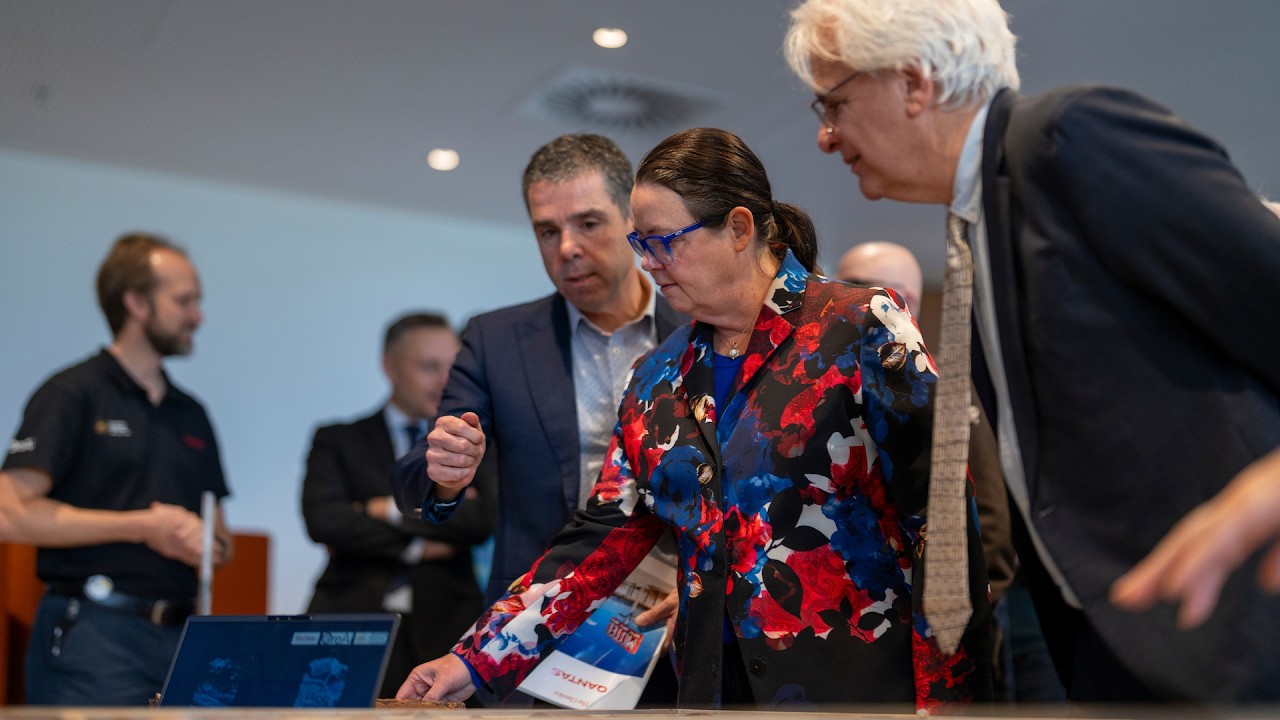
Minister for Resources, the Hon Madeleine King MP: Critical Minerals and National Security
Watch on YouTubeVideo summary
The Honorable Madeleine King, Australia's Minister for Resources, delivered a compelling address emphasizing that the nation's rich geological inheritance has evolved from a simple economic asset into a cornerstone of national security. She argued that while Australia possesses world-leading geoscience capabilities and a skilled workforce, the global dominance of China in midstream and downstream processing has created significant strategic vulnerabilities. Consequently, the government is mobilizing substantial financial resources to reinvigorate domestic critical minerals and rare earths industries, aiming to capture more value along the supply chain rather than merely exporting raw materials. This shift represents a move away from conventional market efficiency toward building resilient, trusted partnerships that prioritize sovereignty and security in an increasingly opaque global trading environment.
A central theme of the discussion was the necessity for Australia to lead international efforts to diversify supply chains and reduce dependency on single suppliers, particularly outside the G7 bloc. The Minister highlighted specific initiatives such as the Gallium production facility at Alcoa's refinery and the Arafura Nolan rare earths project, which are designed to counter export controls and market disruptions imposed by China. These projects demonstrate Australia's commitment to moving down the value chain through processing and refining, thereby alleviating supply domination by one nation. The strategy involves deepening cooperation with allies like the United States, Japan, and Canada through frameworks such as the US-Australia Critical Minerals Framework and the G7 Critical Minerals Production Alliance, ensuring that the world has access to secure alternatives for essential technologies in defense, energy, and advanced manufacturing.
The panelists further elaborated on the complex economic realities driving this strategic pivot, noting that Western nations previously abandoned midstream processing due to thin margins and environmental complexities, allowing China to consolidate control over these sectors. Experts explained that while geological advantages are fixed, intellectual property and technological capabilities can be developed over time, making the midstream sector a viable opportunity for collaboration. The conversation underscored that resilience requires not just absorbing short-term shocks but adapting medium-term strategies and transforming long-term systems through collective action. This approach acknowledges that achieving true security often involves bearing losses in non-commercially viable projects to ensure aggregate supply stability, a necessary trade-off in a democracy facing the risks of economic coercion.
Ultimately, the consensus reached was that Australia must embrace industrial policy and market creation to shape the next generation of critical minerals trading systems. The Minister concluded by stressing that this is a decadal enterprise requiring sustained commitment from government, industry, and academic institutions like ANU and the National Security College. By leveraging its unique geological endowment and trusted partner status, Australia aims to build an enduring alternative market that serves both national interests and global needs. The path forward involves navigating geopolitical uncertainties with clarity, investing in research and innovation, and fostering a new generation of talent dedicated to securing Australia's future as a dominant resources nation capable of delivering on its international leadership responsibilities.
Read the full video transcript
I too want to begin uh by acknowledging
the traditional custodians on the land
in which we gather here today, the
Nanomal people. I pay my respects to
their elders past uh present and accept
that respect to all aiginal and
toristrait islander peoples with us
today. And I'm reminded I've seen some
people in here from Geoscience Australia
where I learned from them when first
becoming minister uh that Australia's uh
first nations people are these this
nation's first miners, mappers,
navigators and indeed scientists. So
thanks uh to ANU and the National
Security College for the invitation uh
to speak here today. Uh thanks to AU
Deputy Vice Chancellor Stuart Wife with
us today and of course James from the
National uh Security College for this
opportunity. Uh I too want to
acknowledge the distinguished guests
from our diplomatic community, the many
heads of missions here uh who have made
time to be here this morning and I'm
delighted to be among so many
distinguished academics, policy leaders,
security practitioners, government,
industry and members of the diplomatic
corps. Collectively, you all sit at the
intersection of ideas, policy, and
national purpose. And that makes you a
vital part of this discussion. Our
economic prosperity has been built on
the back of our resources sector.
Increasingly though, our rich endowment
of natural resources is playing a vital
role in our nation's security. So when
we talk about critical minerals, we are
not simply talking about resources. We
are also talking about sovereign
capabilities that will secure
Australia's future.
Australia's geology is our inheritance
shaped by forces over millennia over
over which we have no control and we
never did. As James says, geology is not
a strategy.
But what we make of the inheritance is
really up to us. In many respects,
generations of Australia have made that
choice and Australia is a dominant
resources nation. We have a worldleading
geoscience capability, a highly skilled
workforce and a mining sector. Globally
recognized as the best in the world.
Through our resources sector, we make an
outsized contribution to global
manufacturing and in providing energy
security to our region. The Albanesei
government understands resources are
central to Australia's national security
and to the economic security of our
region.
The sustained period of peace and
prosperity in our region that we have
known for many years can be attributed
in very large part to the steady,
constant and reliable supply of
Australian energy commodities, coal,
gas, and uranium to our neighbors. But
increasingly, it is the question of
critical minerals that now sits at the
center of strategic decision making.
Critical minerals are key to defense
systems, energy, communications,
advanced technologies, and industrial
capability. They help protect us. They
help to keep the lights on to drive
innovation and deliver economic gains.
There is no future made in Australia
without a strong domestic critical
mineral sector.
The challenge for critical minerals in
rare earths lies in the markets and how
they are structured and traded.
Australia has an abundance of raw
critical minerals and rare earths. But
China over decades has built a
substantial advantage in critical
minerals midstream and downstream
processing leading to outright dominance
in the international market.
Beginning in the 1960s and ramping up in
the 1980s, those western countries with
significant mineral processing capacity
allowed that to atrophy.
That was in large part because of the
increasingly thin margins and growing
environmental complexity and an
unwillingness of governments to manage
that complexity, choosing instead to
outsource the whole enterprise to places
where environmental concerns are often
ignored. Whereas the United States and
Europe were the center of gravity and
rare earth processing in the 1960s. By
the 1990s that capacity including
expertise in mining, separation and
refining all but ceased to exist in
those jurisdictions.
In quite contrast, China has for decades
treated minerals processing as
strategically imported industry and
built that industry up to such an
extraordinary scale that midstream and
downstream supply chains are now wholly
concentrated in that one country.
The result has seen a strategically
significant domination in the global
supply of rare earths. And in recent
years, we've seen a rapid increase in
export controls, restrictions, and bans
across the whole chain of critical
minerals and rare earth production.
This has emphasized the risk of
concentrated supply of the products the
world needs for our modern technology.
The United States, Japan, and our
European partners have recognized their
exposure. They are actively seeking to
build resilient supply chains that are
less dependent on a single supplier and
are looking to Australia as a key ally
in that effort. This creates a challenge
for Australia. We are supporting new
supply chains, deepening international
cooperation and playing a larger role in
the diversification of those resources.
At the same time, we're continuing to
manage trade with our la largest trading
partner.
These are not conventional market
conditions.
But we have a responsibility to step up
and lead on critical minerals and rare
earths globally. And that's exactly what
we are doing. Australia, a country of
about 28 million people, has mobilized
one of the largest financial support
packages anywhere in the world with the
sole purpose of reinvigorating critical
minerals and rare earth processing
capacity here at home. This 28 billion
package ensures Australia is taking on
its international leadership
responsibilities.
The scale of this taxpayer support is
significant, but it is a funding package
that meets the scale of the challenge,
giving what we are asking projects here
at home to confront to take on opaque
markets shaped by concentrated market
power and structural distortions. That
is no easy challenge and no one country
can do this alone.
Just two weeks ago, the G7 leaders
meeting in France signed a new
declaration on cooperation on critical
minerals mining production and the need
to diversify supply chains. The G7
declaration hasn't received much
coverage in Australia, but as the
opening paragraph of the statement
notes, Australia supports a declaration
where G7 leaders committed to reducing
dependency on a single supplier outside
the G7 and partner countries.
In 2025, Australia joined the initial G7
critical minerals production alliance
established by Canada.
We will continue to be a member of the
expanded alliance under the latest
declaration. This declaration is
recognition of the work Australia has
been doing with our partners including
Japan, Canada, and the United States.
The declaration is a direct result of
Australia's global leadership in this
area. It recognizes that today's
critical minerals markets present
unconventional problems that require
unconventional responses.
Australia's response has been to commit
the nation to developing a critical
minerals and rare earth industry that
captures more value and builds sovereign
capability and an enduring position as a
world leader.
If Australia is to capture more value,
we need to move further down the value
chain.
The value and the leverage lie in the
processing and refining and increasingly
in the systems, data and technologies
that sit around them. Ambitious
Australian companies have recognized
this and are attempting to broaden these
concentrated supply chains. Uh for
instance, Victory Metals has established
a rare earth pilot processing facility
in Perth as part of the development of
the North Stanmore heavy rare earth
projects and that's near Q uh in the
Merchesen gold fields of Western
Australia.
The facility will play a critical role
in demonstrating and optimizing rare
earth processing helping to advance
plans for future commercial production.
And I was really glad to be able to
visit that pilot facility recently.
And that facility is itself a milestone
that demonstrates Australia can move
down the value chain and make important
inroads into alleviating outright supply
domination by one nation.
Supply chains that were once optimized
for efficiency are now being reshaped uh
around resilience, trust, strategic
alignment and geostrategic interests. We
are now part of a broader
reconfiguration of a a global trading
order. A system that has been largely
stable since it was created after the
Second World War. Countries are making
different choices about how they manage
risk. This presents both an opportunity
and a test for Australia.
While we are well positioned at the
front end of the supply chain, the next
phase of the work we do with
international partners will be defined
by how effectively we drive the creation
of a sustainable enduring alternative
market for the world.
And this work we will do and indeed are
doing with our partners in the United
States, Japan, Europe, and across the
G7.
We are more than simply a resource
provider. We are an enduring strategic
partner of choice and that's why we're
working with the US on agreements to
deliver strengthen secure and diversify
critical minerals and rare earth supply
chains.
Last year the prime minister industry
minister Tims and I met with the United
States President uh Donald Trump and his
cabinet to sign the landmark United
States Australia framework for securing
of supply and the mining and processing
of critical minerals and rare earths.
One of the projects included in that
deal is the gallium production facility
at Alcoa's Wagerup aluminina refinery in
Western Australia. And this project will
support growing demand for the critical
minerals necessary for semiconductors,
advanced electronics, and defense
applications.
But it will also address the market
disruption caused by the well-reported
introduction by China of export controls
on gallium in 2023.
Gallium is a byproduct of bork site that
we processed to aluminium. We have never
had to make gallium before because it
was freely available on international
markets. That all changed when China put
in place strict export controls on
supplies.
I'm enormously proud of the work of this
government and that of our partners in
Japan and the US who have all worked
together diligently and with purpose
since that trade ban to create new
sovereign capability in the production
of gallium.
Production capacity is anticipated to be
100 tons peranom representing about 10%
of global demand for that commodity.
Australia's financing is being provided
through export finance Australia under
the critical minerals facility and
delivers on the objectives of the
critical mineral strategic reserve.
Another important milestone in building
this industry is the Arafura Nolan's
rare earths project which was able to
announce very recently that it is ready
to commence construction near All
Springs in the heart of our nation as a
direct result of support through our
critical minerals strategic reserve.
All of this would not be possible of
course without the strong leadership of
united government with ministers working
together in lock step in the national
interest. And in this regard, I want to
acknowledge the excellent stewardship of
Australia's trade minister, Don Farrell.
And it's also critical to recognize the
exceptional work of the treasurer, Dr.
Jim Charas, in relation to decisions
facing the foreign investment review
board.
We have similar partnerships uh to the
US framework with nations like Japan and
Canada through multilateral forums like
the quadritical minerals initiative.
We're working with like-minded countries
to build critical mineral supply chains
for our shared economic and national
security.
In doing so, we'll be able to deliver
outcomes we simply couldn't deliver on
our own because resilience requires
scale and scale requires diversification
across global supply chains. This will
require coordination on investment,
shared standard standards and a
willingness to work through the
complexity of building industrial
capability across jurisdictions.
It's very difficult work that takes time
and commitment and it requires
trade-offs. But the alternative
continued concentration and domination
of supply chains by one producer
presents a much greater risk to our
national interests.
The risks of economic coercion are real
and Australia has experienced this
directly. We are already seeing how
disruptions in critical minerals supply
can flow through to manufacturing,
energy systems and defense capability.
They constrain choice, increase costs
and slow technological development.
For countries like Australia, the
challenge is to navigate this
environment with clarity about where we
can have the greatest impact. Part of
that is in industrial policy. It's about
where we and our partners choose to
build capability and how we support it
over time in the face of global
competition and how we confront the
challenge of unfair treatment charges
that make us smelters globally
uncompetitive.
The other part is market creation
because we don't have a viable, secure
or transparent critical mark critical
minerals market at present.
We need to help shape the next
generation of critical minerals markets
and the trading systems that underpin
them.
That means understanding where the
pressure points are, where new
dependencies may emerge and where the
next bottlenecks will sit and
positioning Australia where we can add
and draw down the most value.
And this is where institutions like the
National Security College play an
important role because the challenges we
are dealing with do not sit neatly
within any one single discipline.
They cut across economics, science,
security, technology, and geopolitics.
They require a level of integration
between research, industry, and
government that we have not always had
to bring together in the past. If we get
that right, Australia will be very well
placed.
As I have said, we have the resources,
we have the talent, we have the
technical capability, and we are a
trusted partner in a global system that
is placing increasing value on trust
over cost.
We need to be cleareyed about the limits
of Australia and our partners.
We will not out compete on every mineral
or at every stage in the value chain,
and we don't need to. Our task is to be
deliberate about where we invest, where
we partner, and how we position
ourselves in a system that is
increasingly contested.
Ultimately, this is not just about
resources.
It is about how countries manage
dependence and build resilience in a
more uncertain world. Critical minerals
and rare earths sit at the center of
that challenge.
And is a problem that grows with success
as the markets get bigger. So does the
demand on Australia and our ability to
respond. It's a good problem to have,
but a difficult problem to solve.
As we look to solve problems like this
and many others, it is institutions like
the Australian National University and
the National Security College and people
like all of you here today who will
remain crucial to our efforts.
So thank you once again for the chance
to be part of today's discussion. I'm
looking forward to taking part and the
panel that follows. Thank you so very
much.
>> Thank you.
>> So, thank you so much, Minister. And I'd
like now to invite our other panelists
to take their seat.
Come up. Uh this morning's panel is
moderated by the National Security
Colleges senior advisor and podcast host
Sharon Parker. Sharon is a secundi from
the department of defense with years of
experience in intelligence,
statecraftraft and emerging
technologies. She's joined in
conversation along with the minister
with professor John Maravagenis,
professor of economic geology at A&U, an
internationally recognized expert on or
deposits and rare earths. Professor
Llewellyn Hughes, director of the A&U
Institute for Climate, Energy and
Disaster Solutions, drawing on his
expertise in the political economy of
lowcarbon transitions and the global
clean energy supply chain. And finally,
Dr. Hugh Mai, visiting fellow at the A&U
Crawford School of Public Policy and
former chief economist at BHP. Please
help me in welcoming our panel.
>> Thank you everyone. Uh ladies and
gentlemen,
you know, we've been told for a long
time that Australia is the lucky
country. Uh part of that is obviously
what is in the ground. Can I ask first
Professor John uh Maveraginus, you know,
what is Australia's real strategic
advantage in critical minerals? What do
we have in the ground and what is its
importance?
>> Well, it turns out that
>> Can you hear me? Yeah. It turns out that
we have just about every critical
mineral in in in some amount somewhere.
Many of them are just byproducts as
Meline just mentioned that for instance
we've been throwing gallium away for 150
years and maybe it's about time we
started collecting it. But the the
advantage we have is that we have Mount
Weld in Western Australia that Linus is
mining now and which one of the biggest
uh rare earth deposits in the world. one
of only three that's supplying the world
essentially with with rare earths at the
moment and we have probably three four
five other prospects that could be
developed over the next decade and
that's just in the rare earths there's
antimony there's gallium there's
germanmanium there's there's the whole
periodic table here so it's it behooves
us to take advantage of that geology and
do something smart with it
>> fantastic I think that's where we're
actually heading um you know professor
Llewellyn Hughes, we heard it here this
morning uh from the minister,
unconventional problems require
unconventional solutions and and a lot
of the demand around this is being
driven by the energy transition. Uh you
know what can you tell us about those
capabilities and partnerships and and
what they actually require?
>> Thanks so much and thanks Minister uh
for your remarks uh uh this morning. Um
yeah so uh for those of you who uh have
not had the opportunity to look at it I
I commend to you the work of the
international energy agency um in uh its
analysis of uh future critical minerals
uh demand. Um the energy transition
really uh is already supercharging
demand for a wide range of critical uh
minerals. uh the numbers are pretty
extraordinary. Uh in order to meet a net
zero pathway, for example, you're really
talking about a six-fold increase in
aggregate demand across mineral types uh
in in in volutric terms. Um it takes a
long time to get a mine a mine up. So
one point the first point I guess is
that from a climate change perspective
given our international commitments
uh uh that um that you uh you know we
need to hurry up and it provides a
strong rationale for governments
collectively to uh join together in
order to enable that to happen. The
second point uh you know as the minister
alluded to was the problem of uh
dependence and market power. Um
regardless uh of you know who that actor
might be that has market power um it's
it's a really substantial problem in
many of these markets. Um if you look at
the oil industry for example you know a
natural resource that we faced market
power problems in for years in its
absolute pomp uh OPEC uh you know
controlled about 55% of global
production of oil uh and here as we've
heard uh the the dominance particularly
in the midstream uh in refining uh
although not only that that's not only
the case right if you look at cobalt for
example and the upstream uh problems lie
in
uh in in market dominance um the the the
level of of market power uh is is far in
excess of that. So whether you're
talking uh about uh you know climate
change um whether you're talking uh
about uh the propensity or the
possibility of economic coercion
problems of market power there's a very
strong rationale for um for uh for
like-minded countries to get together
and to intervene. I was really struck by
the remarks I worked in DC for a number
of years and you know when I was
teaching there we spent our time in the
mid2010s teaching about the Washington
consensus right and you can really hear
how we've moved substantially on from
that consensus and are now talking about
how we might collaborate uh we might
come back to it but I think the emphasis
of the minister on the need for
international coordination collaboration
is absolutely crucial
>> well why don't why don't we just go
straight to to that point, you know,
partnerships and industrial policy and
and how the region ally allied
arrangements with Japan, etc. Azan or
the Quad um you know, support sovereign
capability strategy. Now, how do we
avoid just recreating dependence?
>> Yeah. So, uh, look, um, uh, it is such
an extraordinary change, you know,
sitting here and talking about industry
policy because we kind of weren't
allowed to do that for for for a for,
um, you know, for quite a long time. Um,
and I there are two aspects, I think.
First is about um, aligning uh, internal
capabilities within Australia, right? I
mean, as the minister noted, this is a
highly trans disciplinary issue in the
research space. That means we're
reaching from national security across
economics uh you know uh uh earth
sciences uh as well of course uh you
know crucially that's also the case in
terms of government ministries as well
right and department so you've got trade
you've got national security home
affairs uh uh geoscience Australia and
others as well so we kind of you know
institution building was such an
important and interesting framing I
think um because it is so important
domestically the second part of this is
you know when we last thought about
industry polic policy in the 70s um you
know it was all about building
everything at home and exporting final
products but we live in a world of
global value chains today and and so
international collaboration and
coordination is crucial. I think the
agreement that was signed between Prime
Minister Albanzi um uh and Prime
Minister Takahichi from Japan recently
was was a really terrific agreement
because it had a governance overlay
enabling international collaboration and
also identified specific projects and
and and you know so we can think about
how to remove bottlenecks in those
particular projects. So you know I I
think there's you know terrific work
that's been done and we are in a new
world and we need to see more of that.
Fantastic. Thank you. Look, I guess this
takes us then uh and Dr. Hugh McCay to
the idea of uh an enduring strategic
partner of choice. Uh that could be
considered a loaded question and
certainly a geopolitical
statement, but it's a really really
important one to answer and address as
we uh you know, as we sit here today. Um
can you set the market reality for us
and and talk through some of the issues
that we collectively are going to face
as we uh as we move this issue forward.
>> Excellent.
Now uh the way I want to shape this this
conversation is not to think about
individual markets but to talk about
value chains uh as as a few already
have. The way we got to this position is
by the Wall Street mentality which has
perated the West since the 1970s. We've
salami sliced the value chain and we've
put very very high performance standards
in terms of profitability and return on
capital on every slice.
That is why we've abandoned the middle.
Yes, environmental regulations might
have had something to do with it a few
decades ago, but right now it's all
about slim returns on capital and
capital drifting to the the dumbbells of
the value chain. The end with the
intellectual property downstream or the
geological comparative advantage at the
other end. The middle makes no money.
Therefore, it doesn't attract any money.
On the other side of the equation, we
have a financially repressive regime in
China running an economic security
policy willing to bear losses, low
returns on capital in segments of the
value chain to prioritize other elements
of the value chain. Willing to bear that
loss in a vertically integrated
operation
because they're pursuing an economically
secure economy in and of themselves. And
that sort of feeds back on itself to a
coercive uh approach to this particular
this particular issue.
So how do you deal with that? Well,
first of all, you think about what are
the sources of market power? What are
the sources of competitive advantage?
And where are the barriers to entry high
and where are the barriers to entry low?
And this is why the midstream
opportunity is an opportunity. It's not
just something we should talk about
because the barriers to entry there,
there are modest barriers to entry in
terms of intellectual property and in
terms of your ability to deploy the
capital, but ultimately they're not
something that is insurmountable with
the benefit of time.
Geological comparative advantage, you
can't just magic that up. an
intellectual property at the other end
in manufacturing downstream that can be
very difficult to crack. But in the
middle where China's dominance is
profound and going back a step in time,
most of the investment in processing
capacity has been in countries which are
resource poor in their own right and
it's their response to economic security
in this value chain. They want to get
some sense of control over the value so
they go where the barriers to entry are
lowest. The last time treatment and
refining charges were this low globally
was when Japan was building a lot of
smelters in the late 1960s and they were
doing it at a time when they had to bid
up for all the concentrate.
So that's my main sort of jumping off
point. Where are the barriers to entry
lower? They're lowest in the midstream.
That's why everyone can participate if
they choose to. You just need to make
that decision to drop some returns on
aggregate, have lower returns on
capital,
and
you can then leverage your comparative
advantage downstream if you're
Australia. Sorry, upstream if you're
Australia, downstream if you're the
United States, your Taiwan, your Japan,
your South Korea, uh your Germany, uh
upstream for Chile. And I think it can
work uh over the fullness of time.
>> So, you know, I really want to pull the
thread there just a little bit more
because
I think you've captured that in a really
neat little statement. I think uh I
would understand that problem uh having
other issues. One of those is around
coercion of the market and how other
nations might actually respond to
Australia's perspective and what it
intends to actually do. Um, you know,
how should how should we prepare for
that and are there second and third
order steps that we can prepare for to
to make sure that we capture that early?
>> Okay. So when you're targeting
resilience, it's good to be very precise
about what you mean by the term
resilience rather than just throwing it
out there as this nebulous term which
means oh I did slightly less worse than
I might have done which is often the
common usage.
>> Absolutely.
>> Now what is resilience
as an intertemporal concept? First of
all it's your ability to absorb shocks
in the short run.
In the medium term, it's your ability to
adapt.
In the long run,
it's your ability to transform.
And that's really what like-minded
countries are talking about. They're
talking about transformation.
And transformation requires dramatic
interventions
when the direction of travel is not what
you want.
But before we get there, we have to
improve our ability to absorb, which
brings me to coercion. And some of the
tools that we have at our disposal
there, the Australian government has put
some of those tools in place.
They're not necessarily
strong enough yet. Things like the
critical minerals reserve is early days.
that's nent but that can be a very very
flexible tool when you can think about
your ability to absorb
your ability to adapt uh where I'd love
to see more focus uh like the ORAI
project that Riotinto is sponsoring
bringing highquality
uh researchers around the world together
on a topic like substitution
substitution recycling these are areas
which can help you adapt and an embed
medium-term uh options. But then to
transform in the long run, you need to
redesign your system on a full spectrum
basis to be more effective in all of
these areas. And as the minister has
said, different segments of that value
chain, different like-minded countries
are in a better position to attack them.
And that needs a collective strategy
more so than an individual nationbased
strategy because of the different places
those competitive advantages are
distributed.
>> Yeah, I like the reference to uh you
know a non-individual answer there. I
guess my next question then comes back
to you John. uh you know the deposit to
capability gap which I think we see um
what does it take to close the gap and
how long is it realistically going to
take us to get to where Hugh thinks we
should be
>> well one of the obvious barriers we
faced is in processing extraction
separating the rare earths this has been
something our government struggled with
for a decade their initial thoughts were
to put a lot of money into one company
to build a facility in Western Australia
which many of us were critical of but
I'd like to congratulate the government
on recently putting money into ANSTOW, a
government organization that's had the
capability to do this for decades. In
fact, they were world leaders in this
and so expanding that has been a really
smart move and I congratulate you Meline
on that. I think that was really great
because we've been there and that that's
a great organization. So what we need is
is more of that midstream that Hugh was
talking about that we've got the mineral
deposits. We have to get them started
mining and then we have to get that
stuff and we have to process it here
rather than ship it overseas to process
it so that we can get more of the value
in the stream before we send it
overseas.
>> So can I ask a
>> can I ask a uh a synthesis question of
you Minister King? You know, you've
heard the three vantage points.
Obviously, there are um some deep,
broad, and and wide interests there.
You're the person that has has spoken
about scale and jurisdiction. And then
the requirement to target or or to
understand value is trust over cost. Um
there there are going to be costs here.
How do you um how do you respond to to
all of the statements that have been
made today? and uh and how does the the
lay person in Australia then focus on
critical minerals as something they
should know about.
>> Um a lot has been said so I'm not sure I
can synthesize them but I but I would
say I agree with every one of the
panelists there some really uh
thoughtful comments uh um as to to
valuing trust over cost. It goes to that
u market uh piece that that Hugh spoke
about about uh and and I mentioned it in
my remarks. Uh we used to oh we still do
in global trade. We always value
efficiency uh and cost over sometimes
other things. We've done that for some
time. Uh I I do think uh there was the
challenge around confronting changing
community expectations around the
environment. And I agree it's not the
only reason why uh many western
countries sort of chose to outsource. It
just became a bit too tough. Uh
Australia's always mined and and we've
had to because and that's saying the
traditional commodities uh that is the
basis of of our economy and there's
there's no ifs or buts about that.
That's just a fact. So we've always had
to deal with the environmental
challenges and deal with changes uh and
responsibly deal with changes in
community expectations.
And that's a really good thing that
we've got to a good place as well as
dealing with other uh changes in uh for
instance uh paying a great deal more
regard and respect for traditional
owners uh through through native title
on on mining uh and so forth. So uh but
then coupled with how a changing market
uh became and is now uh entirely opaque
uh around critical minerals and rare
earths. And if I can uh one of the
examples I mentioned was was the gallium
uh project uh in uh wager up in WA. And
quite literally no one would be doing
this if if we were able to still get
that commodity at a reasonable price
easily. uh we wouldn't be necessarily
driven to do it but it is an example
that follows the Lionus example the rare
earth's uh example that John mentioned
uh that I mean that facil the the the
mine itself uh is progressing the the
refinery that they've built now in
Calguli uh is progressing really because
of a ban of rare earths to China and I
think it was 2012 that led Japan to
decide well we can't have that kind of
uh future export control hanging over
our head all the time for the things we
need to make and we want to make
technologies whether it be uh for the
transition or for defense applications
or just modern technology. So we will
invest in this project and that's why
that project's happening and that's
their strategic reserve in rare earth so
to speak. Uh gallium's similar uh in
that we didn't have to make it, but
someone stopped selling it, so we got to
make it. And when we can make it, like
John said, we can absolutely do it. It's
a minimal cost in the midstream as an
add-on to something we already do a lot
of.
But we do have to diversify all those
projects. I think John mentioned your
references to the Enyaba project, the
the Aluca project, and a lot of that is
around the actual stockpile that was
there. That was a lot of the value and
and the reason a government before us
and and we followed it as well had to
invest. But making sure there's like an
arc of uh capacities across the country
is really important and investing in
that IP uh and that new knowhow through
the likes of of of ANSTO and and uh the
CRC that that works on this as well is
is also vitally important.
that
>> excuse me as I struggle with the
technology. Uh you know I guess the
the final question might actually land
on how government then sustains this
strategy you know as one of many
strategies that it is working toward
achieving across electoral and commodity
price cycles and things like that. These
are the the dayto-day responses that you
know we'll all have to deal with.
um you know and and I guess I open that
to the floor as well.
>> Do you want me to start? I'll just
start. I didn't ask that last. Why
should people care about critical
minerals as well? Um uh so I'll go to
the sustainment piece is important. Uh
this is taxpay money that that we put
out through the critical minerals
facility. uh the strategic reserve, the
northern Australia infrastructure
facility and uh other works through
export finance Australia
and that's important to remember and we
always remember as a government that's
why these these are all repayable
facilities but also it's not just
Australia and I said that we can't do
this on our own and so making it a
sustainable and enduring response and
building an extra an additional
alternative market we we need our
friends and our friends need us uh and
we are uh making the most of long-term
relationships in energy security
particularly with uh Japan but also the
Republic of Korea and others. Uh we want
them to invest in our critical mineral
strategic reserve. Uh that isn't enough
to do what we want to do. Uh we we will
work with our friends in the United
States. Uh they've announced Project
Vault. We've got our strategic reserve
up much quicker than they'll ever get
Project Vault up. even though that's got
more uh funding into it. So uh we want
them to to join with us uh in investing
in well our comparative advantage for us
as Australia and Australians but that
all goes into uh making sure there is
diversified supply chains uh for other
parts of the globe. Why should everyday
uh people care about critical minerals
and rare earths? Well, it's because it's
in everything. uh and we kind of didn't
either appreciate this and but so are
all minerals by the way but uh also the
these things are are just uh integral to
modern life now uh and we should want to
make the most of our geology which uh
provides them through manufacturing and
for everyday people it's it's jobs it's
a lot of jobs in this industry as well
I'll leave it at Hugh
>> I think that there's a there's a really
important task to increase the uh the
public profile or the excitement around
the industry so we can build the next
generation of people are going to work
in this industry. And that's why uh when
we talk about economic security, we
cannot miss the energy transition
because if you survey your average
22-year-old
uh the energy transition is a much more
motivating and galvanizing force than
his economic security. We have to make
that link so that we have a group of
people who want to study geology, want
to study metallurgy in particular and
this is an industry they want to be
involved in
uh for private reasons commercially and
also for patriotic reasons in the
national interest. And if we don't have
that generation of talent coming
through,
we will be very dependent on imported
skills and we'll have to be able to
track the foreign investment. Now just
adding on to this again though there is
a there's a difficulty politically
around this and I go back to the 1950s
and when the US induced more than 50 new
copper mines in response to a national
interest call to increase the security
of copper supply.
That report said very very clearly we
know that these mines are marginal and
they would not be commercially
successful.
But what happens if you induce minds
that aren't commercially successful and
they become a money pit? And that's a
real problem uh in a democracy cuz to
make a real difference to aggregate
supply you have to induce mines that
wouldn't be financed commercially. You
can accelerate ones which can't get
going countery, but ultimately you need
some non-economic mines to be digging
the dirt and you need some non-economic
smelters to be processing it into metal
and you need some non-economic chemicals
uh facilities which are turning it into
a useful chemical. And so you are
bearing losses and these losses could
endure for a very very long time and the
case needs to be made well in advance
before you choose
uh that particular path.
I I like the uh you know the analogy
you've used I guess with the you know a
global hedgeimon uh when you're a hammer
everything looks like a nail and you can
afford to actually uh you know conduct a
a form of overreach uh by creating too
much. um Australia is not like that and
I think the theme that I'm seeing here
is uh an appeal for leadership across
many sectors to actually communicate
better uh communicate more. Minister,
can I leave the last word with you? If
you were going to deliver a single
cogent message for everything that you
have raised today and everything that's
been raised by the rest of the panel,
what would it be?
single country. Thank you. Um uh
this industry is vital. Uh this industry
is vital to Australia's
economic security into the future. It's
also uh vital for uh national security
into the future. Uh we have to and we
are but we need to continue it. And like
you sorry I'm not being so cogent or
short. Uh like you said this this this
is a lasting enterprise. Uh we won't uh
you know resolve the issue of of
creating alternative supply chains
overnight. This is decadal. Uh so we we
must commit and commit with purpose and
commit with our our friends and partners
because we can't do it alone. But I
guess you know all in all it's it's a
national enterprise. Australia has to
step up and indeed is stepping up to
lead globally in critical minerals and
rare earths. Uh and
you know we won't be dissuaded from
that.
>> What I'm hearing is Australia the gold
standard in critical minerals uh through
life. Yeah. Amazing. Uh lady and
gentlemen, thank you very much for your
time today. Ladies and gentlemen, can I
ask you to please join me in in thanking
our panel.