Video summary
In this update of the T2sday project, the host reflects on a challenging month where initial goals regarding real-time visualization and specific hardware achievements were not fully met due to significant technical hurdles. The primary focus shifts toward explaining the complex architecture of Tenstorrent's Blackhole Quietbox, specifically contrasting its Multi-Instruction Multiple Data (MIMD) approach with traditional Single Instruction Multiple Data (SIMD) systems like NVIDIA GPUs. While SIMD architectures force all processing units to execute the same instruction simultaneously on different data, requiring expensive synchronization logic for divergent paths, MIMD allows each core or "heart" to operate independently. This independence offers greater flexibility but introduces new challenges in managing state and ensuring consistency without constant global coordination.
The host delves into the intricacies of hardware threads within these tiles, noting that unlike software threads which can be spun up and down as needed, all five fixed hardware hearts are always active, meaning idle cycles represent wasted performance potential. He explains his evolution from a simple Arduino-style setup loop to a more sophisticated "task epoch framework" designed to manage the initialization sequences of these diverse cores. This new system treats tasks as functional goals that may span multiple hearts and utilize both private fast RAM and shared L1 memory across different stages, such as booting, growing, living, or reserving resources. The architecture is further differentiated by specialized roles for specific hearts, such as one dedicated to random number generation and others handling data ingestion, unpacking, mathematical processing, packing, and output transmission.
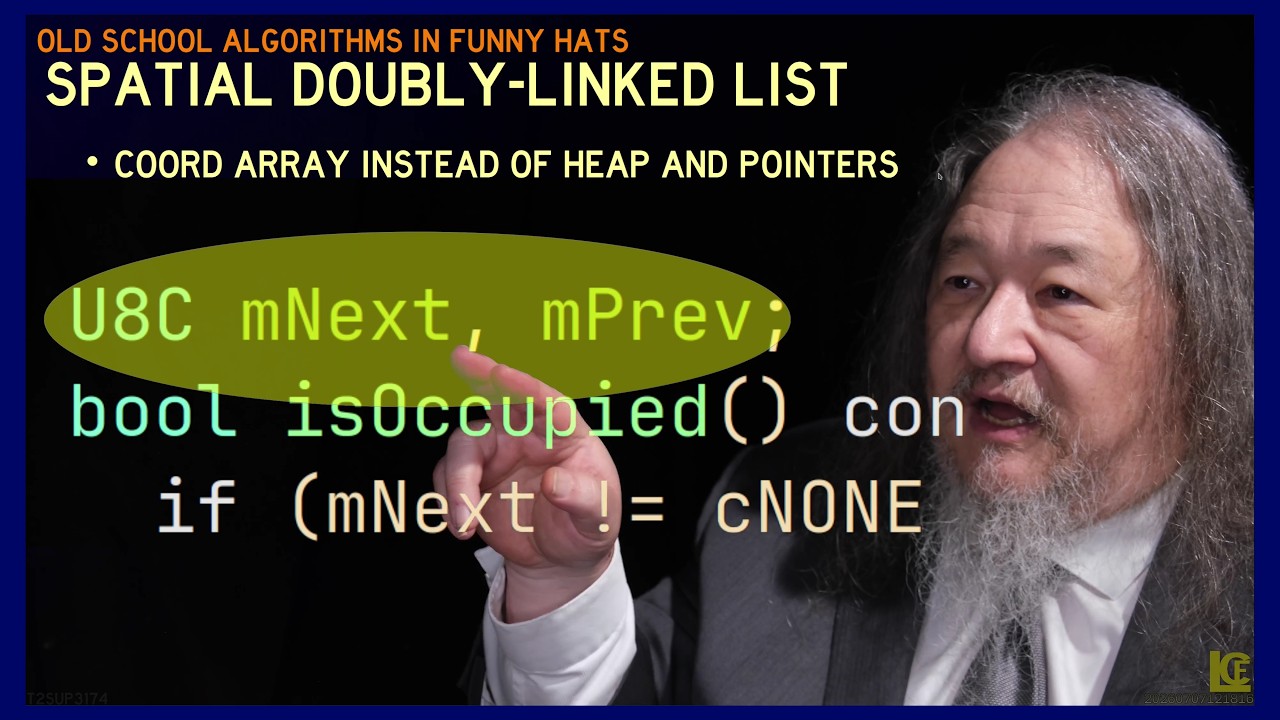
To address the need for efficient communication between the grid of atoms on the chip and the host computer, the developer implemented custom algorithms including atomic compression using a modified Lempel-Ziv method tailored to fit within tight memory constraints rather than relying on standard power-of-two buffer sizes. A significant portion of the update is dedicated to data structures used to track modifications; instead of pointers which can be difficult to manage in this specific context, he utilized 2D coordinates stored as bytes to create a doubly linked list that allows for efficient access and updates from anywhere within the grid. Despite these innovative coding efforts involving traditional computer science concepts like linked lists and atomic operations, the host admits that the system is still not stable enough for a public demonstration, acknowledging that debugging mysterious behaviors caused by complex initialization dependencies has been an exhausting but necessary part of pushing forward with this unique MIMD architecture.
Read the full video transcript
Everybody, it's T Tuesday.
Perhaps you are someone new.
The last T Tuesday update from June is
in the tiny little sense of the uh
um
T Tuesday project channel is number one
against its own previous 10
episodes and it's got 500 views which is
already more than
well, more than most. So so thank you if
you're if you're coming to check back
in,
thank you again.
This is going to be another kind of a
little bit nerdy
but you know, hey, if you're interested
in what life is like living with a Tense
Torrent Quiet Box Black Hole, well, this
is the place to be. So, the goals for
today,
the long and short of it is I did not do
very well. Spiky Interhub for real,
don't even have to explain what that is
because I failed utterly.
Real host viz running, also. And the
fact that there was two reals in those
things was that that was my claim that
it was supposed to be sure that I'd be
able to do it for real this time and I
didn't achieve either of them. I gave
myself a possibility of trying to do
compress atoms to save bandwidth when
sending it up for it to be displayed on
some
video stream at some point.
I I did okay on that except for the part
about sending it up to be displayed.
And yeah, I had big fun. So let's go.
For today, I want to talk a little bit
more about the
architecture uh of the Quiet Box well,
of the Black Holes and the Tense chips
the Tense Torrents chips.
These ideas of hearts hardware threads.
Um
and, you know, calling it a hardware
thread is kind of deceptively simple.
It's like, "Oh, I've used threads. I've
used software threads. How different
could hardware threads be?" Well, it
kind of turns out they're quite
different. Feels quite different. Uh um
and in particular, it shows up in the
init seek, the initialization
sequence. Now, I've been through this uh
story before. Uh uh back uh in the
1990s, I worked on a sort of distributed
social network, sort of like a
multiplayer, not massive, online
role-playing game, blah blah blah,
called CCR. And it became quite
complicated. It had many layers. And the
getting CCR started up it was like
booting an operating system in a lot of
ways. It was like booting an operating
system. It had a tremendous number of
stages and a tremendous amount of code
that needed to run while not all the
facilities of the operating system were
working yet. So, there were these kind
of levels where, you know, here you're
really in the stone age. All you can do
is this. You can't even allocate memory.
And then now you can do a little more,
and so on.
And that has started to happen in the
code that I'm running through the
writing for the T6 tiles.
And it's causing no end of bugs and
lockups and mysterious behavior, which
is why I I think uh I largely failed at
my goals
uh this month. Uh in addition, I I
actually got to do some kind of
old-fashioned
uh you know, computer science
algorithms, like you know, linked lists
and stuff. I want to try to talk about
that a little bit. We'll see how much
time we've got.
Okay. So,
I talked last time about the the
fundamental Tenstorrent uh value
proposition. It is that they're going to
provide MIMD CPUs that have local
memory, that have instructions that are
being fetched from local memory. So,
this little CPU over here and this
little CPU over here do not have to be
doing the same instruction at the same
time. Versus SIMD versus Nvidia, the
traditional GPUs that are fundamentally
based on everybody doing the same
instruction at the same time just on
different data on different parts of the
screen. And as I said last time, there's
lots of sub asterisks in that and and
Nvidia can do much more than just simple
SIMD and so forth. But, it is a
represents a fundamental alternative on
the attitude about how we should do
synchronization. In SIMD, single
instruction multiple data, we're
essentially saying we want everybody to
be sync to be synchronized all the time.
And if you don't want to do that, like
if you want to have an if statement that
some folks some proces- sors are are
going to do and some processes are not
going to do, well, that's going to cost
extra in the model. And in SIMD, you
have to do it by running both
alternatives and telling these guys to
be quiet while we do this one and then
tell those guys to be quiet while we do
that one.
In MIMD, you have synchronization
nowhere.
Everything is running independently, at
least in principle.
And if you want any synchronization,
that's going to cost you. So,
I asked for MIMD.
The movable phase machine cellular
automata architecture that I'm building
up here
is fundamentally a MIMD notion. The the
tran- cellular transitions are complex
wads of code
and different areas of the cellular
automata are running different wads of
code at literally the same time. So, I
want
I got it and now I'm choking on it. Um
so,
on the black hole quiet box, uh and
actually on Wormhole and and pretty much
all of the stuff that
done so far,
uh um
the uh the little teeny cores, the Ten
six cores, uh
have atomic instructions, which means
they can read and write memory in a
single operation, and that allows you to
build uh synchronization systems. It
allows you to build mutual exclusion
primitives. And we don't need to
understand how that stuff really works,
uh but we we it's important to
understand that there are ways of doing
it. Uh uh So, in principle, this L1
memory, this megabyte and a half that
five uh hearts all share, any location
in that, in principle, could be a place
that they would synchronize, that that
different hearts would synchronize.
Uh um and so, okay, there's, you know,
lots of options, but you got to decide
where you want to do it. And every time
you decide to synchronize, it's going to
cost, and there's a bunch of little
gotchas uh about the
this heart and that heart have different
views on L1 memory. One of them may see
a location having been changed while the
other one does not. That's what the
atomics are supposed to deal with, but,
you know,
yeah yeah yeah yeah.
The thing that got into my head was that
I thought I understood
software threads. I thought I understood
threading. You spun one up, you let it
listen to uh internet connection, it
services it, it shuts down, whatever it
is.
Uh uh
hardware threads are different. Five
fixed threads means they're all there,
they're all running. You're bank um a
cycle saved is a cycle wasted. If you
can't think of something for all five of
those hearts to be doing, you're leaving
performance on the table.
So, you know, when you look at the uh,
the
system diagrams from TensTorrent, this
is a sort of a typical picture. You got
a floating point unit, you got a general
purpose, blah, blah, blah. And then
you've got these 1 2 3 4 5 risk
processors. And in this rendering, they
all look the same. So, you think, "Oh,
you know, you just pick an arbitrary one
and then go do something." But that's
not really the case. Here's another
picture that, you know, now we've got
the, uh, the five, uh, hearts uh, across
the top in this particular rendering,
but look at this, only three of them
connect to this TensX engine. And so
forth. In fact, the different hearts on
a TensX tile, uh, are differentiated.
This is This might be hard to see. This
is a picture by Marty 1885, who was, uh,
used to work for TensTorrent, but
something, I don't know, he, uh, doesn't
work for TensTorrent anymore. I hope,
uh, uh,
I hope it there was no bad feeling
there, cuz I I thought he was great. He
was on the Discord and he and he was
Johnny-on-the-spot,
uh, getting rid of spammers and so
forth, which the TensTorrent Discord is
kind of having a lot of trouble with
now, and they don't seem to have a
Discord spam bot. I don't know what
they're doing. Anyway, the point is, in
this, you know, here's a core, 1 2 3 4
5. They're all intended for a special
purpose. One to bring the the the, uh,
data in from outside, one to unpack it,
uh,
uh, one to do math on it, one to pack it
back up again, and one to send it back
out. And if you could do it that way,
then that would be great. But that's of
course not what I need. So,
what I came up with in the last month is
this idea of a task. Now, you know, I
mean, there's millions of notions of
task, so calling it a new abstraction.
But for me, a task is this quite
complicated thing. In particular, it's
not the same as a thread. It's not the
same as a hardware thread, because a
single task may and typically will
involve multiple hardware threads.
And while it's doing that, it may use
both the heart private fast RAM as well
as the L1 shared memory. And if it's
going to do anything that involves some
significant work, it wants to do that
using the heart private RAM if it can.
And again, it it also may require
case-dependent sequencing. So, in this
is another one where, you know, so SIMD
doing the same instruction all the time
is going to be too tight.
My old init
>> [laughter]
>> that I've been using for 9 months
and so forth was essentially like the
Arduino for folks that are familiar with
that, which is actually based on
processing, which is based on wiring,
you know, this whole history over there.
But the concept is you have a setup
function that runs once at the
beginning, and then you have a loop
function that goes over and over and
over again. And I just brought that in
and set it up on the T6 tiles. Except
there are five hearts, so the whole
thing is times five. Here's setup for
heart B, T0123 and C. Live is do the
loop, step is one time around the loop,
all times five. The trick is, of course,
this has nothing to this has nothing
about tasks. This has nothing about
what's supposed to happen in all those
different things. It's just hardware
oriented. And in the reality that, you
know, the initialization of some things
depend on other things. For example, an
initialization of some complex thing
might want to send a message to the host
saying I did it or I couldn't do it. And
yet, the very ability to send a message
to the host is being set up by other
inits like that. So,
>> [sighs]
>> the Arduino style times five was
insufficient. And so, in it it it killed
me this past month.
So now I have the task epoch framework.
So the idea is the mental idea is tasks
are functional goals, things that we
wish to do. They may involve multiple
hearts and bits of code and time and so
forth. And epochs are stages in
initialization, stages in pregnancy,
stages in building up a new life. And so
what we actually want is to specify what
happens at a combination of a task and
an epoch like that. And so there's I now
have code that you know has a list of
epochs. The first one is begin which is
like very absolutely nothing
and then born grow live and reserve, you
know, you think that might have been die
but I don't want these things to die. I
just want them to keep on going.
And then there's this. There's the task
table and and this is my giant
accomplishment for the month.
Like that. So it's got a row for each
task. So there's a boot task, there's a
task that is involved running the clock.
It also involves
calling handlers if you can you can hang
work on the clock to run every
millisecond for example.
And the clock takes care of that. Here's
that log thing that is for sending
messages back to the host about what's
going on in the tiles. Here's the random
number process which is really important
for the MFM architecture so much so that
I'm dedicating an entire heart to be in
charge of random number generation and
feeding it out to everybody else. And
then there's the network on chip, the
communications. And then in each of
these spots there are which hearts are
going to be active at this combination
of boot and begin at this combination at
so in the live epoch, at the in the log
functional task, all
hearts need to run. Versus
underscore means none of them. BO1 means
heart B, heart zero, and heart one all
need to run, but no others. Heart two
and heart two here, heart two is the one
that's doing random number generation.
And so, the weird thing is
and I guess this still kind of blows my
mind, but it it's working kind of good.
It's not working well enough that I can
show you a demo. I'm sorry. I'm a
failure.
But
so, we have so, there's now handlers.
So, the little bits of code that go with
a given task and a given epoch, a given
task, and a given epoch
and a given heart heart num
are written up in little functions like
this. And so,
here is the epoch. In the grow epoch,
only the T0 tile has something to do.
And down here, all of the tiles have
something to do, and so forth.
Um
the random number one has, you know, the
random number generator needs to init
itself. All the other ones, except for
the T2, because it's the one that's in
charge of random numbers, and the NC,
cuz it doesn't have access to heart two
for this particular purpose, they all
have to do something and so on. So, this
is one function that this is run on one
heart. This is run on several hearts and
not all of them. And so forth for these
at different times. And yet, because
it's task-related, it's all about the
PRNG, the random number generator, it's
all in the same place. And this makes me
much happier. So, that's what tasks and
the init sequence is about. I hope it's
going to take me all the way through to
getting all this stuff working and
moving on.
In addition, I tried to do atomic uh
compression to save on space.
And you know, so there's you know, the
Lempel-Ziv LZ compression algorithm that
goes all the way back to the '70s.
Um and it's been worked on by zillions
of people that, you know, Lempel-Ziv
LZSSW,
you know, and so forth. Uh I went
looking around on the web. Uh
this was uh one by Matt Seabrook who
very kindly put it in the public domain.
Yeah, but the a lot of these all go back
to Haruhiko's Haruhiko's
Okamura's 1989 implementation of
Lempel-Ziv, which in turn goes back to
like the '70s. So, I looked at that and
I learned a lot from it. I looked at uh
Ari Dyat's uh one, but it was scary full
of code that was way too optimized and
so on. And I had my own special needs.
In particular, I needed uh compression
that did not require a power of two
buffer size. And they all used power to
buffer sizes cuz they're a little bit
faster. Uh but for me, I needed to make
it as big as I could while still fitting
it into the fast memory of Heart 2,
which only got 4K of uh fast memory. So,
I needed to rewrite it so that it could
not necessarily be a power of two. And I
made it as big as I could pretty much,
so 348 elements.
Uh um In addition,
now there's this challenge. Okay, so we
have a grid uh and a grid which has
about 15,000 atoms in it. And and in a
hub, there's, you know, dozens and
dozens of them uh all over the place.
The hub is not the top-level entire
grid. It's a little substructure that
has about 15,000 atoms in it. And as
events occur, those atoms get changed,
and the changed atoms need to be
reported to the host so that they can be
displayed. Uh um Um so I wanted to
collect a list of modified atoms so that
when it was time to send some packets
off, I'd know where to find them. But I
also needed to be able to access the
middle of elements in that list, not
just at the tail end, the beginning and
end of the list, but into the middle as
well, in case atom that was modified got
modified again before I ended up sending
it up to the host. So the idea was use
coordinates instead of pointers. And
then once you have, you know, so U8C is
two 8-bit coordinates, X and Y. So I'm
saying, you know, 107 3, that atom the
atom located there has been modified. So
then you come through this and do
regular
stuff with it. Um and here's the
declaration, doubly linked 2D spatial
list. So we have There's the whole grid
of these little things and then there it
is. Uh uh
the next and prev
of a doubly linked list that that
absolutely standard except they are both
2D coordinates where each coordinate
axis is one byte. So the entire thing
takes 32 bits, one word to have two
pointers. In exchange we have to we have
to allocate one of those pointer one of
those 32-bit words for every element of
the array whether or not they're
actually in the list, but that's what
allows us to pull it out of the middle.
Okay, there it is.
There was a lot of fun there. It was fun
doing some traditional hacking. I'd
never implemented compression before.
That was fun.
And so forth. So going forward, I want
to get this task table idea firmed up
and I want to get it out there. I want
to do a round of cleaning on the
software base. It is a mess of half-done
ideas. I want to say once we get the
task table working well enough that we
can send atoms up to the host, say,
I want to do a cleanup and then go for
host vis again.
And, you know, you got to push the axe
in order to go on but pop them as much
as possible and have good fun. That is
it. Thank you so much for stopping in. I
hope to see you next time.