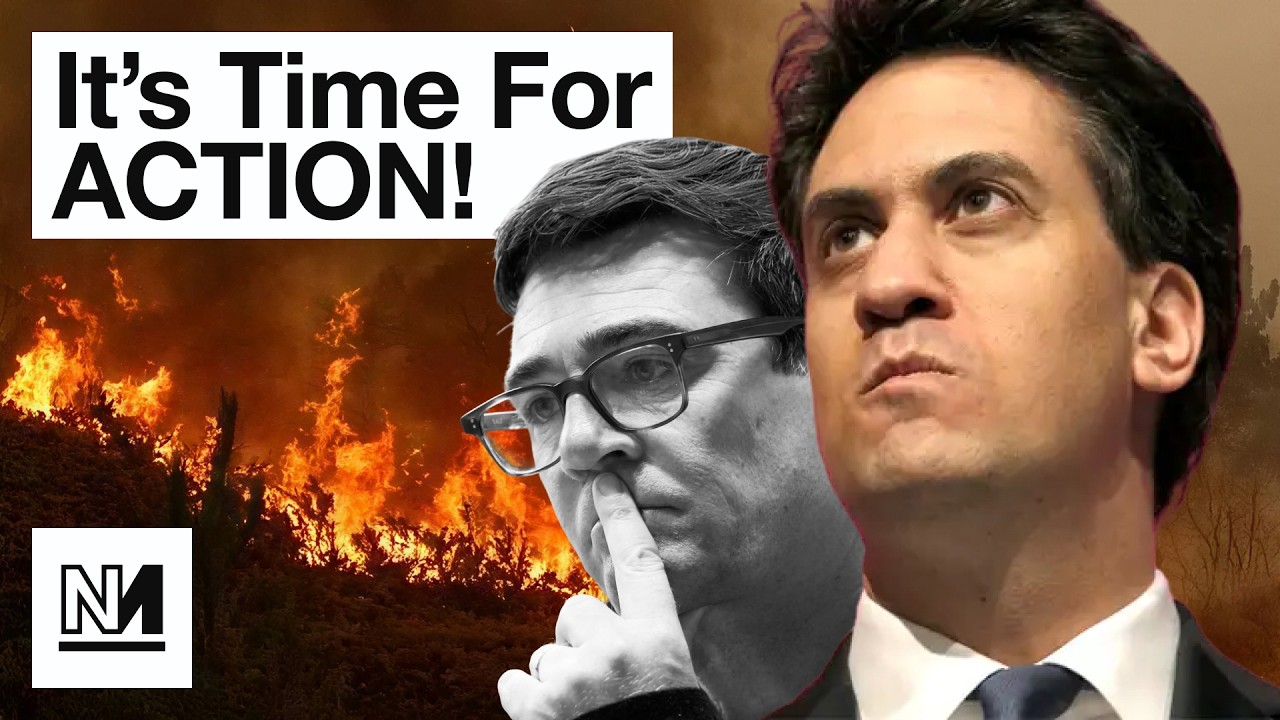
Video summary
The video opens by highlighting the severe impact of record-breaking heatwaves and wildfires across the UK, specifically focusing on dramatic scenes in Stourbridge where intense fires destroyed over ten homes and threatened residential areas due to shifting winds. Despite these apocalyptic events that should logically place climate change at the forefront of political discourse, Prime Minister Andy Burnham has remained notably reluctant to address the issue directly, arguing it does not fit his current government's messaging strategy. This silence from the top contrasts sharply with a call for action from fifty major green groups, including Greenpeace and Friends of the Earth, who have urged leaders to speak out on the existential threat climate change poses to national security, health, and living standards.
In stark contrast to Burnham's hesitation, Foreign Secretary Ed Miliband has adopted a different script by explicitly framing the climate crisis as a critical national security issue that requires immediate international cooperation. However, his ability to lead effectively is complicated by significant domestic contradictions; while advocating for global emission reductions at forums like the UN in September, he faces scrutiny over potential new oil and gas licenses for projects like Rosebank and Jackdaw, which would undermine his climate credentials if approved. Experts note that Britain's diminished role as a major power due to leaving the EU and drastic cuts to its international aid budget from 0.7% down to just 0.3% of GDP further limits its capacity to influence global diplomacy or fund necessary adaptation measures for vulnerable nations, creating a challenging environment for Miliband to execute his vision without compromising on fossil fuel interests.
Despite these structural hurdles, the analysis suggests that Ed Miliband possesses unique political leverage and experience within the Labour Party and cabinet that could be used to block new oil licenses and redirect defense spending toward climate resilience, arguing that current fires and infrastructure failures represent a more immediate threat than distant conflicts like those with Russia. The transcript also details scientific expectations for the coming year, clarifying that recent extreme heat is driven by accumulated emissions rather than El Niño cycles alone, warning of worsening conditions in 2027 as tropical ecosystems stop absorbing carbon due to stress and deforestation. While Burnham eventually made a brief mention of climate change during his visit to Stourbridge regarding clean energy transitions and banned disposable barbecues during the drought, critics view this as insufficiently ambitious given the scale of destruction witnessed by communities who have lost their homes to fire.
Read the full video transcript
Heatwaves and wildfires are on the top
of the news agenda at the moment. On
Thursday, we saw the hottest day of an
already record-breaking year. It was
38.1
degrees
in Q
in West London.
And these were some of the dramatic
scenes
broadcast into our respective living
rooms.
>> Let's just bring you back to these live
pictures that we are getting from the
Sky News helicopter this evening. And
they show
serious fires that have broken out in
Stourbridge in the West Midlands. And uh
there was a fire
that it involved the golf course there
um and several fields there.
But that fire, as you can see there, has
crossed roads and is now um seriously
affecting seriously impacting
uh residential areas.
>> Firefighters were called to this part of
Stourbridge at about 1:30 yesterday
afternoon. And what's really striking
when you talk to people who live here is
the speed at which the fire took hold.
It started off in a field, then blew
onto the golf course which is next to us
here. And then the wind changed
direction and sent it towards houses
down here. Now we know it's more than 10
houses that have been gutted by the fire
that happened here yesterday. People who
live here have been telling us it was
carnage. Um that they can't believe
something like that happened in this
country. And it was more like being in a
film.
>> Right, I've got to get out of there now.
I've got to go. So
that's it. That's the house going up.
>> That was footage from Sky, the BBC, and
social media
of those I mean really
apocalyptic-looking
fires in Stourbridge on Thursday. Um now
you might have thought scenes like that
would put fires front and center of the
political agenda. Um you might have
expected that Andy Burnham would use
this opportunity to really talk about
climate change and the threat it faces
to our health, our safety, our living
standards. However, um the new Prime
Minister has been very reluctant to talk
about climate change. He doesn't think
it fits um with the messaging that he's
trying to put forward um in his new
government. Um and we aren't the only
people to have noticed this silence. Um
today 50 green groups, including
Greenpeace and Friends of the Earth,
have urged Burnham to break his silence
on climate change.
There is though one key figure in the
new government who is speaking from a
different script, someone who hasn't
decided that climate change are two
words that shouldn't be said in public.
Um this is Foreign Secretary Ed
Miliband.
>> This isn't normal.
All this,
all this. These heat waves are sending
us a message. We can all agree that
national security is the first
responsibility of any government, and
the climate crisis is now a serious
national security threat to the British
people. Heat waves, wildfires, droughts
are all going to become more common. But
the good news is we can act. As Foreign
Secretary, I will work with countries
around the world to build a coalition
for action. At the United Nations in
September, I'll be bringing together
foreign ministers to discuss how we
respond to this new national security
threat. And when countries work
together, we can bring down emissions,
slow temperature rises, and help people
adapt to the warming world. I feel this
so deeply. We owe it to future
generations to act. Our planet is
sending us a warning signal, and we are
going to listen.
Now for Ed Miliband, of course, Foreign
Secretary was a bit of a consolation
prize. He wanted to be Chancellor of the
Exchequer. Um that was the job he'd been
prepping for for years. I think he
planned to go into the Treasury and
turbocharge Britain's transition to net
zero. Um, but can he now as foreign
secretary make more of a difference than
he could have done as chancellor? Are
the opportunities even bigger, even
wider?
Well, earlier today I spoke to Simon
Lewis. He's professor of global change
science at UCL.
>> It's much trickier, I think, to be
impactful on the international stage
if your government is not performing
on the national stage.
So, it's going to be tough for Ed
Miliband if these two new oil and gas
licenses, Rosebank and Jackdaw, get
approved. And it could be very soon.
Then he's going to have a real trouble
telling the rest of the world, "Hey, we
need to get our emissions down." If
they're also back home granting new
licenses for, you know, 25 years worth
of new oil and gas emissions.
>> And and who would that matter to?
Because obviously the argument for Jack
Doran Rosebank, I mean there are a
number of arguments for it, but when it
comes to climate people say, "Look,
Britain's emissions aren't that
significant even if they open these new
oil and gas plants." And it's not as if
Xi Jinping really cares what the UK
government is doing and when it comes to
the North Sea. Um, I mean do you
disagree with that or who What What
countries would be influenced, let's
say, by us giving those um two gas and
oil fields the the go-ahead?
>> So, I think we we all know that the uh
UN process is is quite bogged down
because it is consensus-based.
And real leadership is required. And
there's a parallel process now with this
road map to transition away from fossil
fuels. Had its first conference in
Colombia
uh this year. And it could
lead that. It could provide a real
leadership role as a, you know, middle
power country
who's has a good track record compared
to other countries in terms of climate.
You know, officially our emissions since
1990 are 54% down.
Uh by other measures, a quarter down.
Not enough.
And uh certainly not in line with 1.5
degrees C, but significantly better than
many other countries. So, could provide
leadership there, but not if we're
giving oil and gas licenses out to hope.
>> Could you give a bit more context to
this treaty? It has been mentioned on
the show before, but this is a sort of
coalition of the willing, isn't it?
Separate from the COP process and for
countries who have committed to move
away from fossil fuels and I think to
not
um
sort of develop any new fossil fuel
sites.
>> That's right. There's a frustration in
the climate talks that
things get bogged down by what, for
example, Saudi Arabia is is is willing
to sign up to, which is very, very
little.
So, now we all agree that we need to get
to net zero emissions as a world.
And until that happens, the climate
impacts get more and more. So, you know,
I'm seeing sweltering here in the 30
wave in a row in London. And
that's going to get worse and worse
on average until we get to net zero
emissions and then it'll stay at that
point. And people know what the science
is, but there's a bunch of countries
that want to get things done and want to
lead the transition. And there are some
countries that do not want to and
actively want to oppose it, particularly
United States, Saudi Arabia. So,
therefore, the countries that that want
to get something done have moved to a
parallel process, complementary to it,
to work out actually how do we do this
that's economically feasible and
practical and doesn't leave anyone
behind.
>> And what countries are part of that
treaty? I know the first conference was
in Colombia. Who's Who's part of this
coalition of the willing?
>> There were 57 countries. It was co-led
by Colombia and the Netherlands Um
and then a bunch of countries from
Europe, bunch of countries from from
South America and of course all the
small island states
are the kind of the major
groupings.
>> We often speak to you sort of at COPs.
So we're often looking for an expert to
talk to at one of the big COPs
and and you're often there and you're a
great speaker so we get you on.
So I suppose with that
sort of perspective from recent history
what has the UK's role been when it
comes to international climate
diplomacy? Have been Have we been one of
the good guys or the bad guys? Somewhere
in somewhere in the middle?
>> I would say overall one of the good guys
on the spectrum.
Um
we obviously had a lot more power and
leverage when we were part of the
European Union.
Now we're a bit isolated
uh because we don't have this big group
backing behind what the United Kingdom
is saying and and very recently we've
had a much more problematic because
we've had big cuts in the aid budget.
You know, we're now down to 0.3%
of GDP
and
you know, that's having big impacts
because the UK can't or is unwilling to
contribute
to
mitigation, to adaptation in particular
and to the loss and damage funds so that
you know, these massive impacts in small
island states that you know, just are
very very difficult to adapt to. How
we're going to pay for that? And we can
see that adaptation problem here. You
know, we have enormous issues with
adaptation of our hospitals, of our
farming, of our landscapes, of our
homes.
And who is going to pay for that? How is
that going to be paid?
Across the world is a very live live
issue and and a very a very important
one.
>> From what you've said so far, it sounds
like you're suggesting that you know, Ed
Miliband might have his heart in the
right place. He might you know, I
believe he genuinely cares about climate
change and he's passionate about this.
But the position he's going to have to
put forward or the baggage he comes with
when he goes to any meeting with a
foreign leader or his his counterparts,
foreign secretaries of other countries,
is that we're a nation that's
considering opening new oil and gas
fields. And we're a nation that's just
cut our development budget from 0.7 to
0.5 then to 0.3%.
And so in fact, you know, this is one of
the worst situations Britain has ever
been in in recent history when it comes
to our ability, capacity to pursue
climate diplomacy.
>> I would agree with that except
Ed Miliband is
a very impressive political operator.
And he's shown that in his previous role
on net zero and climate and before that
when he was in government in in 2008. So
if someone can do something about that,
you know, he has great leverage in the
Labour Party and in the cabinet to stop
these two oil and gas fields and explain
the kinds of impacts
uh on the UK standing for essentially
almost no jobs, no impact on on bills,
and uh and and very very little income
to the Treasury. It doesn't make any
sense for these to go ahead on their own
terms, never mind with the climate and
the international perspective. And then
I think on aid,
the cut to 0.3%
was supposed to be temporary.
Now if Ed can get some commitment about
how that turns round, that would be very
good. And he could also use his
considerable leverage to, you know, make
the point as he sort of is implicitly
say, "What's the real threat here?
Is it an invasion by Russia?"
I mean currently in the UK at the
moment, we've got huge fires. We've got
people losing their homes to fire. We've
got huge fires in agriculture and
natural bits of of the UK. We've got
hospitals overheating. We've got train
crashes. This is the kind of impact
that Russia could only dream of.
And it's here now because of climate
change.
And we're much better
investing in reducing emissions and
doing the adaptation and changing to
electrification
and renewable energy to produce the
electricity
and helping the world go on that
direction rather than funding ever more
armaments for a much more distant threat
than climate change is which which which
the Russian In my opinion, it is. It's
more distant than this very real, very
now climate impacts.
>> And so does that mean you think it's
smart for
In In the video Ed Miliband released
yesterday, he was saying
"My commitment is to national security.
That's the highest priority of any
government. But given my highest
priority is national security, that's
precisely why I care so much about
climate change." Do you think that's the
right framing? I mean,
you know, at the extreme end, this
probably won't happen, but you could
imagine him sort of saying, "Well,
you've committed to 3% of GDP on
defense.
Maybe if we have a more expansive notion
of defense, we can put some of that
towards climate investments." I'm not
sure if that would get past some of the
right-wing newspapers, but I don't know
what you think about that.
>> Yeah, I'm not sure I'm not sure it would
would get past, but I I think that um
noting that it's a security
uh issue for the UK, whether it's food
security, whether it's our energy supply
security, whether it's our ability to
transport things, you know, in these new
higher temperatures and under these new
climate impacts,
then
I think, you know, yes yes, it is a
national priority. And that by saying
it's national security, that's how you
get
buy-in from senior civil servants,
buy-in from GCHQ,
uh uh buy-in from other um
you know other ministries to be able to
have the kind of comprehensive approach
that's needed to adapt to these
ever-changing conditions because I think
we all just have to remember, and it's
hard to remember, that
in 10 years time, these conditions and
these impacts are going to look good
unless we do something about both the
emissions and adapting to this new world
that we've created.
>> I suppose more as a climate scientist
now in terms of what we can expect over
the coming 12 months because as far as I
understand,
the heatwave we're seeing at the moment
is partly was largely of course driven
by climate change and then also driven
by El Nino, which is a cyclical natural
phenomenon. And also my understanding is
that we're we're kind of only in the
beginning of the El Nino. So the worst
could be yet to come over say the next 6
or 12 months.
So what should we expect over the next 6
or 12 months? What will the rest of this
El Nino have in store?
>> One correction there is that the current
heatwaves are not related to El Nino.
It's only just getting started.
You know these these heatwaves are
driven by more emissions in the
atmosphere
and then we always have had heatwaves,
but what we're having now is heatwaves
on top of already much higher
temperatures and therefore the spikes
that we're seeing are like outside the
comfort zone, outside the tolerance that
UK society was built for.
We have hospitals that are built for a
given temperature range
and now we're increasingly going outside
of that temperature range.
And that's the same for all of the
infrastructure that's been built up in
the UK over the last I mean, you know,
hundreds of years
and certainly decades so that it's it's
no longer kind of exactly fit for
purpose
because what we're seeing is, you know,
we have a band
of of of tolerance, and we're now poking
outside that band of tolerance.
Uh
in terms of the El Niño, so it's unclear
whether it's going to be this strongest
ever El Niño or not quite.
We're still seeing how it's evolving.
And the
UK is not massively affected by El
Niños.
It's not the kind of place like uh like
California, which has like massive
changes in weather patterns, or Peru,
uh or East Africa, and or or or parts of
the Amazon.
Uh so, what we'll mainly see, I think,
is uh
uh huge impact on food production.
Uh because we will have an abnormal
weather
in many places in the world. So, we can
expect
further food price inflation.
And we can also expect um
more events like this uh typhoon in
China, where almost a million people
were evacuated because they got a third
of a year's rain in in in in uh in one
day.
So, we'll just have more unusual
extremes. And in some places it will be
much drier, and in some places it will
be much wetter. But it The impact on the
UK is most likely to be um
uh but via food.
And uh 2027
will guaranteed be a record year for
global temperatures, almost guaranteed
because the El Niño will go on top of
existing climate change. And um
uh and and we'll see uh
natural ecosystems
temporarily stop absorbing carbon, so
we'll see a big increase in the amount
of carbon that we put into the
atmosphere is in the atmosphere
because of because of the changes in the
environment. Essentially, the tropics
will
absorb less carbon than it normally
does.
>> And why is that? I know you're you focus
on tropical forests.
So, I mean, maybe you can relate it to
that, but why is it that hot weather
means that these places won't absorb
carbon? Is it because the forest burned
down or or what's going on there?
>> It will be partly, yeah. People will use
the dry
It's partly because it's hot, but also
dry. And the places where it's dry, then
you can convert the forest to other land
uses. So, some people will
So, cattle ranchers in South America
will take that opportunity to clear
additional lands trying consolidate
lands for for cattle production, for for
example. And and higher temperatures
mean that
um
respiration costs of plants are higher.
So, they're they're absorbing carbon
from the atmosphere through
photosynthesis and then releasing it
through respiration. And that
respiration costs go up as the
temperatures rise. So,
that's the kind of basic basic point.
>> So, the So, the I'm going to put this in
really
stupid person's sort of language, but
the the plant is more The plant is more
stressed. It has to work harder.
Therefore, it absorbs less carbon.
>> Exactly.
>> Perfect.
>> perfect way of putting it.
>> I'm happy that you you reinforced me
that was that was not a completely
ridiculous thing to say. Um
let's link this up as a final question.
Um
sort of putting aside Rosebank
and and Jack Dorney I suppose putting
aside the the aid budget because those
are both things that Ed Miliband's going
to have to negotiate with with with Andy
Burnham. It's going to sort of be about
power struggles within cabinet, I
suppose. Purely as foreign secretary,
what are the things that Ed Miliband can
basically do of his own accord
just using his intellect and charm, I
suppose.
Does it relate to sort of protecting
tropical rainforests? I mean, what can
he do when he's going and meeting other
global leaders?
>> Well, he's already announced that he's
you in UK envoy for the World Bank and
that he is personally going to do that
job rather than giving it to a junior
minister.
So, that's really important because the
World Bank is
um
under siege from the United States in
particular
to stop its climate-related finance for
global South countries.
So, that is a very important fight
internationally that
Ed Miliband knows about and has put
himself in the center of because he can
do a lot of good there for the climate
debate.
Um,
I think that's one crucial thing and
then obviously,
you know, he will be able to provide
uh
some
some leadership because he's very able
against Saudi Arabia and the other
blockers in the international climate
talks because he's got a lot of
experience of how to do that and he was
and he's been quite effective in the
past in doing that, but it's, you know,
it's limited, but it's important that
someone does it and someone
who's very passionate and able can do
it.
>> That was Simon Lewis speaking to me
earlier today. Um, and we do have a bit
of an update on the story because Andy
Burnham has said the words climate
change.
Um, he
well, do that again.
That was Professor Simon Lewis speaking
to me earlier today and we do have an
update for you um because Andy Burnham
has now today said the words climate
change. Um, it was on a visit to
Stourbridge.
>> You know, we have to face up to the
changing climate
and I think we need a
different debate about that. There's no
point denying where we are. We need to
face up to it.
We we more clean energy. Uh, we need to
see that transition accelerate. Uh,
those are all of the issues that, you
know, are
now in discussion, but the Cobra meeting
earlier this week, I think has enabled
us to mobilize resource today to
individuals,
uh, to communities, and to our fire and
rescue services,
uh, and we're very, very grateful to
them.
>> So, he does still seem pretty reluctant
to talk about climate change, right? So,
it was mentioned briefly. He talks about
clean energy, but then he's obviously
moving on
quite quickly. Um, that's what he thinks
as as Prime Minister is visiting people
who've just sort of immediately lost
their homes. He doesn't want to be seen
to be making political points. Now, I
don't think talking about climate change
should be seen as making a political
point, but but clearly some people do.
Um, but yeah, just for whatever reason,
this has now become habitual. He does
not want to talk about this. Um, we
should say that there has been another
update, which is,
um, that not only is he discouraging the
use of disposable barbecues, he's
banning the sale of disposable
barbecues, um,
for the time being, um, while we're
still in drought. Um, lots of people are
suggesting it's not really
ambitious enough, um, as a means,
uh, to to I suppose protect us from
climate change, but also, I mean, I'm
definitely not opposed to it. Um,
disposable barbecues when we're in a
drought do seem like an unnecessary
risk. Um, obviously, I'd advise everyone
when you're out this weekend, don't
start any unnecessary Well, well, don't
start any fires, necessary or
unnecessary. Uh, have a picnic instead.