Video summary
Fred George recounts his evolution from managing massive monolithic Java applications plagued by technical debt in 2004 to embracing modern event-driven microservices architectures. His early experiences at ThoughtWorks and subsequent projects revealed that organizational pressures, poor test coverage, and inexperienced developers often led to systems with unfixable bugs and rigid structures. By experimenting with publish-subscribe models and service decomposition, he demonstrated how breaking coupling could accelerate release cycles from monthly intervals to every three minutes. This shift allowed teams to replace static entity-based data models with immutable event streams inspired by Google's Closure framework, where user interactions are recorded as historical events rather than mutable records, enabling services that can be easily rewritten or discarded without disrupting the broader system.
The adoption of microservices fundamentally transformed development processes and reduced technical debt by encouraging small, disposable components—sometimes as little as a hundred lines of code—that could be updated rapidly if flaws were discovered. Instead of relying on traditional unit tests or complex orchestration governed by central "god classes," George advocates for loosely coupled systems where services asynchronously publish events to interested consumers using tools like Apache Kafka and Hadoop clusters. This approach facilitates the discovery of hidden cross-selling opportunities within user journeys through statistical analysis, allowing businesses to make immediate decisions based on evolving patterns in real-time data rather than static reports. Although challenges such as serialization overhead exist, they are manageable compared to the benefits of avoiding long development cycles and building permanent infrastructure that often fails within a decade despite planning for longevity.
Ultimately, George's philosophy centers on treating software systems as living entities with short lifespans, contrasting sharply with corporate tendencies toward rigid ten-year plans. He emphasizes allowing language agnosticism among developers while focusing on continuous business metric monitoring to validate changes rather than exhaustive acceptance testing. While acknowledging that implicit sequencing dependencies and database table sharing can lead to fragmentation if not managed carefully, he argues that the ability to fail fast and iterate quickly is superior to maintaining complex synchronization in highly interactive environments. By shifting focus from managing entities like customers or sales figures to capturing every interaction as an event, organizations can achieve rapid feedback loops and adapt their digital strategies to meet immediate market needs without being hindered by legacy constraints.
Read the full video transcript
[Music]
[Applause]
well thank you in fact uh
it's always humbling to come to our
conference and you listen to the
constantine and
all these children who are speaking
about these things that
they're so much smarter than you are and
it's too late for me
so i'm going to talk to about
microservice architectures and to some
degree this is a bit of a
personal journey but let me be clear do
not take this journey it is too painful
so i want to sort of share some of my
pain and kind of where my head is at now
pretty much hoping you will not try to
do the same thing
i'm an independent consultant originally
from the u.s i've worked in a lot of
countries i've worked in india i worked
in
china i've lived in london now for the
last six years
uh so i kind of go where the fun stuff
is
so this story kind of starts at the
beginning um
in the beginning we basically were
building systems that i would sort of
say resemble stonehenge if you notice we
have some nice towers of functionality
we have some cross-functional services
and please do not tweet i didn't i was
not the architect of stonehenge
but uh i i do have to say that when
paulo was talking earlier yesterday
he started talking about 1968 well i'm
sorry 1968 is when i started writing
code
so i was having my life flash before my
eyes as he was talking
in fact i was actually one of the people
in ibm at the time in the early 70s
where they experiment on with waterfalls
so i was one of the victims of waterfall
so this is
this is why you see a shell of a person
today
so my story actually starts not back at
stonehenge but really kind of in
2004 and this i was i was
working with an application and i was in
thoughtworks at the time
the application was uh at one about a
million lines of j2e code and at the
at one point in time it was the largest
sun certified jte application in the
world
it was a leasing system quite complex uh
sort of a bellwether application and it
has a very very
nice history associated with it um it
started very very well
it was really a project that agile was
actually tried out in thought works
uh among other things martin fowler
and and ward cunningham came and
consulted on in fact
martin fowler actually joined
thoughtworks after working on this uh
the book enterprise
application patterns that book comes
from a lot of the work he did on this
application
so in some ways it's a very influential
application in our industry
so it started really well so my part of
the part of this application gets in
2004 and what i found in 2004
and now i'd gone to india to work on
this because that's where most of the
developers were working on at that time
what i found in 2004 was a million lines
of code
about 2 000 tests but
70 percent of the tests accepted test
passing was considered victory they were
happy
and i'm like but that's 30 failing and
it was a different 30
every day and they thought that was okay
uh there was a bug database without a
thousand entries in it it was like uh
where are these things it was like oh
these are just the bugs i'm like
okay uh it was they were still working
on it so they're still changing it but
not fixing the bugs or not getting the
test to run
and writing new tests well it was like
why bother the old ones don't run anyway
so why bother writing new ones
now again this is an agile shop and it
wasn't exactly what i expected to find
but this is what i got started with and
just to sort of give an indication i
i do like my metrics to some degree i
you'll find me as a process minimalist i
don't really like processes but
but i will dust off metrics where they
make sense and one of my key metrics i
like keeping track of what's going on in
a project
is count the new unit tests
those have never worked within a project
won't realize but i write a lot of code
in a project
i get in there i write code because
frankly there's no secrets of your
writing code you can try to manage a
project and the programmers will
may not tell you the truth but you're a
developer in there as well there are no
secrets
so i count unit tests because i know if
we're writing unit tests we are in fact
getting more functions more function
with more unit tests it's easy to count
them
and so here's the graph of unit tests
across five months
now anybody tell you about systems that
go up and down like this means you have
a highly
unstable system so this is a five month
timeline and it sees it fascinates from
you know
sometimes even less than 40 all the way
to almost 200 it just seems to vary all
over the place week to week
now the really scary thing is those
numbers at the side
so you take an average week of 80 things
how many programs do i have with this
project
well it turns out i had 40 developers
this is how many tests they're writing
in a week
40 developers will write 80 tests in a
week which means
on average they're writing to a week
which means we're not really writing
them in a bad week obviously not doing
much
in fact i could probably find the three
programmers if they were doing something
else that week
that's why we're down so clearly things
were not working well so
being curious as a developer about why
can't you write tests for this stuff
i decided to run an experiment and so
basically i wrote myself a test it says
i'm going to write this test
and the concept of a loan is a
fundamental aspect this is a system that
does leasing systems
and the idea of the loan was a it's a
very nice encapsulated object it was
you're part of the original design it's
really great idea
but for some reason they decided that
this little number 50 which should be
encapsulated you shouldn't be able to
get to that number directly
people decide yeah i should get to that
number and so you wind up finding
about 40 different places and 37
different classes that reach through and
grab that number
which made it really hard to understand
what's going on
so in my little tests here i i basically
said okay
it's a very easy unit test i'm going to
go in on a saturday so i don't get any
of the serbs i'll mother by myself i can
do this
and five hours later it's not null
so clearly we're broken um
and this was kind of the thing that oh
yes it was a really nice system now
what happened what happened to this
thing that martin fowler and ward
cunningham and all these really
brilliant people
put together this really gorgeous system
and great conceptualizations
what happened to it and so
um one of the things we realized very
quickly and i
sort of brought some colleagues in is
one million lines of code
this application is not one million
lines of code
in fact one of my colleagues said and
very cleverly it's really a hundred
thousand lines code trying to get out
that you could probably if you really
wrote this thing from scratch it's not
that big it really wasn't that
complicated this is my colleague jeff
baywell
you'll come back just hear a lot about
jeff bay because he keeps making really
wonderful observations
uh but that was his idea about it and lo
and behold i think he was right
now again what happened what went on
here and to some degree the question is
well
were they just lazy programmers were
these guys in india just being lazy
about that
but i was in india i was watching these
guys they were working hard they're very
bright guys it wasn't a matter of being
lazy
well maybe they were being sloppy about
it and
you know perhaps a little bit of that
but what didn't really seem to be true
either
uh maybe they were inexperienced and it
turned out yes they actually were quite
inexperienced these were
university hires they'd really not been
exposed to agile practices they hadn't
been exposed to what good programming
looks like
and some executive and thoughtworks had
decided was a really good idea to send
this application over to india where we
have programmers and let's just
work on it and they destroy it
but not intentionally so there's a
little bit also going to work is that
the indians didn't feel they had ability
to say no if they were being told by
their
their us counterparts that you have to
do this they would just do it
when in fact noah had been a good answer
sometimes
now there's a name for all these things
that we use a lot in our industry
we call it technical debt
but i will say that i personally believe
that is another way of saying
one of these other things so i hear
people talk about technical debt
i'm really saying what was it about your
system what was about your organization
that allowed you to create this problem
in the first place
putting a fancy name on it doesn't
change the underlying issue
it should not have happened in the first
place
so we'll come back and talk about that
because somebody at some degree we've
i've got a system now that makes that go
away to a large degree
all right so now we start evolving into
this
so now i'm actually been assigned to
china
because that's where i was needed at the
time and where i've actually gone into a
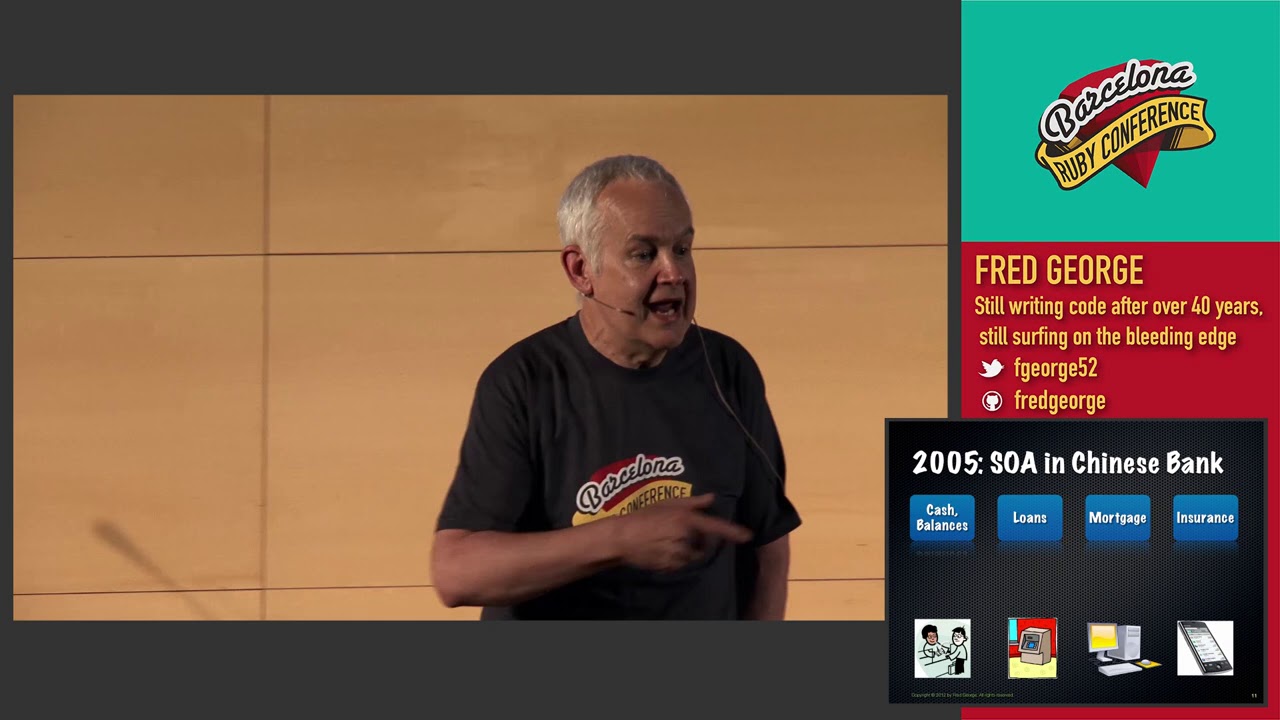
chinese bank and we're consulting with a
chinese bank to bring a service-oriented
architecture to them
now i gotta say at that point in time i
didn't know what that meant
i was fortunate i was working with a
colleague jim weber uh
he published his books about this stuff
in fact i think he's the chief scientist
now for neo4j
so i i really chance to work with a very
bright guy
and the challenge the chinese banks were
facing was they have all these banking
sort of things they want to do just like
everybody else wants to do in banking
mortgages and loans and they have bank
accounts they want to do all these
things
and unlike some of the western banks
particularly the u.s banks which you can
do all these things from your
when you're working with a teller they
also want to do these things with every
other
interaction technique they have with the
customer they want to be able to go to
an atm
and get a loan now in western i can tell
you the united states that was not
possible
but in china they said it was absolutely
feasible in fact they had their even
their smartphones back then were able to
do some of these transactions
that we in the west were just at that
point dreaming about
so they really wanted to get to these
systems in every possible way
and we were brought in basically to to
propose an alternative architecture to
try to get basically one of our clients
uh a foothold in these chinese banks to
help them develop software
so we basically decided what we really
need to build is some sort of pub sub
bus
that in fact we wanted to sort of take
advantage of the fact that if a customer
is in front of me
i want that channel that has a customer
to screen back into the
into the cloud i have a customer
and i want all these other things that
are interested in customers that sort of
wake up and say oh if you have a
customer
well we should probably get him a loan
or home sorry he owes us something on
the credit card
or maybe we want to refinance his
mortgage we want these little services
to wake up and sort of say oh let's do
that
now how you say that back to the
customer that's back to the channel
but the thing that you want to do as an
interaction is sort of broadcast by
these applications
and so it sounded like a really nice
structure to put in place
and in fact the client rejected it uh
they decided they really wanted to go
buy a system from citibank in the north
north america because citibank is
western and therefore it must be better
the fact that citibank wrote this system
in the 1970s and they wouldn't support
your tellers
or anything else apparently was lost on
them
so it was a nice idea but one of the
things i did walk away with
was in fact going back to jeff bay and
his 100 000 lines of code
i began to believe there was another way
of thinking about this application
i was beginning to believe that in fact
it's really
twenty five twenty five thousand line of
code little services trying to get out
that if i went back and restructured
that application
i would probably restructure it
differently than what we were talking
about before
they didn't have to be a stonehenge
so that's 2005. uh now i've been
been sent back to the states i'm working
with the medical systems company
uh of course i've got some new ideas
here just the fact that they always
rejected but i'm sort of got some new
ideas i'm always dangerous with new
ideas
um and we had a system where the
the this company was in the medical
systems business they made
you know x-ray machines and cat scanners
and mris and all these things
and so they had the idea that we should
actually run hospitals
because if you run a hospital then
they'll buy your equipment so they want
to really run the whole hospital and
they were basically trying to rewrite
their platform they decided that the
whole platform was written to c
so they're just going to rewrite in java
and it's like but that's not going to be
different than the c implementation
and we're again trying to suggest some
alternatives so we suggested this pub
sub again it says
you know you have all these things that
are trying to collect data
and you have all these other parties
that are interested in the patient is
interested in it although a lot of cases
you're not allowed to tell him things
but certainly you're a doctor you know
the staff running the emergency rooms or
the
or the critical care units and of course
accountants they seem to love things
about this as well
so we propose again sort of a pub sub
base that says we want
these instruments to publish little
nuggets of information
about what's going on and we'll sort of
route those nuggets to interested
parties so if you're getting an mri
it's very interesting and and probably
your doctor would like to read it and
perhaps
therefore the critical care unit needs
to know what's going on and of course
the account
loves this because there's you know
ching to ching we get more money
um and we started looking these little
nuggets that you would publish
and one of the things we started
thinking about is first of all we want
to publish
conclusions i don't want to publish the
raw data
because you know i don't want to send
just x-ray images over to the patient or
certainly not even to the
critical care unit i need to send
conclusions
what did i figure out as a service
publish the conclusions
and so again if you have a cat scan and
it was jane getting in the cat scan
then the conclusion reached by the team
doing the cat scan may say
yes there is concern and that may
regular alarms on the doctor's system it
certainly may
bring little alarms in other places but
publish the conclusion
there's a reason to go back and get the
original data fine find that later
but publish that but it's also important
to say this information is not always
good
knowing your blood pressure was was
perfectly fine six months ago
does not help you today however
probably your your blood type that
probably hasn't changed in the last six
months
so different data tends to have
different longevity as you publish in
the cloud and we thought it was very
important to age this information out
so this is a little refinement we had in
mind certainly if you're in critical
care situations heart rate and some of
those things are things you want to be
taken
maybe every few minutes so again this
was our idea about how to do these
things
uh again the client said no thank you we
just want to rewrite our java system
so uh when i was putting this
presentation together i actually began
to figure out that i've been very
unsuccessful in my career
but i still get paid well which is kind
of a good trick um
all right rolling right along it turned
out right next door to this medical
assistants firm was this
financial firm that does you know funds
and stuff in the u.s
a very successful firm in fact so
successful they don't make a good client
good clients or clients that are
desperate they let you try things
but a client that is being successful is
very very hard to get change in there
because
there's all sorts of things that try to
stop you like why should we do this
and you can't really answer it on faith
this is one of those particular clients
uh i turned out i decided i didn't want
to work with them because of that reason
but my friend jeff bay uh he got sucked
into it anyway
um and what he did was he said well
we're not going to rewrite your system
but we'll prototype a new sort of solid
architecture
he in fact was trying to get them to run
faster they were on you know once every
three or four months we do a release
sort of thinking
and he was trying to get them into a
different place so he was prototyping a
new system architecture it's not the
real thing but a prototype
and i create these things that i call
the bayesian service principles and
named after jeff bay
and it was two profound observations
jeff made first of all
he says it's okay to run more than one
verge another service at the same time
and when i heard this i was like jeff
this is wrong we got we've got a new
service we got to make sure everybody's
using it
he says no you don't and i try to
explain to him why and i couldn't come
up with any reason
which generally means you know it's a
bad idea i'm stuck in the stonehenge age
i'm back at stonehenge again so he said
that and it was like okay that's that's
kind of interesting and then he said
something else really strange
he says he only allows the system to
deploy one service at a time that's
deployment
you cannot deploy two services only one
and you then put another one
so of course he was trying to say you
can deploy a service
and then you probably knew it for the
client that works with that service you
need to make sure it's that order
and obviously you just get it makes it
more difficult by the way to replace it
with a version 2 and kill all the
version ones because
that's lots of coordination result of
these two really simple ideas
is that we sort of have broken the
dependency upon that old system we've
broken the coupling to that old code
yes we may have somewhat duplicate
services running around doing almost the
same thing
but jeff would say so what and again i
didn't really have a good answer for
that
now assist these guys were basically
deploying about once every three months
with jeff's little rules they were
deploying about three times a day
so he had a profound impact about how
that how you do that stuff
just by basically going through and
breaking some assumptions about how we
had to do things
uh so very quite profound so i would
consider that actually
uh somewhat of a success but he was a
prototype wasn't a real system
but of course gave me even more
dangerous ideas
so i took jeff bay again and he and i
headed up to
a large manufacturing firm automobile
in particular and we're trying to put a
system together for those guys because
they had to replace some parts and
existing cars
uh and basically some parts were getting
somewhat antiquated if they need to
upgrade the parts i can't really say
much more about it but it makes sense
when you hear the domain
um and they and they and it turned out
there's just a lot of variations on
information you were getting so
sometimes a call center would say oh i
found a car it needs to be replaced
sometimes a customer call up say i have
an element i have a car that needs to be
replaced maybe
it happens to be the garage it goes to
to get repaired they notice
it has that part needs to be replaced so
it turned out we were getting
information from all sorts of sources
and lots of lots of different formats
and different information
so that was sort of the challenge now
this this
this company had a uh an in-house vendor
uh
basically that uh yeah i don't remember
what it was but again
in-house vendor had it and uh they
estimated to change their existing
systems in order to accommodate this
water replacement was going to be about
18 months 15 to 18 months
they could modify the legacy system to
do that
the business thought that was actually
infeasible we needed to have this thing
done
with much much much shorter time so good
desperate client
allows you to go play so again
unacceptable business so what do we do
in that environment
well i came up with this what i call the
pinball model
i'll be a little clearer when i talk
about it a little bit but basically the
idea was
i have these information packets and
basically i have a
i need a lot of information in order to
do the replacement order to get the
replacement successful
but i'm starting out with different
little tidbits according to where it
came from
so maybe i know the name of the person
and when he bought the car
maybe i know the address of the
residence that has the car
maybe i'm really lucky actually have the
car vehicle number
but i have this all this other stuff and
we start what we really want to do is we
want to sort of
take this little pinball and bounce it
around the various services and get more
information until it's all filled out
so that was the theory we just want to
kind of balance this packet around
trying to get more information until it
was full in which case
now we have a successful order so how do
we kind of do that
we started defining little services and
we tried to find a service as small as
possible
so this responsibility was basically
just fill in a little bit more
information but just
one tidbit each so i want service as
small as possible but it still does
something interesting
so for example maybe i have a service
that's able to inject this
you know aaa information of some sort
but it needs to have a vin
and it needs to have some other
information in order to calculate that
and then maybe i know the service that
can figure out the event but it has to
have a name and maybe another service
that needs needs could get a name but it
has to have an address
so what i did was we started taking
these packets and started pinging them
in these services
so you know event tends to be one of the
key things i want so i
i sent this little packet off to the vid
service saying here uh
you know can you figure out can you
figure this stuff out and he says well
no no i can't figure out your vin
because
uh i i don't have a van but uh but if
you want the vin you need to go to this
other service and he'll help you get the
vin
so we go down the other little service
and you say oh yeah i can help you but
give me your name well i'm sorry i don't
have a name
but there's this other service over here
that can figure out your name you have
your address
and so we send it over there and say oh
we have an address
so let's fill in the name and then we
sort of bounce it through again and we
kind of go through again until he gets
more information and more information
more information and he finally gets
filled out completely
so that was the idea interesting enough
as we looking at it of course
this is a legacy system it has lots and
lots and lots of databases i mean oh my
goodness the databases
but one of these we decided was we
wanted to carve up the databases
in terms of responsibility any given
service can work with some tables
but they're the only service allowed to
touch those tables
the only service and it turned out the
most interesting services were services
that tagged around
join tables because joint tables seem to
be where the action is
when you sort of marry two static pieces
of information together and making
conclusions
again think back to the medical industry
we're trying to figure out conclusions
and publish those so we took the
database and we sort of carved it up and
we found okay what they say table's this
knee okay you're the guy that owns these
tables and we
segregated all the tables very nicely
and basically we were able to take that
system live in nine weeks
so client was expecting you know you
know 15 18 months we went live in nine
weeks
uh needs to say client was very happy
about this uh
reputation was enhanced uh and again
desperate clients you let you play some
things so
i was very happy with that in fact i
would consider that my success
some of the some of the uh observations
we got from that again adding on to my
new dangerous knowledge
um i began to think about when i used to
talk to even jim weber back in china
about this
where's the service value what does the
boundary of a service look like
and i started drawing back on my own
background my own background i've been
doing object modeling for
oh god it's almost 25 years now so it's
kind of my natural way of thinking
and i began to think that these class
these services were just like classes in
the traditional sense
that they have some behavior and they
have some encapsulated data but they
encapsulate data is really the tables
that they're allowed to own and they
don't want to share the data with
anybody else
good encapsulation again but they still
need to do something not just spit the
data back out to anybody who asks
they need to reach conclusions very much
like good services
so and it turned out these things got
really small that when you carve it up
this small it actually got quite tiny
i also have a small talk background and
it was people have talked about small
talk and
influence and stuff like that that was
my first object language so i
was kind of spoiled but one of the
things i would learn and was taught
actually
actually taught as kind of a kind word
beat
the crap out of me was kind of another
way of saying it but
my teachers basically basically crap out
of me about you these are not
subroutines these are methods in fact if
i called it a subroutine i had to pay
them 25 cents
and if i turn use the word i'm calling
this call you know can't call that's the
subroutine thing 25 cents please
you're invoking a method you're sending
a message
it turns out that way of thinking really
translates very nicely into service
thinking
so after being beat up for many years in
object modeling i began to think this
way as well
and again the encapsulation turns out to
be key in fact making sure nobody cheats
and looks at somebody else's tables
was kind of key to making this work now
we weren't without a little problem so
this is actually a new way of thinking
about things but we did have some issues
come up that were
i guess not too surprising thinking back
on it but again we're always surprised
we don't think about them ahead of time
one is
is we couldn't figure out what's going
on you got pinballs right
pinball has been dancing all around and
sometimes the ball would just keep going
around
and round and round and we were waiting
for it to drop out and would never drop
out
or sometimes we go back in there and the
ball's gone it's like where'd the ball
go
uh and so we had we sort of had to start
doing some
you know tracking and logging and and
how do you count cycles so we started
trying to refine some of these things
some things that tools do a much better
job of now but that was a little bit of
our loss
that wasn't the biggest issue the
biggest issue turned out to be the
programmers themselves
and i had a it was an extremely bright
team uh
i think the guy who started cruise
control originally he was on the team i
had jeff bay on the team and of course
he's a brilliant guy as well
so i had a lot of brilliant guys on that
team but they never had try to carve a
problem up this way
that they never tried to turn up in
little services and encapsulated around
the concepts and
and dancing information around they
really haven't thought about a problem
that way
so i had a rolled off release one they
sent me off to london
uh release two came along and these
terms started getting bigger
there's a little more sharing of the
tables so some of this stuff kind of
began to fall apart
not that it didn't work in fact we kept
delivering very fast certainly compared
to the old cycles
we were still getting rave reviews
within the client the client still loved
us
but to some degree that pure
implementation i had in mind originally
my pinball model
was beginning to sort of crumble a bit
there was a technical day at
thoughtworks
and they actually this project presented
a poster at that and got an award they
got second place for award for a
technical poster
but the subject of the poster was what a
bad idea this was
so i'm a little insulted by that so i'll
go back and say we delivered but
maybe it wasn't necessarily a good idea
because of some of the issues we came up
with
all right roll the clock a little
further i'm off in london now
oh by the way going back to this so now
i have a new view of this
again i'm a little smarter or i think
i'm smarter i now begin to believe in
2006
that there's no such thing as a 5 000
line code service it's way too big
that maybe 500 lines of code is a
reasonable size for a service
and so i've now refined my my thinking
even further
all right so now i'm in in london i'm
working at ford ford's
by the way one of the sponsors here um
a great company to work for it's really
hard to describe what they do because
if you look at some of the products they
have energy comparison phone comparison
uh browser plugins you know little
toolbar plugins
we sell we sell parent cages online we
have a warehouse
and suffolk uh doing that stuff
it's kind of really we actually have a
controlling interest in two perfume
firms
uh it's really hard to describe other
than the fact that we are probably very
technology oriented
and we like to market on the internet
other than that there are almost no
rules for what we will do
so these are my our experiences of that
because of course i got all these ideas
now
starting back in china going back to the
states and now coming in to forward
and you know first probably get unveiled
is we are we are having these
we're doing in advertising and in
internet advertising google's spitting
out reports that you like you wouldn't
believe
about how you're performing and taking
that report data and analyzing it
is very key to becoming very profitable
because if you actually go out there and
advertise on internet
you're probably going to lose money
about on about 8 of the 10 ads you've
got out there
i mean the numbers are really horrible
about how effect and effective it is
but the trick is to turn off those bad
eight and keep the good two
and how fast can i do that makes all the
difference in profitability
so of course now i got great new ideas
of how we should build a system to
accommodate this business
so uh i said pub sub model in fact i was
going to use something called linda
spaces
originally came out of mit there's a
version of linda's spaces built into
ruby called rinda i think it's still in
ruby
now it's still in room we call rinda
spaces not that i know
anybody's ever used them i was trying to
use it but
uh you know we'll see how that story
turned out so i decided well what we
want to do is have again let's let's
build our database but let's make sure
we segregate the tables and not let
these tables be shared because we're
building a brand new database
i don't have to have sharing of that
let's have little services little agents
that are sitting there analyzing this
data and pumping out to people who are
interested like these marketing people
so i want to be able to pick up a
service pick up this data analyze it and
pop something out to this agent saying
here's something you should care about
it's very much like my medical
systems thing all over again and so
uh we start to begin to automate these
recommendations so the more we
understand about what they're doing the
more we can sort of take this and make a
clever service that says oh
here's some new keywords you should try
or here's one you should turn off
may we even turn them off for you as we
continue to evolve this system
so again i was very excited by this we
were using an offshore
offshore teams for implementation uh
again i
ran across the problem that the offshore
team did not understand the architecture
i was trying to implement
and being all short made it even more
difficult
and i had a challenge that the uh the
cto the organization was a former oracle
guy
who says oh you just need a big database
and all this problem goes away
so uh reject it
now interesting enough we come back
a year later same company and we started
to basically implement
an agile card wall because one of these
i did bring into the company was agile
thinking
not just agile thinking for software
development but agile thank you for
everything in the company
whether it's marketing and how marketing
programs we're going to have and we'd
have story cards for that and
we show them the customers and we'd have
you know retrospectives with a customer
about what stories were playing and we
counted points
we put agile everywhere so we we built
ourselves an electronic wall to sort of
track it very lightweightly
but one of the things we started adding
into the card wall was we started
basically
doing some back-end processing these
google reports
and started publishing alerts to the
card wall to tell people to use card
wall that something interesting has gone
on
in other words the system we rejected
the year before we started implementing
again
and in fact we continue to use that
system we actually went to hadoop
clusters
we run five to seven thousand jobs a day
you know aspire was 600 500 600
different services running
across that period all publishing into
this sort of architecture
and so to some degree we finally have
delivered a system that was along the
lines we talked about
now observations and recommendations
from in revelations
sort of from that experience
first of all one of the things that was
interesting is these little services
became
almost disposable entities we didn't
really care about
keeping it around for a long period it
was useless we threw it away and wrote
it again
they became literally very disposable
entities there's no reason not to keep
it if i don't have to
and and it turned out we loosely couple
these things so
we really want them not to have a
relationship to each other so maybe they
share a database
maybe they pull out a common reports
maybe they pass for restful packet
adjacent packet each other
but fundamentally they don't really care
much about each other's internals
now the only thing i didn't like about
that is they still knew that this one
ran and then this one ran and then this
one there was a sequence that was sort
of
implicit in their relationship so that
coupling did exist
we also basically got rid of unit tests
so how do you get rid of unit tests well
first of all we're talking about 100
lines of code
if you need a unit test to try to
understand 100 lines of code to help you
design it then you're probably in the
wrong field
so we would we did that but what we did
do is we required these little services
if they could not run if they couldn't
find a little guru report if they got
some garbage from somebody else
they should raise their hand and say
excuse me i can't run
and we would take notice of that in fact
big big monitors in the in our room
would go red
we'd go chase down what the problem was
that became our
basically our concept of replacing unit
tests because most of the time our
services worked fine
only when they broke and usually grow so
it's a very strange reasons will we go
chase down the problem
a unit test would not have helped us
find that sort of problem
now a side effect of that was we also
got rid of our acceptance test
you say well you got a complex system
you need acceptance tests
well i would say think back to india i
mean i had a complex system there many
lines of code
i could write acceptance tests and get
them to run it's complex system
so it's going to be complex give up on
that but what we do like to do is we
like to monitor business metrics
by business metrics what i mean is how
much clear many clicks do we get how
much money do we make
how many parrot cases did we sell
yesterday we decided that turned out to
be a great
acceptance test first of all it's not
running once when i deploy it's running
all the time
and so when that when those metrics
start going down we are suspicious
something may be going wrong we just go
check into it
maybe it's our software or something we
deploy maybe it's just bad luck
maybe we have another oil crisis who
knows
but it's suspicious uh there was a paper
given at the
go-to conference and our host last year
and a guy was proposing basically you
should write your only real acceptance
test
is business metrics that is the true
black box test
i don't have to understand anything
about the internals to measure the
business
if you measure the business it's a very
robust sort of test
and we found that to be true as well the
side effect of that was
we don't care what language you write
these services in
let me tell you the programmers got
excited by that they started playing
with all sorts of things
we now play with closure we don't play
with node.js you write in ruby maybe you
write something
else we don't care it's 100 lines of
code well what if you pick up somebody
else's code in
in its enclosure it's like it's on a
line of code i understand it rewriting
ruby i don't care
and so the programmers got quite excited
by some of this stuff and it
drives a lot of the motivation as well
so where we stand today um
one of things we inherited we bought a
company a few years ago you
switch which does energy switching to uk
in the uk you can switch energy plant
energy providers the same way we switch
cell providers in the rest of the world
so it turns out to be a fairly lucrative
business but the system we had
which supported lots of sort of
switching capabilities
was a legacy you know microsoft stack i
mean it was absolutely gorgeous
microsoft stack in its time web servers
app servers
sql servers uh i interface here or any
interface there
everything was exactly as designed but
we want to think about that differently
because it was getting to be 10 years
old
we had almost no programmer it was ever
around when it was written
nobody really understood how it worked
anymore getting difficult to change
but we had two new influences on how we
wanted to do this we didn't turn the
same team loose
you turn the same team loose and say
rewrite it you get the same architecture
we didn't want that so we went to the
other team that was doing the little
small services and we got a couple of
those guys and brought them over
and they had two influences first of all
we began to believe
that events are more important than
entities
we think about entities when we talk
about object modeling there's a customer
there's a sale
these are things that you want to hang
your hat on
but according to sort of the event world
they're not really there
so what's really there is it turns out
and this comes from uh
you know one of our guys reading the end
of plex which is about obviously about
google
that google basically report just
requires all sorts of little events if
you go to a web page searching something
you recorded it
if you have to page down to find the
search they record it because
something's wrong with it
if you click on an ad they care about it
or if you click on the third entry and
not the first entry what if you click on
the respelling that they
suggested that's important to them now
they don't know why it's important but
they record everything
because it might become important in the
future we want to take that approach
other influence was we thought we
actually our old system
couldn't record everything because it
couldn't have enough room database was
too slow
we had to pick what we wanted to sort of
save we don't want to lose the old stuff
the old history is very important to us
again going back to google
and here we're influenced a lot by
closure because closure basically has
the idea that
data is immutable i mean once you create
data it's there
you don't can't change it i mean if i
was standing here at the beginning of
the presentation that
is a fact the fact i'm standing over
here now is also a fact but it didn't
invalidate that fact that's a perfectly
good fact as well
let's keep both the facts again we're
influenced by that thinking
so we took the old structure which was
basically you know as you would expect
you know towers of stuff
stonehenge all over again and of course
we have a different stonehenge for each
of our services
we had all sorts of data we collected in
runtime and of course you need a
reporting database
it was not nearly that clear reporting
database went back and forth and back
and forth and eventually gets back to
the reporting database
it almost never worked it was every day
there was something in that pipeline
that broke and we didn't have reporting
but that's what we were stuck with so
our new goals basically
um we want to keep the history because
we think history really is important
uh we want to be able to run real-time
analytics because it's a real-time
business
this is a business in fact that is all
about making sales and making
transitions we weren't able to figure
out until end of months where we made
money
that's in this day in the world and we
also basically want to make sure our
data was easy to change our system
so we created ourselves a set of signals
again google like
so our little our services begin to
collect things like oh you just gave me
a postcode or
oh here's your email address or perhaps
here's your real address or
or you just hit a page and or maybe our
performance of our system is running a
little slow
little events we just start putting
these into a cloud
and it turns out when you start grouping
them together you get really interesting
things going on remember there's no
entity here
where is the customer where is the sale
it's kind of scattered across the events
stream of events
but we started seeing interesting
patterns like if you take the postal
address and the email address you
probably have an
opportunity to sell an energy plan
but what happens if the email address
changes
that probably means somebody new has
moved into the house new opportunity
but what if the postal code address
changes well that guy is moved so maybe
another opportunity
so we started backing up and saying oh
my goodness if we collect all this
little bit of data
i now discovered a use for it i didn't
pre-discover the use for it
that's the google thinking just collect
everything you'll figure out
useful things to do later so we started
doing that
so we have guys that are producing all
these sorts of events and pushing them
in there
we have consumers we're doing a lot of
stuff with r doing statistical analysis
uh yes we do like math uh but we also
write some real time things little
sometimes little perl scripts sometimes
little ruby scripts just collect data
and stream out very interesting things
now we decide we park all this data into
kafka kafka is a project that's been
been given to uh apache from linkedin so
this is the linkedin tracking system
we're tracking all that stuff
relationship stuff that that
linkedin worries about and it tends to
meet the need of a cloud of events very
nicely because these events are related
in various
sundry ways very much like linkedin is
so we use that to put that information
in there
and kafka allows you know streams to
wake up and keep playing from where they
left off
so we've been discovering some
interesting things we're discovering
cross-selling opportunities
we discovered that you know if you're
coming in on the red site we we pass
traffic to the blues blue guys and the
blue guy is passing good
traffic back so we're cross-selling
products across this we're seeing the
patterns of cross-selling
so now we know how to reinforce that
with better advertising and page length
we're also seeing patterns of user
journeys we can actually now map
just by collecting this data running
through various analysis we we build all
sorts of very pretty little maps
that tell us you know what's the city of
our universe what pages are really
getting hit hard
where do we need to reinforce ourselves
so we're collecting a lot of information
about that
and one of the side effects and this
comes from another presentation i make
called
programmer anarchy very much like the
presentation you heard
on the first day about github you know
we're basically running that same sort
of environment
but to some degree we've killed
acceptance tests unit tests refactoring
patterns all those things
are things we do to keep a big
stonehenge running insane
that's what we need to keep it sane in
that environment
but if you kill that environment you're
writing 100 line of code services
all those needs go away it has it
actually was i was quite surprised by
this
basically our architecture has now
influenced our processes in very very
fundamental ways
and again i was again surprised that
that's a result
so where do we stand in terms of
technical debt in this world
well if you think about all the reasons
we had technical debt
to some degree the cause of technical
debt the impact of technical debt you
know reaching through and grabbing that
number 50 and using in 37 other places
it's hard to do that with a service
i mean services by their very nature you
just can't grab their instance variables
their service over there they have
adjacent interface they're restful
and so it turns out it's very very
difficult for 100 lines of code
what if you do write a sloppy one it's
still only 100 lines of code rewrite it
or maybe it's wrong rewrite it it's not
a big deal it's only 100 lines of code
you have not impacted the entire rest of
the universe
and so to some degree this architecture
has also reduced the risk
associated with technical debt i no
longer worried about programmers not
understanding enough about this
so it's actually helped that problem
quite a bit as well
so conclusions and i say so far because
i think this is still a journey for me
uh and the industry to go on but some
fundamental principles of
microservices they are very very small
i mean 100 lines of code is probably
actually a big service these days
and that just hits all sorts of things
you do need to make sure that
decouple as much as possible we're
starting to decouple even flow things
now we're starting to do a little more
pub
sub and decoupling that as well multiple
versions
not only not only is it okay we probably
encourage it
because again uh if the old we can
actually monitor since it's in the cloud
this service has not been invoked for
three months
let's turn it off see what happens see
who gets upset
um certainly the services monitoring
each other very important but it's also
a key responsibility of every service to
publish
important events if you did something
interesting you should publish it
don't wait for somebody to give you a
requirement for that that says we have a
need for that data
if you think it's interesting publish it
we'll find a need in the future
and finally the whole concept what's an
application in this world i have no idea
what it is but that's a real
term that does not fit anymore so that's
kind of gone away as well
i think we are in fact building living
software systems my analogy here is
is basically um that we really have a
long-lived system the system this uh
somebody says we're building are now two
or three years old but almost no service
is much more than six months old
in fact six months old service is
actually quite an ancient service
it's very much like a human body i mean
your cells that you have
here are probably not the same ones you
were born with yet we're still i'm still
me
and we want to think about our systems
that way don't worry about the
individual parts
the entity as a whole is going to
survive quite a bit now we
in in four we are very aggressive about
deploying on average
we're from a software perspective in
fact sometimes more often than this i
think last time i measured
we're deploying something in production
every three and a half minutes
uh that means average on every program
is probably two putting something in
production every
twice a day that's on average so we're
just pushing out stuff again it's a
little hundred line things the risk is
minimal
the interaction's minimal we got the
business metrics on the other end to
make sure things work
we're just pumping out see what happens
pumping out see what happens
um we just got to understand first of
all it is a complex system
and if you think you're going to have a
giant test that ensures it's perfect
you're kidding yourself so accept that
and write your tests around business
metrics
and again it had a radical impact to
their hierarchies
the hardest part will be in fact getting
programmers used to thinking this way
because this is not we've been trained
to think in stonehenge
and this is not stonehenge and so we
find that if we drop a programmer into
the team that's doing things like this
they absorb it pretty quickly but if you
had to start out by yourself
and try to think this way you will
probably get stuck
uh there's a theory of corporations i
got a business degree among other things
and the idea of a corporation is we we
assume in corporation theory
that you're running the business that's
going to be a business forever we're not
trying to do anything stupid to kill the
business
and i think the same thinking needs to
be applied to our software
that we need to think about software as
being something that's going to be
running
forever think about your system that way
don't think about something that's going
to run for the next five years and we're
going to turn it off
i think the statistics are out from a
few years ago
on average we plan for systems the last
10 years in practice they live
17. so we're not even very good about
guessing how long systems left but
assuming it'll be there forever
so that's my story of my journey
microservice architectures
um i've come a long way since the
stonehenge part i think
um i i begin to carve up systems in very
very tiny pieces
i'm finding it much more fun uh because
i can write a little tiny piece and get
it deployed and
i'm feeling like i deploy something
every day feeling really good about
myself versus my old ibm days where i
worked on projects that delivered five
years later
not particularly satisfying work all
right appreciate it thank you
uh are there any questions
thank you very very good talk so uh
someone i know who's
um experimenting a lot with something
that could support this architecture
right like very small
like sort of actor-based stuff right his
his basic thesis is that you can't
support like
adequate uh processing in a system like
this
because the time that you spend sort of
deserializing serializing those messages
between the services
is going to inhibit what you're actually
ultimately going to be able to compute
did any of these services that you guys
worked on were they computation bound
were you worried about actual resources
no not really most most of our time is
spent basically getting getting
reports off google the analysis that
report is very straightforward
we're basically time-bound relative to
bringing the information across the net
and so we haven't gotten anything that
that sort of has that characteristic to
it
and we're also basically in forward we
choose businesses that have fast
feedback cycles fast business feedback
cycles
we want to engage in a business that
builds a product that takes five years
to figure it out
we would avoid that sort of business so
to some degree we are working in in
rarefied environments
uh but i i think that i'm comfortable
with that i'm okay with that
thank you
of course
punch cards yes so
once you start breaking into small
services
naturally the question arises even
before the cpu bound
the question of dependencies and how do
you
deal with all the dependencies that
might arise between the services
unless you are in a very specific case
where there are no dependencies but
um you know there are dependencies
that's why we have flow dependencies
among them so
i can't analyze the google report unless
somebody's pulled the google report
but that's it's relatively simple sort
of things like that
the business domain is in many cases not
that complicated in terms of its
business flow
and somebody said before you know you
can't make the system any simpler than
the business itself
but working some some businesses that
are fairly simple and straightforward i
put some ads out there google tells me
how well they did i pulled the report
analyze the report you know change my
value on those ads and those sort of
cycles are pretty easy to put together
now the knowledge of how the system
works lives within the team that's
working on it
we never write it down but amongst them
they do have the understanding of that
and that's why we can roll people in and
out of that team because the knowledge
stays in the team
but you know our businesses are some
ways not too complicated you know parrot
case you just you know
order a pair cage sell a pair okay ship
the parrot cage take it back
uh you know not the most profound
businesses
okay thanks
i'm curious because you mentioned
linda doppels which is a very old idea
from the early 80s
and during my phd i worked on that a
couple of times but
at the end there's a fundamental problem
of scalability
because trying to match very high number
of
toppers usually was not there are many
ways you can
kind of you know match them how do you
solve that problem because this is
complicated oh i i didn't think it was
that complicated for the domain we were
working in at the time
uh because the number interests were
really quite clear
now i i'm not to say we wouldn't have
had a problem if they actually said yes
but of course they said no so i can
i could sit here and say it worked fine
but we don't really know
um i i thought it was important though
that we'd be able to
you know account always once every event
that had had to do with everything so
that was easy to send those over there
i think the biggest part of the render
space challenge in that system was
we did did have multiple subscribers uh
and they were interested in slightly
different things but you would
definitely write a
for example a physician a desktop or
physician agent would
basically if he saw something critical
come across i went flashing red lights
on the screen and stuff like that
but that's because it's already been
marked critical so i didn't want to over
design the data because certainly
medical field is where they got crazy
with xml once upon a time and built some
really elaborate stuff and
i didn't want to touch that at all i
want to make a very very simple
straightforward conclusion sort of based
you know urgent critical normal and then
just
that's all i care about and it was still
run ranged around the legacy system
which had holes in it
so i just have to be you know try to
stay with that but i don't know because
we didn't finish implementing it
hi i i can see how the system you're
talking about the architecture would
work well for
systems where the data flows in
primarily one major direction
did you ever try to apply this to a
system that requires something like
user experience feedback where there's
things like error conditions that have
to be bubbled up uh immediately back to
the user
uh to some degree you know the the web
sales with
your switch we're doing switching that's
basically a web-based front-end highly
interactive stuff
it has a bit of those characteristics
but we're not talking about
uh i would say anything more than an
e-commerce sort of sales kind of concept
so i would say an untested that field uh
you know one of the things i'm doing
i'm starting to work i started work last
monday for an online newspaper
so i'm now going to take a lot of these
ideas and apply them to a new domain
you know online publishing stuff to sort
of see how much of this stuff works
i'm comfortable it definitely all worked
for us and forward but ford is a
a relatively strange place in some ways
uh so therefore we definitely take
advantage of that in some ways
so i wouldn't necessarily imply it works
for your environment
so um the 100 line services is really
catchy and i
actually do enjoy and i want to move to
this thing
for just us in general but what about
the orchestration and discovery
and routing that's certainly not a 100
line service is it
well first of all i think you're doing
orchestration you're building a god
class
so i i don't believe in orchestration uh
you know
working jim weber that was that was the
era of orchestration and basically
you're building this god class that we
you used to have in our big systems that
said everybody flows to the god class he
decides who gets it next
i think that's a dead idea i mean that's
not redundant it doesn't scale
it has all those other issues i'd much
rather sort of distribute the
intelligence that's why i want to
publish into a bus that says i have
something interesting
and you subscribe because you're
interested and i want to decouple those
two
here i don't wanna i don't wanna
orchestration i'd rather have decoupled
interest
and pumps up stuff so that was a
deliberate choice on that side
um i do believe if you get get stuck in
trying to build this god classes or god
services or
where you call it orchestration or
whatever yeah you're probably going to
go down a rat hole that's going to kill
you
i don't think i answered the whole
question though
oh yeah i i've already made that mistake
thank you very much i'm not going to try
that one again
yes so especially when you start talking
about data flow systems
uh how do you deal with different time
scales and events on different time
scale systems because
a lot of times events need to be
synchronized across services
so what do you do if you have for
instance services that require some
i guess a similar idea of temporality
uh we don't tend to have that in our
industries that we work with
i mean the closest thing we have to sort
of synchronization is i can't obviously
analyze a google report until it
happened
but that's sort of the highest level
temporal defense that we have
we have very i don't think i can think
of any case where we have two things
that have to be coordinated
and therefore before the next thing
happens but if i did i would probably
you know drop them in some
non-relational store and if the service
would keep waking up and not finding it
didn't find it in time he raises a
little handset i can't run
um but in general we wait we prefer the
system to fail
than try to do feedback prevention it
goes back to our
whole if you think about it tests
themselves are not
lean in any way whatsoever because tests
are there just in case something goes
wrong
anytime i use a word just in case or it
may be necessary
i've now moved outside the lean agile
world
i'm doing something but almost by rock i
really want to be just in time in these
sorts of things
i'd rather have a system fail fast than
do defect prevention
and so that's why my unit tests have
gone away because i have i'm deploying
every
you know twice a day i have my business
metrics to tell me when i screwed it up
i don't need to write this test uh
so to some degree the temporal things i
would try to set up as a failure in my
system first before i try to try to do
the coordination
uh but again we don't tend to have that
in our domains at least not that i can
think of
and i got to shut up apparently i guess
i saw the handwave okay i'm afraid
we have no more time for questions but
uh thank you fred thank you
[Applause]
[Music]