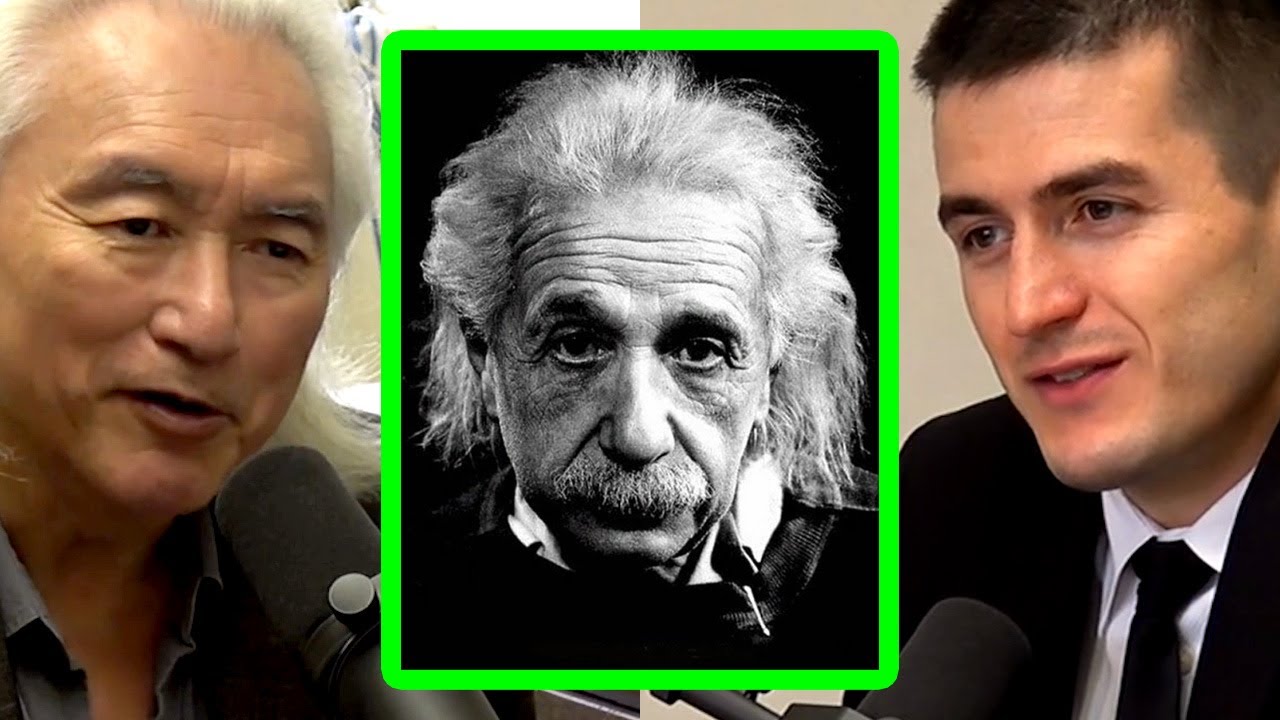
Video summary
Michio Kaku addresses the profound question of what constitutes the mind or nature of Einstein's God, referencing a famous sentiment attributed to Nobel Prize winner Steven Weinberg that suggests our increasing understanding of the universe reveals its pointlessness. However, Kaku counters this by highlighting how giants of physics have viewed divinity differently; specifically, Albert Einstein rejected the personal God found in religious texts who answers prayers and performs miracles. Instead, Einstein embraced the concept proposed by Baruch Spinoza—a deity representing order, simplicity, harmony, and beauty rather than chaos or randomness. Kaku illustrates this elegance by noting that all known laws of physics can be written on a single sheet of paper, contrasting the concise nature of Einstein's equations with the more complex string theory, yet emphasizing that such mathematical unity was not inevitable but reflects an underlying cosmic grace. Kaku uses the metaphor of a young boy entering a vast library to describe humanity's relationship with these physical laws; we are overwhelmed by the simplicity and beauty of this "library," which is the universe itself, containing mysterious phenomena we have yet to discover. While our current knowledge allows us to read only the first page of the first volume, Kaku draws upon Galileo's distinction between science and religion to frame their respective roles in human existence. According to this historical perspective, the purpose of science is to determine how the heavens go—that is, to uncover natural laws—while the purpose of religion is to determine how to reach heaven, focusing on ethics and moral conduct. Kaku argues that as long as these two domains remain separate, humanity remains in a stable position where scientific inquiry explains reality while religious thought guides ethical behavior. The central argument presented concerns the dangers that arise when this boundary between science and morality blurs. Kaku warns against scientists pontificating on ethics or religious figures dictating natural laws, noting that our concepts of right and wrong exist outside the reach of physical theories like string theory. He illustrates the relativity of moral frameworks by comparing human ethics to a squirrel's sense of what is right; just as there is no reference frame for a squirrel regarding complex morality, aliens visiting Earth would likely find human ethical debates confusing or meaningless after an initial period of curiosity. This analogy underscores that while our specific cultural and societal ethics are essential for maintaining civilization and enriching life, they are not mandated by the fundamental laws of physics. Ultimately, Kaku concludes with a nuanced view on the role of morality in the cosmos. He acknowledges that human ethics serve as a necessary mechanism to keep civilizations functioning and make society possible, viewing this development as inherently positive despite its lack of physical necessity. The discussion reinforces the idea that while we may never fully untangle the secrets of why we are here or find definitive meaning through physics alone, preserving the distinction between natural law and moral philosophy is crucial for human progress. By respecting the limits of scientific explanation regarding ethics and recognizing the unique value of our constructed moral systems, humanity can navigate its place in a universe that operates on principles of beauty and order without requiring supernatural intervention to explain those laws.
Read the full video transcript
what do you think is the mind of
Einstein's God do you think there's a
way that we could untangle from this
from this universe of strings why are we
here what is the meaning of it all
well Steven Weinberg winner of the Nobel
Prize once said that the more we learn
about the universe the more we learned
that is pointless
well I don't know I don't profess to
understand the great secrets of the
universe however let me say two things
about what the Giants of physics have
said about this question
Einstein believed in two types of God
one was the God of the Bible the
personal God the God that answers
prayers walks on water as performs
miracles smites the Philistines that's
the personal God that he didn't believe
in he believed in the God of Spinoza the
God of order simplicity harmony Beauty
the universe could have been ugly the
universe could have been messy random
but it's gorgeous you realize that on a
single sheet of paper we can write down
all the known laws of the universe it's
amazing on one sheet of paper
Einstein's equation is one inch long
string theory is a lot longer and so
it's a standard model but you could put
all these equations on one sheet of
paper it didn't have to be that way it
could have been messy and someone Stein
thought of himself as a young boy
entering this huge library for the first
time being overwhelmed by the simplicity
elegance and beauty of this library but
all he could do was read the first page
of the first volume well that library is
the universe with all sorts of
mysterious magical things that we have
yet to find and then Galileo was asked
about this Galileo said that the purpose
of science the purpose of science is to
determine how the heavens ago the
purpose of religion is to determine
how to go to heaven so in other words
science is about natural law and
religion is about ethics how to be a
good person how to go to heaven as long
as we keep these two things apart we're
in great shape the problem occurs when
people from the Natural Sciences begin
to pontificate about ethics and people
from religion begin to pontificate about
natural law that's where we get into big
trouble you think they're fundamentally
distinct morality and ethics and our our
idea of what is right and what is wrong
that's something that's outside the
reach of string theory in physics that's
right if you talk to a squirrel about
what is right and what is wrong yes
there there's no reference frame for a
squirrel and realize that aliens from
out of space if they ever come visit us
they'll try to talk to us like we talked
to squirrels in the forest but
eventually we get bored talking to the
squirrels because they don't talk back
to us
same thing with aliens from out of space
and they come down to earth
they'll be curious about us to a degree
but after a while they just get bored
because we have nothing to offer them so
our sense of right and wrong what does
that mean compared to a squirrels sense
of right and wrong now we of course do
have an ethics that keeps civilizations
in line enriches our life and makes
civilization possible and I think that's
a good thing but it's not mandated by a
law of physics
you