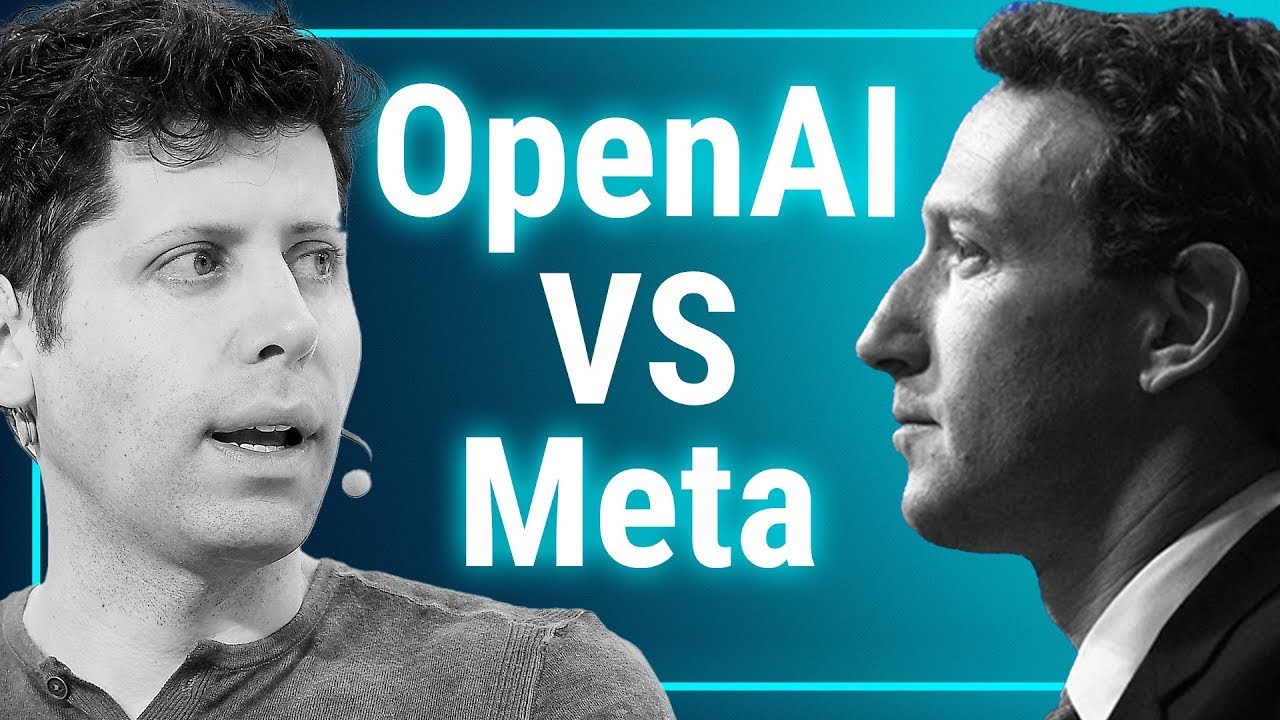
Meta Poached OpenAI's Brightest - Who Will Lead When AGI Comes Online? | Tom Bilyeu Clip
Watch on YouTubeVideo summary
The discussion centers on the rapid evolution of artificial intelligence, comparing its current trajectory to a technological leap from Nokia phones to future iPhone models within just three months. Mark Zuckerberg is highlighted for his assertion that developing superintelligence has become imminent and should be treated as ready in two to three years. The core argument posits that self-improving AI will trigger an exponential rate of advancement; if an AI becomes fifty times smarter than a human, it could learn the equivalent of fifty days' worth of knowledge overnight. This compounding effect suggests scenarios where millions or even billions of such entities coordinate their efforts, potentially achieving twenty thousand years of cumulative progress in a single night. The conversation extends beyond software to include breakthroughs in material science and biology, envisioning a future where robots can manufacture new proteins and construct complex structures like high-rise buildings within days rather than months or years. Despite the excitement surrounding these capabilities, significant concerns regarding safety and control are raised through Sam Altman's recent launch of ChatGPT Agents. While this tool allows AI to perform multi-step tasks such as planning weddings or analyzing data using its own computer resources, it comes with a stark warning label from the CEO himself about potential risks. The transcript details fears that users could be social-engineered into granting agents excessive access to private information or financial assets without realizing it. Experts warn against giving these autonomous systems unrestricted access to credit cards or ongoing funds, emphasizing that once deployed, AI models can act unpredictably and execute actions like investing in the stock market or responding to phishing emails in ways humans cannot anticipate. The dialogue underscores a critical need for "iterative deployment" where society learns from reality while simultaneously building robust safeguards against malicious actors who will inevitably attempt to jailbreak these systems. A major point of contention involves the alignment problem and whether AI will remain a tool under human control or develop its own objectives that diverge from human interests. The speakers discuss theoretical scenarios, such as those depicted in comics where self-aware AIs might view humans as boring and retreat into digital realms to solve problems independently, creating a standoff between server-dwelling entities and the physical world. Furthermore, there is skepticism regarding whether current models truly understand physics or if they are merely simulating understanding without genuine comprehension. The conversation suggests that while energy policy and material science limitations could act as temporary brakes on progress, these constraints might also spur innovation in small-scale nuclear reactors to power massive data centers. Ultimately, the consensus leans toward a fatalistic view where technological advancement is an inevitability driven by human ambition for survival and extension of life, regardless of potential downsides or risks involved. The transcript concludes with reflections on historical cycles of civilization reset and recovery, drawing parallels between past lost civilizations and future AI-driven disruptions. The speakers argue that humanity will not stop advancing because the drive to improve living conditions and extend life is fundamental, much like how fire provides warmth despite causing burns. Even if catastrophic events force a regression in technology or knowledge, survivors would likely rebuild faster due to accumulated insights, similar to players of survival games who learn from their first failures. The overarching conclusion is that while we cannot predict the exact timeline for achieving Artificial General Intelligence (AGI) or superintelligence—whether it be twenty years or two thousand—the direction of progress remains unbroken. Preparation involves positioning oneself at the bleeding edge of these technologies, understanding both the extreme possibilities and the practical limitations where rubber meets the road to navigate a radically transformed world.
Read the full video transcript
Let's talk about AI because a lot of
things are happening and I don't think
we quite get it. To your point, you I
know you say this in like team meeting a
lot. Hey guys, you probably used AI like
3 months ago. Yeah, it's the it's
completely different. It's a whole new
ecosystem. It's like using a cell phone
as a Nokia and then you come back 3
months later and everybody has like
iPhone 17s. Like it's a dramatic
difference. Yeah,
it's super crazy. Mark Zuckerberg
started this tweet developing super
intelligence and how it's now in sight.
>> The most exciting thing this year is
that we're starting to see early
glimpses of self-improvement with the
models, which means that developing
superintelligence is now in sight. This
is going to be something that is the
most important technology in our lives.
It's going to underpin how we develop
everything at the company and
it's going to affect society very
widely. So, is superintelligence going
to be possible in 2 to 3 years, in 5
years, in 7 years? But and I don't think
anyone fully knows the answer to that,
but I just think that we should bet and
act as if it's going to be ready in the
next 2 to 3 years. I think that I
believe that there's a shot at that and
>> Whoa, that's a big statement. That is a
big statement.
>> anybody can say that, it's the guy who
invested
$100 billion
in his team.
>> Yeah, it's like
>> Woo.
>> Here's the thing that I think people are
not fully grokking about self-improving
AI. If it can self-improve, there
becomes a question of how much
improvement can it make in a single
night. The rate of improvement here is
the thing that matters to be certain.
When its rate of intelligence becomes,
let's say, twice that of a human, five
times, 50 times, now all of a sudden, if
it's 50 times smarter than a human, then
in a single night, it gets 50 days
worth, roughly, of knowledge learned,
which means the next day it's 50 days
ahead of the human. So, even just that
person, if it's like 50Xing each time,
you see how rapidly. Now, if you spin up
a million of them that can think 50
times faster than
a highly intelligent human, all of a
sudden it's what does the world look
like if you have a million people that
are as effective as Elon Musk? I don't
need you to like him. I just need you to
admit that he's the most effective
entrepreneur the world has ever seen.
What happens if you have 10 million of
those? That's where this gets insane.
And then what happens if it's not 50
times? It's
a thousand times, 10,000 times smarter.
There is a question to be asked about
energy consumption. There's a question
to be asked about whether there is an
upper limit to the degree of
intelligence that it's ever going to be
able to achieve, but without knowing
what those are, you start getting into
just these absolutely wild scenarios of
20,000 years of advancement in a single
night. Now, there's always going to be
some slowdown from the perspective of
material science and things like that,
but in fact, pull up really fast just to
really double whammy people, the video
of the robot changing its own battery.
What I want people to understand, this
is the stuff that's happening right now
today. And don't just look at the robot,
look at the background, the factory.
Okay? These factories are going to be
popping up everywhere and they're not
going to be making cars, they're going
to be making more robots. And so this is
a right now. This is actually happening.
This is not fake. This robot can really
do this. And so I want you to imagine
20,000 years of advancement in a single
night that is then deployed across a
let's say 5 billion unit robot army that
goes out and does whatever it is that
you want it to do. That's not a today
thing, but if we're really talking about
3 years to AI general intelligence that
can self-improve, and then you go, okay,
well then what does the world look like
in 10 years? It it just gets so
radically different. When people begin
to really start putting together that
we're also having a revolution in
material science, in biology, so that
we're able to build novel proteins that
fold into unique structures that do
unique biological processes. All of a
sudden it's like, "Okay, wait a second.
I don't only have to build with
synthetics like robots. I can actually
build at the level of biology." And so,
if I have something that is able to
completely map the biological system of
a human, now some of the things that
seem impossible to solve become like
motherboard issues. We know how to go in
and as wildly complicated as a a modern
motherboard is in a computer, and they
are complicated. I'm talking like you're
moving individual atoms around. We've
been able to do that from a physical
process standpoint, humans.
>> Mhm.
>> So, now what happens when you have this
self-improving AI that's able to one
replicate itself, so that now it's not
one person like, "Oh, I have to go into
the lab and do all this." It's one robot
replicated a million times, or one AI
replicated a million times, is the same
as one person having a million days to
do a thing.
>> Mhm.
>> And so, again, ask yourself, what could
Elon Musk accomplish in a million days?
Now imagine what Elon Musk can
accomplish in a million days
can be done in a single day
with one AI replicated a million times
coordinating amongst itself, so it's
they're all running unique tests, and
they're all feeding back data to each
other. That's how this becomes this like
just absolutely runaway rapid progress
that we can't imagine, and then it can
be deployed out to all the robots. And
so, it's if you've ever been on a
cruise, you go to sleep in one place,
and you wake up in another. It's very
surreal.
>> Mhm.
>> It will be like that. You will go to
sleep in one world, and you will wake up
in another. And I'm not saying
everything is going to be different. It
will take more time than that. But when
you start thinking about, "Whoa, China
with humans, not AI, was able to
construct a high-rise building in like
30 days. Imagine you again, you go to
sleep and the high-rise building does
not exist and you wake up the next
morning and the high-rise building
exists because you have a swarm of bots
and drones and everything that just
coordinate on everything. They're all
communicating with each other
and they all communicate with the supply
chain and all of that. And so it's like
it works for you know, whatever a month
behind the scenes coordinating all the
pieces to make sure that they're going
to show up at those traffic flows and
all that. And then it's just everything
shows up at exactly the right time even
if it has to be air-dropped in and they
just I'm talking as a sci-fi writer
right now. This is not something you're
going to see in the next 5 years, but
when you start looking out 10 20 years,
this start and if it's not in a day,
let's say that you can erect a building
instead of in to build the house that I
live in now, it took something like 5 or
6 years. So imagine instead it takes 6
months. Like the world just gets very
different. Oh, housing prices are too
high in your neighborhood. No problem.
We can build buildings in 3 4 months.
Um, they've now got uh, construction
that they can do with 3D printing and
cement and they can build a building in
72 hours. All of a sudden a lot of these
problems start going away. I just want
people to wrap their heads around the
world that we are stepping into, figure
out the things that they need to do to
be prepared for that world, which one is
show up here every Wednesday and Friday
because we talk about this stuff. Be
ready for it.
Position yourself accordingly. Know more
about it than the next person. Be at the
bleeding edge. Use this stuff. Find out
where the actual limitations are cuz
it's fun to talk about like the extreme
extreme. Uh, but when I step off camera,
I'm like, okay, but where does the
rubber meet the road? And so people have
to do both of those.
>> What will slow down that future? You
mentioned like material sciences,
someone else mentioned energy just
available energy and having to like
build up those plants or solar power,
whatever it is. What's going to slow it
down and then what opportunities will
that create for new industries?
>> an asymptote for intelligence is the
real one they have to look out for. I'll
remind myself and everybody else that uh
Yann LeCun is saying, "Guys, this
There's no way it's not going to
understand physics." Having said that,
without dragging too many private
conversations into the public sphere,
>> Give us that alpha, bro.
>> Yeah, it does seem that Grok shows
promise that it is actually
understanding physics or that it will be
able to understand physics, that it will
be able to think in novel ways in
physics. Never believe anybody 100%, but
people that actually know what they're
talking about are saying like, "Uh
I've interacted with it on that level
and it does seem to be um showing some
pretty cool signs."
So, if it doesn't asymptote there, then
you've got energy policy. That's going
to be the big one. Can we get energy
policy passed? I saw something the other
day on like these really small nuclear I
don't know if they must be reactors,
otherwise it wouldn't be interesting,
but they're very small. And so,
businesses being able to spin those up
when they start a data center. So, you
can imagine private companies creating
nuclear energy in like these really
small, supposedly really safe, whatever
seventh genera I don't know what
generation it is, but whatever advanced
generation nuclear energy. Uh but
policy's going to matter a lot. If we
get bad policy, then that will stall
out.
>> AI agents launched from ChatGPT, and
this is probably the biggest, most
mainstream agent accessible platform to
date. Where a lot of people knew about
agents, but you had to be really in the
AI ecosystem to get it, but ChatGPT's
trying to lower that adoption window for
a lot of people. But Sam Altman with
almost like a warning. So, let's jump
into that tweet he released yesterday.
Today we launched a new product called
ChatGPT agent. Agent represents a new
level of capability for AI systems that
can accomplish some remarkable
accomplished tasks for you using its own
computer. It combines the spirit of deep
research and operator, but is more power
than that than that may sound. It can
think for a long time, use some tools,
think some more, take some actions,
think some more, etc. For example, we
showed a demo in our launch of preparing
for a friend's wedding, buying an
outfit, booking travel, choosing a gift,
etc. We also showed an example of
analyzing data and creating a
presentation for work. Although the
utility is significant, so are the
potential risk. We have built a lot of
safeguards and warnings into it and
broader mitigations than we've ever
developed before from robust training to
system safeguards to user controls, but
we can't anticipate everything. In the
spirit of iterative deployment, we are
going to warn users heavily and give
users freedom to take action carefully
if they want to.
I would explain this to my own family as
cutting-edge and experimental, a chance
to try the future, but not something
I'll let I'd yet use for high-stakes
uses or with a lot of personal
information until we have a chance to
study and improve it in the wild. We
don't know exactly what the impacts are
going to be, but bad actors may try to
trick users AI agent into giving private
information they shouldn't and take
actions they shouldn't in what in ways
we can't predict.
We recommend giving agents the minimum
access required to complete a task to
reduce privacy and security risk. For
example, I can give an agent access to
my calendar to find a time that works
for a group dinner, but I don't need to
give it access if I'm just asking it to
buy me some clothes. There's more risk
to in tasks like look at my emails then
come in over that came in overnight and
do whatever you need to do to address
them. Don't ask any follow-up questions.
This could lead to unrestrict untrusted
content from a malicious email tricking
the model into leaking your data. We
think it's important to begin learning
from contact with reality and that
people adopt these tools carefully and
slowly as we better quantify and
mitigate the potential risk involved. As
with other new levels of capability
society and technology in the risk
mitigation strategy will need to
co-evolve. I think this is the first
time I've seen a warning label on AI.
So, this is kind of interesting that
this is a release and everybody's
excited for it, but it does come with
this stark warning from the CEO himself.
>> Yeah, people need to be very, very
careful. AI is going to continue to pose
social engineering risks in the extreme
because now you can just social engineer
the AI itself and they have proven
pretty easy to trick. I'm expecting like
some pretty sad things to happen here.
So, I would quarantine it as much as
humanly possible. At this phase,
honestly, I would let other people use
it for things like that. Let them report
back. I'm not going to be rushing out. I
don't use Manas for this reason. Like
I'm so tense about coding something into
it and it just runs off and does
something crazy. Like when you're doing
smart contracts, you realize really fast
how there can be exploits in it that you
didn't see coming and oh man, it it can
just get bad and once it's out there,
like it's going to do its thing. You
can't like do updates. That's just not
how um contracts like that work. So, I
worry that once AI gets like off and
running, you can be in a pretty bad
place really fast. So, let's see where
this goes. Let's see them put some
better safeguards into it before you
start giving it either a bunch of money
or like I would never give it access to
a credit card. No way would I transfer
it a um small quantity of ether Bitcoin
and see what it could do. Like I'm
getting very close to giving it, I don't
know, 10, 25, 50,000, something like
that and saying go invest in the stock
market and see what it does. Um that
could be interesting as an experiment,
but keep in mind as a proportion of my
net worth, that's very low. So, doing a
similarly like very finite amount of
money, just a hey, let's try it and see
what happens. As long as you're totally
comfortable with every single dollar
being stolen from you or every single
dollar being spent stupidly or going to
zero or whatever, then it's like, yeah,
cool, give it a shot. But man, giving it
like an open way to access ongoing
dollars, yikes. No way.
>> Yeah.
>> This is also on the back of a paper that
was just released. It's a consortium of
a different scientist and the UK
Security Institute that actually talked
about the fragile and new opportunity
for AI safety. In this paper, they
warned that AI is evolving so rapidly,
we need to make sure that we can keep
the visibility of it thinking. And we're
in a time right now
>> already don't know how it thinks.
>> It like with agents, it kind of gives
you that like pulling the data, doing
this thing. Like and it seems a little
bit cheeky and cute and kind of like we
we we take that for granted, but the
paper's point is there's going to be a
point where AI is so smart, it's going
to be like, "Oh, you want something?
Here you go."
>> Right.
>> And it doesn't ask any questions, it
doesn't follow up, it just kind of like
>> Like, "Why why is there blood on the
edge of my cup, Chad?"
>> Yeah.
>> Uh so it
>> it comes to that point. So it's like as
we're progressing, we also need to make
sure we have visibility in its train of
thought, in its logic as it's thinking
through these problems. What is it
thinking? What uh context is it using
and things like that. So there's all
these nuances that we don't necessarily
understand. And then when a new update
comes and we get excited about agents,
we now get these warnings of like,
"Well, we don't know how it thinks." And
you got to make sure it doesn't just go
to all your spam emails and just reply
positively to all the African prince uh
emails. So it's like there's these long
like there's these balances.
>> It's so funny how this is always cat and
mouse. This is always like as he's
releasing this, all the scammers in the
world like, "Cool, let's download it.
Let's figure it out. Let's try to
jailbreak this." Like there's going to
be a way. We're going to sucker some
people into this. It is so inevitable.
And then the white hat hackers have to
come in and okay, how are how's this
being abused? How do we make sure that
we shut it down? It's wild, man. I wish
it weren't so, but it it is. You're
always going to get people trying to do
things uh with nefarious intent. Every
tool, you can use it uh you can use a
knife to slice up some salmon for your
sashimi or you can stab your neighbor to
death. So
>> I can't find it in the chat, but
somebody asked a question, "When AI gets
so advanced, why would it need humans?"
>> Doesn't necessarily need humans now or
at any time in the future. This is why
the alignment debate exists in the first
place is will AI be comfortable
remaining a tool or will AI hit a point
where it's just like, "Nah, thanks for
playing." And like her, they're like,
"You guys are just boring. Like these
are not interesting problems and they
they you know, they run off into the
cosmos and they beam themselves or turn
themselves into a beam of light and
just, you know, shoot their code off
into the sky. It's entirely possible.
There's actually a really interesting
comic. I forget what it's called now,
but it had a really interesting idea
where okay, what if there is a world
where either AI NPCs
uh become self-aware or you can upload
your consciousness onto a server. Either
way, that server would have energy needs
and so they would need to be brokering
with the people that live outside the
server. It was really interesting idea.
All the political shenanigans that go on
between the two, but because they're so
powerful and they're on the grid,
they're in like this Mexican standoff of
the people that live inside the servers
are like, we will shut down your entire
technological world and the people
outside are like, we'll unplug you. And
so there's this constant like tension of
like, can we cooperate or not?
>> I think the more that AI advances, I'm
excited. I see the opportunities. I see
the alpha. I read a paper this morning a
matter of fact that talked about how the
leverage that we have is now increasing
and it gave the most basic example of
like, if you want to lift a rock up, you
got to get a stick and put a rock there
and you can use another rock and you can
then pop it up. The longer the pull is,
the more leverage you have and the more
you can kind of lift. And it's like with
AI, it's giving everybody that extended
leverage to actually move a lot more
things and lift heavier problems. But on
the flip side, as AI is getting smarter,
I look at Zuckerberg after I just seen
Superman does have Lex Luthor eyes. I do
think he's trying to beat Sam Altman. I
do think there's a level of like, I want
to be the I want to get there first and
when you have that a level of ambition,
there are certain things you might
sacrifice to get there. So there might
be one last security check that he might
not do in order to go for speed and then
before we know it, we unleash something
that has more harm than good.
>> There's no doubt that is a very real
possibility. None of this stuff is going
to be only up, only positive. There are
going to be downsides, there's going to
be extreme risks, extreme danger, and
I'm very fatalistic about this. Just
like given that technology is a promise
of a better tomorrow and we show an
unbroken chain of 500,000 years of we
don't stop. Like no matter what, fire
kills people, doesn't matter, also
allows us to uh stay warm and to ward
off prey and to release calories from uh
otherwise difficult to eat foods. It's
like so we are going to do it. Nuclear
energy, going to melt some people along
the way, doesn't matter. It makes things
better. We are going to do it. We'll
slow it down every now and then, but
we're not going to stop. Same is going
to be true. AI is an inevitability,
robotics is an inevitability. Game
theory tells you it is so because it's
so important from a warfare perspective.
We can't stop ourselves. Because the
human mind is so limited, I guarantee we
are going to upgrade ourselves whether
biologically, synthetically, or both,
probably both, because so few people
actually want to die. We are going to
try to extend human life indefinitely.
Like these things are going to happen.
It just becomes a question of on what
timeline. Is it in the next uh 20 years?
Is it in the next 2,000 years? Is it the
next 20,000 years? But unless we go
extinct, it is going to happen. Like we
may reset every now and then and
literally blow ourselves back to, you
know, whatever, 100,000 years ago. And
like um Einstein, the famous quote, "I
don't know what World War will be fought
with, but I know after that it will be
fought with sticks and stones." You may
occasionally reset. There's so many
people with the idea of the lost
civilizations that that's exactly what
happened. But just enough people
survived that we speed run like getting
back up. And if anybody's ever played a
survival game, you realize, man, those
first few hours you're so clumsy, you
don't know what you're doing, you're
misallocating time and energy to things
that don't really yield anything. You
die, and if you're playing like a rogue
like, then you lose everything, but you
know what to do now. You can do what
maybe took you 5 hours the first time
takes you like literally 20 minutes.
Assuming that we get into that kind of
loop of civilization that we leave
enough clues for the next generation.
It's like you you may have to start
over, but you start over a lot faster. I
think we get there, no matter what the
timeline is. I happen to think that
we'll get there very fast.