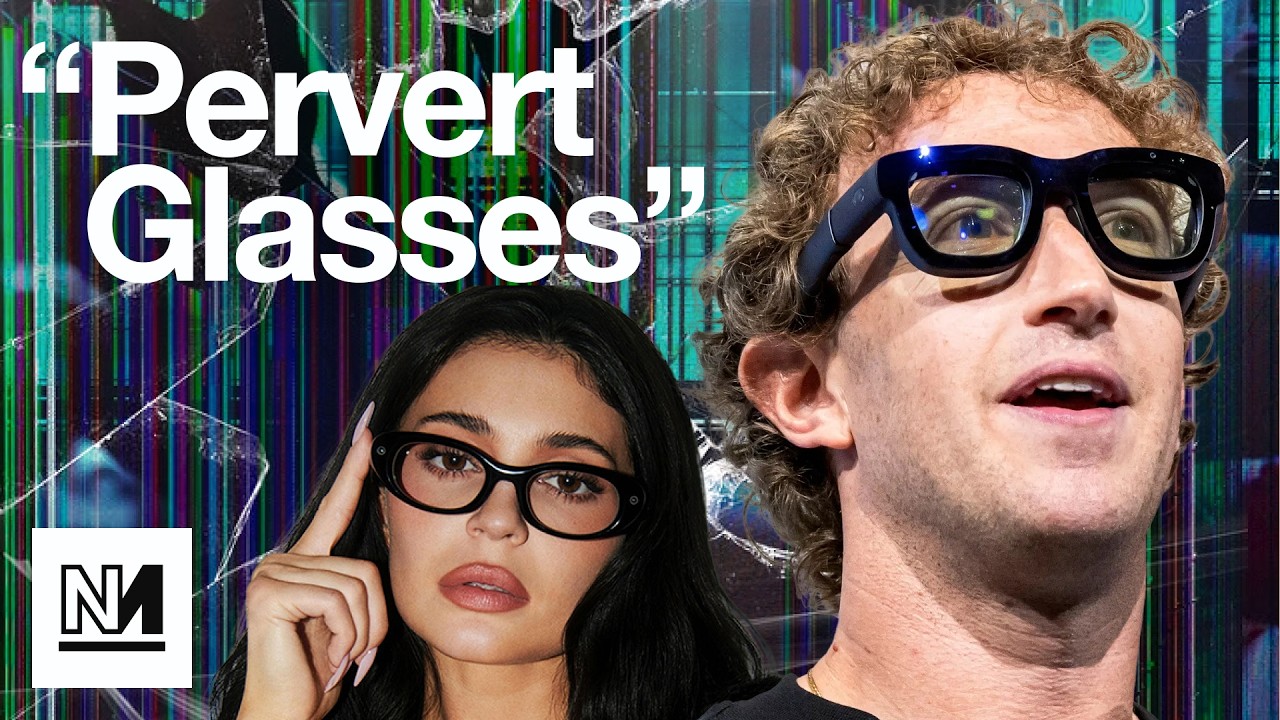
Video summary
The video transcript highlights a growing global backlash against Meta's smart glasses, which are increasingly viewed as invasive surveillance tools rather than helpful consumer electronics. These devices, often marketed with celebrity endorsements like Kylie Jenner, feature discreet cameras and AI capabilities that allow users to record conversations and footage without the subjects' knowledge or consent. The core argument presented is that this technology fundamentally violates personal privacy and dignity, creating a dystopian environment where individuals can be filmed in intimate settings such as doctor's offices, mortuaries, or even during private moments like sex, all while wearing what are colloquially termed "pervert glasses."
The controversy extends beyond mere recording to the handling of this sensitive data by tech giants and their subcontractors. Reports from Kenya reveal that workers at Meta's data processing centers were forced to review streams containing highly private content, including naked bodies, banking card details, and accidental recordings in bathrooms. Although Meta claims this footage is used to train AI models rather than uploaded for public viewing, the sheer volume of intimate data being processed raises serious ethical concerns. Critics argue that these glasses serve no legitimate social purpose other than harvesting proprietary data to give companies like Meta a competitive advantage in robotics and AI development, effectively turning everyday citizens into unwitting contributors to a massive surveillance infrastructure.
In response to the severe public outcry, various governments and regulatory bodies are considering strict measures, including bans on sales to sex offenders, mandatory face-blurring features, and even "kill switches" to disable recording capabilities. Australian officials have proposed legislation to limit data collection and ensure users can demand the deletion of their personal information, while some voices call for a complete ban similar to regulations on controlled drugs or guide dogs. The consensus among the speakers is that relying on technical safeguards is insufficient; instead, the technology itself should be removed from the market to prevent further exploitation of individuals and to avoid fueling an unnecessary expansion of data centers that store unwanted surveillance footage.
Read the full video transcript
People appear to finally be turning off
Silicon Valley tech invading their daily
lives without either their consent or in
some cases even their knowledge. And in
the last week it seems to be so-called
smart glasses that have come in for most
attention with a flurry of articles
focusing on how to constrain their use.
So, what are smart glasses? Well,
they're essentially glasses that contain
a range of technological features
including almost invisible cameras,
instant connections to the internet and
AI in some cases, and lenses that also
serve as screens. Probably the most
famous brand are Meta Ray-Ban advertised
here by professional celebrity Kylie
Jenner. Because the tech is so discreet,
they can be used to film someone without
them ever even knowing.
>> Uh yep, here I am just minding my
business at the airport.
And this guy starts to talk to me.
No idea he recorded this whole
conversation with his glasses.
Is that just creepy? He never asked.
>> Excuse me.
Are you waiting on your boyfriend to
come sit with you?
Just seeing you now. I find you
attractive, so I wanted to say hello.
>> Oh, hi.
>> Yeah.
I'm not looking for a girlfriend, don't
worry.
What are you doing today then?
>> Uh I'm just waiting for my friend. I'm
just an exchange student.
>> Oh, okay.
What do you do then?
>> Uh I'm
uh I'm thinking about doing psychology.
>> You with your boyfriend for long now?
>> Uh maybe two months.
>> Uh that's not a boyfriend. You mean
after two months, that's actually your
boyfriend?
>> You're stealing from me.
>> I'm not stealing from you.
>> What are you doing?
>> Oh, the skull. That's a thousand.
>> DUDE.
>> OH, THE
OH, OKAY. OKAY.
>> Uh that harassment, um that 17-year-old
girl is just, you know, completely
completely grim. And then and to have it
all sort of recorded and posted online
without your without without your
knowledge.
A recent caller into LBC was pretty
passionate about everything that's wrong
with these glasses.
>> Look at the stages of dynamite or
asbestos. It has its uses, but it's it
was absolutely dangerous. This stuff is
dangerous. It's a nice toy,
but the privacy, the dignity. Imagine
you're a woman on the train and some
jackass, if you like, has got these
glasses on. Or you go to a doctor, or in
the mortuary, or this is nasty. What
about people's records, the passport
office, the bank? You've just got these
glasses on. This is disgusting.
>> Now, more and more groups are coming
forward demanding protection from the
use of what is essentially spy
equipment, or as they're increasingly
becoming known, pervert glasses. The Lib
Dems have argued that sex offenders
should be banned from buying smart
glasses to protect women. The backlash
against the technology has been so
severe that Meta is allegedly
considering a kill switch for their
smart glasses, which would unhackably
switch off the the ability for the
glasses to record in some situations.
And in Australia, the country's online
safety regulator is calling for smart
glasses to automatically blur people's
faces when filming. They're also calling
on manufacturers to install features
like lights that make it clearly visible
when someone is recording you. The
problem goes deeper though, because some
of the glasses are almost always
recording. This is a recent report from
Australia's Channel 7 News.
>> One measure of how Australians have
taken to video cameras hidden in
sunglasses, their nickname, pervert
glasses. It's dystopian. But there's
another measure, the cheap end of the
market is currently sold out. You can
pay more for a brand, though observers
here warn the software is already geared
towards sending countless images of
people back to Big Brother.
>> You're not only wearing sunglasses,
you're building the surveillance
infrastructure for Meta.
>> The federal attorney general has
released draft legislation to sharpen
Australian privacy laws for the digital
age. It includes a fair and reasonable
test to limit how much of our
information companies collect and also a
right to a ratio so people can demand
companies delete personal details. But
Minister Rowland has stopped short of
any import ban on smart glasses.
>> We are not in the business of playing
whack-a-mole when it comes to the
emergence of technologies.
>> I've got serious concerns we're not
moving fast enough or broad enough.
>> Tim Roberts calls the government's
proposed laws timid.
>> Australians are definitely more
exploited with respect to our data and
privacy than other people in the world.
>> Recordings made by smart glasses aren't
only affecting the people in front of
them. People on the back end of the
process are having to endure some grim
material, too. In February, Swedish
newspaper Svenska Dagbladet reported on
a Kenyan data processing center used by
Meta, where workers complained that they
were forced to watch the hidden stream
of privacy sensitive data that is fed
straight into the tech giant's systems.
The newspaper reported this from some of
the workers.
We see everything from living rooms to
naked bodies. Meta has that kind of
content in its databases. People can
record themselves in the wrong way and
not even know what they're recording.
They're real people like you and me. The
workers described videos where people's
banking cards are visible by mistake and
people watching porn while wearing the
glasses. Clips that could trigger
enormous scandals if they were leaked.
There are also sex scenes filmed with
smart glasses. Someone is wearing them
having sex. That is why this is so very
sensitive. There are cameras everywhere
in our office and you are not allowed to
bring your own phones or any device that
can record. They were also in in in in
that piece, you know,
workers saying that they're having to
look at videos of people accidentally
filming themselves on the loo.
When the article was published, Meta
admitted subcontracted workers might
sometimes review content filmed on its
smart glasses when people shared it with
Meta AI. So, they're not uploading it.
They're just sort of sharing asking Meta
AI's
about the footage that that that they've
filmed or what's in their field of
vision when they're wearing their their
glasses.
But in response to the story, the
company appears to have gone even
further. They canceled their contract
with the company in Nairobi, claiming it
didn't meet their standards, and leaving
thousands of workers out of a job.
Michael, I I honestly can't see any
reason why should we we should have to
endure these things.
>> Ban them.
>> Ban them. Ban them now.
>> Like they're creepy, there is no social
purpose for them whatsoever.
And I think banning them would be No one
wants to get filmed by someone else's
glasses, right? It's
I feel like there is a lot of room for
kind of anti-tech populism that would be
very, very popular. Like obviously there
is a big backlash against data centers.
You know, I take seriously the idea this
is going to kill us, also obviously I
prefer to slow down the data centers.
But there are obviously, you know, there
are pros and cons there. You can see why
sort of a government thinks, well, there
are reasons to ban them, there are also
reasons to keep them going. You know,
there are clearly sort of rights on both
sides on both sides. When it comes to
these smart glasses,
get rid of them. Like it would be very
popular, they serve no social function
whatsoever.
I wouldn't be surprised if Meta are
subsidizing them because this is a sort
of data harvesting thing. Like with
LLMs, one of the reasons that progress
has been so fast is because companies
got to scrape the entire internet cuz
there's a hell of a lot written on the
internet, and so that's why I mean, they
could maybe I'm anthropomorphizing here,
but that's why they could appear to
learn so much so quickly, right?
When it comes to robotics,
it's you know, we've seen them
advancing, we've seen those sort of
Olympic games for for robots in China.
But
the real issue there is they've got the
same neural network technology, but they
haven't got the same data. Because
whereas we've written, you know,
pretty much all of our thoughts on the
internet for the past 20 years, we
haven't recorded everything we've seen.
So this is going to be used to train
robotics.
Meta will be looking for this as
proprietary data to give them sort of a
competitive advantage against other
people. In the same way that sort of
Tesla's big and in the case of Tesla you
can there is an argument for it, right?
There's a strong argument for
self-driving cars and one of the reasons
why Tesla is so overvalued compared to
its revenue is because people recognize
that Tesla has the best data
when it comes to self-driving cars
because so many people have been driving
their Teslas for the past 10 years um
and many of them have been sort of
constantly filming. So, they're trying
to do the self-driving cars thing for
humans.
Um but we don't want a self-driving
human. Uh so, it's it's creepy. There's
no point in it whatsoever. Banning them
would be popular. It would have no
economic cost to the wider economy and
it would save us all from
perverts and even It's another one of
those things where
what we'll hear is safeguards to stop it
being used for
you know
snooping or abuse or yada yada yada.
Just get rid of it. We don't We don't
need safeguards. We just don't need
these glasses.
>> We don't need them and and all that data
that's collected and all that video
that's sent back to be processed by you
know, that that's all more data centers,
right? That is all stuff that has to be
put somewhere
which we don't need and we don't want.
We don't want those data centers anyway
and now we're getting we're going to get
more of them based on a piece of
technology that nobody wants either. I
mean, I will say cuz someone will point
it out in the chat that apparently
these smart glasses can be very useful
for people who are visually impaired.
But I don't think that's why Meta's in
this business or Ray-Ban.
Uh You know, that's that's not what
they're about, right?
>> No, that that's interesting. That's a
good point. I mean, definitely we could
have them as a medical device that you
can be prescribed by your doctor and if
anyone sells them without a
prescription, it should be a bit like
when you sell any other controlled drug
and that's quite a serious crime.
>> That is a ban for I
>> Yeah, I I don't think just you know, not
everyone is allowed to get a Labrador
and put a guide dog
you know, shiny thing on it, right? That
they're reserved for people who need the
guide dogs. We could do that with these
glasses. It's not beyond our collective
wisdom.
>> It's also very bad for those of us, like
you and I, although I'm not wearing them
now, who wear glasses, right? It's bad
It's like lowers trust in people who
just need to actually see.
I mean, I I you know, if I find myself
filmed by once by someone wearing these
glasses, I think I would just be like so
suspicious of everyone I know wearing
>> Well,
you just need skinny frames. I don't
think that.
>> I don't know. There's
>> I mean, if the glasses if the if the
cameras get smaller and smaller, who
knows? But anyway, this is bad Black
Mirror episode. No purpose for it.
Everything Mark Zuckerberg does is evil.
I don't want this.
>> Yeah, I don't think anybody wants this,
really.