Menopause.exe:running_with_limited_resources "Hacking the Hormonal System Update" - EMF 2026
Watch on YouTubeVideo summary
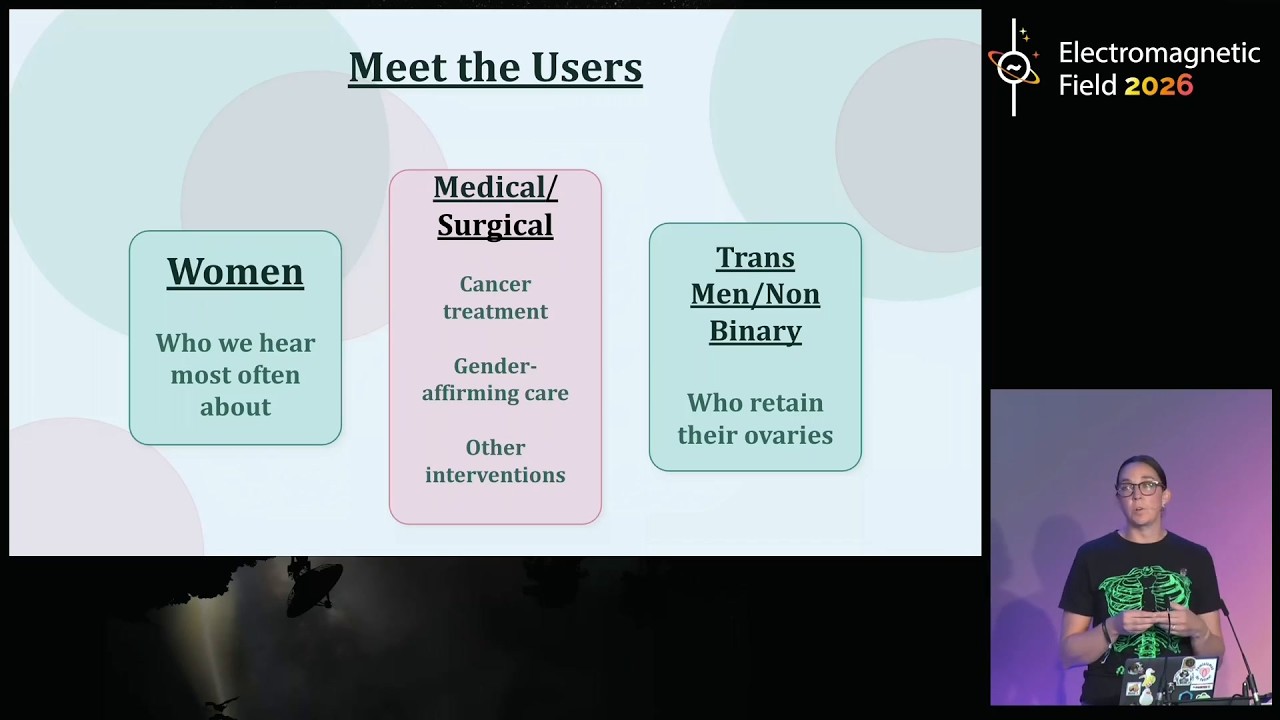
Amy, a certified menopause coach with a medical background, opens her talk by reframing the biological transition of menopause as a "Hormonal System Update" (HSU) that affects over 1.1 billion individuals worldwide, including transgender men and non-binary people who retain their ovaries. She shares her personal journey through this phase in her mid-to-late thirties, describing it not merely as a natural process but as an overwhelming event organized by unqualified planners that brought chaos such as hot flashes, brain fog, and insomnia without the comfort of "cake." Her story highlights how menopause often feels like life falling apart due to hormonal fluctuations where the ovaries stop responding to signals from the brain, leading to a period of desynchronization. She emphasizes that this transition is rarely meant to be endured alone and encourages open conversation to reduce isolation and confusion for everyone navigating these significant biological changes regardless of their specific pathway into menopause.
The core of her presentation explains that while estrogen and progesterone are often viewed solely as reproductive hormones, they actually support nearly every system in the body, regulating brain chemistry like serotonin and dopamine, maintaining bone density and skin elasticity, supporting heart health, and aiding sleep quality. When these levels fluctuate or drop, it creates a "tunnel vision" effect where society focuses only on the most visible symptoms—hot flashes, mood swings, and brain fog—while overlooking over one hundred other potential issues ranging from dizziness and hair thinning to cardiovascular risks like hypertension and insulin resistance. Amy illustrates how this systemic overload can lead to severe mental health challenges, including anxiety spirals at 3:00 a.m., intrusive thoughts, depression, and even suicidal ideation, noting that the risk of suicide is particularly high between ages forty-five and fifty-five. She argues that because these symptoms impact relationships and social interactions by draining one's "social battery," there is often pressure to mask struggles with phrases like "I'm fine," which ultimately leads to burnout and a loss of identity rather than genuine recovery.
To address this crisis, Amy proposes practical strategies for "hacking" the hormonal system update through self-advocacy, lifestyle adjustments, and systemic change in both personal and professional spheres. She suggests building a personalized care team that includes doctors, partners, friends, and therapists to track symptoms and explore medical or non-medical solutions rather than trying to cope alone at work. In the workplace context, she points out that organizations lose valuable talent precisely when individuals are peaking in their careers due to these health issues, urging companies to adopt supportive policies similar to those emerging in countries like the UK, Netherlands, and Germany. Her advice includes communicating energy levels to adjust schedules, utilizing well-being days without apology, seeking shared experiences through support groups, and educating oneself on local standards of care to navigate healthcare systems effectively.
Ultimately, Amy concludes that changing this outdated system does not require a revolution but starts with individual voices opening the conversation about HSU to design better release notes for humanity's collective experience. She stresses that no one is broken or too dramatic; instead, everyone is navigating one of the most significant biological transitions possible and deserves support rather than judgment. By advocating boldly for what they need and supporting others generously, individuals can transform their relationships from sources of stress into pillars of strength. The talk ends with a powerful call to action: silence is outdated, and by speaking honestly about our struggles, we empower ourselves and the community to build a future where health is prioritized over productivity and compassion replaces stigma for everyone undergoing this hormonal system update.
Read the full video transcript
[applause]
Okay. Hello everyone and welcome to my
talk. My name is Amy. I am a certified
menopause coach. Uh my background is
really in the medical field. So my
hardware is sort of the human one. Uh so
if I call estrogen a plug-in or
progesterone a firewall, I'm just very
delighted I used the right terminology.
So really, why talk about menopause in
the first place? So menopause affects
over 1.1
billion individuals worldwide. But this
number also doesn't include transgender
men or non-binary individuals. So
despite its universal impact, it's still
quite quiet and not really talked about.
This leaves uh individuals feeling
isolated, unsupported,
confused, and just left out of the
conversation. So today I want to talk
about menopause by just opening the
conversation, talk about what it is, why
it happens, look at a little bit of
data,
uh and to really do this, uh with a
little bit of science, maybe some
laughs, some honesty, curiosity, and a
whole lot of self-compassion.
So for me, menopause showed up in my
mid30s and it really ramped up uh
towards the end of my the end of my late
30s. Uh it kind of felt like a party I
didn't want to be at. It was organized
by an unqualified party planning
organization. They invited hot flashes,
brain fog, insomnia, and really anybody
that could cause any type of chaos in my
life. And the worst part of my party was
there was no cake. And so that was very
disappointing.
Uh so the hormone fluctuation for me
just felt like my whole life was just
falling down around me and everything
that could go wrong went wrong.
And it really left my transition into
menopause very unpredictable,
very confusing, very frustrating, and at
times very terrifying.
And I think it's important to share my
story. We share our stories and our
struggles.
uh because it's really ne never meant to
be carried on your own. So talking about
it with some honesty and some curiosity
really gives space for others to kind of
be able to be let in to also talk about
their experience.
[snorts]
So really who who experiences menopause
and so when we talk about menopause it's
mainly talked about as as a woman's
issue. Uh but biologically it is a very
complex transition that affects far more
than we acknowledge. Um so we have women
who experience we also have trans um
gender men and non-binary individuals
who still retain their ovaries. Uh we
have individuals that have cancer
treatment. They have gender affirming um
care and any other medical or surgical
intervention. And these these are the
individuals who can experience
menopause. So the pathway may be a
little bit different uh but the impact
of changing hormones can be significant
regardless of how someone arrives there.
So really what what is menopause? So
during menopause, the ovaries gradually
slow their production of estrogen and
progesterone, but the brain will
continue to send signals to the ovaries,
hormonal signals to the ovaries, but
usually the ovaries get to a point that
they're just like, nah, not anymore.
We're not having it. So the
communication between the brain and the
ovaries that just kind of really gets
out of sync.
So there's uh three parts to menopause.
So we have pmenopause which is really
the the transition and this is when
periods become a little bit more
irregular.
Um early symptoms start to show up. Uh
it can last for several years and by
several years I mean anywhere from 4 to
10 years. Um and it can start as early
as your 30s. They are starting to
discover that it is starting much
earlier than they actually are saying
that it is starting. And this is
important because this is kind of really
the longest phase is pmenopause.
And if for some reason your symptoms
don't add up with the age of what they
think menopause or pmenopause should be
happening, then you kind of fall into
this take two paracetamol, come back in
one month, we'll see if it worked type
of loop.
And then we have menopause. And
menopause isn't really a phase. It's
more of a moment in time. And this is
kind of when uh this is when you go 12
months without any type of period. Uh
[snorts] the symptoms really start to
peak around this time and this is
usually between the ages of 44 and 51.
And then after that you kind of just
have the future and this is
postmenopause.
So the body s starts to really adjust.
the symptoms hopefully start to kind of
quiet down a little bit as your body
kind of finds this new kind of uh
stabilized hormonal level. Uh but there
are also some longterm health
considerations in this phase that is
good to uh keep in mind that I'll cover
in a in a little bit.
Okay. So now we have the who, the what,
the why. Um, but yet a lot of us don't
really fit into like the typical
menopause manual.
Um, and and that's just because of
several reasons of assuming that women
are the only individuals that go through
menopause. Healthcare informs using
gendered language, delayed recognition
of symptoms, and not everyone
experiences it the same way. Everybody's
journey is a little bit different.
So because it is a little bit different
for everyone and it involves uh many
different individuals
um I'm going to refer to menopause
moving forward as this kind of hormonal
system update or HSU um as we move
forward through this uh talk.
Okay, just a little bit more science. Um
so estrogen and progesterone are not
just reproductive hormones. they really
just uh they support every system in our
body. So for estrogen, it is a huge
multitasker. Uh it regulates serotonin
and dopamine in the brain.
It keeps the blood vesicles flexible in
the heart. Um it uh maintains bone
density. It supports collagen for the
skin. It helps keep the tissue elastic
in the bladder. Prevents urinary
problems. uh it helps uh reduce
inflammation and also modify it. And
then we have progesterone who's kind of
the quiet assist in all of this. Uh it
helps deeper uh trigger deeper more
restful sleep. It's a natural
anti-anxiety.
It offsets estrogen to kind of balance
out mood and it supports insulin uh
sensitivity. So that's why when your
hormones change, it feels like
everything is just coming from every
direction.
So now we start moving into oh what does
this kind of feel like? What does this
look like? And I call this the common
experience. And I call them the big
threes because um we're talking hot
flashes, mood swings, and brain fog. And
these are the big threes because they
are the loudest, they are the most
visible, and they are the most talked
about. So really they get the spotlight
for the symptoms. Uh but the problem
with this is you begin to have tunnel
vision. And when you have tunnel vision
about something, anything out of the
tunnel vision, meaning all other
symptoms, they just run the risk of
being overlooked.
And that's where the really where the
real harm can begin. It leads to gaps in
care, misdiagnosis, lack of empathy, and
honestly, some really terrible
punchlines to jokes that I think a lot
of us going through HSU just don't find
hilarious.
Okay. So, maybe you're saying, "Okay,
Amy, what are the other symptoms of of
of HSU?"
So, some more wider and uh more common
symptoms uh are things dizziness,
lightadedness, problems with heart
palpitation, problems with your hair
thinning out, weight gain.
Um, and then again with the skin and
some of the other stuff that I talked
about that estrogen plays a role in, but
in real in reality, there's actually
over a 100 plus symptoms that have been
linked with HSU.
Uh, and I would love to put them all on
a slide so that you guys could see them.
Uh, but a we have limited amount of time
and that really wouldn't be a slide.
It'd be more of a medical encyclopedia
and we need s snacks and a sequel. So
just know that there are many many
symptoms that can go with it and it's
important that not only our anyone going
through HSU learns about these symptoms
but also people who are supporting us
understand what these symptoms are as
well because you don't you want to be
able to connect the dots of what is
going on in your life because you don't
want to just treat one system uh one
symptom have multiple appointments come
back for another one and miss the whole
picture of really what might be going on
in your life. And this is why people end
up managing discomfort rather than
understanding the actual changes that
are going on.
So all these symptoms really start to
stack up in someone's life and it can
look very different. And so some people
they wake up super tired again just from
not sleeping. They stare at their coffee
like it's completely betrayed them. Then
9:00 a.m. rolls around. You're googling
on your phone, where is my phone? On the
phone that you think you have lost.
Then you go to work. You're in a mid
meeting and you're negotiating with your
armpits to just like keep it cool.
There's only 10 more minutes left in
this meeting. Lunchtime comes around.
Someone asks, "Hey, how you doing?" You
start crying because they put mustard on
your sandwich at lunch when you asked
them not to. 2 p.m. No more energy. Your
energy has left the building with your
will to answer another email, another
phone call, or just look someone in the
eye. And then you get home, it's time
for bed, you're exhausted, your head
hits the pillow, and the next thing you
know is you have the Netflix sound that
just turns on your head. And it's like,
we're going to binge watch anxiety the
entire series.
Then the night sweats, [sighs] your bed
becomes a sauna, and not a good one.
And then this just happens over and the
cycle just keeps going like Groundhog's
Day over and over again. And this can be
from barely noticeable for some people
to full-blown system chaos on a daily
basis.
So these are the kind of long-term um
health considerations to keep in mind
kind of towards this postmenopause
um phase uh of HSU. Uh and I do want to
just say that most of the evidence in
general and for this talk uh comes from
studies conducted uh in a population of
women. And while more research is needed
to be inclusive for everyone, this
information remains just as important
for anyone experiencing HSU.
So some quick things to keep in mind as
you go through um HSU.
uh is to keep in mind osteoporosis. Um
bone density decreases by about 20% uh
risk of fractures one in three and in
and individuals over the age of 50.
Cardiovascular is another big one 2.6
times higher of a cardio uh vascular
event happening and 30% develop
hypertension within a year. And then
metabolic changes. So increased insulin
resistance um and higher risk of
developing uh diabetes. And so no matter
where you are in your journey in which
phase that you are in uh this is this
information is about supporting your
body preserving your health and giving
yourself kind of the best possible uh
found foundation for the years ahead. So
this isn't something to just keep in
mind when you once you get into that
kind of future phase uh because this is
a complete recalibration of your body.
Um and then we kind of move into the
mental side of stuff. So we have the
physical stuff but then we have um the
mental side because um apparently the
body wasn't complicated enough on its
own. We have to [sighs and gasps] uh go
ahead and put in some mental stuff.
So um what seems to be common that I
notice is there when I speak to
individuals about HSU is there's this
kind of journey that they go through and
it starts really kind of with this fear
like uh okay what is going on what is
happening to me and then it slowly moves
into this kind of phase of understanding
that okay yeah there is there is
something going on this is a
neurological thing my hormones are
changing
And then there's the recognition and
it's when you kind of realize, hm, I'm
not alone. I'm not doing this on my own.
There's a lot of support out there.
And this mental side of it really can be
very difficult for a lot of individuals.
This is where I found myself struggling
the most.
Um, my thoughts became very unfamiliar,
emotions became very unpredictable,
and I just really couldn't trust my own
reactions or myself. And so, also those
who do struggle or have struggled with
mental health um, issues, this can be a
very difficult phase as well because it
feels even heavier and sometimes it just
reopens old shadows and that's just
another thing to tackle in this journey.
And then it goes maybe just a little bit
deeper. And so estrogen and progesterone
interact with the serotonin and the
dopamine which are the messengers and
motivation, mood, uh focus, emotions.
Uh and so it's a little beyond just the
brain fog of, you know, you walk into a
room and you say, "Okay, why was I here?
I'm going to go out of the room and back
in. No, I still don't know why I'm
here." But it's more of dementia- like
symptoms. It's driving somewhere
familiar and then you get there and you
have no idea why you were there. Uh
completely forgetting a conversation you
had less than 24 hours ago. And these
things can become very frightening and
it it's less about HSU and more about
okay maybe I have dementia and there's
this battle that happens in your head
and then there's anxiety and
overthinking and it's kind of the 3:00
a.m. spiral. You know, you lay in bed.
Did I lock the door? Did I put the
emergency brake on the car? No, I don't
think I did. Did my car roll down the
hill? Did it smush someone like a grape?
Do I have a good lawyer? Do I have money
to pay for the lawyer? And then it keeps
going and then you say, "Why am I not
sleeping? I should be sleeping. I have a
meeting tomorrow. It's a very important
meeting. Maybe I should buy a goat."
And then you have the mood changes, but
they become more noticeable and a little
bit what feels more irrational.
It could be 10:00 a.m.
uh you're doing just fine. 10:15 there's
a dog food commercial and you're just
crying about it. uh 10:30, your partner
comes in in eating an apple like a feral
cat, and you just
want to strangle them. [laughter]
[snorts] And then all of these things
layer on top of each other that layer on
top of careers and families and
responsibilities
and
kids, and it just keeps going. And then
you get to this point of burnout that is
just this exhaustion. and you find
yourself living in a world of I just
can't anymore.
[snorts]
And sometimes it's even more than the
3:00 a.m. spiral or the burnout. Uh
there are some really deeper uh mental
risks that come with the hormone
fluctuation
and there's depression, there's
intrusive thoughts, there's suicidal
ideiations.
uh and this is truly where I found
myself uh was in this very depressive uh
suicidal ideiation and this is where I
lived for a very long time and it was
very scary and it was very terrifying.
So each part of HSU kind of carries its
own risks. So if you're in the uh perry
menopause perry menopause
uh 1 in 10 uh report suicidal thoughts
uh in menopause
um [clears throat] the suicide rates uh
are highest between the age of 45 and 55
but also still when everything levels
out in postmenopause uh suicidal
ideiations still do persist. So the
fluctuation of hormones really really
can mess with your mental state
and then we have relationships and
families and so it happen HSU happens in
a relationship ecosystem.
So partners may notice a shift in things
that are going on with you uh but they
don't really recognize what's going on.
uh family members see irritability but
maybe they don't see just the
overwhelming exhaustion and the internal
changes that are going on.
Uh and the symptoms may happen in one
person in their body but the impact can
be felt by others around us. And that
statement isn't about blame or placing
fault in someone of what they are going
through. It's just recognizing that
biological changes can affect the way
that we connect and the way that we
communicate uh and the relationships
that we have. [snorts] And what I can
suggest is patience and understanding.
And it really can change how that is in
a relationship so that relationships can
become a source of support rather than
an additional s uh an additional source
of stress.
And then we have just the social side of
it and the energy um required to engage
with the world suddenly feels very
different and your social battery
battery has just shrunk. The group chats
are too loud. The phone is ringing
straight to voicemail. Someone wants to
do weekend plans. You just kind of say,
"Let's circle around next month."
Someone invites you to a birthday party.
are like that sounds lovely from my
couch and dinner plans
maybe. Do I have to wear pants?
No. So, your social life can feel like a
real loss. And again, this is why
understanding and patience really
matters because when you do the people
around you, the judgment becomes uh
compassion, guilt becomes grace. And if
they also agree to not wear pants,
you've probably found your people.
Because HSU is still so silent, there's
a lot of pressure and kind of this
expectation to just carry on like
nothing has changed. So many people
continue to say, "Ah, I'm fine." and
they're while they're masking symptoms,
they're struggling through the day,
feeling increasingly alone and just
quietly losing confidence.
So over time, kind of pretending that
you're okay becomes very exhausting and
it can bring um this kind of shift in
your identity of just who you are
affecting your confidence and really
anything else around you about yourself.
Uh, and this is partially too because
we're just kind of asked to just cope
with it.
Uh, anyone out there that is
experiencing HSU, if you feel like you
have lost a part of yourself, uh, you're
not alone. This is very common. Uh, this
season doesn't define who you are. And
something that can be very powerful and
beautiful is it is okay to just say,
"I'm not okay." And when we say this to
the people who around us who support us
that we say I am not okay. They are
there to help pick us up because your
worth is not measured in how well you
hide your struggles.
Now a lot of us are still going to work
during this phase and this so HSU it
shows up when we have uh careers we're
leading teams we're building our own
expertise and we're bringing years of
knowledge and experience to the
workforce.
Uh yet many in HSU are finding that
their symptoms are affecting their
confidence, their performance and their
ability to thrive at work. And the
result is that organizations are they
lose talent, very valuable talent at the
exact moment that they need it because
women are I'm sorry, individuals are
peaking in their uh careers around that
age of 44 to 51 and that is the peak of
HSU.
So experienced leaders are stepping
back. Skilled professionals reduce their
hours and high-erforming employees turn
down really wonderful opportunities or
they just leave the workforce
altogether.
And it isn't a talent problem. It's a
support problem. But without
understanding and support, too many
talented individuals are forced to step
away from their careers and probably
many that they actually love.
So when when when people reduce their
hours, step away from leadership
opportunities or leave the workforce
entirely, organizations don't just lose
those valuable um individuals and their
experience, they are losing productivity
uh and the financial investment that
that the company has also put into the
individual and the talent that they
have. And so just to quickly touch on
what kind of the annual loss looks like
uh economically within the within the
workforce. Uh so you can see for three
three of the company or countries that
uh kind of apply to everyone here.
[snorts] Uh this is the annual loss of
uh of of money due to individuals
stepping back from the workforce. uh and
the cost of that gap is very significant
and again this isn't about blaming
anyone who is in this phase of their
life and in the HSU.
Uh really it's far from that. Uh this is
just to point out that this loss is
actually very preventable.
Uh and it's just because the workforce
is a system that was never designed to
support any phase of life that is HSU.
But the good news is we are not destined
to lose our talent. Uh there is a change
that is coming within companies.
Um
uh so 45% of employees in the United
Kingdom now have HSU policies. Uh in the
US they're doing more with uh insurance
cover coverage. The Netherlands they
have more well-being. Uh in Germany is
also recognizing this kind of economical
decrease and starting to create policies
as well. And by creating policies it
reduces the stigma. It makes it easier
for people to ask for support before
they reach the point of just pure
exhaustion in leaving their jobs and
stepping away. Uh so we don't need to oh
sorry [clears throat] we need to
humanize what billions of individuals
are navigating while they can continue
to contribute to the workforce. They
lead teams. They bring their experience
to the table.
So, how do you really support someone
that is in HSU? And there's so many
things you can do. I have just listed
just a few. Um,
but the thing that's really important to
remember is that it's not about having
all the answers if you are supporting
someone or fixing it. That's that's
really not what we need. Um but what we
do need is an environment that is
created where we feel understood, we
feel validated and we feel empowered.
Um I think my husband will hate this but
uh through through my journey I had an
amazing support system.
Um he never tried to fix anything. Uh he
made me see uh feel loved and heard uh
and seen and not alone.
uh he put in the work to [snorts]
educate himself
and to learn about not only what I was
going through but what all individuals
go through so that he can be a support
just beyond me uh but to also be there
for others. So after the talk he will be
out there if anybody wants to talk to
him. So he doesn't know about that yet
but it's probably better than pulling
him up on stage and asking him to speak.
So, he should be happy about that.
Okay, so now it's time to start hacking
the HSU, right? It's time to kind of
tweak it to give it the update that it
really clearly needs because working
harder isn't the goal. I think plenty of
us out there are maxed out as it is. So,
it is really about working smarter. So,
think of this as your open-source
manual. ah see computer terms. Okay. So
really what it comes down to is what you
can do yourself
uh what you can ask for uh different
types of setups and solutions
uh in medical and realistic uh steps
that you can take. Uh I'm not going to
go through every single one of these uh
but I do have more information
afterwards so that uh you can have that
information to take with you. So if you
uh want to take a picture of this that
is uh that is good. Uh so on the
physical hardware hacks it's about
moving daily tracking your symptoms
asking for a proper HSU uh review from
your GP.
um build your own care team and whatever
that looks like whether it's uh your GP,
it's your partner, it's your friends,
but but build your team that feels right
for you and talk about what uh hormonal
and non hormonal options that you have
and for the mental and emotional
reprogramming.
So one thing that I think is very
important is to is to name it and just
to say what it is that is going on. Uh
you can ask for a mental health
screening.
Uh give yourself a little bit of grace.
Um find your anchors in your life. Um
but there's also outlets like therapy
and mindfulness. Um there's sleep
support that also can help
network and relationship upgrades.
Um just communicate what is going on. Um
seek out sh seek out shared experiences.
Uh again build your chosen family that's
around you. Learn about HSU together.
Like I said that was one of the most
powerful things that my husband did was
he just educated himself so that when I
were I was in moments of just like
throwing my hands up and saying I have
no idea. He was there to kind of help
guide
and find support groups. There's plenty
of them out there. Listen, we all need
to talk about it. Sometimes it's over a
glass of wine or a whole bottle of wine,
but there are people to talk to about
it.
And then in the workplace um understand
where your energy window is and then
discuss with your workplace if you can
do your work schedule around where you
have your energy peaks and avoid maybe
where you kind of find yourself in the
valley of your energy. So change your
work hours if you need to. Um, ask your
work to change policies. Make policies.
Be involved. Help them write the
policies.
And [snorts]
if you have well-being days, use them.
Like I said, you don't have to say, "I'm
fine." You don't have to just cope. You
don't have to push through. I mean, you
have to take care of yourself first. So,
putting your well-being over your job,
yes, it's easier said than done, but it
is possible.
>> [snorts]
>> So what else is important about hacking
HSU is know what is going on in your in
your country or where you live. Know
what the standard of care is. Educate
yourself as well so that you know how to
better navigate the system. But com
countries are really starting to make
some really good strides forward in
managing and caring for HSU.
So many countries are starting to listen
to the symptoms and they start treatment
on how really it affects your life. Know
who manages HSU? Is it your is it your
GP? Uh is it a specialist? So figure out
how you navigate into the right care
and what is the standard of care with
hormones versus non hormonal uh
treatments. So So find out what the
standard of care is within your country.
So how to advocate for yourself? So it's
different in every country the way to
navigate this. Uh but the power that you
have stays consistent no matter where
you live. Uh and what is important in na
in advocating for yourself is figure out
what you can say
what uh what you can bring with you to
your appointments.
uh what you can ask for and what are
your rights. And if you start to build
this, then you really are informed
yourself. Then you can be clear, you can
be persistent because yeah, your health
is worth advocating for.
So changing the conversation.
So
we really kind of inherited a a really
crappy system that is built on uh bias
uh gaps in data and research. Uh it's
shaped by silence and it's also based in
assumptions.
But the opportunity we have the
opportunity to start changing that by
opening the conversation
uh share experiences and design it for
everyone who does experience HSU.
So change doesn't require a revolution.
It starts with our voices. My voice,
your voice, our voices all together
because silence is outdated and the
community is the upgrade.
So, [sighs] no one experiencing hormonal
system update is broken, too dramatic,
or just too much. That's not it. We are
really navigating one of the biggest
biological transitions that a human can
experience. So advocate boldly, ask for
what you need and support generously
because this is a system update and
together we are we are writing much
better release notes.
[applause]
>> [applause]