Video summary
The video explores Homer as a master storyteller who utilizes moral simplicity not by presenting single-minded truths, but by weaving narratives from multiple perspectives to engage diverse audiences ranging from common citizens in Sparta to nobles in Ithaca. Much like the director Nolan with his wide appeal, Homer's epic poets traveled between cities and adapted their tales of Odysseus to resonate with people of different classes who might identify either as the hero or as one of the suitors. The poet's primary function is not necessarily to dictate a specific moral lesson but to charm listeners into disengagement from reality, much like how Odysseus himself uses song and story to captivate the Phaeacians while remaining detached from their immediate surroundings.
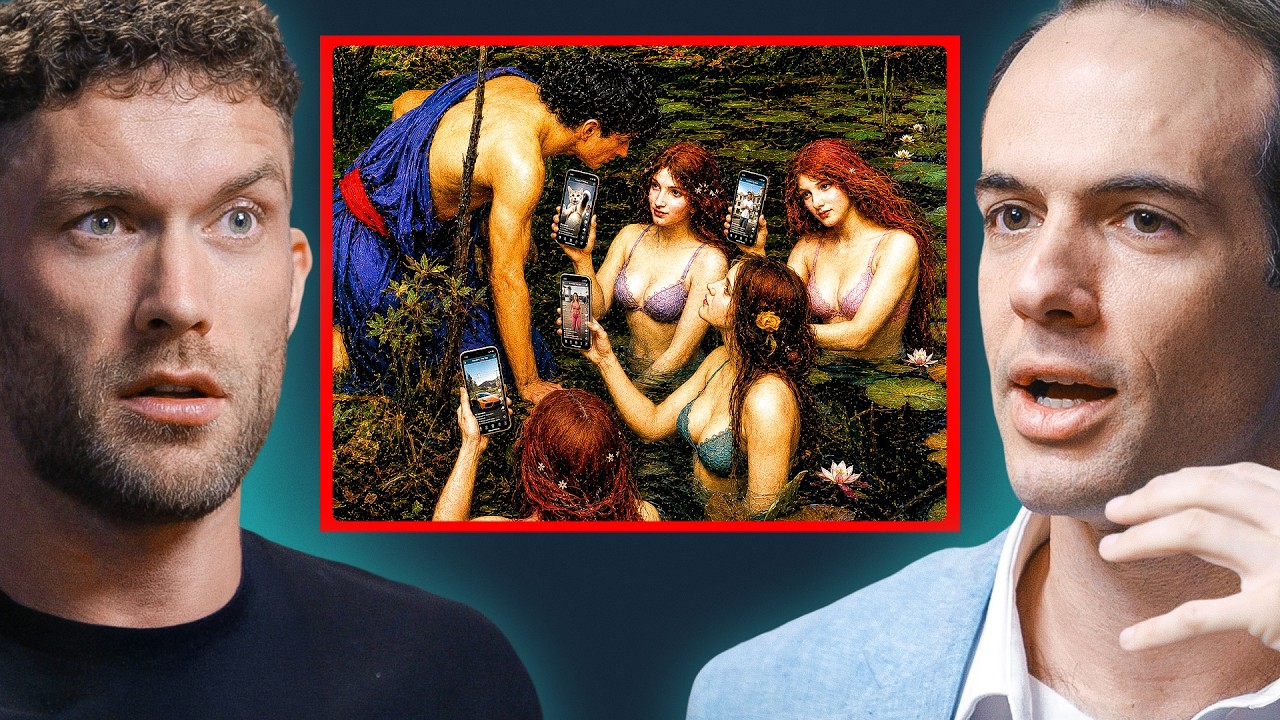
A central metaphor discussed in relation to this dynamic is that of the Sirens, who are portrayed not merely as mythical creatures but as dangerous bards offering infinite knowledge about Troy and the secrets of the universe. The speaker draws a personal parallel between Odysseus's curiosity regarding the Sirens' song and the modern academic or intellectual temptation to constantly seek more information, noting that this drive can lead one down a path similar to those who starved on the rotting bones at the Sirens' island. This allegory extends beyond academia to contemporary digital habits like doom-scrolling, where individuals feel compelled by algorithms designed to make every piece of news seem actionable and important, ultimately leading to a state of unreflection rather than wisdom.
The transcript argues that being overwhelmed by a firehose of information causes apathy because the sheer volume prevents deep thought on what has been consumed, creating an endless cycle where for every conspiracy or insight found, there is another deeper rabbit hole waiting just around the corner. While long-form narratives and stories provide a unique framework that slows down the brain to allow for reflection and better retention compared to fragmented data points, modern society risks drowning in uncertainty without these stabilizing structures. The speaker suggests that while we may feel detoxed from some information overload by finding firm foundations elsewhere, there remains a profound human inclination toward this endless search for insider knowledge that can be destructive if not managed through the grounding power of structured storytelling and critical reflection on our own consumption habits.
Read the full video transcript
This is uh
a good time for Homer to come back for
that reason, I think. Well, because I
think that this is um
Yeah.
There is a There is a kind of moral
simplicity in a lot of ways to Homer,
but
he
he tells the story from multiple
perspectives. Partly because he's
just like Nolan, you know, he's got a a
wide audience. Homer is
uh you know, these epic poets travel
from city to city. They're going from
Aeolus to Sparta to wherever Ithaca and
they have different people of different
classes and different tastes everywhere.
And this you know, they got to get a
story about Odysseus to work for a lot
of different people. Some people are
going to want to take the side of uh
of of of Odysseus or some people are
going to see themselves in the suitors
or uh maybe that's not a great example,
but you know, some people are going to
say, "Hey, this is a lying bastard." And
other people are going to say, "No, he
did what he had to do." And and that's
kind of that's on you. Like to draw out
the message is
is not so much the poet's job. I mean,
he can have his own opinion, but really
his job is to is to help you
get
charmed, get disengaged like Odysseus
does for the Phaeacians, like the bards
do in the story.
And I think also, if I could kind of
allegorize a little bit,
the Sirens in particular that we didn't
go into too much.
I think they're really
it's a timely image because
you know, for me I I I kind of
autobiographizes
Odysseus going to the Sirens. All right,
the Sirens are these divine They're kind
of like bad bards. They're these women
who sing whatever they sing
[clears throat] and they they make you
just want to
go and listen to them.
And piled up in front of the Sirens'
island is just rotting bones of people
who who started listening and they could
just never leave and they starved and
died.
And
I think the reason that Odysseus
wants [clears throat] to hear is because
he's this man of great curiosity. And
And when they actually speak to him,
Homer No, Odysseus tells them
the Phaeacians. He tells what the Sirens
told him. And the Sirens say,
"We can tell you the story of everything
that happened at Troy. All the things
that you didn't know And I'm
paraphrasing, but like all the things
you didn't know about the backstory,
what was going on at Troy, all of the
different, you know, perspectives of the
generals that you were trying to guess
at, but you just couldn't know. Well, we
know them.
We know everything that happens on
Earth. We They can give him
infinite knowledge.
That, whether or not they would say the
same thing to his crew, that's what
they're saying to him. And this is the
thing that a man of those kind of
proclivities wants most in life. Or at
least he knows [clears throat] the power
of that insider knowledge, that special
insight into the universe, the the moly.
He's seen how powerful it is to know the
secrets of a little plant. That kind of
power in you. What if I could find out
something interesting that I could apply
to my morning routine from the Sirens?
And it, you know, for me, I think it's
also the temptation of being an academic
is one of the reasons I left academia
cuz Well, it was one of the reasons I
was in it because I had this I should
tell me more, tell me more, tell me
more. I want to read more. I want to
find out the the the end of that story
or Oh, jeez, five more books I need to
read. And
and that can if you if you follow that
too far, you end up potentially a a
rotting pile of bones at the feet of the
Sirens and never getting home and never
doing what you need to do. It's the kind
of temptation of of knowledge. And
you know,
maybe there's a person or two in your
audience that can relate to the
temptation of the university, but we can
all relate to the the doom scroll. Like
And it's often it's not just like it's
not stupid humor all the time. A lot of
it is you're you're you tell yourself
I'm going to get some insight on, you
know, what what the Bitcoin price is
going to do from this Iran thing. And
oh, well, how can I ignore that
blah blah blah. And it's it's it's all
it all seems actionable. It's it's it's
constructed such
>> It feels important.
>> It feels important. It's designed to
feel important because it's risen up in
the algorithm. And I think this is
really speaks to a profound
uh inclination that people have, a
temptation that people face that leads
them not just to inaction, as you know,
but but to
unreflection, too.
>> Well, certainly if you're permanently
unabsorbed, you have very little time to
do reflect.
>> Mhm.
>> You know, if the
fire hose of new information is
cocking you in the face, you don't have
that much time to think about what
you've already ingested, said Bonnie.
And
when
>> At Y's age.
>> Yeah, yeah, yeah, yeah, the philosopher
B Blue.
Um
that
that sense of
I'm drowning in information. I don't
know what to do about it. This is a line
that I had a
I built Thompson this this
old
informations expert from
worked at three-letter agencies, US
like army. He was basically the special
forces Q from James Bond. And um he
would help them to get to where they
needed he would take phones apart and
all this sort of stuff. And I was asking
him
my current working theory is not that
most of the propaganda and most of it
even the information online is trying to
make people convinced of any one
narrative, it's to drown them in so much
information that they become
apathetic and they just sort of give up
entirely. Now, that might be that at
some point in future that apathy can be
uh,
formed into something useful and sort of
thrust forward in like some vector.
Um, but for the most part, I think when
you
when you firehose people with
information after long enough, they just
go, "I dude, I'm [ __ ] I I have no
idea." Like if you try and go down any
rabbit hole, any conspiracy rabbit hole,
for every one that you find out, there
is an equal and opposite Is that the
physics of the conspiracy system? For
every conspiracy, there is an equal and
opposite conspiracy, which is even
deeper, and then there's an equal and
opposite one. The The iceberg never
stops. It just comes out the other side
of the planet, and that's the tip of the
other side of the iceberg. So, yeah,
this this endless ouroboros of just
looking at
uncertainty and information and and and
uh, yeah, I think I'm certainly feeling
I'm feeling detoxed. Feeling somewhat
salved after after
getting in touch with something that's
got a bit more
like firm foundations, so
>> And this is what you got to think is so
appealing to a
uh, a a person like Alcinous, maybe, or
a person like Odysseus, or like a a guy
like Julius Caesar, about a great story
like that, because they've just got
information coming in them and decisions
to make and all the time and a long
narrative is a way of
is a way of slowing down your brain and
reflecting. It's It's But it's not just
entertainment. It's It has It has
something useful in there. That
narrative structure, you're We're like
programmed to
in
ingest and and process information in
that way much more
um, effectively in long form, when it's
when it's put into a story, yeah.
Because we can remember it, and we can
actually
store that framework of Here's what
happened with Odysseus, and then we can
draw lessons out of it years and years
later that that we need, because we have
that that archetypal uh, narrative
within us. And I think this is one of
the reasons why an oral culture like the
Greeks spent so much time
on these kinds of stories that about
heroes about somebody to emulate and
mind you they're not they're not
simplistic I mean like the Odyssey
doesn't
is you know
he makes a lot of mistakes.
>> Yeah.
>> You can debate about his actions. The
Greeks would debate about his actions. I
mean a lot of the later Greeks
thought he was a bad guy. He was he was
a liar. He's a cheater.
A lot of the later Greeks thought he was
the greatest hero. I mean the
>> There's
it admits of debate and if you brought
back
>> real hero stories that didn't always
have them having a math addict addiction
on the side or
you know banging their secretary in
secret.
>> You could still have complexity. You
don't have to undermine everybody with a
kind of secret mob story or very open
mob story. I think we need more of that
to get through what we're what we're
facing a lot of us at least.
>> You might not believe me but this
is what peak sleep optimization looks
like. Not talking about the nightgown.
It's just for sex appeal. I'm talking
about my eight sleep. The eight sleep
pod five comes with a smart cover you
throw on your mattress that actively
cools or heats each side of the bed up
to 20°. And now they've added the
world's first temperature regulating
duvet and pillow case. So you've got
360° coverage for deep uninterrupted
rest. It's like being Walt Disney
without the cryogenic chamber.
And the racism. Best of all, their
autopilot feature learns your sleep
patterns and makes adjustments to
improve your sleep in real time. It even
detects when you're snoring and lifts
your head a few inches to help you
breathe better. That's why eight sleep
has been clinically proven to add up to
1 hour of quality sleep per night. They
have a 30-day sleep trial so you can buy
it and sleep on it for 29 nights. If you
don't like it, they will give you your
money back. Plus, they ship
internationally. Right now, you can get
up to $350 off the pod five by going to
the link in the description below or
heading to eightsleep.com/modernwisdom
and using the code
modernwisdom@checkout. That's
eightsleep.com/modernwisdom.
and modernwisdom
at checkout. Congratulations, you made
it to the end of the clip and the full
length episode is available
right here.
Go on.