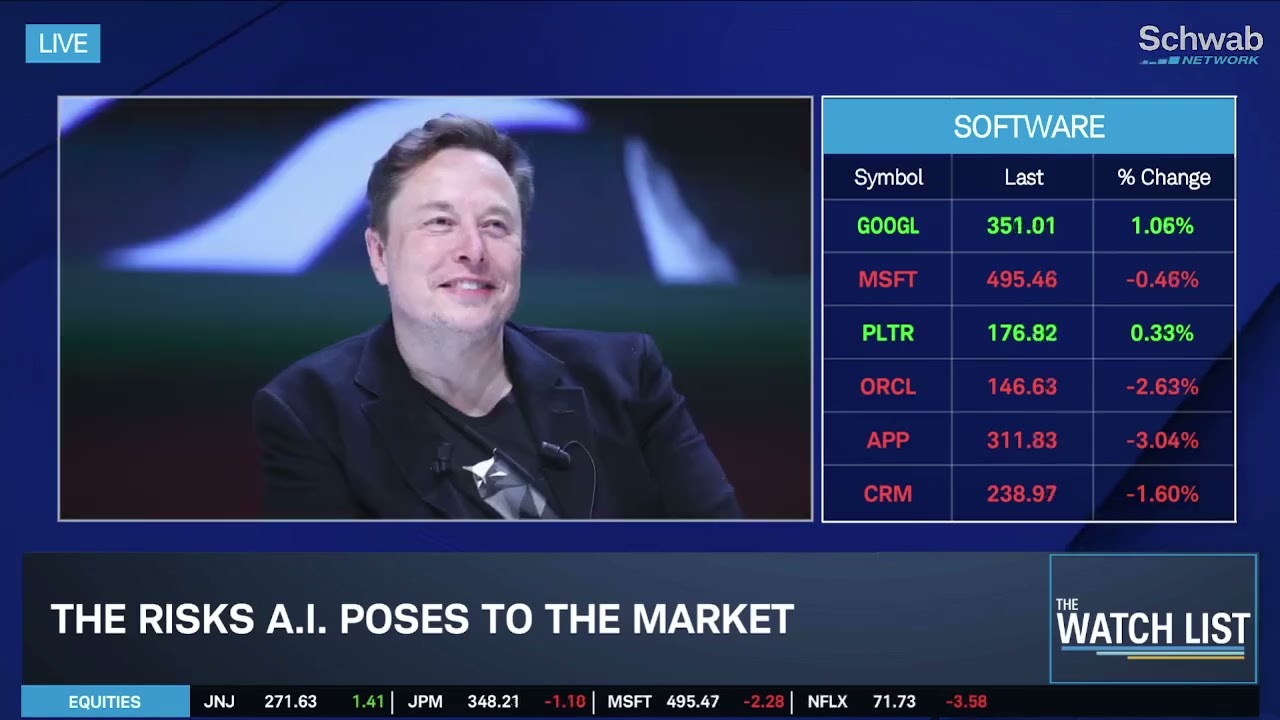
Video summary
The panel discussion on the state of the AI trade highlights a market characterized by rapid volatility and shifting focus between software and hardware sectors. John Freeman from Ravenswood Partners notes that while hyperscalers are expected to perform well, untethered enterprise software lacking network effects faces long-term vulnerability unless it can manage and secure other AI agents. Consequently, his firm favors semiconductor equipment manufacturers like ASML and Lam Research, which benefit directly from the continuation of Moore's Law, over standalone software companies that do not control their underlying hardware infrastructure.
Significant concerns regarding risk and safety have emerged as a major theme, particularly following recent market fluctuations linked to cybersecurity issues like the CrowdStrike incident. Melissa Armo points out that the AI chip sector has been the primary driver of market gains throughout 2026, making it highly susceptible to a potential crash if investors become fearful due to regulatory scares or geopolitical tensions with China. She expresses uncertainty about whether major tech leaders are genuinely pushing back against regulation or if there are ulterior motives behind delaying IPOs and slowing down industry expansion, noting that the sector's dominance creates a single point of failure for the broader market.
Looking toward specific investment opportunities, both experts identify high bandwidth memory and specialized testing interfaces as promising areas within the semiconductor space, citing companies like Mycronics and Teledyne Technologies as undervalued assets with significant upside potential. Additionally, Freeman emphasizes the value of annuity businesses found in data center operations and neo-cloud providers, which offer stable long-term returns once established. Armo adds that despite recent sell-offs in stocks like SanDisk, the anticipation of a strong fall earnings season could provide a boost to these trending-down but fundamentally sound companies, especially with Nvidia showing signs of a potential breakout.
Ultimately, the conversation underscores the tension between the unlimited liability taken on by AI companies and the industry's desire for self-regulation amidst global competition. Freeman suggests that solving the friction between powerful AI agents and safety risks will require AI-based management systems, reinforcing the preference for infrastructure plays over pure software applications. As the market approaches a critical period of earnings reports and potential Federal Reserve rate decisions, investors are advised to navigate the uncertainty by focusing on companies with dominant market positions and essential roles in the AI supply chain, while remaining vigilant about geopolitical developments that could impact the sector's trajectory.
Read the full video transcript
watch this panel. We're taking a broad
look at the state of the AI trade.
Joining us now for that are John
Freeman, co-founder senior analyst at
Ravenswood Partners, and Melissa Armo,
founder owner of The Shark Solution.
It's good to see both of you. John, you
say, "Look, the AI trade keeps shifting
on a weekly basis." It does. Um and even
daily. With one day it's about the
software trade, one day it's about the
chips trade. Uh so, when you think about
this week, this week started with this
existential question. Is the
proliferation of AI moving too fast when
you think about safety, security, etc.?
Uh how do you think about the state of
the AI trade now?
>> Right. So, it's interesting. I mean, I
think software is very is a kind of a
particularly untethered software that
software that's untethered to hardware,
so not the hyperscalers. We think they
were going to do fine. But, software
that's that's enterprise software that's
not tethered to hardware or doesn't have
network effects, I think is really
vulnerable in the long term um unless
like ServiceNow, which is one of our
software positions,
uh they have uh you know, because they
are trying to man they have software
that manages other agents and and and
secures other agents, which obviously I
think you're going to see a pretty
substantial demand for. Other than that,
we really like semi cap equipment and
for a lot of reasons. I think the you
know, continuation of Moore's law
uh with ASML and and with Lam being the
the primary beneficiaries there.
>> Let's talk uh cybersecurity because one
of the big things that came up this week
is risk, right? Risk around the speed
and safety of the AI arms race. Uh
Melissa, I want to hear your thoughts on
this because for instance, you think
about CrowdStrike. It made a big move
this week. It's not the only one in the
cybersecurity space that made a move. Uh
what's your thought on this?
>> Well, Crowd has been strong for quite
some time. That's had a nice lift. But,
when you look at the sector that's been
lifting the market for the majority of
2026. It is the chip sector. It is all
the stocks that are associated with AI.
So, I believe the CEO of Palantir was
mentioning that if something happened,
this could potentially crash the market.
Well, that's true because it's been the
one sector that's been lifting the
market. So, that's the danger if
something happens or people get scared.
Remember Monday, we started the week out
because of this conversation over the
weekend and the market ended up opening
lower. Now, we've recovered since then,
for sure, but the fact is that we're
going into a fall earning season. It's
coming up in a few weeks and if these
companies don't report the way that the
market wants to see them or God forbid
there's some other tweet out there that
scares people, then I think there could
be a problem. I think these companies
are definitely driving towards wanting
to have some kind of regulation and
government inter- intervention just
because of the unlimited liability. I
don't know if there's really any way to
stop you know, or prevent the huge
liability that they're taking on. I
don't know enough about what happened
here that created this issue that came
out over the weekend. I'm not sure if
publicly it's known yet, but you know,
when you think about it, you say, "Okay,
we're in competition with China."
Trump's meeting with uh you know,
President Xi this week and uh Jensen
Huang's going to be there, too, in that
dinner and uh so, I mean, it's going to
be talked about. This isn't the end of
it. It's going to go on and I don't know
really what the outcome's going to be or
if the market will crash eventually
because of this.
>> Melissa though, just I just want to stay
with you for a minute. Do you really
think they want it because there was a
Wall Street Journal report that says
Mark Zuckerberg over at Meta, Jensen
Huang, um and Elon Musk uh pushed back
on a previous plan with regard to
regulation of the AI industry. And there
is the concern about um staying out in
front of China. So, do "Do really think
they want it?
>> I don't know. That's what I'm saying.
There could be an ulterior motive behind
that we're we're not aware of. So,
Anthropic's is still supposed to come
out with the IPO in October. And OpenAI
was supposed to come out this year and
now I guess they pushed that back to
2027. So, maybe maybe that's a good
thing for OpenAI. They're going to wait
and see a little bit longer to see if
they can shore some things up. I really
don't know if there was, again, an
ulterior motive behind it that had to do
with financial reasons or if something
really happened that scared them. But,
let's just say there is something out
there that could potentially be
dangerous. Well, who's to stop China
from from launching it and it happening
anyways? So, I don't know.
>> Okay. John, uh I want to go back to you.
Uh you talked about uh liking Lam
Research ASML. And you say, "Listen, you
you're a fundamentals-focused investor."
Want to hear more about your thoughts on
software, right? Because there are
certainly some opportunities that you
see there. Where do you see opportunity?
>> Well, the friction point that that uh
your our other guest uh just talked
about is this this friction between what
agents can do. They can do tremendous
They're incredibly powerful potentially,
but also at the same time really
dangerous. So, what solves that friction
point? Well, you got to have you can't
do it manually, right? So, there the
solution actually is some sort of
AI-based management of other AI. I think
eventually there's no other way you can
do that, right? So, obviously there's a
lot of work to be done in processes and
and software and all of that kind of
stuff. But, that's the problem to be
solved. And and again, that's why we
like ServiceNow in the software space.
More more more generally, we do like the
hyperscaler space. The the guys who run
the data center with the hyperscale data
centers and the and the neo clouds. We
like NetApp as well. Um and those are
the guys who are going to, you know, be
able to once you get that business,
that's a that's a great annuity business
for a long period of time. So, you know,
we like that. But, generally speaking,
we like semi-cap equipment basically
because it takes more of the economics
of the overall AI pie. Um, you know,
company like like I said, ASML, which is
basically a monopoly, and Lam Research,
which is a dominant player in some of
the key technologies required for
vertical shrink. So, that's where we're
at.
>> And then, Melissa, I want to go back to
you on So, the Fed made its decision on
rates and and just hear me out here, uh,
raising by 25 basis points, uh, and
there's an indication that we'll get
another hike this year. Who do you think
are uh the winners in the AI trade given
the expectation for where rates will
live from here?
>> Well, I think Nvidia definitely looks
like it's trying to break out. I think
Nvidia uh this morning Nvidia in the
pre-market was up at 222. I mean, it
fell into the open, but Nvidia could
have a nice pop in the next week. We've
had a low volume this week and last week
for various reasons, holidays, and
things, but I mean, once we get into the
next week or so, Nvidia could have a
nice pop. I look like 225 for Nvidia.
SanDisk, even though it was so so strong
early in the year, has just been
dragging and dragging and dragging.
Finally, maybe that's going to get a
lift. So, there's quite a lot of things
that have been trending down, even
though they're still in an uptrend, that
have seen big sell-offs that could have
gotten a nice boost here into um the
fall earning season. But, I just want to
make one point to what the previous
guest said, you know, David Sacks came
out and said something from the
administration and said, "Listen, if
there's a problem, you guys got to solve
it." So, you know, you have to be the
overseers of the problem, like don't let
it get out of control kind of thing. So,
again, self-regulate. And that was David
Sacks's point when he came out this week
after the weekend's hubbub. So, I don't
really know, you know, again, if that's
something that they're able to do or
not, but I just wanted to mention that
as well.
>> All right. No no worries at all.
Appreciate that, um, guys. Uh, John, if
you have a quick final thought,
30-second final thought?
>> Sure. I would say the other weird little
I love the little nooks and crannies of
the semi cap equipment space and one of
them I think is very interesting
with regard to high bandwidth memory
which obviously is a big growth area as
well as GPUs and that's the testing
interfaces they're called probe cards.
There's a company called Mycronics and
there's a company called Teledyne
Technologies and we own both of them in
client portfolios and they're I think
they're very interesting and reasonably
priced with a lot of upside potential.
So, they're I think I think those are
some interesting stocks right there.
>> All right, we'll leave it there for
both. Have a great weekend. That's John
Freeman, co-founder and senior analyst
Ravenswood Partners. I'm Melissa Armel,
founder and owner of The Stock Solution.