Video summary
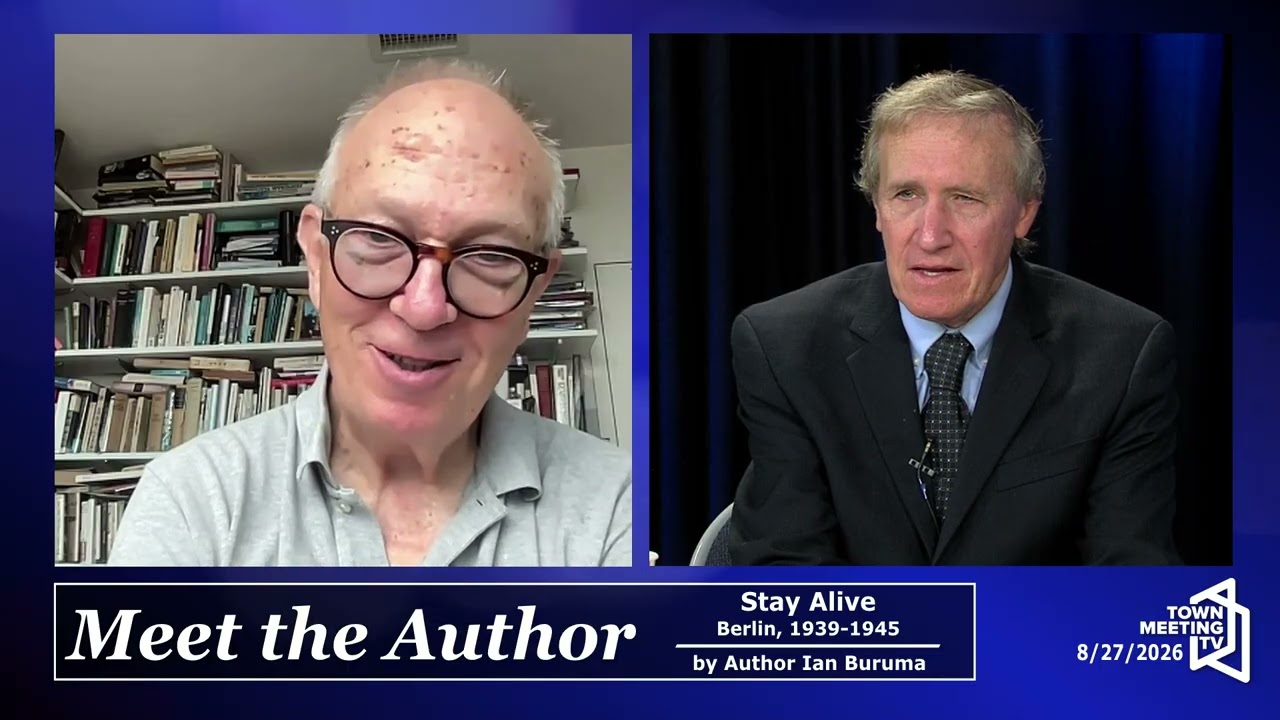
In this episode of "Meet the Author," historian and journalist Ian Buruma discusses his new book, *Stay Alive*, which chronicles life in Berlin from 1939 to 1945. Buruma emphasizes that while the subject matter is serious and far from a casual read, the book avoids being merely a collection of statistics or dense academic research; instead, it focuses deeply on individual human stories. His motivation for writing stems from two primary sources: his childhood memories of hearing his father's experiences as a forced laborer in Nazi Germany, and a desire to explore the often-overlooked perspective of ordinary German citizens who lived under occupation rather than just the suffering of the persecuted. By weaving together personal narratives with historical context, Buruma aims to provide a nuanced understanding of how people coped during a time of extreme moral dilemmas and destruction.
The narrative delves into the complex racial classifications imposed by the Nazis, which determined whether an individual was sent to death camps or faced lesser persecution based on their ancestry and religious upbringing. Buruma also addresses the pervasive ignorance among the German population regarding the Holocaust, arguing that while information about the atrocities was available through sources like BBC radio and letters from soldiers on the Eastern Front, many citizens chose to look away to preserve a semblance of normalcy. The book vividly portrays the deliberate strategy of strategic bombing intended to break civilian morale, illustrating how the resilience of Berliners often led them to rely on the very authorities responsible for their suffering. Furthermore, it covers the horrific violence at the war's end, including the brutal reprisals by the SS against perceived defeatists and the subsequent sexual violence committed by Soviet troops as they advanced into the city.
Beyond recounting historical events, Buruma explores the post-war evolution of German society and its confrontation with its past. He notes a significant divergence between East and West Germany, where the communist regime in the East claimed to be anti-fascist and thus avoided deep reflection on Nazi crimes, while West Germany initially sought to rebuild its economy and ignored the Holocaust until the student protests of the 1960s forced a national reckoning. This period marked the beginning of genuine collective responsibility and education regarding the Holocaust in Western Europe. Buruma connects these historical lessons to contemporary issues, cautioning against drawing direct parallels between current political climates and the Third Reich while acknowledging that liberal democratic values are facing unprecedented pressure from rising ideological extremism. Ultimately, he urges readers to understand the motivations behind human behavior during dark times without justifying atrocities, fostering a deeper empathy for the complexities of survival under tyranny.
Read the full video transcript
[music]
We are grateful to our friends at
Northshshire Books and Monroe Street
Books for their underwriting of this
program. Northshshire Books has outlets
in Manchester, Vermont, [music] and
Saratoga Springs. and Monroe Street
Books is on Route 7 just north of
Mberry. Both are wonderful independent
[music] bookstores and we thank them.
Hello, I am Lewis Meyers and this is
Meet the Author [music] where today our
guest on Zoom with us from New York City
is Mr. Ian Baruma uh who's going to be
talking about his recently published
book Stay Alive uh the story of the life
in Berlin during the war years 1939 to
1945.
Um Mr. Buruma was born and raised in the
Netherlands. He studied sinology which
is actually the study of China at Leiden
University in the Netherlands and also
in Tokyo. He has worked as a journalist
in Asia, Europe, and New York City, and
he has written for and still writes for
many major publications. He is currently
based in New York as is a professor of
human rights and journalism at Bard
College. His book, which was published
this spring, uh received very favorable
positive reviews in the New York Times
and the New Yorker magazine. Uh Mr.
Buma, thank you for being with us today.
Welcome.
>> Pleasure.
Well, I want to start by saying first of
all, um
this is not a beach read just to to uh
tell our our readers this is a very
serious uh researched uh and well-ritten
book on a very troubled time in in in h
in human history uh which I think has
some lessons for us today as well. Um,
Joseph Stalin reportedly uh said at one
time that uh a million deaths is a
statistic and one death is a tragedy.
And I think what you've done in this
book is which is remarkable is take a uh
extraordinarily wellressearched sort of
global look at the conflict and and the
situation in Berlin but then use it to
talk about individual people. One of
whom actually was your father Leo. So
let me ask you when you began thinking
about writing this book and and talk a
little bit about the process of of
beginning and of doing the research.
>> Yes. I mean you say it's not a beach
read. It's it's that depends on one's
taste of course. Uh it's a bit it's a
gloomy subject. In that sense it's not a
beach read but I don't want to give the
impression that that it's full of
statistics and dense research. I'm not a
professional historian and as you say
it's about people. Um I think there are
two reasons I was interested in this
book and and have been it's been
simmering in my mind for a long time.
One is that I grew up with my father's
stories and um I was born in December
1951 so still very much in the shadow of
World War II and one grew up with
stories of occupation
so on and so forth and um I heard
stories from my father. He was not
reticent about his experiences. Um and
uh so Berlin was sort of part of my
childhood even though we hadn't I'd
never been there and we didn't go there
until much much later. That's one reason
um to find out what the city that my
father experienced as a forced laborer
in in Nazi Berlin being bombed day night
and so on. What he I wanted to know more
about that city. Um a city I've grown to
like even love. The other reason was
that growing up in a country that had
been occupied by the Germans, um, one
heard a very one-sided story. It was
always about suffering under the Nazis,
heroics, uh, of of the resistance and
and collaboration, but you never rarely
heard much about what it was like for
the Germans, for ordinary citizens in
Germany. Um, I mean, one read about sort
of villainous SSmen and Gustapo officers
and all that, but what it was just what
it was like to be in the country of the
perpetrators and that is something that
has fascinated me ever since I lived in
Japan uh in the 70s.
>> The your tell tell talk a little bit
about your father uh Leo. um uh what was
his life like before uh the war started
and and talk a little bit more about his
experience during the war.
Well, he was uh a law student when the
war began. Um and um very soon uh the
occupation authorities, the Germans
started distrusting uh students uh
because they thought they would join the
resistance. Um and so he couldn't um
complete his studies during the war. And
in 1943,
uh, when the Germans had run out of
manpower for their own industry because
all the young German men were on the
battle front, they decided they were
going to to force men in occupied
countries to come and work in German
factories. And Dutch and students uh
were given a an option. They could sign
a loyalty oath to the occupation Nazi
government, in which case they could
postpone this um event. uh or they had
to go uh and work in Germany immediately
and my father like more than 70% of
students refused to sign went into
hiding and something went wrong uh in
the student underground and he found
himself on a railway station surrounded
by German police with his father and
they announced that those young men who
did not um immediately sign for work in
Germany that their parents might be
arrested. And after a lot of twoing and
throwing with his father, my father
decided he couldn't risk it. And so he
ended up uh working in a factory in East
Berlin, um my mother was Jewish, but she
lived in in Britain, so she was not
directly involved in the war. My father
was not, and that meant that he had a
certain degree of freedom. Even though
he was in a sort of work in a factory
and in a camp with wooden barracks and
all that, he could still roam around a
bit when he wasn't too hungry or too
exhausted. And so the letters that he
sent to home to his parents and to his
best friend um give you a fascinating
glimpse of daily life in Berlin at the
time. And when I found those letters um
at the time of his death uh just before
co that's really when I decided there's
a book in this.
>> So Mr. Brimma we uh you also spoke to
many other people in in Germany and
Berlin uh individuals who told their
stories as well. How did you find them?
>> Um I was very lucky. This is the first
book that I've ever used uh a research
assistant and I found a marvelous um
woman who lives in Berlin and she went
through um the lists of people in old in
in in senior homes and uh and and
by other means found people to talk to
all of whom were well into their late
80s or 90s. Uh one person was even over
a hundred. So um their memories were not
always clear and they were of course
childhood memories but nonetheless
fascinating to to listen to. The other
sources that I had were letters and
memoirs. Um so I didn't use um I used
secondary sources but I didn't quote
historians on the on on on the period. I
I stuck to eyewitness accounts and that
includes memoirs and autobiographies and
that kind of thing. And
>> I think that makes this book gripping
and personal uh uh and and wrenching. Uh
as I said in the opening quote about
Stalin, uh you know it you bring it down
to the individual and there are
individual tragedies here and individual
heroism in in many cases. Um do you
speak German?
Yes. Uh I speak it ungrammatically but
but I I speak it. the uh the book begins
sort of goes chronologically beginning I
think in 1939 or perhaps even earlier uh
and you see the uh uh the rise not only
well Hitler's already come to power I
think in much of the book but uh Germany
is is certainly doing well in the
beginning of the war obviously as they
uh uh cruise through much of Europe um
and you look at it from the perspective
of both the uh Aryan or or Gentile
German citizens and of course the the
Jewish citizens and others who are being
rounded up. So you have this a very uh
broad camera uh which looks at at how
it's affecting all of them. Um,
how did you remain I I'll say impartial
if if that's the right word in terms of
talking about the experiences of both
the uh the the persecuted and the uh the
people who were then in power.
>> Yes. Well, it's a very good question. I
mean the book starts in September 1939.
So it's literally when the war began
when when uh Germany invaded Poland and
it ends with the last war day of the
war. Um partial and impartial is
difficult words to apply. I mean
obviously I mean I've used the the
diaries of Joseph Gibbles who was the
propaganda minister. A very nasty piece
of work and you can't be impartial in
the sense that you sort of want to give
him his due. I mean there's little due
to give in in in his case. Um but uh I I
do think one has to take a step back and
you can't let simply let your own
emotions dictate uh what you write
because I think what is important in in
any history not just this but you uh by
writing it and researching it you learn
to understand things better and you one
hopes that one's book allows readers to
understand things better. So my aim is
is is to is understanding
not in the sense of justifying but
understanding what happened and what
motivated people and why people behaved
in certain ways rather than simply
condemning which is too easy. I mean
obviously let's say the persecution and
mass murder of Jews cannot be justified
in any any way. I mean but it's not
enough simply to say how terrible. You
have to then describe what happened, why
things happened in a certain way, what
people were involved and uh and and that
will lead then to sort of a deeper
understanding. I think there were and
there were many gray areas you mentioned
that you know obviously there's no gray
area when it comes to Gerbles or or some
of the others obvious many of the others
but there are gray areas where perhaps
your own father's experience where he
certainly didn't support this regime and
yet he felt that he had to go along and
and do the labor because otherwise his
family members would be heard he might
have been executed um but there are
others even under less threat who
cooperated to a certain extent some of
them were true believers. Others were go
alongers, if you will. Um, so you do
write rather well about I don't know if
it was a majority of Germans or
certainly a sizable number of Germans in
Berlin who who were uh if not conflicted
at least in a gray area. Can you talk
about that?
Yes. I mean, I think life is full of
gray areas and life and also even in in
dismal circumstances like living under
uh the Nazis, um life goes on and you
have to cope and this can cause very
serious moral dilemmas. Take one of the
most dramatic ones that that in one case
of that is described in the book. Um
you're a decent person. You're not a
Nazi. You're against the Nazis. um a
Jewish friend or a a Jewish stranger
who's in in danger of his or her life
comes to you and said, "Could you hide
me?" Now, you know that hiding a Jew in
those circumstances, not only you don't
only risk your own life, but you might
risk the lives of your family, your
children. The right thing to do is to
hide such a person. But do you do it at
the do you risk your family to do so?
That's not a simple situation. It's a
real moral dilemma. And there are of
course many other moral
that come up in a criminal state, which
is what it was, that perhaps are less
dramatic, but they happen all the time.
And yet, of course, people people do
have to cope. They live, they have to
survive. And so, and not everybody is a
hero.
>> Was also happening as as you mentioned
in your home country of the Netherlands.
Carrie Tenboom whose book I think I
remember reading many years ago was one
who did shelter uh Jews in in the
Netherlands. So there were people who
who did this who showed extraordinarily
courage um and others who who simply
didn't know what to do or were fearful
and and went along. Um, you also talk in
the book, I think you convey the massive
destruction
uh that occurred in Berlin. And we've
seen footage of the aftermath with just
a ruined city, but you show over time
the uh the the the havoc and the
destruction that the bombing uh Allied
bombing caused. Of course, that was also
happening in London and other places
where the Germans were bombing. But uh
one gets a real sense of utter
destruction and and how a human psyche
can try and survive in those situations.
Can you talk about that a bit?
>> Yes. I mean the destruction was of
course absolutely deliberate. Um it was
the result of a partic of of something
that was called strategic bombing. And
the theory was developed before World
War II and the idea was if you bomb
civilians badly enough and um so that
people can no longer have a roof over
their head and to terrified constantly
that somehow then the the morale of the
civilian population will break and
they'll turn against their leaders. It's
a theory that is still alive and I mean
the bombing of Iran in many ways is
justified by exactly that idea. they'll
they'll then
rise up
which
never actually happens but that that was
so people like Bomber Hack Arthur Harris
who the head of the IRAF charge of
bombing um believed this and he thought
you just have to keep on destroying
destroying destroying destroying and at
some point the war will come to an end.
Of course it didn't. And I think what
happens more often and what what what I
found fascinating reading accounts from
Germans is that the idea Lond in Britain
people were very proud of the idea that
the Londoners quote unquote can take it
and that the resilience of the Cocknes
and uh so forth. Uh the same thing was
true in Berlin. I mean the the Berliners
could take it and there was a resilience
there and being bombed by a foreign
power. Whatever you think of your own
government
puts one's back up and uh and it creates
a kind of solidarity
uh not least with the authorities who
are the only ones who can feed and
shelter you. So it never it never has
the result that was desired but it does
destroy entire cities. Well, the other
thing that happens and and you see this
clearly in your book is people are
simply trying to get survive the night.
Uh so they can't really and they're dis,
you know, they're separated. They're all
in individual bomb shelters or they
can't have the resources to rise up
against a uh their own government
because they're simply trying to
survive, get through to the next day,
find food to, you know, to survive
another day, etc. So um
the uh going back for a moment you we
talked about the gray area you write in
in num various parts of the book about
the distinctions that the Nazis and
Gerbles etc make uh in terms of
someone's Jewishness. So there were
levels of Jewishness and uh I your own
father uh came under one of those
categories but not one that would
necessarily have gotten him sent
immediately to a concentration camp. But
can you talk about that? How did the
Germans
>> No, no, but my my father did not come
into that category because he wasn't
Jewish at all. My mother was. Um and the
categories were in the the racial laws
that the Nazis drew up in in 1935.
And um basically uh what it came down to
is if you had uh four Jewish
grandparents, you were a full Jew. If
you had two Jewish grandparents, you
were a a half Jew of the first degree.
If you had one Jewish grandparent, you
were partly Jew Jewish of the second
degree. Now the people who were fully
This was complicated by the fact that if
you're a half Jew, but you were raised
as a Jew in the Jewish religion, you
counted as a full Jew. Um, so religion
had something to do with it, but it
didn't define it entirely. And what it
meant in in practical terms, in
horrifyingly practical terms, if you
were counted as a full Jew, you had to
be murdered. You were deported to the
death camps in Poland uh or shot. If you
were a half Jew um
and your that you you were bullied in
many ways, you would
have trouble getting jobs and life was
hard, but you would not necessarily be
deported. A Jew married to a gentile
would be protected from de deportation
but also bullied in many other ways
unless the marriage uh the the the
gentile wife had converted or they led a
Jewish religious life in which case you
would so it was absurdly complicated uh
and but it had life and death or death
consequences.
There's always been uh ongoing
discussion of what Germans knew uh and
uh the ordinary German knew about what
was going on e both in the concentration
camps and simply of their neighbors who
were being rounded up and you do talk
about that a bit in the book. What was
your impression? Uh how much did the
average Berliner know about uh what was
happening to people who were being
deported?
Well, I think one has to distinguish
between uh what they could have known,
what they wanted to know, um what they
knew but didn't drew the draw the right
conclusions. I mean, human beings have a
very a great capacity not to know what
they don't want to know. And uh if those
who wanted to know what was going on had
ample opportunity to know. There were a
lot of letters being sent back from the
Russian front, the Eastern front by
soldiers describing in detail what was
going on. Um and and my example when
people say, "Oh, well, people couldn't
really have known is always Anne Frank."
Anne Frank was a teenager locked up in a
in a in a in the attic of a house in
Amsterdam. And in her diary, I think in
1943, she clearly says, uh, we are
destined to be uh killed probably by
gas. And she heard it on the BBC radio.
Now, there were enough people, it was,
it was certainly forbidden. There were
enough people in Germany and in Berlin
who did get information from the BBC and
so people could have known, but many
people didn't want to know. They looked
the other way. Life was more comfortable
that way. Uh, and we know from our own
lives. I mean there are all kinds of
terrible things going on uh in the
country one is living in and you don't
really necessarily want to know too too
painful. By the way, your f earlier
question about where my father fitted in
um that isn't entirely irrelevant. You
had all these different distinctions of
of levels of Jewishness, but you also
had racial distinctions among non-Jews.
So at the bottom of the pile were the
Slavs, the Poles, the Russians uh who
were treated appallingly. A little above
that were uh people like Romanians and
Italians and then above that were people
from the nor Nordic countries. So
Norwegians, Dutch, Danes who are treated
slightly less bad. And uh so these crazy
distinctions um existed amongst Jews as
well as non-Jews.
>> There is a an orgy of violence that
occurs uh first after Hitler is nearly
uh assassinated by some generals from
military officers. Uh he goes absolutely
more berserk than usual uh for him and
uh uh ends up killing 5,000 people. I
mean family members of all the people
that were involved. I mean it's just and
then at the end of the war um and this
is depicted in a movie that Bruno Gans
uh starred in called the last days I
think of Hitler. Um Germans turn
>> the downfall I think.
>> Yes. The downfall a fantastic great
movie. um the the German milit parts of
the German military in the SS turn on
anyone in the German population they
think is being defeist or is deserting
and they're literally hanging Germans
from lamp posts uh at the slightest
pretext. um anyone from the age say of
14 to to 60 they think is uh should be
fighting or should and they send all
these young kids out to die basically uh
at the end of the war to try and stop
the the Russians uh and Americans from
entering the city. Um it's a horrifying
uh tale at the end of the war and just
tragic because so many people got so
close to surviving this war and then did
not and they died at the hands of their
own uh military. U tell us about that
part of the war. at the very end.
>> That really had to do with the delusion
that uh the Germans somehow uh would be
victorious purely because of of sort of
the spirit and the will of the people
because they knew they were facing by
that at that stage they were facing
allied armies in in the case of Berlin
the Soviet Soviet Red Army that was
vastly superior in in manpower in in
tanks in airplanes. I mean the Germans
had were on their last legs and Hitler
wanted to basically wanted all Germans
to fight to the death and the idea was
it spread and this was the propaganda at
the time that the sheer willpower and
spirit of the German race would somehow
prevail and be victorious. And so
anything that put that spirit and that
willpower into doubts like people you
could people overheard in a cafe saying
well I don't think this is going well or
something those people could be arrested
as defeatists and uh and as you pointed
out I mean hung from lamposts and um
this was really part of the craziness of
um Nazi Germany and it froze. The
terrible violence did not end with the
actual end of the war in April of 1945
because as we know the uh for a period
of time the Russian uh army ran a muk
and uh uh used rape as a uh a weapon of
war or now post-war uh and uh thousands
possibly hundred thousand women in
Germany were attacked uh and you do
write about that at the end of the book
um and then of course Germany was uh
Berlin was divided into the eastern and
western sectors
Did the Americans and the British,
knowing the how the Russians were were
behaving, the first wave of Russians at
least, did they do anything to intervene
and uh protect the women in Germany?
>> Well, they wouldn't have been able to
because they weren't in Berlin when this
happened. It it it did come to an end
fairly soon after the war. I mean the
discipline was imposed by the Soviet um
uh the the officers, but um it was
really during the battle of Berlin and
in in
all the way in the in the Soviet in the
Red Army campaign from Russia all the
way to Berlin on the way countless women
were raped and and murdered and and uh
this was really it was revenge and uh
the Russians or the people in of the
Soviet Union, not just Russians, but
Ukrainians and others had been treated
barbarously by the Germans. And Stalin
um did not discourage this. I mean, he
said at one point, well, you know, you
should you should allow the boys to have
a little bit of fun. And so, uh, the
other irony of of of this story is that
a lot of the soldiers in the Red Army
were were peasants who came from areas
where they had never seen an electric
bulb. Um, and they enter Germany and
Germany at that stage in in spring of
1945 was pretty much destroyed. But even
those when when they entered the ruins
of Berlin to them this was a world of un
unheard of luxury they they saw you know
electric light running water um people
in with watches and so uh they felt you
know the German people have treated us
horribly and now now it's our chance to
do what we want and so stealing watches
was part of it and raping women was
other.
>> You talk about how in the years after
the war, Germany has acknowledged to a
large extent uh its collective uh
responsibility
uh or guilt and um uh
there there's and now and and had a very
pacifist
official policy. Their military has
always been quite small since then.
There's been a feeling that we should
not rearm. That of course is changing
now in the face of Soviet actions in
Europe. Um
>> Russian actions.
>> Russian, excuse me. Yes, Russian
actions. Sorry. Um
did tell us talk a little bit about the
German uh response after the war and
their um the way that they did uh sort
of enforce a collective responsibility
if you will.
Well, this is a complicated story
because there was a difference between
West Germany and East Germany. The East
Germans being a communist state took the
view we were the anti-Nazi. We were the
anti-fascists and so we don't really
need to reflect too too much because we
were on the right side. That was the
official line. In West Germany, of
course, it was different. But it took
time. So, in the 40s and even 50s, very
few Germans wanted to acknowledge what
had happened. They wanted to forget
rebuild the country um and build up
industry and the economy and they didn't
want to really think about what had
happened at all. and war crime trials
which had been conducted by the allied
nations in in the late 1940s
uh were seen as enemy propaganda
victor's justice and it was really only
60s when with when the the post-war
generation the children of the of the
adults who were responsible for what had
happened during the war when they grew
up and became students and they started
asking questions and uh and you had a
lot of student protest And it was the
time of the Vietnam War and and
questioning the past then became a real
thing in West Germany and um it became
part of it of school education. People
began began to take it very seriously
but it was less about the war as such.
It was really very much concentrated on
the Holocaust and again the Holocaust
had not been talked about at all really
before the 1960s. It was then that the
Holocaust be became a huge subject and
uh the West Germans tried to deal with
that as best they could. The East
Germans did not because to them the
murder of the Jews was just part of the
the fascist primes and and they were the
anti-fascists. Of course, West Germany
and Berlin in particular became a a
political load stone in the Cold War, of
course, when President Kennedy went
there in 1963 to give his famous speech
and and other places. Um the um
finally, we want to move forward and you
alluded to it a few minutes ago um how
people can not see what they don't want
to see. Um you're a professor of human
rights at Bard College. Um, we are in a
time in this country where we are facing
perhaps some of the same issues that or
echoes that we'll put it of of what you
talk about in your book in the 1930s and
1940s in Germany. Um,
can you talk a little bit about that
when you talk to your students now and
when your students talk to you? What are
some of the issues that come up today in
terms of uh of what we're seeing in this
country today?
Well, the students I find, but that may
be partly because of the the particular
college where I teach, but they they
seem a lot less political than the
students, let's say, of the 1960s and
and early '7s were. So, it doesn't come
up all that much with the students, but
what you're saying certainly
went through my mind when I began to
write this book. And in some ways, it's
one of the reasons I I decided to write
it because uh easy comparisons between
our own times and and and the past are
always a mistake. I mean, Donald Trump
is not Hitler. We're not living in the
Third Reich. Uh
differences are enormous. But it is true
that the post-war world in the west of
liberal democracy, of freedom of speech,
of uh um all the things that we take for
granted are now under a great deal of
pressure. And we're hearing um
ideological statements that 20, 30, 40
years ago would have been impermissible
and would have been completely marginal
because they were too
they they were too much like a lot of
the rhetoric that people got in in
fascist states and Nazi states in in the
1930s and they've become now almost
mainstream. So
there is plenty to worry about. And the
the notion of looking away when bad
things are going on uh was some
something that certainly motivated me in
um researching what it was like to be a
German under much worse circumstances
um in the 1940s.
>> Well, it is a tremendous book. Um and I
want to thank you for for writing it. I
do think it has echoes for our time
today. Uh the book is Stay Alive by Ian
Baruma, the German warriors in Berlin
from 1939 to 1945. I think it's an
invaluable addition to the uh historical
record of that time. Uh Mr. Broom, thank
you so much and uh thank you for being
with us today.
>> Thank you. It was a pleasure.
>> Please join us next time on Meet the
Author. [music]