Video summary
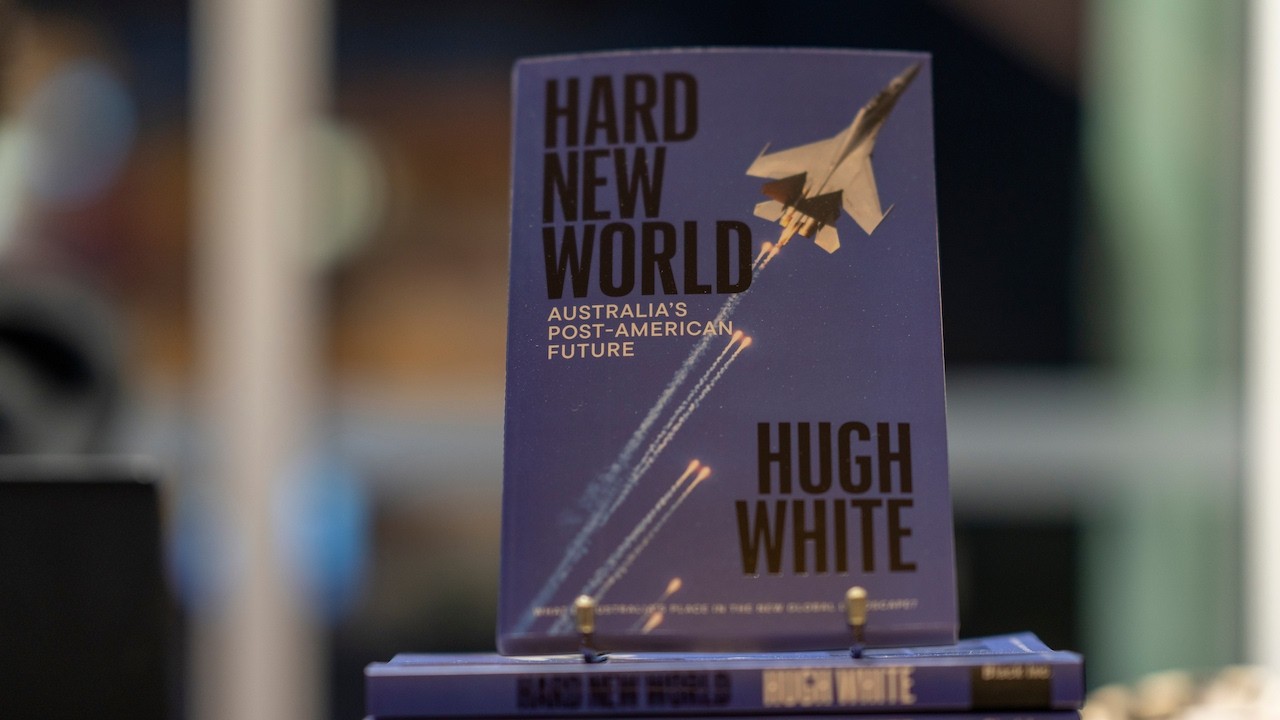
Hugh White asserts that Australia is experiencing its most profound strategic transformation since European settlement, driven by a fundamental shift in global power from the West to Asia. He argues that the United States can no longer maintain dominance in East Asia due to costs and risks comparable to the Cold War, while China lacks the capacity to dominate Eurasia alone because of other major powers like Russia, India, and Indonesia. Consequently, Australia must abandon reliance on US security guarantees and adapt to a multipolar world where no single nation rules globally, requiring independent strategic thinking rather than hoping for American intervention.
To achieve self-reliance, White contends that Australia should leverage its inherent strategic assets, such as island geography and maritime approaches, combined with technological advantages in sensing and weapon guidance like drones. This approach necessitates building a force specifically designed to deny air and maritime access cost-effectively, which implies rejecting expensive projects such as acquiring eight nuclear-powered submarines. Instead of clinging to obsolete strategies like AUKUS, which he views as an empty gesture attempting to preserve a US-led order that is unlikely to materialize, Australia must recognize that assuming the worst about China's behavior is unnecessary and that it will likely act as a less intrusive hegemon similar to the United States in its own hemisphere.
The discussion further addresses the critical implications of nuclear weapons, citing Ukraine as a sobering example where conventional breakthroughs were halted by the credible threat of Russian nuclear use. This raises serious doubts about whether non-nuclear middle powers can win against nuclear great powers, forcing Australia to face a fundamental choice: acquire nuclear weapons at an additional cost of 1-1.5% of GDP or accept being a small power unable to defend itself against major Asian rivals. White emphasizes that global cooperation on existential risks like nuclear war and AI remains possible only if nations accept a realistic understanding of these power dynamics, noting that multipolar systems have historically functioned effectively.
Regarding current diplomatic relations, White criticizes the Albanese government's approach to the Trump administration as akin to a frightened child appeasing an angry dog, arguing that treating Donald Trump as an aberration is mistaken because his election reveals deep structural failures in American politics. He contends that both major parties failed to respond effectively to these challenges, predicting that even if Trump leaves office, American political leadership will likely remain inconsistent for the foreseeable future. This suggests a long-term decline in US engagement in Asia regardless of who holds the presidency, reinforcing the necessity for Australia to develop its own defense capabilities and strategic autonomy in this new era.
Read the full video transcript
Well, thank you very much for having me
here tonight. Um I had a chat to Hugh a
couple of days ago and I asked how much
of it is going to be asking you to
exposition versus interrogation and he's
opted mainly for interrogation. So,
that's the the basis on which I'm going
to approach this tonight assuming many
of you are pretty familiar with his
work. I think I'd like to start with a
question which is about um un you know,
none of us are certain and I think you
highlight this in the book. None of us
are certain about how the world will
evolve. Um
And I want to understand from your point
of view under what evolutions are you
wrong and are the prescriptions that you
put forward here wrong? What sort of
what what world evolutions are where
you're really wrong?
>> Yeah, [snorts] that's a
That's a really good way to start. But
no
But actually, let me start by first of
all saying thank you so much Allegra for
for doing this. I really appreciate you
being here. It's a real honor.
Um particularly with the role you're
playing in politics at the moment. It's
a it's a really good thing. And coming
all the way down from Sydney to
Canberra, you'll probably see more of it
than you want to. And thanks of course
to Colin and the whole institution that
makes MTA what a great uh
uh institution of Canberra it is and for
you all for coming. It's um nice to see
so many people here. So, what under what
circumstances am I wrong? Well, I mean
this
you know, that that the thesis at the
heart of the book is that we are living
through a fundamental shift in the
distribution of wealth and power
uh globally and especially in Asia. And
so, with that situation in which the the
most obvious situation in which I'm
wrong is in which that distribution
doesn't happen stalls or No, I wouldn't
say stalls cuz even if it stalls now,
it's already proceeded far enough to
support that the argument I'm making.
But but if it goes into reverse
and people do talk for example about
peak China, about a China that stalls.
And a lot of people have a very deep
visceral
um almost hormonal faith that somehow
America must always be
almost by definition the world's most
powerful country.
And so I'm wrong if China does go into
reverse
or if America somehow finds it within
itself
to
power itself forward and remain the
strongest power in the world. And not
just the strongest power in the world,
but it's but a power with a margin of
strength that's big enough to allow it
not just to dominate its own hemisphere
cuz whatever happens it'll dominate the
Western Hemisphere, but to dominate East
Asia
and Europe as well.
And you know, never say never, so that's
possible.
But it would seem to me to require
something really remarkable. Just to put
it in a kind of rather crude arithmetic
way.
You know, that
national power is a very complex thing
which can reflect can be can be
expressed in lots of different ways.
But in the end I think
rough approximation it has one
fundamental source and that is the size
of your economy.
And and the size of your economy is
subject to a very simple piece of
arithmetic.
How much uh
value is produced per worker
times how many workers.
And so demographics really matters. Now
America has been the world's most uh
powerful country for a long time because
it's had the world's biggest GDP for a
long time because it's had the biggest
workforce of any of the high
productivity countries.
And and you might say the story of our
time
and I that sounds melodramatic, but I
really think that's this is the way
people will see our future the the
future of this era. Story of our time is
that
the two only two countries in the world
with bigger populations than the United
States have moved from being low
productivity company countries
to being high productivity countries.
So, for America's so
you know, China's population roughly
speaking is four times America's four
times America's.
But when America's per capita
productivity was 10 times China's
actually it was 20 times China's.
It was probably in 1980 50 times
China's.
But but America only
retains its position as a bigger economy
uh if if um
if China's per capita GDP is
less than a quarter of America's. And
that's you know, that's just not
that's not going to happen.
>> I guess I've got the counter though,
which is what if you one of the premises
one of the premises I of the book I see
is that that China's not expansionary
and that there is a counter long-term
countervailing powers through India,
Indonesia, Russia and so you and the EU.
So that is that is kind of one of the
thesis. And so I guess is there an
alternate vision which is not about
America getting stronger, it's actually
about China being much stronger than we
think or others weaker. And under those
circumstances, what does what does it
matter what do we think about what we
should be doing?
>> Oh yes, okay. So we can go wrong the
other way.
>> Yeah.
>> Not that China's that that that the
power shift happens.
And then the question is what does China
do with that power?
Well, one possibility
um is that China ends up ruling the
world.
Um there's a
bloke sold something like half a million
copies back in the 2000s. A bloke called
something like two
half a million copies of a book called
When China Rules the World.
And it was based on the hypothesis that
China would do
what America's been trying to do.
Um now, I've I've never bought that
argument because I do think China is
going to be a very strong country. I
think it's going to be the world's
strongest country. I I think in
in broad terms, it's already the world's
strongest country. It's got the the
biggest GDP by by purchasing power
parity terms, which is the more relevant
measure in my line of work.
Um uh by 25% over the United States. Um
uh but I don't think it's going to be
strong enough to rule the world for the
same reason that America hasn't been
strong enough to rule the world, and
that is because a whole lot of other
centers of power out there.
Now,
um it's possible that
um
you know, China if India completely
fizzles,
and uh which I think is unlikely. I
mean, India's trajectory is uncertain.
Um its path to high productivity is
different from those taken by any other
countries as they've gone through their
industrial revolutions over the
centuries, but I I my my working
hypothesis it'll get there in its own
way.
Um so, it it I think that China's
chances even of dominating Asia as a
whole are quite low. But then, if we ask
does it go on to dominate Eurasia, it's
still got to get round Russia. Now,
people have always you know, the old
Churchill line about Russia being a
mystery wrapped wrapped in a middle
riddle wrapped in an enigma. I think I
got them in the right order. Um
it is right. Russia's very mysterious
place, and people keep on
underestimating it.
Um and I and it's a
it's easy to
list reasons to underestimate Russia at
the moment.
Um but quite apart from anything else,
it still has um
what is it? 1,600 nuclear weapons on
active service, and another 6,000 back
in the warehouse. Um
And one of the stories I'm telling in
the book is that is that the little
holiday we feel we've all had from
nuclear weapons since the end of the
Cold War is over and nuclear weapons are
back.
I think China's even if it economy grows
even faster than I expected will is not
going to be strong enough to dominate a
Russia which has the immense inherent
strength of its territory
and all those nuclear weapons. So, I
think the chances of China being able to
rule the world are actually pretty low.
That doesn't rule out the possibility
that China in the part of the world that
I think it can dominate which is East
Asia and the Western Pacific turns out
to be a nastier hegemon than I'm
expecting.
I mean even expecting is too strong. I
think it's best just to approach the
challenge of what kind of China
we will see in the next few decades
how it will exercise its primary
position in East Asia and the Western
Pacific. I think we do have to be very
conscious of how unsure we are of that.
Um
but part of being unsure of that is not
necessarily assuming the worst. The
strong working hypothesis I in a lot of
commentary in Australia and elsewhere
at least elsewhere and I might say the
Anglo-Saxon world
not elsewhere in Asia
is that China as it becomes the primary
power in our part of the world
behaves very badly indeed. It's it's
like you know
Joe Stalin in Eastern Europe
in the late 1940s or you might say
Imperial Japan in the 1940s and so on.
And that's possible and I don't think we
can rule that out and I think we need to
keep that possibility in mind but I
think it's more likely
that China will end up being a different
kind of hegemon, a hegemon that looks
more like
the way the United States exercises
hegemony or primacy in the Western
Hemisphere
which is still you know ask the Mexicans
or the or the Canadians as
as Colin
you know it should be a pretty rough
sort of a neighbor but it's not it's not
Stalinist Soviet Union, for example.
Now, why do I think it's on balance more
likely that China will be towards that
end of the spectrum?
Um
my reasoning is because it works better.
And and I and I think China can achieve
what it wants to achieve more
economically,
um more more cost-effectively by being a
a less intrusive kind of hegemon.
>> I I think um one question
uh
I guess that I have is, you know, your
love the thesis is that um you know, the
US is is you know, is withdrawing
effectively
um whether admitted or not um from Asia
as a as a major power. And I guess one
question is it's but you're you observe
very rightly that you know, Australia
has flourished under the US you know,
hegemon or the US you know, the sort of
US imposed kind of order was one that
they've certainly um driven. So,
therefore, isn't Australia's role at
this point to um
you know, to preserve that as long as we
possibly can and take the actions that
we can to preserve that um and be aware
of actions that may precipitate um
a shift from you know, the world order
that has served us so well to this world
order we are not so certain what would
look like.
>> Yeah, no, a really really good question
because you know, I
a significant slice of what you might
call Australian national debate on these
questions.
Um
and particularly by people who who so to
speak
Well, I'm going to say like me, I don't
really mean that. A lot of people who
think that the end of Australia's
strategic dependence on the United
States would be a good thing in itself
because I think that America's a bad
country or they think dependence is a
bad thing. I I think either of those
things. I think America's got a bad
government at the moment, but I don't
think it's a bad country. And I don't
think dependence on a great and powerful
friend is a bad idea
if it works.
And if I was and you know, I've been
I've been in this business for a while
now and I've spent a lot of that time
um
actively engaged in you know, in the
little way that that a an official does,
sort of tending tending the the the the
the alliance um you know, like a careful
gardener. Um but
so if I thought that it would keep
working for us, if I thought that we
that Australia could continue to rely on
the United States to play the kind of
role it's been playing in Asia if for
many decades now and to play the kind of
role that it's played in Australia's
security
uh well, since your grandfather
negotiated a treaty. Um
>> [laughter]
>> Yes.
Um
Then then I'd be all in favor of it. I
would like nothing better
than for Australia to be able to
continue to rely on the United States
cuz I think that's really worked for us.
But the reason why that's worked for us
is because the United States has seen
its interests strongly served by
maintaining a dominant position in these
Asia and seen its alliance with
Australia as a as a useful
not vital really, but as a useful
component of that.
Um actually, that's what your
grandfather persuaded Dallas of. You
know what I mean? That was the whole
argument that he conducted with him. We
are going to be useful to you in what
you're trying to do. Now, America had
very good reasons in the 1940s and 1950s
and indeed right through to the 1980s to
want to sustain a strong position in
East Asia and the Western Pacific. The
heart of my argument is that in an era
in which China is strong enough to raise
the cost and risk to the United States
of preserving that that leadership
position in East Asia
to a very high level, a level comparable
with the costs and risks it had to pay
during the Cold War to contain the
Soviet Union, but which the fact that
China is not going to like the Soviet
Union
is not going to pose a risk of becoming
a a a superpower rival global hegemon
that could dominate Eurasia by itself,
which the Soviet Union could do, but
which China I don't think can do because
of the new distribution of wealth and
power in this new
in this new era, then the rationale for
the United States to to maintain its
position position in East Asia,
the balance between the costs and risks
of doing so and the imperatives to do so
has shifted to the point where I don't
think the United States
is going to stick around. And if it's
not going to stick around in East Asia,
if it doesn't need a strong strategic
position in East Asia, it doesn't need
Australia.
And I my I one of my arguments is that
that proposition that the United States
doesn't have the imperative to stick
around in Asia, pay the costs and risks
that would be needed to resist China's
challenge.
I I
my one of my part of my argument is that
that's not just a a future prediction,
but that's what's happening. When you
actually look back over, for example,
the 15 years since Barack Obama came to
Canberra and announced the pivot, which
was the first point at which the United
States, so to speak,
officially acknowledged that it had a
you know, that China was there and was
trying to push it out of the region.
If you look at the 15 years of American
policy since then, and not just under
Trump,
but under Obama and Biden,
what we've seen is the United States
failing to respond to China's challenge.
Now, we know what a strong power
confronted with a rising rival
looks like.
It for example, in the first decade of
the 20th century, and for that matter,
the last decade of the 19th century,
when Britain faced Germany's rising
power and particularly Germany's
emergence to major naval power,
um what did the British do? They
started building ships. And they they
built a lot of ships.
And you know, there was a great
battlefield race, the battleship race.
Um now, what you would have expected to
see with an America that really did feel
that its strategic imperatives required
it to maintain a strong position in East
Asia in the face of China's challenge,
is that it would have seen its military
capability in the Western Pacific going
up like that.
As China's military capability in the
Western Pacific went up like that.
But in fact, what happened is that
America's military position in the
Western Pacific has gone like that.
And China's has gone like that. Now, if
America had gone like that, too, I'd
say, "Oh, okay. They're serious. We can
continue to rely on them."
But you know,
that you doesn't want to pay attention
to what people say in this business. You
want to pay attention to what they do.
And that to me is very compelling
evidence that the United States simply
doesn't
hasn't in the end felt the imperative to
do what would be necessary to maintain
the position in East Asia in the Western
Pacific, which we
which which it must continue to maintain
if it's going to continue to play the
role of ally
that we look to it. So, yes, it would
make lots of sense if we if we thought
the United States was serious,
it would make lots of sense for us to do
whatever we can to support it. But if
the United States is not doing what it's
required to support it,
then it's not it's dumb for us to pin
our hopes and to frame our policies
around the assumption
that we can if we help United States
maintain the position
that it used to have. And that's, for
example,
what AUKUS does.
>> I guess what, you know, there's that old
saying, you know, the Americans will do
um the right thing when all the other,
you know, when all the other exam uh
opportun- sorry, the options have been
exhausted. I guess one question is and
and I I would talk about Taiwan for a
moment because
you know, that is you could you can
argue to say, well, you know, very much
America hasn't invested to the extent
that we would like to see in in this
area over this period of time.
But, um
I think the realization, I think of
Taiwan's role, particularly from a
technology point of view, it's critical.
Um we see that, you know, literally the
sort of of the AI race is absolutely
critical and therefore, you know, in
does that actually change the game in
terms of um the importance and therefore
the energy that America will put in this
place. And, you know, certainly one of
the counters I've had to your argument
is to say, well, look, you know, Trump
is actually an interventionist
president. He's, you know, if you look
at Venezuela, if you look at Iran, if
you look at what he'd like to do in
Greenland. So, you know, it's so maybe
there's actually more appetite for
intervention than than sort of this kind
of retreat of the US um you know, which
is which is at least of the argument, I
think, that that we're sort of looking
at.
>> Yeah. No, really really good. Well, two
two good two two two two two two good
questions.
Look, obviously, and you know, Taiwan is
central to this because Taiwan turns out
to be as an accident of history
um
you know, the point at which
America's resolve to preserve its
position as a leading country in East or
at least as a leading country in East
Asia or the Western Pacific and China's
determination to push it out and which
is I'm I'm sure for what it's worth, I'm
sure that's what China's trying to do.
Um
Taiwan has by an by an accident of
history turns out to be the place where
that's most likely to be tested. And I
think it's tested there whether or not
there's actually a war.
Um and the the you know, the heart of my
argument is that what's really important
about Taiwan is precisely that it has
that symbolic significance.
But, there's also an argument that
Taiwan is very important in itself, and
some people argue that it's important
because of its actual kind of
operational location and so on. But a
really important a part of the argument
is that that's where all the chips come
from.
And where the best, you know, the the
smartest chips come from.
And that is obviously extremely
important.
Really important.
But but I still don't think it's what
will
drive the United States to defend
Taiwan.
And the reason for that is that
important are the chips are, it's
important to recognize what a conflict
over Taiwan would be like.
It would be the first great power war
since the Second World War.
It will be the first war between nuclear
powers, give or take a couple of things
on the India-Pakistan border,
but the first serious war between
between nuclear armed states since,
well, ever.
Um
And and it would be by far the biggest
war we've seen, and the and the most
intense war we've seen since the Second
World War.
And it would almost certainly be a
nuclear war. And I say that because I
think it's very unlikely that either
side can win a decisive victory
at conventional level. And it's very
likely that both sides would take very
serious casualties very quickly, within
a few weeks.
Um and therefore both sides would would
face a situation where they suffered
enormous uh costs and damage,
had no way of achieving anything that
looked remotely like a win. Both have
nuclear weapons available. Both would
fear that the other side would start to
use nuclear weapons. Both would fear
that the other side would make the
calculation I'm about to describe. That
is, they say,
"Well, if we can't win with
conventionals, we either step back,
which would seem by that stage
unthinkable,
or step forward to a nuclear exchange."
Uh you know, back in the Cold War, we
all used to be terribly conscious of how
likely it was that any superpower
confrontation between the US and the
Soviet Union would go nuclear within
hours.
Well, I'm I continue to be surprised by
how complacent people are about the
likelihood the same thing would happen
between the US and China. So, that being
so, yes, it would be a really terrible
thing for the United States to lose
access
and for the for that matter for the
United States to see China gain access
to the fabs of TMS TSMC in Taiwan.
But not worse than a nuclear war.
Not not, you know, you've when when it's
got a
Most of us, I think, are of an age
we've we've we've got to remember what
nuclear war means, and it is almost
unimaginable.
It's it's it's hundreds of millions of
casualties.
And and and TSMC's a very valuable
company, not that valuable.
>> No, I guess I I I mean, I
I think the the the argument you make
that in the, you know, in the sort of
sort of Kennedy Kennedy and others, you
had were credible in the sense that they
said, you know, we are willing to lose
an American city uh to protect um to
protect Europe. That was I mean, I find
that really hard to It's genuinely hard
to sort of almost believe that any
president or any any world any sort of
national leader would be willing to
lose,
>> Yeah.
>> you know, its own a city of their own
people for another country. So, I guess
my question is, was that Was it Was that
Was that commitment that credible? Um
and are we just, when it comes to the
nuclear war, just recognizing that no
country, you know, will
push that trigger genuinely because
because every, you know, if you look at
China, the incentives for either of them
to do it are so terrible, even if they
do believe the other one's going to do
it. That means tens of millions of their
own people will die, and they both have
such extensive um
weapons sort of caches that, you know,
then it's there is going to be second
strike, third strike, you know, there's
no one's going to get away from
retaliation. Therefore, who would
actually press the button?
>> Yeah. No, it's I mean, it remains
a deep mystery about the Cold War
whether either side would actually have
done
what they said they'd do.
But, I think it's a uh well, there's a
couple of points to make.
The first is that um
I think it's very clear that no country
would ever do it unless they genuine and
no leader would ever do it unless they
genuinely believe that the survival of
their own country was at stake.
Um
so, you know, the credibility of the of
the US extended deterrence to its NATO
allies
depended on a very strong conviction
in Washington
one might say in Moscow and also in
Europe
that for the United States
they a Soviet um invasion successful
Soviet invasion of Western Europe would
threaten the United States directly.
Uh Thomas Schelling, the
the you know, one of the great
strategists of the nuclear age
uh
the way he expressed this was we you
know, the
the the the other guy, the adversary,
has to be
that the country you're pretending
you're protecting is California. You
know, that's
And and so and one is one of the reasons
why I'm
pretty confident about my argument
when we're touching on before about why
I don't think the United States the
imperative for the United States to to
maintain its position in the Western
Pacific is no longer strong enough to
justify the cost and risks, including
the risk of nuclear war involved
is that during the Cold
and for that matter during the Second
World War and even in in a way in the
First World War
what was at stake for the United States
was the was the danger that one single
country would come to dominate the whole
of Eurasia and only a country that
dominated the whole of Eurasia would be
strong enough to challenge the United
States at home in the Western Hemisphere
cuz the Western Hemisphere is inherently
a very secure place because of what
Donald Trump calls those big beautiful
oceans
on either side. Um so, you know, why
how how was it credible that the United
States would have fought a nuclear war
over Berlin, for example, as it
very strongly threatened to do. Kennedy
threatened to do in 1961. Well, it was
because everyone, people in Washington,
people in Moscow, people in Berlin for
that were born and were convinced
that um
that uh the loss of Berlin would lead to
the loss of Europe, would lead to the
Soviet hegemony over the whole of
Eurasia, would would would develop into
it and and a substantial threat to the
United States.
Now, if you thought that China was if
that that if China took took Taiwan
it would dominate East Asia and the
Western Pacific and then go on to
dominate the whole of Eurasia. In other
words, if Russia and India and Europe
weren't there
then that would be
um
that would be a situation in which the
United States could could credibly
threaten to fight a nuclear war
because the risk of China dominating the
whole of Eurasia would be quite high.
But the that risk is much lower now than
it was in relation to the Soviet Union,
for example, in the early 1950s because
in the early 1950s
if you think of what else was happening
in Eurasia
there was Russia, the Soviet Union
>> Mhm.
>> world's strongest army, by 1950 already
with nuclear weapons. Europe was flat on
its back. Well, half of Europe was
already under Soviet control. The rest
of Europe was flat on its back.
Uh China was had just
become a communist country and was a
Soviet asset already. Japan was
recovering from the war and was flat on
its back. India was just post-colonial,
was flat on its back, and had a very
strong indigenous communist movement,
particularly in Bengal. Southeast Asia
was all in pieces all over the workshop
floor.
Um you know, the Soviet Union then was
not as strong as China is now, but it
was much stronger relative to its
neighbors than China is. What was
distinctive about the Soviet Union and
what required the United States to do
what it did,
and what made US nuclear deterrence
credible,
was was that uh it it
Russia, so to speak, stood alone in
Eurasia. Today, China is a very powerful
country, but it's surrounded by other
very powerful countries.
>> Yeah.
We haven't talked much about AUKUS, um
and I know a lot of people are
interested in in that question in
particular. I mean, I know there's a
thesis of are we ever going to get the
ships, and do we want them, which I'm
I'm you're very clear, I think, um
um on on both of on both of those. I
think I guess the question is,
you know, how important is AUKUS
actually? Because I think, you know,
there's we can we can, you know, you're
very clear on sort of your views on it,
but I think one of the questions is,
you know, we're [snorts]
obsessing over the these, particularly
the submarine aspect of them. Um but
there are many other, you know,
sort of levers we have in in defense.
You know, the government is, you know,
busy sort of creating partnerships with
Canada and Japan and many sort of
Pacific nations. So, you know, this is,
you know, you could argue this is a
hedging move, sort of hedge still with
AUKUS with the US, um but also build,
you know, multilateral relationships in
in significant ways in other areas.
Yeah, well, I mean, I guess what do you
see the greatest risks that uh AUKUS
poses to this country?
>> Okay.
>> [gasps]
>> Big subject. Um
>> And we're going to have to move to
audience questions in a few minutes.
I've got one more before we finish.
>> All right. I'll be
>> [laughter and gasps]
>> I'll I'll be I'll be quick.
>> or less.
>> AUKUS is two things. One is it's a
submarine acquisition program.
And you know, just to put it in a
nutshell, I've only got two problems
with it. The first is we don't need
nuclear-powered submarines, and the
second is we're not going to get them.
Um
>> [laughter]
>> And otherwise, it you know, it's it's
it's it's it's great.
Don't get me started.
But the other thing is is and and you
know, don't just ask what can how
Canberra sees AUKUS, ask how Washington
sees AUKUS. From Washington's point of
view, it is all about a very clear
statement by Australia that it is going
to do whatever is necessary to support
the United States to maintain its
position as the strongest power in East
Asia in the Western Pacific. Even though
the United States is itself not actually
serious about that. In fact, you know,
why was AUKUS look attractive to the
Biden administration? Because it was a
way of looking like they were being
serious about responding to China
without doing anything. And in
particular, without paying anything.
Um you know, it was it's the very
emptiness of the gesture, which to me is
so telling about it.
Um So
and so let me just focus on that second
one. You know, I I think um
uh
I I think the way in which AUKUS
expresses to the world and to ourselves
and for that matter the United States
that we are that we see uh
that our strategic future necessarily
tied up with preserving America's
position [clears throat] as leading
power in East Asia
as a big mistake because I don't think
it's going to work for all of the
reasons that we talked about. And it
gets its in gets in the way of us doing
those other things, what you described
as the hedging. Cuz what we need to do
is to think to ourselves not how do we
try and preserve a US leading position
in East Asia, which we're not going to
succeed in doing.
But how do we adapt and learn to make
our way in an Asia in which the United
States is no longer playing a
significant role?
Uh which is a big deal because Colin
alluded to in his kind introduction, you
know, we've never been here before. You
know, since 1788, either Britain or
America has been the dominant power in
East Asia, except for a few months
between the 7th or 8th of December 19
41, depending on which side of the date
line you're on that morning, and the 4th
of June 1942, the Battle of Midway. So,
um you know, where this this is a big
new challenge for us. Now, my
reservation about the way we've gone
about,
including the present government, has
gone about trying to build, rebuild,
expand relations and strategic
interactions with our neighbors, is that
we continue to do it on the basis that
our primary objective is to find a way
to preserve American leadership. And so,
you go to Jakarta, for example, and you
you know, sign a defense treaty with
Indonesia.
Um
from Australia's perspective, the
purpose of that is to try and encourage
Indonesia to support the United States
as the United States tries to push back
against China. It's trying to trying to
get Indonesia to take sides. Well,
Indonesia's not going to take sides.
Neither's anybody else in Southeast
Asia, possible exception of the
Philippines, but
the Philippines is not a model of
strategic constancy.
Um No
No is South Korea. The only country that
might is Japan.
Well, maybe.
I mean, the Japan-American relationship
is of a depth and complexity
that we that we don't understand,
including the fact that it originated in
defeat and nuclear bombing.
>> Um I'm going to my last question was um
you know, is is question about politics
because you are pretty critical of
politicians.
Um you know, which
>> Some politicians.
>> [laughter]
>> Um and I think, you know, in your you
contrast, I think, our current sort of
effective crop of politics versus
historical. And I guess I'm I want to
ask you, why is this why do you think
this has happened, and what will make a
difference to the quality of debate that
you think we need we do need to have?
>> Yeah.
>> Um, because I think, you know, AUKUS is
an example where there has not been, and
this is probably my my starting beef
with AUKUS is that this isn't had a a
proper interrogation in the public
domain. And I think that is one of the
biggest concerns, I think, many people
have about it is, you know, we don't
understand it, and we're not really sure
if we do need it or not, or if it's a
good thing. But that's that's a pub
that's a that's a question of sort of
government uh property and process is is
a is a starting point on that.
>> Yeah. Okay, now, really good really
really good question.
>> And then, audience questions, so get
ready.
>> So, look, um,
you know, I I do think we are facing one
of the biggest moments in Australian
history. It is, as I said, it's the
biggest transformation of our strategic
circumstances since European settlement.
It's not the only transformation of our
strategic circumstances since European
settlement. At the end of the 19th
century, the early 20th century,
Australians understood that British
power was fading,
and they thought to themselves, how can
we improve our capacity to make our way
in a world in which Britain is no longer
the dominant power it had been in 1788.
And they did a whole lot of quite
exciting things, including federation.
Federation was lots of things, but more
than anything else was an act of
strategic policy.
In at the end of the Second World War,
we faced a collapse of the old European
empires, the emergence of a completely
new range of independent states in a you
know, a new a new Asia. Uh we saw the
very significant erosion of British
capacity. What did we do? We set out and
we built a set of relationships. We
engaged in the emergence of
post-colonial Asia.
And we built an alliance with the United
States and the Colombo Plan and, you
know,
our grandfather again. Um
Uh
but but, you know, I mean, looking back
at it, they and it was a bipartisan
thing cuz, you know, it Chif- Chifley
and Evatt in their weird ways Well,
Chifley in his normal way, Evatt in his
weird way. But but but, you know, and
Casey, I mean, you know, there was a
whole lot of people who really got the
fact that we had to
rethink Australia's place in the world
because the world had changed around us.
And then at the end of the '60s and
early '70s as as Vietnam came came apart
in our hands as forward defense lost
credibility.
Um
you know, Australian political leaders
again on both sides of politics, you
know, Gorton on the one side, Whitlam on
the other,
um is re- redefined Australia's place in
the world again
uh with the opening to China, with the
emergence of self-reliance as the
foundation of our defense policy. So,
you know, successfully Australians have
seen shift big changes. I think this
one's the biggest one. But the
difference is that this time we're
pretending it's our political leaders
are pretending it's not happening.
You know, Penny Wong continues to to
describe America
as indispensable.
It's not indispensable.
I mean, we'll we'll go on without it.
It's not going to be easy, but we're
going to go on without it. So, what
strikes me is that this time round
our political leadership, or rather I'm
going to allow ourselves to say our our
two major political parties
have found themselves unable to
recognize and respond to
this fundamental shift in our strategic
circumstances the way their predecessors
did.
Why is this happening? I think it's
primarily a failure of the of the
political parties themselves
to attract and promote and develop
people who've got really strong
interests in these things.
Um
You know, where
to put it this way, where where are the
Gareth Evanses
of the present Labor Party, not to put
too fine a point on it. Um
and you know, where where are the where
are the Malcolm Frasers of the present
Liberal Party? I mean, you know, Malcolm
Fraser was a
strange guy, but he really thought about
this stuff.
Um
And so on. And so on. I mean, you know,
there's a there's a there's a
galaxy of quite impressive people, um
starting with Alfred Deakin, on both
sides of politics, who's thought about
these things. And And they're just not
there today. Now, partly, I think it's a
generational thing. Today's political
leaders
came of age
in the 1990s. And the 1990s was a
magical decade because it really did
seem that America was going to rule the
world. And going back to where we
started, that's a world I'll sign up to.
And I can see why any Australian
political leader would think, "Yeah,
that's the world I want." But they just
haven't noticed that whilst we're
exporting 2 million tons of iron ore to
China a day,
uh China's actually grown strong enough
to overturn that model of the of the
global and for that matter the regional
order. And as I said, you know, that's
you know, I do think our political
parties
are failing to produce the people that
we need to conduct a national debate
required to see our way through this.
>> Right. Audience questions.
>> [snorts]
>> Surely we've got some people who Oh,
excellent.
>> Rod Holsgrove here. We have met. I I
haven't read your book. I look forward
to it. I think you do touch on it, but
I've got a fundamental question in terms
of
looking at our global situation,
the number of existential risk you've
referred to, uh nuclear war, AI, climate
change.
How do we get back up? I mean, I was
involved with environmental major
environmental conferences in the 1990s
and so
world summits and all this sort of
stuff. How do we Is it Have Have we lost
the plot in globally now to
We really need to work together to save
the world, really, don't we?
Fundamentally and
I don't see any chance of that now.
>> No, look, it's a really important It's a
really important question because
Uh
one one of the consequences
of the failure of
uh the United States and for that matter
the United States and its allies
to respond effectively to the
fundamental shift in the distribution of
wealth and power from which flows a
fundamental shift in the global order
has been our inability to create the
institutions or at least to make the
institutions we've got work well enough
to deal with a whole lot of other
issues. So, one of the problems is that
it does for example, increase the risk
of nuclear war. I mean, I think the risk
of nuclear war is higher now than most
people recognize because nuclear power
great nuclear armed great powers are in
active strategic competition.
Um Now, you know, the good news is uh I
don't think the United States is really
serious about um sustaining its position
in East Asia and therefore is perhaps
not as likely to go to war with China.
The bad news is it can still make a
terrible mistake at 3:00 in the morning
particularly when the people in the
situation at 3:00 in the morning are
going to be Donald Trump, J.D. Vance,
and they've had Hixath.
I mean, really.
But But beyond that, um
you know, things like
how we manage AI,
about which I have no idea, or how we
respond to climate change,
um you know, these are things which
require global action. Now, the fact is
you can get global institutions to work
effectively to do this. That's actually
in its own daggy way that's what the UN
has done for us. But in order to make
the UN work,
what we have to do and other
institutions is what we have to do is
that we live in a multipolar world
with a number of very powerful states
whose interests are going to need to be
respected. We may not like that, but
that's that's the way the world works.
Now, in fact, multipolar systems
can work quite effectively both to keep
the peace and to cooperate on all sorts
of things. And the the example is the
19th century.
You know, the 19th century, coming out
of the Napoleonic Wars,
and the 19th century was a century in
which almost all the powers concentrated
in Europe, and what mattered globally
was how the European powers dealt with
one another. But what you have was five
European great powers, very different in
ideologies and outlooks, you know, from
sort of
weird absolutist Russia on the one hand
to Republican France to
um you know, constitutional monarchy
Britain, a very different
perspectives and ideologies, but they
managed to work together to keep the
peace between themselves
and to do all sorts of things, build all
all sorts of international global
institutions. You know, the
international postal union, for example,
which you know, is the first of them. Um
but which you know, which is now a bit
of a bit of a joke, but actually it was
terribly important. You know, these
things can be made to work. Now, you
know, the world can work together, but
in order to do so, it has to start with
a realistic understanding of the
fundamental mentals of relationships
between the stronger states. And that
means recognizing that not to put too
fine a point on it, America is not going
to rule the world. It you know, in the
1990s, it looked like it might, and I
would have loved that, but that's not
the world we live in. So, in order to
Now, in a sense, the good news is the UN
was actually, as it existed at the
moment, was designed in a multipolar
world. That's why there are five
permanent members of the Security
Council. That's what that is.
Um
Uh but uh but we have to work a lot
harder to rebuild
that sense. And also, you know, I don't
think Australia's helping.
>> Hi.
Thank Thank you. Terrific presentation,
as always. Um
can you update us on how we should
defend ourselves?
Um and you you've you've written about
that quite extensively, as as many will
be aware.
Uh
you know, the the proliferation of
drones, the likelihood of nuclear
proliferation.
>> Yeah. Yeah.
>> What does that mean for us in defending
ourselves?
>> Uh thanks, David. Just settle in for a
an hour or two.
>> [laughter]
>> But no, but seriously, look, a very
important part of our thinking about how
we respond to the kind of world I'm
depicting here is a question of how we
think about our defense in the military
sense.
Uh if we're living in an East Asia in
which China is the leading power, if
we're living in an Asia in which India
is also a great power, and probably a
great power that's difficult to deal
with, and in which Indonesia,
as it will be, is the fourth biggest
economy in the world,
and has the power that goes with that,
then
I I don't think it's
I I don't think it's inevitable that
Australia ends up facing a great power
military threat, but I certainly think
it's a possibility that Australian
policy makers need to take very
seriously, and we need to take very
seriously the fact that we'll approach
that for the first time in our history
without a great and powerful friend. So,
the question is, can Australia defend
itself independently from the forces
that a major Asian power
could project towards us?
And uh you know, my
very brief version of the answer to your
question is that I think we probably can
because we have such inherent strategic
assets, including the scale of our
island,
and the fact that it is an island and
the scale the
the length of its maritime approaches
because projecting military power over
sea is remains very hard work
and it's and technology is on our side
and it making easier to find for us to
find and to hit
platforms, ships, aircraft, missiles
that are being thrown at us against
those long maritime approaches.
And that's those are very deep
technological trends that go all the way
back to the late 19th century but
they're accelerating pretty fast uh
as and this is one of the things we're
seeing in the emergence of of of drones.
Um uh in in an era in which it's much
easier to to to find things. Sensing has
improved, you know, changed
exponentially in the last few decades
and much easier to guide weapons to
towards something it found. That's
really what the drone story is all
about. And so um I you know, I I do
think Australia is inherently quite a
defensible place.
Um uh but we'd have to build a defense
force very specifically around the most
important tasks
which is denying air and maritime
approaches to hostile forces.
And we'd have to focus very strongly on
doing that in the most cost-effective
way
and that involves us to be a lot more
disciplined about how we design our
force structure than we've been in the
past and it would for example amongst
other things suggest that spending 368
billion dollars on eight nuclear-powered
submarines
is not the way to do it.
Um
then there's the question of nuclear
weapons.
And there is a this this is gets very
dark.
There is a question
whether
the the nuclear weapons era that we've
lived in since the mid-1960s
in which the confidence that a whole lot
of countries have had that they would
could rely on a a nuclear armed power or
other
to provide extended nuclear deterrence
for them, going back to what we're
talking about before,
meant that a whole lot of countries who
could have built nuclear weapons didn't.
Now, one of the arguments I make in the
book
is that Ukraine has been very sobering
in this regard.
Um it seemed to me that it there's
always been a very
low chance that Ukraine could reclaim
the territory it's lost to Russia.
Because any decisive Ukrainian
breakthrough in the land war
would run a very high risk that the that
the Russians would threaten to use
nuclear weapons to stop them.
As they did
uh in the the the moment where the
Ukrainians were closest to that
objective
in the counteroffensives uh at the end
of 2022.
And and and that that kind of nuclear
blackmail the Russians don't have to use
a nuclear weapon, they just have to
credibly threaten to use a nuclear
weapon.
And that raises the question whether any
middle power non-nuclear armed
can win a conventional war against a
nuclear armed great power.
And that means [clears throat] that for
Australia to think about its defenses in
that in the kind of Asia that I'm
talking about, we would have to have a
national debate about whether
we should whether we need to acquire
nuclear weapons.
Uh and the alternative of course is to
decide well, we're actually not going to
bother trying to defend ourselves. Now,
most people in Australia, if you say
that, look at you as if you're mad, but
actually
no, it's a choice countries can make.
Um you know, it most countries in the
world are small powers who have no real
capacity to defend themselves if
attacked by great power.
And they make their way in the world.
It's not comfortable, but you know, they
get there.
Um and I think that's the kind of choice
that Australia might face. Are we going
to serious about being a middle power?
Or are we content to be a small power?
And I think that's a really big kind of
you know, fundamental identity question
for Australia to contemplate. And I
think we'd be
very optimistic if we think that we can
work through that issue
uh if we can avoid working through that
issue
on the one hand deciding whether we
spend the money required to achieve the
conventional defense that I sketched a
minute ago.
Call it 3% of GDP.
And then on top of that
not as an alternative to it
whether we felt we needed to take the
nuclear route. Call that another 1% of
GDP or maybe even 1.5% in the early
decades.
You know, this is a pretty dark picture.
But that's why the book's called Hard
New World.
>> Hugh, um
>> Sorry, this is the last question.
>> Thank you. Very quick question. Um
Australian foreign policy regards the
United States. It seems to be that
Australia's
the government is trying to play a a
very small target, to play along very
nicely and in the hope that there will
be a a change of uh government over
there in the not too distant future.
Uh do you think that's a a reasonable
hypothesis as to what's currently going
on? And uh if so, what are the risks in
playing along in that uh space?
>> Yeah. No, really really good question.
Yeah, sometimes
um
the Albanese government dealing with the
Trump administration looks like a very
frightened child patting it ahead with a
very big and angry-looking dog. Um
and uh
look, I think I
I I of course, you know, it always makes
sense to try and
you know
keep out of harm's way as much as
possible. I don't in a sense criticize
the Albanese government at the tactical
day-to-day level for sort of trying to,
you know, pat the dog on the head and
then get out of the room.
But at But at the But at the broader
level, I think it's a mistaken
approach for two reasons. The first is
because I don't think Trump is an
aberration. Well, at least he is an
aberration, but he's as, you know, one
of the chapters in the book is I think
we called it the you know, the American
Revolution.
Um something really big has happened in
American domestic politics. Now, that's
in a sense separate from the big
questions we're asking about what's
happening to America's role in Asia and
globally, because I think that was
happening with or without Trump.
But Trump himself is very important, and
just to put it in a nutshell,
um
you know, for for for this extraordinary
man You know, one of the problems with
Trump is that we sort of get used to
him.
But it's extraordinary that this person
with his character and his attributes
and his colleagues, I might say, should
be governing the United States.
I mean, you know, really?
Think back Think back to the the the the
election of Barack Obama.
And think, really? And they went to this
guy?
Now, there's all sorts of
deep explanations for that, but I think
one way of focusing on that is to think,
how feeble
have America's great political parties
been?
I mean, the Republican Party, confronted
with this guy, just fell apart.
And the Democrats, confronted with this
guy, have got no idea what to do.
Now, in the end, I mean, it goes back to
the thing we touched on before.
Political parties really matter
to make democracies work.
And I think the failure of both the
Republican and the Democratic parties to
respond effectively to Trump shows
there's something really deep wrong with
American politics. And so, when Trump
goes, and this is what I think about,
what's going to happen in 2028?
Kamala Harris versus J.D. Vance.
I mean, really.
We we
we we you know, we we quite apart from
the fundamental
grand strategic arguments that I make
about why I don't think America's going
to stay engaged nationally, which I
think would be true whatever whoever it
was in the White House. I I do think we
have to lay on top of that a whole
separate layer. And that is that you
know, American political leadership is
likely to be very spotty for a very long
time to come.