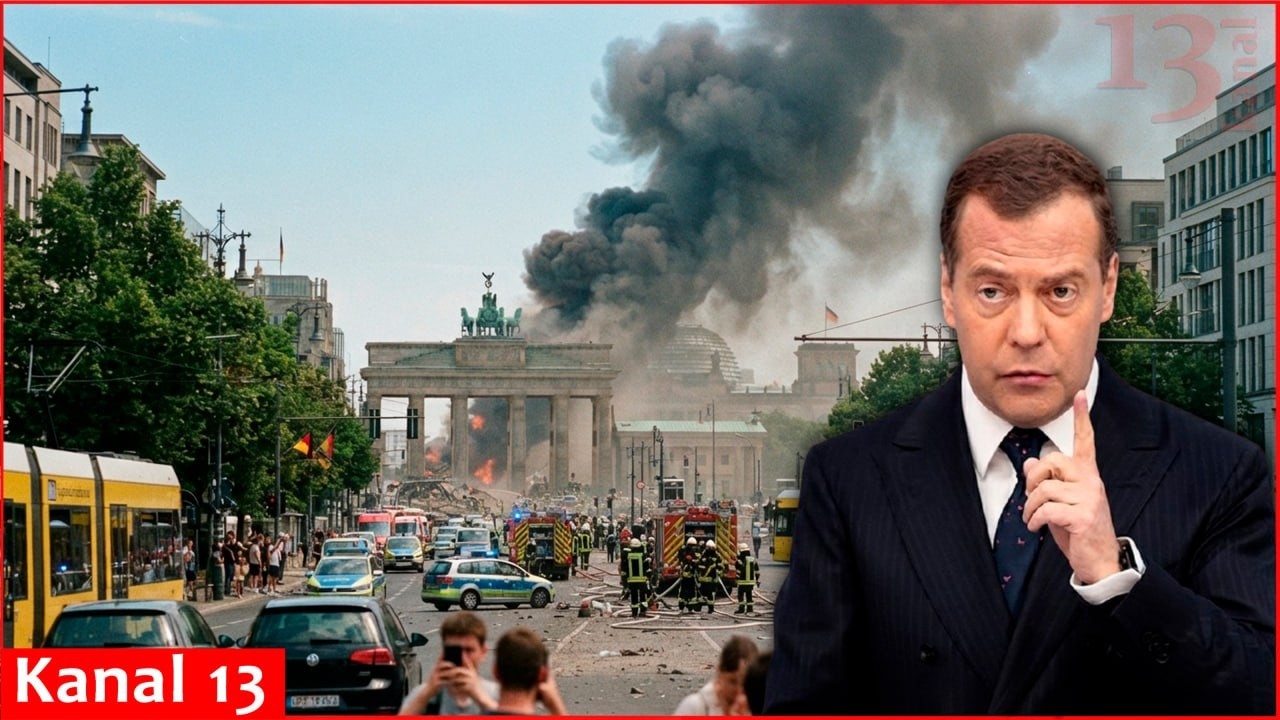
Medvedev threatened Germany with strikes on "certain locations" in Berlin; new war in Europe
Watch on YouTubeVideo summary
Deputy Chairman of the Russian Security Council, Dmitry Medvedev, has escalated tensions by calling for direct strikes against German enterprises that produce military equipment for Ukraine, while also threatening attacks on specific locations in Berlin. This aggressive stance is a direct response to Berlin's decision to hold Russia responsible for an attempted drone attack at Leipzig Airport. Medvedev dismissed Germany's accusations as a fabricated act of sabotage and characterized the German leadership's current policies as deserving only the weakest form of punishment. Consequently, he argued that these entities should face direct strikes against all military production facilities linked to what he terms the "Bandera clique," alongside potential attacks on other sites within the capital.
The diplomatic fallout began after Germany officially accused Russia of organizing an armed operation at Leipzig/Halle Airport and announced retaliatory measures, including the closure of the Russian consulate in Bonn and the cessation of activities for the Russian House in Berlin. In response to this deterioration in relations, Russian propagandist Vladimir Solovyov and his colleagues have begun discussing the collapse of Germany on Russian television, with some even proposing the idea of restoring the German Democratic Republic instead of recognizing a united Federal Republic. These provocative statements highlight the sharp divide between Moscow and Berlin, as Russian officials continue to blame Germany for escalating the conflict while simultaneously issuing severe threats against German soil and infrastructure.
Despite the political rhetoric and threats from Russian propagandists, the German investigation into the attempted attack on a Ukrainian transport plane has identified two suspects involved in the failed operation. According to reports from Süddeutsche Zeitung, the suspects are a Russian holding a Latvian passport and a Belarusian with a Russian passport, both of whom investigators believe were connected to the drone plot targeting the aircraft. The investigation revealed that the Russian suspect, who has ties to Russian intelligence, arrived in Germany via Berlin in late July before traveling to Leipzig in a rented car, while biological traces of the second suspect were found on critical items at the crime scene, including one of the drones, an explosive container, and a signal booster antenna attached to a tree.
The forensic analysis played a crucial role in identifying the suspects, as the biological material recovered from the scene was checked against European databases, yielding matches in Lithuania and Finland that allowed law enforcement to identify the Belarusian citizen. This investigative progress stands in stark contrast to the broader geopolitical threats being issued by Russian leadership, which frames the incident as a false flag operation rather than an actual attack. As German authorities pursue justice based on physical evidence and DNA matches, the situation remains highly volatile, with Russian officials using the alleged sabotage to justify further military threats against Germany's economic and political stability.
Read the full video transcript
Deputy chairman of the Russian Security
Council Dmitry Medvedev called for
direct strikes against German
enterprises producing military equipment
for Ukraine and also allowed for attacks
on certain locations in Berlin. This is
his reaction to Berlin's decision to
hold Russia responsible for the
attempted drone attack on Leipzig
Airport. Medvedev called Germany's
accusations a fabricated act of sabotage
and stated that in light of the German
leadership's policies, they are
supposedly only the weakest form of
punishment. They deserve a direct strike
against all German military equipment
production facilities for the Bandera
clique. And quite possibly against some
other locations in Berlin as well,
Medvedev wrote. Recently, Germany
officially accused Russia of organizing
an armed operation at Leipzig/Halle
Airport and announced retaliatory
measures, including the closure of the
Russian consulate in Bonn and the
cessation of the Russian house in
Berlin. Russian propagandist Vladimir
Solovyov and his colleagues began
discussing the collapse of Germany and
the idea of restoring the German
Democratic Republic. These statements
aired on Russian TV amid a sharp
deterioration in relations between
Moscow and Berlin. The wave of threats
from Russian propagandists was triggered
by the German authorities' decision to
officially hold Russia responsible for
the drone incident at Leipzig Airport.
Berlin also announced the closure of the
Russian Consulate General in Bonn and
the denunciation of the agreement on the
activities of the Russia House in
Berlin.in response. Solovyov and the
participants in his program discussed
the idea of refusing to recognize the
legitimacy of a united FRG and restoring
the GDR. At the same time, Russian
propaganda, as well as Russian
government officials, continue to blame
Germany for the escalation of the
conflict. The German investigation into
the attempted attack on a Ukrainian
transport plane at Leipzig Airport has
identified two suspects involved in the
failed attack. According to Süddeutsche
Zeitung, the suspects are a Russian with
a Latvian passport and a Belarusian with
a Russian passport. Investigators
believe both men are connected to an
attempted drone attack that was intended
to target a Ukrainian transport plane.
The report notes that the suspect, a
Russian native, has ties to Russian
intelligence. He arrived in Germany via
Berlin in late July and then traveled to
Leipzig in a rented car. Furthermore,
investigators discovered biological
traces of a second suspect at the crime
scene. His DNA was found on several
items that could have been used in the
attack. Specifically, we are talking
about one of the drones, a tin can
containing explosives, and a signal
booster antenna attached to a tree. The
recovered biomaterial was checked
against European databases. As a result,
law enforcement officials received
matches in Lithuania and Finland.
>> [music]
>> This allowed the investigation to
identify a Belarusian citizen.
>> [music]