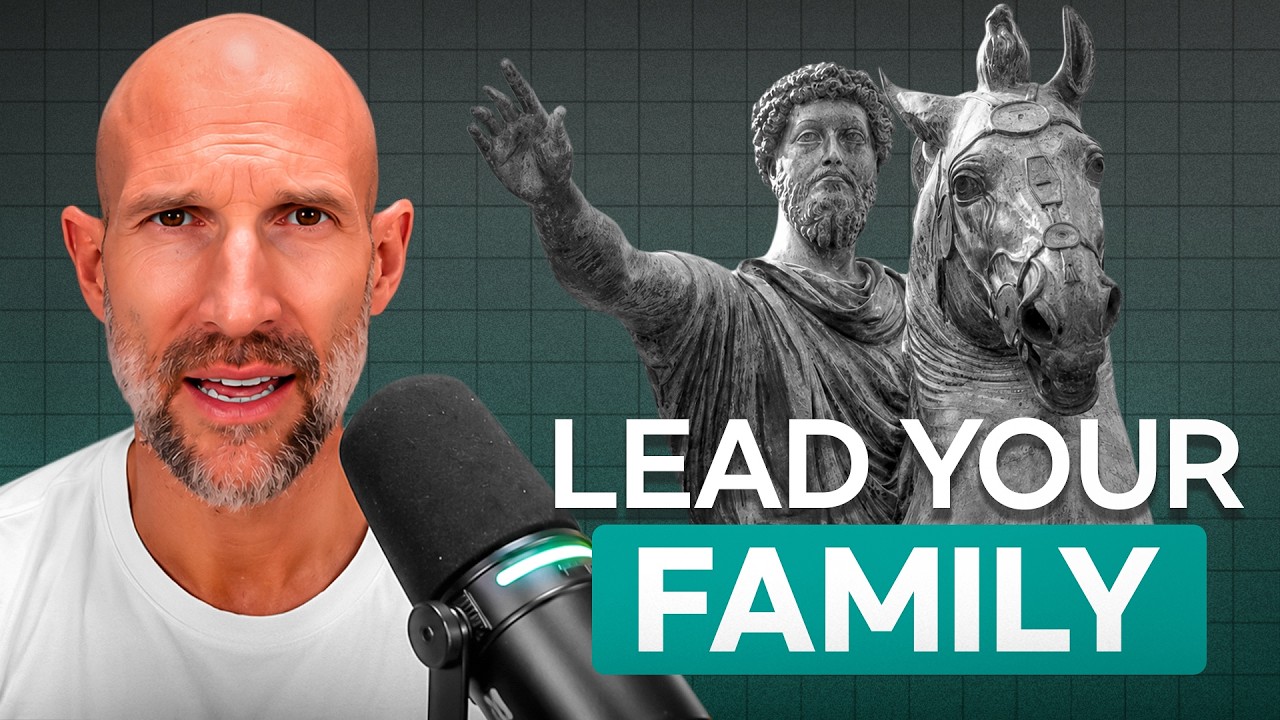
Meditations: The 2,000-Year-Old Stoic Manual for Those Who Want to Lead Their Families
Watch on YouTubeVideo summary
The video explores how Marcus Aurelius's ancient Stoic philosophy, specifically from his private writings *Meditations*, serves as a timeless guide for modern leaders and parents facing chaos at home. The speaker draws parallels between the Roman Emperor's life of war and political turmoil with the daily struggles of high-achieving individuals who feel absent in their own families due to stress or alcohol use. Central to this philosophy is the concept that while one cannot control external events, such as a pandemic, business failures, or family crises, one always retains power over their internal response. The speaker emphasizes the critical difference between reacting impulsively under pressure and responding with calm deliberation, arguing that true leadership begins within the household where individuals are constantly observed by their loved ones.
To cultivate this inner strength, the transcript outlines specific Stoic practices adapted for modern life, including morning reflection on gratitude, evening journaling to process emotions, and deliberate exposure to discomfort like cold showers or late-night work commitments. These exercises build resilience against stress and anxiety, allowing individuals to remain present rather than drifting into mediocrity. The speaker illustrates these principles with personal anecdotes, such as recording a podcast episode at 8:15 PM despite being tired, and maintaining composure during a stressful family visa crisis in the UK. By consciously choosing discipline over comfort and presence over escape, one can transform obstacles into opportunities for growth rather than sources of frustration or blame.
The discussion further addresses the psychological barriers to change, particularly the fear of judgment from others known as "goop" (the good opinion). The speaker challenges listeners to stop worrying about what colleagues, friends, or family think and instead focus on living in harmony with themselves and their values. He points out that alcohol chemically increases cortisol levels, creating the very anxiety people try to escape, thus perpetuating a cycle of dependency rather than providing relief. By facing these truths directly and accepting finite time as motivation for action, individuals can break free from self-deception and take responsibility for leading with integrity in every room they enter.
Ultimately, the message is an invitation to adopt a stoic mindset not through suppression but by building reliable inner architecture that fosters trustworthiness and calmness during storms. The speaker shares his own sixteen-year journey of sobriety as proof that change is possible without relying solely on willpower, suggesting instead a structured approach supported by neuroscience and community. He encourages viewers to take immediate action within the next ninety days to reclaim their presence for themselves and their families, framing this decision not as an admission of failure but as a powerful choice to lead with clarity and love.
Read the full video transcript
This alcohol is getting in the way of
you leading. You are the Marcus Aurelius
of your household. Whether you feel like
it or not, your family is watching. How
you respond to chaos, how you show up on
a Tuesday night. Whether you're present
or managing, whether you lead or drift
into mediocrity. [music]
You've probably seen the movie
Gladiator.
It starred Russell Crowe. I'm
Australian. He was born in New Zealand,
but was raised in Australian. And so we
Australians, we like to claim him as
Australian even though he was born in
New Zealand. The actor Richard Harris
played the character in that movie of
Marcus Aurelius, the old emperor.
You might recall he was tired, he was
wise. He was surrounded by political
chaos and a son that he knows is
unworthy of the throne. And there's a
scene where he sits with Maximus who is
played by Russell Crowe and he says
something quietly devastating.
He says he has lived most of his life in
war or preparing for it and that he
fears he has been absent from the things
that mattered.
Most people remember Maximus, the
character of Maximus played by Russell
Crowe. But I really remember the actor
Richard Harris who plays Marcus
Aurelius, the emperor.
I remember the emperor, Marcus Aurelius.
Marcus Aurelius wasn't a fictional
character. He was real. And what the
actor Richard Harris captured in that
film
was that dignity, that quiet authority,
that weight of a man who knows he could
have been more present.
That's exactly what the book Meditations
is about. This is the book right here.
If you are watching on the YouTube
channel or if you're watching on
Spotify, there is a link in the
description which will take you through
to the YouTube channel where you can see
it. But I'm holding up the book here,
Meditations by Marcus Aurelius.
I actually bought this book in a
bookstore in Cambridge in the United
Kingdom in the summer of 2024.
And I'm just flicking through it here
and you can see I've highlighted certain
sections that speak to me. Let me read
this. Let me just flick through and I'll
randomly choose a page and see something
that I've highlighted. Let's have a
look. Okay, here we go.
Let's see. I seek the truth which has
never caused harm to anyone. No, the
person who is harmed is one who persists
in his selfdeception and ignorance. H I
like that. How about this one? Life is
short and our earthly existence yields
but a single harvest, a holy
disposition, and acts that serve the
common good. I like that. Let's keep
going.
Uh, let it make no difference to you
whether you are shivering or warm, if
only you were doing your duty, or
whether you are overt tired or have had
sufficient sleep, or are greeted with
disparagement or praise, or are in the
process of dying, or are busy with
something else. For even the act of
dying is one of the acts of our life.
And so in that too, it is enough to make
good use of what the moment brings.
Wow, I love that. talking a lot there
about presence which is a theme uh of
today's episode.
So yes, Marcus Aurelius was the emperor
of Rome from 161 to 180 AD, the most
powerful man on earth.
And every night alone in his tent on
military campaign or in the palace
depending on where he was, he wrote
these private notes to himself. They
weren't speeches.
It wasn't philosophy for public
consumption. They were just notes and
reminders, self-corrections.
Let me just quote from the book again.
You have power over your mind, not
outside events.
Realize this and you will find strength.
Or another one, the impediment to action
advances action. What stands in the way
becomes the way.
Or this one, confine yourself to the
present.
Now, historically, it's understood that
Marcos Aurelius never intended anyone to
read these notes. And yet, we've been
reading them now for
2,000 years.
And I've been thinking about them
constantly because every page I read and
every section that I highlight, as I
have here in this book, as I'm flicking
through, you can see the sections where
I've highlighted it.
I see the men and women in our stop
drinking program which is called project
90 over at our organization
called alcohol-free lifestyle which
we've had now since 2015. I've been
alcohol free, alcohol-f free, I'm sorry,
since 2010.
And every page I read of meditations by
Marcos Aurelius, I see the men and women
in that program, high achievers,
business owners, executives, founders,
fathers, mothers, men, women who are
powerful in every room except the one
that matters most, their own home.
So, let me give you some quick context
here because this makes Marcus
Aurelius's quotes land harder. Marcus
Aurelius was the last of what historians
call the five good emperors. He
inherited the most powerful empire the
world had ever seen and spent most of
his reign on the northern frontier
fighting Germanic tribes in brutal
conditions. In fact, if you remember the
movie Gladiator, in the opening scene,
um, Maximus, played by Russell Crowe, is
fighting the Germanic tribes in brutal
conditions. It's cold, it's wet, it's
damp, and it's a brutal war.
And Marcus Aurelius was also a dev
devoted, I'm sorry, student of Stoicism.
Now, stoicism was a Greek philosophy and
that was founded around 300 BC and it
spread through Rome and became the
dominant philosophy of the educated
Roman world. And its central idea is
this. You cannot control what happens to
you.
You can only control your response to
it.
Not your feelings, not your
circumstances,
not other people, your response. And in
our project 90 program over at alcohol-f
free lifestyle where we rewire the
mindset around alcohol of our clients
including business owners and executives
and entrepreneurs mostly in their 40s
50s and 60s. I often talk about the
difference between reaction versus
response
because most of us are reacting to life
instead of responding to life. And
reacting is the cortisol floods our
brain. We get irritable. We get
stressed. We lash out. We can't control
our emotions. We say something that we
later regret. Alcohol exacerbates that.
Alcohol leads to more of that because
alcohol causes us irritation, stress,
anxiety, fatigue,
frustration, hostility, combiveness.
And so when something happens that we
don't like, we react.
However, Marcus Aurelius and the idea of
stoicism, the Greek philosophy is
we control our response.
The more stoic way is to respond, not to
react.
The Stoics called this the dichotomy of
control and they built an entire
practice around it. It included morning
reflection, evening journaling,
deliberate exposure to discomfort to
build resilience,
voluntary hardship so that real hardship
doesn't break you. So if we just go over
that morning reflection in Project 90 in
our stop drinking program, we have folks
do what's called the daily 20. And I
have people write down 20 things they're
grateful for every single day during the
90 days that they're in our program.
That's morning reflection.
Evening journaling, we don't make that a
requirement of participation in our
event, but we suggest it. We invite
people to do it. In fact, just today, I
took three, actually, no, I think I took
four of my journals that I had been
writing in over the past two or three
years with me in my backpack. And I took
it to the Peramino Cafe in the Wake Bio
Hotel
near where I live. And I went and
reviewed notes that I'd taken. And some
of them were notes that I'd taken in
relationship counseling with my wife and
I and our relationship counselor. Some
of the notes were from a business
mastermind I went to couple of years
ago. So, some of the notes were from a
mentor uh who was guiding me and helping
me become a better leader in my
business, be a better CEO and founder
for alcohol-free lifestyle and how to
show up for my staff and how to set a
culture that is positive and empowering
and inspiring.
That those notes were from journaling
over the years, from taking notes.
That's the dichotomy of control. That's
the practice.
Deliberate exposure to discomfort builds
resilience. Well, I guess you could say
taking an ice bath or a cold shower is
deliberate exposure to discomfort. And
the cold shower obviously builds
resilience
because you don't really want to step
into that cold shower. You don't want to
step into an ice bath, which is all the
rage at the moment in 2026. People going
doing ice baths and ice bath clubs and
it's uncomfortable being in that
freezing cold water. However, it gets us
to focus on our breath. It gets us to
stay calm and focused and present
and it's a challenge. It's challenging.
But then when we get out, we get the
profound benefits of that of reducing
our stress, reducing our anxiety, and it
builds resilience.
And then voluntary hardship, so that
real hardship doesn't break you. Excuse
me. I mean, in some ways, this is an
example right now. I'm recording this uh
podcast episode and it gives me a lot of
pleasure to do it. Having said that,
it's 8:15 p.m. at night. I'm in the
basement of my home. My wife and
daughters are up in bed already and
they're sleeping. I've had dinner. I
didn't particularly want to record this
episode right now in this moment.
However, I said to my staff uh 2 days
ago on Tuesday's uh weekly executive
call that we had that I was going to
record three podcast episodes in a row
and have it complete by Thursday evening
and have all three published the day
after. Well, this is the third one. If
you look back to the podcast episode
before this one, you'll see that I uh
did a podcast episode uh called Die with
Zero. In fact, let me let me just have a
look. What is it? Die with zero. How to
stop sabotaging your best experiences?
And then the day before that I uh had
recorded one and the next day it was
posted and it was entitled 98% of people
are drifting. Are you one of them? So,
if you have a look, if you're listening
to this podcast episode now in Spotify
or Apple Podcast and you just go back
one or two episodes, you'll see the
episodes that I recorded beginning on
Tuesday night than last night and now
tonight. Now, candidly, as I was saying,
I didn't particularly want to record
this episode tonight. I'm tired. It's
Thursday. I'd rather be going and
preparing for sleep right now. as much
as I'm enjoying talking about Marcos
Aurelius in meditations, but
I said I was going to do it and I'm
holding myself accountable. It's
voluntary hardship in a way, I guess,
because it's late at night. I kind of
want to be done for the day, but here I
am in the basement by myself with the
lights on speaking into the camera.
You're watching me now on YouTube or
you're listening to me on this podcast.
That's stoicism. That's the dichotomy of
control.
Now, Marcus Aurelius didn't just write
about stoicism. He practiced it while
running an empire, while fighting wars
and bar, excuse me, burying children. He
lost multiple children during his reign.
He watched his closest advisers betray
him. He led a Rome ravaged by the
Antonyine plague, one of the deadliest
pandemics in ancient history.
And every night he wrote things like
in the book meditations,
accept the things to which fate binds
you and love the people with whom fate
brings you together.
Another quote he said, it is not death
that a man should fear, but he should
fear never beginning to live.
To be clear, this is not a self-help
book. This is a man doing the hardest
thing a powerful person can do. And that
is holding himself accountable when when
no one else could. Holding himself
accountable when no one else could. No
one's really holding me accountable to
recording this podcast episode tonight
except myself. I declared it. My staff
aren't calling me right now. Hey, have
you done that third one? No. I'm holding
myself accountable.
I declared I was going to do it and I'm
going to do it and I'm doing it.
And I enjoy doing it. I don't want you
to feel like I'm you're listening to me
and I'm like, "This sucks." It doesn't
suck. It's great. It's amazing for me.
It's just doing it now.
I I would prefer to have done it a
different time. I'd love to just
procrastinate and push it off until
tomorrow. [sighs]
But you know what? A good plan today is
better than a perfect plan tomorrow.
So, where have I been stoic? Where have
I been displaying this? And where have I
failed? The stoic practice isn't a
destination. It's a daily discipline.
And Marcus Aurelius knew that. He wrote
the same reminders to himself over and
over. Not because he'd forgotten them,
but because the human mind forgets them
constantly under pressure. Think about
it. When we're under pressure, we forget
this. All of our best intentions go out
the window. We react instead of respond.
If you listened to one of my uh previous
two episodes, possibly yesterday's one
when I was talking about die with zero,
you you would have heard me reference
this recent episode I had where uh I
tried to get my family visas for the UK
only to real I'm sorry I we were about
to go to the UK only at the last minute
for me to realize that my Colombian
citizen family, my wife, my daughter, my
stepdaughter required UK visas. Whereas
2 years earlier they did not require UK
visas. I didn't think they needed it
this time, but only to realize at the
last minute they did. And the result was
we had to cancel our flight. We had to
cancel plans. It was a mess. My mother
was uh had flown over from Australia to
the UK waiting for us to fly from
Colombia to meet her in the UK only for
me to have to call her and say, "I
messed up. I uh we're not going to get
the visas in time to come and see you.
my mom has to return to Australia and
we're going to miss her on this trip.
There were tears. There was
disappointment.
And if you want to I'm not sure that you
would want to, but if you'd if you'd
care to uh hear the full story behind
that, you can just listen to the
previous episode that I recorded uh
which was called Die with Zero.
Now that was it felt stressful for me. I
had to change hotels. I had to call my
mom. My mom was upset. I had to change
flights.
It was it was all a big mess, right? And
I felt the old pull. Now, not for
alcohol, cuz I haven't drunk alcohol
since 2010. But I felt the pull for
reaction and for blame and for the
release of just losing it. And candidly,
internally, I was cursing the UK
government bureaucracy because I wanted
to get the visa within 24, 48 hours. And
I realized it was going to take 5 days.
And I couldn't understand why it was
going to take 5 days. And the UK
government wanted the proof of the birth
birth certificate of my daughter and
they wanted that translated into
English. And then they wanted to make
sure that that to to prove that my wife
could fund her her uh her trip and
wanted to make sure that I could fund
their trip. And oh my goodness, me the
paperwork that was required.
But I didn't lose it. Internally,
thinking wise, I was somewhat losing it,
but I didn't lose it demonstrabably on
the outside. Not because I'm naturally
calm, but because I've spent 16 years
building the discipline that stoicism
describes, the alcohol-free version of
that discipline.
And Marcus Aurelius wrote this, "You
have power over your mind, not outside
events."
realize this and you will find strength.
Now, that is not a motivational poster
or something that you'd, you know, frame
and put it on your bathroom wall. That's
a man reminding himself
that his response is the only thing he
owns. Despite being on campaign in a
war, exhausted, surrounded by chaos, it
is his response
that he owns.
in Atlanta. Uh, and I referenced this in
in the past episode as well. So, for
those who were listening who listening
to both episodes, apologies for
repeating myself, but in Atlanta in
April, I took my father, my 81-year-old
father Ron, to one of our alcohol-free
lifestyle events. There were 55 clients
there. We were there for two or three
days listening to speakers and engaging
with each other, going out to dinners,
having a wonderful time. and my father
Ron sat in the room and watched
transformed executives, founders and
fathers and mothers who were all who had
all come to us and our organization at
some point or another tired, irritable,
stressed, rock bottom, drinking too
much, marital strain, poor performance,
bad sleep, all of that. only to then
learn how to release alcohol in the
simplest way to make new friends, make
new allies, and love living
alcohol-free, not being sober, not being
in recovery, not doing 12 steps, not
surrendering to a higher power. We don't
do any of that at alcohol-free
lifestyle. We empower our members to
choose loving an alcohol-free lifestyle.
And my father sat in that room and he
watched people transformed,
men and women who had been white
knuckling their way through life. using
alcohol to manage what stoicism was
designed to handle.
And there were there were times there
where my dad sat quietly there.
That's a stoic moment.
Not dramatic, not loud,
just sitting there in silence observing.
My daughter is uh almost 6 months old.
Her name is Isabella. And every morning
I'm with her.
I get up and I prepare to go to the to
the gym. I put my clothes on. I pack my
backpack and I and I walk to the gym.
But before I go, every morning I go and
I spend at least 5 minutes with her. It
doesn't sound like a lot, 5 minutes. But
I do it.
I come back later on and I spend hours
with her. But in the morning, 5 minutes.
as I'm somewhat in a rush, I'm somewhat
packing, I'm somewhat on a schedule, I
go and I just spend five minutes with
her every morning fully there and I'm
not managing a hangover and I'm not half
present.
There's a line in meditations by Marcus
Aurelius which is confine yourself to
the present. Confine yourself to the
present. That is the whole thing. That's
what alcohol steals and what living
alcohol-f free returns the present.
Now, this is where I want to speak
directly to you if you have not taken
action yet on anything on the biggest
issue in your life. More specifically,
if you're listening on the Alcohol-Free
Lifestyle Podcast, I'm speaking to you
if you haven't taken action yet on
finally living alcohol-f free.
I'm going to read you some lines from
meditations
written 2,000 years ago by the then most
powerful man on earth, and I want you to
notice how precisely they describe
what's happening inside you right now,
possibly. Okay, so here's one of the
quotes. Again, I'm if you're watching on
the YouTube channel, I'm holding up the
book here, okay? And if you're listening
on the audio, uh you can go and watch
the YouTube video version of this uh
version if you like over on our YouTube
channel, which is at Alcohol-Free
Lifestyle or on the James Swanic YouTube
channel.
He who lives in harmony with himself
lives in harmony with the universe.
If you are drinking any amount of
alcohol right now, you are not living in
harmony with yourself. I submit.
I submit you know it. Your partner knows
it. Your kids feel it. Even if they
can't name it.
There's a version of you that you sense,
the calmer one, the more decisive one,
the one who walks into a room and leads
instead of manages. And you are not
fully living as that person.
that gap, that dissonance.
That's what this quote is about. Let me
say the quote again. He who lives in
harmony with himself lives in harmony
with the universe.
Here's another quote. The first rule is
to keep an untroubled spirit. The second
is to look things in the face and know
them for what they are.
My invitation to you, the listener right
now is or the viewer on YouTube, look
things in the face and know them for
what they are.
Not what you've told yourself, not what
you've rationalized over years of
functioning fine. I'm just doing fine
and inverted commas here, but what they
actually are. The drinking is not
helping you unwind.
Because we now know through studies of
the human brain that alcohol spikes
cortisol, which is our stress hormone,
by 30 to 40% the following morning.
Think about that. Cortisol rises 30 to
40% the morning after you drink.
That's chemically creating the anxiety
that you are drinking to escape.
You are creating the anxiety that you
choose to drink to try to escape from.
It's chemically creating the anxiety you
are drinking to escape. Look that in the
face and know it for what it is. Another
quote from Marcus Aurelius's
meditations. Waste no more time arguing
about what a good man should be. B1.
I like that.
If you've been thinking about releasing
alcohol from your life for 6 months or
longer, maybe you have been listening to
this podcast for some time, maybe you've
been following me on social media,
telling yourself that you'll sort it out
when things calm down.
This is the line, okay, from Marcus
Aurelius. Waste no more time arguing
about what a good man should be. Be one.
My invitation to you is waste no more
time. Marcus Aurelius wasn't writing
that for weak men and women. He was
writing it for himself. The emperor of
Rome, a man with every reason to defer,
every excuse available, every comfort in
the world at his disposal. And he wrote,
"Be one. Not tomorrow, not after the
next quarter, not when the kids are
older.
Now
I have an invitation for you. I'll offer
it to you twice before I finish this
episode.
If you knew, if you really knew that
your time was finite, that your children
are watching right now, that the version
of you capable of leading your family
with calm and presence is only 90 days
away, which is the duration of our
original flagship project 90day stop
drinking process. What would you do
differently right now today?
My invitation to you is to text someone
on my team. His name is Kai. K A I
wonderful man. He's British. He is a
real human being. I'm going to give you
a number right now where you can text
him and just open the conversation about
what's possible for you specifically how
we might be able to support you to
finally release alcohol and love living
alcohol-f free with professional support
with neuroscience coaches in an
incredible community of people who are
going to support you. Here's the number.
the text kayak. If you're in the US, you
don't need the plus one. If you're
outside the US, you do. Here's the
number. 361
321
7764.
That is Kai's cell phone number. If you
want to hear it again, just press the
back 15 seconds button on your Spotify
or just go back 15 seconds here on the
YouTube. I'll also put uh Kai's number
in the description of this podcast on
Spotify and on Apple podcast and I'll
put it in the u I'll put it as a pinned
comment here in the YouTube video if you
are watching. But if you text Kai your
name, your number, tell him you were
listening to this episode and that you'd
like to explore
quitting alcohol, reducing alcohol with
our help in our 90-day program and
you're a business owner, executive, high
achiever, retiree, you're in your 40s,
50s or 60s, then text Kai at that
number. Again, real human, no AI, no
bots, no script, just a conversation
about what's possible for you.
So, another quote from Michael Aurelius.
It never ceases to amaze me. We all love
ourselves more than other people, but
care more about their opinion than our
own. Oh, that's interesting. It never
ceases to amaze me. We all love
ourselves more than other people, but
care more about their opinion than our
own.
Hm.
Here's how I think that relates to this
particular situation, especially for
those who are wanting to release alcohol
finally from their life. You're not
taking action because of what other
people will think.
What what will my colleagues think? What
will my drinking friends think? What
will my friends and family think? What
does it say about me if I need a
program? What does it say about me if I
have to pay money to go and join a
program? I should just be able to quit
for free. I should just be able to do
this on my own. And I should should
should should.
If you could have quit drinking on your
own, you would have. You haven't, so you
can't.
But stop worrying and caring about the
opinion of other people. There's a
gentleman I met who calls it goop. Go O
P. The good opinion of other people.
Why are you worrying about goop? Stop
worrying about goop. The good opinion of
other people.
Who cares what your colleagues think,
what your drinking friends think, what
your friends think, what your colleagues
think. You're worried that people think,
"Oh, you're an alcoholic. You must be an
alcoholic. She's an alcoholic." Rubbish.
They're too busy thinking about
themselves.
Stop thinking about what other people
will think. Marcus Aurelius saw this
pattern in himself. He wrote it down
2,000 years ago.
You love yourself. I know you do. You
want to be better. I know you do because
we all do. But you are handing the
decision to imaginary critics who aren't
even watching.
You're so scared what other people are
going to think that you are handing your
power to these imaginary people.
Imaginary critics who aren't even
watching.
Take action. Stop worrying about what
other people are going to think and do
it for yourself, for your husband, for
your wife, for your family. Another
quote from Marcus Aurelius's
meditations. The impediment to action
advances action. What stands in the way
becomes the way.
A lot of people argue that this is the
most famous line from meditations.
The reason is is that the thing that
you're afraid of, the discomfort
of the identity shift that will take
place if you become an alcohol-free
living person.
The social awkwardness, the fear that
you can't do it, that is not the
obstacle to your better life. That is
the way to your better life. The
obstacle is the way. Ryan Holiday
famously wrote that book. I actually
interviewed Ryan Holiday on the James
Swanic show many years ago, 2014.
Wow. Has it been 12 years? It has been.
The thing you're afraid of, the
discomfort of releasing alcohol, the
social awkwardness of sharing with
people that you are now alcohol-f free,
the fear that you can't do it,
that is not the obstacle.
That is the way to your better life.
Every man and woman in our program hit
that wall. Every single one of them, the
ones who became unrecognizable
to their families, to themselves, are
the ones who walked through it. Anyway,
my invitation to you is get over
yourself.
Take the action. Stop worrying what
other people think. It's okay to have
fear as to whether you can do it. But
even if you're 75% sure, just borrow
that remaining 25% from me because I
know that we have a system and a process
and a power powerful community and
amazing coaches who will support you.
Now again, Marcus Aurelius didn't write
meditations to be published. He wrote it
because leadership is lonely. Because
being the most powerful man in the world
didn't make the internal work any
easier.
Because every morning he he had to
choose again who he was going to be that
day. And he chose discipline over
comfort, presence over escape, response
over reaction. And we talk about that a
lot in Project 90. How to respond versus
react.
Stop reacting, start responding. And
response lives in that half second, half
minute, 5 seconds moment between when
you are reactive and frustrated and the
cortisol is rising and you just want to
lash out
and when you don't and then you pause
and then you respond. You really want to
swear but you
respond.
That's choosing discipline over comfort,
presence over escape.
And I'm inviting you now to make that
same choice. Not because alcohol has
destroyed your life because maybe it
hasn't. Maybe it hasn't destroyed it.
But maybe you're dying a death by a
thousand cuts.
Few pounds that you don't want here. A
little irritation with your wife or
husband there. Your kids who are grown
now don't call you. And then you're not
as present with them.
Maybe you're not rock bottom, but you're
headed that way. Maybe it won't come for
a few more years, but it's coming. I
talked about the drift in an earlier
episode
talking about the book Outwitting the
Devil by the author Napoleon Hill. We
talked about the drift. And if you go
back a few episodes, if you haven't
listened to that, then I invite you to
do so. The name of the episode is 98% of
people are drifting. Are you one of
them? In that book, I do a review of the
book. I'm so sorry. in that podcast
episode and on that YouTube video.
Again, if you go back on YouTube and wa
and watch it, I do a review of that
book, Outwitting the Devil. It was
published in 1938.
I'm so sorry. It was written in 1938,
but it was only published in 2011, 70
years later. His publisher refused to
release it because it was so
controversial.
Wonderful book.
talks about the drift, how we just drift
into mediocrity.
We accept the comfort of our mediocrity
and we continue to drift into further
mediocrity. And again, maybe alcohol has
not destroyed your life,
I'm inviting you, if it's compromising
your life, your health, your wealth,
your love, your happiness, your
relationship, take action. Get support.
Do not try to do this on your own. It is
a statistically ineffective strategy.
I've seen it thousands of times. The
most ineffective strategy is willpower.
And yet, we all think we should be able
to solve it on our own because we're all
high achievers. We're business owners.
We're entrepreneurs. We're executives.
We've succeeded in many areas of life.
And our social circle think that we've
succeeded. And we've got a nice car. We
got a nice home. And we're doing pretty
well except for this thing.
You're a leader,
but this alcohol is getting in the way
of you leading. You are the Marcus
Aurelius of your household. Whether you
feel like it or not, your family is
watching how you respond to chaos, how
you show up on a Tuesday night, whether
you're present or managing, whether you
lead or drift into mediocrity. Like
Napoleon Hill spoke about in the book
Outwitting the Devil. Stoicism is not
about suppressing emotion. It's about
building the inner architecture that
makes you reliable,
trustworthy, calm in the storm.
I was calm in the storm of this UK visa
issue that we had last week. In fact, my
wife Lara praised me uh in fact praised
me to our relationship coach that we
meet with every two weeks on a virtual
call was saying I was really impressed
by James and the way he handled the UK
visa thing. There was so many things
going on. It was a mess. And every time
I spoke to him about he was calm. Now,
truthfully, I wasn't that calm. Under
the surface, I was I was somewhat
freaking out. But on the surface, I was
calm. I was calm in the storm. And my
wife noticed that. She appreciated that.
She admired that about me. I was the
rock in the storm. I was the oak tree
with squirrels running around at the
base of the oak tree in that moment.
Your family doesn't need you to be
perfect. They need you to be present
though.
And presence, real presence, the kind
that builds memory dividends as the
author Bill Perkins talks about in the
book Die with Zero.
The kind that makes your father go quiet
with pride as what happened with my
father in Atlanta recently. That is on
the other side of this decision for you
to release alcohol.
I've been where you are.
March 11th, 2010, 16 years ago, Austin,
Texas.
Mild hangover, sitting in an IHOP in
International House of Pancakes.
I looked out the window and I made a
decision. My decision was I was going to
stop drinking for 30 days. It's now been
16 years. I made that decision not
because I was broken, but because I
wanted to be the man that I sensed I
could be.
That's stoicism.
It's not dramatic. It's not loud. It's
just a decision or a choice. A powerful
choice made in private, kept in
practice, one day at a time.
Marcus Aurelius wrote one more line I
want to leave you with. Here it is. You
could leave life right now. Let that
determine what you do and say and think.
I don't think that's morbid. I find it
clarifying. I'll repeat the quote. You
could leave life right now.
Let that determine what you do and say
and think.
If you knew, if you really knew that
your time was finite, that your children
are watching right now, that the version
of you capable of leading this family
with calm and presence is just 90 days
away,
what would you do differently today? Few
minutes ago, I said I was going to give
you Kai's number twice on this call.
Here's the second and final time. Text
Kai if you'd like to explore working
with us. If you'd like to explore
meeting me, working with me, and my team
of coaches to finally love living
alcohol-f free, not being sober, not
being in recovery, but being in a
incredibly supportive community of
business owners, entrepreneurs,
executives, high achievers, attorneys,
doctors, retirees, executives,
amazing people, all successful except
for alcohol, and all quietly conquering
alcohol's grip on them.
If you'd like to speak with a real human
being about this and explore what that
might look like, then text Kai at this
number 361
321
7764.
Again, he is a real human being.
We don't do AI or bots or automated
messages here where we're pretending to
be someone else.
Takes Kai. He's a real human.
A University of Washington study in 2023
found a 98% reduction in alcohol
consumption after 90 days in our project
90 program.
So they put hundreds of study
participants through this scientific
study at the University of Washington.
It was led by Professor Christopher
Barnes. And what they found was a 98%
reduction in alcohol consumption
from those people who went through our
90-day stop drinking process. We don't
do willpower. We use neuroscience.
It's the same neuroplasticity that
Marcus Aurelius was describing just in a
different language 2,000 years ago.
Your brain can rewire. Your family is
worth it.
Waste no more time. Text Kai.
One more time for good measures. 361-
321-7764.
Thank you so much for listening. Really
appreciate it. If you feel like you got
value from this, will you please do me a
huge favor and hit the subscribe button
so you're notified about the next
episode?
Do me a favor as well if it speaks to
you. If you're watching on YouTube,
would you go ahead and leave a comment
down in the comments section down below?
I will respond. I promise you. If you're
the first person to comment, take a
risk. Just comment. Just say, "Hey, I
enjoyed this." If you did, of course, or
hey, I didn't enjoy this if you didn't.
Of course, honesty is the best policy.
Please do subscribe to the channel if
you're on YouTube. Watch this. And
please do share this with someone else.
Again, this is not a individual [music]
singleminded vision of life here. This
is sharing.
We can make breakthroughs together. So,
please do share it. Just click the share
button now and send it as a WhatsApp or
a text or an email to someone you know
that might appreciate meditations, that
might appreciate Maros Aurelius, that
might love the movie Gladiator, that
might be looking to quit drinking. If
you feel like this could help, please go
ahead and send it to them. Just a
reminder, the James Swanic Show is
relaunching. You might be listening to
this on the James Swanic Show. I started
in 2012, I think, and I've had a 7-year
hiatus, but the James Swanic Show is
back. If you go over to the James Swanic
show in Apple podcast and Spotify,
you'll find it there. Please do
subscribe. You'll see new episodes
coming. You might be listening to this
on the Alcohol-Free Lifestyle Podcast.
So, there are two podcasts, the
Alcohol-Free Lifestyle Podcast and the
James Swanic Show podcast. There are two
YouTube channels, the Alcohol-Free
Lifestyle YouTube channel and the James
Swanic YouTube channel. Please go over
there, subscribe, look around, look at
some content, tell me what you feel,
[music] tell me how you think. I would
love to hear from you. If you want to
email me with a suggestion on something
you'd like me to talk about, you can
email me at
james@alcoholfrelifefestyle.com.
Thank you so much for listening. I'm
James Swanik. I'll catch you on the next
one.