Video summary
Traditional rice cultivation practices often involve leaving straw in the fields or burning it after harvest, which leads to significant negative economic, environmental, and social consequences. Straw is rich in essential nutrients like nitrogen, phosphorus, and potassium that are vital for crop growth, yet burning destroys these resources and releases greenhouse gases that contribute to global warming. Furthermore, open-field burning poses serious safety risks by potentially igniting forests, spreading to neighboring crops, or damaging nearby homes. To address these issues, mechanized composting has emerged as a superior alternative that transforms straw into valuable organic fertilizer, thereby reducing the need for chemical inputs and significantly lowering the carbon footprint of agricultural operations.
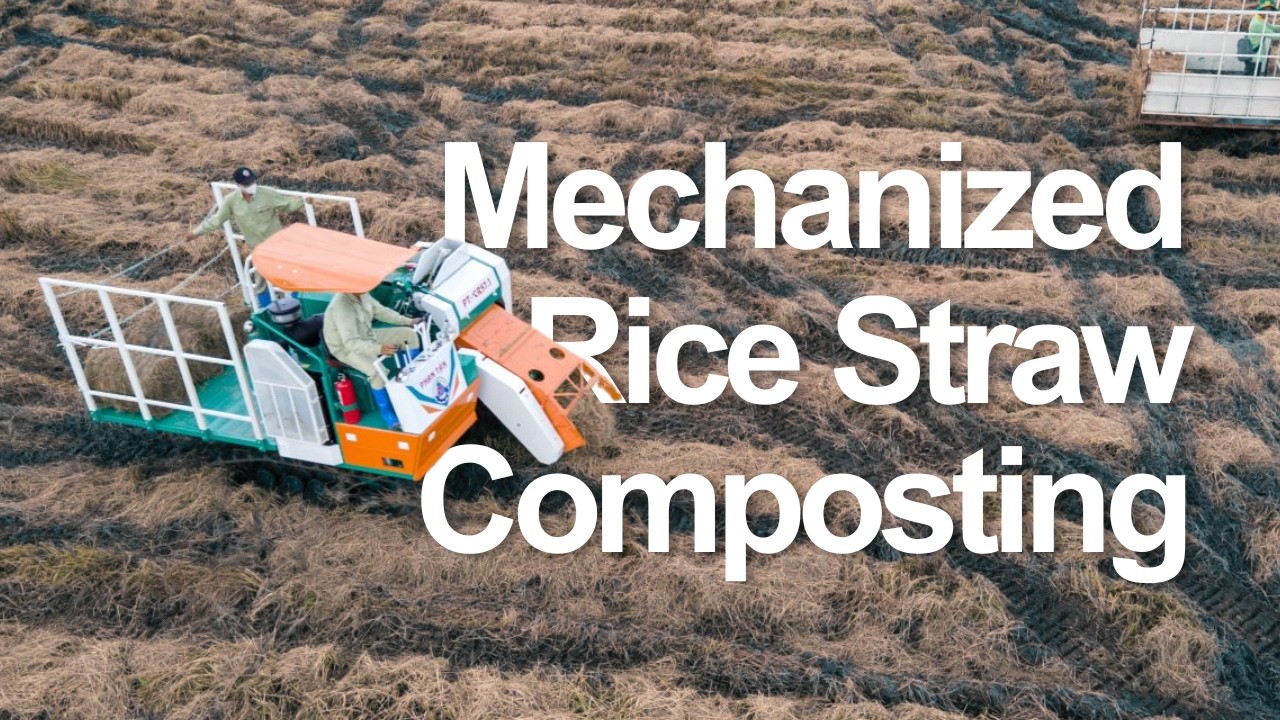
The core of this modern approach is the high-speed rotary kiln technology developed under projects led by the International Rice Research Institute (IRRI), which integrates physics, chemistry, and engineering to rapidly decompose straw into high-quality compost. This automated system features a 70 hp engine capable of processing up to 300 cubic meters per stroke while automatically spraying organic matter or fertilizer at a rate of 6 to 7 liters per hour. Compared to traditional manual methods or those using backhoes, this technology cuts production time from weeks down to just one day, saving nearly half the labor and time required for baling. The machine performs two critical functions simultaneously: it mixes and balances the straw while spraying a specialized fertilizer mixture containing lime, sugar, water, and other organic components like palm oil and coconut husk to ensure optimal decomposition.
Producing this high-quality compost requires precise management of raw materials and environmental conditions throughout the process. A typical batch involves specific quantities of straw, coconut husks, and mixed fertilizers prepared on a large scale, often within a tented area that allows for temperature and humidity control. The production cycle begins with preparing the soil base and arranging the mixture to reach a height of one meter, followed by running the composting machine to mix the materials thoroughly. Operators must continuously monitor the internal conditions; if temperatures exceed 70 degrees Celsius or humidity drops below 40%, additional water is added, and the tent is opened briefly to regulate heat before sealing it again once the temperature stabilizes. This second stage of adding ingredients like coconut shells occurs after an initial 10 to 15 days, ensuring that large objects are crushed and the mixture ripens rapidly into a stable product.
The final outcome of this mechanized process is a versatile straw mulch product ready for use in organic farming within approximately 30 to 45 days, depending on factory specifications. At maturity, the compost maintains an ideal temperature range between 30 and 40 degrees Celsius with humidity levels between 40% and 50%, making it safe and effective for soil amendment. The Udom Suriya Agricultural Community produces two distinct types of this finished product: a loose straw mulch suitable for general application and a full-length straw mulch designed for specific crop needs. By adopting this technology, farmers can effectively manage their post-harvest waste, enhance soil fertility with beneficial microorganisms, and create a sustainable cycle that supports both crop growth and environmental health without relying on destructive burning practices.
Read the full video transcript
[Music]
Through traditional agricultural practices in rice cultivation, farmers often leave straw on the field or burn it after harvesting, which has negative economic, environmental and social impacts. Many studies have shown that straw contains important nutrients such as
[Music]
80% nitrogen, 40% phosphorus and 30% potassium,
which are absorbed by the rice crop. Incorporating straw into the soil can reduce the need for additional fertilizer for the next season's crops, but burning straw can also cause the loss of these important nutrients. For example, burning straw causes the loss of about
[Music]
6.5 [Music] 5
Kilograms per ton of straw. In addition, it contributes to greenhouse gas emissions, which leads to global warming and climate change. The practice of burning straw before planting the next crop can also cause forest fires or fires that spread to other unharvested crops and houses. Therefore, it is essential to have an appropriate method to better manage straw. The straw composting process is the process of breaking down straw into
[music]
into biodegradable products for use in soil amendment or as a fertilizer. Straw compost is a substance that can be used in organic or safe crop production. By using straw as a compost, farmers can reduce their carbon footprint significantly. Straw is made from straw, which is a type of compost that helps promote crop growth through the nutrients and beneficial microorganisms it contains. Straw provides many benefits from the process.
[Music]
[Music] [Music]
[Music]
Incorporating the equipment into the production process is a comparison between the traditional production process and the high-speed rotary kiln. The rotary kiln, developed under the project led by the International Rice Research Institute (IRRI), is a technology that combines the advantages of physics, chemistry, and technology to make the rice
[Music]
quickly decompose and produce high-quality fertilizer. This technology has been verified by the International Rice Research Institute in Vietnam with the following technical characteristics: Automatic rotary kiln with engine power
[Music]
[Music] 70 hp Engine capacity 183 to
300
cubic meters per stroke Automatic spraying of organic matter or fertilizer
[Music]
6 to 7
liters per hour Reduce time and
labor in production with this technology The process takes about
45
Only one day, which saves almost half of the time compared to traditional baling such as manual baling and baling using a backhoe or other equipment. The baling machine has two important functions that are essential to improve the efficiency of the baling process as well as to produce baling quality. The first is baling and mixing the straw.
[Music]
After the baling is well-balanced, the second function
[Music] 2
sprays the mixed fertilizer mixture onto the baled straw at the same time. To produce
5
tons of baling, we need raw materials such as lime kg moisture
53%, straw 886 kg moisture [Music]
9.3%, palm oil 2638
kg moisture 44.7 7%, coconut husk 1250
kg moisture 41.7% 7% [Music]
Mixed fertilizer mixture
5 kg sugar
1.9 liters of water and 145
This is a production activity by the Udom Suriya community. The first step is to prepare the above materials as follows: width [
Music]
[Music]
1.2 meters, length 1 meter, length 30
[Music]
meters. First, prepare the soil and water it well. Then, arrange the soil on the soil and water it well again. Then, continue to arrange the same soil until it is one meter high. Step 1: Return the compost to the composting machine, which is equipped with a composting machine so that the composting mixture can be sprayed automatically.
[Music]
When the composting machine is running, the machine is then controlled to run back through the composting machines so that the large objects can be mixed well with the open compost.
[Music]
3 The
removal of large objects and the promotion of the crushing process from the return of the machine-made material is carried out by a thick tent to promote the rapid ripening of the fruit. The temperature and humidity of the fruit must be monitored regularly during the
[Music]
During this period, if the temperature is too high, exceeding
70 degrees or the humidity is too low, less than
40%, add more
water to the fruit and return it, then open the tent for a certain period of time, but return it when the temperature of the fruit drops. Step 1
[Music]
4
Returning the fruit with the second ingredient This return of the second ingredient is made after the first return for
10 [Music] days to 15 days.
Before returning, add the remaining ingredients such as coconut and rice or coconut shells, and after returning, return it to the same place. At this time, continue to monitor the temperature and humidity as well. Step
5 The
price of the finished product is determined between
30 and 45
days must be monitored for temperature, humidity and moisture levels according to the factory. The humidity is between
[Music]
30 degrees Celsius to 40 degrees Celsius, the humidity is between
40 and 50% and the time is between [Music]
6.5 5 to 7.
This indicates that the straw mulch product can be considered a product for and can be used on crops. The Udom Sorya Agricultural Community has two types of straw mulch products:
[Music]
1 is a loose straw mulch type
2 is a full-length straw mulch
[Music]